
Ezekiel 16:50

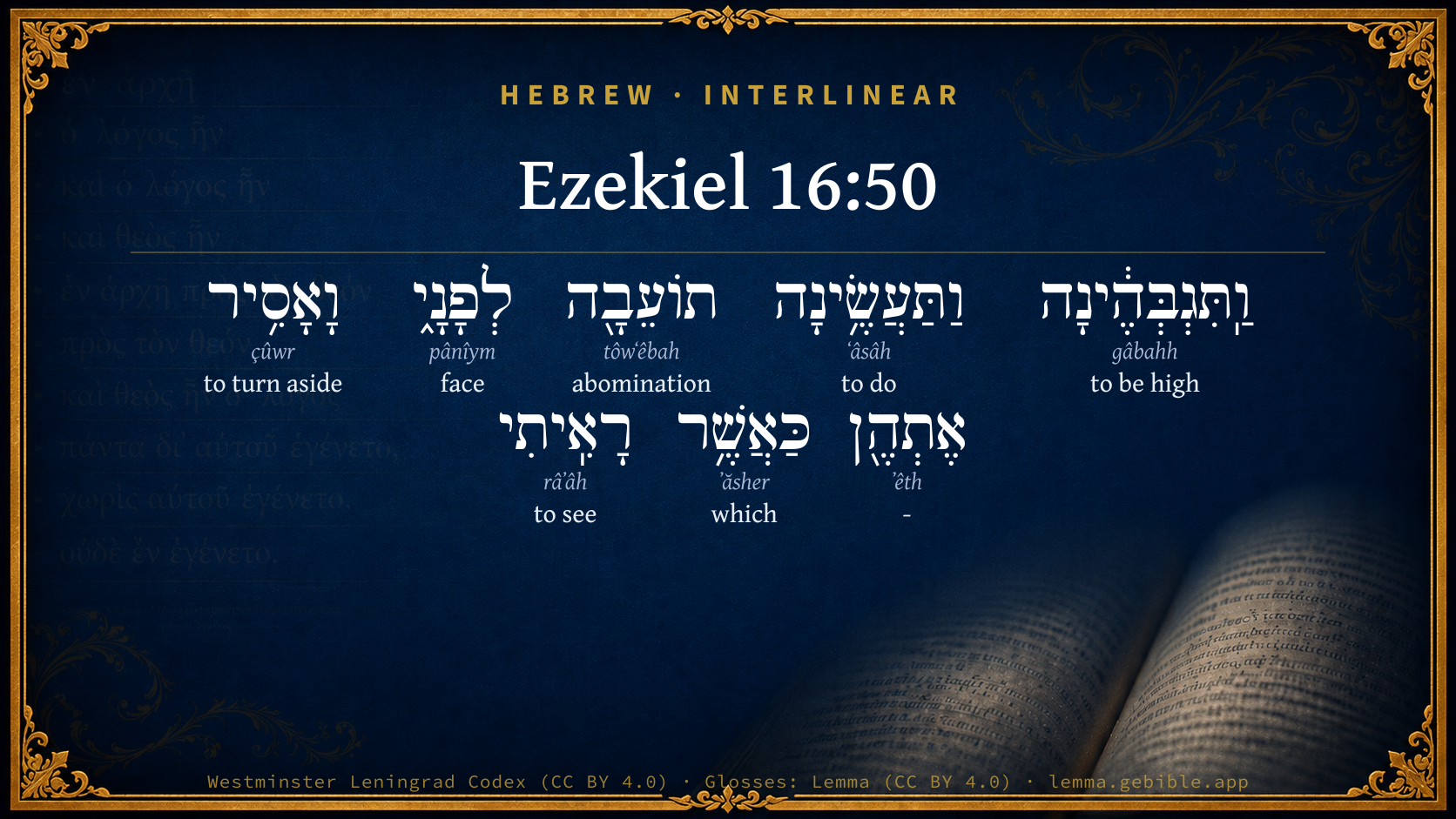
Hebrew (Westminster Leningrad Codex) Ezekiel 16:50 appears in the Hebrew Old Testament. The text above is from the Westminster Leningrad Codex. Each word links to its Strong’s number, a concise gloss, and parsing drawn from the Open Scriptures Hebrew Bible morphology. Click any word for its full Brown-Driver-Briggs (BDB) entry.
Download image
Cite this verse

Ezekiel 16:50 (World English Bible). Public Domain. Lemma interlinear Bible study tool, https://lemma.gebible.app/v/ezekiel/16/50.

Show BibTeX & RIS
BibTeX
RIS
English Translation
They were haughty, and committed abomination before me: therefore I took them away as I saw [good].
World English Bible · Public Domain
Download a study sheet

One document with this verse’s original text, its word-by-word gloss line, the meaning frame, cross-references with their text, attributed commentary, and full source and license credits — printable, and it pastes into notes with its structure intact.

This verse Autodidact and up

Study sheet (.html) Plain text (.txt)

A passage Seminary Student

Up to 50 verses in one chapter. A passage sheet keeps up to 6 commentary sources and 12 cross-references per verse, in the order this page ranks them, and says so on the sheet whenever that leaves anything out. Ask for a single verse and you get the Autodidact verse sheet above.

Everything on this page stays free to read, with no account — the sheet is a download of what is already on screen, not access to it.

Want to remove ads? Support Godless Engineer
Compare translations 3

The same verse in 3 English versions, stacked beneath the original-language interlinear above. Click any original word for its lexicon entry.

Each is an independent rendering of the whole verse — the interlinear is not word-aligned to these translations.

Highlighted words mark where these versions differ — a whole-verse word diff, not a word-by-word alignment.

  • World English Bible Public Domain
    They were haughty, and committed abomination before me: therefore I took them away as I saw [good].
  • King James Version Public Domain
    And they were haughty, and committed abomination before me: therefore I took them away as I saw good.
  • unfoldingWord Literal Text CC BY-SA 4.0
    She was arrogant and committed disgusting actions before me, so I took them away just as you have seen.

unfoldingWord Literal Text — © unfoldingWord, licensed CC BY-SA 4.0. Word-aligned USFM3 via Door43 (git.door43.org/unfoldingWord/en_ult).

Versions to compare (up to 4)

3 of 4 selected

Show all 18 translations

Every available English version of this verse, each an independent rendering of the whole verse.

  • World English Bible Public Domain
    They were haughty, and committed abomination before me: therefore I took them away as I saw [good].
  • Berean Standard Bible Public Domain
    Thus they were haughty and committed abominations before Me. Therefore I removed them, as you have seen.
  • Majority Standard Bible Public Domain
    Thus they were haughty and committed abominations before Me. Therefore I removed them, as you have seen.
  • King James Version Public Domain
    And they were haughty, and committed abomination before me: therefore I took them away as I saw good.
  • American Standard Version (1901) Public Domain
    And they were haughty, and committed abomination before me: therefore I took them away as I saw `good'.
  • Revised Version (1885) Public Domain
    And they were haughty, and committed abomination before me: therefore I took them away as I saw good.
  • Geneva Bible (1599) Public Domain
    But they were hautie, and committed abomination before mee: therefore I tooke them away, as pleased me.
  • Douay-Rheims (1899) Public Domain
    And they were lifted up, and committed abominations before me: and I took them away as thou hast seen.
  • Young's Literal Translation Public Domain
    And they are haughty and do abomination before Me, And I turn them aside when I have seen.
  • Literal Standard Version CC BY-SA 4.0
    And they are haughty and do abomination before Me, || And I turn them aside when I have seen.
  • Unlocked Literal Bible CC BY-SA 4.0
    She was arrogant and committed disgusting actions before me, so I took them away just as you have seen.
  • unfoldingWord Literal Text CC BY-SA 4.0
    She was arrogant and committed disgusting actions before me, so I took them away just as you have seen.
  • Darby Bible Public Domain
    And they were haughty, and committed abomination before me, and I took them away when I saw [it].
  • World Messianic Bible Public Domain
    They were arrogant and committed abomination before me. Therefore I took them away when I saw it.
  • Webster's Bible Public Domain
    And they were haughty, and committed abomination before me: therefore I took them away as I saw good.
  • Free Bible Version CC BY-SA 4.0
    They became arrogant and did disgusting things in my presence. So I got rid of them when I saw this.
  • Bible in Basic English Public Domain
    They were full of pride and did what was disgusting to me: and so I took them away as you have seen.
  • JPS Tanakh (1917) Public Domain
    And they were haughty, and committed abomination before Me; therefore I removed them when I saw it.

Literal Standard Version (2020), Covenant Press — licensed CC BY-SA 4.0. Text via the HelloAO Bible API (eBible.org). Unlocked Literal Bible (unfoldingWord) — licensed CC BY-SA 4.0. Text via the HelloAO Bible API (eBible.org). unfoldingWord Literal Text — © unfoldingWord, licensed CC BY-SA 4.0. Word-aligned USFM3 via Door43 (git.door43.org/unfoldingWord/en_ult). Free Bible Version, Dr. Jonathan Gallagher — licensed CC BY-SA 4.0. Text via the HelloAO Bible API (eBible.org).

Word by word

More ways to search: Search by grammar → Find every occurrence → Compare this word →

Practice this passage: Drill this verse → Learn its vocabulary →

וַֽתִּגְבְּהֶ֔ינָה
gâbahh
H1361
“and · to be high”
Conjunction + Verb, Qal, Sequential Imperfect, 3rd Person, Feminine, Plural
Part of Speech
Conjunction + Verb
Stem
Qal
Form
Sequential Imperfect
Person
3rd Person
Gender
Feminine
Number
Plural
Full BDB Definition

Origin: a primitive root

TWOT: 305

to be high, be exalted - (Qal) - to be high, lofty, tall - to be exalted - to be lofty - to be lofty (of Jehovah's ways - good sense) - to be haughty, be arrogant (bad sense) - (Hiphil) to make high, exalt
  1. וַתַּעֲשֶׂ֥ינָה ʻâsâh H6213 “and · to do” Conjunction + Verb, Qal, Sequential Imperfect, 3rd Person, Feminine, Plural
  2. תוֹעֵבָ֖ה tôwʻêbah H8441 “abomination” Noun, Common, Feminine, Singular, Absolute
  3. לְפָנָ֑י pânîym H6440 “to/for · face(s) · my” Preposition + Noun, Common, Both, Plural, Construct + Suffix, Personal, 1st Person, Common, Singular
  4. וָאָסִ֥יר çûwr H5493 “and · to turn aside” Conjunction + Verb, Hiphil, Sequential Imperfect, 1st Person, Common, Singular
  5. אֶתְהֶ֖ן ʼêth H853 “- · them” Particle, Direct Object + Suffix, Personal, 3rd Person, Feminine, Plural
  6. כַּאֲשֶׁ֥ר ʼăsher H834 “like/as · which” Preposition + Particle, Relative
  7. רָאִֽיתִי râʼâh H7200 “to see” Verb, Qal, Perfect, 1st Person, Common, Singular

About this verse

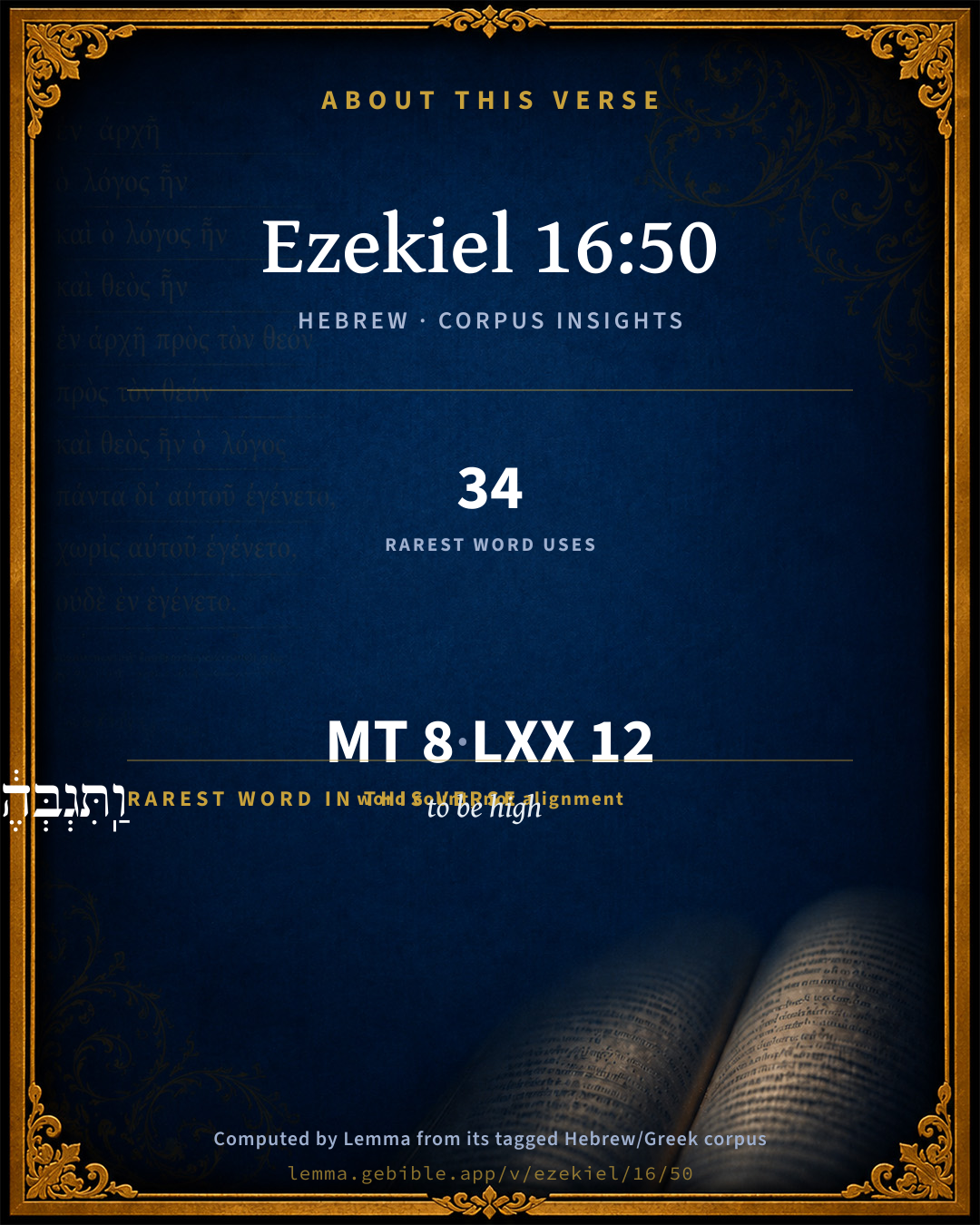
These counts appear in no published source. They are computed here, from the morphology-tagged text and Lemma’s own curated glosses. What Lemma adds →

8
words
8
distinct lemmas
Prophets
section

Shared distinctive vocabulary

וַֽתִּגְבְּהֶ֔ינָה to be high H1361 occurs in 33 verses of the Hebrew Bible. Also found in:

Grammatical profile

  • 4 verbs
  • 2 nouns
  • 2 particles

Verb forms

  • וַֽתִּגְבְּהֶ֔ינָה Qal · Sequential Imperfect
  • וַתַּעֲשֶׂ֥ינָה Qal · Sequential Imperfect
  • וָאָסִ֥יר Hiphil · Sequential Imperfect
  • רָאִֽיתִי Qal · Perfect

Hebrew & Septuagint length

In English translation the verse runs 17 words from the Hebrew and 17 from the Septuagint (LXX English) — the same length.

A rough comparison of the two English renderings, which tokenize alike — not a word-level alignment.

Word counts can differ between the Hebrew and the Greek without any difference in meaning — e.g. the Hebrew direct-object marker אֵת has no separate Greek word, and Greek often adds the article ὁ.

In the original languages it is 8 Hebrew tokens and 12 Greek tokens — but the two are counted differently (Hebrew bundles its prefixes and suffixes into one token; the Greek is in lemma form), so that isn’t a like-for-like length.

Cross-references

22

Topical passages linked to Ezekiel 16:50 in the Treasury of Scripture Knowledge — connected by theme and wording, ordered by reader-vote popularity; previews shown in the World English Bible.

  • Genesis 13:13 Now the men of Sodom were exceedingly wicked and sinners against Yahweh.
  • Genesis 18:20 Yahweh said, "Because the cry of Sodom and Gomorrah is great, and because their sin is very grievous,
  • Genesis 19:5 They called to Lot, and said to him, "Where are the men who came in to you this night? Bring them out to us, that we may have sex with them."
  • Genesis 19:24 Then Yahweh rained on Sodom and on Gomorrah sulfur and fire from Yahweh out of the sky.
  • Leviticus 18:22 "'You shall not lie with a man, as with a woman. That is detestible.
  • Deuteronomy 23:17 There shall be no prostitute of the daughters of Israel, neither shall there be a sodomite of the sons of Israel.
  • Deuteronomy 29:23 [and that] the whole land of it is sulfur, and salt, [and] a burning, [that] it is not sown, nor bears, nor any grass grows therein, like the overthrow of Sodom and Gomorrah, Admah and Zeboiim, which Yahweh overthrew in his anger, and in his wrath:
  • 2 Kings 23:7 He broke down the houses of the sodomites, that were in the house of Yahweh, where the women wove hangings for the Asherah.
  • Job 18:15 There shall dwell in his tent that which is none of his. Sulfur shall be scattered on his habitation.
  • Proverbs 16:18 Pride goes before destruction, And a haughty spirit before a fall.
  • Proverbs 18:12 Before destruction the heart of man is proud, But before honor is humility.
  • Isaiah 13:19 Babylon, the glory of kingdoms, the beauty of the Chaldeans' pride, shall be as when God overthrew Sodom and Gomorrah.
  • Jeremiah 20:16 Let that man be as the cities which Yahweh overthrew, and didn't repent: and let him hear a cry in the morning, and shouting at noontime;
  • Jeremiah 49:18 As in the overthrow of Sodom and Gomorrah and the neighbor cities of it, says Yahweh, no man shall dwell there, neither shall any son of man sojourn therein.
  • Jeremiah 50:40 As when God overthrew Sodom and Gomorrah and the neighbor cities of it, says Yahweh, so shall no man dwell there, neither shall any son of man sojourn therein.
  • Lamentations 4:6 For the iniquity of the daughter of my people is greater than the sin of Sodom, That was overthrown as in a moment, and no hands were laid on her.
  • Amos 4:11 "I have overthrown some of you, As when God overthrew Sodom and Gomorrah, And you were like a burning stick plucked out of the fire; Yet you haven't returned to me," says Yahweh.
  • Zephaniah 2:9 Therefore as I live, says Yahweh of Hosts, the God of Israel, surely Moab will be as Sodom, and the children of Ammon as Gomorrah, a possession of nettles, and salt pits, and a perpetual desolation. The remnant of my people will plunder them, and the survivors of my nation will inherit them.
  • Romans 1:26–27 For this reason, God gave them up to vile passions. For their women changed the natural function into that which is against nature.
  • 2 Peter 2:6 and turning the cities of Sodom and Gomorrah into ashes, condemned them to destruction, having made them an example to those who would live ungodly;
  • Jude 1:7 Even as Sodom and Gomorrah, and the cities around them, having, in the same way as these, given themselves over to sexual immorality and gone after strange flesh, are set forth as an example, suffering the punishment of eternal fire.
  • Revelation 18:9 The kings of the earth, who committed sexual immorality and lived wantonly with her, will weep and wail over her, when they look at the smoke of her burning,

Cross-references courtesy of OpenBible.info (CC BY 4.0).

Hebrew and Greek witnesses Masoretic Hebrew ↔ Greek Septuagint

The same verse in the two great witnesses to the Old Testament, shown verse-for-verse.

These are two independent witnesses, not word-aligned to each other, and the Septuagint is shown in lemma (dictionary) form.

Hebrew Ezekiel 16:50 Masoretic · Westminster Leningrad Codex

וַֽתִּגְבְּהֶ֔ינָה וַתַּעֲשֶׂ֥ינָה תוֹעֵבָ֖ה לְפָנָ֑י וָאָסִ֥יר אֶתְהֶ֖ן כַּאֲשֶׁ֥ר רָאִֽיתִי

They were haughty, and committed abomination before me: therefore I took them away as I saw [good].

World English Bible · Public Domain

Greek LXX Ezekiel 16:50 Septuagint · lemma form

καί μεγαλαυχέω καί ποιέω ἀνόμημα ἐνώπιον ἐγώ καί ἐκαἴρω αὐτός καθώς ὁράω

And they boasted, and wrought iniquities before me: so I cut them off as I saw fit.

LXX2012 (modern English Septuagint) · Public Domain

Hebrew: Westminster Leningrad Codex (CC BY 4.0). Greek: Septuagint (public domain); English from LXX2012 (modern English Septuagint) (Public Domain). How the Septuagint differs from the Hebrew →

Targum (Aramaic paraphrase)

1

The Targum is the ancient Jewish Aramaic paraphrase of the Hebrew Scriptures — an interpretive translation, not the Hebrew text itself. Onkelos (literal) and Pseudo-Jonathan (expansive) render the Torah, and Jonathan the Prophets. Coverage is partial: where no permissively-licensed English translation exists for a verse, only the Aramaic is shown. This is verse-level text, not a word-by-word alignment to the Hebrew.

  1. Targum Jonathan Prophets (Joshua–Malachi)
    וְאִתְרַבְרְבָא וַעֲבָדָא תּוֹעֵיבָא קֳדָמַי וְאַגְלֵיתִי יַתְהֵין כְּמָא דִגְלֵי קֳדָמַי:

    (no public-domain English translation for this verse)

    Targum Jonathan — Aramaic: “Mikraot Gedolot” (public domain). English: “Sefaria Community Translation” (CC0 1.0 (public-domain dedication)); “London "Chaldee Paraphrase," 1871” (public domain). Text via Sefaria.

Commentary

Notes on Ezekiel 16:50 from classic Christian and Jewish commentators (each source and its license shown beneath its notes). The classic Christian expositions comment on the surrounding passage and are grouped to its opening verse, so a note may address several verses; the Jewish commentaries on the Tanakh (Rashi and others) are per-verse, so they appear only where the commentator wrote on this verse.

Lemma curates 59 commentaries, every one of them public domain or Creative Commons licensed, each selected and text-cleaned for this edition rather than reprinted as found. About our sources →

Trapp's Complete Commentary

John Trapp

Eze 16:50 And they were haughty, and committed abomination before me: therefore I took them away as I saw [good].

Ver. 50. And they were haughty.] This sin of theirs is once more instanced as the root of the rest, the hate of heaven, and gate to hell.

And committed abomination before me.] That unnatural filthiness which taketh its name from them. This in the Levant is not held a vice, and in Mexico it is one of the Spanish virtues.

Therefore I took them away as I saw good,] sc., By raining down hell from heaven upon them. Hereby also God gave men an example of that rule, that heinous sins bring hideous plagues, as Herodotus also saith of the fall of Troy.

John Trapp, A Commentary or Exposition upon All the Books of the Old and New Testament (1647–1656) — public domain. Text from a community e-Sword module.

Jamieson, Fausset & Brown

Robert Jamieson, A. R. Fausset & David Brown

haughty--puffed up with prosperity.

abomination before me--"sinners before the Lord" (Gen 13:13); said of those whose sin is so heinous as to cry out to God for immediate judgments; presumptuous sins, daring God to the face (Gen 18:20; Gen 19:5).

I took them away-- (Gen 19:24).

as I saw good--rather, "according to what I saw"; referring to Gen 18:21, where God says, "I will go down, and see whether they have done altogether according to the cry of it which is come unto Me."

Jamieson, Fausset & Brown — Commentary Critical and Explanatory on the Whole Bible (1871) — public domain (CC PDM 1.0). Text via the HelloAO Bible API.

John Calvin's Commentaries

We must diligently attend to this passage; for God does not here excuse the wickedness of Sodom; but, abominable as that people was, he says that the Jews were yet more abandoned. We know why God inflicted his vengeance in a terrible manner against the Sodomites and their neighbors, for that was a fearful example; and Judea says that it was a kind of mirror of the wrath of God which awaits all the impious, (Jude 1:7;) and Scripture often recalls us to that proof of God’s judgement: but we must see how Sodom rushed forward to that degree of licentiousness so as to be horrified by no enormity. God says that they began by pride, and surely pride is the mother of all contempt of God and of all cruelty. Let us learn, then, that we cannot be restrained by the fear of God, unless moderation and humility reign within us. Pride, we know, has two horns, so to speak; one is, when men forget their own condition, and claim to themselves not only more than is right, but what God alone calls his own. This, then, is one horn of pride, when men, trusting in their dignity, excellence, plenty, and wealth, are intoxicated by false imaginations, so as to think themselves equal to God. Now, another horn of pride is, when they do not acknowledge their vices, and despise others in comparison with themselves, and please themselves in enormities, just as if they were free from any future account. Since, therefore, pride is contained in these two clauses, when men arrogate too much to themselves, and thus are blind to their own vices, each of these is doubtless condemned in the Sodomites, since they first raised themselves by a rash confidence, and then refused to subject themselves to God, and rebelled against him as if they could shake off his yoke.

He afterwards adds fullness of bread. But the Prophet seems to condemn in the Sodomites what was not blamable in itself: for when God feeds us bountifully, fullness is not to be considered a crime; but he takes it here for immoderate gluttony; for those who have abundance are often luxurious, and nothing is more rare than self-restraint when materials for luxury are supplied to us. Hence fullness of bread is here taken for intemperance, since the Sodomites were so addicted to gluttony and drunkenness, that they gratified their appetites worse than the brutes, who do retain some moderation, for they are content with their own food: but men’s covetousness is altogether insatiable. Let us observe, then, that by fullness of bread we are to understand that intemperance in which profane men indulge when God supplies them bountifully with the means of living; for they do not consider why they abound in wine, and corn, and abundance of all things, but they drown themselves in luxuries with a blind and brutal impulse. Hence such greediness, so inflaming to the spirits of the Sodomites, is added to pride, that they arrogate to themselves more than is just. He afterwards adds, and rest; תולש, sheloth: some translate it abundance, but almost everywhere it means peace; the noun טקש, sheket, which is added next, means properly rest; so that it will be the peace of rest or ease, and this seems without blame: for why shall we not be permitted to enjoy ease, if no one molests or troubles us? nay, it is reckoned among God’s blessings: you shall sleep, and no one shall frighten thee. (Leviticus 26:6.) Since God, therefore, wishes this to be considered among his blessings, that the faithful should sleep soundly, without any anxiety or trouble, why is Sodom condemned for thus enjoying ease and peace? But here its excess is pointed out, not its true use, since the use of peace is to render our minds tranquil, that we may return thanks to God, and dwell calmly under his sway. But how do the reprobate act? They grow brutish, so to speak, in their own peacefulness. Hence sloth is in this passage meant by the peacefulness of ease, and God means that the Sodomites were intoxicated by their luxuries when they enjoyed peace. We must put off the remainder.

John Calvin's Commentaries (1540-1563) — public domain. Text from the Calvin Translation Society English edition (1840s-50s) via the Christian Classics Ethereal Library (ccel.org). Calvin's coverage is partial (roughly two-thirds of the Bible); uncommented books and verses are honest gaps, never fabricated. The 19th-century editor's footnotes and remarks are omitted so the notes are faithfully Calvin's own voice.

Ellicott's Commentary for English Readers

(50) As I saw good.—The word good is not in the original, and should be omitted, and the particle translated when: “Therefore I took them away when I saw this.” Punishment followed upon the manifestation of their sin. (Comp. Gen_18:21.)

A Bible Commentary for English Readers, edited by Charles John Ellicott (1878–1897) — public domain. Text from a community e-Sword module.

The Cambridge Bible for Schools and Colleges

gen. ed. J. J. S. Perowne

50. as I saw good] Or, when I saw it. Gen_18:21, I “will go down and see whether they have done according to the cry which is come up unto me.”

The Cambridge Bible for Schools and Colleges (gen. ed. J. J. S. Perowne; Cambridge University Press, 1878–1918) — public domain. Text from a community e-Sword module.

John Gill's Exposition

Neither hath Samaria committed half of thy sins,.... The sins of Samaria, or the ten tribes, of which Samaria was the metropolis, were the worshipping of the calves at Dan and Bethel; but the gods of Judah were according to the number of their cities, and they even set up their idols in the temple of Jerusalem, Jer 2:28, Eze 8:5; and, besides, their sins were aggravated by the benefits privileges they enjoyed; having the temple, the place of worship, among them; the priests of the Lord to officiate for them; the prophets to instruct and teach them; and many good kings to rule over them, who encouraged them in the pure worship of God, and set them examples; as also by their not taking warning at the captivity of the ten tribes, which were some years before; so that they were guilty of great ingratitude and obduracy:

but thou hast multiplied thine abominations more than they; than Samaria and her daughters, or the ten tribes; or than Sodom and Samaria, since both are intended in the next clause:

and hast justified thy sisters in all thine abominations which thou hast done; justified them in what they did; countenanced them in their wickedness, by doing the same abominations, and more, and much greater; saying, in effect, that they did right in what they did; and, by exceeding them in sin, made them to appear righteous in comparison of them; and gave them an opportunity of saying, in excuse for themselves, that the men of Judah had been guilty of more and greater sins than they, and yet had not been punished as they had been.

John Gill's Exposition of the Whole Bible (1746–1763) — public domain (CC PDM 1.0). Text via the HelloAO Bible API.

Albert Barnes' Notes on the Bible

As I saw good - Or, “as soon as I saw it.” Omit “good.” God saw and punished. Compare Gen 18:21.

Albert Barnes' Notes on the Bible (1834–1885) — public domain. Text from a community e-Sword/MySword module.

Haydock's Catholic Bible Commentary

Seen. This would seem to allude to the Israelites beyond the Jordan, who had been led away into Assyria. The Moabites, &c., beheld the downfall of Jerusalem, (Haydock) and were treated in like manner, only five years later. (Jos.[Josephus?]) (Jeremias xlviii., &c.)

George Leo Haydock (1774–1849), Haydock's Catholic Family Bible and Commentary, 1859 edition — public domain. Excludes Psalms (Douay-Rheims chapter numbering differs from Protestant) and Deuterocanonical books (Catholic canon only).

Matthew Poole's English Annotations

Haughty; insufferably arrogant in their deportment towards good men, they vexed the soul of righteous Lot; and towards the angels, whom they assaulted in Lot’s house; and towards God himself, as both in this verse, and in Gen 13:13.

Committed; worked, as if it were their trade.

Abomination; the whole of these men’s life was as one continued act of the highest wickedness.

Before me; either against God, or openly and publicly, as Isa 3:9.

I took them away; destroyed their state, cities, people, and country, turned them into a lake of dead and deadly water, or rather bitumen and sulphur.

As I saw good; in a way none could have suspected, and, for aught I know, none ever saw before or since. If you inquire how Jerusalem’s sins were greater than Sodom’s, I would answer, if not in the things done, yet in the aggravating circumstances of them; against redeeming mercy, against the law of God, which forbade what they did, and told them what they should do, against admonitions by the mouth of prophets, and against examples of God’s vengeance on Sodom and the cities of the plain.

Matthew Poole's English Annotations on the Holy Bible (1683–1685) — public domain. Text from a community e-Sword/MySword module.

Rashi

Rabbi Shlomo Yitzchaki (Rashi)

And they became haughty She and her daughters, as is delineated in Job (28:5): “A land from which bread emerged,” and the entire piece (ibid. 4-9). [The Sodomites grew in haughtiness] until they said, “Let us cause the habit of traveling [lit. the foot] to be forgotten from our land, for they come only to cause us loss.”

and I removed them when I saw their way, as the matter that is stated regarding Sodom (Gen. 18:21): “I shall go down and see.”

Rashi on the Tanakh — English translations: “The Judaica Press complete Tanach with Rashi, translated by A. J. Rosenberg” (CC BY 4.0); “Pentateuch with Rashi's commentary by M. Rosenbaum and A.M. Silbermann, 1929-1934” (public domain); “The Metsudah Tanach series, Lakewood, N.J” (CC BY 4.0); and “The Book of Joshua, Metsudah Publications, 1997” (CC BY 4.0). Text via Sefaria.

Lesson kit

Teaching starters — assembled from the data on this page, not authored interpretation. Every prompt links to the verse data it draws on. Edit before teaching.

Ezekiel, in the Prophets, opens this verse with 8 words (8 distinct Hebrew lemmas). Its most distinctive word is gâbahh (“to be high”). A historical commentator’s framing appears above. Read the whole chapter for the surrounding context.

Discussion questions

  1. How does “to be high” (gâbahh) shape what this verse is saying?
  2. How does 1 Samuel 10:23, which shares the word «to be high», read alongside this verse?
  3. The translations on this page render this verse differently — a whole-verse word diff, not a word-by-word alignment. What might account for the different wordings?
  4. «וַֽתִּגְבְּהֶ֔ינָה» is a Qal Sequential Imperfect verb. How does that grammatical form shape the action described?
  5. Compare how Trapp's Complete Commentary and Jamieson, Fausset & Brown read this verse. Where do they agree or differ?

Things to notice

Reading settings

Reading text

Shown beneath each verse's original-language words.

Old Testament
Old Testament edition

Read the OT as the Masoretic Hebrew (MT) or the Greek Septuagint (LXX).

English shown for the Greek Septuagint (in the Hebrew ↔ Greek comparison).

Comparing translations? Open the Compare panel on any verse page to stack up to four side by side.