
Ezekiel 16:2

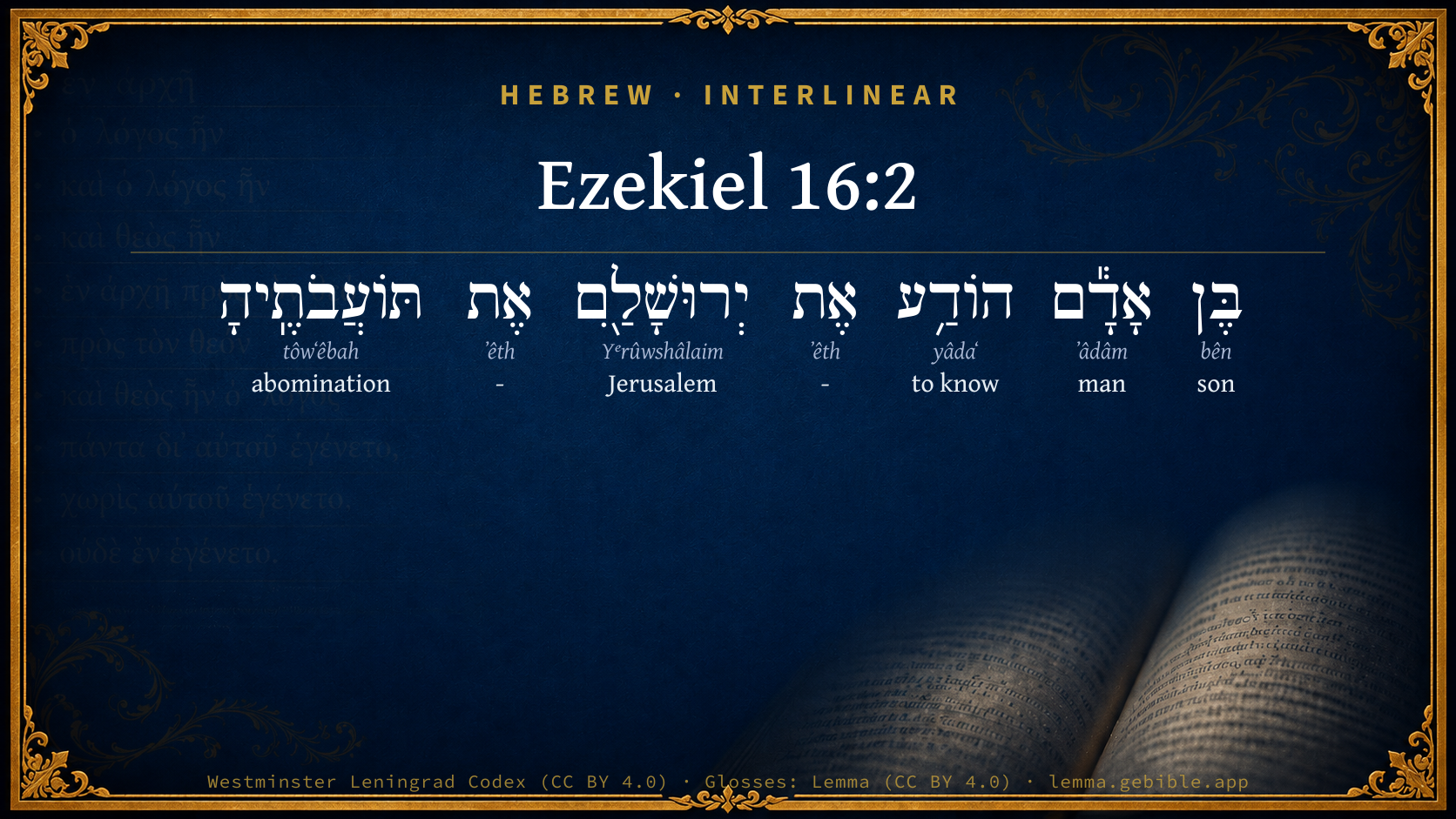
Hebrew (Westminster Leningrad Codex) Ezekiel 16:2 appears in the Hebrew Old Testament. The text above is from the Westminster Leningrad Codex. Each word links to its Strong’s number, a concise gloss, and parsing drawn from the Open Scriptures Hebrew Bible morphology. Click any word for its full Brown-Driver-Briggs (BDB) entry.
Download image
Cite this verse

Ezekiel 16:2 (World English Bible). Public Domain. Lemma interlinear Bible study tool, https://lemma.gebible.app/v/ezekiel/16/2.

Show BibTeX & RIS
BibTeX
RIS
English Translation
Son of man, cause Jerusalem to know her abominations;
World English Bible · Public Domain
Download a study sheet

One document with this verse’s original text, its word-by-word gloss line, the meaning frame, cross-references with their text, attributed commentary, and full source and license credits — printable, and it pastes into notes with its structure intact.

This verse Autodidact and up

Study sheet (.html) Plain text (.txt)

A passage Seminary Student

Up to 50 verses in one chapter. A passage sheet keeps up to 6 commentary sources and 12 cross-references per verse, in the order this page ranks them, and says so on the sheet whenever that leaves anything out. Ask for a single verse and you get the Autodidact verse sheet above.

Everything on this page stays free to read, with no account — the sheet is a download of what is already on screen, not access to it.

Want to remove ads? Support Godless Engineer
Compare translations 3

The same verse in 3 English versions, stacked beneath the original-language interlinear above. Click any original word for its lexicon entry.

Each is an independent rendering of the whole verse — the interlinear is not word-aligned to these translations.

Highlighted words mark where these versions differ — a whole-verse word diff, not a word-by-word alignment.

  • World English Bible Public Domain
    Son of man, cause Jerusalem to know her abominations;
  • King James Version Public Domain
    Son of man, cause Jerusalem to know her abominations,
  • unfoldingWord Literal Text CC BY-SA 4.0
    “Son of man, inform Jerusalem about her abominations,

unfoldingWord Literal Text — © unfoldingWord, licensed CC BY-SA 4.0. Word-aligned USFM3 via Door43 (git.door43.org/unfoldingWord/en_ult).

Versions to compare (up to 4)

3 of 4 selected

Show all 18 translations

Every available English version of this verse, each an independent rendering of the whole verse.

  • World English Bible Public Domain
    Son of man, cause Jerusalem to know her abominations;
  • Berean Standard Bible Public Domain
    “Son of man, confront Jerusalem with her abominations
  • Majority Standard Bible Public Domain
    “Son of man, confront Jerusalem with her abominations
  • King James Version Public Domain
    Son of man, cause Jerusalem to know her abominations,
  • American Standard Version (1901) Public Domain
    Son of man, cause Jerusalem to know her abominations;
  • Revised Version (1885) Public Domain
    Son of man, cause Jerusalem to know her abominations,
  • Geneva Bible (1599) Public Domain
    Sonne of man, cause Ierusalem to knowe her abominations,
  • Douay-Rheims (1899) Public Domain
    Son of man, make known to Jerusalem her abominations.
  • Young's Literal Translation Public Domain
    `Son of man, cause Jerusalem to know her abominations, and thou hast said:
  • Literal Standard Version CC BY-SA 4.0
    “Son of man, cause Jerusalem to know her abominations, and you have said,
  • Unlocked Literal Bible CC BY-SA 4.0
    “Son of man, inform Jerusalem about her abominations,
  • unfoldingWord Literal Text CC BY-SA 4.0
    “Son of man, inform Jerusalem about her abominations,
  • Darby Bible Public Domain
    Son of man, cause Jerusalem to know her abominations,
  • World Messianic Bible Public Domain
    “Son of man, cause Jerusalem to know her abominations;
  • Webster's Bible Public Domain
    Son of man, cause Jerusalem to know her abominations,
  • Free Bible Version CC BY-SA 4.0
    “Son of man, challenge Jerusalem over her disgusting practices.
  • Bible in Basic English Public Domain
    Son of man, make clear to Jerusalem her disgusting ways,
  • JPS Tanakh (1917) Public Domain
    'Son of man, cause Jerusalem to know her abominations,

Literal Standard Version (2020), Covenant Press — licensed CC BY-SA 4.0. Text via the HelloAO Bible API (eBible.org). Unlocked Literal Bible (unfoldingWord) — licensed CC BY-SA 4.0. Text via the HelloAO Bible API (eBible.org). unfoldingWord Literal Text — © unfoldingWord, licensed CC BY-SA 4.0. Word-aligned USFM3 via Door43 (git.door43.org/unfoldingWord/en_ult). Free Bible Version, Dr. Jonathan Gallagher — licensed CC BY-SA 4.0. Text via the HelloAO Bible API (eBible.org).

Word by word

More ways to search: Search by grammar → Find every occurrence → Compare this word →

Practice this passage: Drill this verse → Learn its vocabulary →

About this verse

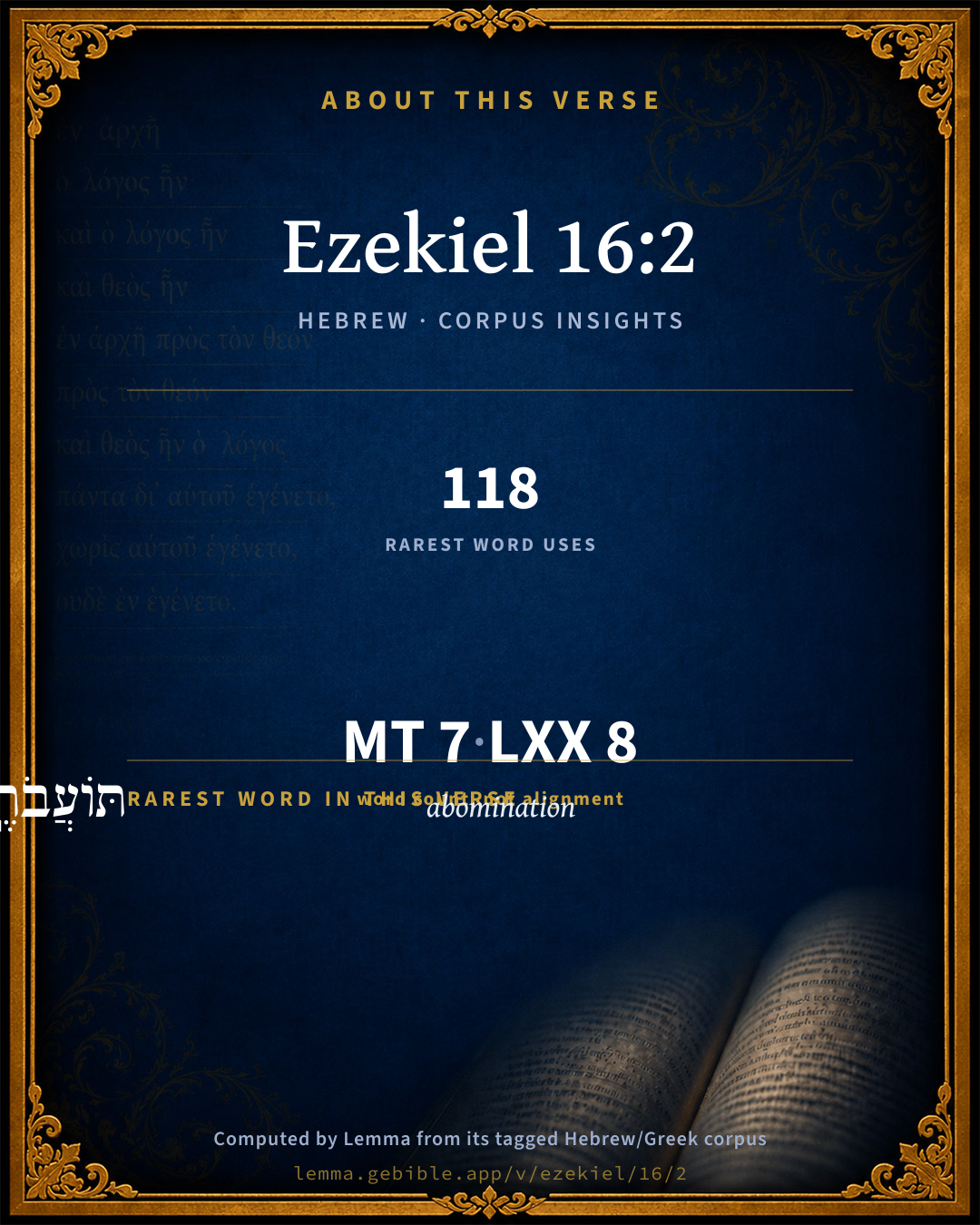
These counts appear in no published source. They are computed here, from the morphology-tagged text and Lemma’s own curated glosses. What Lemma adds →

7
words
6
distinct lemmas
Prophets
section

Grammatical profile

  • 1 verb
  • 4 nouns
  • 2 particles

Verb forms

  • הוֹדַ֥ע Hiphil · Imperative

Hebrew & Septuagint length

In English translation the verse runs 9 words from the Hebrew and 9 from the Septuagint (LXX English) — the same length.

A rough comparison of the two English renderings, which tokenize alike — not a word-level alignment.

Word counts can differ between the Hebrew and the Greek without any difference in meaning — e.g. the Hebrew direct-object marker אֵת has no separate Greek word, and Greek often adds the article ὁ.

In the original languages it is 7 Hebrew tokens and 8 Greek tokens — but the two are counted differently (Hebrew bundles its prefixes and suffixes into one token; the Greek is in lemma form), so that isn’t a like-for-like length.

Cross-references

7

Topical passages linked to Ezekiel 16:2 in the Treasury of Scripture Knowledge — connected by theme and wording, ordered by reader-vote popularity; previews shown in the World English Bible.

  • Ezekiel 22:2 You, son of man, will you judge, will you judge the bloody city? then cause her to know all her abominations.
  • Ezekiel 20:4 Will you judge them, son of man, will you judge them? Cause them to know the abominations of their fathers;
  • Isaiah 58:1 Cry aloud, don't spare, lift up your voice like a trumpet, and declare to my people their disobedience, and to the house of Jacob their sins.
  • Ezekiel 8:9–17 He said to me, Go in, and see the wicked abominations that they do here.
  • Ezekiel 23:36 Yahweh said moreover to me: Son of man, will you judge Oholah and Oholibah? then declare to them their abominations.
  • Ezekiel 33:7–9 So you, son of man, I have set you a watchman to the house of Israel; therefore hear the word at my mouth, and give them warning from me.
  • Hosea 8:1 "Put the trumpet to your lips! Something like an eagle is over Yahweh's house, Because they have broken my covenant, And rebelled against my law.

Cross-references courtesy of OpenBible.info (CC BY 4.0).

Hebrew and Greek witnesses Masoretic Hebrew ↔ Greek Septuagint

The same verse in the two great witnesses to the Old Testament, shown verse-for-verse.

These are two independent witnesses, not word-aligned to each other, and the Septuagint is shown in lemma (dictionary) form.

Hebrew Ezekiel 16:2 Masoretic · Westminster Leningrad Codex

בֶּן אָדָ֕ם הוֹדַ֥ע אֶת יְרוּשָׁלִַ֖ם אֶת תּוֹעֲבֹתֶֽיהָ

Son of man, cause Jerusalem to know her abominations;

World English Bible · Public Domain

Greek LXX Ezekiel 16:2 Septuagint · lemma form

υἱός ἄνθρωπος διαμαρτύρομαι ὁ ἰερουσαλήμ ὁ ἀνομία αὐτός

Son of man, testify to Jerusalem of her iniquities;

LXX2012 (modern English Septuagint) · Public Domain

Hebrew: Westminster Leningrad Codex (CC BY 4.0). Greek: Septuagint (public domain); English from LXX2012 (modern English Septuagint) (Public Domain). How the Septuagint differs from the Hebrew →

Targum (Aramaic paraphrase)

1

The Targum is the ancient Jewish Aramaic paraphrase of the Hebrew Scriptures — an interpretive translation, not the Hebrew text itself. Onkelos (literal) and Pseudo-Jonathan (expansive) render the Torah, and Jonathan the Prophets. Coverage is partial: where no permissively-licensed English translation exists for a verse, only the Aramaic is shown. This is verse-level text, not a word-by-word alignment to the Hebrew.

  1. Targum Jonathan Prophets (Joshua–Malachi)
    בַּר אָדָם חוֹכַת יַת יַתְבֵי יְרוּשְׁלֵם וְחַוֵי לְהוֹן יַת תּוֹעֲבָתְהוֹן:

    Mortal man, rebuke the residents of Jerusalem and show them their abominations.

    Targum Jonathan — Aramaic: “Mikraot Gedolot” (public domain). English: “Sefaria Community Translation” (CC0 1.0 (public-domain dedication)); “London "Chaldee Paraphrase," 1871” (public domain). Text via Sefaria.

Commentary

Notes on Ezekiel 16:2 from classic Christian and Jewish commentators (each source and its license shown beneath its notes). The classic Christian expositions comment on the surrounding passage and are grouped to its opening verse, so a note may address several verses; the Jewish commentaries on the Tanakh (Rashi and others) are per-verse, so they appear only where the commentator wrote on this verse.

Lemma curates 59 commentaries, every one of them public domain or Creative Commons licensed, each selected and text-cleaned for this edition rather than reprinted as found. About our sources →

Trapp's Complete Commentary

John Trapp

Eze 16:2 Son of man, cause Jerusalem to know her abominations,

Ver. 2. Cause Jerusalem to know her abominations.] Which as yet she taketh no knowledge of. Rebuke her therefore sharply, that she may be sound in the faith, if God peradventure will give them repentance to the acknowledging of the truth.

John Trapp, A Commentary or Exposition upon All the Books of the Old and New Testament (1647–1656) — public domain. Text from a community e-Sword module.

Joseph Benson's Commentary

Eze 16:2. Cause Jerusalem to know her abominations — Her foul sins and multiplied transgressions, especially her idolatries, or spiritual adulteries, and unexampled folly in her lewdness. “This might probably be done by way of letter, as Jeremiah signified the will of God to the captives at Babylon. God here particularly upbraids Jerusalem for her iniquities, because it was the place he had chosen for his peculiar residence; and yet the inhabitants had defiled that very place, nay, and the temple itself with idolatry; the sin particularly denoted by the word abomination.” “Nothing can give us a greater horror of the crimes of Jerusalem than the manner in which Ezekiel speaks here. This city must certainly have carried her impiety to the greatest height, to merit reproaches so lively and strong.” See Lowth and Calmet.

Joseph Benson's Commentary on the Old and New Testaments (1811–1818) — public domain. Text from a community e-Sword module.

Adam Clarke's Commentary

Verse 2. Cause Jerusalem to know her abominations] And such a revelation of impurity never was seen before or since. Surely the state of the Jews, before the Babylonish captivity, was the most profligate and corrupt of all the nations of the earth. This chapter contains God's manifesto against this most abominable people; and although there are many metaphors here, yet all is not metaphorical. Where there was so much idolatry, there must have been adulteries, fornications, prostitutions, and lewdness of every description. The description of the prophet is sufficiently clear, except where there is a reference to ancient and obsolete customs. What a description of crimes! The sixth satire of Juvenal is its counterpart. General remarks are all that a commentator is justified in bestowing on this very long, very circumstantial, and caustic invective. For its key, see on the thirteenth and sixty-third verses. See Clarke on Eze 16:13; "Eze 16:63".

Adam Clarke's Commentary on the Bible (1810–1826) — public domain. Text from a community e-Sword/MySword module.

The Cambridge Bible for Schools and Colleges

gen. ed. J. J. S. Perowne

2. cause Jerusalem to know] The object of the chapter is to impress on Israel the necessity of the Divine judgment because of her persistent idolatry through all her history (ch. Eze_20:4, Eze_22:2, Eze_23:36). Jerusalem, which is spoken to throughout, represents the kingdom of Judah, and even the whole family of Israel in its early history.

The Cambridge Bible for Schools and Colleges (gen. ed. J. J. S. Perowne; Cambridge University Press, 1878–1918) — public domain. Text from a community e-Sword module.

John Gill's Exposition

And say, thus saith the Lord God unto Jerusalem,.... To the inhabitants of Jerusalem, as the Targum:

thy birth and thy nativity is of the land of Canaan; here the Jewish ancestors for a time dwelt and sojourned, Abraham, Isaac, and Jacob; and so the Targum, Jarchi, Kimchi, and Ben Melech, interpret the first word, "thy habitation" or "sojourning" (f): but whereas it follows, "and thy nativity", this does not solve the difficulty; which may be said to be of the land of Canaan, because their ancestors were born here; for though Abraham was a Chaldean he was called out of Chaldea into the land of Canaan, where Isaac was born; and so was Jacob, the father of the twelve tribes; besides, the Israelites were the successors of the Canaanites in their land, and so seemed to descend from them; and it is not unusual for such to be reckoned the children of those whom they succeed; to which may be added, that they were like to the Canaanites in their manners, particularly in their idolatries; and so their children, as such, are said to be the offspring and descendants of those whose examples they follow, or whom they imitate; see the history of Susannah in the Apocrypha:

"So he put him aside, and commanded to bring the other, and said unto him, O thou seed of Chanaan, and not of Juda, beauty hath deceived thee, and lust hath perverted thine heart.'' (Susannah 1:56)

thy father was an Amorite, and thy mother an Hittite; Abraham and Sarah, who were, properly speaking, the one the father, the other the mother, of the Jewish nation, were Chaldeans; and neither Amorites nor Hittites; yet, because they dwelt among them; are so called; and especially since before their conversion they were idolaters, as those were; besides, the Jews who descended from Judah, and from whom they have their name, very probably sprung from ancestors who might be Amorites and Hittites: since Judah married the daughter of a Canaanite, and such an one seems to be Tamar, he took for his son Er, and by whom he himself had two sons, Pharez and Zarah, from the former of which the kings of Judah lineally descended, Gen 37:2; besides, the Jews were the successors of these people, and possessed their land, and imitated them in their wicked practices, Amo 2:10; and these two, the Amorite and Hittite, of all the seven nations, are mentioned, because they were the worst, and the most wicked, Gen 15:16. The Jews (g) say Terah the father of Abraham, and his ancestors, came from Canaan.

(f) "habitationes tuae", Pagninus, Calvin; "mansiones tuae", Montanus; "habitatio tua", Vatablus, Grotius; so R. Sol. Urbin. Ohel Moed, fol. 30. 1. (g) T. Bab. Sanhedrin, fol. 44. 2. & Gloss. in ib.

John Gill's Exposition of the Whole Bible (1746–1763) — public domain (CC PDM 1.0). Text via the HelloAO Bible API.

Matthew Poole's English Annotations

Declare to them that are with thee, and to them that are at Jerusalem, to these declare by letter, to those by word of mouth, what state theirs was in their infancy what I did for them, for the whole nation of the Jews, for so I take Jerusalem here to signify. Make them know: it was not in his power to give them understandings, and to enlighten their minds, but his declaring to them is here called making them to know, because it was sufficient to have brought it to their knowledge.

Her abominations; her multiplied transgressions, which were increased beyond number, and her great, foul sins, called here abominations, her idolatries spiritual adulteries, and unexemplified folly in her lewdness, changing her God and Husband, Jer 2:10-13.

Matthew Poole's English Annotations on the Holy Bible (1683–1685) — public domain. Text from a community e-Sword/MySword module.

The Pulpit Commentary

Leading sinners to a knowledge of their sins.

"Son of man, cause Jerusalem to know her abominations.

I THAT SIN IS ESSENTIALLY VILE IN ITS CHARACTER. The sins of the inhabitants of Jerusalem were "abominations" in the sight of God. David says of the wicked, "They are corrupt, they have done abominable works;" "Corrupt are they, and have done abominable iniquity." And Jehovah said to the Jews, "Oh, do not this abominable thing that I hate!" In its own nature sin "is an evil thing and a bitter" It is a polluting thing, defiling the soul; it is a degrading thing, dishonouring the soul. It is an infraction of the order of God"s universe, and is inimical to its true interests. Sin is evil "in every respect hateful to God, hurtful to man, darkening the heavens, burdening the earth.

II THAT SINNERS OFTEN FAIL TO RECOGNIZE THEIR OWN SIN. The inhabitants of Jerusalem at this time were sadly corrupted by sin, but were so oblivious to the fact that the prophet is summoned to bring them to a knowledge of their abominations. David did not recognize as his own the foul crimes which he had committed when they were set before him parabolically. It was not until the Prophet Nathan said unto him, "Thou art the man!" that he saw himself to be the sinner he really was. (2Sa_12:1-14) The Pharisees in the time of our Lord"s ministry were really great sinners, but they regarded themselves as the excellent of the earth. We are quick to behold the mote that is in our brother"s eye, but we take no notice of the beam that is in our own eye. This failure of sinners to recognize their own sin may arise:

1. From the subtlety of sin. Sin approaches the soul in dangerous disguises. "Were the vision of sin seen in a full light, undressed and unpainted, it were impossible, while it so appeared, that any one soul could be in love with it, but all would rather flee from it as hideous and abominable." Wickedness veils itself in the garb of what is harmless, respectable, or excellent. Avarice hides its hard and hungry features under the name of economy. Harsh censoriousness wears the cloak of honest plain spokenness, etc.

2. From the proneness of men to excuse sin in themselves. Until man is brought to see and feel his sins aright, he is ready to palliate or to extenuate them. Men are cruelly indulgent to themselves in this respect. And in some cases pride and self-flattery blind men to their own offences.

III THAT THE MINISTERS OF GOD SHOULD ENDEAVOUR TO BRING SINNERS TO A KNOWLEDGE OF THEIR SINS. To this duty Ezekiel was summoned in our text. And this is incumbent on the ministers of Jesus Christ.

1. For the conversion of the sinners. "Without the knowledge of sin, repentance and conversion are not to be thought of." "As a physician, when he wishes to heal a wound thoroughly, must probe it to the bottom, so a teacher, when he wishes to convert men thoroughly, must first seek to bring them to a knowledge of their sins.

2. For the deliverance of their own souls. (Cf. Eze_3:17-21 Eze_33:7-9)

3. For the vindication of the Law and government of God. Sin is an outrage of his holy Law, and it should be exhibited as such. Persistence in sin calls down Divine punishment, and the sin should be set forth unto men, that they will recognize the righteousness of the punishment. If sin be not properly estimated by men, how shall the Divine dealings in the punishment of it be justified unto them? Therefore the ministers of Jesus Christ should endeavour to cause sinners to know their sins. W.J.

The Pulpit Commentary (1880–1919), ed. H.D.M. Spence-Jones & Joseph S. Exell — public domain. Text from a community e-Sword module.

Rashi

Rabbi Shlomo Yitzchaki (Rashi)

let...know Heb. הוֹדַע, fais savoir in French, inform.

Rashi on the Tanakh — English translations: “The Judaica Press complete Tanach with Rashi, translated by A. J. Rosenberg” (CC BY 4.0); “Pentateuch with Rashi's commentary by M. Rosenbaum and A.M. Silbermann, 1929-1934” (public domain); “The Metsudah Tanach series, Lakewood, N.J” (CC BY 4.0); and “The Book of Joshua, Metsudah Publications, 1997” (CC BY 4.0). Text via Sefaria.

Lesson kit

Teaching starters — assembled from the data on this page, not authored interpretation. Every prompt links to the verse data it draws on. Edit before teaching.

Ezekiel, in the Prophets, opens this verse with 7 words (6 distinct Hebrew lemmas). Its most distinctive word is tôwʻêbah (“abomination”). A historical commentator’s framing appears above. Read the whole chapter for the surrounding context.

Discussion questions

  1. How does “abomination” (tôwʻêbah) shape what this verse is saying?
  2. Ezekiel 22:2 shares this passage’s theme. How do the two illuminate each other?
  3. These translations render this verse differently. What is at stake in choosing one wording over another?
  4. The verb «הוֹדַ֥ע» is Hiphil Imperative. How does its form color the action?
  5. Reading how Trapp's Complete Commentary and Joseph Benson's Commentary read this verse, where do the two commentators agree and where do they part?

Things to notice

Reading settings

Reading text

Shown beneath each verse's original-language words.

Old Testament
Old Testament edition

Read the OT as the Masoretic Hebrew (MT) or the Greek Septuagint (LXX).

English shown for the Greek Septuagint (in the Hebrew ↔ Greek comparison).

Comparing translations? Open the Compare panel on any verse page to stack up to four side by side.