Ezekiel 44:6

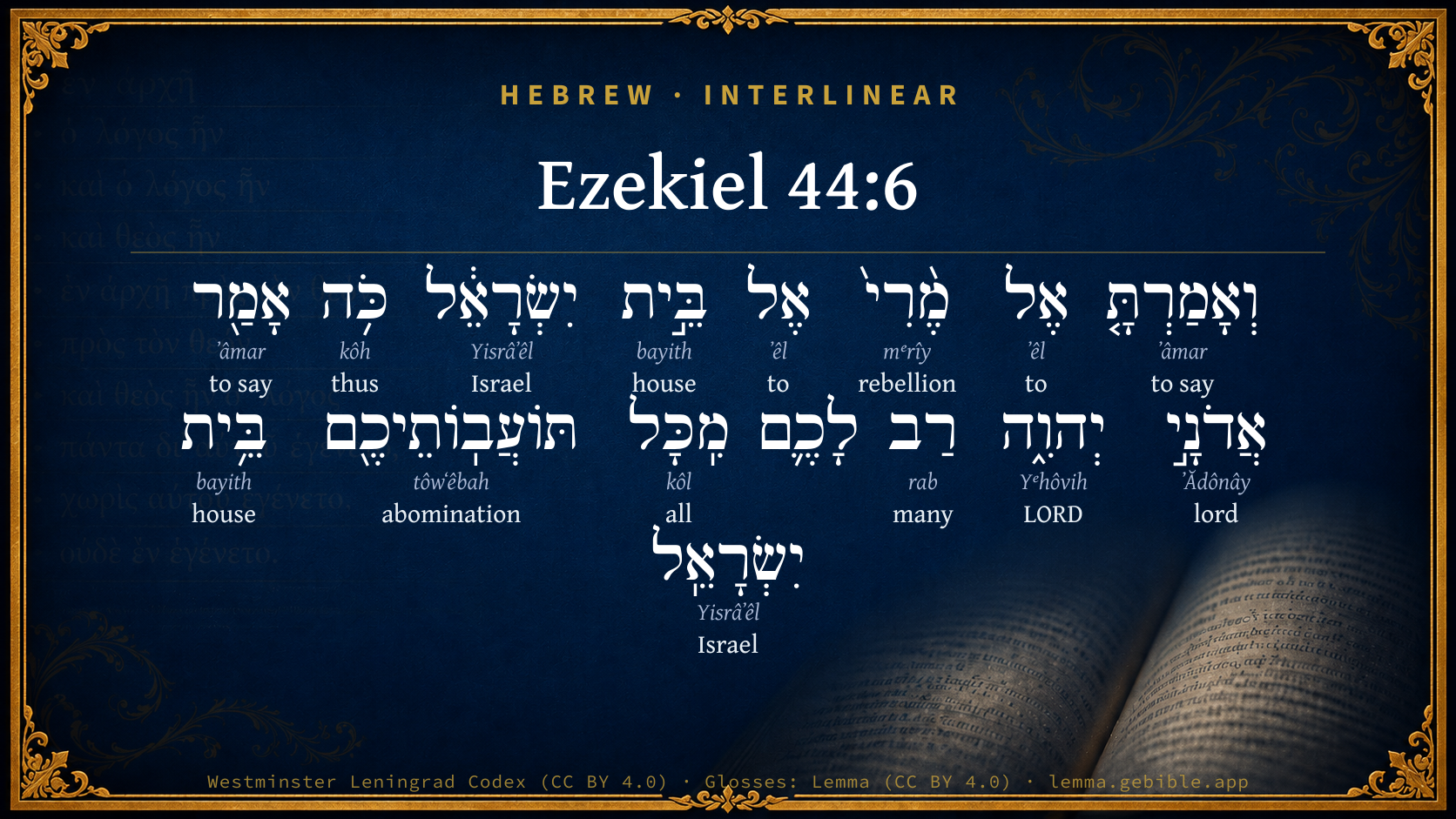
Hebrew (Westminster Leningrad Codex) Ezekiel 44:6 appears in the Hebrew Old Testament. The text above is from the Westminster Leningrad Codex. Each word links to its Strong’s number, a concise gloss, and parsing drawn from the Open Scriptures Hebrew Bible morphology. Click any word for its full Brown-Driver-Briggs (BDB) entry.
Download image
Cite this verse

Ezekiel 44:6 (World English Bible). Public Domain. Lemma interlinear Bible study tool, https://lemma.gebible.app/v/ezekiel/44/6.

Show BibTeX & RIS
BibTeX
RIS
English Translation
You shall tell the rebellious, even to the house of Israel, Thus says the Lord Yahweh: you house of Israel, let it suffice you of all your abominations,
World English Bible · Public Domain
Download a study sheet

One document with this verse’s original text, its word-by-word gloss line, the meaning frame, cross-references with their text, attributed commentary, and full source and license credits — printable, and it pastes into notes with its structure intact.

This verse Autodidact and up

Study sheet (.html) Plain text (.txt)

A passage Seminary Student

Up to 50 verses in one chapter. A passage sheet keeps up to 6 commentary sources and 12 cross-references per verse, in the order this page ranks them, and says so on the sheet whenever that leaves anything out. Ask for a single verse and you get the Autodidact verse sheet above.

Everything on this page stays free to read, with no account — the sheet is a download of what is already on screen, not access to it.

Want to remove ads? Support Godless Engineer
Compare translations 3

The same verse in 3 English versions, stacked beneath the original-language interlinear above. Click any original word for its lexicon entry.

Each is an independent rendering of the whole verse — the interlinear is not word-aligned to these translations.

Highlighted words mark where these versions differ — a whole-verse word diff, not a word-by-word alignment.

  • World English Bible Public Domain
    You shall tell the rebellious, even to the house of Israel, Thus says the Lord Yahweh: you house of Israel, let it suffice you of all your abominations,
  • King James Version Public Domain
    And thou shalt say to the rebellious, even to the house of Israel, Thus saith the Lord GOD; O ye house of Israel, let it suffice you of all your abominations,
  • unfoldingWord Literal Text CC BY-SA 4.0
    Then say to the rebellious ones, the house of Israel, ‘The Lord Yahweh says this: Let all of your disgusting actions be enough for you, house of Israel—

unfoldingWord Literal Text — © unfoldingWord, licensed CC BY-SA 4.0. Word-aligned USFM3 via Door43 (git.door43.org/unfoldingWord/en_ult).

Versions to compare (up to 4)

3 of 4 selected

Show all 18 translations

Every available English version of this verse, each an independent rendering of the whole verse.

  • World English Bible Public Domain
    You shall tell the rebellious, even to the house of Israel, Thus says the Lord Yahweh: you house of Israel, let it suffice you of all your abominations,
  • Berean Standard Bible Public Domain
    Tell the rebellious house of Israel that this is what the Lord GOD says: ‘I have had enough of all your abominations, O house of Israel.
  • Majority Standard Bible Public Domain
    Tell the rebellious house of Israel that this is what the Lord GOD says: ‘I have had enough of all your abominations, O house of Israel.
  • King James Version Public Domain
    And thou shalt say to the rebellious, even to the house of Israel, Thus saith the Lord GOD; O ye house of Israel, let it suffice you of all your abominations,
  • American Standard Version (1901) Public Domain
    And thou shalt say to the rebellious, even to the house of Israel, Thus saith the Lord Jehovah: O ye house of Israel, let it suffice you of all your abominations,
  • Revised Version (1885) Public Domain
    And thou shalt say to the rebellious, even to the house of Israel, Thus saith the Lord GOD: O ye house of Israel, let it suffice you of all your abominations,
  • Geneva Bible (1599) Public Domain
    And thou shalt say to the rebellious, euen to ye house of Israel, Thus saith ye Lord God, O house of Israel, ye haue ynough of al your abominations,
  • Douay-Rheims (1899) Public Domain
    And thou shalt say to the house of Israel that provoketh me: Thus saith the Lord God: Let all your wicked doings suffice you, 0 house of Israel:
  • Young's Literal Translation Public Domain
    and hast said unto the rebellious, unto the house of Israel: Thus said the Lord Jehovah: Enough to you -- of all your abominations, O house of Israel.
  • Literal Standard Version CC BY-SA 4.0
    and have said to [the] rebellion, to the house of Israel, Thus said Lord YHWH: Enough from you—of all your abominations, O house of Israel.
  • Unlocked Literal Bible CC BY-SA 4.0
    Then say to the rebellious ones, the house of Israel, 'The Lord Yahweh says this: Let all of your disgusting actions be enough for you, house of Israel—
  • unfoldingWord Literal Text CC BY-SA 4.0
    Then say to the rebellious ones, the house of Israel, ‘The Lord Yahweh says this: Let all of your disgusting actions be enough for you, house of Israel—
  • Darby Bible Public Domain
    and say to the rebellious, to the house of Israel, Thus saith the Lord Jehovah: Let it suffice you of all your abominations, O house of Israel,
  • World Messianic Bible Public Domain
    You shall tell the rebellious, even the house of Israel, ‘The Lord GOD says: “You house of Israel, let that be enough of all your abominations,
  • Webster's Bible Public Domain
    And thou shalt say to the rebellious, even to the house of Israel, Thus saith the Lord GOD; O ye house of Israel, let it suffice you of all your abominations;
  • Free Bible Version CC BY-SA 4.0
    Tell those rebels, the people of Israel, that this is what the Lord God says: I've had more than enough of all your disgusting sins, people of Israel!
  • Bible in Basic English Public Domain
    And say to the uncontrolled children of Israel, This is what the Lord has said: O you children of Israel, let it be enough for you, among the disgusting things which you have done,
  • JPS Tanakh (1917) Public Domain
    And thou shalt say to the rebellious, even to the house of Israel: Thus saith the Lord GOD: O ye house of Israel, let it suffice you of all your abominations,

Literal Standard Version (2020), Covenant Press — licensed CC BY-SA 4.0. Text via the HelloAO Bible API (eBible.org). Unlocked Literal Bible (unfoldingWord) — licensed CC BY-SA 4.0. Text via the HelloAO Bible API (eBible.org). unfoldingWord Literal Text — © unfoldingWord, licensed CC BY-SA 4.0. Word-aligned USFM3 via Door43 (git.door43.org/unfoldingWord/en_ult). Free Bible Version, Dr. Jonathan Gallagher — licensed CC BY-SA 4.0. Text via the HelloAO Bible API (eBible.org).

Word by word

More ways to search: Search by grammar → Find every occurrence → Compare this word →

Practice this passage: Drill this verse → Learn its vocabulary →

מֶ֨רִי֙
mᵉrîy
H4805
“rebellion”
Noun, Common, Masculine, Singular, Absolute
Part of Speech
Noun
Type
Common
Gender
Masculine
Number
Singular
State
Absolute
Full BDB Definition

Origin: from H4784

TWOT: 1242a

rebellion - rebellion - rebellious (in construct)
  1. וְאָמַרְתָּ֤ ʼâmar H559 “and · to say” Conjunction + Verb, Qal, Sequential Perfect, 2nd Person, Masculine, Singular
  2. אֶל ʼêl H413 “to” Preposition
  3. אֶל ʼêl H413 “to” Preposition
  4. בֵּ֣ית bayith H1004 “house of” Noun, Common, Masculine, Singular, Construct
  5. יִשְׂרָאֵ֔ל Yisrâʼêl H3478 “Israel” Noun, Proper
  6. כֹּ֥ה kôh H3541 “thus” Adverb
  7. אָמַ֖ר ʼâmar H559 “to say” Verb, Qal, Perfect, 3rd Person, Masculine, Singular
  8. אֲדֹנָ֣י ʼĂdônây H136 “Lord · my” Noun, Common, Masculine, Plural, Construct + Suffix, Personal, 1st Person, Common, Singular
  9. יְהוִ֑ה Yᵉhôvih H3069 “LORD” Noun, Proper
  10. רַב rab H7227 “many” Adjective, Adjective, Masculine, Singular, Absolute
  11. מִֽכָּל kôl H3605 “from · all of” Preposition + Noun, Common, Masculine, Singular, Construct
  12. תּוֹעֲבֽוֹתֵיכֶ֖ם tôwʻêbah H8441 “abominations · your” Noun, Common, Feminine, Plural, Construct + Suffix, Personal, 2nd Person, Masculine, Plural
  13. בֵּ֥ית bayith H1004 “house of” Noun, Common, Masculine, Singular, Construct
  14. יִשְׂרָאֵֽל Yisrâʼêl H3478 “Israel” Noun, Proper

About this verse

These counts appear in no published source. They are computed here, from the morphology-tagged text and Lemma’s own curated glosses. What Lemma adds →

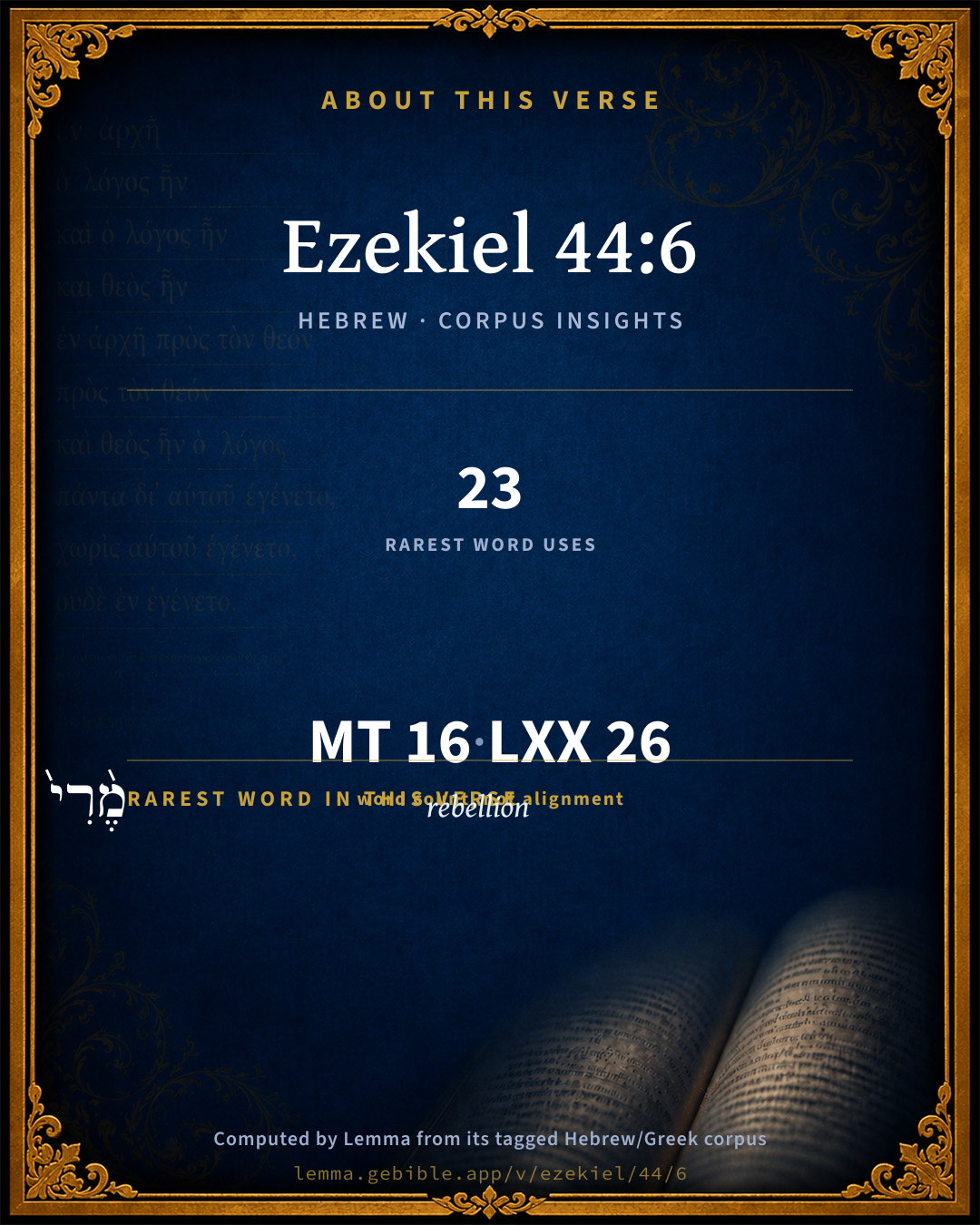
16
words
11
distinct lemmas
Prophets
section

Notable vocabulary

The rarest word here is מֶ֨רִי֙ rebellion H4805 — appearing just 23 times in the whole Hebrew Bible.

Shared distinctive vocabulary

מֶ֨רִי֙ rebellion H4805 occurs in 21 verses of the Hebrew Bible. Also found in:

Grammatical profile

  • 2 verbs
  • 9 nouns
  • 1 adjective
  • 3 prepositions
  • 1 adverb

Verb forms

  • וְאָמַרְתָּ֤ Qal · Sequential Perfect
  • אָמַ֖ר Qal · Perfect

Repetition

Words recur within this verse — often emphatic in Hebrew:

  • וְאָמַרְתָּ֤ to say H559 ×2
  • בֵּ֣ית house H1004 ×2
  • יִשְׂרָאֵ֔ל Israel H3478 ×2
  • אֶל to H413 ×2

Hebrew & Septuagint length

In English translation the verse runs 28 words from the Hebrew and 33 from the Septuagint (LXX English) — closely comparable.

A rough comparison of the two English renderings, which tokenize alike — not a word-level alignment.

Word counts can differ between the Hebrew and the Greek without any difference in meaning — e.g. the Hebrew direct-object marker אֵת has no separate Greek word, and Greek often adds the article ὁ.

In the original languages it is 16 Hebrew tokens and 26 Greek tokens — but the two are counted differently (Hebrew bundles its prefixes and suffixes into one token; the Greek is in lemma form), so that isn’t a like-for-like length.

Cross-references

5

Topical passages linked to Ezekiel 44:6 in the Treasury of Scripture Knowledge — connected by theme and wording, ordered by reader-vote popularity; previews shown in the World English Bible.

  • Ezekiel 3:9 As an adamant harder than flint have I made your forehead: don't be afraid of them, neither be dismayed at their looks, though they are a rebellious house.
  • Ezekiel 45:9 Thus says the Lord Yahweh: Let it suffice you, princes of Israel: remove violence and spoil, and execute justice and righteousness; dispossessing my people, says the Lord Yahweh.
  • 1 Peter 4:3 For we have spent enough of our past time doing the desire of the Gentiles, and having walked in lewdness, lusts, drunken binges, orgies, carousings, and abominable idolatries.
  • Ezekiel 2:5–8 They, whether they will hear, or whether they will forbear, (for they are a rebellious house), yet shall know that there has been a prophet among them.
  • Ezekiel 3:26–27 and I will make your tongue cleave to the roof of your mouth, that you shall be mute, and shall not be to them a reprover; for they are a rebellious house.

Cross-references courtesy of OpenBible.info (CC BY 4.0).

Hebrew and Greek witnesses Masoretic Hebrew ↔ Greek Septuagint

The same verse in the two great witnesses to the Old Testament, shown verse-for-verse.

These are two independent witnesses, not word-aligned to each other, and the Septuagint is shown in lemma (dictionary) form.

Hebrew Ezekiel 44:6 Masoretic · Westminster Leningrad Codex

וְאָמַרְתָּ֤ אֶל מֶ֨רִי֙ אֶל בֵּ֣ית יִשְׂרָאֵ֔ל כֹּ֥ה אָמַ֖ר אֲדֹנָ֣י יְהוִ֑ה רַב לָכֶ֛ם מִֽכָּל תּוֹעֲבֽוֹתֵיכֶ֖ם בֵּ֥ית יִשְׂרָאֵֽל

You shall tell the rebellious, even to the house of Israel, Thus says the Lord Yahweh: you house of Israel, let it suffice you of all your abominations,

World English Bible · Public Domain

Greek LXX Ezekiel 44:6 Septuagint · lemma form

καί εἶπον πρός ὁ οἶκος ὁ παραπικραίνω πρός ὁ οἶκος ὁ ἰσραήλ ὅδε λέγω κύριος ὁ θεός ἱκανόω σύ ἀπό πᾶς ὁ ἀνομία σύ οἶκος ἰσραήλ

And you shall say to the provoking house, even to the house of Israel, Thus says the Lord God; Let it suffice you to have committed all your iniquities, O house of Israel!

LXX2012 (modern English Septuagint) · Public Domain

Hebrew: Westminster Leningrad Codex (CC BY 4.0). Greek: Septuagint (public domain); English from LXX2012 (modern English Septuagint) (Public Domain). How the Septuagint differs from the Hebrew →

Targum (Aramaic paraphrase)

1

The Targum is the ancient Jewish Aramaic paraphrase of the Hebrew Scriptures — an interpretive translation, not the Hebrew text itself. Onkelos (literal) and Pseudo-Jonathan (expansive) render the Torah, and Jonathan the Prophets. Coverage is partial: where no permissively-licensed English translation exists for a verse, only the Aramaic is shown. This is verse-level text, not a word-by-word alignment to the Hebrew.

  1. Targum Jonathan Prophets (Joshua–Malachi)
    וְתֵימַר לְעַמָא סַרְבָנָא לִדְבֵית יִשְׂרָאֵל כִּדְנַן אֲמַר יְיָ אֱלֹהִים סַגִי לְכוֹן מִכָּל תּוֹעֲבַתְכוֹן בֵּית יִשְׂרָאֵל:

    (no public-domain English translation for this verse)

    Targum Jonathan — Aramaic: “Mikraot Gedolot” (public domain). English: “Sefaria Community Translation” (CC0 1.0 (public-domain dedication)); “London "Chaldee Paraphrase," 1871” (public domain). Text via Sefaria.

Commentary

Notes on Ezekiel 44:6 from classic Christian and Jewish commentators (each source and its license shown beneath its notes). The classic Christian expositions comment on the surrounding passage and are grouped to its opening verse, so a note may address several verses; the Jewish commentaries on the Tanakh (Rashi and others) are per-verse, so they appear only where the commentator wrote on this verse.

Lemma curates 59 commentaries, every one of them public domain or Creative Commons licensed, each selected and text-cleaned for this edition rather than reprinted as found. About our sources →

Trapp's Complete Commentary

John Trapp

Eze 44:6 And thou shalt say to the rebellious, [even] to the house of Israel, Thus saith the Lord GOD; O ye house of Israel, let it suffice you of all your abominations,

Ver. 6. And thou shalt say to the rebellious.] Heb., To rebellion. Vulgate, To the exasperating house.

Let it suffice you.] Ye have sinned enough, and more than enough. {1Pe 4:3} Now that I have set you up a new temple, turn over a new leaf for shame; {as Eze 43:10} when shall it once be? {Jer 13:27}

John Trapp, A Commentary or Exposition upon All the Books of the Old and New Testament (1647–1656) — public domain. Text from a community e-Sword module.

Tyndale Open Study Notes

Tyndale Open Resources

44:6-8 The people of Israel were called rebels because they had failed to control access to the sanctuary in the past; they had hired uncircumcised foreigners to come into the sanctuary and probably employed them as Temple guards and gatekeepers. This task should not have been delegated to foreigners; it should have been performed by the Levites, whom the Lord had assigned to perform it (cp. 44:10).

Tyndale Open Study Notes — © Tyndale Open Resources, licensed CC BY-SA 4.0. Text via the HelloAO Bible API.

The Cambridge Bible for Schools and Colleges

gen. ed. J. J. S. Perowne

6. The “rebellious,” lit. rebellion, a term frequently used in ch. 1–24 (e.g. Eze_2:5, Eze_3:9, Eze_12:2, Eze_17:12, Eze_24:3), but dropped since the fall of the city. Recollection of the former abominations practised in the sanctuary again brings it to the prophet’s lips.

The Cambridge Bible for Schools and Colleges (gen. ed. J. J. S. Perowne; Cambridge University Press, 1878–1918) — public domain. Text from a community e-Sword module.

John Gill's Exposition

And thou shalt say to the rebellious, even to the house of Israel,.... This is a character of literal Israel from the beginning, Deu 9:24, and frequently given it in this prophecy, Eze 2:2, Eze 3:9 and well agrees with these declining churches in the latter day, and even in our times; it represents them as rebellious, because of their disregard to the ordinances of God's house, and to the laws and rules of it; and are not only called "rebellious", but "rebellion" (g) itself; expressive of the greatness of their sin, and the aggravations of it:

thus saith the Lord God, O ye house of Israel, let it suite you of all your abominations; that is, let the abominations you have committed, will worship and superstition, paying a regard to the doctrines and commandments of men, be sufficient; stop and proceed no further; relinquish those things which are so abominable in my sight; let the time past suffice to have wrought them; cease entirely from them; see Pe1 4:3, these abominations are more particularly expressed in the following words.

(g) "ad inobedientiam", Cocceius, Starckius.

John Gill's Exposition of the Whole Bible (1746–1763) — public domain (CC PDM 1.0). Text via the HelloAO Bible API.

Matthew Poole's English Annotations

The rebellious: see Eze 2:3,6-8.

Let it suffice you; let the time you have spent on your sins, your many great sins and abominations, let it be thought enough, nay, too much, as 1Pe 4:3; do so no more.

Matthew Poole's English Annotations on the Holy Bible (1683–1685) — public domain. Text from a community e-Sword/MySword module.

Whedon's Commentary on the Bible

Daniel D. Whedon

6. The rebellious — Perhaps it was the remembrance of the vision of sin which he had once before seen as he stood in this north gate (chap. viii) which led to this sharp personal reference. The old unrepentant Israel in the old Jerusalem was often called rebellious (Eze_2:5; Eze_3:9; Eze_12:2, etc.), but the new Israel of the new Jerusalem now being described was perfectly obedient and holy. The slipping in of this term here shows that every item of this description was intended to be a lesson to the captives who surrounded Ezekiel.

Daniel D. Whedon (gen. ed.), Commentary on the Old and New Testaments (1874–1909) — public domain. Text from a community e-Sword module.

The Pulpit Commentary

Let it suffice you of all your abominations. It was not without sights canoe that at the north gate, which had formerly been represented as the scene of Israel"s idolatries, (Eze_8:5) the prophet should be reminded of those past iniquities of his nation, and receive instructions as to how the new community should be preserved from lapsing into similar transgressions.

A sufficiency of sin.

I OBSERVE IN WHAT THE SUFFICIENCY OF SIN CONSISTS. All sin is in excess of what it should be, for no sin is permissible. How, then, can there be such a thing as a sufficiency of it? We may regard this as an ironical idea, or as a thought that is useful in the argumentum ad hominem. It is as though a man had said he must have some sin, and now the question is raised Has he not had enough? Those who sin greatly may be said to have had more than enough to have attained what St. James calls "a superfluity of naughtiness". (Jam_1:21) The sufficiency of sin may be tested in three ways.

1. By its magnitude. What more can the sinner desire? Would he still add to his enormous pile of guilt? Surely no mortal man could crave a heavier account.

2. By its fruits. The pleasures of sin soon cloy, and the foolish slave of vice has to turn from one to another form of evil to whet his jaded appetite. One would have thought that he had got his surfeit. Is there yet more pleasure to be extracted from the rotten root of sin? Certainly the more it is drawn upon the less really enjoyable are its products.

3. By its penalties. All this tin must be paid for, and the time of reckoning is at hand. Is not the sin already committed enough to have to answer for? It will be a heavy account as it is, if no more be added.

II CONSIDER HOW THE SUFFICIENCY OF SIN IS TO BE TREATED.

1. It should not be increased. It is great enough; let us add no more to it. This awful tale of guilt can never be met; it would be madness to proceed still further in piling up accusations against one"s self.

2. It should be regarded with profound penitence. There are not many things of which the sinner is full. In regard to his better nature he seems to be a helpless bankrupt. Indeed, he has but one perfect thing his sin. He is rich only in one commodity wickedness. Surely the consciousness of such a state of affairs should overwhelm him with grief and shame.

3. It should be brought to God for pardon. Man cannot undo the past, nor can he compensate for the many misdeeds he has committed. Were his sin but small, it would still be impossible for him to atone for it. With a fullness of sin to account for, there can be no possibility for hope in man alone. But great as man"s sin is, the love of God is even greater. Heavy as is his guilt, the merits of Christ outweigh it all. Thanks be to God, the sufficiency of man"s sin is met by the sufficiency of Christ"s atonement. The sin was great to require the death of the Son of God; but since Christ has died for it, the supreme work of redemption has been accomplished. Even a surfeit of past sin is now no barrier to God"s full pardon of his penitent children.

The Pulpit Commentary (1880–1919), ed. H.D.M. Spence-Jones & Joseph S. Exell — public domain. Text from a community e-Sword module.

John Wesley's Explanatory Notes

Let it suffice - Let the time you have spent on your sins suffice.

John Wesley, Explanatory Notes Upon the Whole Bible (1754–1765) — public domain. Text via the GEBible commentary corpus.

unfoldingWord translationNotes

Door43 World Missions Community

the house of Israel

The word "house" is a metonym for the family that lives in the house, in this case the Israelites, the descendants of Jacob over many years. See how you translated this in Ezekiel 3:1. AT: "the Israelites" or "the Israelite people group" (See: Metonymy)

Let all of your disgusting actions be enough for you

"Your disgusting actions have been more than enough for you" or "You have done far too many disgusting deeds"

disgusting actions

See how you translated this in Ezekiel 5:9.

translationWords

rebel

Israel

Lord Yahweh

alien

circumcise

flesh

sanctuary

profane

bread

blood

covenant

unfoldingWord translationNotes — © Distant Shores Media and the Door43 World Missions Community, licensed CC BY-SA 4.0. Source: git.door43.org/Door43/en_tn.

Lesson kit

Teaching starters — assembled from the data on this page, not authored interpretation. Every prompt links to the verse data it draws on. Edit before teaching.

Ezekiel, in the Prophets, opens this verse with 16 words (11 distinct Hebrew lemmas). Its most distinctive word is mᵉrîy (“rebellion”). A historical commentator’s framing appears above. Read the whole chapter for the surrounding context.

Discussion questions

  1. How does “rebellion” (mᵉrîy) shape what this verse is saying?
  2. How does Numbers 17:10, which shares the word «rebellion», read alongside this verse?
  3. What does the repetition of “to say” (2× in this one verse) do in this verse?
  4. The translations on this page render this verse differently — a whole-verse word diff, not a word-by-word alignment. What might account for the different wordings?
  5. «וְאָמַרְתָּ֤» is a Qal Sequential Perfect verb. How does that grammatical form shape the action described?
  6. Compare how Trapp's Complete Commentary and Tyndale Open Study Notes read this verse. Where do they agree or differ?

Things to notice

Reading settings

Reading text

Shown beneath each verse's original-language words.

Old Testament
Old Testament edition

Read the OT as the Masoretic Hebrew (MT) or the Greek Septuagint (LXX).

English shown for the Greek Septuagint (in the Hebrew ↔ Greek comparison).

Comparing translations? Open the Compare panel on any verse page to stack up to four side by side.