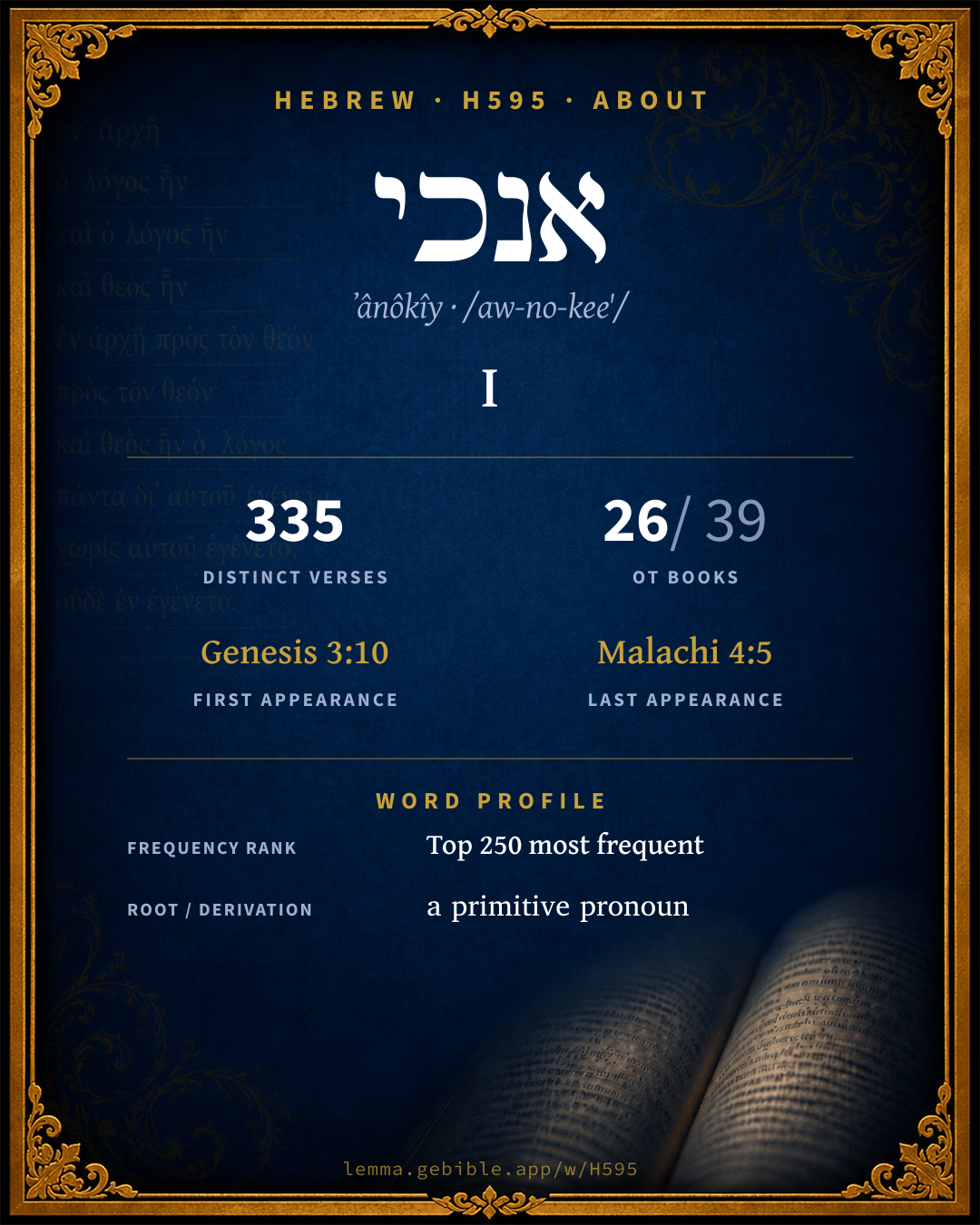
אָֽנֹכִ֫י
I
Full lexicon entry — Brown-Driver-Briggs (BDB)
From Brown-Driver-Briggs (BDB)
Where this word appears
Grammar key — what these labels mean
Part of speech
- Pronoun
- A word standing in for a noun (“he,” “this,” “who”).
Person
- 1st Person
- The speaker (“I / we”).
Gender
- Common
- Either gender — not distinguished for this form.
Number
- Singular
- One.
Every verse where H595 appears in the Book of 1 Samuel — 26 distinct verses. Click any verse to open its interlinear word-by-word view. Verse text shown in the World English Bible for context — . Each verse’s Hebrew form is shown with its reference; the English is not keyword-highlighted, since the data carries no word-level English alignment. Use “Compare translations” on any verse to read it across multiple English versions. This concordance covers the Hebrew Bible; Septuagint (Greek Old Testament) occurrences are not indexed here.
1 Samuel
- 1 Samuel 1:8 אָֽנֹכִי֙ pron pers 1cs Elkanah her husband said to her, Hannah, why weep you? and why don't you eat? and why is your heart grieved? am I not better to you than ten sons?
- 1 Samuel 1:15 אָנֹ֔כִי pron pers 1cs Hannah answered, No, my lord, I am a woman of a sorrowful spirit: I have drunk neither wine nor strong drink, but I poured out my soul before Yahweh.
- 1 Samuel 1:28 אָנֹכִ֗י pron pers 1cs therefore also I have granted him to Yahweh; as long as he lives he is granted to Yahweh. He worshiped Yahweh there.
- 1 Samuel 2:23 אָנֹכִ֤י pron pers 1cs He said to them, Why do you such things? for I hear of your evil dealings from all this people.
- 1 Samuel 2:24 אָנֹכִ֣י pron pers 1cs No, my sons; for it is no good report that I hear: you make Yahweh's people to disobey.
- 1 Samuel 3:11 אָנֹכִ֛י pron pers 1cs Yahweh said to Samuel, Behold, I will do a thing in Israel, at which both the ears of everyone who hears it shall tingle.
- 1 Samuel 4:16 אָֽנֹכִי֙ pron pers 1cs The man said to Eli, I am he who came out of the army, and I fled today out of the army. He said, How went the matter, my son?
- 1 Samuel 9:19 אָנֹכִ֣י pron pers 1cs Samuel answered Saul, and said, I am the seer; go up before me to the high place, for you shall eat with me today: and in the morning I will let you go, and will tell you all that is in your heart.
- 1 Samuel 9:21 אָ֨נֹכִי֙ pron pers 1cs Saul answered, Am I not a Benjamite, of the smallest of the tribes of Israel? and my family the least of all the families of the tribe of Benjamin? why then speak you to me after this manner?
- 1 Samuel 10:8 אָֽנֹכִי֙ pron pers 1cs You shall go down before me to Gilgal; and, behold, I will come down to you, to offer burnt offerings, and to sacrifice sacrifices of peace-offerings: seven days shall you wait, until I come to you, and show you what you shall do.
- 1 Samuel 10:18 אָנֹכִ֛י pron pers 1cs and he said to the children of Israel, Thus says Yahweh, the God of Israel, I brought up Israel out of Egypt, and I delivered you out of the hand of the Egyptians, and out of the hand of all the kingdoms that oppressed you:
- 1 Samuel 12:23 אָנֹכִ֗י pron pers 1cs Moreover as for me, far be it from me that I should sin against Yahweh in ceasing to pray for you: but I will instruct you in the good and the right way.
- 1 Samuel 15:14 אָנֹכִ֖י pron pers 1cs Samuel said, What means then this bleating of the sheep in my ears, and the lowing of the oxen which I hear?
- 1 Samuel 16:3 וְ/אָֽנֹכִ֗י conj + pron pers 1cs Call Jesse to the sacrifice, and I will show you what you shall do: and you shall anoint to me him whom I name to you.
- 1 Samuel 17:8 אָנֹכִ֣י pron pers 1cs He stood and cried to the armies of Israel, and said to them, Why are you come out to set your battle in array? am I not a Philistine, and you servants to Saul? choose you a man for you, and let him come down to me.
- 1 Samuel 17:43 אָנֹ֔כִי pron pers 1cs The Philistine said to David, Am I a dog, that you come to me with sticks? The Philistine cursed David by his gods.
- 1 Samuel 17:45 וְ/אָנֹכִ֣י conj + pron pers 1cs Then said David to the Philistine, You come to me with a sword, and with a spear, and with a javelin: but I come to you in the name of Yahweh of hosts, the God of the armies of Israel, whom you have defied.
- 1 Samuel 18:18 אָֽנֹכִי֙ pron pers 1cs David said to Saul, Who am I, and what is my life, [or] my father's family in Israel, that I should be son-in-law to the king?
- 1 Samuel 18:23 וְ/אָנֹכִ֖י conj + pron pers 1cs Saul's servants spoke those words in the ears of David. David said, Seems it to you a light thing to be the king's son-in-law, seeing that I am a poor man, and lightly esteemed?
- 1 Samuel 20:5 וְ/אָנֹכִ֛י conj + pron pers 1cs David said to Jonathan, Behold, tomorrow is the new moon, and I should not fail to sit with the king at meat: but let me go, that I may hide myself in the field to the third day at evening.
- 1 Samuel 20:36 אָנֹכִ֖י pron pers 1cs He said to his boy, Run, find now the arrows which I shoot. As the boy ran, he shot an arrow beyond him.
- 1 Samuel 21:2 אָנֹכִ֥י pron pers 1cs David said to Ahimelech the priest, The king has commanded me a business, and has said to me, Let no man know anything of the business about which I send you, and what I have commanded you: and I have appointed the young men to such and such a place.
- 1 Samuel 22:22 אָנֹכִ֣י pron pers 1cs David said to Abiathar, I knew on that day, when Doeg the Edomite was there, that he would surely tell Saul: I have occasioned [the death] of all the persons of your father's house.
- 1 Samuel 23:17 וְ/אָנֹכִ֖י conj + pron pers 1cs He said to him, Don't be afraid; for the hand of Saul my father shall not find you; and you shall be king over Israel, and I shall be next to you; and that also Saul my father knows.
- 1 Samuel 24:4 אָנֹכִ֜י pron pers 1cs The men of David said to him, Behold, the day of which Yahweh said to you, Behold, I will deliver your enemy into your hand, and you shall do to him as it shall seem good to you. Then David arose, and cut off the skirt of Saul's robe secretly.
- 1 Samuel 30:13 אָנֹ֗כִי pron pers 1cs David said to him, To whom belong you? and whence are you? He said, I am a young man of Egypt, servant to an Amalekite; and my master left me, because three days ago I fell sick.
About this entry
At a glance — auto-summarized from this page’s data, not written by a person. Every figure links to its source below. This summary describes the numbers; it doesn’t interpret them.
אנכי (ʼânôkîy) is a Hebrew name most often rendered “I.” It first appears in Genesis 3:10. It turns up in 335 verses across 26 books, a common footprint. The sections below give every occurrence and version rendering.
Gloss history
Strong's 1890 vs modern scholarship
About this word
Strong's H595 catalogs a Hebrew word from the Hebrew Old Testament.
These counts are not copied from any lexicon or concordance. They are computed here, from the morphology-tagged Hebrew Old Testament. What Lemma adds →
- 335
- distinct verses
- The word appears in 335 distinct verses.
- 26 / 39
- OT books
- The word appears in 26 of 39 Old Testament books.
- #138
- by frequency
- Top 250 most frequent Hebrew words (rank 138 of 8,640 Hebrew words by occurrence).
View all 335 occurrences in the concordance →
Most concentrated in
- Deuteronomy 55 verses 16%
- Genesis 53 verses 16%
- Jeremiah 34 verses 10%
By section of the Old Testament
By traditional corpus
Conventional, traditional groupings — biblical authorship is debated, so this is a traditional corpus grouping, not an authorship claim. Each share is this word’s portion of its verses in that division of the Hebrew canon. Each figure is a share of the word’s 335 distinct verses.
- Prophets (Nevi'im) 162 verses · 48%
- Torah (Pentateuch) 135 verses · 40%
- Writings (Ketuvim) 38 verses · 11%
How translations render this word
Counts come from each version’s own published word-to-Strong’s tagging or interlinear alignment — an approximate guide to how each version renders this word, not a word-level alignment the data otherwise carries. Because each total is that version’s own tagged count, the per-version totals vary from one another and need not match the appearance or distinct-verse counts above. These counts may also differ from a printed concordance because Lemma counts each distinctly tagged rendering and does not collapse phrase taggings into a single head-word total. This is a fixed set of word-tagged versions (KJV, ASV, BSB, ULT) and does not change with the reading translation you choose elsewhere. Each version’s license is shown beside its name below (and on Sources).
BDB lists this Strong’s number as 2 distinct words (homographs). Each count above pools all of them and is not split by sense — see the Senses section below. A low-frequency rendering may belong to a different one of those words, not the primary meaning.
- King James Version†: I 1×, Moreover as for me 1×, Which 1×
- American Standard Version†: I 1×, Moreover as for me 1×, Who 1×
- Berean Standard Bible†: I 284×, I am 21×, Am i 12×
- unfoldingWord Literal Text†: I 280×, Myself 21×, I am 17×
King James Version Public Domain
Renders H595 across 3† tagged occurrences — most commonly:
American Standard Version Public Domain
Renders H595 across 3† tagged occurrences — most commonly:
Berean Standard Bible Public Domain
Renders H595 across 351† tagged occurrences — most commonly:
Plus 13 renderings that appear only once — usually multi-word phrases or single function words the recovered tagging swept in, not distinct renderings. Not rendered by a distinct English word in 7 further occurrences.
unfoldingWord Literal Text CC BY-SA 4.0
Renders H595 across 371† tagged occurrences — most commonly:
Plus 12 renderings that appear only once — usually multi-word phrases or single function words the recovered tagging swept in, not distinct renderings.
Senses in the full BDB
What do BDB’s symbols mean?
BDB uses these scholarly abbreviations:
| Symbol | Meaning |
|---|---|
| 𝔊 | the Septuagint (the ancient Greek translation, LXX) |
| 𝔙 | the Vulgate (the Latin translation) |
| 𝔖 | the Syriac version (the Peshitta) |
| 𝔗 | the Targum (the Aramaic translation) |
| ψ | the Psalms |
| √ | root (the underlying root or stem) |
| ‖ | parallel passage (a synonymous or contrasted parallel) |
| † | the dagger: every passage where the word occurs is cited |
The 0 senses and sub-senses the full Brown-Driver-Briggs lexicon distinguishes for this word, in lexicon order (not ranked by frequency), with BDB’s own verbatim wording and sub-sense lettering. Shown in Hebrew script with BDB’s own scholarly abbreviations. The condensed entry is in the Lexicon Entry tab. See also the Forms in the corpus table below.
אנכי I (once Jb 33
אנכי II on. 1 sg. v. supr. sub אֲנִי.
Senses from the full Brown-Driver-Briggs lexicon (Brown, Driver, Briggs; Oxford 1906 — public domain), digitized via Sefaria, supplemented by the OpenScriptures HebrewLexicon (CC BY 4.0). Full attribution on Sources.
Word origin
I. (once Jb 33:9 אָֽנֹכִ֑י) pron. 1 s. comm. I; Gn 3:10; 7:4; 15:1, 2; 16:5 + often With הֲ, הֶאָנֹכִי †Nu 11:12 Jb 21:4. (Assyrian anâku, Ph. & Moab. אנך: not in Arabic Aramaic Ethiopic; but ku appears as the affix of the 1 s. in the Ethiopic verb (e.g. waladkū = Heb. יָלַדְתִּי). אָנֹכִי and אֲנִי appear to be two parallel formations (both containing the element ani [cf. the sf. -نِيَ, -נִי] or ana, & one strengthened by the addition of the demonst. basis ku [prob. akin to ܟܳܐ כָּא, כֹּה here]: cf. Sta§ 179 WSG 95 f. 98–101), of which, in most of the Sem. languages, one prevailed to the exclusion of the other, but which in Heb. maintained their place side by side.) In some cases אני and אנכי appear capable of being used indifferently; in others the choice seems to have been determined, partly by rhythmical considerations, partly by a growing preference for אֲנִי among later writers. Thus when appended to the verb for emph. (whether with or without גַּם) the lighter form אֲנִי is nearly always used (Lv 20:5; 26:24, 32; Dt 12:30; Ju 1:3; 8:23; 2 S 12:28; 17:15; 18:2, 22; Je 17:18; 21:5; Ez 17:22; Jb 13:2 +; cf. the cases Gn 27:34 1 S 25:24 2 S 19:1 1 K 1:26 Pr 23:15); on the contrary, in the emph. rhetorical style of Dt, אָנֹכִי is preferred (in the discourses, uniformly, except 12:30, in acc. with usage just noted, & 29:5 in a standing expression; on 32:49, 52 (P) cf. infr.) In partic. phrases, also, usage prefers sometimes. אני, sometimes אנכי; thus there occurs חַי־אָנִי Nu 14:21 & always, except Dt 32:40; (אָ֑נִי) אִתְּךָ אֲנִי Je 1:8, 19; 30:11; 46:18; Is 43:2, 5); אֲנִי יהוה Ex 6:2, 6–8 & elsewhere in P, & especially freq. in H (Lv 18:2, 4, 6 etc.) & Ez, also Gn 15:7; 28:13; Dt 29:5 Ju 6:10 +; (אנכי יהוה much less freq.; only JE & proph. writers, †Ex 20:2 = Dt 5:6, Ho 12:10; 13:4 ψ 81:11, Ex 20:5 = Dt 5:9, Is 43:11; 44:24; 51:15 (Ex 4:11 is diff.) cf. DrJPh. xi. 224 f.); אני אמרתי Is 38:10; (Hez.) 49:4; Je 5:4; 10:19 (3:19 אנכי) Ru 4:4 ψ 30:7; 31:23; 41:5; 82:6 +; ויאמר אָ֑נִי (in reponse to a qu.) Gn 27:24 Ju 13:11 2 S 20:17 1 K 13:14; 18:8 (וי׳ אנכי only 2 S 2:20; on the contrary, with a predicate, אָנֹכִי is regularly employed, Gn 24:34 1 S 30:13 2 S 1:8 עֲמָלֵקִי אָנֹ֑כִי 11:5; 20:17; Is 6:5; Je 1:6; Jon 1:9); (הִנְנִי) וַאֲנִי הִנֵּה Gn 6:17; 9:9; Ex 31:6; Nu 3:12 + (but הִנֵּה אָנֹכִי Gn 24:13, 43; 25:32; Ex 3:13; 19:9 +; הִנֵּה אֲנִי is very uncommon; v. ib. 226). So far as the usage of partic. books is concerned, in the Pent. (except Dt) אֲנִי is used in P (incl. H) always (about 130 times) except Gn 23:4 (cf. Ez below); in JE אנכי is preferred, though not exclusively (81: 48). In S there are 50 instances of each form. Je has some 54 instances of אני, 37 of אנכי. In later books the preponderance of אֲנִי is evident. Thus in Ez אני occurs 138 times, אנכי once 36:28 (perhaps a reminiscense of Je 11:4b; 24:7; 30:22); in La Hg Ezr Est Ec אני 45 times, אנכי never; in Ch אני 30 times, אנכי once 1 Ch 17:1 (from 2 S 7:2); in Dn אני 23 times, אנכי once 10:11. Vid. more fully GiesebrechtZAW 1881, 251–8 Drl.c. 222–7.
I. pron. 1 sg. v. supr. sub אֲנִי.
— Brown-Driver-Briggs (Oxford 1906, public domain), digitized via Sefaria, supplemented by the OpenScriptures HebrewLexicon (CC BY 4.0). See Sources.
Origin: a primitive pronoun
Jastrow Dictionary
A second Hebrew/Aramaic lexicon for comparison, covering Aramaic and post-biblical (Talmudic, Targumic, Midrashic) usage that the biblical-Hebrew BDB does not. Matched by lemma rather than by Strong’s number, so a lemma may carry more than one Jastrow headword (shown separately below), and the entries cover usage well beyond the Bible.
אָנֹכִי
- v. אֲנָךְ II; cmp. אִינָּךְ) I. Pesik. R. s. 21, v. אָנוֹךְ. Sabb. 105ᵃ א׳ נוטריקון anokhi may be interpreted as an acrostichon א̇נא נֹפשי כ̇תבית י̇הבית I myself have written, have given (the Law). Pesik. Baḥod. p. 109ᵇ; v. אָנוֹךְ.—Pl. אֲנַחְנוּ, נַחְנוּ. Ber. 14ᵇ; a. fr. V. אֲנִי, אָנוּ.
נְכֵי
- to deduct. Targ. Y. Lev. XXVII, 18.—Y. Sot. V, 20ᶜ bot.; Y. Ber. IX, 14ᵇ bot. אנא מְנַכֵּי, v. הַנְכָּיָה. Sabb. 140ᵃ מְנַכּוּ, v. זְכוּתָא. B. Kam. 97ᵇ, sq. אי מחמת … מְנַכִּינָן ליה וכ׳ if provisions have become cheaper in consequence of the increased weight of the coin, we impose upon the creditor a corresponding reduction of the debt &c.; a. fr.
- to be injured, suffer. Y. Ab. Zar. II, 41ᵈ top אשתון … ואִנְּכוּן the first drank and did not die, but were sick; ib. ולא מייתין אינכון read ואִי׳; (Y. Ter. VIII, 45ᵈ bot. only מייתין). Y. Dem. I, 22ᵃ top ולא אנכון and they suffered no more (from mice). Ib. יעבור ולא מִנְּכָה let him cross, he shall not be injured. Y. Keth. XII, 35ᵇ top כל הן דהוא מהו מִנְּכֵי wherever he be buried, what does he lose (what difference does it make to him)?; Y. Kil. IX, 32ᶜ top טנכי (corr. acc.).
- to harm. Y. Sabb. III, 6ᵃ bot. (in Hebr. dict.) ומַכֵּי הוא לה כלום can he harm her in any manner?; Y. Bets. II, 61ᶜ
A Dictionary of the Targumim, the Talmud Babli and Yerushalmi, and the Midrashic Literature (Marcus Jastrow; London, Luzac, 1903) — Public Domain. Digitized via Sefaria. Digitized via Sefaria. Full attribution on Sources.
Forms in the corpus
The 47 distinct written forms H595 takes in the Hebrew Bible, most frequent first — each parse links to that state’s occurrences in the concordance. Hebrew forms include their vowel points and cantillation, so a single lemma takes many written forms.
| Form | Parsing | Example | Uses |
|---|---|---|---|
| אָנֹכִ֖י | Pronoun, Personal, 1st Person, Common, Singular | Deuteronomy 4:2 | 40 |
| אָנֹכִ֥י | Pronoun, Personal, 1st Person, Common, Singular | Amos 2:13 | 35 |
| אָנֹכִ֛י | Pronoun, Personal, 1st Person, Common, Singular | Deuteronomy 4:8 | 25 |
| אָנֹכִ֣י | Pronoun, Personal, 1st Person, Common, Singular | Deuteronomy 6:2 | 25 |
| אָֽנֹכִי֙ | Pronoun, Personal, 1st Person, Common, Singular | Amos 6:8 | 23 |
| אָנֹכִ֤י | Pronoun, Personal, 1st Person, Common, Singular | Deuteronomy 4:40 | 16 |
| וְ/אָנֹכִ֖י | Pronoun, Personal, 1st Person, Common, Singular | Deuteronomy 31:23 | 15 |
| אָנֹכִ֜י | Pronoun, Personal, 1st Person, Common, Singular | Amos 5:1 | 14 |
| אָנֹכִי֙ | Pronoun, Personal, 1st Person, Common, Singular | Deuteronomy 4:2 | 13 |
| אָנֹכִ֗י | Pronoun, Personal, 1st Person, Common, Singular | Deuteronomy 29:14 | 12 |
| וְ/אָנֹכִ֣י | Pronoun, Personal, 1st Person, Common, Singular | Hosea 7:13 | 12 |
| אָנֹֽכִי | Pronoun, Personal, 1st Person, Common, Singular | Exodus 4:10 | 11 |
| אָנֹכִ֞י | Pronoun, Personal, 1st Person, Common, Singular | Deuteronomy 5:9 | 11 |
| אָנֹ֑כִי | Pronoun, Personal, 1st Person, Common, Singular | Amos 7:14 | 10 |
| אָנֹ֔כִי | Pronoun, Personal, 1st Person, Common, Singular | Amos 7:14 | 10 |
| אָנֹכִ֧י | Pronoun, Personal, 1st Person, Common, Singular | Deuteronomy 6:6 | 7 |
| אָנֹכִ֨י | Pronoun, Personal, 1st Person, Common, Singular | Daniel 10:11 | 7 |
| וְ/אָנֹכִ֛י | Pronoun, Personal, 1st Person, Common, Singular | Amos 2:10 | 7 |
| וְ/אָנֹכִ֗י | Pronoun, Personal, 1st Person, Common, Singular | Deuteronomy 31:18 | 6 |
| וְ/אָ֣נֹכִ֔י | Pronoun, Personal, 1st Person, Common, Singular | Ezekiel 36:28 | 5 |
| אָנֹכִ֕י | Pronoun, Personal, 1st Person, Common, Singular | Genesis 26:24 | 4 |
| אָנֹכִי֩ | Pronoun, Personal, 1st Person, Common, Singular | Amos 4:7 | 4 |
| וְ/אָֽנֹכִי֙ | Pronoun, Personal, 1st Person, Common, Singular | 1 Kings 3:7 | 4 |
| אָ֝נֹכִ֗י | Pronoun, Personal, 1st Person, Common, Singular | Job 9:35 | 3 |
| אָ֭נֹכִֽי | Pronoun, Personal, 1st Person, Common, Singular | Job 29:16 | 3 |
| אָנֹ֖כִי | Pronoun, Personal, 1st Person, Common, Singular | Amos 7:14 | 3 |
| אָנֹ֗כִי | Pronoun, Personal, 1st Person, Common, Singular | Exodus 4:10 | 3 |
| אָנֹכִי֮ | Pronoun, Personal, 1st Person, Common, Singular | Exodus 34:10 | 3 |
| וְ/אָנֹכִ֥י | Pronoun, Personal, 1st Person, Common, Singular | 2 Samuel 12:7 | 3 |
| וְ/אָנֹכִ֨י | Pronoun, Personal, 1st Person, Common, Singular | 2 Samuel 3:39 | 3 |
| וְ/אָנֹכִי֙ | Pronoun, Personal, 1st Person, Common, Singular | Exodus 4:12 | 3 |
| אָ֠נֹכִי | Pronoun, Personal, 1st Person, Common, Singular | Deuteronomy 5:5 | 2 |
| אָֽנֹכִ֖י | Pronoun, Personal, 1st Person, Common, Singular | Exodus 20:2 | 2 |
| וְ/אָ֨נֹכִ֜י | Pronoun, Personal, 1st Person, Common, Singular | Amos 2:9 | 2 |
| אָ֨נֹכִי֙ | Pronoun, Personal, 1st Person, Common, Singular | 1 Samuel 9:21 | 1 |
| אָֽנֹכִ֛י | Pronoun, Personal, 1st Person, Common, Singular | Deuteronomy 4:1 | 1 |
| אָנֹ֘כִי֮ | Pronoun, Personal, 1st Person, Common, Singular | 2 Samuel 3:8 | 1 |
| אָנֹכִ֑י | Pronoun, Personal, 1st Person, Common, Singular | Job 33:9 | 1 |
| אָנֹכִ֡י | Pronoun, Personal, 1st Person, Common, Singular | Jeremiah 50:9 | 1 |
| אָֽנֹכִ֗י | Pronoun, Personal, 1st Person, Common, Singular | Judges 5:3 | 1 |
| אָֽנֹכִ֞י | Pronoun, Personal, 1st Person, Common, Singular | Exodus 20:5 | 1 |
| הֶ/אָנֹכִ֣י | Pronoun, Personal, 1st Person, Common, Singular | Numbers 11:12 | 1 |
| הֶ֭/אָנֹכִי | Pronoun, Personal, 1st Person, Common, Singular | Job 21:4 | 1 |
| וְ/אָֽנֹכִ֗י | Pronoun, Personal, 1st Person, Common, Singular | 1 Samuel 16:3 | 1 |
| וְ/אָנֹכִ֞י | Pronoun, Personal, 1st Person, Common, Singular | Deuteronomy 10:10 | 1 |
| וְ/אָנֹכִ֤י | Pronoun, Personal, 1st Person, Common, Singular | Hosea 11:3 | 1 |
| וְ/אָּנֹכִ֖י | Pronoun, Personal, 1st Person, Common, Singular | Ruth 2:10 | 1 |
Same root — word family
Other BDB entries built from the same root as H595, grouped by Strong’s listed origin. These share a root / origin per the lexicon — not necessarily a shared meaning. Each links to that word’s own entry.
Derived from this word
Proper names from this root
People and places named from this root — a name, not an additional meaning of the word.
Compare all same-root words → 1 of the same-root words is a proper name (a person or place). They share a root, not necessarily a meaning.
Septuagint verse parallels
This word appears in 314 verses that also exist in the Greek Old Testament (Septuagint), out of the 335 Hebrew verses it occurs in. You can read those verses in Greek by switching the Old Testament edition to the Septuagint.
Read these verses in the Septuagint
- Genesis 3:10
- Exodus 3:6
- Numbers 11:12
- Deuteronomy 4:1
- Joshua 1:2
- Judges 5:3
- Ruth 2:10
- 1 Samuel 1:8
- 2 Samuel 1:8
- 1 Kings 2:2
- 2 Kings 4:13
- 1 Chronicles 17:1
This is a verse-level parallel only — the same verses exist in both the Hebrew and Greek Old Testaments. No word-level Hebrew↔Greek correspondence is claimed: the data carries no such alignment, so no Greek word is shown as this Hebrew word’s translation. Coverage is not total — the Septuagint omits the deuterocanon and renumbers the Psalms, so some Hebrew verses have no direct Greek parallel.