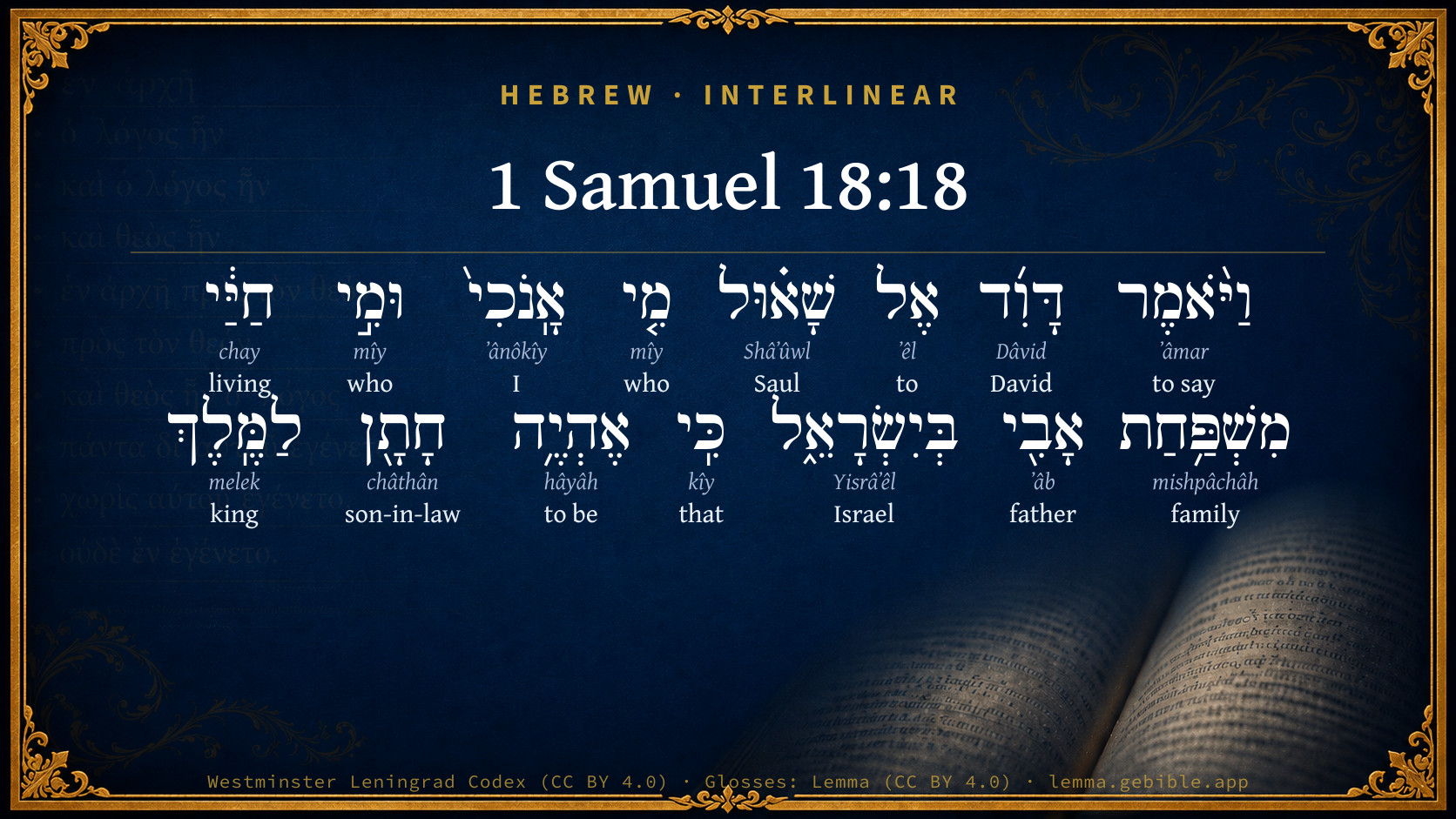
1 Samuel 18:18

Hebrew (Westminster Leningrad Codex) 1 Samuel 18:18 appears in the Hebrew Old Testament. The text above is from the Westminster Leningrad Codex. Each word links to its Strong’s number, a concise gloss, and parsing drawn from the Open Scriptures Hebrew Bible morphology. Click any word for its full Brown-Driver-Briggs (BDB) entry.
Download image
Cite this verse

1 Samuel 18:18 (World English Bible). Public Domain. Lemma interlinear Bible study tool, https://lemma.gebible.app/v/1-samuel/18/18.

Show BibTeX & RIS
BibTeX
RIS
English Translation
David said to Saul, Who am I, and what is my life, [or] my father's family in Israel, that I should be son-in-law to the king?
World English Bible · Public Domain
Download a study sheet

One document with this verse’s original text, its word-by-word gloss line, the meaning frame, cross-references with their text, attributed commentary, and full source and license credits — printable, and it pastes into notes with its structure intact.

This verse Autodidact and up

Study sheet (.html) Plain text (.txt)

A passage Seminary Student

Up to 50 verses in one chapter. A passage sheet keeps up to 6 commentary sources and 12 cross-references per verse, in the order this page ranks them, and says so on the sheet whenever that leaves anything out. Ask for a single verse and you get the Autodidact verse sheet above.

Everything on this page stays free to read, with no account — the sheet is a download of what is already on screen, not access to it.

Want to remove ads? Support Godless Engineer
Compare translations 3

The same verse in 3 English versions, stacked beneath the original-language interlinear above. Click any original word for its lexicon entry.

Each is an independent rendering of the whole verse — the interlinear is not word-aligned to these translations.

Highlighted words mark where these versions differ — a whole-verse word diff, not a word-by-word alignment.

  • World English Bible Public Domain
    David said to Saul, Who am I, and what is my life, [or] my father's family in Israel, that I should be son-in-law to the king?
  • King James Version Public Domain
    And David said unto Saul, Who am I? and what is my life, or my father's family in Israel, that I should be son in law to the king?
  • unfoldingWord Literal Text CC BY-SA 4.0
    But David said to Saul, “Who I, and what my family, the clan of my father in Israel, that I should be son-in-law to the king?”

unfoldingWord Literal Text — © unfoldingWord, licensed CC BY-SA 4.0. Word-aligned USFM3 via Door43 (git.door43.org/unfoldingWord/en_ult).

Versions to compare (up to 4)

3 of 4 selected

Show all 18 translations

Every available English version of this verse, each an independent rendering of the whole verse.

  • World English Bible Public Domain
    David said to Saul, Who am I, and what is my life, [or] my father's family in Israel, that I should be son-in-law to the king?
  • Berean Standard Bible Public Domain
    And David said to Saul, “Who am I, and what is my family or my father’s clan in Israel, that I should become the son-in-law of the king?”
  • Majority Standard Bible Public Domain
    And David said to Saul, “Who am I, and what is my family or my father’s clan in Israel, that I should become the son-in-law of the king?”
  • King James Version Public Domain
    And David said unto Saul, Who am I? and what is my life, or my father's family in Israel, that I should be son in law to the king?
  • American Standard Version (1901) Public Domain
    And David said unto Saul, Who am I, and what is my life, `or' my father's family in Israel, that I should be son-in-law to the king?
  • Revised Version (1885) Public Domain
    And David said unto Saul, Who am I, and what is my life, or my father’s family in Israel, that I should be son in law to the king?
  • Geneva Bible (1599) Public Domain
    And Dauid answered Saul, What am I? and what is my life, or the family of my father in Israel, that I should be sonne in law to the King?
  • Douay-Rheims (1899) Public Domain
    And David said to Saul: Who am I, or what is my life, or my father's family in Israel, that I should be son in law of the king?
  • Young's Literal Translation Public Domain
    And David saith unto Saul, `Who `am' I? and what my life -- the family of my father in Israel -- that I am son-in-law to the king?'
  • Literal Standard Version CC BY-SA 4.0
    And David says to Saul, “Who [am] I? And what [is] my life—the family of my father in Israel—that I am son-in-law of the king?”
  • Unlocked Literal Bible CC BY-SA 4.0
    David said to Saul, “Who am I, and who are my relatives, or my father's clan in Israel, that I should be son-in-law to the king?”
  • unfoldingWord Literal Text CC BY-SA 4.0
    But David said to Saul, “Who I, and what my family, the clan of my father in Israel, that I should be son-in-law to the king?”
  • Darby Bible Public Domain
    And David said to Saul, Who am I? and what is my life, [or] my father's family in Israel, that I should be son-in-law to the king?
  • World Messianic Bible Public Domain
    David said to Saul, “Who am I, and what is my life, or my father’s family in Israel, that I should be son-in-law to the king?”
  • Webster's Bible Public Domain
    And David said to Saul, Who am I? and what is my life, or my father's family in Israel, that I should be son-in-law to the king?
  • Free Bible Version CC BY-SA 4.0
    “But who am I, and what status does my family have in Israel, for me to become the son-in-law of the king?” David replied.
  • Bible in Basic English Public Domain
    And David said to Saul, Who am I, and what is my father's family in Israel, that I am to be son-in-law to the king?
  • JPS Tanakh (1917) Public Domain
    And David said unto Saul: 'Who am I, and what is my life, or my father's family in Israel, that I should be son-in-law to the king?'

Literal Standard Version (2020), Covenant Press — licensed CC BY-SA 4.0. Text via the HelloAO Bible API (eBible.org). Unlocked Literal Bible (unfoldingWord) — licensed CC BY-SA 4.0. Text via the HelloAO Bible API (eBible.org). unfoldingWord Literal Text — © unfoldingWord, licensed CC BY-SA 4.0. Word-aligned USFM3 via Door43 (git.door43.org/unfoldingWord/en_ult). Free Bible Version, Dr. Jonathan Gallagher — licensed CC BY-SA 4.0. Text via the HelloAO Bible API (eBible.org).

Word by word

More ways to search: Search by grammar → Find every occurrence → Compare this word →

Practice this passage: Drill this verse → Learn its vocabulary →

חָתָ֖ן
châthân
H2860
“son-in-law”
Noun, Common, Masculine, Singular, Absolute
Part of Speech
Noun
Type
Common
Gender
Masculine
Number
Singular
State
Absolute
Full BDB Definition

Origin: from H2859

TWOT: 781c

son-in-law, daughter's husband, bridegroom, husband
  1. וַיֹּ֨אמֶר ʼâmar H559 “and · to say” Conjunction + Verb, Qal, Sequential Imperfect, 3rd Person, Masculine, Singular
  2. דָּוִ֜ד Dâvid H1732 “David” Noun, Proper
  3. אֶל ʼêl H413 “to” Preposition
  4. שָׁא֗וּל Shâʼûwl H7586 “Saul” Noun, Proper
  5. מִ֤י mîy H4310 “who” Particle, Interrogative
  6. אָֽנֹכִי֙ ʼânôkîy H595 “I” Pronoun, Personal, 1st Person, Common, Singular
  7. וּמִ֣י mîy H4310 “and · who” Conjunction + Particle, Interrogative
  8. חַיַּ֔י chay H2416 “living things · my” Noun, Common, Masculine, Plural, Construct + Suffix, Personal, 1st Person, Common, Singular
  9. מִשְׁפַּ֥חַת mishpâchâh H4940 “family of” Noun, Common, Feminine, Singular, Construct
  10. אָבִ֖י ʼâb H1 “father · my” Noun, Common, Masculine, Singular, Construct + Suffix, Personal, 1st Person, Common, Singular
  11. בְּיִשְׂרָאֵ֑ל Yisrâʼêl H3478 “in/at · Israel” Preposition + Noun, Proper
  12. כִּֽי kîy H3588 “that” Conjunction
  13. אֶהְיֶ֥ה hâyâh H1961 “to be” Verb, Qal, Imperfect, 1st Person, Common, Singular
  14. לַמֶּֽלֶךְ melek H4428 “to/for the · king” Preposition, Determined + Noun, Common, Masculine, Singular, Absolute

About this verse

These counts appear in no published source. They are computed here, from the morphology-tagged text and Lemma’s own curated glosses. What Lemma adds →

15
words
14
distinct lemmas
Historical
section

Notable vocabulary

The rarest word here is חָתָ֖ן son-in-law H2860 — appearing just 20 times in the whole Hebrew Bible.

Shared distinctive vocabulary

חָתָ֖ן son-in-law H2860 occurs in 19 verses of the Hebrew Bible. Also found in:

Grammatical profile

  • 2 verbs
  • 8 nouns
  • 1 pronoun
  • 1 preposition
  • 1 conjunction
  • 2 particles

Verb forms

  • וַיֹּ֨אמֶר Qal · Sequential Imperfect
  • אֶהְיֶ֥ה Qal · Imperfect

Repetition

A word recurs within this verse — often emphatic in Hebrew:

Hebrew & Septuagint length

In English translation the verse runs 26 words from the Hebrew and 26 from the Septuagint (LXX English) — the same length.

A rough comparison of the two English renderings, which tokenize alike — not a word-level alignment.

Word counts can differ between the Hebrew and the Greek without any difference in meaning — e.g. the Hebrew direct-object marker אֵת has no separate Greek word, and Greek often adds the article ὁ.

In the original languages it is 15 Hebrew tokens and 12 Greek tokens — but the two are counted differently (Hebrew bundles its prefixes and suffixes into one token; the Greek is in lemma form), so that isn’t a like-for-like length.

Cross-references

8

Topical passages linked to 1 Samuel 18:18 in the Treasury of Scripture Knowledge — connected by theme and wording, ordered by reader-vote popularity; previews shown in the World English Bible.

  • 2 Samuel 7:18 Then David the king went in, and sat before Yahweh; and he said, Who am I, Lord Yahweh, and what is my house, that you have brought me thus far?
  • 1 Samuel 9:21 Saul answered, Am I not a Benjamite, of the smallest of the tribes of Israel? and my family the least of all the families of the tribe of Benjamin? why then speak you to me after this manner?
  • 1 Samuel 18:23 Saul's servants spoke those words in the ears of David. David said, Seems it to you a light thing to be the king's son-in-law, seeing that I am a poor man, and lightly esteemed?
  • Exodus 3:11 Moses said to God, "Who am I, that I should go to Pharaoh, and that I should bring forth the children of Israel out of Egypt?"
  • Ruth 2:10 Then she fell on her face, and bowed herself to the ground, and said to him, Why have I found favor in your sight, that you should take knowledge of me, seeing I am a foreigner?
  • Proverbs 15:33 The fear of Yahweh teaches wisdom. Before honor is humility.
  • Proverbs 18:12 Before destruction the heart of man is proud, But before honor is humility.
  • Jeremiah 1:6 Then said I, Ah, Lord Yahweh! behold, I don't know how to speak; for I am a child.

Cross-references courtesy of OpenBible.info (CC BY 4.0).

Hebrew and Greek witnesses Masoretic Hebrew ↔ Greek Septuagint

The same verse in the two great witnesses to the Old Testament, shown verse-for-verse.

These are two independent witnesses, not word-aligned to each other, and the Septuagint is shown in lemma (dictionary) form.

Hebrew 1 Samuel 18:18 Masoretic · Westminster Leningrad Codex

וַיֹּ֨אמֶר דָּוִ֜ד אֶל שָׁא֗וּל מִ֤י אָֽנֹכִי֙ וּמִ֣י חַיַּ֔י מִשְׁפַּ֥חַת אָבִ֖י בְּיִשְׂרָאֵ֑ל כִּֽי אֶהְיֶ֥ה חָתָ֖ן לַמֶּֽלֶךְ

David said to Saul, Who am I, and what is my life, [or] my father's family in Israel, that I should be son-in-law to the king?

World English Bible · Public Domain

Greek LXX 1 Samuel 18:18 Septuagint · lemma form

καί ὁράω σαούλ ὅτι κύριος μετά δαυίδ καί πᾶς ἰσραήλ ἀγαπάω αὐτός

And David said to Saul, Who am I, and What is the life of my father’s family in Israel, that I should be the king’s son—in-law?

LXX2012 (modern English Septuagint) · Public Domain

Hebrew: Westminster Leningrad Codex (CC BY 4.0). Greek: Septuagint (public domain); English from LXX2012 (modern English Septuagint) (Public Domain). How the Septuagint differs from the Hebrew →

Targum (Aramaic paraphrase)

1

The Targum is the ancient Jewish Aramaic paraphrase of the Hebrew Scriptures — an interpretive translation, not the Hebrew text itself. Onkelos (literal) and Pseudo-Jonathan (expansive) render the Torah, and Jonathan the Prophets. Coverage is partial: where no permissively-licensed English translation exists for a verse, only the Aramaic is shown. This is verse-level text, not a word-by-word alignment to the Hebrew.

  1. Targum Jonathan Prophets (Joshua–Malachi)
    וַאֲמַר דָוִד לְשָׁאוּל מַן אֲנָא וּמַן חַיַי (בְּרַם) זַרְעִית אַבָּא בְּיִשְׂרָאֵל אֲרֵי אֲהֵי חֲתָנָא לְמַלְכָּא:

    (no public-domain English translation for this verse)

    Targum Jonathan — Aramaic: “Mikraot Gedolot” (public domain). English: “Sefaria Community Translation” (CC0 1.0 (public-domain dedication)); “London "Chaldee Paraphrase," 1871” (public domain). Text via Sefaria.

Commentary

Notes on 1 Samuel 18:18 from classic Christian and Jewish commentators (each source and its license shown beneath its notes). The classic Christian expositions comment on the surrounding passage and are grouped to its opening verse, so a note may address several verses; the Jewish commentaries on the Tanakh (Rashi and others) are per-verse, so they appear only where the commentator wrote on this verse.

Lemma curates 59 commentaries, every one of them public domain or Creative Commons licensed, each selected and text-cleaned for this edition rather than reprinted as found. About our sources →

Trapp's Complete Commentary

John Trapp

1Sa 18:18 And David said unto Saul, Who [am] I? and what [is] my life, [or] my father’s family in Israel, that I should be son in law to the king?

Ver. 18. And David said unto Saul, Who am I?] Time was, when Saul, being of a better spirit, could say as much as David here doth, viz., when he was first anointed by Samuel to be king. But now it was otherwise, Honores mutant mores. David here without dissimulation abaseth himself, as unfit for such a marriage. And what just cause had Saul to fear so modest and lowly minded a man?

John Trapp, A Commentary or Exposition upon All the Books of the Old and New Testament (1647–1656) — public domain. Text from a community e-Sword module.

The Biblical Illustrator

Joseph S. Exell

1Sa_18:18

What is my life?

The grandeur of life

Who am I? and What is my life? Am I only like some larger ephemera on the leaves of the green bay tree of existence, born in the morning and gone at evening? Is the inner world of memory, conscience, and hope, only some mocking dreamland of existence? Are all its agonies of remorse, its stretchings-forth into the infinite, its feelings of accountability, only the workings of a diseased imagination? Or am I what I feel to be--a soul--an immortal soul--a responsible soul; having, after the close of lifes brief stewardship, to give account of myself to God? Now there are really two questions involved in this text. The first is, What is life? The second is, What is my life? If the Christian ideal be a true one, if each man carries within him the grandeur of immortality, how am I acting with my own great nature? Am I despising and treading under foot my birthright? Am I weaving it into a vestment of beauty, or into a garment of shame?

I. Is my life a new life? Amongst the Hebrews the birth of a child was an occasion of gladdest joy. Its birthday was a festival. So now there is joy in the presence of the angels of God over one sinner that repenteth. If we are in Christ we are new creatures, old things are passed away; old ideas of life, old habits of life, old associations of life--all things are become new. Another world has come into sight, as clearly as this world came into the view of the blind man to whom Jesus gave sight. I do not say the old life is altogether gone. No. The silkworms winter skin clings to the moth until it is ready to spread its wings and soar away, and much of the old nature clings to the Christian till he is ready to depart and be with Christ, which is far better. Paul felt the old man still clinging to him. O wretched man that I am, who shall deliver me from the body of this death? So shall we. But for all this, the new life is there. We love prayer, we love Gods house, we love to talk with Christ; we bear the blossoms in us of the better life--the fruits of the Spirit are love, joy, peace.

II. Is my life a dignified life? Yes! Dignified! Have we come to this, that we think ermine-clad judges, and purple-clad rulers, alone have dignified estate? Let me hope not! It was once thought a great dignity to be a Roman citizen--but there was a greater dignity. I am a man! sounds a deeper depth of dignity than I am a Roman citizen. Yes, and what the world wants just now is to feel this: the dignity of life, as life. Why the greatest physical wonder in creation is man; and the greatest moral wonder is man. Do you think if men and women felt this, that our towns and cities would be disgraced as they are by lascivious songs and dances at our places of public entertainment, or by debasing drunkenness, or by hollow-hearted profanity, which misnames itself wit? Do you think, if the dignity of life itself was properly estimated, that men would not rather be bankrupt in cash, than bankrupt in character? Men would say, Think what manner of men we are; and pointing to the lofty hills, or the all-surrounding sea, they would say: these shall perish, but we shall remain.

III. Is my life a Divine vocation? I hold, with Mr. Ruskin, that we were never sent into this world to do anything into which we cannot put our hearts. That is a serious statement, and not to be adopted without reflection; but I for one believe it to be quits true. Now let us remember that every honourable vocation is a Divine vocation; that circumstances and fitnesses constitute the calling of God, the voice speaking to us and saying Son, go there. If we miss this, we shall come to artificial ideas of vocation.

IV. Is my life a personal accountability? Is it like imprisoned air, that once released returns to the universal atmosphere? Is it like the tiny mountain rill which flows into the great river, and thence into the wide sea? Is it, that is to say, in any personal sense mine? Upon our answer to this depends our deliverance from all these Pantheistic ideas of God, which make Him the great Spirit of the Universe; all life being His life, and our own spirits only part of the great spirit, departing at death to its central source. Now the Bible declares emphatically our personal and unalterable individuality, and our consciousness accords with this. We are, in the strictest sense of the word, separate existences, and when we depart hence we shall be separate existences still. Any property we may possess, be it large or small, changes hands at death; we brought nothing into the world, and it is certain we shall carry nothing out. But we do not lose ourselves; thought, conscience, memory, remain the same, I cannot change my life for yours, nor can you change with your brother. What is my life? Is it a dreary fatalism? Our inner life answers with swift decision,--No! Is it the result of influences which have helplessly overborne us? No. The Spirit of the Living God has been nigh to every one of us. Had this poor man cried, the Lord would have heard him and delivered him out of all his troubles.

V. Is my life a redeemed life? It depends upon which side of Redemption you look at it. In one sense, all lives are redeemed lives. Christ is the propitiation not for our sins only, but for the sins of the whole world. Christ died for all. So far then as the Great Atonement is concerned, the oblation was for all. Once in the end of the world Christ appeared to put away sin by the sacrifice of Himself. But on the other side of the Redemption comes in our personality again. Whosoever believeth in Him shall not perish, but have everlasting life. Believe on the Lord Jesus Christ and thou shalt be saved. Faith then, as you well know, is the condition of redemption, and faith is the trust of the soul in the redeeming Christ. Surely we know whether we have trust or not. In human affairs it is not so hard to tell. I saw a diamond this week, and held it in my hand, which at the African diggings was sold for three thousand five hundred pounds; it had been consigned to an agent here, far away from its finder and possessor. Could that man, across the seas, have any difficulty in deciding if he had trusted his agent here? I trow not And what does Paul say, I know in whom I have believed, and that He is able to keep that which I have committed to Him unto that day. Beautiful are human trusts--in love, in commerce, in friendship--there is poetry enough in human trusts. But there may be failure here. Alas, there often is! But Christ never deserted or failed the soul committed to Him. Never!

VI. Is my life a mortal life. Here again it depends upon which side you study it. On one side it is, For what is your life, it is even as a vapour which appeareth for a little time and then passeth away. Yes! All flesh is grass. Yes! The wind passeth over it and it is gone, and the place thereof shall know it no more. Sad enough on this side is human life. The fairest forms and faces lie tonight amid the clods of the valley. Tennysons little May Queen sees the hawthorn blossom no more, and the Pride of the Village becomes the prey of worms. It has been ever so. The dark Egyptian beauties, the fair Grecian forms, the proud Roman damsels, descend to the dust. Pharoahs leave their palaces for the pyramids. Caesars leave their purples for the same chambers that their meanest slaves occupy. There, the rich and the poor--the strong and the weak--the servant and the master--all meet together. Few of us like to think of it. The tabernacles we have dwelt in so long, tended so carefully, adorned so constantly, and have come to consider part of our very selves--these must not only die, but become the subjects of corruption tool. The grass withereth, the flower thereof falleth away. And is this, we may ask, all of life? Did God introduce us into this world, where temptation tries, care wearies, doubt perplexes, sorrow burdens, sickness weakens, bereavement embitters--only to pass through much tribulation to the tomb! Oh! it cannot be! All the teachings of Scripture, all the promises of Christ, all the undying hopes of the human heart, tell us it cannot be. Immortality is the birthright of humanity, and though, during long ages the light of this truth burned dimly, Christ came to bring light and immortality to light through the Gospel. My life is mortal--and it is immortal too. (W. H. Statham.)

The Biblical Illustrator, edited by Joseph S. Exell (c. 1880s–1900s) — public domain. Text from a community e-Sword module.

Joseph Benson's Commentary

1Sa 18:18. David said, Who am I? and what is my life? — How little is my life worth, that by the exposing of that to some hazard, I should purchase a king’s daughter! In these expressions David showeth not only his humility, but also his wisdom, in discovering so deep a sense of his own meanness, that Saul might see how far he was from aspiring at the kingdom. Or my father’s family in Israel? — In riches, for otherwise David’s family was as noble as any in Israel. That I should be son-in-law to the king — This was not a refusal of the honour but a modest acknowledgment how unworthy he was of it; and it indicates such modesty and prudence, that, considering David’s youth, and all other circumstances, we may well conclude that nothing but the Spirit of the Lord being with him could have made him act so wisely.

Joseph Benson's Commentary on the Old and New Testaments (1811–1818) — public domain. Text from a community e-Sword module.

Tyndale Open Study Notes

Tyndale Open Resources

18:18 Who am I, and what is my family: An expression of humility (see also 2 Sam 7:18; cp. Exod 3:11). David’s family could not afford the bride price to marry the king’s daughter (1 Sam 18:23-25).

Tyndale Open Study Notes — © Tyndale Open Resources, licensed CC BY-SA 4.0. Text via the HelloAO Bible API.

Ellicott's Commentary for English Readers

(18) What is my life?—These words in David’s modest and wise answer have been variously interpreted. (a) They have been taken to refer to David’s personal life; but surely that has been alluded to in the preceding words, “Who am I?” (b) As referring to the condition of life in which he was born and to which he was accustomed; so Keil; but it is doubtful if the Hebrew word here used ever has this significance. (c) With a reference to David’s family; so Ewald and Lange. Ewald would translate, “What are my folks or relations?” Of these (c) is undoubtedly the preferable meaning.

A Bible Commentary for English Readers, edited by Charles John Ellicott (1878–1897) — public domain. Text from a community e-Sword module.

The Cambridge Bible for Schools and Colleges

gen. ed. J. J. S. Perowne

18. what is my life] Probably, who are my folk, even my father’s family? David acknowledges himself unworthy of the proposed honour on the score of social position.

The Cambridge Bible for Schools and Colleges (gen. ed. J. J. S. Perowne; Cambridge University Press, 1878–1918) — public domain. Text from a community e-Sword module.

John Gill's Exposition

But it came to pass, at the time when Merab, Saul's daughter,

should have been given to David,.... Either when the giving of her to him was talked of, or when the time fixed for her marriage was come:

that she was given to Adriel the Meholathite to wife: Saul either having in reality never designed she should be given to David, only proposed it to please the people, or to affront David, and expose him to shame and confusion by the step he meant to take, or however he soon changed his mind; though Abarbinel's notion is, that the young lady had disposed of herself to this person without her father's knowledge, which seems not likely; the person she was given to was the son of Barzillai the Meholathite, Sa2 21:8; and some have observed, as the curse of God on this match, that all her sons were delivered to the Gibeonites, and hanged up, as related in the same place; for though these sons are said to be brought up by Michal, they were bore by Merab to him.

John Gill's Exposition of the Whole Bible (1746–1763) — public domain (CC PDM 1.0). Text via the HelloAO Bible API.

Albert Barnes' Notes on the Bible

What is my life - i. e., condition, or means of living (Pro 27:27 margin).

Albert Barnes' Notes on the Bible (1834–1885) — public domain. Text from a community e-Sword/MySword module.

Haydock's Catholic Bible Commentary

Life. What exploits have I performed deserving such an honour? or what offices have my relations yet enjoyed? (Calmet) --- David considers only his abject condition, and forgets his victories. (Haydock)

George Leo Haydock (1774–1849), Haydock's Catholic Family Bible and Commentary, 1859 edition — public domain. Excludes Psalms (Douay-Rheims chapter numbering differs from Protestant) and Deuterocanonical books (Catholic canon only).

Matthew Poole's English Annotations

My life, i.e. my manner of living. How obscure is that condition in which I was born, and have been bred! Or rather thus, How little is my life worth, that by the exposing of that to some hazard (which Saul required of him). I should purchase a king’s daughter! In these expressions David showeth not only his humility, but also his wisdom, in discovering so deep a sense of his own meanness, that Saul might see how far he was from aspiring at the kingdom, and might have no occasion to suspect that he was already anointed thereto.

Matthew Poole's English Annotations on the Holy Bible (1683–1685) — public domain. Text from a community e-Sword/MySword module.

Whedon's Commentary on the Bible

Daniel D. Whedon

18. David said unto Saul — David’s words in this verse not only show his unsuspecting innocency and humility of soul, but seem also to indicate that he himself understood Saul’s offer of his daughter to be in accordance with his promise.

Daniel D. Whedon (gen. ed.), Commentary on the Old and New Testaments (1874–1909) — public domain. Text from a community e-Sword module.

John Wesley's Explanatory Notes

What is my life - How little is my life worth, that by the exposing of that to some hazard, I should purchase a king's daughter! In these expressions David sheweth not only his humility, but also his wisdom, in discovering so deep a sense of his own meanness, that Saul might see how far he was from aspiring at the kingdom.

John Wesley, Explanatory Notes Upon the Whole Bible (1754–1765) — public domain. Text via the GEBible commentary corpus.

Lesson kit

Teaching starters — assembled from the data on this page, not authored interpretation. Every prompt links to the verse data it draws on. Edit before teaching.

1 Samuel, in the Historical, opens this verse with 15 words (14 distinct Hebrew lemmas). Its most distinctive word is châthân (“son-in-law”). A historical commentator’s framing appears above. Read the whole chapter for the surrounding context.

Discussion questions

  1. The word châthân carries the sense “son-in-law.” How does it shape the verse?
  2. Genesis 19:12 shares the word «son-in-law» with this verse. How do the two illuminate each other?
  3. “who” occurs 2× in this one verse. What is the effect of the repetition?
  4. These translations render this verse differently; the difference is in the English rendering, not the original. What questions does that raise?
  5. The verb «וַיֹּ֨אמֶר» is Qal Sequential Imperfect. How does its form color the action?
  6. Reading how Trapp's Complete Commentary and The Biblical Illustrator read this verse, where do the two commentators agree and where do they part?

Things to notice

Reading settings

Reading text

Shown beneath each verse's original-language words.

Old Testament
Old Testament edition

Read the OT as the Masoretic Hebrew (MT) or the Greek Septuagint (LXX).

English shown for the Greek Septuagint (in the Hebrew ↔ Greek comparison).

Comparing translations? Open the Compare panel on any verse page to stack up to four side by side.