Judges 5:3

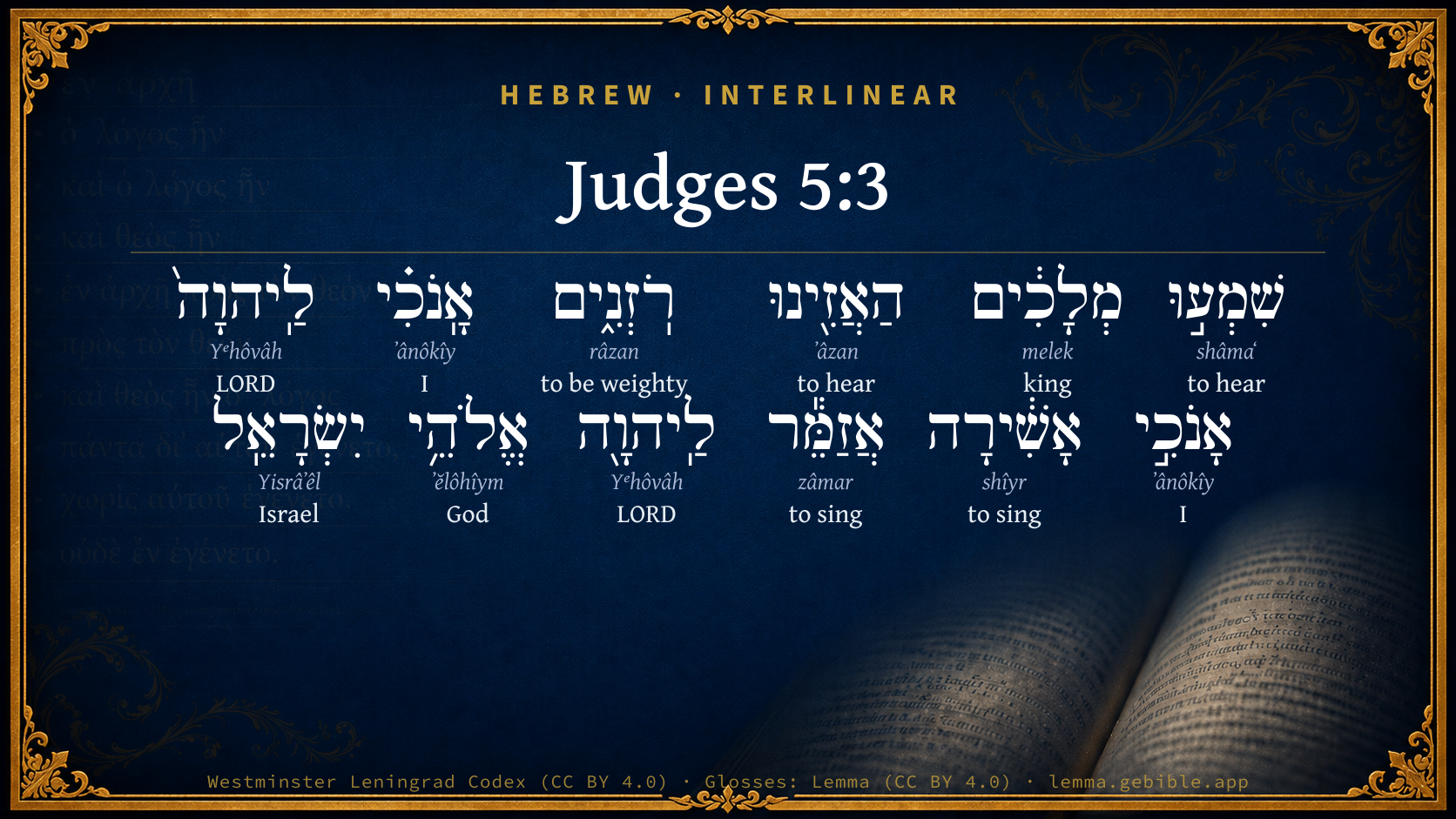
Hebrew (Westminster Leningrad Codex) Judges 5:3 appears in the Hebrew Old Testament. The text above is from the Westminster Leningrad Codex. Each word links to its Strong’s number, a concise gloss, and parsing drawn from the Open Scriptures Hebrew Bible morphology. Click any word for its full Brown-Driver-Briggs (BDB) entry.
Download image
Cite this verse

Judges 5:3 (World English Bible). Public Domain. Lemma interlinear Bible study tool, https://lemma.gebible.app/v/judges/5/3.

Show BibTeX & RIS
BibTeX
RIS
English Translation
Hear, you kings; give ear, you princes; I, [even] I, will sing to Yahweh; I will sing praise to Yahweh, the God of Israel.
World English Bible · Public Domain
Highlights
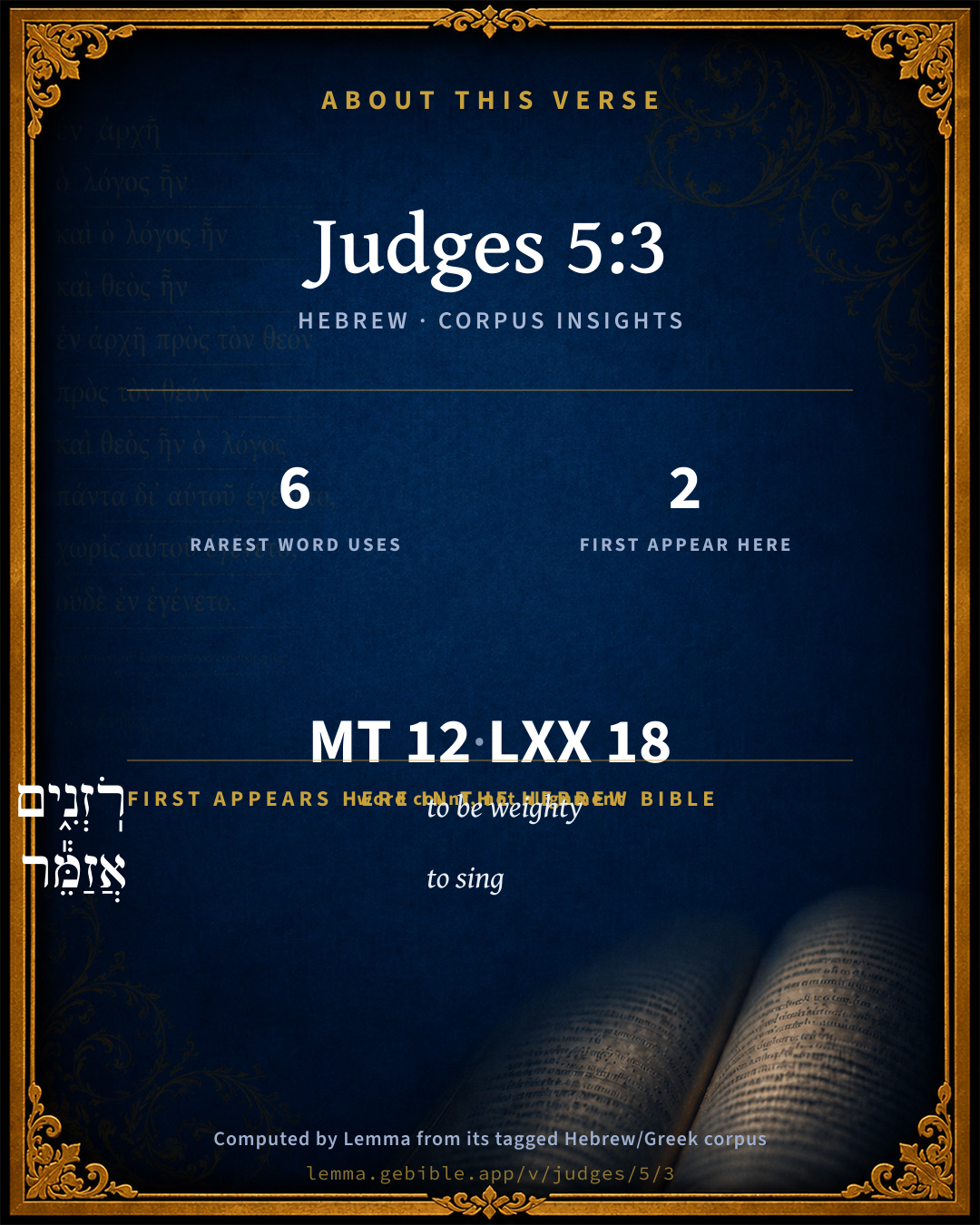
  • 2 first appearances in the Hebrew Bible
Full analysis ↓
Download a study sheet

One document with this verse’s original text, its word-by-word gloss line, the meaning frame, cross-references with their text, attributed commentary, and full source and license credits — printable, and it pastes into notes with its structure intact.

This verse Autodidact and up

Study sheet (.html) Plain text (.txt)

A passage Seminary Student

Up to 50 verses in one chapter. A passage sheet keeps up to 6 commentary sources and 12 cross-references per verse, in the order this page ranks them, and says so on the sheet whenever that leaves anything out. Ask for a single verse and you get the Autodidact verse sheet above.

Everything on this page stays free to read, with no account — the sheet is a download of what is already on screen, not access to it.

Want to remove ads? Support Godless Engineer
Compare translations 3

The same verse in 3 English versions, stacked beneath the original-language interlinear above. Click any original word for its lexicon entry.

Each is an independent rendering of the whole verse — the interlinear is not word-aligned to these translations.

Highlighted words mark where these versions differ — a whole-verse word diff, not a word-by-word alignment.

  • World English Bible Public Domain
    Hear, you kings; give ear, you princes; I, [even] I, will sing to Yahweh; I will sing praise to Yahweh, the God of Israel.
  • King James Version Public Domain
    Hear, O ye kings; give ear, O ye princes; I, even I, will sing unto the LORD; I will sing praise to the LORD God of Israel.
  • unfoldingWord Literal Text CC BY-SA 4.0
    Listen, kings! Give ear, rulers! I, to Yahweh, I, may I sing. I will make music to Yahweh, the God of Israel.

unfoldingWord Literal Text — © unfoldingWord, licensed CC BY-SA 4.0. Word-aligned USFM3 via Door43 (git.door43.org/unfoldingWord/en_ult).

Versions to compare (up to 4)

3 of 4 selected

Show all 18 translations

Every available English version of this verse, each an independent rendering of the whole verse.

  • World English Bible Public Domain
    Hear, you kings; give ear, you princes; I, [even] I, will sing to Yahweh; I will sing praise to Yahweh, the God of Israel.
  • Berean Standard Bible Public Domain
    Listen, O kings! Give ear, O princes! I will sing to the LORD; I will sing praise to the LORD, the God of Israel.
  • Majority Standard Bible Public Domain
    Listen, O kings! Give ear, O princes! I will sing to the LORD; I will sing praise to the LORD, the God of Israel.
  • King James Version Public Domain
    Hear, O ye kings; give ear, O ye princes; I, even I, will sing unto the LORD; I will sing praise to the LORD God of Israel.
  • American Standard Version (1901) Public Domain
    Hear, O ye kings; give ear, O ye princes; I, `even' I, will sing unto Jehovah; I will sing praise to Jehovah, the God of Israel.
  • Revised Version (1885) Public Domain
    Hear, O ye kings; give ear, O ye princes; I, even I, will sing unto the LORD; I will sing praise to the LORD, the God of Israel.
  • Geneva Bible (1599) Public Domain
    Heare, ye Kings, hearken ye princes: I, euen I will sing vnto the Lord: I will sing praise vnto the Lord God of Israel.
  • Douay-Rheims (1899) Public Domain
    Hear, O ye kings, give ear, ye princes: It is I, it is I, that will sing to the Lord, I will sing to the Lord the God of Israel.
  • Young's Literal Translation Public Domain
    Hear, ye kings; give ear, ye princes, I, to Jehovah, I -- I do sing, I sing praise to Jehovah, God of Israel.
  • Literal Standard Version CC BY-SA 4.0
    Hear, you kings; give ear, you princes, || I sing to YHWH, || I sing praise to YHWH, God of Israel.
  • Unlocked Literal Bible CC BY-SA 4.0
    Listen, you kings! Pay attention, you leaders! I, I will sing to Yahweh; I will sing praises to Yahweh, the God of Israel.
  • unfoldingWord Literal Text CC BY-SA 4.0
    Listen, kings! Give ear, rulers! I, to Yahweh, I, may I sing. I will make music to Yahweh, the God of Israel.
  • Darby Bible Public Domain
    "Hear, O kings; give ear, O princes; to the LORD I will sing, I will make melody to the LORD, the God of Israel.
  • World Messianic Bible Public Domain
    “Hear, you kings! Give ear, you princes! I, even I, will sing to the LORD. I will sing praise to the LORD, the God of Israel.
  • Webster's Bible Public Domain
    Hear, O ye kings; give ear, O ye princes; I, even I, will sing to the LORD; I will sing praise to the LORD God of Israel.
  • Free Bible Version CC BY-SA 4.0
    Listen, kings! Pay attention, rulers! I, yes I, will sing to the Lord; I will praise the Lord, the God of Israel, in song.
  • Bible in Basic English Public Domain
    Give attention, O kings; give ear, O rulers; I, even I, will make a song to the Lord; I will make melody to the Lord, the God of Israel.
  • JPS Tanakh (1917) Public Domain
    Hear, O ye kings; give ear, O ye princes; I, unto the LORD will I sing; I will sing praise to the LORD, the God of Israel.

Literal Standard Version (2020), Covenant Press — licensed CC BY-SA 4.0. Text via the HelloAO Bible API (eBible.org). Unlocked Literal Bible (unfoldingWord) — licensed CC BY-SA 4.0. Text via the HelloAO Bible API (eBible.org). unfoldingWord Literal Text — © unfoldingWord, licensed CC BY-SA 4.0. Word-aligned USFM3 via Door43 (git.door43.org/unfoldingWord/en_ult). Free Bible Version, Dr. Jonathan Gallagher — licensed CC BY-SA 4.0. Text via the HelloAO Bible API (eBible.org).

Word by word

More ways to search: Search by grammar → Find every occurrence → Compare this word →

Practice this passage: Drill this verse → Learn its vocabulary →

רֹֽזְנִ֑ים
râzan
H7336
“being weighty”
Verb, Qal, Participle Active, Masculine, Plural, Absolute
Part of Speech
Verb
Stem
Qal
Form
Participle Active
Gender
Masculine
Number
Plural
State
Absolute
Full BDB Definition

Origin: a primitive root

TWOT: 2142

(Qal) to be weighty, be judicious, be commanding
  1. שִׁמְע֣וּ shâmaʻ H8085 “hear” Verb, Qal, Imperative, 2nd Person, Masculine, Plural
  2. מְלָכִ֔ים melek H4428 “kings” Noun, Common, Masculine, Plural, Absolute
  3. הַאֲזִ֖ינוּ ʼâzan H238 “hear” Verb, Hiphil, Imperative, 2nd Person, Masculine, Plural
  4. אָֽנֹכִ֗י ʼânôkîy H595 “I” Pronoun, Personal, 1st Person, Common, Singular
  5. לַֽיהוָה֙ Yᵉhôvâh H3068 “to/for · LORD” Preposition + Noun, Proper
  6. אָנֹכִ֣י ʼânôkîy H595 “I” Pronoun, Personal, 1st Person, Common, Singular
  7. אָשִׁ֔ירָה shîyr H7891 “to sing” Verb, Qal, Cohortative, 1st Person, Common, Singular
  8. אֲזַמֵּ֕ר zâmar H2167 “to sing” Verb, Piel, Imperfect, 1st Person, Common, Singular
  9. לַֽיהוָ֖ה Yᵉhôvâh H3068 “to/for · LORD” Preposition + Noun, Proper
  10. אֱלֹהֵ֥י ʼĕlôhîym H430 “God(s) of” Noun, Common, Masculine, Plural, Construct
  11. יִשְׂרָאֵֽל Yisrâʼêl H3478 “Israel” Noun, Proper

About this verse

These counts appear in no published source. They are computed here, from the morphology-tagged text and Lemma’s own curated glosses. What Lemma adds →

12
words
10
distinct lemmas
Historical
section

Notable vocabulary

The rarest word here is רֹֽזְנִ֑ים to be weighty H7336 — appearing just 6 times in the whole Hebrew Bible.

First appearance in Scripture

These words make their first canonical appearance in the Hebrew Bible here:

  • רֹֽזְנִ֑ים to be weighty H7336
  • אֲזַמֵּ֕ר to sing H2167

Shared distinctive vocabulary

רֹֽזְנִ֑ים to be weighty H7336 occurs in 6 verses of the Hebrew Bible. Also found in:

Grammatical profile

  • 5 verbs
  • 5 nouns
  • 2 pronouns

Verb forms

  • שִׁמְע֣וּ Qal · Imperative
  • הַאֲזִ֖ינוּ Hiphil · Imperative
  • רֹֽזְנִ֑ים Qal · Participle Active
  • אָשִׁ֔ירָה Qal · Cohortative
  • אֲזַמֵּ֕ר Piel · Imperfect

Repetition

Words recur within this verse — often emphatic in Hebrew:

  • לַֽיהוָה֙ LORD H3068 ×2
  • אָֽנֹכִ֗י I H595 ×2

Hebrew & Septuagint length

In English translation the verse runs 24 words from the Hebrew and 33 from the Septuagint (LXX English) — closely comparable.

A rough comparison of the two English renderings, which tokenize alike — not a word-level alignment.

Word counts can differ between the Hebrew and the Greek without any difference in meaning — e.g. the Hebrew direct-object marker אֵת has no separate Greek word, and Greek often adds the article ὁ.

In the original languages it is 12 Hebrew tokens and 18 Greek tokens — but the two are counted differently (Hebrew bundles its prefixes and suffixes into one token; the Greek is in lemma form), so that isn’t a like-for-like length.

Cross-references

16

Topical passages linked to Judges 5:3 in the Treasury of Scripture Knowledge — connected by theme and wording, ordered by reader-vote popularity; previews shown in the World English Bible.

  • Psalms 138:4–5 All the kings of the earth will give you thanks, Yahweh, For they have heard the words of your mouth.
  • Ezra 7:21 I, even I Artaxerxes the king, do make a decree to all the treasurers who are beyond the River, that whatever Ezra the priest, the scribe of the law of the God of heaven, shall require of you, it be done with all diligence,
  • Psalms 2:10–12 Now therefore be wise, you kings. Be instructed, you judges of the earth.
  • Psalms 49:1–2 Hear this, all you peoples. Listen, all you inhabitants of the world,
  • Psalms 119:46 I will also speak of your statutes before kings, And will not be disappointed.
  • Genesis 6:17 I, even, I do bring the flood of waters on this earth, to destroy all flesh having the breath of life from under the sky. Everything that is in the earth will die.
  • Genesis 9:9 "As for me, behold, I establish my covenant with you, and with your offspring after you,
  • Exodus 31:6 I, behold, I have appointed with him Oholiab, the son of Ahisamach, of the tribe of Dan; and in the heart of all who are wise-hearted I have put wisdom, that they may make all that I have commanded you:
  • Leviticus 26:28 then I will walk contrary to you in wrath; and I also will chastise you seven times for your sins.
  • Deuteronomy 32:1 Give ear, you heavens, and I will speak; Let the earth hear the words of my mouth.
  • Deuteronomy 32:3 For I will proclaim the name of Yahweh: Ascribe greatness to our God.
  • Judges 5:7 The rulers ceased in Israel, they ceased, Until that I Deborah arose, That I arose a mother in Israel.
  • 1 Kings 18:22 Then Elijah said to the people, "I, even I only, am left a prophet of Yahweh; but Baal's prophets are four hundred fifty men.
  • 1 Kings 19:10 He said, I have been very jealous for Yahweh, the God of hosts; for the children of Israel have forsaken your covenant, thrown down your altars, and slain your prophets with the sword: and I, even I only, am left; and they seek my life, to take it away.
  • 1 Kings 19:14 He said, I have been very jealous for Yahweh, the God of hosts; for the children of Israel have forsaken your covenant, thrown down your altars, and slain your prophets with the sword; and I, even I only, am left; and they seek my life, to take it away.
  • Psalms 27:6 Now my head will be lifted up above my enemies around me. I will offer sacrifices of joy in his tent. I will sing, yes, I will sing praises to Yahweh.

Cross-references courtesy of OpenBible.info (CC BY 4.0).

Hebrew and Greek witnesses Masoretic Hebrew ↔ Greek Septuagint

The same verse in the two great witnesses to the Old Testament, shown verse-for-verse.

These are two independent witnesses, not word-aligned to each other, and the Septuagint is shown in lemma (dictionary) form.

Hebrew Judges 5:3 Masoretic · Westminster Leningrad Codex

שִׁמְע֣וּ מְלָכִ֔ים הַאֲזִ֖ינוּ רֹֽזְנִ֑ים אָֽנֹכִ֗י לַֽיהוָה֙ אָנֹכִ֣י אָשִׁ֔ירָה אֲזַמֵּ֕ר לַֽיהוָ֖ה אֱלֹהֵ֥י יִשְׂרָאֵֽל

Hear, you kings; give ear, you princes; I, [even] I, will sing to Yahweh; I will sing praise to Yahweh, the God of Israel.

World English Bible · Public Domain

Greek LXX Judges 5:3 Septuagint · lemma form

ἀκούω βασιλεύς καί ἐνὠτόζομαι σατράπης ἐγώ εἰμί ὁ κύριος ἐγώ εἰμί ᾄδω ψάλλω ὁ κύριος ὁ θεός ἰσραήλ

Hear, you⌃ kings, and listen, rulers: I will sing, it is I who will sing to the Lord, it is I, I will sing a psalm to the Lord the god of Israel.

LXX2012 (modern English Septuagint) · Public Domain

On this verse, Ellicott's Commentary for English Readers discusses the Septuagint’s reading. Read the note in Commentary ↓

Hebrew: Westminster Leningrad Codex (CC BY 4.0). Greek: Septuagint (public domain); English from LXX2012 (modern English Septuagint) (Public Domain). How the Septuagint differs from the Hebrew →

Targum (Aramaic paraphrase)

1

The Targum is the ancient Jewish Aramaic paraphrase of the Hebrew Scriptures — an interpretive translation, not the Hebrew text itself. Onkelos (literal) and Pseudo-Jonathan (expansive) render the Torah, and Jonathan the Prophets. Coverage is partial: where no permissively-licensed English translation exists for a verse, only the Aramaic is shown. This is verse-level text, not a word-by-word alignment to the Hebrew.

  1. Targum Jonathan Prophets (Joshua–Malachi)
    שְׁמָעוּ מַלְכַיָא דַאֲתוֹ עִם סִיסְרָא לִקְרָבָא אֲצִיתוּ שִׁלְטוֹנַיָא דַהֲווֹ עִם יָבִין מַלְכָּא דִכְנָעַן לָא בְּחֵילַתְכוֹן וְלָא בִּגְבוּרַתְכוֹן אִתְגַבַּרְתּוּן וּסְלֵקְתּוּן עַל דְבֵית יִשְׂרָאֵל אֲמַרַת דְבוֹרָה בִּנְבוּאָה קֳדָם יְיָ אֲנָא מְשַׁבְּחָא מוֹדָא וּמְבָרְכָא קֳדָם יְיָ אֱלָהָא דְיִשְׂרָאֵל:

    (no public-domain English translation for this verse)

    Targum Jonathan — Aramaic: “Mikraot Gedolot” (public domain). English: “Sefaria Community Translation” (CC0 1.0 (public-domain dedication)); “London "Chaldee Paraphrase," 1871” (public domain). Text via Sefaria.

Commentary

Notes on Judges 5:3 from classic Christian and Jewish commentators (each source and its license shown beneath its notes). The classic Christian expositions comment on the surrounding passage and are grouped to its opening verse, so a note may address several verses; the Jewish commentaries on the Tanakh (Rashi and others) are per-verse, so they appear only where the commentator wrote on this verse.

Lemma curates 59 commentaries, every one of them public domain or Creative Commons licensed, each selected and text-cleaned for this edition rather than reprinted as found. About our sources →

Trapp's Complete Commentary

John Trapp

Jdg 5:3 Hear, O ye kings; give ear, O ye princes; I, [even] I, will sing unto the LORD; I will sing [praise] to the LORD God of Israel.

Ver. 3. Hear, O ye kings.] Hear and give ear, be not proud, cast down your crowns, and give glory to God. The altar of incense was compassed about with a crown of pure gold, {Lev 3:1-17} to show that gratitude is a rich and royal virtue, best beseeming the best princes.

John Trapp, A Commentary or Exposition upon All the Books of the Old and New Testament (1647–1656) — public domain. Text from a community e-Sword module.

Joseph Benson's Commentary

Jdg 5:3. Hear, O ye kings, &c. — The prophetess begins her song with summoning the attention of the neighbouring kings and princes, that they might understand and lay to heart what God had done for Israel, and learn from thence not to oppress them, lest the same vengeance which had fallen upon Jabin and his people should be inflicted on them. I, even I, will sing unto the Lord — She declares that Jehovah should be the object of her praise, who, she would have the world to know, was superior to all in power, and would defend his people while they depended on him alone.

Joseph Benson's Commentary on the Old and New Testaments (1811–1818) — public domain. Text from a community e-Sword module.

Ellicott's Commentary for English Readers

(3) Hear, O ye kings.—There were no kings or princes in Israel, but the appeal is to the “kings of the earth,” as in Psa_2:10; for which reason the LXX. render “princes” by satraps. The Chaldee refers it to the kings allied with Jabin.

A Bible Commentary for English Readers, edited by Charles John Ellicott (1878–1897) — public domain. Text from a community e-Sword module.

The Cambridge Bible for Schools and Colleges

gen. ed. J. J. S. Perowne

3. The great ones of the earth are called upon to attend the praises of the victorious God of Israel. Hear … give ear a frequent parallelism, e.g. Gen_4:23; kings … princes again in Hab_1:10; Psa_2:2; Pro_8:15; Pro_31:4. The word for princes thus occurs chiefly in the later literature, but it may have belonged to the elevated style in ancient poetry. I, unto Yahweh I will sing; there is a ring about the words in the original, and a strong emphasis on the pronoun. I will make melody, with voice and instruments, a word specially frequent in the Psalter.

The Cambridge Bible for Schools and Colleges (gen. ed. J. J. S. Perowne; Cambridge University Press, 1878–1918) — public domain. Text from a community e-Sword module.

John Gill's Exposition

Hear, O ye kings; give ear, O ye princes,.... Not only the neighbouring ones, but all the kings and princes of the earth, far and near, then and in succeeding ages; Deborah desires and wishes that all potentates might hear of the wonderful works of God done for his people, that they might learn to know there is one that is higher than they, to whom all the amazing things done in the world are to be ascribed; and be cautious how they oppressed the people of God, since sooner or later he would avenge them on them. The Targum restrains this to the kings that came with Sisera and the governors with Jabin; but if there were any such, as it is not improbable there were, see Jdg 5:19; yet it is most likely that they were slain with them: there are some, as Kimchi observes, who think this respects the people of Israel, who were all the sons of kings; but the first sense is best:

I, even I, will sing unto the Lord, I will sing praise to the Lord God of Israel: which are the words of Deborah particularly, and the repetitions serve to express how cordial, earnest, and vehement she was in her praise and thankfulness to God; thereby setting an example to others, encouraging them to the same practice, and directing persons of every rank and quality to give praise only to Jehovah, the self-existing, everlasting, and unchangeable Being; to him who is the Lord and God of Israel in a peculiar manner, and not to any of the gods of the Gentiles.

John Gill's Exposition of the Whole Bible (1746–1763) — public domain (CC PDM 1.0). Text via the HelloAO Bible API.

Haydock's Catholic Bible Commentary

Kings. She invites all who have authority, whether in or out of Israel, to attend unto the dispensations of Providence. God alternatively cherishes and corrects his people. David makes a similar appeal to all kings and judges, Psalm ii. 10. --- It is I. She dwells with a degree of rapture on the thought that God had shewn his power so wonderfully, and had effected his gracious purpose by the hand of a woman! (Haydock) --- She directed Barac. (Worthington)

George Leo Haydock (1774–1849), Haydock's Catholic Family Bible and Commentary, 1859 edition — public domain. Excludes Psalms (Douay-Rheims chapter numbering differs from Protestant) and Deuterocanonical books (Catholic canon only).

Matthew Poole's English Annotations

You especially that live near to Israel, and have evil minds and designs against Israel, know this for your instruction, and caution, and terror too, if you shall presume to molest them.

To the Lord God of Israel, who, as you see by this plain instance, is both able and resolved to defend them from all their enemies.

Matthew Poole's English Annotations on the Holy Bible (1683–1685) — public domain. Text from a community e-Sword/MySword module.

Whedon's Commentary on the Bible

Daniel D. Whedon

3. Kings… princes — The kings and princes of the Canaanites (and, indeed, of all the earth) are referred to, not the princes of Israel, for Israel, at this time, had no kings. The prophetess, having opened her song with an exclamation of blessing to Jehovah, now boldly calls on the heathen kings to listen to her strains of triumph, and from them take warning and instruction. Compare Psa_2:10.

I… even I will sing — That is, I, Deborah; comp. Jdg_5:7. “O kings,” she says, in lofty defiance, “I, even I, a feeble woman, sing a song of triumph over you.”

Will sound the harp — The original word rendered “sound the harp,” is the one used for singing with an instrument. She will not only sing, but play with a stringed instrument to the Lord.

Daniel D. Whedon (gen. ed.), Commentary on the Old and New Testaments (1874–1909) — public domain. Text from a community e-Sword module.

The Pulpit Commentary

Her song was worthy to be listened to by kings and princes. She calls their attention to the tale she had to tell of the great acts of the Lord.

The Pulpit Commentary (1880–1919), ed. H.D.M. Spence-Jones & Joseph S. Exell — public domain. Text from a community e-Sword module.

John Wesley's Explanatory Notes

The princes - You especially that live near, and have evil designs against Israel, know this for your caution, and terror too, if you presume to molest them. God of Israel - Who, as you see by this plain instance, is both able and resolved to defend them from all their enemies.

John Wesley, Explanatory Notes Upon the Whole Bible (1754–1765) — public domain. Text via the GEBible commentary corpus.

Keil & Delitzsch

C. F. Keil & F. Delitzsch

3 Hear, ye kings; give ear, ye princes!

I, to the Lord will I sing,

Will sing praise to the Lord, the God of Israel.

4 Lord, when Thou wentest out from Seir,

When Thou marchedst out of the fields of Edom,

The earth trembled, and the heavens also dropped;

The clouds also dropped water.

5 The mountains shook before the Lord,

Sinai there before the Lord, the God of Israel.

The "kings and princes" are not the rulers in Israel, for Israel had no kings at that time, but the kings and princes of the heathen nations, as in Psa 2:2. These were to discern the mighty acts of Jehovah in Israel, and learn to fear Jehovah as the almighty God. For the song to be sung applies to Him, the God of Israel. זמּר, ψάλλειν, is the technical expression for singing with an instrumental accompaniment (see at Exo 15:2).

Keil & Delitzsch — Biblical Commentary on the Old Testament (1861–1891) — public domain (CC PDM 1.0). Text via the HelloAO Bible API. (Old Testament only.)

unfoldingWord translationNotes

Door43 World Missions Community

General Information:

Deborah and Barak's song continues using poetry. (See: Poetry)

Listen, you kings! Pay attention, you leaders

Deborah and Barak speak to the kings and leaders as if they were there listening to the song. (See: Apostrophe)

you kings ... you leaders

This refers to kings and leaders in general, not to specific kings or leaders.

when you went out from Seir, when you marched from Edom

This refers to the time when the Israelites left Edom to start conquering the people in Canaan. Yahweh empowering his people to defeat the people of Canaan is spoken of as if he were a warrior leading the Israelite army. (See: Metaphor)

Seir

Seir is a mountain on the border of the land of Israel and Edom. (See: How to Translate Names)

the earth shook, and the skies also trembled; also the clouds poured down water

Possible meanings are 1) this is poetic language that emphasizes Yahweh's power by describing it as causing earthquakes and storms or 2) the people of Canaan being terrified as the Israelites were about to attack them is spoken of as if the earth and sky were shaking. (See: Metaphor)

translationWords

king

God

Edom

heaven

unfoldingWord translationNotes — © Distant Shores Media and the Door43 World Missions Community, licensed CC BY-SA 4.0. Source: git.door43.org/Door43/en_tn.

Rashi

Rabbi Shlomo Yitzchaki (Rashi)

I…I. The word is doubled. I have heard in the name of Midrash Agaddah: the Holy One blessed is He did not deny a reward for [Mount] Tovor and [Mount] Carmel, who came to the giving of Torah so that it might be given on them, and turned away in humiliation. The Holy One, blessed is He told them, "Eventually, I shall reward you doubly. At Sinai it is said, 'I am the Lord your God;' at Tovor it shall be said, 'I…I.' At Sinai it is said, 'I am the Lord your God;' At Carmel it shall be said doubly, 'Adonoy is God,' 'Adonoy is God!' in Eliyahu's days."

Rashi on the Tanakh — English translations: “The Judaica Press complete Tanach with Rashi, translated by A. J. Rosenberg” (CC BY 4.0); “Pentateuch with Rashi's commentary by M. Rosenbaum and A.M. Silbermann, 1929-1934” (public domain); “The Metsudah Tanach series, Lakewood, N.J” (CC BY 4.0); and “The Book of Joshua, Metsudah Publications, 1997” (CC BY 4.0). Text via Sefaria.

Lesson kit

Teaching starters — assembled from the data on this page, not authored interpretation. Every prompt links to the verse data it draws on. Edit before teaching.

Judges, in the Historical, opens this verse with 12 words (10 distinct Hebrew lemmas). Its most distinctive word is râzan (“to be weighty”). A historical commentator’s framing appears above. Read the whole chapter for the surrounding context.

Discussion questions

  1. The word râzan carries the sense “to be weighty.” How does it shape the verse?
  2. 2 words here appear for the first time in Scripture. What is being introduced at this debut?
  3. Psalms 2:2 shares the word «to be weighty» with this verse. How do the two illuminate each other?
  4. “LORD” occurs 2× in this one verse. What is the effect of the repetition?
  5. These translations render this verse differently. What is at stake in choosing one wording over another?
  6. The verb «שִׁמְע֣וּ» is Qal Imperative. How does its form color the action?
  7. Reading how Trapp's Complete Commentary and Joseph Benson's Commentary read this verse, where do the two commentators agree and where do they part?

Things to notice

Reading settings

Reading text

Shown beneath each verse's original-language words.

Old Testament
Old Testament edition

Read the OT as the Masoretic Hebrew (MT) or the Greek Septuagint (LXX).

English shown for the Greek Septuagint (in the Hebrew ↔ Greek comparison).

Comparing translations? Open the Compare panel on any verse page to stack up to four side by side.