
Hosea 7:13

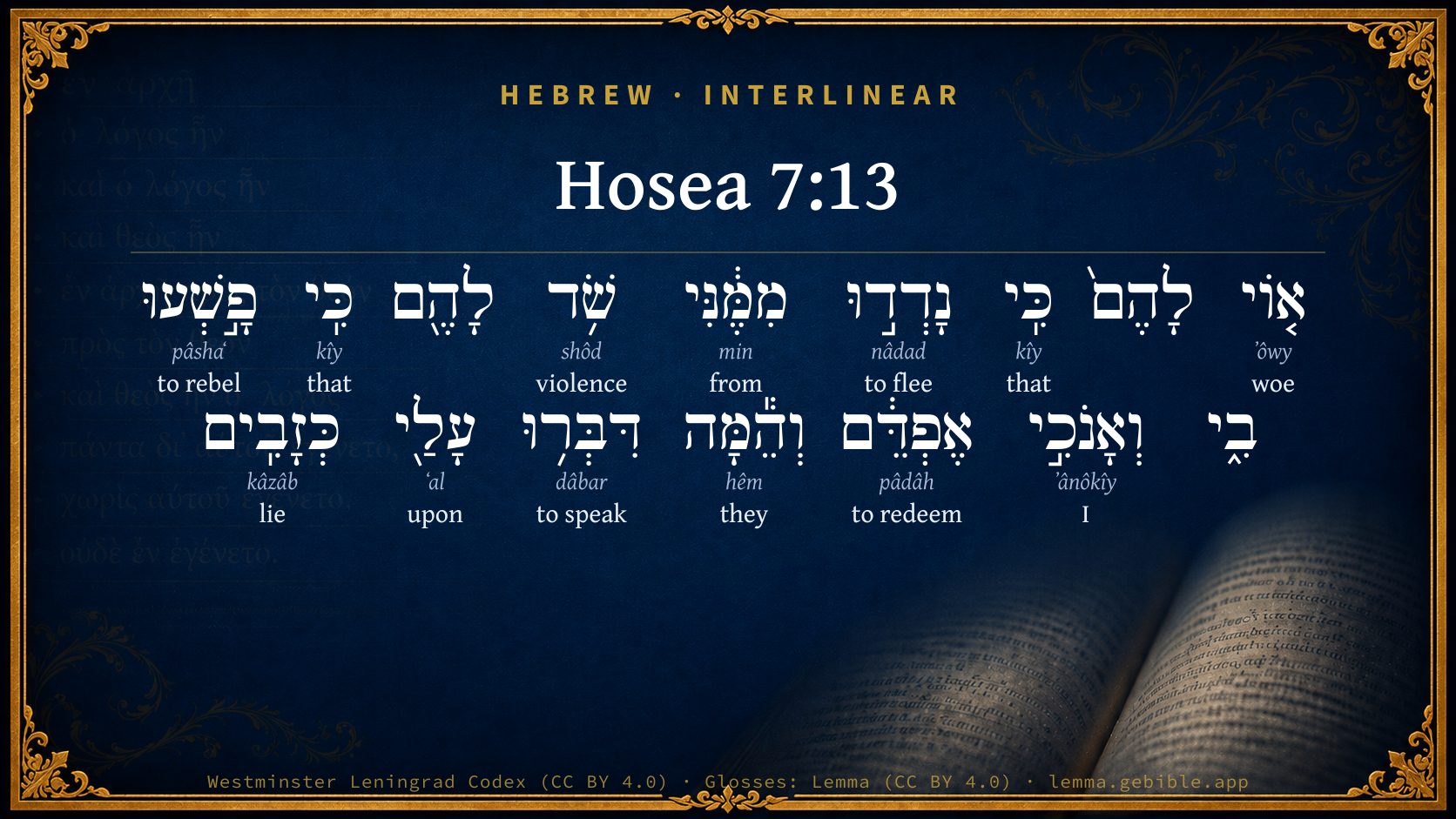
Hebrew (Westminster Leningrad Codex) Hosea 7:13 appears in the Hebrew Old Testament. The text above is from the Westminster Leningrad Codex. Each word links to its Strong’s number, a concise gloss, and parsing drawn from the Open Scriptures Hebrew Bible morphology. Click any word for its full Brown-Driver-Briggs (BDB) entry.
Download image
Cite this verse

Hosea 7:13 (World English Bible). Public Domain. Lemma interlinear Bible study tool, https://lemma.gebible.app/v/hosea/7/13.

Show BibTeX & RIS
BibTeX
RIS
English Translation
Woe to them! For they have wandered from me. Destruction to them! For they have trespassed against me. Though I would redeem them, Yet they have spoken lies against me.
World English Bible · Public Domain
Download a study sheet

One document with this verse’s original text, its word-by-word gloss line, the meaning frame, cross-references with their text, attributed commentary, and full source and license credits — printable, and it pastes into notes with its structure intact.

This verse Autodidact and up

Study sheet (.html) Plain text (.txt)

A passage Seminary Student

Up to 50 verses in one chapter. A passage sheet keeps up to 6 commentary sources and 12 cross-references per verse, in the order this page ranks them, and says so on the sheet whenever that leaves anything out. Ask for a single verse and you get the Autodidact verse sheet above.

Everything on this page stays free to read, with no account — the sheet is a download of what is already on screen, not access to it.

Want to remove ads? Support Godless Engineer
Compare translations 3

The same verse in 3 English versions, stacked beneath the original-language interlinear above. Click any original word for its lexicon entry.

Each is an independent rendering of the whole verse — the interlinear is not word-aligned to these translations.

Highlighted words mark where these versions differ — a whole-verse word diff, not a word-by-word alignment.

  • World English Bible Public Domain
    Woe to them! For they have wandered from me. Destruction to them! For they have trespassed against me. Though I would redeem them, Yet they have spoken lies against me.
  • King James Version Public Domain
    Woe unto them! for they have fled from me: destruction unto them! because they have transgressed against me: though I have redeemed them, yet they have spoken lies against me.
  • unfoldingWord Literal Text CC BY-SA 4.0
    Woe to them, for they have wandered from me! Destruction to them, for they have revolted against me! And I, I would redeem them, but they, they have spoken lies against me.

unfoldingWord Literal Text — © unfoldingWord, licensed CC BY-SA 4.0. Word-aligned USFM3 via Door43 (git.door43.org/unfoldingWord/en_ult).

Versions to compare (up to 4)

3 of 4 selected

Show all 18 translations

Every available English version of this verse, each an independent rendering of the whole verse.

  • World English Bible Public Domain
    Woe to them! For they have wandered from me. Destruction to them! For they have trespassed against me. Though I would redeem them, Yet they have spoken lies against me.
  • Berean Standard Bible Public Domain
    Woe to them, for they have strayed from Me! Destruction to them, for they have rebelled against Me! Though I would redeem them, they speak lies against Me.
  • Majority Standard Bible Public Domain
    Woe to them, for they have strayed from Me! Destruction to them, for they have rebelled against Me! Though I would redeem them, they speak lies against Me.
  • King James Version Public Domain
    Woe unto them! for they have fled from me: destruction unto them! because they have transgressed against me: though I have redeemed them, yet they have spoken lies against me.
  • American Standard Version (1901) Public Domain
    Woe unto them! for they have wandered from me; destruction unto them! for they have trespassed against me: though I would redeem them, yet they have spoken lies against me.
  • Revised Version (1885) Public Domain
    Woe unto them! for they have wandered from me; destruction unto them! for they have trespassed against me: though I would redeem them, yet they have spoken lies against me.
  • Geneva Bible (1599) Public Domain
    Wo vnto them: for they haue fled away from me: destruction shalbe vnto them, because they haue transgressed against me: though I haue redeemed them, yet they haue spoken lyes against me.
  • Douay-Rheims (1899) Public Domain
    Woe to them, for they have departed from me: they shall be wasted because they have transgressed against me: and I redeemed them: and they have spoken lies against me.
  • Young's Literal Translation Public Domain
    Wo to them, for they wandered from Me, Destruction to them, for they transgressed against Me, And I -- I ransom them, and they have spoken lies against Me,
  • Literal Standard Version CC BY-SA 4.0
    Woe to them, for they wandered from Me, || Destruction to them, for they transgressed against Me, || And I ransom them, and they have spoken lies against Me,
  • Unlocked Literal Bible CC BY-SA 4.0
    Woe to them! For they have strayed from me. Devastation is coming to them! They have rebelled against me! I would have rescued them, but they spoke lies against me.
  • unfoldingWord Literal Text CC BY-SA 4.0
    Woe to them, for they have wandered from me! Destruction to them, for they have revolted against me! And I, I would redeem them, but they, they have spoken lies against me.
  • Darby Bible Public Domain
    Woe unto them! for they have wandered from me; destruction unto them! for they have transgressed against me. And I would redeem them; but they speak lies against me.
  • World Messianic Bible Public Domain
    Woe to them! For they have wandered from me. Destruction to them! For they have trespassed against me. Though I would redeem them, yet they have spoken lies against me.
  • Webster's Bible Public Domain
    Woe to them! for they have fled from me: destruction to them! because they have transgressed against me: though I have redeemed them, yet they have spoken lies against me.
  • Free Bible Version CC BY-SA 4.0
    What disaster is coming to them because they have strayed from me! Destruction is coming to them because they have rebelled against me! I wish I could redeem them, but they tell lies about me.
  • Bible in Basic English Public Domain
    May trouble be theirs! for they have gone far away from me; and destruction, for they have been sinning against me; I was ready to be their saviour, but they said false words against me.
  • JPS Tanakh (1917) Public Domain
    Woe unto them! for they have strayed from Me; Destruction unto them! for they have transgressed against Me; Shall I then redeem them, seeing they have spoken lies against Me?

Literal Standard Version (2020), Covenant Press — licensed CC BY-SA 4.0. Text via the HelloAO Bible API (eBible.org). Unlocked Literal Bible (unfoldingWord) — licensed CC BY-SA 4.0. Text via the HelloAO Bible API (eBible.org). unfoldingWord Literal Text — © unfoldingWord, licensed CC BY-SA 4.0. Word-aligned USFM3 via Door43 (git.door43.org/unfoldingWord/en_ult). Free Bible Version, Dr. Jonathan Gallagher — licensed CC BY-SA 4.0. Text via the HelloAO Bible API (eBible.org).

Word by word

More ways to search: Search by grammar → Find every occurrence → Compare this word →

Practice this passage: Drill this verse → Learn its vocabulary →

א֤וֹי
ʼôwy
H188
“woe”
Particle, Interjection
Part of Speech
Particle
Type
Interjection
Full BDB Definition

Origin: probably from H183 (in the sense of crying out after)

TWOT: 42

woe! alas! oh! - passionate cry of grief or despair
  1. כִּֽי kîy H3588 “that” Conjunction
  2. נָדְד֣וּ nâdad H5074 “to flee” Verb, Qal, Perfect, 3rd Person, Common, Plural
  3. מִמֶּ֔נִּי min H4480 “from · me” Preposition + Suffix, Personal, 1st Person, Common, Singular
  4. שֹׁ֥ד shôd H7701 “violence” Noun, Common, Masculine, Singular, Absolute
  5. כִּֽי kîy H3588 “that” Conjunction
  6. פָ֣שְׁעוּ pâshaʻ H6586 “to rebel” Verb, Qal, Perfect, 3rd Person, Common, Plural
  7. וְאָנֹכִ֣י ʼânôkîy H595 “and · I” Conjunction + Pronoun, Personal, 1st Person, Common, Singular
  8. אֶפְדֵּ֔ם pâdâh H6299 “to redeem · them” Verb, Qal, Imperfect, 1st Person, Common, Singular + Suffix, Personal, 3rd Person, Masculine, Plural
  9. וְהֵ֕מָּה hêm H1992 “and · they” Conjunction + Pronoun, Personal, 3rd Person, Masculine, Plural
  10. דִּבְּר֥וּ dâbar H1696 “to speak” Verb, Piel, Perfect, 3rd Person, Common, Plural
  11. עָלַ֖י ʻal H5921 “upon · me” Preposition + Suffix, Personal, 1st Person, Common, Singular
  12. כְּזָבִֽים kâzâb H3577 “lies” Noun, Common, Masculine, Plural, Absolute

About this verse

These counts appear in no published source. They are computed here, from the morphology-tagged text and Lemma’s own curated glosses. What Lemma adds →

16
words
12
distinct lemmas
Prophets
section

Notable vocabulary

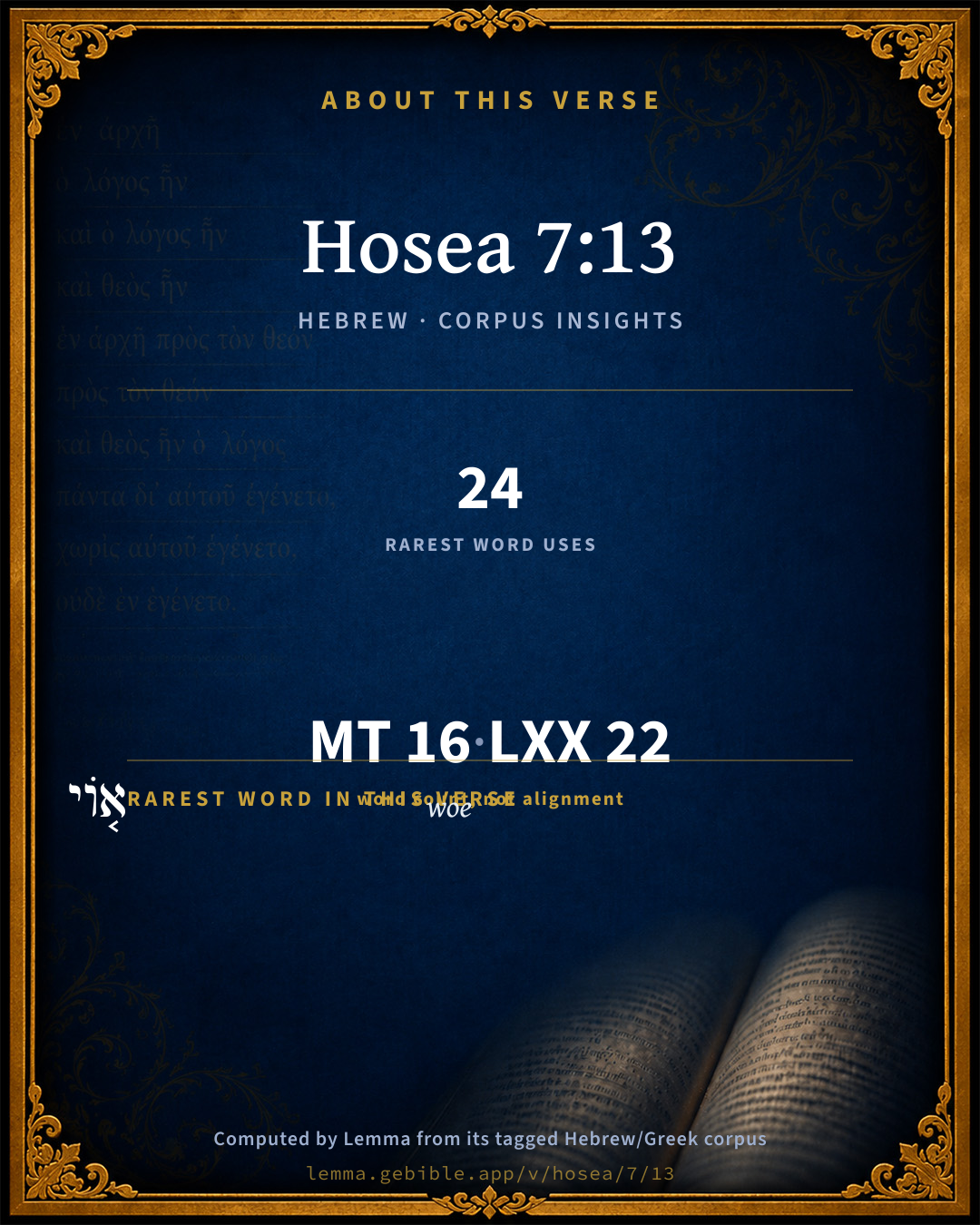
The rarest word here is א֤וֹי woe H188 — appearing just 24 times in the whole Hebrew Bible.

Shared distinctive vocabulary

א֤וֹי woe H188 occurs in 23 verses of the Hebrew Bible. Also found in:

Grammatical profile

  • 4 verbs
  • 2 nouns
  • 2 pronouns
  • 5 prepositions
  • 2 conjunctions
  • 1 particle

Verb forms

  • נָדְד֣וּ Qal · Perfect
  • פָ֣שְׁעוּ Qal · Perfect
  • אֶפְדֵּ֔ם Qal · Imperfect
  • דִּבְּר֥וּ Piel · Perfect

Repetition

A word recurs within this verse — often emphatic in Hebrew:

  • כִּֽי that H3588 ×2

Hebrew & Septuagint length

In English translation the verse runs 30 words from the Hebrew and 29 from the Septuagint (LXX English) — closely comparable.

A rough comparison of the two English renderings, which tokenize alike — not a word-level alignment.

Word counts can differ between the Hebrew and the Greek without any difference in meaning — e.g. the Hebrew direct-object marker אֵת has no separate Greek word, and Greek often adds the article ὁ.

In the original languages it is 16 Hebrew tokens and 22 Greek tokens — but the two are counted differently (Hebrew bundles its prefixes and suffixes into one token; the Greek is in lemma form), so that isn’t a like-for-like length.

Cross-references

36

Topical passages linked to Hosea 7:13 in the Treasury of Scripture Knowledge — connected by theme and wording, ordered by reader-vote popularity; previews shown in the World English Bible.

  • Hosea 9:12 Though they bring up their children, Yet I will bereave them, so that not a man shall be left. Indeed, woe also to them when I depart from them!
  • Lamentations 5:16 The crown is fallen from our head: Woe to us! for we have sinned.
  • Hosea 11:12 Ephraim surrounds me with falsehood, And the house of Israel with deceit; And Judah still us unruly with God, And is unfaithful to the Holy One.
  • Matthew 23:13–29 "Woe to you, scribes and Pharisees, hypocrites! For you devour widows' houses, and as a pretense you make long prayers. Therefore you will receive greater condemnation.
  • Deuteronomy 15:15 You shall remember that you were a bondservant in the land of Egypt, and Yahweh your God redeemed you: therefore I command you this thing today.
  • Nehemiah 1:10 Now these are your servants and your people, whom you have redeemed by your great power, and by your strong hand.
  • Job 21:14–15 They tell God, 'Depart from us, For we don't want to know about your ways.
  • Job 22:17 Who said to God, 'Depart from us;' And, 'What can the Almighty do for us?'
  • Psalms 106:10 He saved them from the hand of him who hated them, And redeemed them from the hand of the enemy.
  • Psalms 107:2–3 Let the redeemed by Yahweh say so, Whom he has redeemed from the hand of the adversary,
  • Psalms 139:7–9 Where could I go from your Spirit? Or where could I flee from your presence?
  • Isaiah 31:1 Woe to those who go down to Egypt for help, and rely on horses, and trust in chariots because they are many, and in horsemen because they are very strong, but they don't look to the Holy One of Israel, neither seek Yahweh!
  • Isaiah 41:14 Don't be afraid, you worm Jacob, and you men of Israel; I will help you, says Yahweh, and your Redeemer is the Holy One of Israel.
  • Isaiah 43:1 But now thus says Yahweh who created you, Jacob, and he who formed you, Israel: Don't be afraid, for I have redeemed you; I have called you by your name, you are mine.
  • Isaiah 59:13 transgressing and denying Yahweh, and turning away from following our God, speaking oppression and revolt, conceiving and uttering from the heart words of falsehood.
  • Isaiah 63:8 For he said, Surely, they are my people, children who will not deal falsely: so he was their Savior.
  • Jeremiah 14:10 Thus says Yahweh to this people, Even so have they loved to wander; they have not refrained their feet: therefore Yahweh does not accept them; now will he remember their iniquity, and visit their sins.
  • Jeremiah 18:11–12 Now therefore, speak to the men of Judah, and to the inhabitants of Jerusalem, saying, Thus says Yahweh: Behold, I frame evil against you, and devise a device against you: return you now everyone from his evil way, and amend your ways and your doings.
  • Jeremiah 42:20 For you have dealt deceitfully against your own souls; for you sent me to Yahweh your God, saying, Pray for us to Yahweh our God; and according to all that Yahweh our God shall say, so declare to us, and we will do it:
  • Jeremiah 44:17–18 But we will certainly perform every word that is gone forth out of our mouth, to burn incense to the queen of the sky, and to pour out drink-offerings to her, as we have done, we and our fathers, our kings and our princes, in the cities of Judah, and in the streets of Jerusalem; for then had we plenty of food, and were well, and saw no evil.
  • Ezekiel 16:23 It is happen after all your wickedness, (woe, woe to you! says the Lord Yahweh),
  • Ezekiel 18:2 What do you mean, that you use this proverb concerning the land of Israel, saying, The fathers have eaten sour grapes, and the children's teeth are set on edge?
  • Ezekiel 18:25 Yet you say, The way of the Lord is not equal. Hear now, house of Israel: Is my way not equal? Aren't your ways unequal?
  • Ezekiel 34:6 My sheep wandered through all the mountains, and on every high hill: yes, my sheep were scattered on all the surface of the earth; and there was none who searched or sought.
  • Hosea 7:1 When I would heal Israel, Then the iniquity of Ephraim is uncovered, Also the wickedness of Samaria; For they commit falsehood, And the thief enters in, And the gang of robbers ravages outside.
  • Hosea 7:3 They make the king glad with their wickedness, And the princes with their lies.
  • Hosea 9:17 My God will cast them away, because they did not listen to him; And they will be wanderers among the nations.
  • Hosea 11:2 They called to them, so they went from them. They sacrificed to the Baals, And burned incense to engraved images.
  • Jonah 1:3 But Jonah rose up to flee to Tarshish from the presence of Yahweh. He went down to Joppa, and found a ship going to Tarshish; so he paid its fare, and went down into it, to go with them to Tarshish from the presence of Yahweh.
  • Jonah 1:10 Then were the men exceedingly afraid, and said to him, "What is this that you have done?" For the men knew that he was fleeing from the presence of Yahweh, because he had told them.
  • Micah 6:4 For I brought you up out of the land of Egypt, And redeemed you out of the house of bondage. I sent before you Moses, Aaron, and Miriam.
  • Malachi 3:13–15 "Your words have been stout against me," says Yahweh. "Yet you say, 'What have we spoken against you?'
  • Matthew 23:37 "Jerusalem, Jerusalem, who kills the prophets, and stones those who are sent to her! How often would I have gathered your children together, even as a hen gathers her chickens under her wings, and you would not!
  • 1 Peter 1:18–19 knowing that you were redeemed, not with corruptible things, with silver or gold, from the useless way of life handed down from your fathers,
  • 1 John 1:10 If we say that we haven't sinned, we make him a liar, and his word is not in us.
  • Revelation 8:13 I saw, and I heard an eagle, flying in mid heaven, saying with a loud voice, "Woe! Woe! Woe for those who dwell on the earth, because of the other voices of the trumpets of the three angels, who are yet to sound!"

Cross-references courtesy of OpenBible.info (CC BY 4.0).

Hebrew and Greek witnesses Masoretic Hebrew ↔ Greek Septuagint

The same verse in the two great witnesses to the Old Testament, shown verse-for-verse.

These are two independent witnesses, not word-aligned to each other, and the Septuagint is shown in lemma (dictionary) form.

Hebrew Hosea 7:13 Masoretic · Westminster Leningrad Codex

א֤וֹי לָהֶם֙ כִּֽי נָדְד֣וּ מִמֶּ֔נִּי שֹׁ֥ד לָהֶ֖ם כִּֽי פָ֣שְׁעוּ בִ֑י וְאָנֹכִ֣י אֶפְדֵּ֔ם וְהֵ֕מָּה דִּבְּר֥וּ עָלַ֖י כְּזָבִֽים

Woe to them! For they have wandered from me. Destruction to them! For they have trespassed against me. Though I would redeem them, Yet they have spoken lies against me.

World English Bible · Public Domain

Greek LXX Hosea 7:13 Septuagint · lemma form

οὐαί αὐτός ὅτι ἀποπηδάω ἀπό ἐγώ δείλαιος εἰμί ὅτι ἀσεβέω εἰς ἐγώ ἐγώ δέ λυτρόω αὐτός αὐτός δέ καταλαλέω κατά ἐγώ ψευδής

Woe to them! for they have started aside from me: they are cowards; for they have sinned against me: yet I redeemed them, but they spoke falsehoods against me.

LXX2012 (modern English Septuagint) · Public Domain

On this verse, The Pulpit Commentary discusses the Septuagint’s reading. Read the note in Commentary ↓

Hebrew: Westminster Leningrad Codex (CC BY 4.0). Greek: Septuagint (public domain); English from LXX2012 (modern English Septuagint) (Public Domain). How the Septuagint differs from the Hebrew →

Targum (Aramaic paraphrase)

1

The Targum is the ancient Jewish Aramaic paraphrase of the Hebrew Scriptures — an interpretive translation, not the Hebrew text itself. Onkelos (literal) and Pseudo-Jonathan (expansive) render the Torah, and Jonathan the Prophets. Coverage is partial: where no permissively-licensed English translation exists for a verse, only the Aramaic is shown. This is verse-level text, not a word-by-word alignment to the Hebrew.

  1. Targum Jonathan Prophets (Joshua–Malachi)
    וַי לְהוֹן אֲרֵי אִתְרְחָקוּ מִדְחַלְתִּי בָּזוֹזִין אַיְתֵי עֲלֵיהוֹן אֲרֵי מְרָדוּ בְּמֵימְרִי וַאֲנָא הֲוֵיתִי פָּרִיק לְהוֹן וְאִינוּן מְמַלְלִין קֳדָמַי כַּדִיבִין:

    (no public-domain English translation for this verse)

    Targum Jonathan — Aramaic: “Mikraot Gedolot” (public domain). English: “Sefaria Community Translation” (CC0 1.0 (public-domain dedication)); “London "Chaldee Paraphrase," 1871” (public domain). Text via Sefaria.

Commentary

Notes on Hosea 7:13 from classic Christian and Jewish commentators (each source and its license shown beneath its notes). The classic Christian expositions comment on the surrounding passage and are grouped to its opening verse, so a note may address several verses; the Jewish commentaries on the Tanakh (Rashi and others) are per-verse, so they appear only where the commentator wrote on this verse.

Lemma curates 59 commentaries, every one of them public domain or Creative Commons licensed, each selected and text-cleaned for this edition rather than reprinted as found. About our sources →

Trapp's Complete Commentary

John Trapp

Hos 7:13 Woe unto them! for they have fled from me: destruction unto them! because they have transgressed against me: though I have redeemed them, yet they have spoken lies against me.

Ver. 13. Woe unto them! for they have fled from me] As Cain (the devil’s patriarch) did when he went out from the presence of the Lord, in his father’s family, into the land of Nod, Gen 4:16, being himself a "have not," that is, a runaway, Hos 7:12, of the same root that is here made use of in the text (Nadedu). Now as that land took name of Cain, and his woeful state therein, so is every land and place a Nod to apostates; and St Jude throws a woe after them, "Woe unto them, for they have gone in the way of Cain," Jdg 1:11, that is, they have wickedly departed from God and his blessing, and gotten into the world’s warm sun; yea, they not only go from God, but flee from him in hurried haste, as from an enemy; a metaphor from birds flying amain: Pro 27:8, "As a bird that wandereth from her nest" (where God took order for her security, Deu 22:6-7), "so is a man that wandereth from his place" (how much more from his God, that infinite good!), exposed to misery and mischief, to ruth and ruin. Woe to such, yea, double woe: Woe and alas: destruction to such, and devastation, as the word signifieth, שׁר. Perdition and destruction, as the apostle phraseth it, 1Ti 6:9, whereby is meant torments without end, and past imagination; remediless misery, mischief without measure. This truth must be told, however it be taken, that wicked men may not perish without warning. Toothless truths and silken words would better please people, who are most of them sick of a Noli me tangere, and cry out against these fierce preachers, that come with their Woe unto them, Destruction unto them, &c. This is the way, say they, to drive men into utter despair. We answer, first, if it should be so, yet that is not the proper effect of the word so dispensed; but to abate the pleasure that reprobates take in sin, and to restrain them from outrage; that they despair, it proceeds merely from their own corruption and guiltiness. They reply, that it comes rather from the severity of the teachers, who set themselves to preach damnation, and utter terrible things. Secondly, therefore, we answer, that the mad world (ever beside itself in point of salvation) is herein very much mistaken. Let them give us an instance of any one that was ever driven to despair by the sincere preaching of the word: and yet for one bitter word given by us, the prophets gave ten. This whole Prophecy of Hosea is much more comminatory then consolatory. God himself comes here with Woe unto them, Destruction to them. Indeed by this pathetic exclamation he declareth his affection toward them whom he threateneth; and how little delight he takes either in their destruction or in such denunciation thereof; and so must God’s ministers, &c.

Because they have transgressed against me] This is a new degree of their apostasy from God. Wicked men and deceivers grow worse and worse, and add rebellion to sin. As a stone will fall down to come to its centre, though it break itself in twenty pieces; so will apostates, till they come to their own place with Judas; they cease not till they become altogether filthy, Psa 53:3, as the dog at his vomit, or the sow in her slough, 2Pe 2:22. It fareth with such as in that case, Lev 13:18-20; if a man had a boil healed, and it afterwards broke out, it proved the plague of leprosy.

Though I have redeemed them, yet they have spoken lies against me] All was done against God, whence the word "me" is so often inculcated in this and the next verse. God is, as it were, a sufferer in all the sins of the sons of men; and this is no small aggravation of the evil of sin, that it strikes at God’s face, lifts at his throne, makes to his dishonour. "Thou hast made me to serve with thy sins, and wearied me with thine iniquities," Isa 43:23. And to show this to be so, it was, that the offender was confined to the city of refuge during the high priest’s life, as being the chief god on earth. Good David was very sensible of this, and much humbled, when he said, "Against thee, thee only have I sinned," Psa 51:4. The trespass was against Uriah, but the transgression against God, so gracious a God; and there lay the pinch of his grief; viz. the unkindness that was in his sin. Therefore also Moses, in his swan song, sets on this humbling consideration, Deu 32:6, "Do ye thus requite the Lord, O foolish people and unwise? is not he thy father?" and wilt thou kick against his naked bowels? hast nowhere else to hit him but there? Again, "Is not he thy Redeemer," that hath bought thee, and brought thee out of the iron furnace, where thou labouredst in the very fire, and wast wearied out with unsufferable servitude? More, "hath he not made thee," and dost thou rebel against thy Maker, thy Master? Or, "hath he not made thee," that is, exalted thee? in which sense he is said to have made Moses and Aaron, 1Sa 12:6, that is, to have advanced them to that honour in his Church; and so we say, such a one is made for ever. Lastly, "hath he not established thee," that thou mightest abide in his grace, and remain unmoveable? and dost thou yet "evil requite him?" &c. To render good for evil is divine; good for good is human; evil for evil is brutish; but evil for good is devilish. See how grievously God taketh it here. "Though I have redeemed them," viz. out of the hands of their enemies in general (see an ample proof hereof, Neh 9:1-38 and the whole Book of Judges throughout), and in special, as a late particular mercy to Ephraim; I have delivered and prospered them in their wars, under Jeroboam, the son of Joash, 2Ki 14:27, and therefore they should have given me their good word at least, and spoken good of my name; yet "they have spoken lies against me," ascribing the glory of their deliverances to their idols, or arrogating it to themselves, or fathering their false worship upon me as the author, or at least, abettor thereof, by my present prospering of them. See Jer 7:10.

John Trapp, A Commentary or Exposition upon All the Books of the Old and New Testament (1647–1656) — public domain. Text from a community e-Sword module.

Joseph Benson's Commentary

Hos 7:13-14. Wo unto them, &c. — These are words both of menace and lamentation. The prophet at once foretels and bewails their miseries. For they have fled from me — As if it had not been enough that they at first left my government, temple, and worship, they have gone still further from me by their sinful and idolatrous courses. Destruction unto them — The ruin of their country and commonwealth will be the consequence of their apostacy. Because they have transgressed against me — Rebelliously cast off my authority and laws. Though I have redeemed them, yet they have spoken lies, &c. — Though I delivered them from the Egyptians, and afforded them many other signal deliverances, yet they have not given me true glory, but have likened me to golden calves, and other images. Idolatry is frequently called in Scripture a lie, because it gives false representations of things; attributing power, &c., to things which, in their own nature, have no such power, or representing the Deity by forms which he is in no way like; therefore it was, properly speaking, changing the truth and glory of God into a lie, or, speaking lies against him. They also belied his corrections, as if not deserved; they belied the good which God had done them, as if it were too little, or not done by him, but by their idols. And they have not cried unto me, when they howled, &c. — When they bemoaned their calamities, as sick men bewail themselves upon their beds of sickness; yet they did not call upon me heartily and sincerely. They assemble, &c., for corn and wine, and they rebel, &c. — When they assemble themselves to deprecate a famine, they still retain the same disobedient temper toward me.

Joseph Benson's Commentary on the Old and New Testaments (1811–1818) — public domain. Text from a community e-Sword module.

Tyndale Open Study Notes

Tyndale Open Resources

7:13 What sorrow: This word (Hebrew ’oy) was used at funerals to mourn the dead. In God’s eyes, Israel was as good as dead because they had rebelled against him. Rebellion against a human king was a capital crime; how much more serious it was for God’s people to rebel against their heavenly king. • I wanted to redeem them: This Hebrew word means paying a fee to repatriate someone who has been enslaved. It is often associated with the exodus from Egypt. The Lord desired to do for the Israelites what he did when he brought their ancestors out of their slavery to pagan gods, but they . . . told lies about him.

Tyndale Open Study Notes — © Tyndale Open Resources, licensed CC BY-SA 4.0. Text via the HelloAO Bible API.

Geneva Bible (1599)

Geneva Bible translators

That is, divers times redeemed them, and delivered them from death.

Geneva Bible (1599) marginal notes — public domain. Text via Bolls.life.

Jamieson, Fausset & Brown

Robert Jamieson, A. R. Fausset & David Brown

fled--as birds from their nest (Pro 27:8; Isa 16:2).

me--who both could and would have healed them (Hos 7:1), had they applied to Me.

redeemed them--from Egypt and their other enemies (Mic 6:4).

lies-- (Psa 78:36; Jer 3:10). Pretending to be My worshippers, when they all the while worshipped idols (Hos 7:14; Hos 12:1); also defrauding Me of the glory of their deliverance, and ascribing it and their other blessings to idols [CALVIN].

Jamieson, Fausset & Brown — Commentary Critical and Explanatory on the Whole Bible (1871) — public domain (CC PDM 1.0). Text via the HelloAO Bible API.

Adam Clarke's Commentary

Verse 13. Wo unto them!] They shall have wo, because they have fled from me. They shall have destruction, because they have transgressed against me.

Though I have redeemed them] Out of Egypt; and given them the fullest proof of my love and power.

Yet they have spoken lies against me.] They have represented me as rigorous and cruel; and my service as painful and unprofitable.

Adam Clarke's Commentary on the Bible (1810–1826) — public domain. Text from a community e-Sword/MySword module.

John Calvin's Commentaries

Here the Prophet takes away from the Israelites the hope of pardon, and declares that it was all over with them, for God had now resolved to destroy them. For as God everywhere declares himself to be ready and inclined to pardon, hypocrites hope that God will be propitious to them; and entertaining this vain confidence, they despise his threatening and boldly rise up against him. Hence the Prophet here shows, that God would hereafter be inexorable to them, because they had too long pertinaciously abused his patience. Woe to them! he says, for they have withdrawn from me: desolation to them! for they have acted perfidiously towards me There is then no reason, says the Prophet, for them to delude themselves in future with vain confidence, as they have hitherto done; for this has been once for all determined by God — to indict on them his extreme vengeance, for their defection deserves this.

He then adds, I will redeem them, and they have spoken lies against me. They who render the first word in the future tense, think that the Prophet asks a question, “Shall I redeem them? for they have spoken lies against me:” and they think it to be an indefinite mode of speaking — “Should I redeem them, men of no faith; for what good should I do by such kindness?” Others give this expositions — “Though I wished to redeem them, yet I found that this would not be beneficial nor just, because they speak lies against me;” as though God did not express here what he had done, but what he had wished to do. But the past tense is not unsuitable to this place; and we know how common and familiar to the Hebrews was the change of tenses. The meaning, then, will be, “I have redeemed them, and they have spoken lies against me;” that is, “I have often delivered them from death, when they were in extreme peril; but they have not changed their disposition; nay, they have deprived me of the praise due for their deliverance, and they have lived in no way better after their deliverance. Since, then, I have hitherto conferred my benefits to no good purpose, nothing now remains but that I must destroy them.” And this seems to me to be the Prophet’s meaning.

He then declares, in the first clause, that they hoped for mercy in vain from God, because their ultimate destruction was decreed. Then follows the reason for this, because they had foolishly and impiously abused the favor of God, inasmuch as, having been redeemed by him, they yet went on in their own wickedness, and even acted perfidiously towards God, while yet they pretended to act differently. Since, then, there was no change for the better, God now shows that he would spend his favor no longer on men so impious. Now this place teaches how intolerable is our ingratitude, when, after having been redeemed by the Lord, we keep not the faith pledged to him, and which he requires from us; for God is our deliverer on this condition, that we be wholly devoted to him. For he who has been redeemed ought not so to live, as if he had a right to himself and to his own will; but he ought to be wholly dependent on his Redeemer. If, then, we thus act perfidiously towards God, after having been delivered by his grace, we shall be guilty of such impiety and perfidiousness as deserve a twofold vengeance: and this is what the Prophet here teaches.

We indeed know how mercifully God had spared the people of Israel: after they had fallen away into superstitious worship, and had also violated their faith to the posterity of David, the Lord did not yet cease to show to that people many favors, notwithstanding their unworthiness. We know also, that under Jeroboam prosperity had attended them beyond all human expectation. But they yet hardened themselves more and more in their wickedness, so far were they from returning to the right way. Let us now proceed —

John Calvin's Commentaries (1540-1563) — public domain. Text from the Calvin Translation Society English edition (1840s-50s) via the Christian Classics Ethereal Library (ccel.org). Calvin's coverage is partial (roughly two-thirds of the Bible); uncommented books and verses are honest gaps, never fabricated. The 19th-century editor's footnotes and remarks are omitted so the notes are faithfully Calvin's own voice.

Ellicott's Commentary for English Readers

(13) Fled.—The word thus translated is used of the wandering flight of birds, and arises naturally out of the images employed in Hos_7:11-12.

(13) Though I have redeemed.—Should be, Though I would fain redeem them: an impressive picture of all the insults to longsuffering Divine love.

A Bible Commentary for English Readers, edited by Charles John Ellicott (1878–1897) — public domain. Text from a community e-Sword module.

The Cambridge Bible for Schools and Colleges

gen. ed. J. J. S. Perowne

13. they have fled from me] like birds scared out of their nest (Isa_16:2); but the Israelites have only themselves to blame for the fatal consequence. They have left their true home, and shall find no second (see on Hos_9:17).

transgressed] Or, ‘rebelled; strictly, ‘broken away.’

though I have redeemed …] Rather, I indeed would redeem them, but they, &c. The ‘lies’ of the Israelites related (see next verse) to Jehovah’s power and willingness to save.

The Cambridge Bible for Schools and Colleges (gen. ed. J. J. S. Perowne; Cambridge University Press, 1878–1918) — public domain. Text from a community e-Sword module.

John Gill's Exposition

Woe unto them, for they have fled from me,.... From the Lord, from his worship, and the place of it; from obedience to him, and the service of him; as birds fly from their nests, and leave their young, and wander about; so they had deserted the temple at Jerusalem, and forsaken the service of the sanctuary, and set up calves at Dan and Bethel, and worshipped them; and, instead of fleeing to God for help in time of distress, fled further off still, even out of their own land to Egypt or Assyria: the consequence of which was, nothing but ruin; and so lamentation and woes:

destruction unto them, because they have transgressed against me; against the laws which God gave them; setting up idols, and worshipping them, and so broke the first table of the law; committing murder, adultery, thefts and robberies, with which they are charged the preceding part of this chapter, and so transgressed the second table of the law; and by all brought destruction upon themselves, which was near at hand, and would certainly come, as here threatened; though they promised themselves peace, and expected assistance from neighbouring nations, but in vain, having made the Lord their enemy, by breaking his laws:

though I have redeemed them; out of Egypt formerly, and out of the hands of the Moabites, Ammonites, Philistines, and others, in the times of the judges; and more lately in the times of Joash and Jeroboam the second, who recovered many cities out of the hands of the Syrians. Aben Ezra, Jarchi, and Kimchi, interpret this of the good disposition of God towards them, having it in his heart to redeem them now from their present afflictions and distresses, but that they were so impious and wicked, and so unfaithful to him:

yet they have spoken lies against me; against his being and providence, being atheistically inclined; or pretending repentance for their sins, when they were hypocrites, and returned to their former courses; or setting up idols in opposition to him, which were vanity to him; attributing all their good things to them, and charging him with all their evils. Abendana reads the words interrogatively, "should I redeem them, when they have spoken lies against me?" (t) no, I will not.

(t) "et ego redimerem eos?" so some in Rivet.

John Gill's Exposition of the Whole Bible (1746–1763) — public domain (CC PDM 1.0). Text via the HelloAO Bible API.

Albert Barnes' Notes on the Bible

Woe unto them, for they have fled from Me - The threatening rises in severity, as did the measure of their sin. Whereas “Salvation belonged to God” Psa 3:8 alone, and they only “abide under His shadow” Psa 91:1-2, who make Him their “refuge, woe” must needs come on them, who leave Him. “They forsake their own mercy” Jon 2:8. “Woe” they draw upon themselves, who forget God; how much more then they, who willfully and with a high hand transgress against Him! “Destruction unto them, for they have transgressed against Me.” To be separated from God is the source of all evils; it is the “pain of loss” of God’s presence, in hell; but “destruction” is more than this; it is everlasting death.

And I have redeemed them and they have spoken lies against Me - The “I” and “they” are both emphatic in Hebrew; ”I redeemed;” “they spoke lies.” Such is man’s requital of His God. Oft as He redeemed, so often did they traduce Him. Such was the history of the passage through the wilderness; such, of the period under the Judges; such had it been recently, when God delivered Israel by the hand of Jereboam II 2Ki 14:25-27. The word, “I have redeemed,” denotes “habitual oft-renewed deliverance,” “that He was their constant Redeemer, from whom they had found help, did still find it, and might yet look to find it, if they did not, by their ill behavior, stop the course of His favor toward them” . God’s mercy overflowed their ingratitude. “They” had Spoken lies against Him, often as He had delivered them; He was still their abiding Redeemer. “I do redeem them.”

They have spoken lies against Me - People “speak lies” against God, in their hearts, their words, their deeds; whenever they harbor thoughts, speak words, or act, so as to deny that God is what He is, or as to imply that He is not what He has declared Himself to be. Whoever seeks anything out of God or against His will; whoever seeks from man, or from idols, or from fortune, or from his own powers, what God alone bestows; whoever acts as if God was not a good God, ready to receive the penitent, or a just God who will avenge the holiness of His laws and “not clear the guilty,” does in fact, “speak lies against God.” People, day by day, “speak lies against God,” against His Wisdom, His providence, His justice, His Goodness, His Omniscience, when they are thinking of nothing less. Jeroboam spake lies against God, when he said, “these be thy gods, O Israel, which brought thee out of the land of Egypt,” whereas God had so often enforced upon them Exo 20:2; Lev 19:36; Lev 23:43; Num 15:41; Deu 5:6, Deu 5:15, “the Lord redeemed you out of the house of bondmen, from the hand of Pharaoh king of Egypt (Deu 7:8; add. Deu 13:5; Deu 15:15; Deu 24:18); the Lord thy God brought thee out thence with a mighty hand and stretched out arm.”

Israel “spake lies against God,” when he said, “these are my rewards which my lovers have given me” Hos 2:12, or when, “they returned not to Him” but “called on Egypt,” as though God would not help them, who said that He would, or as though Egypt could help them, of whom God said that it should not. Sometimes, they “spoke” out “lies” boldly, telling God’s true prophets that He had not sent them, or forbidding them to speak in His Name; sometimes covertly, as when they turned to God, not sincerely but feignedly; but always perversely. And when God the Son came on earth to “redeem them,” then still more, they spoke lies against Him, all His life long, saying, “He deceiveth the people,” and all their other blasphemies, and , “when He, forgave them the sin of His death, saying, “Father, forgave them for they know not what they do,” they persevered in “speaking lies” against Him, and bribed the soldiers to speak lies against Him,” and themselves do so to this day.

Albert Barnes' Notes on the Bible (1834–1885) — public domain. Text from a community e-Sword/MySword module.

Haydock's Catholic Bible Commentary

Lies, attributing their deliverance to the golden calf, (3 Kings xii. 28.; Calmet; Exodus xxxii. 8.; Menochius) and always denying my justice and power.

George Leo Haydock (1774–1849), Haydock's Catholic Family Bible and Commentary, 1859 edition — public domain. Excludes Psalms (Douay-Rheims chapter numbering differs from Protestant) and Deuterocanonical books (Catholic canon only).

Matthew Poole's English Annotations

Woe unto them! it is the voice both of menace and lamentation, the prophet doth at once foretell and bewail their miseries.

They have fled from me; as if it were not enough that they did at first leave my government, temple, and worship, they have gone further from me, they have hastened herein, they flew from me as birds on wing: their sin is apostacy.

Destruction unto them! this explains the woe already mentioned, such woe it will be as ends in destruction.

Because they have transgressed against me; rebelliously cast off my law and government, much in state, more in church matters, oppressors in one, idolaters in the other, and incorrigible in both.

Though I have redeemed them; out of Egypt; but that is long since, and the prophet speaks of deliverance nearer to the times he lived in: God redeemed them partly by Joash, 2Ki 18, but more fully by Jeroboam the Second, 2Ki 14, and would have completed this deliverance, but they by sins hinder it.

Yet they have spoken lies against me; practically they belie me, fleeing to idols, worshipping them, praying to them, as if I were not able or willing to help them; and ascribing praise of the good they enjoy to their idols, Hos 2:5-7; they belied his corrections, as if not deserved, or severer than need; they belied the good done, as if too little, or not done by God, but by their idol.

Matthew Poole's English Annotations on the Holy Bible (1683–1685) — public domain. Text from a community e-Sword/MySword module.

The Pulpit Commentary

Woe unto them! for they have fled from me: destruction (margin, spoil) unto them! because they have transgressed against me. Of these exclamations, the first is general and indefinite, the second is specific and precise. The thought of coming chastisement calls forth the exclamation of woe; while the second exclamation fixes the character and explains the nature of that woe denounced. In neither case does yhiy or aboy need to be supplied; the opposite expression is or hklB In assigning the reason, there is a retrospective reference to the figures of the two immediately preceding verses. The word ddn with rain is employed in relation to birds which, when scared from their nest, fly away. Kimchi thinks it applies to the abstention or withdrawal of the Israelites from Divine service in the national sanctuary in Jerusalem. His comment is: "They fly from me, from the service of the house of my sanctuary, to the service of the calves; and this is a breach of faith and defection from me." The LXX translate the beginning of the second clause freely by deilaioi eisin , equivalent to "they are cowards;" and Jerome by "miseri (maticulose) erunt, et semper timentis ac formidantes." The cause assigned is their breaking covenant with God, which is expressed by vp, literally, "to break away from," "tear one"s self loose from." Though I have redeemed them. This first part of the last clause is rendered

(1) as a past by some, as Jerome, who refers it to the redemption from Egypt; thus also the Chaldee: "And I was their Deliverer." Rosenm approves of this, but, instead of restricting it to the deliverance from Egypt, includes their recent deliverance from the Syrians by Jeroboam II It is

(2) better rendered in a voluntative or optative sense: "I would (should like) to redeem them, but they speak lies against (or, concerning) me." The verb ephdem cannot with any propriety be taken for a preterit. Yet they have spoken lies against me; rather, but they on their part have spoken lies con cerning me. The prophet had already charged them with lying at ver. 3, and previously at Hos_4:2; but their lies were not confined to their intercourse or dealings with their fellow-men; they spoke lies against or, as the preposition sometimes signifies, concerning God. The lies in question included, no doubt, a denial of his essential Deity or sole Divinity; of his power or willingness either to protect or punish. Or they might consist in their falsehood in drawing near to God with their lips without either true faith or real affection in their hearts; some were directly opposed to the claims of Jehovah, some insincere in his service, and others turned aside to the idolatry of the calves all, with probably some honorable exceptions, had proved false to his covenant with Israel. The last clause has been taken

(3) independently by Ewald, without any considerable alteration of the sense: "I, for my part, would redeem them, but they, on their side, speak lies against me." Other acceptations,

(a) interrogative and

(b) conditional, evidently mistake the sense.

The whole clause is correctly explained by Kimchi thus: It was in my heart to redeem them out of their distress; but they speak lies against me, while they say that I know nothing nor exercise any providential care over their actions, whether their actions are good or bad. Therefore I have withdrawn my providential oversight, and have hidden my face from them, and they shall be consumed."

The Pulpit Commentary (1880–1919), ed. H.D.M. Spence-Jones & Joseph S. Exell — public domain. Text from a community e-Sword module.

John Wesley's Explanatory Notes

Spoken lies - They belied his corrections as if not deserved; they belied the good done, as if too little, or not done by God, but by their idol.

John Wesley, Explanatory Notes Upon the Whole Bible (1754–1765) — public domain. Text via the GEBible commentary corpus.

Keil & Delitzsch

C. F. Keil & F. Delitzsch

"Woe to them! for they have flown from me; devastation to them! for they have fallen away from me. I would redeem them, but they speak lies concerning me. Hos 7:14. They did not cry to me in their heart, but howl upon their beds; they crowd together for corn and new wine, and depart against me." The Lord, thinking of the chastisement, exclaims, Woe to them, because they have fled from Him! Nâdad, which is applied to the flying of birds, points back to the figures employed in Hos 7:11, Hos 7:12. Shōd, used as an exclamation, gives the literal explanation of 'ōi (woe). The imperfect 'ephdēm cannot be taken as referring to the redemption out of Egypt, because it does not stand for the preterite. It is rather voluntative or optative. "I would (should like to) redeem them (still); but they say I cannot and will not do it." These are the lies which they utter concerning Jehovah, partly with their mouths and partly by their actions, namely, in the fact that they do not seek help from Him, as is explained in Hos 7:14. They cry to the Lord; yet it does not come from the heart, but (כּי after לא) they howl (יילילוּ, cf. Ges. 70, 2, note) upon their beds, in unbelieving despair at the distress that has come upon them. What follows points to this. Hithgōrēr, to assemble, to crowd together (Psa 56:7; Psa 59:4; Isa 54:15); here to gather in troops or crowd together for corn and new wine, because their only desire is to fill their belly. Thus they depart from God. The construction of סוּר with ב, instead of with מן or מאחרי, is a pregnant one: to depart and turn against God.

Keil & Delitzsch — Biblical Commentary on the Old Testament (1861–1891) — public domain (CC PDM 1.0). Text via the HelloAO Bible API. (Old Testament only.)

Scofield Reference Notes

C. I. Scofield

redeemed

(See Scofield "Isa 59:20"). See Scofield "Exo 14:30".

The Scofield Reference Bible (1917 edition), notes by C. I. Scofield — public domain. Text from a community e-Sword module.

Rashi

Rabbi Shlomo Yitzchaki (Rashi)

I would redeem them I wanted to redeem them from the evil in which they are [found].

but they spoke lies about Me They said to Jeremiah, (Jer. 43:2) “You speak falsely; the Lord our God did not send you to say, ‘You shall not come to Egypt.’”

Rashi on the Tanakh — English translations: “The Judaica Press complete Tanach with Rashi, translated by A. J. Rosenberg” (CC BY 4.0); “Pentateuch with Rashi's commentary by M. Rosenbaum and A.M. Silbermann, 1929-1934” (public domain); “The Metsudah Tanach series, Lakewood, N.J” (CC BY 4.0); and “The Book of Joshua, Metsudah Publications, 1997” (CC BY 4.0). Text via Sefaria.

Lesson kit

Teaching starters — assembled from the data on this page, not authored interpretation. Every prompt links to the verse data it draws on. Edit before teaching.

Hosea, in the Prophets, opens this verse with 16 words (12 distinct Hebrew lemmas). Its most distinctive word is ʼôwy (“woe”). A historical commentator’s framing appears above. Read the whole chapter for the surrounding context.

Discussion questions

  1. How does “woe” (ʼôwy) shape what this verse is saying?
  2. How does Numbers 21:29, which shares the word «woe», read alongside this verse?
  3. What does the repetition of “that” (2× in this one verse) do in this verse?
  4. These translations render this verse differently; the difference is in the English rendering, not the original. What questions does that raise?
  5. «נָדְד֣וּ» is a Qal Perfect verb. How does that grammatical form shape the action described?
  6. Compare how Trapp's Complete Commentary and Joseph Benson's Commentary read this verse. Where do they agree or differ?

Things to notice

Reading settings

Reading text

Shown beneath each verse's original-language words.

Old Testament
Old Testament edition

Read the OT as the Masoretic Hebrew (MT) or the Greek Septuagint (LXX).

English shown for the Greek Septuagint (in the Hebrew ↔ Greek comparison).

Comparing translations? Open the Compare panel on any verse page to stack up to four side by side.