Ezekiel 36:28

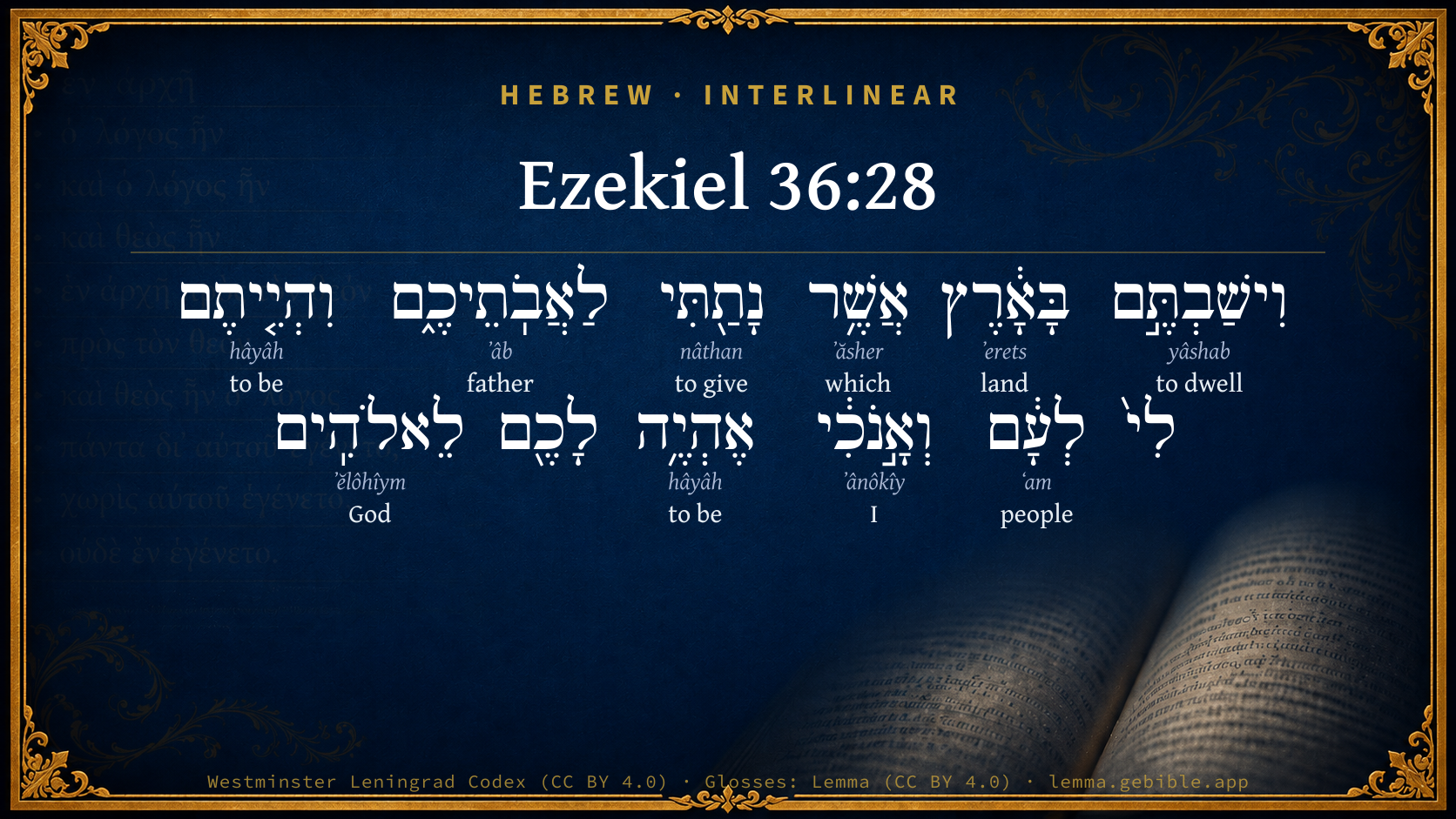
Hebrew (Westminster Leningrad Codex) Ezekiel 36:28 appears in the Hebrew Old Testament. The text above is from the Westminster Leningrad Codex. Each word links to its Strong’s number, a concise gloss, and parsing drawn from the Open Scriptures Hebrew Bible morphology. Click any word for its full Brown-Driver-Briggs (BDB) entry.
Download image
Cite this verse

Ezekiel 36:28 (World English Bible). Public Domain. Lemma interlinear Bible study tool, https://lemma.gebible.app/v/ezekiel/36/28.

Show BibTeX & RIS
BibTeX
RIS
English Translation
You shall dwell in the land that I gave to your fathers; and you shall be my people, and I will be your God.
World English Bible · Public Domain
Download a study sheet

One document with this verse’s original text, its word-by-word gloss line, the meaning frame, cross-references with their text, attributed commentary, and full source and license credits — printable, and it pastes into notes with its structure intact.

This verse Autodidact and up

Study sheet (.html) Plain text (.txt)

A passage Seminary Student

Up to 50 verses in one chapter. A passage sheet keeps up to 6 commentary sources and 12 cross-references per verse, in the order this page ranks them, and says so on the sheet whenever that leaves anything out. Ask for a single verse and you get the Autodidact verse sheet above.

Everything on this page stays free to read, with no account — the sheet is a download of what is already on screen, not access to it.

Want to remove ads? Support Godless Engineer
Compare translations 3

The same verse in 3 English versions, stacked beneath the original-language interlinear above. Click any original word for its lexicon entry.

Each is an independent rendering of the whole verse — the interlinear is not word-aligned to these translations.

Highlighted words mark where these versions differ — a whole-verse word diff, not a word-by-word alignment.

  • World English Bible Public Domain
    You shall dwell in the land that I gave to your fathers; and you shall be my people, and I will be your God.
  • King James Version Public Domain
    And ye shall dwell in the land that I gave to your fathers; and ye shall be my people, and I will be your God.
  • unfoldingWord Literal Text CC BY-SA 4.0
    Then you will inhabit the land that I gave to your ancestors; you will be my people, and I will be your God.

unfoldingWord Literal Text — © unfoldingWord, licensed CC BY-SA 4.0. Word-aligned USFM3 via Door43 (git.door43.org/unfoldingWord/en_ult).

Versions to compare (up to 4)

3 of 4 selected

Show all 18 translations

Every available English version of this verse, each an independent rendering of the whole verse.

  • World English Bible Public Domain
    You shall dwell in the land that I gave to your fathers; and you shall be my people, and I will be your God.
  • Berean Standard Bible Public Domain
    Then you will live in the land that I gave your forefathers; you will be My people, and I will be your God.
  • Majority Standard Bible Public Domain
    Then you will live in the land that I gave your forefathers; you will be My people, and I will be your God.
  • King James Version Public Domain
    And ye shall dwell in the land that I gave to your fathers; and ye shall be my people, and I will be your God.
  • American Standard Version (1901) Public Domain
    And ye shall dwell in the land that I gave to your fathers; and ye shall be my people, and I will be your God.
  • Revised Version (1885) Public Domain
    And ye shall dwell in the land that I gave to your fathers; and ye shall be my people, and I will be your God.
  • Geneva Bible (1599) Public Domain
    And ye shall dwell in the land, that I gaue to your fathers, and ye shalbe my people, and I will be your God.
  • Douay-Rheims (1899) Public Domain
    And you shall dwell in the land which I gave to your fathers, and you shall be my people, and I will be your God.
  • Young's Literal Translation Public Domain
    And ye have dwelt in the land that I have given to your fathers, And ye have been to Me for a people, And I -- I am to you for God.
  • Literal Standard Version CC BY-SA 4.0
    And you have dwelt in the land that I have given to your fathers, || And you have been to Me for a people, || And I am to you for God.
  • Unlocked Literal Bible CC BY-SA 4.0
    Then you will inhabit the land that I gave to your ancestors; you will be my people, and I will be your God.
  • unfoldingWord Literal Text CC BY-SA 4.0
    Then you will inhabit the land that I gave to your ancestors; you will be my people, and I will be your God.
  • Darby Bible Public Domain
    And ye shall dwell in the land that I gave to your fathers, and ye shall be my people, and I will be your God.
  • World Messianic Bible Public Domain
    You will dwell in the land that I gave to your fathers. You will be my people, and I will be your God.
  • Webster's Bible Public Domain
    And ye shall dwell in the land that I gave to your fathers; and ye shall be my people, and I will be your God.
  • Free Bible Version CC BY-SA 4.0
    Then you will live in the country I gave to your forefathers. You will be my people, and I will be your God.
  • Bible in Basic English Public Domain
    So that you may go on living in the land which I gave to your fathers; and you will be to me a people, and I will be to you a God.
  • JPS Tanakh (1917) Public Domain
    And ye shall dwell in the land that I gave to your fathers; and ye shall be My people, and I will be your God.

Literal Standard Version (2020), Covenant Press — licensed CC BY-SA 4.0. Text via the HelloAO Bible API (eBible.org). Unlocked Literal Bible (unfoldingWord) — licensed CC BY-SA 4.0. Text via the HelloAO Bible API (eBible.org). unfoldingWord Literal Text — © unfoldingWord, licensed CC BY-SA 4.0. Word-aligned USFM3 via Door43 (git.door43.org/unfoldingWord/en_ult). Free Bible Version, Dr. Jonathan Gallagher — licensed CC BY-SA 4.0. Text via the HelloAO Bible API (eBible.org).

Word by word

More ways to search: Search by grammar → Find every occurrence → Compare this word →

Practice this passage: Drill this verse → Learn its vocabulary →

וְאָ֣נֹכִ֔י
ʼânôkîy
H595
“and · I”
Conjunction + Pronoun, Personal, 1st Person, Common, Singular
Part of Speech
Conjunction + Pronoun
Type
Personal
Person
1st Person
Gender
Common
Number
Singular
Full BDB Definition

Origin: a primitive pronoun

TWOT: 130

I (first person singular)
  1. וִישַׁבְתֶּ֣ם yâshab H3427 “and · to dwell” Conjunction + Verb, Qal, Sequential Perfect, 2nd Person, Masculine, Plural
  2. בָּאָ֔רֶץ ʼerets H776 “in/at the · land” Preposition, Determined + Noun, Common, Both, Singular, Absolute
  3. אֲשֶׁ֥ר ʼăsher H834 “which” Particle, Relative
  4. נָתַ֖תִּי nâthan H5414 “to give” Verb, Qal, Perfect, 1st Person, Common, Singular
  5. לַאֲבֹֽתֵיכֶ֑ם ʼâb H1 “to/for · fathers · your” Preposition + Noun, Common, Masculine, Plural, Construct + Suffix, Personal, 2nd Person, Masculine, Plural
  6. וִהְיִ֤יתֶם hâyâh H1961 “and · to be” Conjunction + Verb, Qal, Sequential Perfect, 2nd Person, Masculine, Plural
  7. לְעָ֔ם ʻam H5971 “to/for · people” Preposition + Noun, Common, Masculine, Singular, Absolute
  8. אֶהְיֶ֥ה hâyâh H1961 “to be” Verb, Qal, Imperfect, 1st Person, Common, Singular
  9. לֵאלֹהִֽים ʼĕlôhîym H430 “to/for · God(s)” Preposition + Noun, Common, Masculine, Plural, Absolute

About this verse

These counts appear in no published source. They are computed here, from the morphology-tagged text and Lemma’s own curated glosses. What Lemma adds →

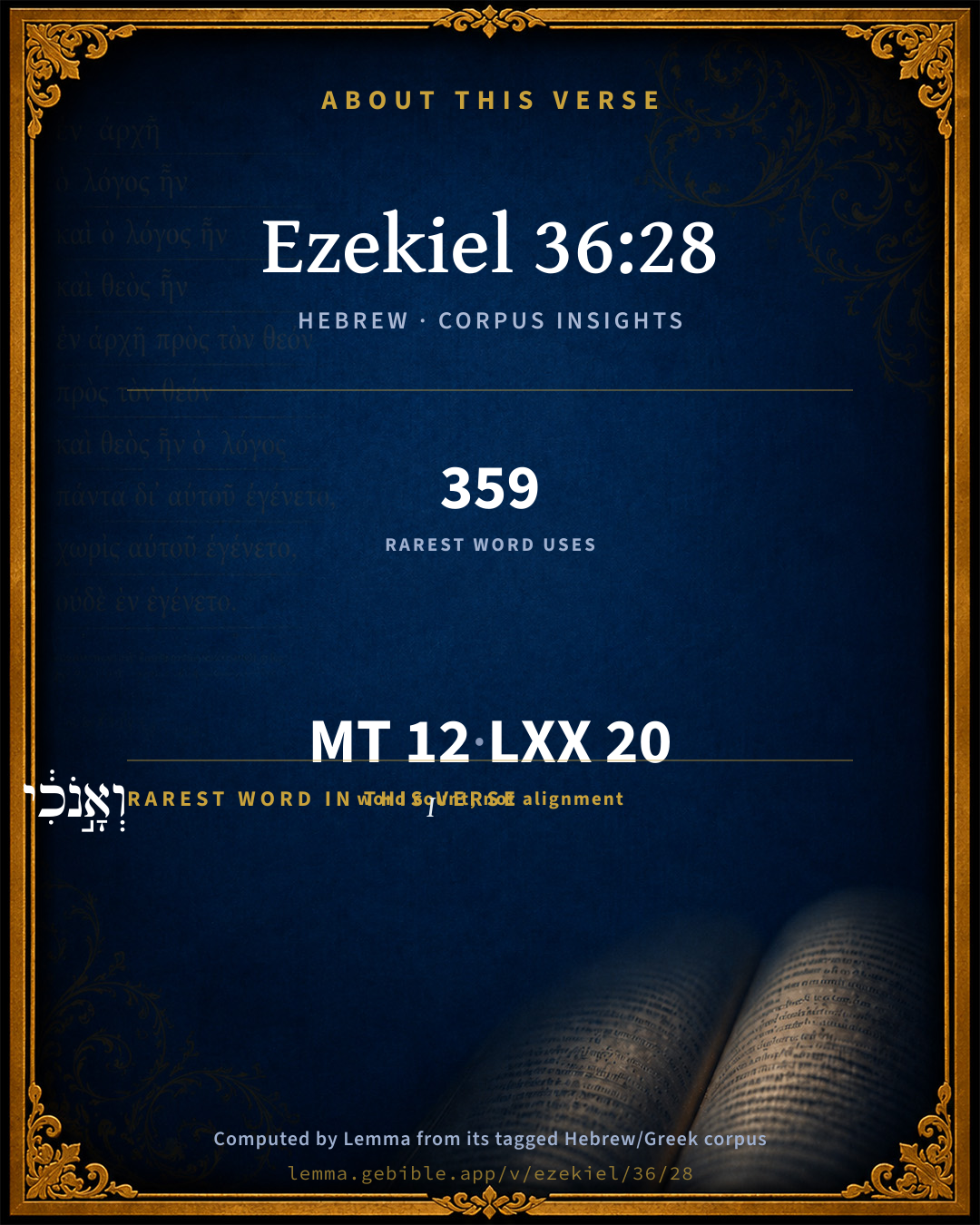
12
words
9
distinct lemmas
Prophets
section

Grammatical profile

  • 4 verbs
  • 4 nouns
  • 1 pronoun
  • 2 prepositions
  • 1 particle

Verb forms

  • וִישַׁבְתֶּ֣ם Qal · Sequential Perfect
  • נָתַ֖תִּי Qal · Perfect
  • וִהְיִ֤יתֶם Qal · Sequential Perfect
  • אֶהְיֶ֥ה Qal · Imperfect

Repetition

A word recurs within this verse — often emphatic in Hebrew:

  • וִהְיִ֤יתֶם to be H1961 ×2

Hebrew & Septuagint length

In English translation the verse runs 24 words from the Hebrew and 29 from the Septuagint (LXX English) — closely comparable.

A rough comparison of the two English renderings, which tokenize alike — not a word-level alignment.

Word counts can differ between the Hebrew and the Greek without any difference in meaning — e.g. the Hebrew direct-object marker אֵת has no separate Greek word, and Greek often adds the article ὁ.

In the original languages it is 12 Hebrew tokens and 20 Greek tokens — but the two are counted differently (Hebrew bundles its prefixes and suffixes into one token; the Greek is in lemma form), so that isn’t a like-for-like length.

Cross-references

20

Topical passages linked to Ezekiel 36:28 in the Treasury of Scripture Knowledge — connected by theme and wording, ordered by reader-vote popularity; previews shown in the World English Bible.

  • Jeremiah 31:33 But this is the covenant that I will make with the house of Israel after those days, says Yahweh: I will put my law in their inward parts, and in their heart will I write it; and I will be their God, and they shall be my people:
  • Jeremiah 32:38 and they shall be my people, and I will be their God:
  • Ezekiel 37:27 My tent also shall be with them; and I will be their God, and they shall be my people.
  • Ezekiel 11:20 that they may walk in my statutes, and keep my ordinances, and do them: and they shall be my people, and I will be their God.
  • Ezekiel 37:23 neither shall they defile themselves any more with their idols, nor with their detestable things, nor with any of their transgressions; but I will save them out of all their dwelling-places, in which they have sinned, and will cleanse them: so shall they be my people, and I will be their God.
  • Matthew 22:32 'I am the God of Abraham, and the God of Isaac, and the God of Jacob?' God is not the God of the dead, but of the living."
  • Revelation 21:7 He who overcomes, I will give him these things. I will be his God, and he will be my son.
  • Song of Solomon 6:3 I am my beloved's, and my beloved is mine. He browses among the lilies,
  • Jeremiah 30:22–23 You shall be my people, and I will be your God.
  • Ezekiel 14:11 that the house of Israel may go no more astray from me, neither defile themselves any more with all their transgressions; but that they may be my people, and I may be their God, says the Lord Yahweh.
  • Ezekiel 37:25 They shall dwell in the land that I have given to Jacob my servant, in which your fathers lived; and they shall dwell therein, they, and their children, and their children's children, forever: and David my servant shall be their prince for ever.
  • Ezekiel 28:25 Thus says the Lord Yahweh: When I shall have gathered the house of Israel from the peoples among whom they are scattered, and shall be sanctified in them in the sight of the nations, then shall they dwell in their own land which I gave to my servant Jacob.
  • Ezekiel 36:10 and I will multiply men on you, all the house of Israel, even all of it; and the cities shall be inhabited, and the waste places shall be built;
  • Ezekiel 39:28 They shall know that I am Yahweh their God, in that I caused them to go into captivity among the nations, and have gathered them to their own land; and I will leave none of them any more there;
  • Hosea 1:10 Yet the number of the children of Israel will be as the sand of the sea, which can't be measured nor numbered; and it will come to pass that, in the place where it was said to them, 'You are not my people,' they will be called 'sons of the living God.'
  • Zechariah 13:9 I will bring the third part into the fire, And will refine them as silver is refined, And will test them like gold is tested. They will call on my name, and I will hear them. I will say, 'It is my people;' And they will say, 'Yahweh is my God.'"
  • 2 Corinthians 6:16–7:1 What agreement has a temple of God with idols? For you are a temple of the living God. Even as God said, "I will dwell in them, and walk in them; and I will be their God, and they will be my people."
  • Hebrews 8:10 "For this is the covenant that I will make with the house of Israel. After those days," says the Lord; "I will put my laws into their mind, I will also write them on their heart. I will be to them a God, And they will be to me a people.
  • Hebrews 11:16 But now they desire a better country, that is, a heavenly one. Therefore God is not ashamed of them, to be called their God, for he has prepared a city for them.
  • Revelation 21:3 I heard a loud voice out of heaven saying, "Behold, God's dwelling is with people, and he will dwell with them, and they will be his people, and God himself will be with them as their God.

Cross-references courtesy of OpenBible.info (CC BY 4.0).

Hebrew and Greek witnesses Masoretic Hebrew ↔ Greek Septuagint

The same verse in the two great witnesses to the Old Testament, shown verse-for-verse.

These are two independent witnesses, not word-aligned to each other, and the Septuagint is shown in lemma (dictionary) form.

Hebrew Ezekiel 36:28 Masoretic · Westminster Leningrad Codex

וִישַׁבְתֶּ֣ם בָּאָ֔רֶץ אֲשֶׁ֥ר נָתַ֖תִּי לַאֲבֹֽתֵיכֶ֑ם וִהְיִ֤יתֶם לִי֙ לְעָ֔ם וְאָ֣נֹכִ֔י אֶהְיֶ֥ה לָכֶ֖ם לֵאלֹהִֽים

You shall dwell in the land that I gave to your fathers; and you shall be my people, and I will be your God.

World English Bible · Public Domain

Greek LXX Ezekiel 36:28 Septuagint · lemma form

καί καταοἰκέω ἐπί ὁ γῆ ὅς δίδωμι ὁ πατήρ σύ καί εἰμί ἐγώ εἰς λαός καΐἐγώ εἰμί σύ εἰς θεός

And you⌃ shall dwell upon the land which I gave to your fathers; and you⌃ shall be to me a people, and I will be to you a God.

LXX2012 (modern English Septuagint) · Public Domain

Hebrew: Westminster Leningrad Codex (CC BY 4.0). Greek: Septuagint (public domain); English from LXX2012 (modern English Septuagint) (Public Domain). How the Septuagint differs from the Hebrew →

Targum (Aramaic paraphrase)

1

The Targum is the ancient Jewish Aramaic paraphrase of the Hebrew Scriptures — an interpretive translation, not the Hebrew text itself. Onkelos (literal) and Pseudo-Jonathan (expansive) render the Torah, and Jonathan the Prophets. Coverage is partial: where no permissively-licensed English translation exists for a verse, only the Aramaic is shown. This is verse-level text, not a word-by-word alignment to the Hebrew.

  1. Targum Jonathan Prophets (Joshua–Malachi)
    וְתֵיתְבוּן בְּאַרְעָא דִיהָבֵית לַאֲבָהַתְכוֹן וּתְהוֹן קֳדָמַי לְעַם וַאֲנָא אֱהֶוֵי לְכוֹן לֵאלָהָא:

    (no public-domain English translation for this verse)

    Targum Jonathan — Aramaic: “Mikraot Gedolot” (public domain). English: “Sefaria Community Translation” (CC0 1.0 (public-domain dedication)); “London "Chaldee Paraphrase," 1871” (public domain). Text via Sefaria.

Commentary

Notes on Ezekiel 36:28 from classic Christian and Jewish commentators (each source and its license shown beneath its notes). The classic Christian expositions comment on the surrounding passage and are grouped to its opening verse, so a note may address several verses; the Jewish commentaries on the Tanakh (Rashi and others) are per-verse, so they appear only where the commentator wrote on this verse.

Lemma curates 59 commentaries, every one of them public domain or Creative Commons licensed, each selected and text-cleaned for this edition rather than reprinted as found. About our sources →

Trapp's Complete Commentary

John Trapp

Eze 36:28 And ye shall dwell in the land that I gave to your fathers; and ye shall be my people, and I will be your God.

Ver. 28. And ye shall dwell in the land,] i.e., In Judea, or rather in the Church, {a} which began in Judea, saith the Jesuit well The Church of Rome, then, is not the mother Church; no, though we take it in its primitive purity.

{a} A Lapide.

John Trapp, A Commentary or Exposition upon All the Books of the Old and New Testament (1647–1656) — public domain. Text from a community e-Sword module.

The Biblical Illustrator

Joseph S. Exell

Eze_36:28

Ye shall dwell in the land . . . and ye shall be My people.

The blessedness of the saints

I. The abundance of the blessings of grace. A newborn infant is the most helpless of all creatures. In its nakedness, weakness, dumbness, how dependent on a mothers love; yet not more so than Gods people are on His care and kindness. Theirs are therefore circumstances in which His promises are exceedingly precious. The condition of believers closely resembles that of a man of boundless affluence, whose wealth lies, not so much in money, as in moneys worth; in bills and bonds, all to be duly honoured, so soon as they become due. With these promises the poorest Christian is really a richer man than other men, with all their possessions; nor would he part with one of them for the worlds wealth. Are you cast down because, while others have shallows, you have depths, dark depths of sorrow and suffering to pass through? Be it so: it is as easy for God to march the host through the wide, deep sea, as across the bed of Jordan. Are your corruptions strong? Be it so: Samson found it as easy to snap a new spun cable as withes fresh gathered on the rivers bank; and believe me it is as easy for God to break thy tyrants strongest as his lightest chain. A chain of iron and a thread of flax are all one to God. The blood of thy Saviour cleanseth from every sin; and nothing being impossible, nay, not even difficult to Omnipotence, be assured that in your battle, and watch, and toil, you shall find this promise true, My grace is sufficient for thee.

II. The happiness which Gods people enter on at death. Gods people are like His ancient Israel. They have enemies who will harass them in life, and follow on their track to the very shores of time; but whoever or whatever these may be--sin, sorrow, poverty, temptations, trials, fears, doubts, Satan himself--oh! a death bed shall be the death of them all. This is what the redeemed escape from, but what they escape to, oh, the joys they enter on when they are with Christ, who can tell? We know that to die is--not shall be at a future time, and after some intermediate state--but to die is gain, gain immediate. One step, and what a step! the soul is in glory. And what and where is heaven? I cannot tell. It looks to the eye of faith, much like a star to the eye of flesh. A shining object, we see it gleaming in the dusky fields of space, but see nothing more, even when our eyes are assisted by the most powerful telescope. By what beings it is inhabited; what forms they have; what tongue they speak; what the character of the landscape in these upper worlds, we do not know, and perhaps never shall, till we have cast loose a body which, like an anchor, moors us to this earth, and with a soul unchained, free perhaps as thought, we are left to roam the universe, and pass, as on the rapid wings of a wish, from world to world of our Fathers kingdom. Never, till then, shall we know either where or what heaven is. The best description of it is to say that it is indescribable.

III. The complete blessedness of the saints at the resurrection in the restoration of all that sin forfeited. There were periods in creation; progressive stages. Step by step the work advanced to its consummation. Like creation, the Gospel has had its periods of progress. It gradually advanced in its development from the date of the first promise given by God; when He, the Judge, and the culprits, man and the devil, stood face to face upon the ruins of Eden. There yet remains an aspect of redemption in which it is not complete. All that death and Satan hold they must relinquish; all that Christ has purchased He shall possess. The soul wants her partner; and although the exile may return no more, nor see his native land, the redeemed shall come back to claim their bodies from the earth; aye, and claim the very earth they lie in. The saints shall inherit the earth. Under laws accommodated to a new economy, this wide world shall become one smiling Eden, where, exempt from physical as from moral evils, none shall shiver amid arctic frosts, nor wither under tropic heat; and these fields of snow and arid sands shall be all flowered with roses. From the convulsions of expiring, or rather the birth-pangs of parturient nature, a newborn world shall come; a home worthy of immortals; a palace befitting its King. The blood that, falling on Calvary, dyed earths soil shall bless it; and this ancient theatre of Satans triumph shall be the seat of Emmanuels kingdom, and the witness of His glory. (T. Guthrie, D. D.)

The Biblical Illustrator, edited by Joseph S. Exell (c. 1880s–1900s) — public domain. Text from a community e-Sword module.

Joseph Benson's Commentary

Eze 36:28-30. And ye shall dwell in the land — Spiritual blessings, promised in the last three verses, are now followed with temporal blessings. Thus does earth often follow heaven, and godliness hath the promise of the life that now is, as well as of that which is to come. When the Israelites are thus prepared for mercy, then shall they return to their possessions, and be settled again in them. And there God will acknowledge them for his people, and will protect and bless them as such, bestowing liberally upon them all good things. I will also save you — Will continue to save you; from all your uncleannesses — I will take away the guilt of them, deliver you from the power and pollution of them, and preserve you from the punishments due to them. Salvation from all uncleanness includes justification, entire sanctification, and meetness for glory. And I will call for the corn, &c. — All necessaries are here comprised in one. And lay no famine upon you — This was one of the judgments which they had laboured under; and it had been as much as any other a reproach to them, that they should be starved in a land so famed for fruitfulness. But it is here promised, that now this calamity should afflict them no more, nor should they any more bear the reproach of it, but should have the credit of possessing abundance; the fruit of the tree, and the increase of the field, being multiplied to them.

Joseph Benson's Commentary on the Old and New Testaments (1811–1818) — public domain. Text from a community e-Sword module.

Jamieson, Fausset & Brown

Robert Jamieson, A. R. Fausset & David Brown

ye . . . my people, . . . I . . . your God-- (Eze 11:20; Jer 30:22).

Jamieson, Fausset & Brown — Commentary Critical and Explanatory on the Whole Bible (1871) — public domain (CC PDM 1.0). Text via the HelloAO Bible API.

Adam Clarke's Commentary

Verse 28. Ye shall be my people] Wholly given up to me in body, soul, and spirit.

And I will be your God.] To fill you with love, joy, peace, meekness, gentleness, longsuffering, fidelity and goodness, to occupy your whole soul, and gratify your every desire.

Adam Clarke's Commentary on the Bible (1810–1826) — public domain. Text from a community e-Sword/MySword module.

Ellicott's Commentary for English Readers

(28) Ye shall dwell in the land.—The Israelites were not yet able to seek the spiritual, except as con. nected with the temporal blessing; and, indeed, the temporal was, in the ordering of Providence, a necessary means to the spiritual. Therefore the promise of earthly restoration must yet be made, and must in due time be literally fulfilled.

A Bible Commentary for English Readers, edited by Charles John Ellicott (1878–1897) — public domain. Text from a community e-Sword module.

The Cambridge Bible for Schools and Colleges

gen. ed. J. J. S. Perowne

28. Again, the consequence of walking in Jehovah’s statutes will be that they shall inherit the land for ever, cf. Eze_28:25, Eze_37:25. The promise attached to the fifth commandment—the first commandment with promise—belongs to the commandments given to Israel as a whole. The keeping of them was the condition of remaining in the land. When the people disregarded them they were driven out, and only when their former sins were forgiven could they be restored (Isa_40:2). It may be a question whether there be now any connexion between Israel and the land of Canaan. If there be, the condition of restoration to it is faith and obedience on the part of the people. A restoration of Jews still in unbelief to Canaan, even if it should occur, could have no meaning so far as the redemptive providence of God is concerned, and would not enter into any relation with the Old Testament scriptures. Comp. the order stated Eze_36:33.

The Cambridge Bible for Schools and Colleges (gen. ed. J. J. S. Perowne; Cambridge University Press, 1878–1918) — public domain. Text from a community e-Sword module.

John Gill's Exposition

And ye shall dwell in the land which I gave to your fathers,.... Not only shall be brought into it, but shall inhabit it, and continue there, and that in great safety and plenty; and which will be the more valued and esteemed, and reckoned a great blessing to enjoy; because this land is the gift of God, and what he gave to their fathers, Abraham, Isaac, and Jacob, by promise so long ago, and to their seed; of which promise it appears he is not unmindful:

and ye shall be my people, and I will be your God; which is the sum and substance of the covenant of grace; which will now be renewed, and the blessings of it applied. The Jews will appear to be the people of God by their effectual calling and conversion; and God will show himself to be their God, by his presence with them, his protection of them, and that communion with himself he will admit them to: see Jer 31:1, "the loammi" will be taken off, and they will be again declared to be the covenant people of God, Hos 1:9.

John Gill's Exposition of the Whole Bible (1746–1763) — public domain (CC PDM 1.0). Text via the HelloAO Bible API.

Albert Barnes' Notes on the Bible

Ye shall be my people - (Compare 2Co 6:16-18; Heb 8:10. The writers of the New Testament appropriated these and similar phrases of the Old Testament to the Church of Christ. Between the restoration of the Jews (the first step) there are many steps toward the end - the spread of Christ’s Church throughout the world, the conversion of the Gentiles, and the acknowledgment of the true God - which justify men in looking forward to a time when the Gospel shall be preached in all the world, and the earth become the kingdom of God in a fuller sense than it has ever yet been. But all these are “steps.” Our prophecies look beyond all this to a new heaven to a new earth, and to a new Jerusalem Rev 21:3.

Albert Barnes' Notes on the Bible (1834–1885) — public domain. Text from a community e-Sword/MySword module.

Matthew Poole's English Annotations

Spiritual blessings, promised in Eze 36:25-27, are now followed with temporal blessings; so earth doth follow heaven.

Ye shall dwell: God adds this to his taking, gathering, and bringing into the land, Eze 36:24; when they are there, they shall settle and continue proprietors, possessing their own houses and lands.

Which I gave; they were greatly pleased to think Canaan their land was by God given to their fathers; in this land under this character you shall dwell, the land that was your right by promise to Abraham, 1346 years or near it.

My people, as your fathers were, who reverenced, loved, worshipped, obeyed, and believed in me.

Your God, as I was their God, to protect, guide, comfort, and enrich, &c.; see Eze 11:20; to perform my promise to their faith and patience; and so you shall inherit the blessing.

Matthew Poole's English Annotations on the Holy Bible (1683–1685) — public domain. Text from a community e-Sword/MySword module.

Whedon's Commentary on the Bible

Daniel D. Whedon

28-36. The new Israel, which possesses the new heart and the new spirit, shall be permitted to re-establish covenant relations with Jehovah and shall once more return to their old land, which shall yield fruitful harvests forever (Eze_36:29, etc.; compare Eze_28:25; Eze_37:25), and be like the very garden of Eden (Eze_36:35; compare Eze_31:9). These promises were, however, conditional upon a spiritual transformation (Eze_36:33) as were the original promises (Exo_19:5; Lev_26:3-12), and some terms which are here used to express covenant relationship with Israel were later transferred to the Christian Church (2Co_6:16-18) through which, according to the New Testament hope, this prophecy will find its larger future fulfillment (Rom_11:25-27; Rev_21:3).

Daniel D. Whedon (gen. ed.), Commentary on the Old and New Testaments (1874–1909) — public domain. Text from a community e-Sword module.

The Pulpit Commentary

Vers. 28-31 describe the results which should follow in Israel"s experience when God should have thus gathered, cleansed, and renewed them. They should then have

(1) permanent occupation of the land (ver. 28);

(2) covenant relationship with God as his people (ver. 28);

(3) protection against future lapsing into idolatry and immorality (ver. 29);

(4) abundant supply for every want (vers. 29, 30); and

(5) a deepening sense of self-humiliation on account of and repentance for past sin (ver. 31).

Ye shall dwell in the land. As the Jews who returned from Babylon did not permanently dwell in the land, but were again ejected from it, the promise contained in these words must be viewed as having been conditional on the realization of the moral and spiritual purity above described. If, therefore, it be aroused that inasmuch as this promise must be fulfilled (2Co_1:20; Heb_10:23) the Jews must yet be restored to Palestine, the reply is that their return can only take place when they have been converted to Christianity; so that the whole promise must be regarded as receiving its highest fulfillment in the experiences of the Church of Christ. That this view is correct is vouched for by the fact that the words, Ye shall be my people and I will be your God (comp. Eze_11:20; Jer_7:23 Jer_11:4 Jer_30:22) descriptive of thecovenant relationship in which Jehovah stood towards Israel (Lev_26:12; Deu_26:17, Deu_26:18) have been chosen by New Testament writers to set forth the relationship of God towards the Christian Church, first here on earth, (2Co_6:16-18) and afterwards in the heavenly Jerusalem. (Rev_21:3)

The Pulpit Commentary (1880–1919), ed. H.D.M. Spence-Jones & Joseph S. Exell — public domain. Text from a community e-Sword module.

John Wesley's Explanatory Notes

Ye shall dwell - Observe: then, and not before, are these promises to be fulfilled to the house of Israel. And I will be your God - This is the foundation of the top-stone of a believer's happiness.

John Wesley, Explanatory Notes Upon the Whole Bible (1754–1765) — public domain. Text via the GEBible commentary corpus.

Lesson kit

Teaching starters — assembled from the data on this page, not authored interpretation. Every prompt links to the verse data it draws on. Edit before teaching.

Ezekiel, in the Prophets, opens this verse with 12 words (9 distinct Hebrew lemmas). Its most distinctive word is ʼânôkîy (“I”). A historical commentator’s framing appears above. Read the whole chapter for the surrounding context.

Discussion questions

  1. The word ʼânôkîy carries the sense “I.” How does it shape the verse?
  2. Jeremiah 31:33 shares this passage’s theme. How do the two illuminate each other?
  3. “to be” occurs 2× in this one verse. What is the effect of the repetition?
  4. The translations on this page render this verse differently — a whole-verse word diff, not a word-by-word alignment. What might account for the different wordings?
  5. The verb «וִישַׁבְתֶּ֣ם» is Qal Sequential Perfect. How does its form color the action?
  6. Reading how Trapp's Complete Commentary and The Biblical Illustrator read this verse, where do the two commentators agree and where do they part?

Things to notice

Reading settings

Reading text

Shown beneath each verse's original-language words.

Old Testament
Old Testament edition

Read the OT as the Masoretic Hebrew (MT) or the Greek Septuagint (LXX).

English shown for the Greek Septuagint (in the Hebrew ↔ Greek comparison).

Comparing translations? Open the Compare panel on any verse page to stack up to four side by side.