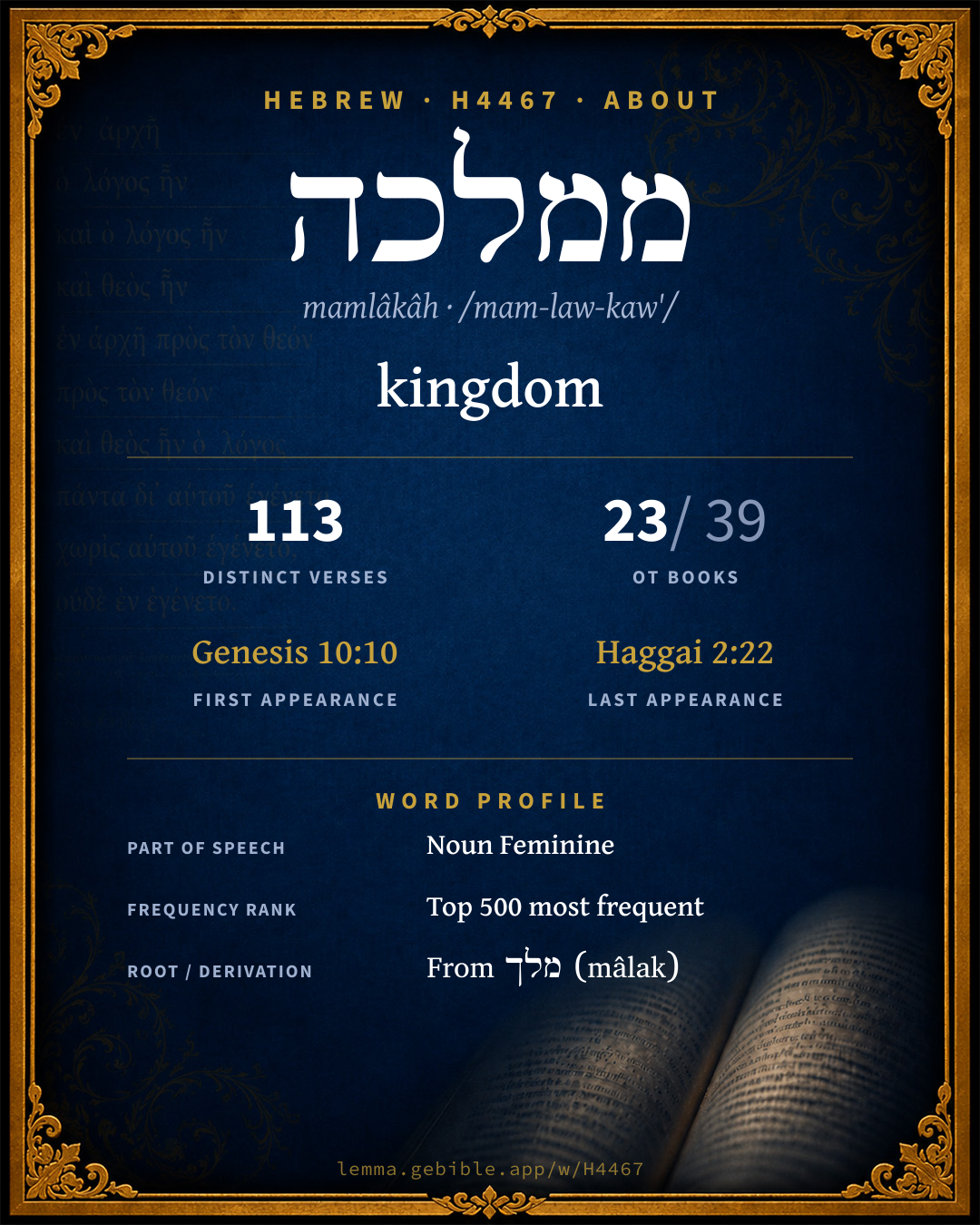
מַמְלָכָה
kingdom
also: dominion, reign, sovereignty fuller range ↓
Full lexicon entry — Brown-Driver-Briggs (BDB)
From Brown-Driver-Briggs (BDB)
Where this word appears
See every Absolute-state word in the Hebrew Bible →
Grammar key — what these labels mean
Part of speech
- Noun
- A naming word — a person, place, thing, or idea.
Noun type
- Common
- A common noun — a general class of person, place, or thing (“king,” “city,” “water”), not a specific name.
State
- Construct
- A noun bound to a following noun in a possessive / “of” relationship (the construct chain).
- Absolute
- The independent form of a noun, not bound to a following word.
Gender
- Feminine
- Grammatically feminine.
Number
- Plural
- More than one (in Hebrew, generally three or more).
- Singular
- One.
Every verse where H4467 appears in the Book of 2 Chronicles — 19 distinct verses. Click any verse to open its interlinear word-by-word view. Verse text shown in the World English Bible for context — . Each verse’s Hebrew form is shown with its reference; the English is not keyword-highlighted, since the data carries no word-level English alignment. Use “Compare translations” on any verse to read it across multiple English versions. This concordance covers the Hebrew Bible; Septuagint (Greek Old Testament) occurrences are not indexed here.
2 Chronicles
- 2 Chronicles 9:19 מַמְלָכָֽה n c fs Twelve lions stood there on the one side and on the other on the six steps: there was nothing like it made in any kingdom.
- 2 Chronicles 11:1 הַ/מַּמְלָכָ֖ה ptcl def.art + n c fs When Rehoboam was come to Jerusalem, he assembled the house of Judah and Benjamin, one hundred eighty thousand chosen men, who were warriors, to fight against Israel, to bring the kingdom again to Rehoboam.
- 2 Chronicles 12:8 מַמְלְכ֥וֹת n c fp cs Nevertheless they shall be his servants, that they may know my service, and the service of the kingdoms of the countries.
- 2 Chronicles 13:5 מַמְלָכָ֧ה n c fs Ought you not to know that Yahweh, the God of Israel, gave the kingdom over Israel to David forever, even to him and to his sons by a covenant of salt?
- 2 Chronicles 13:8 מַמְלֶ֣כֶת n c fs cs Now you think to withstand the kingdom of Yahweh in the hand of the sons of David; and you are a great multitude, and there are with you the golden calves which Jeroboam made you for gods.
- 2 Chronicles 14:5 הַ/מַּמְלָכָ֖ה ptcl def.art + n c fs Also he took away out of all the cities of Judah the high places and the sun-images: and the kingdom was quiet before him.
- 2 Chronicles 17:5 הַ/מַּמְלָכָה֙ ptcl def.art + n c fs Therefore Yahweh established the kingdom in his hand; and all Judah brought to Jehoshaphat tribute; and he had riches and honor in abundance.
- 2 Chronicles 17:10 מַמְלְכ֣וֹת n c fp cs The fear of Yahweh fell on all the kingdoms of the lands that were round about Judah, so that they made no war against Jehoshaphat.
- 2 Chronicles 20:6 מַמְלְכ֣וֹת n c fp cs and he said, Yahweh, the God of our fathers, aren't you God in heaven? and aren't you ruler over all the kingdoms of the nations? and in your hand is power and might, so that none is able to withstand you.
- 2 Chronicles 20:29 מַמְלְכ֣וֹת n c fp cs The fear of God was on all the kingdoms of the countries, when they heard that Yahweh fought against the enemies of Israel.
- 2 Chronicles 21:3 הַ/מַּמְלָכָ֛ה ptcl def.art + n c fs Their father gave them great gifts, of silver, and of gold, and of precious things, with fortified cities in Judah: but the kingdom gave he to Jehoram, because he was the firstborn.
- 2 Chronicles 21:4 מַמְלֶ֤כַת n c fs cs Now when Jehoram was risen up over the kingdom of his father, and had strengthened himself, he killed all his brothers with the sword, and various also of the princes of Israel.
- 2 Chronicles 22:9 לְ/מַמְלָכָֽה prep + n c fs He sought Ahaziah, and they caught him (now he was hiding in Samaria), and they brought him to Jehu, and killed him; and they buried him, for they said, He is the son of Jehoshaphat, who sought Yahweh with all his heart. The house of Ahaziah had no power to hold the kingdom.
- 2 Chronicles 22:10 הַ/מַּמְלָכָ֖ה ptcl def.art + n c fs Now when Athaliah the mother of Ahaziah saw that her son was dead, she arose and destroyed all the seed royal of the house of Judah.
- 2 Chronicles 23:20 הַ/מַּמְלָכָֽה ptcl def.art + n c fs He took the captains of hundreds, and the nobles, and the governors of the people, and all the people of the land, and brought down the king from the house of Yahweh: and they came through the upper gate to the king's house, and set the king on the throne of the kingdom.
- 2 Chronicles 25:3 הַ/מַּמְלָכָ֖ה ptcl def.art + n c fs Now it happened, when the kingdom was established to him, that he killed his servants who had killed the king his father.
- 2 Chronicles 29:21 הַ/מַּמְלָכָ֥ה ptcl def.art + n c fs They brought seven bulls, and seven rams, and seven lambs, and seven male goats, for a sin-offering for the kingdom and for the sanctuary and for Judah. He commanded the priests the sons of Aaron to offer them on the altar of Yahweh.
- 2 Chronicles 32:15 וּ/מַמְלָכָ֔ה conj + n c fs Now therefore don't let Hezekiah deceive you, nor persuade you after this manner, neither believe you him; for no god of any nation or kingdom was able to deliver his people out of my hand, and out of the hand of my fathers: how much less shall your God deliver you out of my hand?
- 2 Chronicles 36:23 מַמְלְכ֤וֹת n c fp cs Thus says Cyrus king of Persia, All the kingdoms of the earth has Yahweh, the God of heaven, given me; and he has charged me to build him a house in Jerusalem, which is in Judah. Whoever there is among you of all his people, Yahweh his God be with him, and let him go up.
About this entry
At a glance — auto-summarized from this page’s data, not written by a person. Every figure links to its source below. This summary describes the numbers; it doesn’t interpret them.
ממלכה (mamlâkâh) is a Hebrew noun most often rendered “kingdom.” Beyond its headline sense, its full sense range takes in “dominion”, “reign”, and “sovereignty”. It turns up in 113 verses across 23 books, a common footprint. Scripture first uses it in Genesis 10:10. It clusters with מלך, מלוכה and מלך under a shared root. The sections below give every sense, occurrence, and version rendering.
Gloss history
Strong's 1890 vs modern scholarship
About this word
Strong's H4467 catalogs a Hebrew word from the Hebrew Old Testament.
These counts are not copied from any lexicon or concordance. They are computed here, from the morphology-tagged Hebrew Old Testament. What Lemma adds →
- 113
- distinct verses
- The word appears in 113 distinct verses.
- 23 / 39
- OT books
- The word appears in 23 of 39 Old Testament books.
- #372
- by frequency
- Top 500 most frequent Hebrew words (rank 372 of 8,640 Hebrew words by occurrence).
View all 113 occurrences in the concordance →
Most concentrated in
- 2 Chronicles 19 verses 17%
- Jeremiah 17 verses 15%
- Isaiah 13 verses 12%
By section of the Old Testament
By traditional corpus
Conventional, traditional groupings — biblical authorship is debated, so this is a traditional corpus grouping, not an authorship claim. Each share is this word’s portion of its verses in that division of the Hebrew canon. Each figure is a share of the word’s 113 distinct verses.
- Prophets (Nevi'im) 71 verses · 63%
- Writings (Ketuvim) 31 verses · 27%
- Torah (Pentateuch) 11 verses · 10%
How translations render this word
Counts come from each version’s own published word-to-Strong’s tagging or interlinear alignment — an approximate guide to how each version renders this word, not a word-level alignment the data otherwise carries. Because each total is that version’s own tagged count, the per-version totals vary from one another and need not match the appearance or distinct-verse counts above. These counts may also differ from a printed concordance because Lemma counts each distinctly tagged rendering and does not collapse phrase taggings into a single head-word total. This is a fixed set of word-tagged versions (KJV, ASV, BSB, ULT) and does not change with the reading translation you choose elsewhere. Each version’s license is shown beside its name below (and on Sources).
- King James Version: Kingdom 41×, Kingdoms 19×, All the kingdoms 13×
- American Standard Version: Kingdom 37×, Kingdoms 19×, All the kingdoms 9×
- Berean Standard Bible: Kingdom 46×, Kingdoms 41×, Royal 8×
- unfoldingWord Literal Text: Kingdom 52×, Kingdoms 21×, Kingdoms of 20×
King James Version Public Domain
Renders H4467 across 116 tagged occurrences — most commonly:
Plus 27 renderings that appear only once — usually multi-word phrases or single function words the recovered tagging swept in, not distinct renderings. Not rendered by a distinct English word in 1 further occurrence.
American Standard Version Public Domain
Renders H4467 across 116 tagged occurrences — most commonly:
Plus 31 renderings that appear only once — usually multi-word phrases or single function words the recovered tagging swept in, not distinct renderings.
Berean Standard Bible Public Domain
Renders H4467 across 117 tagged occurrences — most commonly:
Plus 10 renderings that appear only once — usually multi-word phrases or single function words the recovered tagging swept in, not distinct renderings.
unfoldingWord Literal Text CC BY-SA 4.0
Renders H4467 across 113 tagged occurrences — most commonly:
Plus 11 renderings that appear only once — usually multi-word phrases or single function words the recovered tagging swept in, not distinct renderings.
Senses in the full BDB
What do BDB’s symbols mean?
BDB uses these scholarly abbreviations:
| Symbol | Meaning |
|---|---|
| 𝔊 | the Septuagint (the ancient Greek translation, LXX) |
| 𝔙 | the Vulgate (the Latin translation) |
| 𝔖 | the Syriac version (the Peshitta) |
| 𝔗 | the Targum (the Aramaic translation) |
| ψ | the Psalms |
| √ | root (the underlying root or stem) |
| ‖ | parallel passage (a synonymous or contrasted parallel) |
| † | the dagger: every passage where the word occurs is cited |
The 3 senses and sub-senses the full Brown-Driver-Briggs lexicon distinguishes for this word, in lexicon order (not ranked by frequency), with BDB’s own verbatim wording and sub-sense lettering. Shown in Hebrew script with BDB’s own scholarly abbreviations. The condensed entry is in the Lexicon Entry tab. See also the Forms in the corpus table below.
- 1. kingdom, realm, chiefly non-Isr.: Gn 10:10 (J), 20:9 (E), Nu 32:33(×2) (P), Dt 3:4, 10, 13, 21; 28:25 Jos 11:10 (D), 1 S 10:18 1 K 5:1; 10:20; 18:10(×2) (both ‖ גּוֹי), Is 10:10 1 Ch 16:20 = ψ 105:13 (‖ עַם and גּוֹי), ψ 135:11 Is 14:16; 19:2(×2), 23:11 2 Ch 9:19; 14:4; 29:21; 32:15 (‖ גּוֹי), Ne 9:22 (‖ עַם), ψ 46:7 (‖ גוֹי), 79:6 (‖ id.), 102:23 (‖ עַם), Is 60:12 (‖ גּוֹי), so Je 1:10; 18:7, 9; 27:8; 28:8; Je 49:28; 51:20, 27 Am 6:2 Na 3:5 Zp 3:8 Hg 2:22 Ez 17:14; 29:14, 15; 37:22; מַמְלְכוֹת הַגּוֹיִם 2 Ch 20:6, cf. Is 13:4; מַמְלְכוֹת הָאָרֶץ 2 K 19:15, 19 = Is 37:16, 20, 2 Ch 36:23 = Ezr 1:2, ψ 68:33 Is 23:17 Je 15:4; 24:9; 25:26; 29:18; 34:1, 17; מַמְלְכוֹת הָֽאֲרָצוֹת 1 Ch 29:30 2 Ch 12:8; 17:10; 20:29; of Isr. Am 9:8 Dt 17:20 2 S 3:28 La 2:2 2 Ch 21:4; cf. מַמְלֶכֶת כֹּהֲנִים Ex 19:6 (‖ גּוֹי קָדוֹשׁ); of Mess. king Is 9:6; צְבִי מַמְלָכוֹת (of Babylon) Is 13:19, גְּבֶרֶת מ׳ (id.) 47:5; מִשְׁפְּחֹת מַמְלְכוֹת צָפ֫וֹנָה Je 1:15. e.g. Genesis 10:10
- 2. sovereignty, dominion 1 S 13:14 (Isr.; c. תָּקוּם), cf. 24:21; 2 Ch 13:8 מ׳ י׳ בְּיַד בְּנֵי דָּוִיד; לְךָ י׳ הַמַּמ׳ 1 Ch 29:11; חָֽזְקָה בְּיַד 2 K 14:5; ח׳ עַל 2 Ch 25:3 הֶהֱזִיק בְּיַד 2 K 15:19 cf. 2 Ch 22:9; הֵכִין מ׳ אֶל (subj. י׳) 1 S 13:13 (Isr.), cf. 2 S 7:12, 16 (‖ בַּיִת); 2 Ch 17:5 (בְּיַד) cf. 1 K 2:46 (נָכוֹנָה בְּיַד); נִשֵּׂא מ׳ (subj. י׳ 2 S 5:12; נָתַן מ׳ לְדָוִד עַל (subj. י׳) 2 Ch 13:5, cf. 21:3; קָרַע הַמּ׳ מִן (subj. י׳) 1 S 28:17 (Isr.) 1 K 11:11 (sq. מֵעַל), v 31; 14:8; מִן om. 11:13; לָקַח מִיָּדוֹ 11:34 (or = kingdom?), הֶעֱבִיר מ׳ מִן (subj. י׳), 2 S 3:10 (Isr.); נִשְׁבַּת מ׳ מִן Is 17:3; cf. תָּשׁוּב הַמּ׳ לְ 1 K 12;12:26; עדיך תאתה ובאה … מ׳ Mi 4:8; הֵשִׁיב מ׳ לְ 2 Ch 11:1; כִּסֵּא מ׳ Dt 17:18 (Isr.; יָשַׁב עַל), 2 S 7:13 (כֹּנֵן י׳), 1 K 9:5 (הֵקִים י׳) 2 Ch 23:20, כִּסֵּא מַמְלָכוֹת Hg 2:22; בֵּית מ׳ royal house Am 7:13; עָרֵי הַמּ׳ royal cities Jos 10:2 cf. 1 S 27:5; זֶרַע הַמּ׳ royal seed, children, 2 K 11:1 = 2 Ch 22:10. e.g. 1 Samuel 13:14
- 3. reign, בְּרֵאשִׁית מ׳ Je 27:1; 28:1 in the beginning of the reign of (cf. מַלְכוּת 2, מַמְלָכוּת 3). e.g. Jeremiah 27:1
Senses from the full Brown-Driver-Briggs lexicon (Brown, Driver, Briggs; Oxford 1906 — public domain), digitized via Sefaria, supplemented by the OpenScriptures HebrewLexicon (CC BY 4.0). Full attribution on Sources.
Word origin
n.f. kingdom, sovereignty, dominion, reign;—abs. מ׳ Jos 10:2 +; cstr. מַמְלֶ֫כֶת Ex 19:6 + 11 times (incl. Mi 4:8 before לְ); sf. מַמְלַכְתִּי Gn 20:9 +, etc.; pl. מַמְלָכוֹת Dt 3:21 +; cstr. מַמְלְכוֹת Dt 28:25 +;—
— Brown-Driver-Briggs (Oxford 1906, public domain), digitized via Sefaria, supplemented by the OpenScriptures HebrewLexicon (CC BY 4.0). See Sources.
Derived from מלך (mâlak) (H4427) — to reign.
Forms in the corpus
The 61 distinct written forms H4467 takes in the Hebrew Bible, most frequent first — each parse links to that state’s occurrences in the concordance. Hebrew forms include their vowel points and cantillation, so a single lemma takes many written forms.
The 60 most common forms are shown; 1 rarer form follow in the full concordance.
Same root — word family
Other BDB entries built from the same root as H4467, grouped by Strong’s listed origin. These share a root / origin per the lexicon — not necessarily a shared meaning. Each links to that word’s own entry.
Derives from
Shares the same root
- מלוכה mᵉlûwkâh H4410 kingship
- מלך melek H4428 king
- מלך mᵉlak H4431 counsel
- מלכות malkûwth H4438 kingdom
- מלכת mᵉleketh H4446 queen
Derived from this word
Proper names from this root
People and places named from this root — a name, not an additional meaning of the word.
- ימלך Yamlêk H3230 Jamlech
- מלוך Mallûwk H4409 Malluch
- מלך Môlek H4432 Molech
- מלכת Môleketh H4447 Hammoleketh
Compare all same-root words → Showing 4 of 12 — not the complete family. 4 of the same-root words are proper names (people or places). They share a root, not necessarily a meaning.
Septuagint verse parallels
This word appears in 106 verses that also exist in the Greek Old Testament (Septuagint), out of the 113 Hebrew verses it occurs in. You can read those verses in Greek by switching the Old Testament edition to the Septuagint.
Read these verses in the Septuagint
- Genesis 10:10
- Exodus 19:6
- Numbers 32:33
- Deuteronomy 3:4
- Joshua 10:2
- 1 Samuel 10:18
- 2 Samuel 3:10
- 1 Kings 2:46
- 2 Kings 11:1
- 1 Chronicles 16:20
- 2 Chronicles 9:19
- Ezra 1:2
This is a verse-level parallel only — the same verses exist in both the Hebrew and Greek Old Testaments. No word-level Hebrew↔Greek correspondence is claimed: the data carries no such alignment, so no Greek word is shown as this Hebrew word’s translation. Coverage is not total — the Septuagint omits the deuterocanon and renumbers the Psalms, so some Hebrew verses have no direct Greek parallel.