
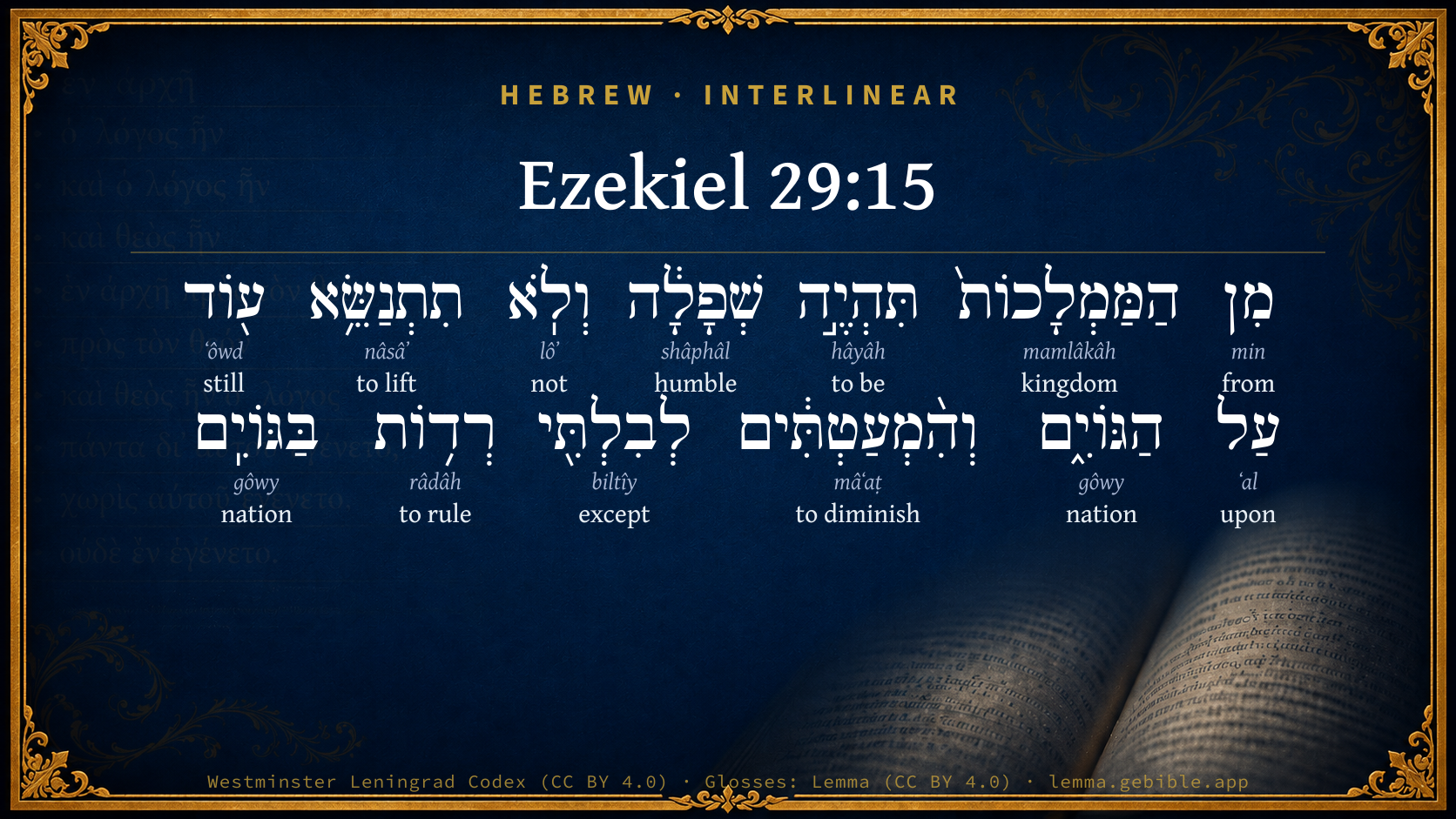
Ezekiel 29:15

Hebrew (Westminster Leningrad Codex) Ezekiel 29:15 appears in the Hebrew Old Testament. The text above is from the Westminster Leningrad Codex. Each word links to its Strong’s number, a concise gloss, and parsing drawn from the Open Scriptures Hebrew Bible morphology. Click any word for its full Brown-Driver-Briggs (BDB) entry.
Download image
Cite this verse

Ezekiel 29:15 (World English Bible). Public Domain. Lemma interlinear Bible study tool, https://lemma.gebible.app/v/ezekiel/29/15.

Show BibTeX & RIS
BibTeX
RIS
English Translation
It shall be the base of the kingdoms; neither shall it any more lift itself up above the nations: and I will diminish them, that they shall no more rule over the nations.
World English Bible · Public Domain
Download a study sheet

One document with this verse’s original text, its word-by-word gloss line, the meaning frame, cross-references with their text, attributed commentary, and full source and license credits — printable, and it pastes into notes with its structure intact.

This verse Autodidact and up

Study sheet (.html) Plain text (.txt)

A passage Seminary Student

Up to 50 verses in one chapter. A passage sheet keeps up to 6 commentary sources and 12 cross-references per verse, in the order this page ranks them, and says so on the sheet whenever that leaves anything out. Ask for a single verse and you get the Autodidact verse sheet above.

Everything on this page stays free to read, with no account — the sheet is a download of what is already on screen, not access to it.

Want to remove ads? Support Godless Engineer
Compare translations 3

The same verse in 3 English versions, stacked beneath the original-language interlinear above. Click any original word for its lexicon entry.

Each is an independent rendering of the whole verse — the interlinear is not word-aligned to these translations.

Highlighted words mark where these versions differ — a whole-verse word diff, not a word-by-word alignment.

  • World English Bible Public Domain
    It shall be the base of the kingdoms; neither shall it any more lift itself up above the nations: and I will diminish them, that they shall no more rule over the nations.
  • King James Version Public Domain
    It shall be the basest of the kingdoms; neither shall it exalt itself any more above the nations: for I will diminish them, that they shall no more rule over the nations.
  • unfoldingWord Literal Text CC BY-SA 4.0
    It will be the lowliest of the kingdoms, and it will not be lifted up any more among the nations. I will diminish them so they will no longer rule over nations.

unfoldingWord Literal Text — © unfoldingWord, licensed CC BY-SA 4.0. Word-aligned USFM3 via Door43 (git.door43.org/unfoldingWord/en_ult).

Versions to compare (up to 4)

3 of 4 selected

Show all 18 translations

Every available English version of this verse, each an independent rendering of the whole verse.

  • World English Bible Public Domain
    It shall be the base of the kingdoms; neither shall it any more lift itself up above the nations: and I will diminish them, that they shall no more rule over the nations.
  • Berean Standard Bible Public Domain
    Egypt will be the lowliest of kingdoms and will never again exalt itself above the nations. For I will diminish Egypt so that it will never again rule over the nations.
  • Majority Standard Bible Public Domain
    Egypt will be the lowliest of kingdoms and will never again exalt itself above the nations. For I will diminish Egypt so that it will never again rule over the nations.
  • King James Version Public Domain
    It shall be the basest of the kingdoms; neither shall it exalt itself any more above the nations: for I will diminish them, that they shall no more rule over the nations.
  • American Standard Version (1901) Public Domain
    It shall be the basest of the kingdoms; neither shall it any more lift itself up above the nations: and I will diminish them, that they shall no more rule over the nations.
  • Revised Version (1885) Public Domain
    It shall be the basest of the kingdoms; neither shall it any more lift itself up above the nations: and I will diminish them, that they shall no more rule over the nations.
  • Geneva Bible (1599) Public Domain
    It shall be the smallest of the kingdomes, neither shall it exalt it selfe any more aboue the nations: for I will diminish them, that they shall no more rule the nations.
  • Douay-Rheims (1899) Public Domain
    It shall be the lowest among other kingdoms, and it shall no more be exalted over the nations, and I will diminish them that they shall rule no more over the nations.
  • Young's Literal Translation Public Domain
    Of the kingdoms it is lowest, And it lifteth not up itself any more above the nations, And I have made them few, So as not to rule among nations.
  • Literal Standard Version CC BY-SA 4.0
    It is lowest of the kingdoms, || And it does not lift itself up above the nations anymore, || And I have made them few, || So as not to rule among nations.
  • Unlocked Literal Bible CC BY-SA 4.0
    It will be the lowliest of the kingdoms, and it will not be lifted up any more among the nations. I will diminish them so they will no longer rule over nations.
  • unfoldingWord Literal Text CC BY-SA 4.0
    It will be the lowliest of the kingdoms, and it will not be lifted up any more among the nations. I will diminish them so they will no longer rule over nations.
  • Darby Bible Public Domain
    It shall be the basest of kingdoms; neither shall it exalt itself any more above the nations; and I will diminish them, so that they shall no more rule over the nations.
  • World Messianic Bible Public Domain
    It will be the lowest of the kingdoms. It won’t lift itself up above the nations any more. I will diminish them so that they will no longer rule over the nations.
  • Webster's Bible Public Domain
    It shall be the basest of the kingdoms; neither shall it exalt itself any more above the nations: for I will diminish them, that they shall no more rule over the nations.
  • Free Bible Version CC BY-SA 4.0
    Egypt will be the lowest of kingdoms and won't ever be more important than other nations again. I will bring Egypt down so that it won't ever be able to rule over the nations again.
  • Bible in Basic English Public Domain
    It will be the lowest of the kingdoms, and never again will it be lifted up over the nations: I will make them small, so that they may not have rule over the nations.
  • JPS Tanakh (1917) Public Domain
    It shall be the lowliest of the kingdoms, neither shall it any more lift itself up above the nations; and I will diminish them, that they shall no more rule over the nations.

Literal Standard Version (2020), Covenant Press — licensed CC BY-SA 4.0. Text via the HelloAO Bible API (eBible.org). Unlocked Literal Bible (unfoldingWord) — licensed CC BY-SA 4.0. Text via the HelloAO Bible API (eBible.org). unfoldingWord Literal Text — © unfoldingWord, licensed CC BY-SA 4.0. Word-aligned USFM3 via Door43 (git.door43.org/unfoldingWord/en_ult). Free Bible Version, Dr. Jonathan Gallagher — licensed CC BY-SA 4.0. Text via the HelloAO Bible API (eBible.org).

Word by word

More ways to search: Search by grammar → Find every occurrence → Compare this word →

Practice this passage: Drill this verse → Learn its vocabulary →

שְׁפָלָ֔ה
shâphâl
H8217
“humble”
Adjective, Adjective, Feminine, Singular, Absolute
Part of Speech
Adjective
Type
Adjective
Gender
Feminine
Number
Singular
State
Absolute
Full BDB Definition

Origin: from H8213

TWOT: 2445c

low, humble - low (in height) - low (in station), humble (of condition or spirit) - humiliated - lowly (as subst)
  1. מִן min H4480 “from” Preposition
  2. הַמַּמְלָכוֹת֙ mamlâkâh H4467 “the · kingdoms” Particle, Definite Article + Noun, Common, Feminine, Plural, Absolute
  3. תִּהְיֶ֣ה hâyâh H1961 “to be” Verb, Qal, Imperfect, 3rd Person, Feminine, Singular
  4. וְלֹֽא lôʼ H3808 “and · not” Conjunction + Particle, Negative
  5. תִתְנַשֵּׂ֥א nâsâʼ H5375 “to lift” Verb, Hithpael, Imperfect, 3rd Person, Feminine, Singular
  6. ע֖וֹד ʻôwd H5750 “still” Adverb
  7. עַל ʻal H5921 “upon” Preposition
  8. הַגּוֹיִ֑ם gôwy H1471 “the · nations” Particle, Definite Article + Noun, Common, Masculine, Plural, Absolute
  9. וְהִ֨מְעַטְתִּ֔ים mâʻaṭ H4591 “and · to diminish · them” Conjunction + Verb, Hiphil, Sequential Perfect, 1st Person, Common, Singular + Suffix, Personal, 3rd Person, Masculine, Plural
  10. לְבִלְתִּ֖י biltîy H1115 “to/for · except” Preposition + Conjunction
  11. רְד֥וֹת râdâh H7287 “to rule” Verb, Qal, Infinitive Construct
  12. בַּגּוֹיִֽם gôwy H1471 “in/at the · nations” Preposition, Determined + Noun, Common, Masculine, Plural, Absolute

About this verse

These counts appear in no published source. They are computed here, from the morphology-tagged text and Lemma’s own curated glosses. What Lemma adds →

13
words
12
distinct lemmas
Prophets
section

Notable vocabulary

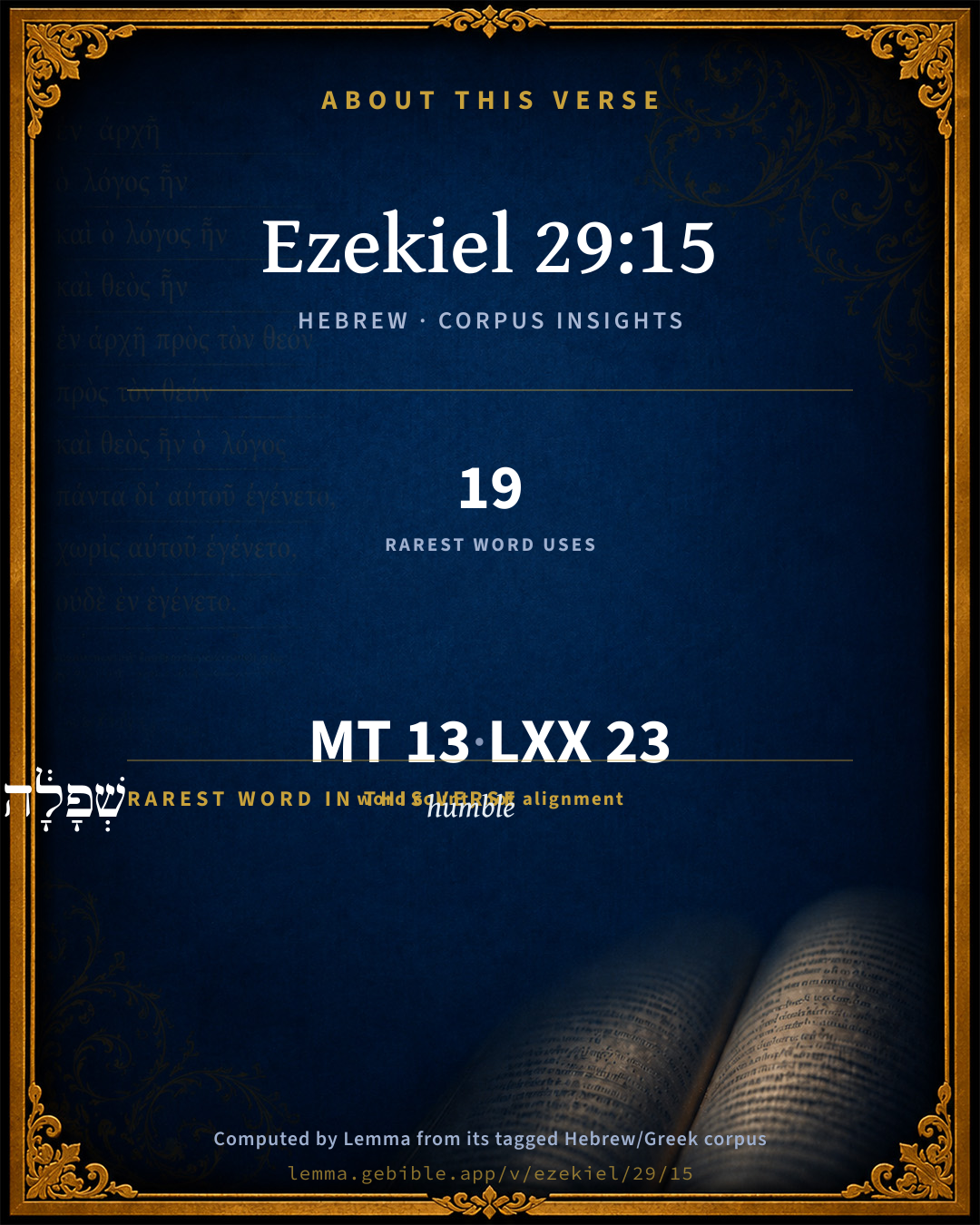
The rarest word here is שְׁפָלָ֔ה humble H8217 — appearing just 19 times in the whole Hebrew Bible.

Shared distinctive vocabulary

שְׁפָלָ֔ה humble H8217 occurs in 18 verses of the Hebrew Bible. Also found in:

Grammatical profile

  • 4 verbs
  • 3 nouns
  • 1 adjective
  • 2 prepositions
  • 1 conjunction
  • 1 adverb
  • 1 particle

Verb forms

  • תִּהְיֶ֣ה Qal · Imperfect
  • תִתְנַשֵּׂ֥א Hithpael · Imperfect
  • וְהִ֨מְעַטְתִּ֔ים Hiphil · Sequential Perfect
  • רְד֥וֹת Qal · Infinitive Construct

Repetition

A word recurs within this verse — often emphatic in Hebrew:

  • הַגּוֹיִ֑ם nation H1471 ×2

Hebrew & Septuagint length

In English translation the verse runs 33 words from the Hebrew and 38 from the Septuagint (LXX English) — closely comparable.

A rough comparison of the two English renderings, which tokenize alike — not a word-level alignment.

Word counts can differ between the Hebrew and the Greek without any difference in meaning — e.g. the Hebrew direct-object marker אֵת has no separate Greek word, and Greek often adds the article ὁ.

In the original languages it is 13 Hebrew tokens and 23 Greek tokens — but the two are counted differently (Hebrew bundles its prefixes and suffixes into one token; the Greek is in lemma form), so that isn’t a like-for-like length.

Cross-references

8

Topical passages linked to Ezekiel 29:15 in the Treasury of Scripture Knowledge — connected by theme and wording, ordered by reader-vote popularity; previews shown in the World English Bible.

  • Ezekiel 30:13 Thus says the Lord Yahweh: I will also destroy the idols, and I will cause the images to cease from Memphis; and there shall be no more a prince from the land of Egypt: and I will put a fear in the land of Egypt.
  • Zechariah 10:11 He will pass through the sea of affliction, And will strike the waves in the sea, And all the depths of the Nile will dry up; And the pride of Assyria will be brought down, And the scepter of Egypt will depart.
  • Ezekiel 17:6 It grew, and became a spreading vine of low stature, whose branches turned toward him, and the roots of it were under him: so it became a vine, and brought forth branches, and shot forth sprigs.
  • Ezekiel 17:14 that the kingdom might be base, that it might not lift itself up, but that by keeping his covenant it might stand.
  • Ezekiel 31:2 Son of man, tell Pharaoh king of Egypt, and to his multitude: Whom are you like in your greatness?
  • Ezekiel 32:2 Son of man, take up a lamentation over Pharaoh king of Egypt, and tell him, You were likened to a young lion of the nations: yet are you as a monster in the seas; and you did break forth with your rivers, and troubled the waters with your feet, and fouled their rivers.
  • Nahum 3:8–9 Are you better than No-Amon, who was situated among the rivers, who had the waters around her; whose rampart was the sea, and her wall was of the sea?
  • Daniel 11:42–43 He shall stretch forth his hand also on the countries; and the land of Egypt shall not escape.

Cross-references courtesy of OpenBible.info (CC BY 4.0).

Hebrew and Greek witnesses Masoretic Hebrew ↔ Greek Septuagint

The same verse in the two great witnesses to the Old Testament, shown verse-for-verse.

These are two independent witnesses, not word-aligned to each other, and the Septuagint is shown in lemma (dictionary) form.

Hebrew Ezekiel 29:15 Masoretic · Westminster Leningrad Codex

מִן הַמַּמְלָכוֹת֙ תִּהְיֶ֣ה שְׁפָלָ֔ה וְלֹֽא תִתְנַשֵּׂ֥א ע֖וֹד עַל הַגּוֹיִ֑ם וְהִ֨מְעַטְתִּ֔ים לְבִלְתִּ֖י רְד֥וֹת בַּגּוֹיִֽם

It shall be the base of the kingdoms; neither shall it any more lift itself up above the nations: and I will diminish them, that they shall no more rule over the nations.

World English Bible · Public Domain

Greek LXX Ezekiel 29:15 Septuagint · lemma form

παρά πᾶς ὁ ἀρχή οὐ μή ὑψόω ἔτι ἐπί ὁ ἔθνος καί ὀλιγοστός αὐτός ποιέω ὁ μή εἰμί αὐτός πολύς ἐν ὁ ἔθνος

and it shall be a base kingdom beyond all other kingdoms; it shall not any more be exalted over the nations; and I will make them few in number, that they may not be great among the nations.

LXX2012 (modern English Septuagint) · Public Domain

Hebrew: Westminster Leningrad Codex (CC BY 4.0). Greek: Septuagint (public domain); English from LXX2012 (modern English Septuagint) (Public Domain). How the Septuagint differs from the Hebrew →

Targum (Aramaic paraphrase)

1

The Targum is the ancient Jewish Aramaic paraphrase of the Hebrew Scriptures — an interpretive translation, not the Hebrew text itself. Onkelos (literal) and Pseudo-Jonathan (expansive) render the Torah, and Jonathan the Prophets. Coverage is partial: where no permissively-licensed English translation exists for a verse, only the Aramaic is shown. This is verse-level text, not a word-by-word alignment to the Hebrew.

  1. Targum Jonathan Prophets (Joshua–Malachi)
    מִן מַלְכְּוָתָא תְּהֵי חֲלָשָׁא וְלָא תִתְרַבְרֵב עוֹד עַל עַמְמַיָא וְאַזְעִירִינוּן בְּדִיל דְלָא יִפְלְחוּן בְּעַמְמַיָא:

    (no public-domain English translation for this verse)

    Targum Jonathan — Aramaic: “Mikraot Gedolot” (public domain). English: “Sefaria Community Translation” (CC0 1.0 (public-domain dedication)); “London "Chaldee Paraphrase," 1871” (public domain). Text via Sefaria.

Commentary

Notes on Ezekiel 29:15 from classic Christian and Jewish commentators (each source and its license shown beneath its notes). The classic Christian expositions comment on the surrounding passage and are grouped to its opening verse, so a note may address several verses; the Jewish commentaries on the Tanakh (Rashi and others) are per-verse, so they appear only where the commentator wrote on this verse.

Lemma curates 59 commentaries, every one of them public domain or Creative Commons licensed, each selected and text-cleaned for this edition rather than reprinted as found. About our sources →

Trapp's Complete Commentary

John Trapp

Eze 29:15 It shall be the basest of the kingdoms; neither shall it exalt itself any more above the nations: for I will diminish them, that they shall no more rule over the nations.

Ver. 15. It shall be the basest of the kingdoms.] And worthily, for their worshipping the basest creatures, {see Rom 1:23-24} but especiailly for their faithlessness to God’s Israel.

For I will diminish them.] As God hath likewise done the Persians at this day - who have undone their confederates, the Egyptians and Georgians {a} - and the Grecians no less, who have now lost their liberty, and are so degenerate, by means of the Turkish oppression, that in all Graecia is hardly to be found any small remembrance of the glory thereof. {b}

{a} Turkish History.

{b} Ibid., 260.

John Trapp, A Commentary or Exposition upon All the Books of the Old and New Testament (1647–1656) — public domain. Text from a community e-Sword module.

John Gill's Exposition

And it shall be the basest of the kingdoms,.... That belonged to the Persian monarchy, or to the Macedonian empire, being more kept under than the rest, lest it should regain its former strength and glory; though it became more famous in the times of some of the Ptolemies, yet never recovered its former greatness; and is now exceeding base indeed, as appears from the preceding note:

neither shall it exalt itself any more above the nations; so as to conquer them, and make them tributary to it, as it had done:

for I will demolish them, that they shall no more rule over the nations; for though they made war upon other nations in the time of the Lagidae, yet they did not subdue them, and annex them to their kingdom, being much weakened both as to men and money.

John Gill's Exposition of the Whole Bible (1746–1763) — public domain (CC PDM 1.0). Text via the HelloAO Bible API.

Matthew Poole's English Annotations

The basest; the most abject, debased, and most underling. It is likely the kings to whom Egypt was tributary kept them lowest, as knowing how dangerous that kingdom might be, as it recovered its ancient greatness; and the word seems to intimate this, for it is more than the kingdoms it shall be depressed.

Neither shall it exalt itself; its masters would so watch and check it. I will diminish them; beside the hard and cruel usages of the Persian kings, which might be unjust enough, God’s most just judgment should follow them to lessen their numbers, power, wealth, and honour.

They shall no more rule over the nations; though once they had subdued and ruled, yet should they not any more. In the times of the Ptolemies, though it was considerable, yet then it was not a kingdom that ruled the nations about her, though she made war upon them.

Matthew Poole's English Annotations on the Holy Bible (1683–1685) — public domain. Text from a community e-Sword/MySword module.

Whedon's Commentary on the Bible

Daniel D. Whedon

15. The basest of the kingdoms — Compare Eze_17:14. Egypt never recovered from the conquest of Nebuchadnezzar. She was easily conquered by the Persians, fell a prey to the Greeks, was tossed about by the Romans, and has never, even to this day, had an independent native ruler on the throne. Never again should Egypt be “the confidence of the house of Israel” (Eze_29:16; compare Isa_30:2-3; Isa_36:4; Isa_36:6; 2Ki_23:35; 2Ki_17:4).

Daniel D. Whedon (gen. ed.), Commentary on the Old and New Testaments (1874–1909) — public domain. Text from a community e-Sword module.

The Pulpit Commentary

It shall be the basest of the kingdoms. The words describe vividly the condition of Egypt under the Persian monarchy, after its conquest by Cambyses. With the Ptolemies it rose again to something like eminence, but that, it must be remembered, was an alien dynasty. The nationality of Egypt was suppressed, and Alexandria, practically a Greek city, took the place of Memphis, Sais, and Thebes.

The Pulpit Commentary (1880–1919), ed. H.D.M. Spence-Jones & Joseph S. Exell — public domain. Text from a community e-Sword module.

John Wesley's Explanatory Notes

No more rule - Though in the times of the Ptolemeys, it was considerable, yet then, even then it did not rule the nations about her.

John Wesley, Explanatory Notes Upon the Whole Bible (1754–1765) — public domain. Text via the GEBible commentary corpus.

unfoldingWord translationNotes

Door43 World Missions Community

General Information:

Yahweh continues giving Ezekiel his message to Pharaoh.

the lowliest of the kingdoms

Here "lowliest" represents least important. AT: "the least important of the kingdoms" (See: Metaphor)

it will not be lifted up any more among the nations

Here "be lifted up" represents becoming important. AT: "it will not become important again among the nations" (See: Metaphor)

I will diminish them

"I will make them small." Here "diminish them" represents making Egypt weak or unimportant. (See: Metaphor)

The Egyptians will no longer be a reason for confidence for the house of Israel

The abstract noun "confidence" can be translated with the verbs "trust" or "rely on." AT: "The house of Israel will no longer trust in the Egyptians" or "The house of Israel will no longer rely on the Egyptians" (See: Abstract Nouns)

the house of Israel

Here "house" represents the people of Israel. AT: "the people of Israel" or "the nation of Israel" (See: Metonymy)

they will be a reminder of the iniquity that Israel committed

How Egypt would be a reminder can be stated clearly. The abstract nouns "reminder" and "iniquity" can be expressed with the verbs "remember" and "sin." AT: "when Israel sees what I do to Egypt, Israel will remember how Israel sinned" (See: Assumed Knowledge and Implicit Information and Abstract Nouns)

when they turned to Egypt for help

Here "turn ... for help" is a metonym for "ask ... for help." AT: "whenever they asked Egypt to help them" (See: Metonymy)

translationWords

kingdom

nation

confidence

iniquity

unfoldingWord translationNotes — © Distant Shores Media and the Door43 World Missions Community, licensed CC BY-SA 4.0. Source: git.door43.org/Door43/en_tn.

Rashi

Rabbi Shlomo Yitzchaki (Rashi)

So that they shall not domineer over the nations [Heb. רְדוֹת,] an expression of ruling, like (Gen. 1:28): “and rule (וּרְדוּ) over the fish of the sea.”

Rashi on the Tanakh — English translations: “The Judaica Press complete Tanach with Rashi, translated by A. J. Rosenberg” (CC BY 4.0); “Pentateuch with Rashi's commentary by M. Rosenbaum and A.M. Silbermann, 1929-1934” (public domain); “The Metsudah Tanach series, Lakewood, N.J” (CC BY 4.0); and “The Book of Joshua, Metsudah Publications, 1997” (CC BY 4.0). Text via Sefaria.

Lesson kit

Teaching starters — assembled from the data on this page, not authored interpretation. Every prompt links to the verse data it draws on. Edit before teaching.

Ezekiel, in the Prophets, opens this verse with 13 words (12 distinct Hebrew lemmas). Its most distinctive word is shâphâl (“humble”). A historical commentator’s framing appears above. Read the whole chapter for the surrounding context.

Discussion questions

  1. The word shâphâl carries the sense “humble.” How does it shape the verse?
  2. Leviticus 13:20 shares the word «humble» with this verse. How do the two illuminate each other?
  3. “nation” occurs 2× in this one verse. What is the effect of the repetition?
  4. The translations on this page render this verse differently — a whole-verse word diff, not a word-by-word alignment. What might account for the different wordings?
  5. The verb «תִּהְיֶ֣ה» is Qal Imperfect. How does its form color the action?
  6. Reading how Trapp's Complete Commentary and John Gill's Exposition read this verse, where do the two commentators agree and where do they part?

Things to notice

Reading settings

Reading text

Shown beneath each verse's original-language words.

Old Testament
Old Testament edition

Read the OT as the Masoretic Hebrew (MT) or the Greek Septuagint (LXX).

English shown for the Greek Septuagint (in the Hebrew ↔ Greek comparison).

Comparing translations? Open the Compare panel on any verse page to stack up to four side by side.