Isaiah 60:12

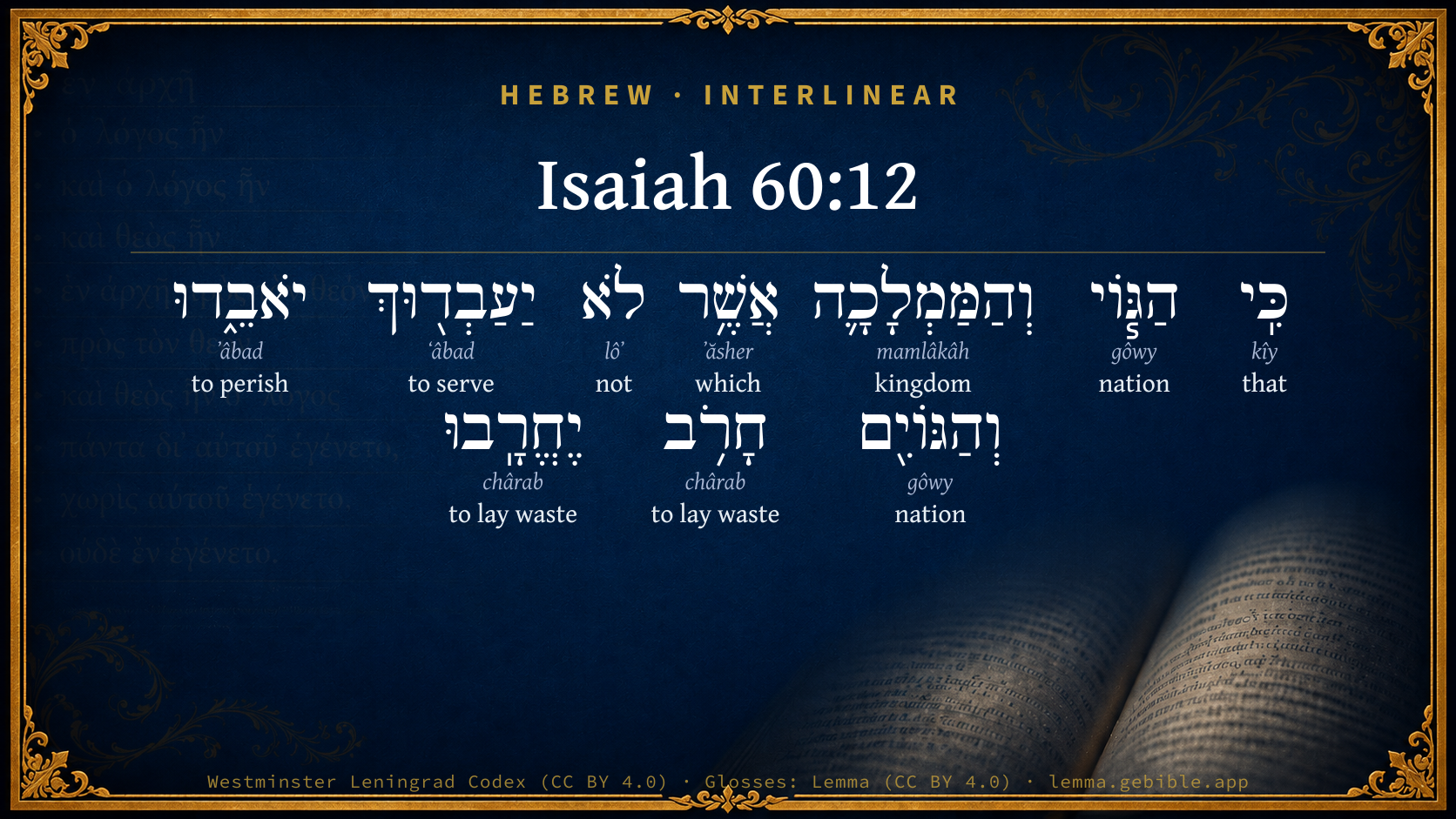
Hebrew (Westminster Leningrad Codex) Isaiah 60:12 appears in the Hebrew Old Testament. The text above is from the Westminster Leningrad Codex. Each word links to its Strong’s number, a concise gloss, and parsing drawn from the Open Scriptures Hebrew Bible morphology. Click any word for its full Brown-Driver-Briggs (BDB) entry.
Download image
Cite this verse

Isaiah 60:12 (World English Bible). Public Domain. Lemma interlinear Bible study tool, https://lemma.gebible.app/v/isaiah/60/12.

Show BibTeX & RIS
BibTeX
RIS
English Translation
For that nation and kingdom that will not serve you shall perish; yes, those nations shall be utterly wasted.
World English Bible · Public Domain
Download a study sheet

One document with this verse’s original text, its word-by-word gloss line, the meaning frame, cross-references with their text, attributed commentary, and full source and license credits — printable, and it pastes into notes with its structure intact.

This verse Autodidact and up

Study sheet (.html) Plain text (.txt)

A passage Seminary Student

Up to 50 verses in one chapter. A passage sheet keeps up to 6 commentary sources and 12 cross-references per verse, in the order this page ranks them, and says so on the sheet whenever that leaves anything out. Ask for a single verse and you get the Autodidact verse sheet above.

Everything on this page stays free to read, with no account — the sheet is a download of what is already on screen, not access to it.

Want to remove ads? Support Godless Engineer
Compare translations 3

The same verse in 3 English versions, stacked beneath the original-language interlinear above. Click any original word for its lexicon entry.

Each is an independent rendering of the whole verse — the interlinear is not word-aligned to these translations.

Highlighted words mark where these versions differ — a whole-verse word diff, not a word-by-word alignment.

  • World English Bible Public Domain
    For that nation and kingdom that will not serve you shall perish; yes, those nations shall be utterly wasted.
  • King James Version Public Domain
    For the nation and kingdom that will not serve thee shall perish; yea, those nations shall be utterly wasted.
  • unfoldingWord Literal Text CC BY-SA 4.0
    For the nation and the kingdom that does not serve you will perish, and nations, destroying, they will destroy.

unfoldingWord Literal Text — © unfoldingWord, licensed CC BY-SA 4.0. Word-aligned USFM3 via Door43 (git.door43.org/unfoldingWord/en_ult).

Versions to compare (up to 4)

3 of 4 selected

Show all 18 translations

Every available English version of this verse, each an independent rendering of the whole verse.

  • World English Bible Public Domain
    For that nation and kingdom that will not serve you shall perish; yes, those nations shall be utterly wasted.
  • Berean Standard Bible Public Domain
    For the nation or kingdom that will not serve you will perish; it will be utterly destroyed.
  • Majority Standard Bible Public Domain
    For the nation or kingdom that will not serve you will perish; it will be utterly destroyed.
  • King James Version Public Domain
    For the nation and kingdom that will not serve thee shall perish; yea, those nations shall be utterly wasted.
  • American Standard Version (1901) Public Domain
    For that nation and kingdom that will not serve thee shall perish; yea, those nations shall be utterly wasted.
  • Revised Version (1885) Public Domain
    For that nation and kingdom that will not serve thee shall perish; yea, those nations shall be utterly wasted.
  • Geneva Bible (1599) Public Domain
    For the nation and the kingdome, that will not serue thee, shall perish: and those nations shalbe vtterly destroyed.
  • Douay-Rheims (1899) Public Domain
    For the nation and the kingdom that will not serve thee, shall perish: and the Gentiles shall be wasted with desolation.
  • Young's Literal Translation Public Domain
    For the nation and the kingdom that do not serve thee perish, Yea, the nations are utterly wasted.
  • Literal Standard Version CC BY-SA 4.0
    For the nation and the kingdom that does not serve you perishes, || Indeed, the nations are utterly desolated.
  • Unlocked Literal Bible CC BY-SA 4.0
    Indeed, nations and kingdoms that will not serve you will perish; those nations will be completely destroyed.
  • unfoldingWord Literal Text CC BY-SA 4.0
    For the nation and the kingdom that does not serve you will perish, and nations, destroying, they will destroy.
  • Darby Bible Public Domain
    For the nation and the kingdom that will not serve thee shall perish; and those nations shall be utterly wasted.
  • World Messianic Bible Public Domain
    For that nation and kingdom that will not serve you shall perish; yes, those nations shall be utterly wasted.
  • Webster's Bible Public Domain
    For the nation and kingdom that will not serve thee shall perish; yes, those nations shall be utterly wasted.
  • Free Bible Version CC BY-SA 4.0
    Any nation or kingdom that does not serve you will be completely destroyed.
  • Bible in Basic English Public Domain
    For the nation or kingdom which will not be your servant will come to destruction; such nations will be completely waste.
  • JPS Tanakh (1917) Public Domain
    For that nation and kingdom that will not serve thee shall perish; yea, those nations shall be utterly wasted.

Literal Standard Version (2020), Covenant Press — licensed CC BY-SA 4.0. Text via the HelloAO Bible API (eBible.org). Unlocked Literal Bible (unfoldingWord) — licensed CC BY-SA 4.0. Text via the HelloAO Bible API (eBible.org). unfoldingWord Literal Text — © unfoldingWord, licensed CC BY-SA 4.0. Word-aligned USFM3 via Door43 (git.door43.org/unfoldingWord/en_ult). Free Bible Version, Dr. Jonathan Gallagher — licensed CC BY-SA 4.0. Text via the HelloAO Bible API (eBible.org).

Word by word

More ways to search: Search by grammar → Find every occurrence → Compare this word →

Practice this passage: Drill this verse → Learn its vocabulary →

חָרֹ֥ב
chârab
H2717
“to lay waste”
Verb, Qal, Infinitive Absolute
Part of Speech
Verb
Stem
Qal
Form
Infinitive Absolute
Full BDB Definition

Origin: a primitive root

TWOT: 731 , 732

to be waste, lay waste, make desolate, be desolate, be in ruins - (Qal) to be waste, be desolate - (Niphal) - to be made desolate - desolate (participle) - (Hiphil) to lay waste, make desolate - (Hophal) to be laid waste - to be dry, be dried up - (Qal) to be dried, be dried up - (Pual) to be dried - (Hiphil) to dry up - (Hophal) to be dried up - to attack, smite down, slay, fight
  1. כִּֽי kîy H3588 “that” Conjunction
  2. הַגּ֧וֹי gôwy H1471 “the · nation” Particle, Definite Article + Noun, Common, Masculine, Singular, Absolute
  3. וְהַמַּמְלָכָ֛ה mamlâkâh H4467 “and · the · kingdom” Conjunction + Particle, Definite Article + Noun, Common, Feminine, Singular, Absolute
  4. אֲשֶׁ֥ר ʼăsher H834 “which” Particle, Relative
  5. לֹא lôʼ H3808 “not” Particle, Negative
  6. יַעַבְד֖וּךְ ʻâbad H5647 “to serve · you” Verb, Qal, Imperfect, 3rd Person, Masculine, Plural + Suffix, Personal, 2nd Person, Feminine, Singular
  7. יֹאבֵ֑דוּ ʼâbad H6 “to perish” Verb, Qal, Imperfect, 3rd Person, Masculine, Plural
  8. וְהַגּוֹיִ֖ם gôwy H1471 “and · the · nations” Conjunction + Particle, Definite Article + Noun, Common, Masculine, Plural, Absolute
  9. יֶחֱרָֽבוּ chârab H2717 “to lay waste” Verb, Qal, Imperfect, 3rd Person, Masculine, Plural

About this verse

These counts appear in no published source. They are computed here, from the morphology-tagged text and Lemma’s own curated glosses. What Lemma adds →

10
words
8
distinct lemmas
Prophets
section

Shared distinctive vocabulary

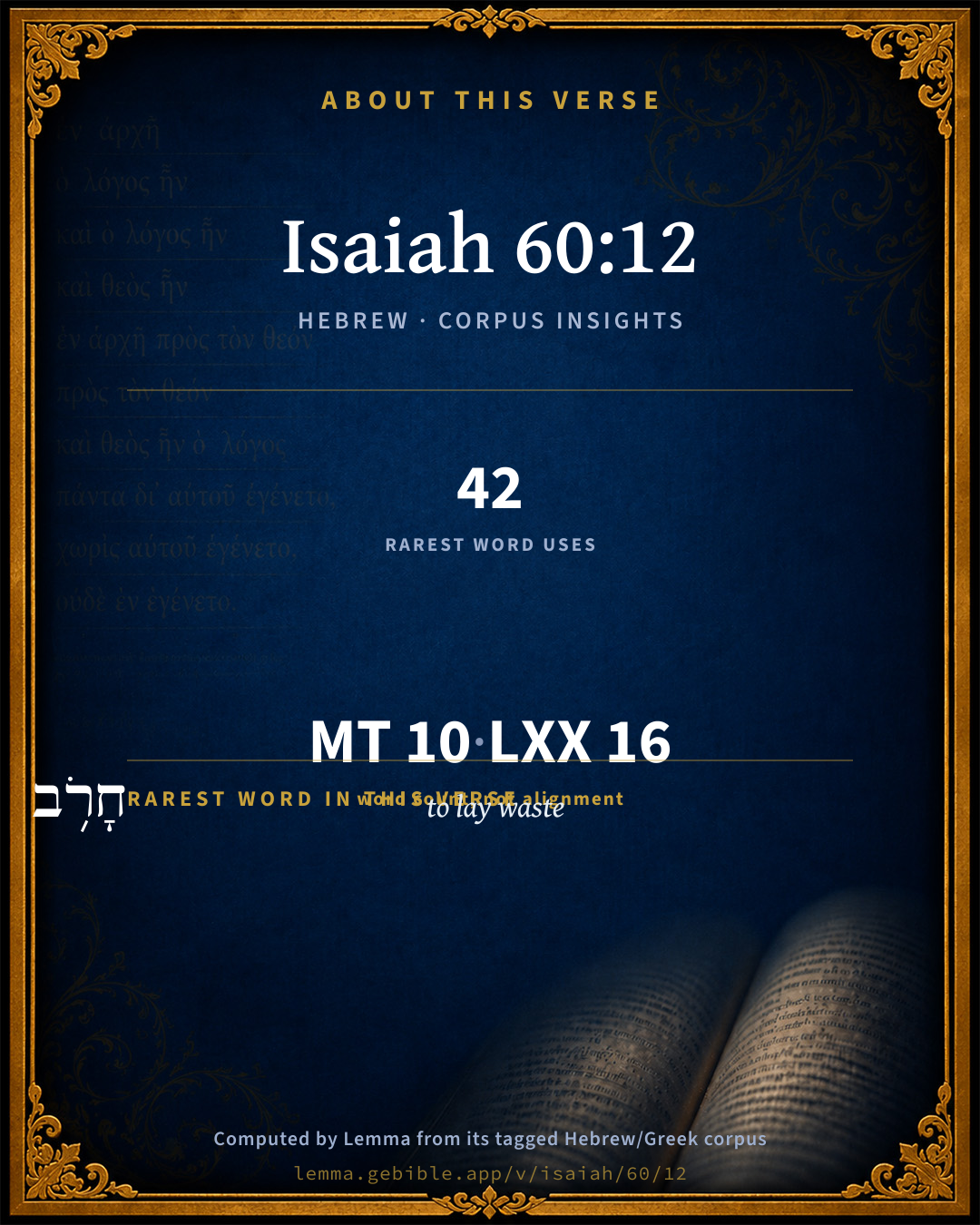
חָרֹ֥ב to lay waste H2717 occurs in 38 verses of the Hebrew Bible. Also found in:

Grammatical profile

  • 4 verbs
  • 3 nouns
  • 1 conjunction
  • 2 particles

Verb forms

  • יַעַבְד֖וּךְ Qal · Imperfect
  • יֹאבֵ֑דוּ Qal · Imperfect
  • חָרֹ֥ב Qal · Infinitive Absolute
  • יֶחֱרָֽבוּ Qal · Imperfect

Repetition

Words recur within this verse — often emphatic in Hebrew:

  • הַגּ֧וֹי nation H1471 ×2
  • חָרֹ֥ב to lay waste H2717 ×2

Hebrew & Septuagint length

In English translation the verse runs 19 words from the Hebrew and 21 from the Septuagint (LXX English) — closely comparable.

A rough comparison of the two English renderings, which tokenize alike — not a word-level alignment.

Word counts can differ between the Hebrew and the Greek without any difference in meaning — e.g. the Hebrew direct-object marker אֵת has no separate Greek word, and Greek often adds the article ὁ.

In the original languages it is 10 Hebrew tokens and 16 Greek tokens — but the two are counted differently (Hebrew bundles its prefixes and suffixes into one token; the Greek is in lemma form), so that isn’t a like-for-like length.

Cross-references

11

Topical passages linked to Isaiah 60:12 in the Treasury of Scripture Knowledge — connected by theme and wording, ordered by reader-vote popularity; previews shown in the World English Bible.

  • Isaiah 54:15 Behold, they may gather together, but not by me: whoever shall gather together against you shall fall because of you.
  • Zechariah 14:12–19 This will be the plague with which Yahweh will strike all the peoples who have warred against Jerusalem: their flesh will consume away while they stand on their feet, and their eyes will consume away in their sockets, and their tongue will consume away in their mouth.
  • Psalms 2:12 Kiss the son, lest he be angry, and you perish in the way, For his wrath will soon be kindled. Blessed are all those who take refuge in him.
  • Isaiah 14:2 The peoples shall take them, and bring them to their place; and the house of Israel shall possess them in the land of Yahweh for servants and for handmaids: and they shall take them captive whose captives they were; and they shall rule over their oppressors.
  • Isaiah 41:11 Behold, all those who are incensed against you shall be disappointed and confounded: those who strive with you shall be as nothing, and shall perish.
  • Daniel 2:44–45 In the days of those kings shall the God of heaven set up a kingdom which shall never be destroyed, nor shall the sovereignty of it be left to another people; but it shall break in pieces and consume all these kingdoms, and it shall stand forever.
  • Daniel 2:35 Then was the iron, the clay, the brass, the silver, and the gold, broken in pieces together, and became like the chaff of the summer threshing floors; and the wind carried them away, so that no place was found for them: and the stone that struck the image became a great mountain, and filled the whole earth.
  • Zechariah 12:2–4 "Behold, I will make Jerusalem a cup of reeling to all the surrounding peoples, and on Judah also will it be in the siege against Jerusalem.
  • Matthew 21:44 He who falls on this stone will be broken to pieces, but on whoever it will fall, it will scatter him as dust."
  • Luke 19:27 But bring those enemies of mine who didn't want me to reign over them here, and kill them before me.'"
  • Revelation 2:26–27 He who overcomes, and he who keeps my works to the end, to him I will give authority over the nations.

Cross-references courtesy of OpenBible.info (CC BY 4.0).

Hebrew and Greek witnesses Masoretic Hebrew ↔ Greek Septuagint

The same verse in the two great witnesses to the Old Testament, shown verse-for-verse.

These are two independent witnesses, not word-aligned to each other, and the Septuagint is shown in lemma (dictionary) form.

Hebrew Isaiah 60:12 Masoretic · Westminster Leningrad Codex

כִּֽי הַגּ֧וֹי וְהַמַּמְלָכָ֛ה אֲשֶׁ֥ר לֹא יַעַבְד֖וּךְ יֹאבֵ֑דוּ וְהַגּוֹיִ֖ם חָרֹ֥ב יֶחֱרָֽבוּ

For that nation and kingdom that will not serve you shall perish; yes, those nations shall be utterly wasted.

World English Bible · Public Domain

Greek LXX Isaiah 60:12 Septuagint · lemma form

ὁ γάρ ἔθνος καί ὁ βασιλεύς ὅστις οὐ δουλεύω σύ ἀποὀλλύω καί ὁ ἔθνος ἐρημία ἐρημόω

For the nations and the kings which will not serve you shall perish; and those nations shall be made utterly desolate.

LXX2012 (modern English Septuagint) · Public Domain

Hebrew: Westminster Leningrad Codex (CC BY 4.0). Greek: Septuagint (public domain); English from LXX2012 (modern English Septuagint) (Public Domain). How the Septuagint differs from the Hebrew →

Targum (Aramaic paraphrase)

1

The Targum is the ancient Jewish Aramaic paraphrase of the Hebrew Scriptures — an interpretive translation, not the Hebrew text itself. Onkelos (literal) and Pseudo-Jonathan (expansive) render the Torah, and Jonathan the Prophets. Coverage is partial: where no permissively-licensed English translation exists for a verse, only the Aramaic is shown. This is verse-level text, not a word-by-word alignment to the Hebrew.

  1. Targum Jonathan Prophets (Joshua–Malachi)
    אֲרֵי עַם וּמַלְכוּ דְלָא יִפְלְחוּנִיךְ יְרוּשְׁלֵם יֵיבְדוּן וְעַמְמַיָא אִשְׁתֵּיצָאָה יִשְׁתֵּיצוּן:

    For the nation and kingdom that will not serve thee, 0 Jerusalem, shall perish; yea, those nations shall be utterly destroyed.

    Targum Jonathan — Aramaic: “Mikraot Gedolot” (public domain). English: “Sefaria Community Translation” (CC0 1.0 (public-domain dedication)); “London "Chaldee Paraphrase," 1871” (public domain). Text via Sefaria.

Commentary

Notes on Isaiah 60:12 from classic Christian and Jewish commentators (each source and its license shown beneath its notes). The classic Christian expositions comment on the surrounding passage and are grouped to its opening verse, so a note may address several verses; the Jewish commentaries on the Tanakh (Rashi and others) are per-verse, so they appear only where the commentator wrote on this verse.

Lemma curates 59 commentaries, every one of them public domain or Creative Commons licensed, each selected and text-cleaned for this edition rather than reprinted as found. About our sources →

Trapp's Complete Commentary

John Trapp

Isa 60:12 For the nation and kingdom that will not serve thee shall perish; yea, [those] nations shall be utterly wasted.

Ver. 12. For the nation and kingdom that will not serve thee shall perish.] They are utterly out then, who hold that men may be saved in what religion soever, so be it they lead an honest life. And Pope Julius III is justly accused of sacrilege for stamping money with his own image and this inscription, "The nation and kingdom that will not serve thee shall perish."

John Trapp, A Commentary or Exposition upon All the Books of the Old and New Testament (1647–1656) — public domain. Text from a community e-Sword module.

The Biblical Illustrator

Joseph S. Exell

Isa_60:12

For the nation and kingdom that will not serve Thee shall perish

The character and doom of a corrupt nation

I.

THE CHARACTER OF A CORRUPT NATION. The text implies--

1. That there is a certain course of human life which the Bible recognizes as serving the Lord.

2. That nations as well as individuals are bound to pursue that course. There is no sentiment more common, none more philosophically absurd, none more morally pernicious than this: that communities of men are relieved from obligations which are binding upon individuals.

II. THE DOOM OF A CORRUPT NATION. They shall perish, yea, those nations shall be utterly wasted.

1. The doom is most calamitous. It shall perish.

(1) Perish as to their national existence. Their commerce shall waste away; their government shall be dissolved; all the institutions they glory in shall die out. The whole land shall be desolate as an old castle, Many great nations have thus died. Where are the empires of the Pharaohs, the Belshazzars, the Alexanders and the Caesars? They have perished, they have utterly wasted.

(2) But there is a more solemn sense still in which nations perish, that is, in a spiritual sense. They shall lose their souls. Not their existence, not their consciousness, not their memories; but their mercies, their friendships, their hopes, their heaven, their God.

2. The doom is most certain. It is here threatened with emphasis--they shall perish, yea, etc. All analogy indicates its certainty. Our subject explains--

(1) National convulsions.

(2) The true method of promoting national stability. (Homilist.)

The Biblical Illustrator, edited by Joseph S. Exell (c. 1880s–1900s) — public domain. Text from a community e-Sword module.

The Preacher's Complete Homiletical Commentary

Joseph S. Exell (gen. ed.)

NECESSITY OF RELIGION TO THE WELL-BEING OF A NATION

Isa_60:12. The nation and kingdom that will not serve Thee shall perish, &c.

I. True religion is essential to the welfare of a nation. But what is human welfare? What is that state to which we can, with full satisfaction, attach the idea of well-being? In a word—what is happiness, that object which all desire, and seek and strive to obtain, &c.? Legislation, &c., will not affect the solid welfare of a nation. Facts confirm what reason had anticipated, that true religion is the only foundation of a nation’s welfare. The reasons of the fact arise from the very nature of the case in the operation of moral causes. What the religion of the Gospel teaches and does, &c.

II. By what means may we most effectively endeavour to realise the welfare of our country, and that as the fruit of its religion? All Christians are called to promote the conversion of sinners, the more expansive holiness of believers, and the universal glory of their Lord: in a word, to make the nation Christian, by making the persons who compose the nation such. Respecting the selection and applica-of the particular methods for this purpose, the new Testament allows very great latitude provided that grand principles be preserved—

(1) Spirituality;

(2) simplicity;

(3) liberty.—J. P. Smith, D.D., LL.D.: Pulpit Memorials, pp. 59–75.

The Preacher's Complete Homiletical Commentary (gen. ed. Joseph S. Exell; Funk & Wagnalls, c. 1892) — public domain (pre-1929). A full-Bible homiletical/sermon-outline anthology covering 65 of 66 books (2 John is absent from the source module). Text from a community e-Sword module.

Tyndale Open Study Notes

Tyndale Open Resources

60:12 In the coming age, nations that refuse to obey God will be destroyed.

Tyndale Open Study Notes — © Tyndale Open Resources, licensed CC BY-SA 4.0. Text via the HelloAO Bible API.

Geneva Bible (1599)

Geneva Bible translators

He showeth that God hath given all power and authority here in earth for the use of his Church, and that they which will not serve and profit the same, shall be destroyed.

Geneva Bible (1599) marginal notes — public domain. Text via Bolls.life.

Jamieson, Fausset & Brown

Robert Jamieson, A. R. Fausset & David Brown

For--the reason which will lead Gentile kings and people to submit themselves; fear of the God in Israel (Zac 14:17).

Jamieson, Fausset & Brown — Commentary Critical and Explanatory on the Whole Bible (1871) — public domain (CC PDM 1.0). Text via the HelloAO Bible API.

The Cambridge Bible for Schools and Colleges

gen. ed. J. J. S. Perowne

12. Comp. Zec_14:17-18. The verse is objected to by Duhm and Cheyne on account of its prosaic character and unrhythmical structure, and also because it violates the strophic arrangement which these writers find in the chapter. It certainly seems to intrude awkwardly between Isa_60:11 and Isa_60:13.

shall be utterly wasted] The verb applies strictly to the lands rather than to the peoples (see the notes on ch. Isa_37:18).

The Cambridge Bible for Schools and Colleges (gen. ed. J. J. S. Perowne; Cambridge University Press, 1878–1918) — public domain. Text from a community e-Sword module.

John Gill's Exposition

For the nation and kingdom that will not serve thee shall perish,.... That will not serve the Lord Christ, and worship him with his church and people; that will not be obedient to the laws and ordinances of his house; but appoint another head over them, the pope of Rome; and make other laws, and set up other ordinances, rejecting the authority of Christ, the rule of his word, and the order of his churches:

yea, those nations shall be utterly wasted; even all the antichristian states, when the vials of God's wrath will be poured out upon them; see Zac 14:17.

John Gill's Exposition of the Whole Bible (1746–1763) — public domain (CC PDM 1.0). Text via the HelloAO Bible API.

Albert Barnes' Notes on the Bible

For the nation and kingdom - Perhaps this is given as a reason for What is said in the previous verse - that kings and their subjects should come to Zion and embrace the true religion, because if it were not done they would perish. This is certainly one reason why sinners hasten to embrace the Saviour; and when this truth becomes deeply impressed on a community, it is one of the means of a revival of religion. An apprehension of danger; a certain anticipation of ruin if the gospel is not embraced; a conviction that ‘there is salvation in no other,’ is often a means of leading people to seek the Saviour.

That will not serve thee - That will not become the servant of the church of God: that is, that will not promote its interests, obey its laws, and maintain the true religion.

Shall perish - This is applied particularly here to a ‘nation’ and a ‘kingdom.’ The idea is, that no nation can flourish that does not obey the law of God, or where the worship of the true God is not maintained. History is full of affecting illustrations of this. The ancient republics and kingdoms fell because they had not the true religion. The kingdoms of Babylon, Assyria, Macedonia, and Egypt; the Roman empire, and all the ancient monarchies and republics, soon fell to ruin because they had not the salutary restraints of the true religion, and lacked the protection of the true God. France east off the government of God in the Revolution, and was drenched in blood. It is a maxim of universal truth, that the nation which does not admit the influence of the laws and the government of God must be destroyed. No empire is strong enough to wage successful war with the great Yahweh; and sooner or later, notwithstanding all that human policy can do, corruption, sensuality, luxury, pride, and far-spreading vice, will expose a nation to his displeasure, and bring down the heavy arm of his vengeance.

There is no truth of more vital interest to this nation (America) than this; no declaration in any ancient writing expressive of the course of events in this world, that hangs with note portentous interest over this republic, than that ‘the nation that will not serve god shall perish.’ As a nation, we have nothing else to depend on but our pubic virtue, our intelligence, our respect for the laws of heaven. Our defense is not to be in standing armies - but in God, as our living and everwatchful protector and friend. Our hope is not in a vast navy, in strong ramparts, in frowning battlements, but in the favor of the Most High. No martial array, no strong fortresses, no line-of-battle-ships, can save a nation that has cast off the government of God, and that is distinguished for the violation of treaties and for oppression, bribery, and corruption. The nation that violates the Sabbath; that tramples on the rights of unoffending men and women; that disregards the most solemn compacts; and that voluntarily opens upon itself the floodgates of infidelity and vice, must expect to meet with the displeasure of the Almighty. And it is as true of an individual as it is of a nation. Of any human or angelic being; of any association or combination of human beings or angels that does not obey God, it is true that they shall be utterly destroyed.

Albert Barnes' Notes on the Bible (1834–1885) — public domain. Text from a community e-Sword/MySword module.

Haydock's Catholic Bible Commentary

Desolation. Though the Machabees conquered several nations, this can only be verified in the Church of Christ, to which God has subjected all; so that out of his faith none can be saved, Hebrews ii. 8.

George Leo Haydock (1774–1849), Haydock's Catholic Family Bible and Commentary, 1859 edition — public domain. Excludes Psalms (Douay-Rheims chapter numbering differs from Protestant) and Deuterocanonical books (Catholic canon only).

Matthew Poole's English Annotations

That will not serve thee; do offices of kindness; so is the word used, Isa 19:23; or rather, that will not submit to Christ’s sceptre.

Shall perish; shall be no more sui juris, but subdued to thee; and as refusing subjection to Christ, shall perish everlastingly; as they all perished in the deluge that were not in the ark: they that should be saved were added to the church, Act 2:47; Rev 21:24.

Utterly wasted, Heb. wasting be wasted, viz. by the sword: accordingly we read of many victories in Josephus that the Jews obtained, and in the Book of the Maccabees, as a fulfilling of this prophecy; but this doth principally relate to the spiritual Jerusalem, and this seems to anticipate an objection, If the gates stand continually open, we shall be in danger of enemies. Not so, saith he, for they shall either serve thee or perish.

Matthew Poole's English Annotations on the Holy Bible (1683–1685) — public domain. Text from a community e-Sword/MySword module.

Whedon's Commentary on the Bible

Daniel D. Whedon

12. Nation and kingdom — Even at the height of Messianic triumphs it would seem resistance was occasionally made. So in the New Testament, at the so-called millennial periods, the conquests of the true religion will not fully prevail till after long unsuccessful struggles.

Shall perish — Final resistance will end disastrously. This is the providential law, till the last enemy shall be conquered. Absolute peril awaits all who resist God.

Daniel D. Whedon (gen. ed.), Commentary on the Old and New Testaments (1874–1909) — public domain. Text from a community e-Sword module.

The Pulpit Commentary

The nation... that will not serve thee shall perish. God"s curse shall be upon them; they shall wither and decay for lack of the Divine favour and of the graces which God dispenses to mankind through his Church. (comp. Zec_14:17-19)

The condition of national prosperity.

"Every nation shall fall unless it serves the Lord, the righteous God, the God of Israel, through whom alone is salvation. The figure of serving Israel means serving the God of Israel" (Matthew Arnold). Foerster remarks that "the Roman pontiffs abuse this oracle of the prophet to establish their tyranny over monarchs. In particular, it is recorded of Pius IV, that at the time of his election he caused a coin to be struck, on one side of which was his own image, adorned with a triple crown, and on the other these words of the prophet were inscribed." Barnes gives suggestions for the historical illustration of the passage: "The idea of the verse is that no nation can flourish and long continue that does not obey the Law of God, or where the true religion does not prevail, and the worship of the true God is not maintained. History is full of affecting illustrations of this. The ancient republics and kingdoms fell because they had not the true religion. The kingdoms of Babylon, Assyria, Macedonia, and Egypt; the Roman empire, and all the ancient monarchies and republics, soon fell to ruin because they had not the salutary restraints of the true religion, and because they lacked the protection of the true God. France cast off the government of God in the first Revolution, and was drenched in blood. It is a maxim of universal truth that the nation which does not admit the influence of the laws and the government of God must be destroyed. No empire is strong enough to wage successful war with the great Jehovah; and, sooner or later, notwithstanding all that human policy can do, corruption, sensuality, luxury, pride, and far-spreading vice will expose a nation to the displeasure of God, and bring down the heavy arm of his vengeance." The precise form in which this subject is dealt with must depend on the standpoint of the preacher. It is better, therefore, only to give the lines in which thoughts, arguments, and persuasions may run. The conditions of national prosperity are

I BELIEF IN GOD. Atheism never has built up, and never can build up, a stable nation. An atheistic nation is like a wall of loose stones. There is nothing to bind it into a unity of strength.

II ACKNOWLEDGMENT OF GOD. From different points of view the absolute necessity for some public and authorized testimony of the national faith may be urged.

III OBEDIENCE TO GOD. By the recognition of his Law as the absolute standard of national righteousness, the final court of appeal.

IV REFERENCE TO GOD. In all times of national perplexity or peril. "Righteousness exalteth a nation," but righteousness is this trying to know God"s will, and trying to do it. R.T.

The Pulpit Commentary (1880–1919), ed. H.D.M. Spence-Jones & Joseph S. Exell — public domain. Text from a community e-Sword module.

John Wesley's Explanatory Notes

Serve - That will not submit to Christ's scepter.

John Wesley, Explanatory Notes Upon the Whole Bible (1754–1765) — public domain. Text via the GEBible commentary corpus.

J. A. Alexander on Isaiah

Joseph Addison Alexander

“For the nation and the kingdom which will not serve thee shall perish, and the nations shall be desolated, desolated.” Similar threatenings are found in Zec 12:2-3, and Zec 4:1-7, in the last of which places there is a specific threat of drought, as the appointed punishment. This has led some writers to explain the last verb here as meaning to be utterly dried up or parched. But in Isa 37:18, above, it is applied to nations in the general sense of desolation. The ‘for’ at the beginning of the verse is commonly explained as introducing a reason for the confluence of strangers just before predicted, namely, the desire of escaping this destruction; but it may as well be understood to give a reason for the promise of increase in general. The gates of Zion shall be crowded because all shall enter into them but those who are to perish. The nations in the last clause may mean the nations just described, or, as the common version expresses it, those nations. But it may also mean, perhaps more naturally, those who still continue to be Gentiles, heathen, by refusing to unite themselves with Israel. The threatening in this verse is a very serious one, however understood; but it is also very strange and unaccountable if understood as meaning that all nations shall be utterly destroyed which will not serve the Jews when restored to their own country. Even if we give to serve the mitigated sense of showing favor and assisting, there is still something almost revolting in the penalty annexed to the omission; how much more if we understand it as denoting actual subjection and hard bondage. The whole is rendered clear by the assumption that the threatening was intended to apply, in its most obvious and strongest sense, to all those nations which refuse to be connected with the Church or Israel of God.

Joseph Addison Alexander, The Prophecies of Isaiah (1846–1847; New York: Scribner, 1870–1878) — public domain. Text from a community e-Sword module.

unfoldingWord translationNotes

Door43 World Missions Community

General Information:

Yahweh continues speaking to the people of Israel.

those nations will be completely destroyed

This can be stated in active form. AT: "I will completely destroy the people of those nations" (See: Active or Passive)

The glory of Lebanon

This refers to Lebanon being famous for its beautiful trees, especially cypress and cedar. The exact identification of all the trees is not known.

the place of my feet

This refers to Yahweh's temple. (See: Metonymy)

translationWords

nation

kingdom

servant

perish

Lebanon

cypress

fir

sanctuary

glory

unfoldingWord translationNotes — © Distant Shores Media and the Door43 World Missions Community, licensed CC BY-SA 4.0. Source: git.door43.org/Door43/en_tn.

Ibn Ezra

Rabbi Abraham ibn Ezra

חרב יחרבו They will be slain. This verb is derived from חרב sword; comp. החרב נחרבו they are surely slain. (2 Kgs. 3:23). Some explain it they shall be utterly wasted, and compare it with חרבן destruction. I prefer the first explanation.

Ibn Ezra on the Tanakh — English translations: “Sefaria Community Translation” (CC0 1.0 (public-domain dedication)); “Yalkut, Sifsei Chachomim Chumash, Metsudah Publications, 2009” (CC BY 4.0); and “Commentary of Ibn Ezra on Isaiah - trans. by M. Friedlander, 1873” (public domain). Text via Sefaria.

Lesson kit

Teaching starters — assembled from the data on this page, not authored interpretation. Every prompt links to the verse data it draws on. Edit before teaching.

Isaiah, in the Prophets, opens this verse with 10 words (8 distinct Hebrew lemmas). Its most distinctive word is chârab (“to lay waste”). A historical commentator’s framing appears above. Read the whole chapter for the surrounding context.

Discussion questions

  1. How does “to lay waste” (chârab) shape what this verse is saying?
  2. Genesis 8:13 shares the word «to lay waste» with this verse. How do the two illuminate each other?
  3. “nation” occurs 2× in this one verse. What is the effect of the repetition?
  4. These translations render this verse differently; the difference is in the English rendering, not the original. What questions does that raise?
  5. The verb «יַעַבְד֖וּךְ» is Qal Imperfect. How does its form color the action?
  6. Reading how Trapp's Complete Commentary and The Biblical Illustrator read this verse, where do the two commentators agree and where do they part?

Things to notice

Reading settings

Reading text

Shown beneath each verse's original-language words.

Old Testament
Old Testament edition

Read the OT as the Masoretic Hebrew (MT) or the Greek Septuagint (LXX).

English shown for the Greek Septuagint (in the Hebrew ↔ Greek comparison).

Comparing translations? Open the Compare panel on any verse page to stack up to four side by side.