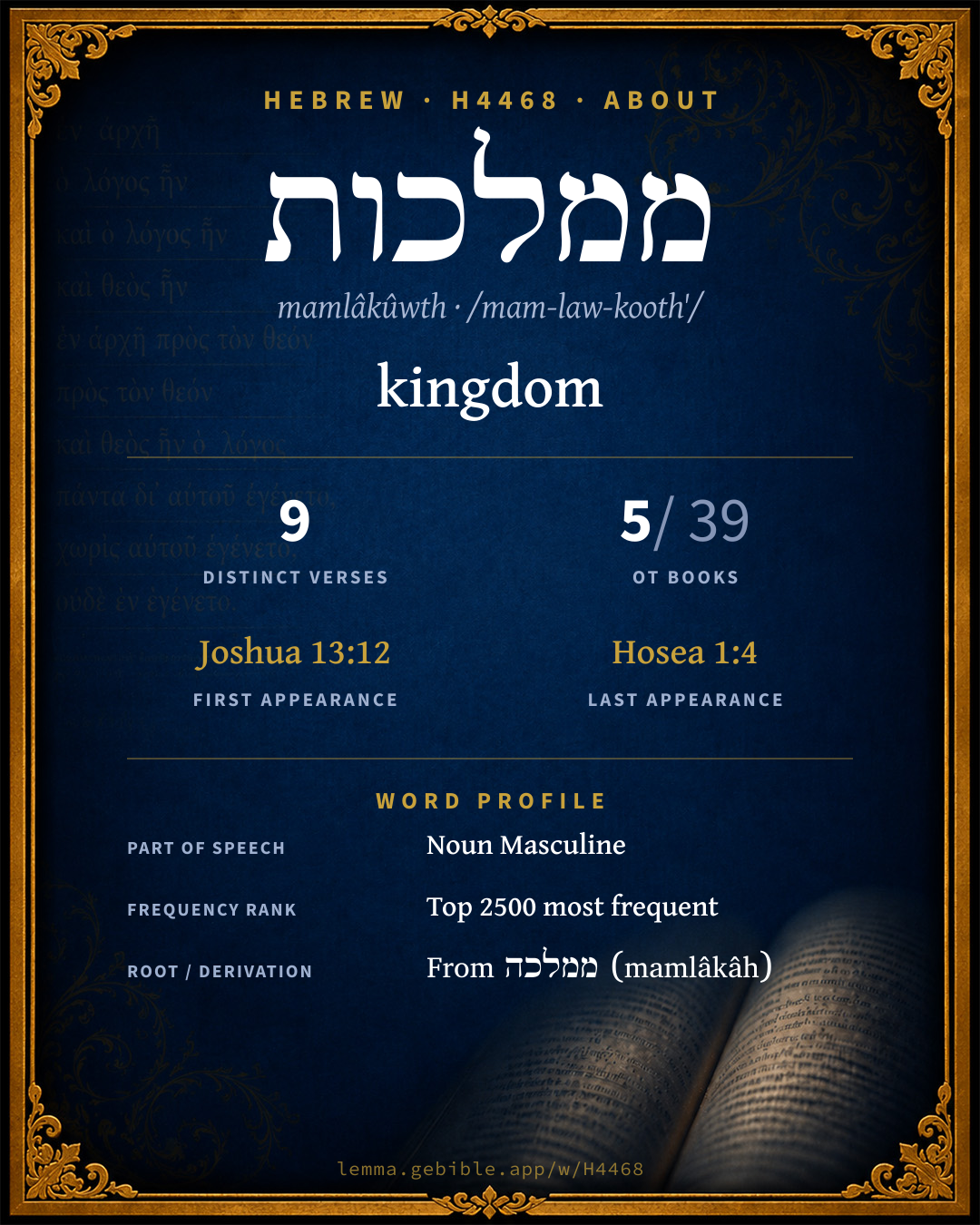
מַמְלָכוּת
kingdom
also: dominion, reign, sovereignty fuller range ↓
Full lexicon entry — Brown-Driver-Briggs (BDB)
From Brown-Driver-Briggs (BDB)
Where this word appears
Grammar key — what these labels mean
Part of speech
- Noun
- A naming word — a person, place, thing, or idea.
Noun type
- Common
- A common noun — a general class of person, place, or thing (“king,” “city,” “water”), not a specific name.
State
- Construct
- A noun bound to a following noun in a possessive / “of” relationship (the construct chain).
Gender
- Feminine
- Grammatically feminine.
Number
- Singular
- One.
Every verse where H4468 appears — 9 distinct verses across 5 books. Click any verse to open its interlinear word-by-word view. Verse text shown in the World English Bible for context — . Each verse’s Hebrew form is shown with its reference; the English is not keyword-highlighted, since the data carries no word-level English alignment. Use “Compare translations” on any verse to read it across multiple English versions. This concordance covers the Hebrew Bible; Septuagint (Greek Old Testament) occurrences are not indexed here.
Joshua 5 verses
- Joshua 13:12 מַמְלְכ֥וּת n c fs cs all the kingdom of Og in Bashan, who reigned in Ashtaroth and in Edrei (the same was left of the remnant of the Rephaim); for these did Moses strike, and drove them out.
- Joshua 13:21 מַמְלְכ֗וּת n c fs cs and all the cities of the plain, and all the kingdom of Sihon king of the Amorites, who reigned in Heshbon, whom Moses struck with the chiefs of Midian, Evi, and Rekem, and Zur, and Hur, and Reba, the princes of Sihon, who lived in the land.
- Joshua 13:27 מַמְלְכ֗וּת n c fs cs and in the valley, Beth Haram, and Beth Nimrah, and Succoth, and Zaphon, the rest of the kingdom of Sihon king of Heshbon, the Jordan and the border [of it], to the uttermost part of the sea of Chinnereth beyond the Jordan eastward.
- Joshua 13:30 מַמְלְכ֣וּת n c fs cs Their border was from Mahanaim, all Bashan, all the kingdom of Og king of Bashan, and all the towns of Jair, which are in Bashan, sixty cities:
- Joshua 13:31 מַמְלְכ֥וּת n c fs cs and half Gilead, and Ashtaroth, and Edrei, the cities of the kingdom of Og in Bashan, were for the children of Machir the son of Manasseh, even for the half of the children of Machir according to their families.
1 Samuel 1 verse
2 Samuel 1 verse
Jeremiah 1 verse
Hosea 1 verse
About this entry
At a glance — auto-summarized from this page’s data, not written by a person. Every figure links to its source below. This summary describes the numbers; it doesn’t interpret them.
The Hebrew noun ממלכות centers on the idea of “kingdom.” The word gravitates to Joshua (56%), then 1 Samuel and 2 Samuel. It turns up in 9 verses across 5 books, an uncommon footprint. Alongside “kingdom” the lexicon also lists “dominion”, “reign”, and “sovereignty” — part of its full sense range. Older and newer Bibles part ways — “kingdom” in the King James Version, “kingdom of” (unfoldingWord Literal Text) in modern versions. See the renderings breakdown. For the data behind this summary, explore the sense tree and the renderings breakdown below.
Gloss history
Strong's 1890 vs modern scholarship
About this word
Strong's H4468 catalogs a Hebrew word from the Hebrew Old Testament.
These counts are not copied from any lexicon or concordance. They are computed here, from the morphology-tagged Hebrew Old Testament. What Lemma adds →
- 9
- distinct verses
- The word appears in 9 distinct verses.
- 5 / 39
- OT books
- The word appears in 5 of 39 Old Testament books.
- #2,481
- by frequency
- Top 2500 most frequent Hebrew words (rank 2,481 of 8,640 Hebrew words by occurrence).
View all 9 occurrences in the concordance →
By section of the Old Testament
By traditional corpus
Conventional, traditional groupings — biblical authorship is debated, so this is a traditional corpus grouping, not an authorship claim. Each share is this word’s portion of its verses in that division of the Hebrew canon. Each figure is a share of the word’s 9 distinct verses.
- Prophets (Nevi'im) 9 verses · 100%
How translations render this word
Counts come from each version’s own published word-to-Strong’s tagging or interlinear alignment — an approximate guide to how each version renders this word, not a word-level alignment the data otherwise carries. Because each total is that version’s own tagged count, the per-version totals vary from one another and need not match the appearance or distinct-verse counts above. These counts may also differ from a printed concordance because Lemma counts each distinctly tagged rendering and does not collapse phrase taggings into a single head-word total. This is a fixed set of word-tagged versions (KJV, ASV, BSB, ULT) and does not change with the reading translation you choose elsewhere. Each version’s license is shown beside its name below (and on Sources).
- King James Version: Kingdom 5×, All the kingdom 3×
- American Standard Version: Kingdom 4×, All the kingdom 3×
- Berean Standard Bible: Kingdom 7×
- unfoldingWord Literal Text: Kingdom of 8×
King James Version Public Domain
Renders H4468 across 9 tagged occurrences — most commonly:
Plus 1 rendering that appears only once — usually multi-word phrases or single function words the recovered tagging swept in, not distinct renderings.
American Standard Version Public Domain
Renders H4468 across 9 tagged occurrences — most commonly:
Plus 2 renderings that appear only once — usually multi-word phrases or single function words the recovered tagging swept in, not distinct renderings.
Berean Standard Bible Public Domain
Renders H4468 across 9 tagged occurrences — most commonly:
Plus 2 renderings that appear only once — usually multi-word phrases or single function words the recovered tagging swept in, not distinct renderings.
unfoldingWord Literal Text CC BY-SA 4.0
Renders H4468 across 9 tagged occurrences — most commonly:
Plus 1 rendering that appears only once — usually multi-word phrases or single function words the recovered tagging swept in, not distinct renderings.
Senses in the full BDB
What do BDB’s symbols mean?
BDB uses these scholarly abbreviations:
| Symbol | Meaning |
|---|---|
| 𝔊 | the Septuagint (the ancient Greek translation, LXX) |
| 𝔙 | the Vulgate (the Latin translation) |
| 𝔖 | the Syriac version (the Peshitta) |
| 𝔗 | the Targum (the Aramaic translation) |
| ψ | the Psalms |
| √ | root (the underlying root or stem) |
| ‖ | parallel passage (a synonymous or contrasted parallel) |
| † | the dagger: every passage where the word occurs is cited |
The 3 senses and sub-senses the full Brown-Driver-Briggs lexicon distinguishes for this word, in lexicon order (not ranked by frequency), with BDB’s own verbatim wording and sub-sense lettering. Shown in Hebrew script with BDB’s own scholarly abbreviations. The condensed entry is in the Lexicon Entry tab. See also the Forms in the corpus table below.
- 1. kingdom of Og Jos 13:12, 30, 31; of Sihon v 21, 27. e.g. Joshua 13:12
- 2. dominion, royal power c. קָרַע מֵעַל (subj. י׳) 1 S 15:28; c. הֵשִׁיב לְ (hum. subj.) 2 S 16:3; c. הִשְׁבִּית Ho 1:4. e.g. 1 Samuel 15:28
- 3. reign בְּרֵאשִׁית מַמ׳ Je 26:1 (cf. מַמְלָכָה 3, מַלְכוּת 2). e.g. Jeremiah 26:1
Senses from the full Brown-Driver-Briggs lexicon (Brown, Driver, Briggs; Oxford 1906 — public domain), digitized via Sefaria, supplemented by the OpenScriptures HebrewLexicon (CC BY 4.0). Full attribution on Sources.
Word origin
n.f. kingdom, dominion, reign (on form cf. We 1 S 15:28 Drad loc. id.);—cstr. מַמְלְכוּת Jos 13:12 + 8 times;
— Brown-Driver-Briggs (Oxford 1906, public domain), digitized via Sefaria, supplemented by the OpenScriptures HebrewLexicon (CC BY 4.0). See Sources.
Derived from ממלכה (mamlâkâh) (H4467) — kingdom.
Jastrow Dictionary
A second Hebrew/Aramaic lexicon for comparison, covering Aramaic and post-biblical (Talmudic, Targumic, Midrashic) usage that the biblical-Hebrew BDB does not. Matched by lemma rather than by Strong’s number, so a lemma may carry more than one Jastrow headword (shown separately below), and the entries cover usage well beyond the Bible.
מַלְכוּת
- 1. kingdom, government; office. Ab. III, 5 עול מ׳ the yoke of (secular) government (burden of office). Ber. 13ᵇ, a. fr. עול מ׳ שמים the yoke of (submission to) divine government. Gitt. VIII, 5, v. הוּגָּן. Ber. 48ᵇ, a. e. אין מ׳ נוגעת וכ׳, v. חָבֵר. Sot. 11ᵇ (ref. to בתים, Ex. I, 21) בתי מ׳ dynasties.—מרד במ׳ to rebel against the government, to commit treason. Snh. 49ᵃ; a. fr.—מ׳ הָרִשְׁעָה the wicked government (Rome). Ber. 61ᵇ Ms. M. a. early ed. (later ed. יון); a. fr.—קרוב למ׳ connected with the court (influential). B. Kam. 83ᵃ. Gitt. 14ᵇ; a. fr.—Pl. מַלְכִיּוֹת. Gen. R. s. 44 ארבעה … גיהינם ומ׳ וכ׳ the Lord showed him (Abraham) four things: future punishment, (persecution by foreign) governments &c.; Mekh. Yithro, s. 9 ארבע מ׳ וכ׳ the four empires which were destined to subject his descendants. Ber. 34ᵇ, a. e. אין בין … אלא שעבוד מ׳ מלבד there will be no difference (in the conditions of life) between the present and the Messianic days except (the delivery from) the oppression of governments; a. fr. e.g. Exodus 1:21
- 2. (in liturgy) a benediction invoking God as king (אלהינו מלך העולם). Ib. 12ᵃ כל ברכה שאין בה מ׳ וכ׳ a benediction in which the word ‘king’ does not occur, is no benediction.—Pl. מַלְכִיּוֹת the references to the divine kingdom in the Musaf of the New Year’s Day, the section called Malkhiyoth. R. Hash. IV, 5. Ib. 6 עשרה מ׳ the recitation of ten Biblical verses referring to the divine government. Ib. (32ᵇ) זכרונות מ׳ וכ׳ Ms. M. (ed. sing.), v. זִכָּרוֹן. Y. ib. III, 58ᵈ; a. e.
A Dictionary of the Targumim, the Talmud Babli and Yerushalmi, and the Midrashic Literature (Marcus Jastrow; London, Luzac, 1903) — Public Domain. Digitized via Sefaria. Digitized via Sefaria. Full attribution on Sources.
Forms in the corpus
The 6 distinct written forms H4468 takes in the Hebrew Bible, most frequent first — each parse links to that state’s occurrences in the concordance. Hebrew forms include their vowel points and cantillation, so a single lemma takes many written forms.
| Form | Parsing | Example | Uses |
|---|---|---|---|
| מַמְלְכ֥וּת | Noun, Common, Feminine, Singular, Construct | 2 Samuel 16:3 | 3 |
| מַמְלְכ֗וּת | Noun, Common, Feminine, Singular, Construct | Joshua 13:21 | 2 |
| מַמְלְכ֖וּת | Noun, Common, Feminine, Singular, Construct | Hosea 1:4 | 1 |
| מַמְלְכ֛וּת | Noun, Common, Feminine, Singular, Construct | Jeremiah 26:1 | 1 |
| מַמְלְכ֣וּת | Noun, Common, Feminine, Singular, Construct | Joshua 13:30 | 1 |
| מַמְלְכ֧וּת | Noun, Common, Feminine, Singular, Construct | 1 Samuel 15:28 | 1 |
Septuagint verse parallels
This word appears in 8 verses that also exist in the Greek Old Testament (Septuagint), out of the 9 Hebrew verses it occurs in. You can read those verses in Greek by switching the Old Testament edition to the Septuagint.
Read these verses in the Septuagint
This is a verse-level parallel only — the same verses exist in both the Hebrew and Greek Old Testaments. No word-level Hebrew↔Greek correspondence is claimed: the data carries no such alignment, so no Greek word is shown as this Hebrew word’s translation. Coverage is not total — the Septuagint omits the deuterocanon and renumbers the Psalms, so some Hebrew verses have no direct Greek parallel.