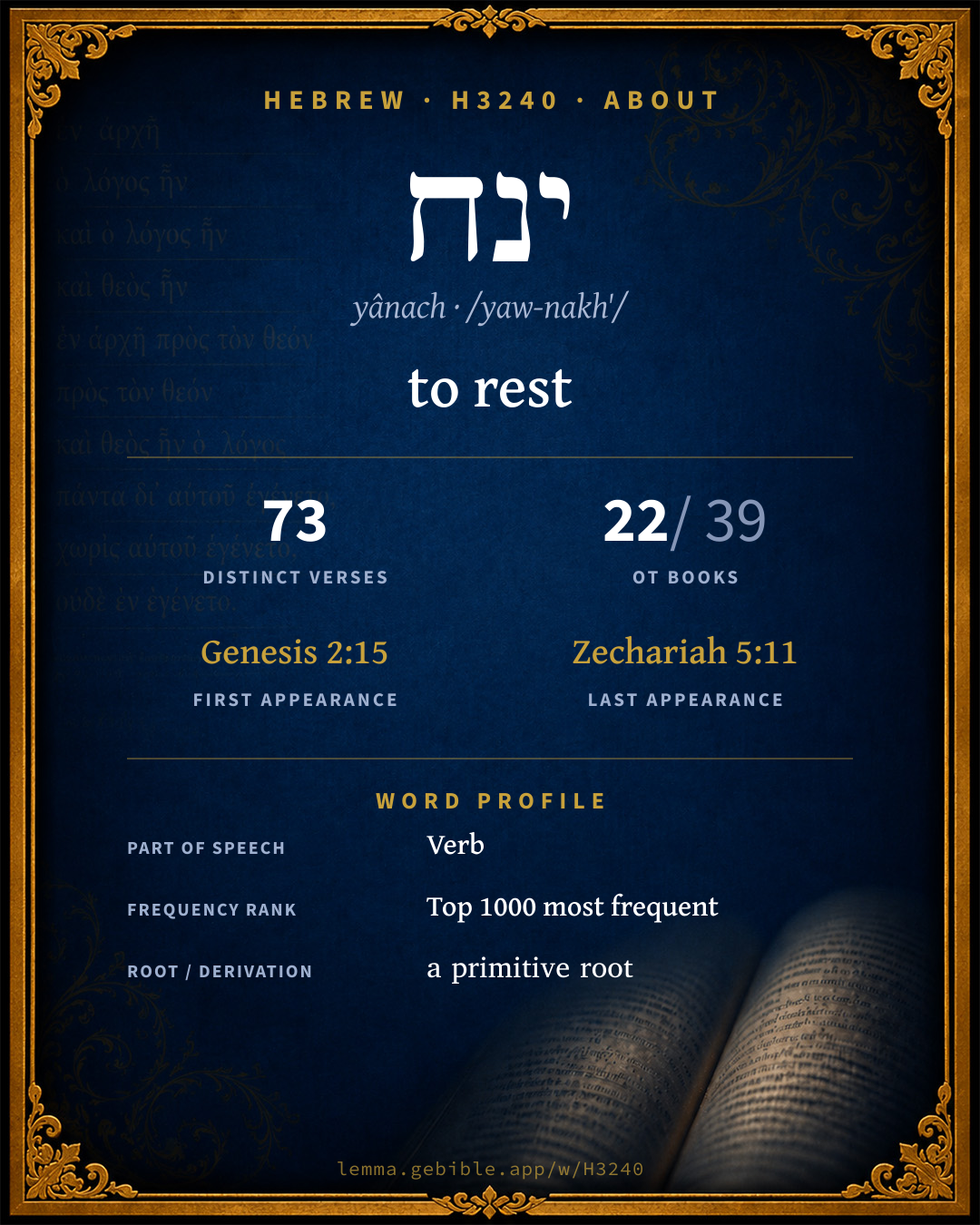
יָנַח
to rest
‘to rest’ is one of 13 main senses fuller range ↓
Full lexicon entry — Brown-Driver-Briggs (BDB)
From Brown-Driver-Briggs (BDB)
Where this word appears
See every Hiphil verb in the Hebrew Bible →
Grammar key — what these labels mean
Part of speech
- Verb
- An action or state-of-being word.
Stem
- Hiphil
- The causative active stem (“he caused / brought about”).
- Hophal
- The passive counterpart of the Hiphil (“he was caused to…”).
Form
- Perfect
- A completed action or state — Hebrew marks aspect (completeness) more than strict tense (“he wrote”).
- Sequential Imperfect
- An imperfect with prefixed waw — the standard past-narrative form (waw-consecutive imperfect).
- Imperative
- A direct command (“write!”).
- Sequential Perfect
- A perfect with prefixed waw continuing a preceding imperfect or command (waw-consecutive perfect).
- Jussive
- A third- or second-person volitional form expressing wish or command (“let him write”).
- Imperfect
- An incomplete, ongoing, or future action (“he will / would write”).
- Infinitive Construct
- A bound verbal noun, frequently with prepositions (“to write / in writing”).
- Participle Passive
- A verbal adjective expressing action received (“written”).
- Participle Active
- A verbal adjective expressing ongoing or characteristic action (“writing / one who writes”).
State
- Absolute
- The independent form of a noun, not bound to a following word.
Person
- 3rd Person
- The one spoken about (“he / she / it / they”).
- 2nd Person
- The one addressed (“you”).
- 1st Person
- The speaker (“I / we”).
Gender
- Masculine
- Grammatically masculine.
- Common
- Either gender — not distinguished for this form.
- Feminine
- Grammatically feminine.
Number
- Singular
- One.
- Plural
- More than one (in Hebrew, generally three or more).
Grammatical forms 22 distinct
- Verb, Hiphil, Sequential Imperfect, 3rd Person, Masculine, Singular 12 times (16%)
- Verb, Hiphil, Perfect, 3rd Person, Masculine, Singular 8 times (11%)
- Verb, Hiphil, Sequential Imperfect, 3rd Person, Masculine, Plural 7 times (9%)
- Verb, Hiphil, Imperative, 2nd Person, Masculine, Plural 5 times (7%)
- Verb, Hiphil, Imperative, 2nd Person, Masculine, Singular 5 times (7%)
- Verb, Hiphil, Sequential Perfect, 1st Person, Common, Singular 4 times (5%)
- Verb, Hiphil, Jussive, 2nd Person, Masculine, Singular 4 times (5%)
- Verb, Hiphil, Sequential Perfect, 3rd Person, Masculine, Singular 4 times (5%)
+14 more forms (26 occurrences)
Parsed forms decoded from the imported morphology (morphhb / Westminster Leningrad Codex — WLC text public domain, morphhb tagging CC BY 4.0), counted across 75 parsed occurrences — not distinct verses.
Every verse where H3240 appears — 73 distinct verses across 22 books. Click any verse to open its interlinear word-by-word view. Verse text shown in the World English Bible for context — . Each verse’s Hebrew form is shown with its reference; the English is not keyword-highlighted, since the data carries no word-level English alignment. Use “Compare translations” on any verse to read it across multiple English versions. This concordance covers the Hebrew Bible; Septuagint (Greek Old Testament) occurrences are not indexed here.
Genesis 4 verses
- Genesis 2:15 וַ/יַּנִּחֵ֣/הוּ conj + Hiphil wimpf 3ms + sfx pers 3ms Yahweh God took the man, and put him into the garden of Eden to dress it and to keep it.
- Genesis 19:16 וַ/יַּנִּחֻ֖/הוּ conj + Hiphil wimpf 3mp + sfx pers 3ms But he lingered; and the men laid hold on his hand, and on the hand of his wife, and on the hand of his two daughters, Yahweh being merciful to him; and they took him out, and set him outside of the city.
- Genesis 39:16 וַ/תַּנַּ֥ח conj + Hiphil wimpf 3fs She laid up his garment by her, until his master came home.
- Genesis 42:33 הַנִּ֣יחוּ Hiphil impv 2mp The man, the lord of the land, said to us, 'Hereby will I know that you are honest men. Leave one of your brothers with me, and take grain for the famine of your houses, and go your way.
Exodus 5 verses
- Exodus 16:23 הַנִּ֧יחוּ Hiphil impv 2mp He said to them, "This is that which Yahweh has spoken, 'Tomorrow is a solemn rest, a holy Sabbath to Yahweh. Bake that which you want to bake, and boil that which you want to boil; and all that remains over lay up for yourselves to be kept until the morning."
- Exodus 16:24 וַ/יַּנִּ֤יחוּ conj + Hiphil wimpf 3mp They laid it up until the morning, as Moses asked, and it didn't become foul, neither was there any worm in it.
- Exodus 16:33 וְ/הַנַּ֤ח conj + Hiphil impv 2ms Moses said to Aaron, "Take a pot, and put an omer-full of manna in it, and lay it up before Yahweh, to be kept throughout your generations."
- Exodus 16:34 וַ/יַּנִּיחֵ֧/הוּ conj + Hiphil wimpf 3ms + sfx pers 3ms As Yahweh commanded Moses, so Aaron laid it up before the Testimony, to be kept.
- Exodus 32:10 הַנִּ֣יחָ/ה Hiphil impv 2ms + sfx h Now therefore leave me alone, that my wrath may burn hot against them, and that I may consume them; and I will make of you a great nation."
Leviticus 3 verses
- Leviticus 7:15 יַנִּ֥יחַ Hiphil impf 3ms The flesh of the sacrifice of his peace offerings for thanksgiving shall be eaten on the day of his offering. He shall not leave any of it until the morning.
- Leviticus 16:23 וְ/הִנִּיחָ֖/ם conj + Hiphil wpf 3ms + sfx pers 3mp "Aaron shall come into the Tent of Meeting, and shall take off the linen garments, which he put on when he went into the Holy Place, and shall leave them there.
- Leviticus 24:12 וַ/יַּנִּיחֻ֖/הוּ conj + Hiphil wimpf 3mp + sfx pers 3ms They put him in custody, until the will of Yahweh should be declared to them.
Numbers 5 verses
- Numbers 15:34 וַ/יַּנִּ֥יחוּ conj + Hiphil wimpf 3mp They put him in custody, because it had not been declared what should be done to him.
- Numbers 17:4 וְ/הִנַּחְתָּ֖/ם conj + Hiphil wpf 2ms + sfx pers 3mp You shall lay them up in the tent of meeting before the testimony, where I meet with you.
- Numbers 17:7 וַ/יַּנַּ֥ח conj + Hiphil wimpf 3ms Moses laid up the rods before Yahweh in the tent of the testimony.
- Numbers 19:9 וְ/הִנִּ֛יחַ conj + Hiphil wpf 3ms A man who is clean shall gather up the ashes of the heifer, and lay them up outside of the camp in a clean place; and it shall be kept for the congregation of the children of Israel for a water for impurity: it is a sin-offering.
- Numbers 32:15 לְ/הַנִּיח֖/וֹ prep + Hiphil inf.cs + sfx pers 3ms For if you turn away from after him, he will yet again leave them in the wilderness; and you will destroy all this people.
Deuteronomy 3 verses
- Deuteronomy 14:28 וְ/הִנַּחְתָּ֖ conj + Hiphil wpf 2ms At the end of every three years you shall bring forth all the tithe of your increase in the same year, and shall lay it up within your gates:
- Deuteronomy 26:4 וְ/הִ֨נִּיח֔/וֹ conj + Hiphil wpf 3ms + sfx pers 3ms The priest shall take the basket out of your hand, and set it down before the altar of Yahweh your God.
- Deuteronomy 26:10 וְ/הִנַּחְתּ֗/וֹ conj + Hiphil wpf 2ms + sfx pers 3ms Now, behold, I have brought the first of the fruit of the ground, which you, Yahweh, have given me. You shall set it down before Yahweh your God, and worship before Yahweh your God:
Joshua 3 verses
- Joshua 4:3 וְ/הִנַּחְתֶּ֣ם conj + Hiphil wpf 2mp and command you them, saying, Take hence out of the midst of the Jordan, out of the place where the priests' feet stood firm, twelve stones, and carry them over with you, and lay them down in the lodging-place, where you shall lodge this night.
- Joshua 4:8 וַ/יַּנִּח֖וּ/ם conj + Hiphil wimpf 3mp + sfx pers 3mp The children of Israel did so as Joshua commanded, and took up twelve stones out of the midst of the Jordan, as Yahweh spoke to Joshua, according to the number of the tribes of the children of Israel; and they carried them over with them to the place where they lodged, and laid them down there.
- Joshua 6:23 וַ/יַּ֨נִּיח֔וּ/ם conj + Hiphil wimpf 3mp + sfx pers 3mp The young men the spies went in, and brought out Rahab, and her father, and her mother, and her brothers, and all that she had; all her relatives also they brought out; and they set them outside of the camp of Israel.
Judges 5 verses
- Judges 2:23 וַ/יַּנַּ֤ח conj + Hiphil wimpf 3ms So Yahweh left those nations, without driving them out hastily; neither delivered he them into the hand of Joshua.
- Judges 3:1 הִנִּ֣יחַ Hiphil pf 3ms Now these are the nations which Yahweh left, to prove Israel by them, even as many [of Israel] as had not known all the wars of Canaan;
- Judges 6:18 וְ/הִנַּחְתִּ֖י conj + Hiphil wpf 1cs Please don't go away, until I come to you, and bring out my present, and lay it before you. He said, I will wait until you come again.
- Judges 6:20 וְ/הַנַּח֙ conj + Hiphil impv 2ms The angel of God said to him, Take the flesh and the unleavened cakes, and lay them on this rock, and pour out the broth. He did so.
- Judges 16:26 הַנִּ֣יחָ/ה Hiphil impv 2ms + sfx h and Samson said to the boy who held him by the hand, Allow me that I may feel the pillars whereupon the house rests, that I may lean on them.
1 Samuel 2 verses
- 1 Samuel 6:18 הִנִּ֤יחוּ Hiphil pf 3cp and the golden mice, according to the number of all the cities of the Philistines belonging to the five lords, both of fortified cities and of country villages, even to the great stone, whereon they set down the ark of Yahweh, [which stone remains] to this day in the field of Joshua the Beth-shemite.
- 1 Samuel 10:25 וַ/יַּנַּ֖ח conj + Hiphil wimpf 3ms Then Samuel told the people the manner of the kingdom, and wrote it in a book, and laid it up before Yahweh. Samuel sent all the people away, every man to his house.
2 Samuel 3 verses
- 2 Samuel 16:11 הַנִּ֤חוּ Hiphil impv 2mp David said to Abishai, and to all his servants, Behold, my son, who came forth from my bowels, seeks my life: how much more [may] this Benjamite now [do it]? let him alone, and let him curse; for Yahweh has invited him.
- 2 Samuel 16:21 הִנִּ֖יחַ Hiphil pf 3ms Ahithophel said to Absalom, Go in to your father's concubines, that he has left to keep the house; and all Israel will hear that you are abhorred of your father: then will the hands of all who are with you be strong.
- 2 Samuel 20:3 הִנִּיחַ֩ Hiphil pf 3ms David came to his house at Jerusalem; and the king took the ten women his concubines, whom he had left to keep the house, and put them in custody, and provided them with sustenance, but didn't go in to them. So they were shut up to the day of their death, living in widowhood.
1 Kings 6 verses
- 1 Kings 7:47 וַ/יַּנַּ֤ח conj + Hiphil wimpf 3ms Solomon left all the vessels [unweighed], because they were exceeding many: the weight of the brass could not be found out.
- 1 Kings 8:9 הִנִּ֥חַ Hiphil pf 3ms There was nothing in the ark save the two tables of stone which Moses put there at Horeb, when Yahweh made a covenant with the children of Israel, when they came out of the land of Egypt.
- 1 Kings 13:29 וַ/יַּנִּחֵ֥/הוּ conj + Hiphil wimpf 3ms + sfx pers 3ms The prophet took up the body of the man of God, and laid it on the donkey, and brought it back; and he came to the city of the old prophet, to mourn, and to bury him.
- 1 Kings 13:30 וַ/יַּנַּ֥ח conj + Hiphil wimpf 3ms He laid his body in his own grave; and they mourned over him, [saying], Alas, my brother!
- 1 Kings 13:31 הַנִּ֖יחוּ Hiphil impv 2mp It happened, after he had buried him, that he spoke to his sons, saying, When I am dead, then bury me in the tomb in which the man of God is buried; lay my bones beside his bones.
- 1 Kings 19:3 וַ/יַּנַּ֥ח conj + Hiphil wimpf 3ms When he saw that, he arose, and went for his life, and came to Beersheba, which belongs to Judah, and left his servant there.
2 Kings 2 verses
- 2 Kings 17:29 וַ/יַּנִּ֣יחוּ conj + Hiphil wimpf 3mp However every nation made gods of their own, and put them in the houses of the high places which the Samaritans had made, every nation in their cities in which they lived.
- 2 Kings 23:18 הַנִּ֣יחוּ Hiphil impv 2mp He said, Let him be; let no man move his bones. So they let his bones alone, with the bones of the prophet who came out of Samaria.
1 Chronicles 1 verse
2 Chronicles 3 verses
- 2 Chronicles 1:14 וַ/יַּנִּיחֵ/ם֙ conj + Hiphil wimpf 3ms + sfx pers 3mp Solomon gathered chariots and horsemen: and he had one thousand four hundred chariots, and twelve thousand horsemen, that he placed in the chariot cities, and with the king at Jerusalem.
- 2 Chronicles 4:8 וַ/יַּנַּח֙ conj + Hiphil wimpf 3ms He made also ten tables, and placed them in the temple, five on the right side, and five on the left. He made one hundred basins of gold.
- 2 Chronicles 9:25 וַ/יַּנִּיחֵ/ם֙ conj + Hiphil wimpf 3ms + sfx pers 3mp Solomon had four thousand stalls for horses and chariots, and twelve thousand horsemen, that he bestowed in the chariot cities, and with the king at Jerusalem.
Esther 1 verse
Psalms 3 verses
- Psalms 17:14 וְ/הִנִּ֥יחוּ conj + Hiphil wpf 3cp From men by your hand, Yahweh, From men of the world, whose portion is in this life. You fill the belly of your cherished ones. Your sons have plenty, And they store up wealth for their children.
- Psalms 105:14 הִנִּ֣יחַ Hiphil pf 3ms He allowed no one to do them wrong. Yes, he reproved kings for their sakes,
- Psalms 119:121 תַּ֝נִּיחֵ֗/נִי Hiphil impf 2ms + sfx pers 1cs I have done what is just and righteous. Don't leave me to my oppressors.
Ecclesiastes 5 verses
- Ecclesiastes 2:18 שֶׁ֣/אַנִּיחֶ֔/נּוּ ptcl rel + Hiphil impf 1cs + sfx pers 3ms I hated all my labor in which I labored under the sun, seeing that I must leave it to the man who comes after me.
- Ecclesiastes 5:12 מַנִּ֥יחַֽ Hiphil ptcp.act ms The sleep of a laboring man is sweet, whether he eats little or much; but the abundance of the rich will not allow him to sleep.
- Ecclesiastes 7:18 תַּנַּ֣ח Hiphil juss 2ms It is good that you should take hold of this. Yes, also from that don't withdraw your hand; for he who fears God will come forth from them all.
- Ecclesiastes 10:4 תַּנַּ֑ח יַנִּ֖יחַ Hiphil juss 2ms Hiphil impf 3ms If the spirit of the ruler rises up against you, don't leave your place; for gentleness lays great offenses to rest.
- Ecclesiastes 11:6 תַּנַּ֣ח Hiphil juss 2ms In the morning sow your seed, And in the evening don't withhold your hand; For you don't know which will prosper, whether this or that, Or whether they both will be equally good.
Isaiah 4 verses
- Isaiah 14:1 וְ/הִנִּיחָ֖/ם conj + Hiphil wpf 3ms + sfx pers 3mp For Yahweh will have compassion on Jacob, and will yet choose Israel, and set them in their own land: and the foreigner shall join himself with them, and they shall cleave to the house of Jacob.
- Isaiah 28:2 הִנִּ֥יחַ Hiphil pf 3ms Behold, the Lord has a mighty and strong one; as a tempest of hail, a destroying storm, as a tempest of mighty waters overflowing, will he cast down to the earth with the hand.
- Isaiah 46:7 וְ/יַנִּיחֻ֤/הוּ conj + Hiphil impf 3mp + sfx pers 3ms They bear it on the shoulder, they carry it, and set it in its place, and it stands, from its place it shall not move: yes, one may cry to it, yet it can not answer, nor save him out of his trouble.
- Isaiah 65:15 וְ/הִנַּחְתֶּ֨ם conj + Hiphil pf 2mp You shall leave your name for a curse to my chosen; and the Lord Yahweh will kill you; and he will call his servants by another name:
Jeremiah 3 verses
- Jeremiah 14:9 תַּנִּחֵֽ/נוּ Hiphil juss 2ms + sfx pers 1cp Why should you be like a scared man, as a mighty man who can't save? yet you, Yahweh, are in the midst of us, and we are called by your name; don't leave us.
- Jeremiah 27:11 וְ/הִנַּחְתִּ֤י/ו conj + Hiphil wpf 1cs + sfx pers 3ms But the nation that shall bring their neck under the yoke of the king of Babylon, and serve him, that [nation] will I let remain in their own land, says Yahweh; and they shall till it, and dwell therein.
- Jeremiah 43:6 הִנִּ֨יחַ֙ Hiphil pf 3ms the men, and the women, and the children, and the king's daughters, and every person who Nebuzaradan the captain of the guard had left with Gedaliah the son of Ahikam, the son of Shaphan; and Jeremiah the prophet, and Baruch the son of Neriah;
Ezekiel 9 verses
- Ezekiel 16:39 וְ/הִנִּיח֖וּ/ךְ conj + Hiphil wpf 3cp + sfx pers 2fs I will also give you into their hand, and they shall throw down your vaulted place, and break down your lofty places; and they shall strip you of your clothes, and take your beautiful jewels; and they shall leave you naked and bare.
- Ezekiel 22:20 וְ/הִנַּחְתִּ֥י conj + Hiphil wpf 1cs As they gather silver and brass and iron and lead and tin into the midst of the furnace, to blow the fire on it, to melt it; so will I gather you in my anger and in my wrath, and I will lay you there, and melt you.
- Ezekiel 37:14 וְ/הִנַּחְתִּ֥י conj + Hiphil wpf 1cs I will put my Spirit in you, and you shall live, and I will place you in your own land: and you shall know that I, Yahweh, have spoken it and performed it, says Yahweh.
- Ezekiel 40:42 וְ/יַנִּ֤יחוּ conj + Hiphil impf 3mp There were four tables for the burnt offering, of hewn stone, a cubit and a half long, and a cubit and a half broad, and one cubit high; whereupon they laid the instruments with which they killed the burnt offering and the sacrifice.
- Ezekiel 41:9 מֻנָּ֔ח Hophal ptcp.pass ms The thickness of the wall, which was for the side-chambers, on the outside, was five cubits: and that which was left was the place of the side-chambers that belonged to the house.
- Ezekiel 41:11 לַ/מֻּנָּ֔ח הַ/מֻּנָּ֔ח prep det + Hophal ptcp.pass ms ptcl def.art + Hophal ptcp.pass ms The doors of the side-chambers were toward [the place] that was left, one door toward the north, and another door toward the south: and the breadth of the place that was left was five cubits round about.
- Ezekiel 42:13 יַנִּ֣יחוּ Hiphil impf 3mp Then said he to me, The north chambers and the south chambers, which are before the separate place, they are the holy chambers, where the priests who are near to Yahweh shall eat the most holy things: there shall they lay the most holy things, and the meal-offering, and the sin-offering, and the trespass-offering; for the place is holy.
- Ezekiel 42:14 יַנִּ֧יחוּ Hiphil impf 3mp When the priests enter in, then shall they not go out of the holy place into the outer court, but there they shall lay their garments in which they minister; for they are holy: and they shall put on other garments, and shall approach to that which pertains to the people.
- Ezekiel 44:19 וְ/הִנִּ֥יחוּ conj + Hiphil wpf 3cp When they go forth into the outer court, even into the outer court to the people, they shall put off their garments in which they minister, and lay them in the holy chambers; and they shall put on other garments, that they not sanctify the people with their garments.
Hosea 1 verse
Amos 1 verse
Zechariah 1 verse
About this entry
At a glance — auto-summarized from this page’s data, not written by a person. Every figure links to its source below. This summary describes the numbers; it doesn’t interpret them.
At its core, ינח (yânach) means “to rest.” The King James Version usually renders it “leave,” while modern versions prefer “rest” (unfoldingWord Literal Text) — see the renderings breakdown. With 73 verses in 22 books, it is a moderately common word in the Hebrew Bible. Scripture first uses it in Genesis 2:15. Ranging over 13 senses, it is not a single-sense word. Each statement above links to its evidence; the full detail follows below.
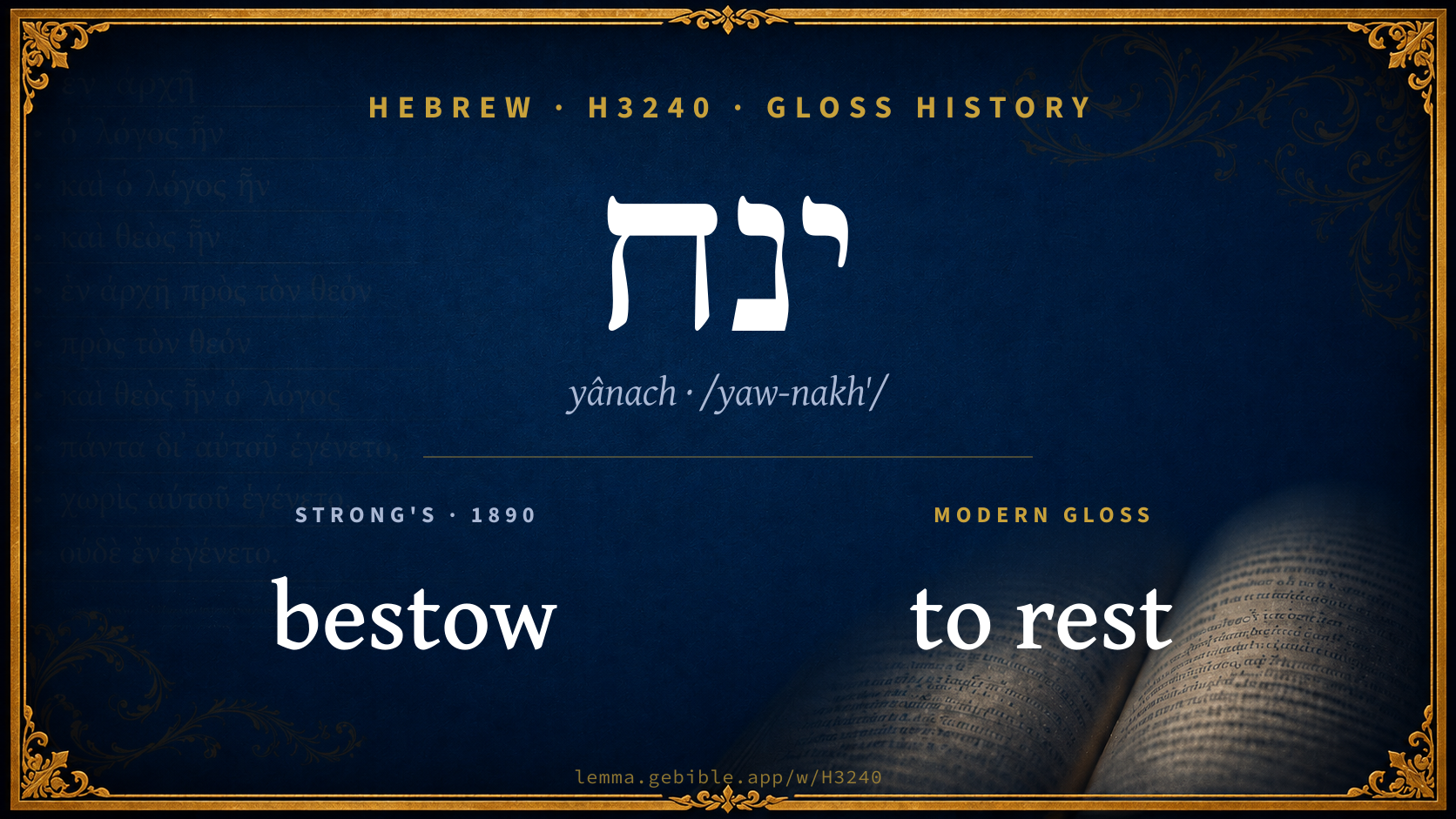
Gloss history
Strong's 1890 vs modern scholarship
About this word
Strong's H3240 catalogs a Hebrew word from the Hebrew Old Testament.
These counts are not copied from any lexicon or concordance. They are computed here, from the morphology-tagged Hebrew Old Testament. What Lemma adds →
- 73
- distinct verses
- The word appears in 73 distinct verses.
- 22 / 39
- OT books
- The word appears in 22 of 39 Old Testament books.
- #532
- by frequency
- Top 1000 most frequent Hebrew words (rank 532 of 8,640 Hebrew words by occurrence).
View all 73 occurrences in the concordance →
By section of the Old Testament
By traditional corpus
Conventional, traditional groupings — biblical authorship is debated, so this is a traditional corpus grouping, not an authorship claim. Each share is this word’s portion of its verses in that division of the Hebrew canon. Each figure is a share of the word’s 73 distinct verses.
- Prophets (Nevi'im) 40 verses · 55%
- Torah (Pentateuch) 20 verses · 27%
- Writings (Ketuvim) 13 verses · 18%
How translations render this word
Counts come from each version’s own published word-to-Strong’s tagging or interlinear alignment — an approximate guide to how each version renders this word, not a word-level alignment the data otherwise carries. Because each total is that version’s own tagged count, the per-version totals vary from one another and need not match the appearance or distinct-verse counts above. These counts may also differ from a printed concordance because Lemma counts each distinctly tagged rendering and does not collapse phrase taggings into a single head-word total. This is a fixed set of word-tagged versions (KJV, ASV, BSB, ULT) and does not change with the reading translation you choose elsewhere. Each version’s license is shown beside its name below (and on Sources).
- King James Version: Leave 5×, Left 5×, Lay 3×
- American Standard Version: Lay 4×, Left 4×, He suffered 2×
- unfoldingWord Literal Text: Rest 8×, Leave 7×, Let 5×
King James Version Public Domain
Renders H3240 across 75 tagged occurrences — most commonly:
Plus 47 renderings that appear only once — usually multi-word phrases or single function words the recovered tagging swept in, not distinct renderings.
American Standard Version Public Domain
Renders H3240 across 76 tagged occurrences — most commonly:
Plus 56 renderings that appear only once — usually multi-word phrases or single function words the recovered tagging swept in, not distinct renderings.
unfoldingWord Literal Text CC BY-SA 4.0
Renders H3240 across 107 tagged occurrences — most commonly:
Plus other, less common renderings. Plus 54 renderings that appear only once — usually multi-word phrases or single function words the recovered tagging swept in, not distinct renderings.
13 senses in BDB, in lexicon order
The 13 senses BDB distinguishes for this word, in lexicon order (not ranked by frequency or importance). The full entry — with sub-senses — is in the Lexicon Entry tab.
- to rest
(Qal)
- to rest, settle down and remain
- to repose, have rest, be quiet
(Hiphil)
- to cause to rest, give rest to, make quiet
- to cause to rest, cause to alight, set down
- to lay or set down, deposit, let lie, place
- to let remain, leave
- to leave, depart from
- to abandon
- to permit
This word has an unusually long lexicon entry — 13 senses across its verb stems. The first 10 are shown above in lexicon order; the remaining 3 senses (more of the same, repeated under each stem) and the full sub-sense tree are in the Lexicon Entry tab.
Word origin
Origin: a primitive root
Jastrow Dictionary
A second Hebrew/Aramaic lexicon for comparison, covering Aramaic and post-biblical (Talmudic, Targumic, Midrashic) usage that the biblical-Hebrew BDB does not. Matched by lemma rather than by Strong’s number, so a lemma may carry more than one Jastrow headword (shown separately below), and the entries cover usage well beyond the Bible.
יָנַח
- , v. נוּחַ
A Dictionary of the Targumim, the Talmud Babli and Yerushalmi, and the Midrashic Literature (Marcus Jastrow; London, Luzac, 1903) — Public Domain. Digitized via Sefaria. Digitized via Sefaria. Full attribution on Sources.
Forms in the corpus
The 64 distinct written forms H3240 takes in the Hebrew Bible, most frequent first — each parse links to that stem’s occurrences in the concordance. Hebrew forms include their vowel points and cantillation, so a single lemma takes many written forms.
The 60 most common forms are shown; 4 rarer forms follow in the full concordance.
Same root — word family
Other BDB entries built from the same root as H3240, grouped by Strong’s listed origin. These share a root / origin per the lexicon — not necessarily a shared meaning. Each links to that word’s own entry.
Proper names from this root
People and places named from this root — a name, not an additional meaning of the word.
Compare all same-root words → 1 of the same-root words is a proper name (a person or place). They share a root, not necessarily a meaning.
Septuagint verse parallels
This word appears in 72 verses that also exist in the Greek Old Testament (Septuagint), out of the 73 Hebrew verses it occurs in. You can read those verses in Greek by switching the Old Testament edition to the Septuagint.
Read these verses in the Septuagint
- Genesis 2:15
- Exodus 16:23
- Leviticus 7:15
- Numbers 15:34
- Deuteronomy 14:28
- Joshua 4:3
- Judges 2:23
- 1 Samuel 6:18
- 2 Samuel 16:11
- 1 Kings 7:47
- 2 Kings 17:29
- 1 Chronicles 16:21
This is a verse-level parallel only — the same verses exist in both the Hebrew and Greek Old Testaments. No word-level Hebrew↔Greek correspondence is claimed: the data carries no such alignment, so no Greek word is shown as this Hebrew word’s translation. Coverage is not total — the Septuagint omits the deuterocanon and renumbers the Psalms, so some Hebrew verses have no direct Greek parallel.