
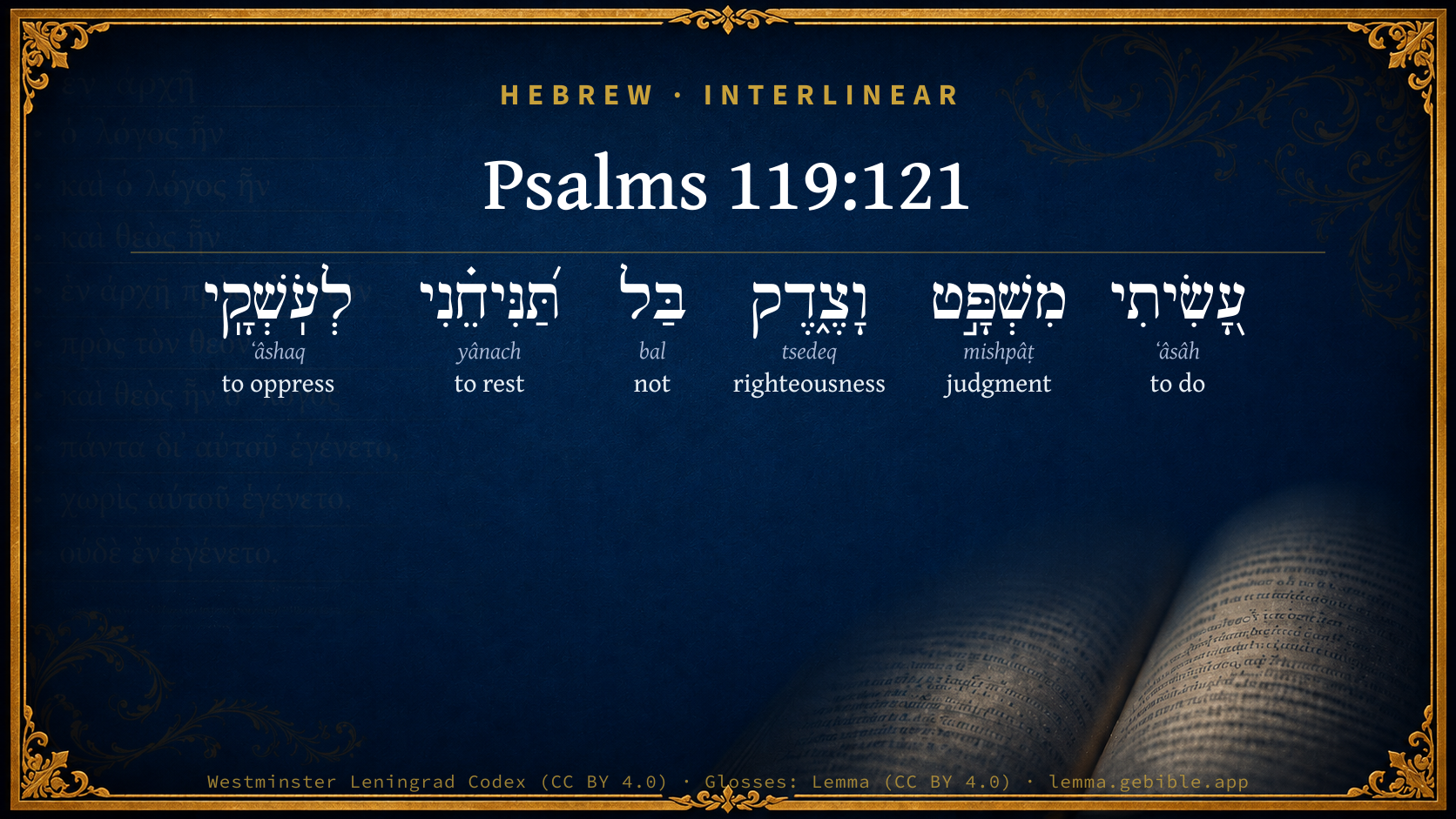
Psalms 119:121

Hebrew (Westminster Leningrad Codex) Psalms 119:121 appears in the Hebrew Old Testament. The text above is from the Westminster Leningrad Codex. Each word links to its Strong’s number, a concise gloss, and parsing drawn from the Open Scriptures Hebrew Bible morphology. Click any word for its full Brown-Driver-Briggs (BDB) entry.
Download image
Cite this verse

Psalms 119:121 (World English Bible). Public Domain. Lemma interlinear Bible study tool, https://lemma.gebible.app/v/psalms/119/121.

Show BibTeX & RIS
BibTeX
RIS
English Translation
I have done what is just and righteous. Don't leave me to my oppressors.
World English Bible · Public Domain
Download a study sheet

One document with this verse’s original text, its word-by-word gloss line, the meaning frame, cross-references with their text, attributed commentary, and full source and license credits — printable, and it pastes into notes with its structure intact.

This verse Autodidact and up

Study sheet (.html) Plain text (.txt)

A passage Seminary Student

Up to 50 verses in one chapter. A passage sheet keeps up to 6 commentary sources and 12 cross-references per verse, in the order this page ranks them, and says so on the sheet whenever that leaves anything out. Ask for a single verse and you get the Autodidact verse sheet above.

Everything on this page stays free to read, with no account — the sheet is a download of what is already on screen, not access to it.

Want to remove ads? Support Godless Engineer
Compare translations 3

The same verse in 3 English versions, stacked beneath the original-language interlinear above. Click any original word for its lexicon entry.

Each is an independent rendering of the whole verse — the interlinear is not word-aligned to these translations.

Highlighted words mark where these versions differ — a whole-verse word diff, not a word-by-word alignment.

  • World English Bible Public Domain
    I have done what is just and righteous. Don't leave me to my oppressors.
  • King James Version Public Domain
    I have done judgment and justice: leave me not to mine oppressors.
  • unfoldingWord Literal Text CC BY-SA 4.0
    I have done justice and righteousness; do not leave me to those oppressing me.

unfoldingWord Literal Text — © unfoldingWord, licensed CC BY-SA 4.0. Word-aligned USFM3 via Door43 (git.door43.org/unfoldingWord/en_ult).

Versions to compare (up to 4)

3 of 4 selected

Show all 17 translations

Every available English version of this verse, each an independent rendering of the whole verse.

  • World English Bible Public Domain
    I have done what is just and righteous. Don't leave me to my oppressors.
  • Berean Standard Bible Public Domain
    I have done what is just and right; do not leave me to my oppressors.
  • Majority Standard Bible Public Domain
    I have done what is just and right; do not leave me to my oppressors.
  • King James Version Public Domain
    I have done judgment and justice: leave me not to mine oppressors.
  • American Standard Version (1901) Public Domain
    AYIN. I have done justice and righteousness: Leave me not to mine oppressors.
  • Revised Version (1885) Public Domain
    I have done judgment and justice: leave me not to mine oppressors.
  • Geneva Bible (1599) Public Domain
    AIN. I haue executed iudgement and iustice: leaue me not to mine oppressours.
  • Young's Literal Translation Public Domain
    `Ain.' I have done judgment and righteousness, Leave me not to mine oppressors.
  • Literal Standard Version CC BY-SA 4.0
    [AYIN] I have done judgment and righteousness, || Do not leave me to my oppressors.
  • Unlocked Literal Bible CC BY-SA 4.0
    I do what is just and right; do not abandon me to my oppressors.
  • unfoldingWord Literal Text CC BY-SA 4.0
    I have done justice and righteousness; do not leave me to those oppressing me.
  • Darby Bible Public Domain
    AIN. I have done judgment and justice: leave me not to mine oppressors.
  • World Messianic Bible Public Domain
    I have done what is just and righteous. Don’t leave me to my oppressors.
  • Webster's Bible Public Domain
    AIN. I have done judgment and justice; leave me not to my oppressors.
  • Free Bible Version CC BY-SA 4.0
    I have done what's fair and right, so please don't abandon me to my enemies.
  • Bible in Basic English Public Domain
    AIN I have done what is good and right: you will not give me into the hands of those who are working against me.
  • JPS Tanakh (1917) Public Domain
    AIN. I have done justice and righteousness; leave me not to mine oppressors.

Literal Standard Version (2020), Covenant Press — licensed CC BY-SA 4.0. Text via the HelloAO Bible API (eBible.org). Unlocked Literal Bible (unfoldingWord) — licensed CC BY-SA 4.0. Text via the HelloAO Bible API (eBible.org). unfoldingWord Literal Text — © unfoldingWord, licensed CC BY-SA 4.0. Word-aligned USFM3 via Door43 (git.door43.org/unfoldingWord/en_ult). Free Bible Version, Dr. Jonathan Gallagher — licensed CC BY-SA 4.0. Text via the HelloAO Bible API (eBible.org).

Word by word

More ways to search: Search by grammar → Find every occurrence → Compare this word →

Practice this passage: Drill this verse → Learn its vocabulary →

לְעֹֽשְׁקָֽי
ʻâshaq
H6231
“to/for · oppressing · me”
Preposition + Verb, Qal, Participle Active, Masculine, Plural, Construct + Suffix, Personal, 1st Person, Common, Singular
Part of Speech
Preposition + Verb
Stem
Qal
Form
Participle Active
Gender
Masculine
Number
Plural
State
Construct
Full BDB Definition

Origin: a primitive root (comp. H6229 )

TWOT: 1713

to press upon, oppress, violate, defraud, do violence, get deceitfully, wrong, extort - (Qal) - to oppress, wrong, extort - to oppress - (Pual) to be exploited, be crushed
  1. עָ֭שִׂיתִי ʻâsâh H6213 “to do” Verb, Qal, Perfect, 1st Person, Common, Singular
  2. מִשְׁפָּ֣ט mishpâṭ H4941 “judgment” Noun, Common, Masculine, Singular, Absolute
  3. וָצֶ֑דֶק tsedeq H6664 “and · righteousness” Conjunction + Noun, Common, Masculine, Singular, Absolute
  4. בַּל bal H1077 “not” Particle, Negative
  5. תַּ֝נִּיחֵ֗נִי yânach H3240 “to rest · me” Verb, Hiphil, Imperfect, 2nd Person, Masculine, Singular + Suffix, Personal, 1st Person, Common, Singular

About this verse

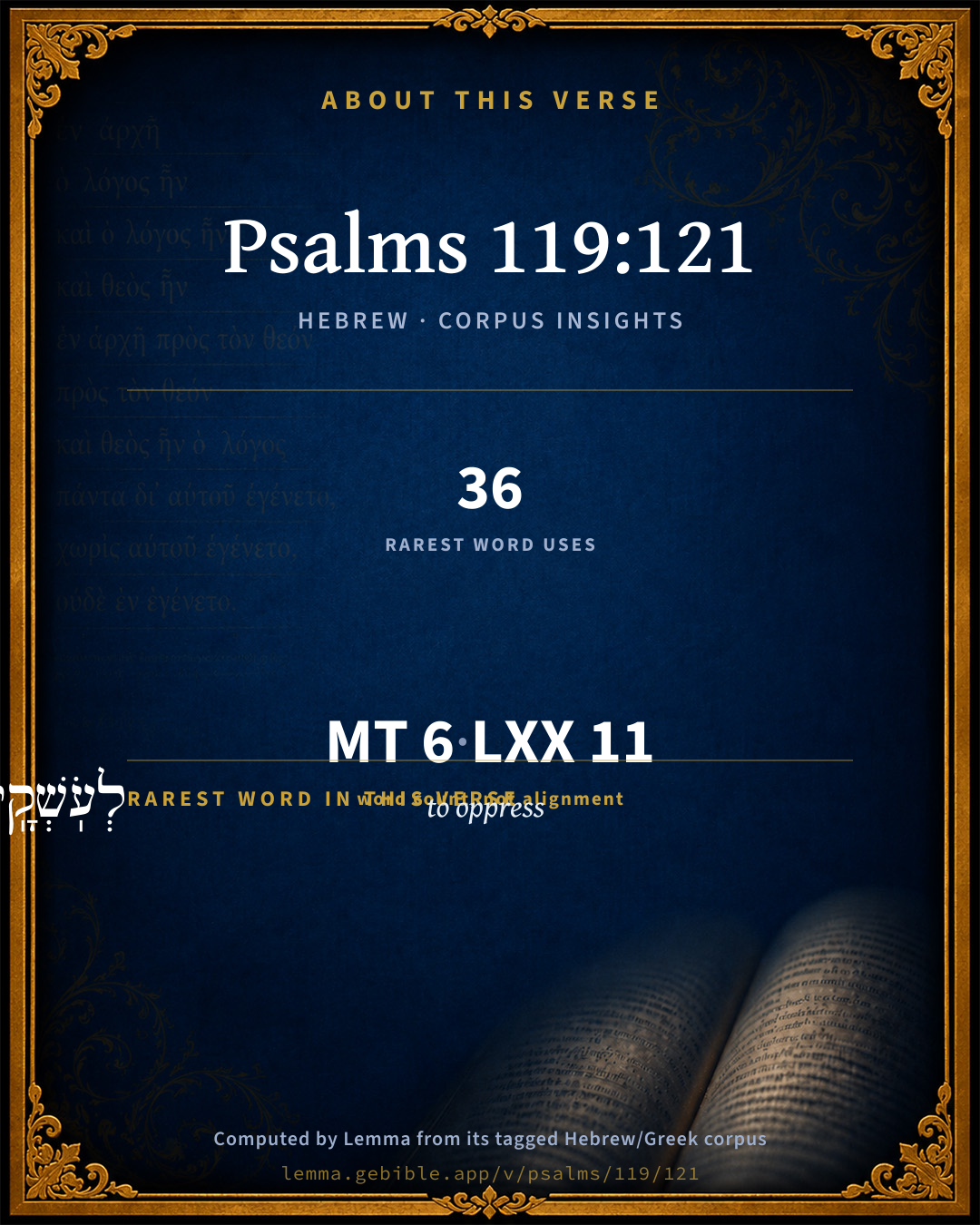
These counts appear in no published source. They are computed here, from the morphology-tagged text and Lemma’s own curated glosses. What Lemma adds →

6
words
6
distinct lemmas
Wisdom
section

Shared distinctive vocabulary

לְעֹֽשְׁקָֽי to oppress H6231 occurs in 35 verses of the Hebrew Bible. Also found in:

Grammatical profile

  • 3 verbs
  • 2 nouns
  • 1 particle

Verb forms

  • עָ֭שִׂיתִי Qal · Perfect
  • תַּ֝נִּיחֵ֗נִי Hiphil · Imperfect
  • לְעֹֽשְׁקָֽי Qal · Participle Active

Hebrew & Septuagint length

In English translation the verse runs 14 words from the Hebrew and 15 from the Septuagint (LXX English) — closely comparable.

A rough comparison of the two English renderings, which tokenize alike — not a word-level alignment.

Word counts can differ between the Hebrew and the Greek without any difference in meaning — e.g. the Hebrew direct-object marker אֵת has no separate Greek word, and Greek often adds the article ὁ.

In the original languages it is 6 Hebrew tokens and 11 Greek tokens — but the two are counted differently (Hebrew bundles its prefixes and suffixes into one token; the Greek is in lemma form), so that isn’t a like-for-like length.

Cross-references

12

Topical passages linked to Psalms 119:121 in the Treasury of Scripture Knowledge — connected by theme and wording, ordered by reader-vote popularity; previews shown in the World English Bible.

  • 2 Samuel 8:15 David reigned over all Israel; and David executed justice and righteousness to all his people.
  • Psalms 18:20–24 Yahweh has rewarded me according to my righteousness. According to the cleanness of my hands has he recompensed me.
  • Psalms 37:33 Yahweh will not leave him in his hand, Nor condemn him when he is judged.
  • 2 Corinthians 1:12 For our boasting is this: the testimony of our conscience, that in holiness and sincerity of God, not in fleshly wisdom but in the grace of God we behaved ourselves in the world, and more abundantly toward you.
  • 1 Samuel 24:11–15 Moreover, my father, behold, yes, see the skirt of your robe in my hand; for in that I cut off the skirt of your robe, and didn't kill you, know you and see that there is neither evil nor disobedience in my hand, and I have not sinned against you, though you hunt after my life to take it.
  • 1 Samuel 25:28 Please forgive the trespass of your handmaid: for Yahweh will certainly make my lord a sure house, because my lord fights the battles of Yahweh; and evil shall not be found in you all your days.
  • Psalms 7:3–5 Yahweh, my God, if I have done this, If there is iniquity in my hands,
  • Psalms 57:3–4 He will send from heaven, and save me, He rebukes the one who is pursuing me. Selah. God will send out his loving kindness and his truth.
  • Psalms 75:2 When I choose the appointed time, I will judge blamelessly.
  • Acts 21:16 Some of the disciples from Caesarea also went with us, bringing one Mnason of Cyprus, an early disciple, with whom we would stay.
  • Acts 25:10–11 But Paul said, "I am standing before Caesar's judgment seat, where I ought to be tried. I have done no wrong to the Jews, as you also know very well.
  • 2 Peter 2:9 the Lord knows how to deliver the godly out of temptation and to keep the unrighteous under punishment for the day of judgment;

Cross-references courtesy of OpenBible.info (CC BY 4.0).

Hebrew and Greek witnesses Masoretic Hebrew ↔ Greek Septuagint

The same verse in the two great witnesses to the Old Testament, shown verse-for-verse.

You’re reading Greek Psalm 118 (Hebrew Psalm 119). The Septuagint counts the superscription, so verse numbers can differ from the Hebrew — chapter-level alignment, not verse-by-verse. Numbering follows Rahlfs.

These are two independent witnesses, not word-aligned to each other, and the Septuagint is shown in lemma (dictionary) form.

Hebrew Psalms 119:121 Masoretic · Westminster Leningrad Codex

עָ֭שִׂיתִי מִשְׁפָּ֣ט וָצֶ֑דֶק בַּל תַּ֝נִּיחֵ֗נִי לְעֹֽשְׁקָֽי

I have done what is just and righteous. Don't leave me to my oppressors.

World English Bible · Public Domain

Greek LXX Greek Psalm 118:121 Septuagint · lemma form

αιν ποιέω κρίμα καί δικαιοσύνη μή παραδίδωμι ἐγώ ὁ ἀδικέω ἐγώ

I have done judgment and justice; deliver me not up to them that injure me.

LXX2012 (modern English Septuagint) · Public Domain

Hebrew: Westminster Leningrad Codex (CC BY 4.0). Greek: Septuagint (public domain); English from LXX2012 (modern English Septuagint) (Public Domain). How the Septuagint differs from the Hebrew →

Commentary

Notes on Psalms 119:121 from classic Christian and Jewish commentators (each source and its license shown beneath its notes). The classic Christian expositions comment on the surrounding passage and are grouped to its opening verse, so a note may address several verses; the Jewish commentaries on the Tanakh (Rashi and others) are per-verse, so they appear only where the commentator wrote on this verse.

Lemma curates 59 commentaries, every one of them public domain or Creative Commons licensed, each selected and text-cleaned for this edition rather than reprinted as found. About our sources →

Trapp's Complete Commentary

John Trapp

Psa 119:121 AIN. I have done judgment and justice: leave me not to mine oppressors.

Ver. 121. I have done judgment and justice] I have lived in all good conscience before God until this day, Act 23:1; my cause is right, and my carriage righteous. But innocence is no target against detraction and deadly practice; therefore

Leave me not to mine oppressors] Or traducers for they will soon exceed their commission, Zec 1:15.

John Trapp, A Commentary or Exposition upon All the Books of the Old and New Testament (1647–1656) — public domain. Text from a community e-Sword module.

The Biblical Illustrator

Joseph S. Exell

Psa_119:121-123

I have done judgment and justice.

What every man should do, and what every man requires

I. What every man should do. I have done judgment and justice. The whole moral code of the universe may be reduced to two words--Be just.

1. Be just to self. Properly train your own faculties, discipline your own affections, regulate your own activities.

2. Be just to other creatures. Whether they be small or large, irrational or intelligent. The meanest insect as well as the greatest soul hem claims on you.

3. Be just to the Creator. The kindest Being thank the most, the greatest Being reverence the most, the best Being adore the most.

II. What every man requires. Be surety for Thy servant for good; or, as some read, Interpose for Thy servant for good. There is a thing here which every man requires, viz. the merciful interposition of God. Be surety--interpose--for Thy servant. Unless He, in mercy, intervenes on our behalf, we are ruined for ever. Every awakened soul hungers for this, it is the great hunger of the soul. Mine eyes fail for Thy salvation. (Homilist.)

The Biblical Illustrator, edited by Joseph S. Exell (c. 1880s–1900s) — public domain. Text from a community e-Sword module.

The Treasury of David

Charles H. Spurgeon

Ver. 121. I have done judgment and justice. This was a great thing for an Eastern ruler to say at any time, for these despots mostly cared more far gain than justice. Some of them altogether neglected their duty, and would not even do judgment at all, preferring their pleasures to their duties; and many more of them sold their judgments to the highest bidders by taking bribes, or regarding the persons of men. Some rulers gave neither judgment nor justice, others gave judgment without justice, but David gave judgment and justice, and saw that his sentences were carried out. He could claim before the Lord that he had dealt out even handed justice, and was doing so still. On this fact he founded a plea with which he backed the prayer "Leave me not to mine oppressors." He who, as far as his power goes, has been doing right, may hope to be delivered from his superiors when attempts are made by them to do him wrong. If I will not oppress others, I may hopefully pray that others may not oppress me. A course of upright conduct is one which gives us boldness in appealing to the Great Judge for deliverance from the injustice of others. Nor is this kind of pleading to be censured as self righteous: when we are dealing with God as to our shortcomings, we use a very different tone from that with which we face the censures of our fellow men; when they are in the question, and we are guiltless towards them, we are justified in pleading our innocence.

Ver. 121. This commences a new division of the Psalm indicated by the Hebrew letter Ain a letter which cannot well be represented in the English alphabet, as there is, in fact, no letter in our language exactly corresponding with it. It would be best represented probably by what are called "breathings" in Greek. Albert Barnes.

Ver. 121. I have done judgment against the wicked, "and justice" towards the good. Simon de Muis, 1587-1644.

Ver. 121. I have done judgment and justice. Here the view of David in his judicial capacity might present itself to us; and if so, we have David in the midst of large experience; for the words would take in a large portion of his life. How blessed were their reflections, if, after a long reign, all sovereign rulers could thus appeal unto God. It should be so; for to him all shall be accountable at last. Even although we only conceive of David as speaking in the character of a private man, the sentiment is worthy of all consideration... For parents to say this of their dealings with their children, masters of servants, a man of his neighbours, is very excellent. John Stephen.

Ver. 121. Judgment and "justice, "are often put in Scripture for the same, and when put together, the latter is as an epithet to the former. "I have done judgment and justice, "that is, I have done judgment justly, exactly, to a hair. Joseph Caryl.

Ver. 121.

Do right and be a king,

Be this thy brazen bulwark of defence,

Still to preserve thy conscious innocence,

Nor ever turn pale with guilt. Francis's Horace.

Ver. 121. If our heart condemn us not, then have we confidence before God: 1Jo 3:21. This "testimony of conscience" has often been "the rejoicing" of the Lord's people, when suffering under unmerited reproach or "proud oppression." They have been enabled to plead it without offence in the presence of their holy, heart searching God; nay, even when, in the near prospect of the great and final account, they might well have been supposed to shrink from the strict and unerring scrutiny of their Omniscient Judge. Perhaps, however, we are not sufficiently aware of the importance of moral integrity in connexion with our spiritual comfort. Mark the boldness which it gave David in prayer: "I have done judgment and justice: leave me not to mine oppressors." Charles Bridges.

Ver. 121. Leave me not to mine oppressors. That is, maintain me against those who would wrong me, because I do right; interpose thyself between me and my enemies, as if thou wert my pledge. Impartial justice upon oppressors sometimes lays judges open to oppression; but yet they who run greatest hazards in zeal for God shall find God ready to be their surety, when they pray, "be surety for thy servant, "as in the next verse. Abraham Wright.

Ver. 121-122. I have done judgment and justice; but, that I may always do it, and never fail in doing it, "uphold thy servant unto good, "by directing him, so that he may always relish what is good, and then the consequence will be that "the proud will not calumniate me; "for he that is well established "unto good, "and so made up that nothing but what is good and righteous will be agreeable to him, he will so persevere that he will have no reason for fearing "the proud that calumniate him." Robert Bellarmine.

Verses 121-128. The just man's prayer against injustice. Out of the prison of oppression he appeals to God to be his surely (Ps 119:121-122); utters his weary longing for deliverance (Ps 119:123-125); points to the "time" (Ps 119:126); and professes his supreme love for God's law in contrast to the oppressors' contempt of it (Ps 119:127-128).

Outlines Upon Keywords of the Psalm, by Pastor C. A. Davis.

Ver. 121-122. The double appeal.

1. Of conscious integrity: "I have done judgment, "etc.

2. Of conscious deficiency: "Be surety for thy servant for good." C.A.D.

Psalms 119:122*

Ver. 122. Be surety for thy servant for good. Answer for me. Do not leave thy poor servant to die by the hand of his enemy and thine. Take up my interests and weave them with thine own, and stand for me. As my Master, undertake thy servants' cause, and represent me before the faces of haughty men till they see what an august ally I have in the Lord my God.

Let not the proud oppress me. Thine interposition will answer the purpose of my rescue: when the proud see that thou art my advocate they will hide their heads. We should have been crushed beneath our proud adversary the devil if our Lord Jesus had not stood between us and the accuser, and become a surety for us. It is by his suretyship that we escape like a bird from the snare of the fowler. What a blessing to be able to leave our matters in our Surety's hands, knowing that all will be well, since he has an answer for every accuser, a rebuke for every reviler.

Good men dread oppression, for it makes even a wise man mad, and they send up their cries to heaven for deliverance; nor shall they cry in vain, for the Lord will undertake the cause of his servants, and fight their battles against the proud. The word "servant" is wisely used,as a plea for favour for himself, and the word "proud" as an argument against his enemies. It seems to be inevitable that proud men should become oppressors, and that they should take most delight in oppressing really gracious men.

Charles H. Spurgeon's The Treasury of David (1869–1885) — public domain. Psalms only. Text from a community e-Sword/MySword module.

Joseph Benson's Commentary

AIN.

Psa 119:121-124. I have done judgment and justice — That is, just judgment, Ecc 5:7, namely, toward mine oppressors, whom I have no way injured. Be surety for thy servant for good — For my safety and comfort. Do thou undertake and plead my cause against all my enemies, as a surety rescues the poor persecuted debtor from the hands of a severe creditor. Mine eyes fail, &c., for the word of thy righteousness — For the performance of thy righteous, or faithful, or merciful word, or promise. Deal, &c., according to thy mercy — Not according to strict justice, nor according to my sins.

Joseph Benson's Commentary on the Old and New Testaments (1811–1818) — public domain. Text from a community e-Sword module.

J. A. Alexander on Psalms

Joseph Addison Alexander

121. (Psa 119:121) I do justice and righteousness; leave me not to my oppressors. The first verb is in the past tense, I have done and I still do. Do justice, not in the restricted or forensic sense of redressing wrong judicially, but in the wide sense of executing justice or reducing it to practice.

Joseph Addison Alexander, The Psalms Translated and Explained (1850) — public domain. Text from a community e-Sword module.

Tyndale Open Study Notes

Tyndale Open Resources

119:121-128 Ayin (ע): The servant of the Lord strains to endure the evil around him. He boldly petitions the Lord to rescue him immediately!

Tyndale Open Study Notes — © Tyndale Open Resources, licensed CC BY-SA 4.0. Text via the HelloAO Bible API.

Matthew Henry's Commentary

David here appeals to God, 1. As his witness that he had not done wrong; he could truly say, "I have done judgment and justice, that is, I have made conscience of rendering to all their due, and have not by force or fraud hindered any of their right." Take him as a king, he executed judgment and justice to all his people, Sa2 8:15. Take him in a private capacity, he could appeal to Saul himself that there was no evil or transgression in his hand, Sa1 24:11. Note, Honesty is the best policy and will be our rejoicing in the day of evil. 2. As his Judge, that he might not be wronged. Having done justice for others that were oppressed, he begs that God would do him justice and avenge him of his adversaries: "Be surety for thy servant, for good; undertake for me against those that would run me down and ruin me." He is sensible that he cannot make his part good himself, and therefore begs that God would appear for him. Christ is our surety with God; and, if he be so, Providence shall be our surety against all the world. Who or what shall harm us if God's power and goodness be engaged for our protection and rescue? He does not prescribe to God what he should do for him; only let it be for good, in such way and manner as Infinite Wisdom sees best; "only let me not be left to my oppressors." Though David had done judgment and justice, yet he had many enemies; but, having God for his friend, he hoped they should not have their will against him; and in that hope he prayed again, Let not the proud oppress me. David, one of the best of men, was oppressed by the proud, whom God beholds afar off; the condition therefore of the persecuted is better than that of the persecutors, and will appear so at last.

Matthew Henry's Commentary on the Whole Bible (1708–1710) — public domain (CC PDM 1.0). Text via the HelloAO Bible API.

Adam Clarke's Commentary

LETTER ע AIN. - Sixteenth Division

Verse 121. I have done judgment and justice] I have given the best decision possible on every case that came before me; and I have endeavoured to render to all their due.

Adam Clarke's Commentary on the Bible (1810–1826) — public domain. Text from a community e-Sword/MySword module.

John Calvin's Commentaries

121. I have done judgment and righteousness. The Prophet implores the help of God against the wicked who troubled him, and he does so in such a manner as at the same time to testify that the harassing treatment he received from them was on his part altogether undeserved. If we would have God to come down to succor us, it becomes us to see to it that we meet him with the testimony of a good conscience. As He everywhere promises his aid to the afflicted who are unrighteously oppressed, it is no superfluous protestation which the Prophet makes, that he had not provoked his enemies, but had restrained himself from all injury and wrong-doing, and had not even attempted to requite evil for evil. In asserting that he had at all times done judgment, he means that whatever rite wicked practiced, he steadfastly persevered in following after integrity, and never turned aside from what was just and right in any of his public or private transactions.

John Calvin's Commentaries (1540-1563) — public domain. Text from the Calvin Translation Society English edition (1840s-50s) via the Christian Classics Ethereal Library (ccel.org). Calvin's coverage is partial (roughly two-thirds of the Bible); uncommented books and verses are honest gaps, never fabricated. The 19th-century editor's footnotes and remarks are omitted so the notes are faithfully Calvin's own voice.

The Cambridge Bible for Schools and Colleges

gen. ed. J. J. S. Perowne

121. Conscious of his own rectitude the Psalmist prays that he may not be abandoned to the will of his oppressors. His conduct corresponds to the character of God. Cp. Psa_33:5; Psa_89:14.

121–128. Ayin. It is time for Jehovah to interpose on behalf of His servant, but the faithlessness of men only confirms his love for the law.

The Cambridge Bible for Schools and Colleges (gen. ed. J. J. S. Perowne; Cambridge University Press, 1878–1918) — public domain. Text from a community e-Sword module.

John Gill's Exposition

I am thy servant,.... Not only by creation, but by grace; and as he had a work to do, he desires to know what it was; and as it was proper he should know his Master's will, he applies to him for it; using this as an argument, that he was his servant, devoted to his service, and willing to perform it to the best of his knowledge and ability; and therefore prays,

give me understanding, that I may know thy testimonies; the Scriptures, which testify of the will of God; which are only rightly understood by those who have their understandings opened and enlightened; or have an understanding given them, that they may understand them, so as to receive and embrace the doctrine, and do the precepts of them: and such an understanding is the gift of God, and owing to his powerful and efficacious grace; see Luk 24:45.

John Gill's Exposition of the Whole Bible (1746–1763) — public domain (CC PDM 1.0). Text via the HelloAO Bible API.

Albert Barnes' Notes on the Bible

I have done judgment and justice - This commences a new division of the psalm, indicated by the Hebrew letter Ayin (ע ‛) - a letter which cannot well be represented in the English alphabet, as there is, in fact, no letter in our language exactly corresponding with it. It would be best represented probably by what are called “breathings” in Greek. The meaning of the first part of this verse is, “I have led a righteous and upright life.” It is equivalent to saying that he had kept the law of God, or had made that the rule of his conduct.

Leave me not to mine oppressors - To the people who would do me wrong; who seek my hurt. He urged this on the ground that he had been obedient to the divine law, and might, therefore, with propriety, make this request, or might claim the divine protection. Man has no merit of his own, and no claim on God; but when he is his true friend, it is not improper to expect that he will interpose in his behalf; nor is it improper to present this in the form of a prayer. Our loving God, and serving him, though it is done imperfectly, is, in fact, a reason why he should and will interpose in our behalf.

Albert Barnes' Notes on the Bible (1834–1885) — public domain. Text from a community e-Sword/MySword module.

Matthew Poole's English Annotations

AIN

Judgment and justice, i.e. just judgment, as Ecc 5:8, to wit, towards mine oppressors, whom I have no way injured.

Matthew Poole's English Annotations on the Holy Bible (1683–1685) — public domain. Text from a community e-Sword/MySword module.

Whedon's Commentary on the Bible

Daniel D. Whedon

ע, Ayin.

121-128. Leave me not to mine oppressors—Let “him that thinketh he standeth, take heed lest he fall.” Such is the line of thought in this division. In the pressure of evil the strongest has feelings of weakness. When the rod of the wicked rests heavily on the lot of the righteous, the latter is tempted to put forth his hand to iniquity. Hope and confidence need to be sustained by prayer. When men make void—nullify—the law, it still remains law, and the giver will know how to magnify and make it honourable. Therefore the psalmist loves and abides by it, even when he sees it broken.

Daniel D. Whedon (gen. ed.), Commentary on the Old and New Testaments (1874–1909) — public domain. Text from a community e-Sword module.

The Pulpit Commentary

eAIN.

I have done judgment and justice (comp. vers. 30, 31, 55, 56, etc). Leave me not to mine oppressors; rather, thou wilt not leave me to mine oppressors. The nexus of the thought seems to be, "As I have not oppressed any, so wilt thou not suffer me to be crushed by oppression.

Vers. 121-136. Looking to God.

A very large part of our Christian life is found in the uplifting of our heart to God in silent or vocal prayer. We look up for

I HIS MERCIFUL REGARD. (Vers. 124, 132, 135) We ask God to regard us as those who have humbled themselves before him, who trust in his mercy, who are his children in Jesus Christ; and we know that we shall not appeal in vain. To all such he has promised his merciful regard, the light of his countenance, his abiding favor, his Divine friendship.

II SPIRITUAL DISCERNMENT. (Vers. 124, latter part, 125-135) It is the continually recurring note, "Teach me thy statutes." In the words of the awakened apostle, "Lord, what wilt thou have me to do?" In our own ignorance, and in the confusion caused by so many contending voices, each purporting to be the truth, we may well cry, Give me understanding," etc. (ver. 125). We want to know with whom, in the Church and in the world, we should be associated; what is the true meaning and what the real message our Master delivered by his own lips or through the writings of his apostles; how we can best serve him in the field of active work, etc. We want to be able to distinguish between the plausible and the true, between the attractive and the wise, in all the counsels that are uttered in his Name. There is nothing we more need than spiritual discernment, when so many lights are shining of which we may be sure that some are not kindled at the altar of heavenly wisdom.

III HIS PROTECTION. (Vers. 121, 134) Oppression is not so rampant now as it has been, but it still exists in many places and in many forms. So that there is still need for the psalmist"s prayer; and it may be that many a heart, in loneliness and suffering, finds relief in this appeal to God, "Leave me not to my oppressors." The psalmist goes further; he asks for

a. THE ASSURANCE OF HIS PROTECTION. (Ver. 122) Such as God gave to Moses when he sent him to Pharaoh, and to David and Solomon when he gave them their thrones; such as Christ gave to Paul when he was in Corinth and was shrinking in spirit before his stupendous task. (Act_18:9, Act_18:10) Our Lord gives us the assurance that no harm shall happen to us which he does not permit, which he will not control and overrule for good. (Mat_5:11, 12 10:29-31)

b. THE PRESERVATION OF OUR SPIRITUAL INTEGRITY. (Ver. 133) Our first and chief obligation is to continue in that path of holy service in which the grace of God has placed us, and to maintain our freedom from everything that degrades and enslaves us. But this is a great thing to do; many have set forth on their Christian course confident of success, and they have been defeated. They have wandered from the way of wisdom; they have become the victim of some degrading habit. They did not look up to God daily and earnestly, or they would have been upheld. If there be any signs, however slight, of moral entanglement, let "our eyes be ever unto the Lord, and he will pluck our feet out of the net". (Psa_25:15)

VI HIS INTERVENTION. (Vers. 126, 136) Grieved at heart, perplexed in spirit, overwhelmed by the forces of evil and the temporary triumph of iniquity, what can we do? We may not cease to bear our testimony to the truth, but we may bring our burden to the Lord; we may plead that the cause of righteousness is not ours, but his, and pray, hopefully and even confidently, for the manifestation of his power. "It is time for thee, Lord, to work.

Vers. 121-128. An appeal of the righteous to the righteous God against the unrighteous.

The psalmist

I PLEADS HIS INNOCENCE AND INTEGRITY. (Ver. 121) "If I will not oppress others, I may hopefully pray that others may not oppress me". (1Jn_3:20) It was a great thing in those days of old, when might stood for right in well-nigh all men"s estimation, when"They should take who have the power, And they should keep who can was considered "the good old rule, the simple plan." At such time for a man to be able to say, "I have done justice and judgment," was indeed a rare and remarkable thing. But if, by the grace of God, this has been true of us, and we know it, there is no wrong in the affirmation of it when pleading before God.

II IMPLIES GOD"S PROTECTION. (Ver. 122) "Be Surety;" that is, "be my Champion, my Defender." He knows the righteous Lord loveth righteousness, and therefore he confidently appeals to him. Nothing so secures the putting forth of the Divine power as the consciousness and confession of the littleness of our own.

III DEPRECATES ITS LONG DELAY. (Ver. 123) "He wept, waited, and watched" for its coming, until from very weariness his eyesight began to give way. It is good to tell the Lord our trouble, to pour it out before him as the psalmist does here. Trouble is like water; it gets less by being poured from one vessel into another.

IV CONFESSES HIS NEED OF MERCY. (Ver. 124) Before men he could hold up his head, and declare that he was guilty of no wrong, as in ver. 121; but before God it is mercy that he implores, for he, as all who know themselves, knew full well his need thereof.

V FOR THE THIRD TIME AVOWS THAT HE IS GOD"S "SERVANT." (Vers. 122, 124, 125) Why this repeated avowal? Surely it is:

1. A confession of Gods absolute right to deal with him as he pleases. He is the absolute property of God by creation, redemption, preservation, and personal choice. But:

2. A profession of confident trust that the Lord wilt be mindful of his own, will not give him over unto the will of his enemies.

3. It is a renewal of his self-devotion. He does not want to renounce his service, to take anything back, but rather, under the oppression of his enemies, he would all the more consecrate himself to God. Where God gives a spirit like this, it is the sure harbinger and herald of the speedy coming of the needed help. It lays hold upon God.

VI CALLS ATTENTION TO THE PREVAILING CORRUPTION. (Ver. 126) How often God"s servants have said, "It is time for thee, Lord, to work"! and when they have been made deeply sensible of the sins and sorrows of men, so that their hearts grieve over them (see ver. 136), then it is a token that the time for the Lord"s interposition is at hand. "Where the carcass is, there will the vultures be gathered together.

VII PROTESTS THAT, HOWEVER IT BE WITH MEN GENERALLY, HE LOGES AND ESTEEMS THE LORD"S COMMANDMENTS AS ALTOGETHER RIGHT AND PRECIOUS. (Cf. Joh_21:15-17) Such are the appeals and the appellants that have favor with God and prevail righteous, lowly, earnest, devoted, grieved at sin, true, believing. S.C.

The Pulpit Commentary (1880–1919), ed. H.D.M. Spence-Jones & Joseph S. Exell — public domain. Text from a community e-Sword module.

John Wesley's Explanatory Notes

Judgment, &c. - Just judgment.

John Wesley, Explanatory Notes Upon the Whole Bible (1754–1765) — public domain. Text via the GEBible commentary corpus.

Keil & Delitzsch

C. F. Keil & F. Delitzsch

The eightfold Ajin. In the present time of apostasy and persecution he keeps all the more strictly to the direction of the divine word, and commends himself to the protection and teaching of God. In the consciousness of his godly behaviour (elsewhere always צדק וּמשׁפּט, here in one instance משׁפט וצדק) the poet hopes that God will surely not (בּל) leave him to the arbitrary disposal of his oppressors. This hope does not, however, raise him above the necessity and duty of constant prayer that Jahve would place Himself between him and his enemies. ערב seq. acc. signifies to stand in any one's place as furnishing a guarantee, and in general as a mediator, Job 17:3; Isa 38:14; לטוב similar to לטובה, Psa 86:17, Neh 5:19 : in my behalf, for my real advantage. The expression of longing after redemption in Psa 119:123 sounds like Psa 119:81. "The word of Thy righteousness" is the promise which proceeds from God's "righteousness," and as surely as He is "righteous" cannot remain unfulfilled. The one chief petition of the poet, however, to which he comes back in Psa 119:124., has reference to the ever deeper knowledge of the word of God; for this knowledge is in itself at once life and blessedness, and the present calls most urgently for it. For the great multitude (which is the subject to הפרוּ) practically and fundamentally break God's law; it is therefore time to act for Jahve (עשׂה ל as in Gen 30:30, Isa 64:4, Eze 29:20), and just in order to this there is need of well-grounded, reliable knowledge. Therefore the poet attaches himself with all his love to God's commandments; to him they are above gold and fine gold (Psa 19:11), which he might perhaps gain by a disavowal of them. Therefore he is as strict as he possibly can be with God's word, inasmuch as he acknowledges and observes all precepts of all things (כּל־פּקּוּדי כל), i.e., all divine precepts, let them have reference to whatsoever they will, as ישׁרים, right (ישּׁר, to declare both in avowal and deed to be right); and every false (lying) tendency, all pseudo-Judaism, he hates. It is true Psa 119:126 may be also explained: it is time that Jahve should act, i.e., interpose judicially; but this thought is foreign to the context, and affords no equally close union for על־כן; moreover it ought then to have been accented עת לעשׂות ליהוה. On כּל־פּקּוּדי כל, "all commands of every purport," cf. Isa 29:11, and more as to form, Num 8:16; Eze 44:30.

The expression is purposely thus heightened; and the correction כל־פקודיך (Ewald, Olshausen, and Hupfeld) is also superfluous, because the reference of what is said to the God of revelation is self-evident in this connection.

Keil & Delitzsch — Biblical Commentary on the Old Testament (1861–1891) — public domain (CC PDM 1.0). Text via the HelloAO Bible API. (Old Testament only.)

Kretzmann's Popular Commentary

Paul E. Kretzmann

Ain. The Proper Estimation of God’s Word in the Midst of Oppression. —

v. 121. I have done judgment and justice, performing and observing the rules of conduct which have been labeled with God’s approval in His Word; leave me not to mine oppressors. Just as the consciousness of guilt aggravates any suffering, so the feeling of having performed one’s duty yields at least a measure of comfort.

v. 122. Be surety for Thy servant for good, becoming his advocate and so answerable for him against the slurs and accusations of the enemies; let not the proud the arrogant mockers, oppress me, by making use of cruelty whenever opportunity offers and they feel that they have the power to use it.

v. 123. Mine eyes fail, with anxious gazing, for Thy salvation, for the final deliverance promised to all believers, and for the Word of Thy righteousness, in which the righteousness of the Lord is promised to all those who accept it in faith. This is, of course, not a matter of merit on his part, as the psalmist says:

v. 124. Deal with Thy servant according unto Thy mercy, according to His free grace and favor, the outflow of His love, and teach me Thy statutes; for every believer, having accepted the mercy of the heavenly Father, is anxious to show his appreciation of it by following the precepts of His holy will as closely as possible.

v. 125. I am Thy servant, desiring nothing more than to occupy a position of the lowest service before Jehovah; give me understanding, a proper appreciation and insight, that I may know Thy testimonies, the Word in which God testifies of Himself, for the truth, against sin.

v. 126. It is time for Thee, Lord, to work, all the signs and conditions of the times point to the urgent need of the Lord’s interference; for they have made void Thy Law, set aside His Word as no longer possessing validity, just as the godless scoffers are trying to do in our days. A thorough and firm knowledge of the Word being all the more necessary when the enmity against it is so great, the psalmist adds:

v. 127. Therefore I love Thy commandments above gold, yea, above fine gold, which might be his as the reward of denial of the truth.

v. 128. Therefore I esteem all Thy precepts concerning all things to be right, he is bound to acknowledge all the directions of the Lord as good and praiseworthy, not only in matters of doctrine, but also in instructions pertaining to the everyday conduct of life; and I hate every false way, utterly rejecting every tendency which does not conform to the rule of the divine Word. It is true to this day that the Bible instructs the conscientious Christian in every question pertaining to his entire conduct, and therefore it should not only be consulted, but also followed with constant faithfulness.

Paul E. Kretzmann, Popular Commentary of the Bible (1921–1924) — public domain. Text from a community e-Sword module.

unfoldingWord translationNotes

Door43 World Missions Community

AYIN

This is the name of the sixteenth letter of the Hebrew alphabet. In the Hebrew language, each line of verses 121-128 begins with this letter.

do not abandon me to my oppressors

"do not allow people to oppress me"

Guarantee the welfare of your servant

The writer speaks about himself as "your servant." AT: "Guarantee my welfare" or "Help and protect me, your servant" (See: First, Second, or Third Person)

the proud

This nominal adjective can be stated as an adjective. AT: "those who are proud" or "proud people" (See: Nominal Adjectives)

translationWords

just

oppress

servant

proud

unfoldingWord translationNotes — © Distant Shores Media and the Door43 World Missions Community, licensed CC BY-SA 4.0. Source: git.door43.org/Door43/en_tn.

Lesson kit

Teaching starters — assembled from the data on this page, not authored interpretation. Every prompt links to the verse data it draws on. Edit before teaching.

Psalms, in the Wisdom, opens this verse with 6 words (6 distinct Hebrew lemmas). Its most distinctive word is ʻâshaq (“to oppress”). A historical commentator’s framing appears above. Read the whole chapter for the surrounding context.

Discussion questions

  1. How does “to oppress” (ʻâshaq) shape what this verse is saying?
  2. How does Leviticus 6:2, which shares the word «to oppress», read alongside this verse?
  3. These translations render this verse differently; the difference is in the English rendering, not the original. What questions does that raise?
  4. «עָ֭שִׂיתִי» is a Qal Perfect verb. How does that grammatical form shape the action described?
  5. Compare how Trapp's Complete Commentary and The Biblical Illustrator read this verse. Where do they agree or differ?

Things to notice

Reading settings

Reading text

Shown beneath each verse's original-language words.

Old Testament
Old Testament edition

Read the OT as the Masoretic Hebrew (MT) or the Greek Septuagint (LXX).

English shown for the Greek Septuagint (in the Hebrew ↔ Greek comparison).

Comparing translations? Open the Compare panel on any verse page to stack up to four side by side.