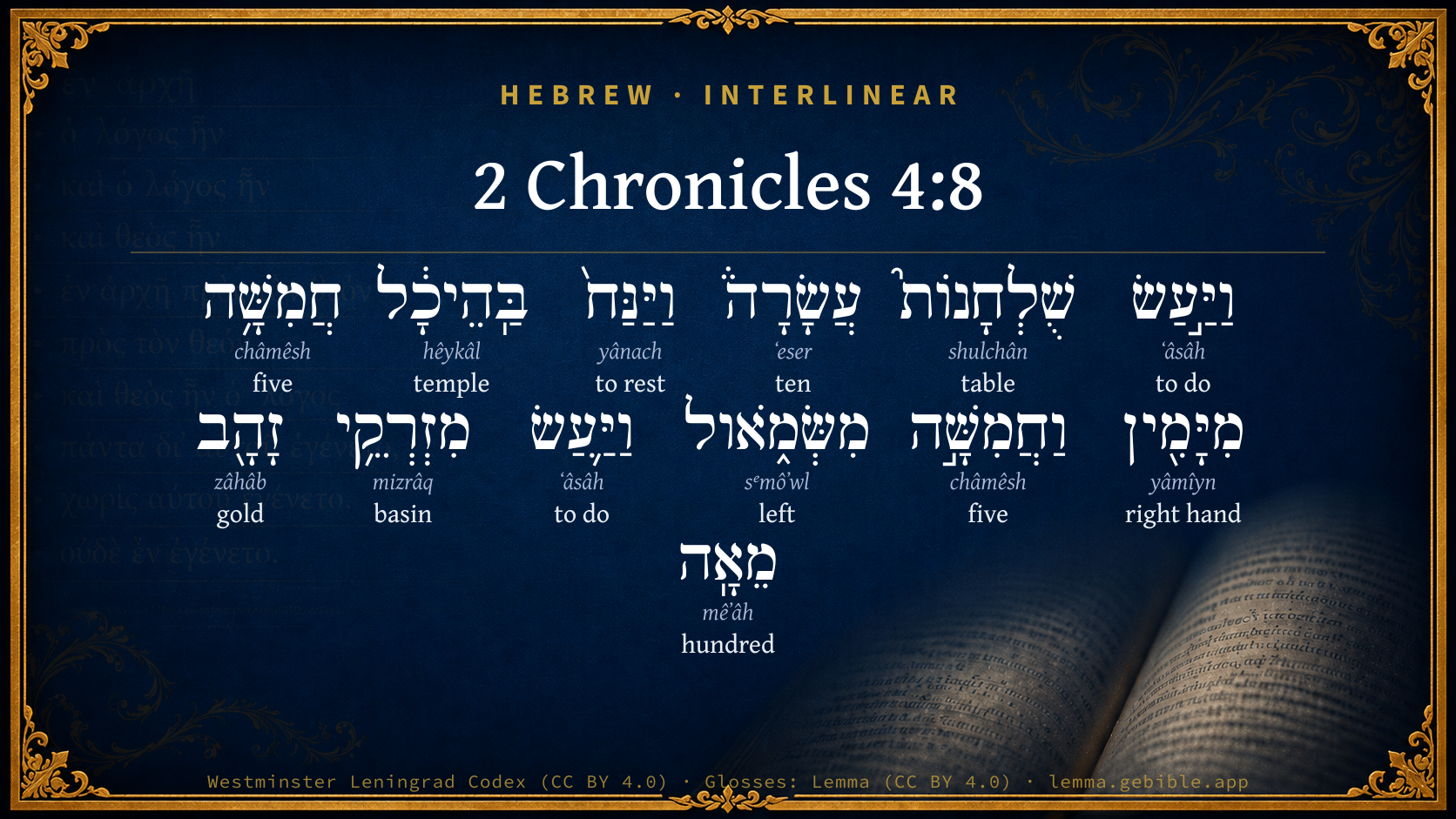
2 Chronicles 4:8

Hebrew (Westminster Leningrad Codex) 2 Chronicles 4:8 appears in the Hebrew Old Testament. The text above is from the Westminster Leningrad Codex. Each word links to its Strong’s number, a concise gloss, and parsing drawn from the Open Scriptures Hebrew Bible morphology. Click any word for its full Brown-Driver-Briggs (BDB) entry.
Download image
Cite this verse

2 Chronicles 4:8 (World English Bible). Public Domain. Lemma interlinear Bible study tool, https://lemma.gebible.app/v/2-chronicles/4/8.

Show BibTeX & RIS
BibTeX
RIS
English Translation
He made also ten tables, and placed them in the temple, five on the right side, and five on the left. He made one hundred basins of gold.
World English Bible · Public Domain
Download a study sheet

One document with this verse’s original text, its word-by-word gloss line, the meaning frame, cross-references with their text, attributed commentary, and full source and license credits — printable, and it pastes into notes with its structure intact.

This verse Autodidact and up

Study sheet (.html) Plain text (.txt)

A passage Seminary Student

Up to 50 verses in one chapter. A passage sheet keeps up to 6 commentary sources and 12 cross-references per verse, in the order this page ranks them, and says so on the sheet whenever that leaves anything out. Ask for a single verse and you get the Autodidact verse sheet above.

Everything on this page stays free to read, with no account — the sheet is a download of what is already on screen, not access to it.

Want to remove ads? Support Godless Engineer
Compare translations 3

The same verse in 3 English versions, stacked beneath the original-language interlinear above. Click any original word for its lexicon entry.

Each is an independent rendering of the whole verse — the interlinear is not word-aligned to these translations.

Highlighted words mark where these versions differ — a whole-verse word diff, not a word-by-word alignment.

  • World English Bible Public Domain
    He made also ten tables, and placed them in the temple, five on the right side, and five on the left. He made one hundred basins of gold.
  • King James Version Public Domain
    He made also ten tables, and placed them in the temple, five on the right side, and five on the left. And he made an hundred basins of gold.
  • unfoldingWord Literal Text CC BY-SA 4.0
    And he made 10 tables, and he gave rest in the temple, five on the right, and five on the left. And he made 100 basins of gold.

unfoldingWord Literal Text — © unfoldingWord, licensed CC BY-SA 4.0. Word-aligned USFM3 via Door43 (git.door43.org/unfoldingWord/en_ult).

Versions to compare (up to 4)

3 of 4 selected

Show all 18 translations

Every available English version of this verse, each an independent rendering of the whole verse.

  • World English Bible Public Domain
    He made also ten tables, and placed them in the temple, five on the right side, and five on the left. He made one hundred basins of gold.
  • Berean Standard Bible Public Domain
    Additionally, he made ten tables and placed them in the temple, five on the south side and five on the north. He also made a hundred gold bowls.
  • Majority Standard Bible Public Domain
    Additionally, he made ten tables and placed them in the temple, five on the south side and five on the north. He also made a hundred gold bowls.
  • King James Version Public Domain
    He made also ten tables, and placed them in the temple, five on the right side, and five on the left. And he made an hundred basins of gold.
  • American Standard Version (1901) Public Domain
    He made also ten tables, and placed them in the temple, five on the right side, and five on the left. And he made a hundred basins of gold.
  • Revised Version (1885) Public Domain
    He made also ten tables, and placed them in the temple, five on the right side, and five on the left. And he made an hundred basons of gold.
  • Geneva Bible (1599) Public Domain
    And he made ten tables, and put them in the Temple, fiue on the right hand, and fiue on the left: and he made an hundreth basens of golde.
  • Douay-Rheims (1899) Public Domain
    And he made ten golden candlesticks, according to the form which they were commanded to be made by: and he set them in the temple, five on the right hand, and five on the left.
  • Young's Literal Translation Public Domain
    And he maketh ten tables, and placeth in the temple, five on the right, and five on the left; and he maketh bowls of gold a hundred.
  • Literal Standard Version CC BY-SA 4.0
    And he makes ten tables, and places [them] in the temple, five on the right, and five on the left; and he makes one hundred bowls of gold.
  • Unlocked Literal Bible CC BY-SA 4.0
    He made ten tables and placed them in the temple, five on the right side, and five on the left. He made one hundred basins of gold.
  • unfoldingWord Literal Text CC BY-SA 4.0
    And he made 10 tables, and he gave rest in the temple, five on the right, and five on the left. And he made 100 basins of gold.
  • Darby Bible Public Domain
    And he made ten tables, and placed them in the temple, five on the right hand and five on the left. And he made a hundred golden bowls.
  • World Messianic Bible Public Domain
    He made also ten tables, and placed them in the temple, five on the right side and five on the left. He made one hundred basins of gold.
  • Webster's Bible Public Domain
    He made also ten tables, and placed them in the temple, five on the right side, and five on the left. And he made a hundred basins of gold.
  • Free Bible Version CC BY-SA 4.0
    In addition he made ten tables and placed them in the Temple, five on the south side and five on the north. He also made a hundred gold basins.
  • Bible in Basic English Public Domain
    He made ten tables, and put them in the Temple, five on the right side and five on the left. And he made a hundred gold basins.
  • JPS Tanakh (1917) Public Domain
    He made also ten tables, and placed them in the temple, five on the right side, and five on the left. And he made a hundred basins of gold.

Literal Standard Version (2020), Covenant Press — licensed CC BY-SA 4.0. Text via the HelloAO Bible API (eBible.org). Unlocked Literal Bible (unfoldingWord) — licensed CC BY-SA 4.0. Text via the HelloAO Bible API (eBible.org). unfoldingWord Literal Text — © unfoldingWord, licensed CC BY-SA 4.0. Word-aligned USFM3 via Door43 (git.door43.org/unfoldingWord/en_ult). Free Bible Version, Dr. Jonathan Gallagher — licensed CC BY-SA 4.0. Text via the HelloAO Bible API (eBible.org).

Word by word

More ways to search: Search by grammar → Find every occurrence → Compare this word →

Practice this passage: Drill this verse → Learn its vocabulary →

מִזְרְקֵ֥י
mizrâq
H4219
“basins of”
Noun, Common, Masculine, Plural, Construct
Part of Speech
Noun
Type
Common
Gender
Masculine
Number
Plural
State
Construct
Full BDB Definition

Origin: from H2236

TWOT: 585a

bowl, basin - bowl (for wine) - basin (vessel for throwing or tossing a liquid)
  1. וַיַּ֣עַשׂ ʻâsâh H6213 “and · to do” Conjunction + Verb, Qal, Sequential Imperfect, 3rd Person, Masculine, Singular
  2. שֻׁלְחָנוֹת֮ shulchân H7979 “tables” Noun, Common, Masculine, Plural, Absolute
  3. עֲשָׂרָה֒ ʻeser H6235 “ten” Adjective, Cardinal number, Masculine, Singular, Absolute
  4. וַיַּנַּח֙ yânach H3240 “and · to rest” Conjunction + Verb, Hiphil, Sequential Imperfect, 3rd Person, Masculine, Singular
  5. בַּֽהֵיכָ֔ל hêykâl H1964 “in/at the · temple” Preposition, Determined + Noun, Common, Masculine, Singular, Absolute
  6. חֲמִשָּׁ֥ה châmêsh H2568 “five” Adjective, Cardinal number, Masculine, Singular, Absolute
  7. מִיָּמִ֖ין yâmîyn H3225 “from · right hand” Preposition + Noun, Common, Feminine, Singular, Absolute
  8. וַחֲמִשָּׁ֣ה châmêsh H2568 “and · five” Conjunction + Adjective, Cardinal number, Masculine, Singular, Absolute
  9. מִשְּׂמֹ֑אול sᵉmôʼwl H8040 “from · left” Preposition + Noun, Common, Masculine, Singular, Absolute
  10. וַיַּ֛עַשׂ ʻâsâh H6213 “and · to do” Conjunction + Verb, Qal, Sequential Imperfect, 3rd Person, Masculine, Singular
  11. זָהָ֖ב zâhâb H2091 “gold” Noun, Common, Masculine, Singular, Absolute
  12. מֵאָֽה mêʼâh H3967 “hundred” Adjective, Cardinal number, Both, Singular, Absolute

About this verse

These counts appear in no published source. They are computed here, from the morphology-tagged text and Lemma’s own curated glosses. What Lemma adds →

13
words
11
distinct lemmas
Historical
section

Shared distinctive vocabulary

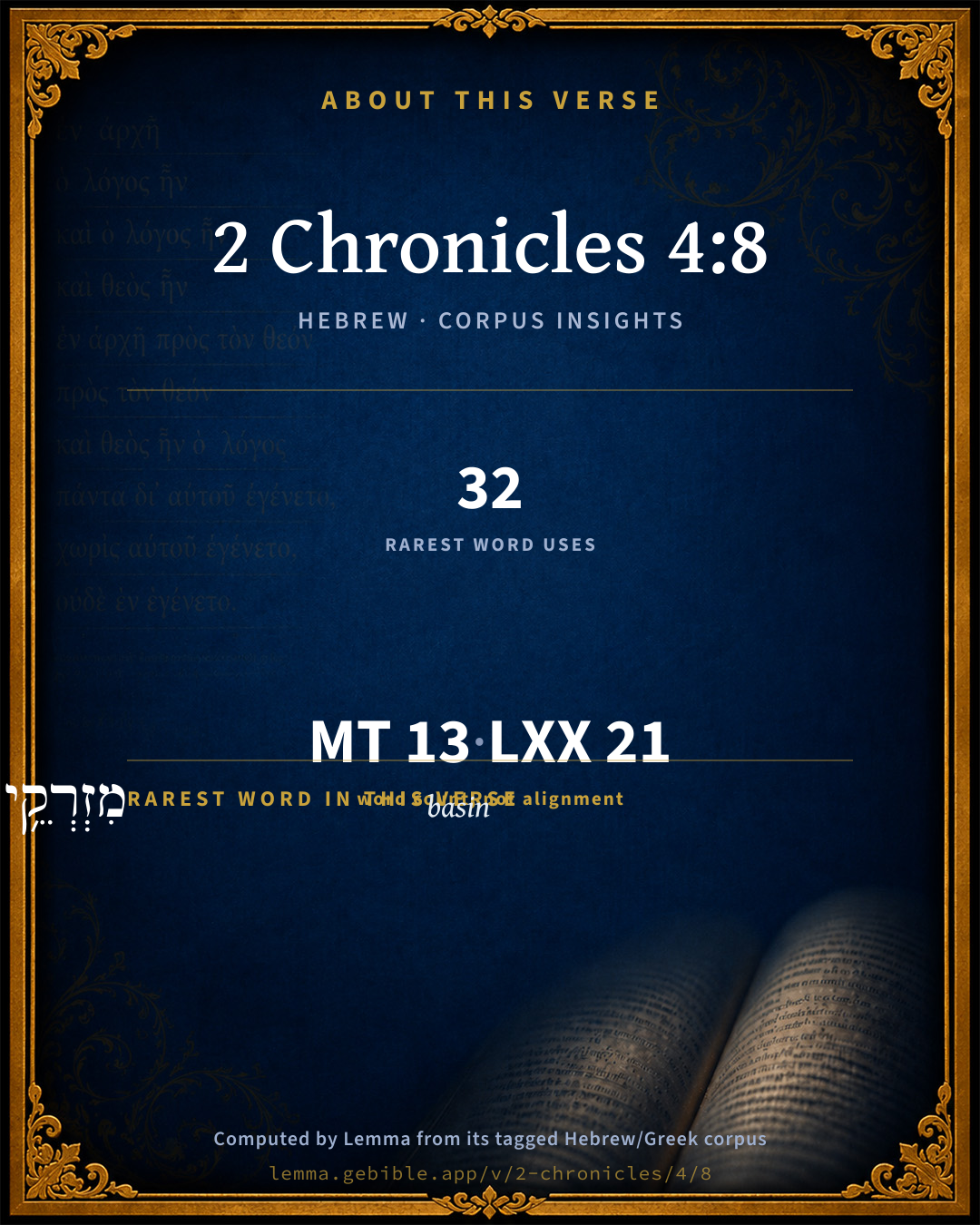
מִזְרְקֵ֥י basin H4219 occurs in 32 verses of the Hebrew Bible. Also found in:

Grammatical profile

  • 3 verbs
  • 6 nouns
  • 4 adjectives

Verb forms

  • וַיַּ֣עַשׂ Qal · Sequential Imperfect
  • וַיַּנַּח֙ Hiphil · Sequential Imperfect
  • וַיַּ֛עַשׂ Qal · Sequential Imperfect

Repetition

Words recur within this verse — often emphatic in Hebrew:

  • וַיַּ֣עַשׂ to do H6213 ×2
  • חֲמִשָּׁ֥ה five H2568 ×2

Hebrew & Septuagint length

In English translation the verse runs 28 words from the Hebrew and 28 from the Septuagint (LXX English) — the same length.

A rough comparison of the two English renderings, which tokenize alike — not a word-level alignment.

Word counts can differ between the Hebrew and the Greek without any difference in meaning — e.g. the Hebrew direct-object marker אֵת has no separate Greek word, and Greek often adds the article ὁ.

In the original languages it is 13 Hebrew tokens and 21 Greek tokens — but the two are counted differently (Hebrew bundles its prefixes and suffixes into one token; the Greek is in lemma form), so that isn’t a like-for-like length.

Cross-references

9

Topical passages linked to 2 Chronicles 4:8 in the Treasury of Scripture Knowledge — connected by theme and wording, ordered by reader-vote popularity; previews shown in the World English Bible.

  • 1 Kings 7:48 Solomon made all the vessels that were in the house of Yahweh: the golden altar, and the table whereupon the show bread was, of gold;
  • Exodus 25:23–30 "You shall make a table of acacia wood. Two cubits shall be its length, and a cubit its breadth, and one and a half cubits its height.
  • Exodus 37:10–16 He made the table of acacia wood. Its length was two cubits, and its breadth was a cubit, and its height was a cubit and a half.
  • Isaiah 25:6 In this mountain will Yahweh of Hosts make to all peoples a feast of fat things, a feast of wines on the lees, of fat things full of marrow, of wines on the lees well refined.
  • Ezekiel 44:16 they shall enter into my sanctuary, and they shall come near to my table, to minister to me, and they shall keep my charge.
  • Zechariah 14:20 In that day there will be on the bells of the horses, "HOLY TO YAHWEH;" and the pots in Yahweh's house will be like the bowls before the altar.
  • Malachi 1:12 "But you profane it, in that you say, 'Yahweh's table is polluted, and its fruit, even its food, is contemptible.'
  • 1 Corinthians 10:21 You can't both drink the cup of the Lord and the cup of demons. You can't both partake of the table of the Lord, and of the table of demons.
  • Jeremiah 52:18–19 The pots also, and the shovels, and the snuffers, and the basins, and the spoons, and all the vessels of brass with which they ministered, took they away.

Cross-references courtesy of OpenBible.info (CC BY 4.0).

Hebrew and Greek witnesses Masoretic Hebrew ↔ Greek Septuagint

The same verse in the two great witnesses to the Old Testament, shown verse-for-verse.

These are two independent witnesses, not word-aligned to each other, and the Septuagint is shown in lemma (dictionary) form.

Hebrew 2 Chronicles 4:8 Masoretic · Westminster Leningrad Codex

וַיַּ֣עַשׂ שֻׁלְחָנוֹת֮ עֲשָׂרָה֒ וַיַּנַּח֙ בַּֽהֵיכָ֔ל חֲמִשָּׁ֥ה מִיָּמִ֖ין וַחֲמִשָּׁ֣ה מִשְּׂמֹ֑אול וַיַּ֛עַשׂ מִזְרְקֵ֥י זָהָ֖ב מֵאָֽה

He made also ten tables, and placed them in the temple, five on the right side, and five on the left. He made one hundred basins of gold.

World English Bible · Public Domain

Greek LXX 2 Chronicles 4:8 Septuagint · lemma form

καί ποιέω τράπεζα δέκα καί τίθημι ἐν ὁ ναός πέντε ἐκ δεξιός καί πέντε ἐκ εὐώνυμος καί ποιέω φιάλη χρυσοῦς ἑκατόν

And he made ten tables, and put them in the temple, five on the right hand, and five on the left: and he made one hundred golden bowls.

LXX2012 (modern English Septuagint) · Public Domain

Hebrew: Westminster Leningrad Codex (CC BY 4.0). Greek: Septuagint (public domain); English from LXX2012 (modern English Septuagint) (Public Domain). How the Septuagint differs from the Hebrew →

Commentary

Notes on 2 Chronicles 4:8 from classic Christian and Jewish commentators (each source and its license shown beneath its notes). The classic Christian expositions comment on the surrounding passage and are grouped to its opening verse, so a note may address several verses; the Jewish commentaries on the Tanakh (Rashi and others) are per-verse, so they appear only where the commentator wrote on this verse.

Lemma curates 59 commentaries, every one of them public domain or Creative Commons licensed, each selected and text-cleaned for this edition rather than reprinted as found. About our sources →

Trapp's Complete Commentary

John Trapp

2Ch 4:8 He made also ten tables, and placed [them] in the temple, five on the right side, and five on the left. And he made an hundred basons of gold.

Ver. 8. He made also ten tables.] Lyra holdeth that all these were for shewbread, each of them having twelve loaves weekly set thereon, one hundred thirty-two in all. In our heavenly "Father’s house is bread enough."

He made a hundred basons of gold.] To receive the blood of the sacrifices. The blood of Christ is most precious, and must not be trampled on.

John Trapp, A Commentary or Exposition upon All the Books of the Old and New Testament (1647–1656) — public domain. Text from a community e-Sword module.

The Pulpit Commentary

Ten tables. These tables also (the use of which is given in ver. 19) are not mentioned, so far as their making is concerned, in the parallel, except in its summary, ver. 48, (cf. 1Ki 7) where furthermore only one table, called "the table", (Exo_25:23) is specified, with which agreeszmi, 2Ch_29:18. It is hard to explain this variation of statement. It is at least an arbitrary and forced explanation to suppose that ten tables constituted the furniture in question, while only one was used at a time. Keil and Bertheau think that the analogy of the ten candlesticks points to the existence of ten tables. The question, however, is, where is the call for, or where are the indications of any analogy? A hundred basins of gold. The Hebrew word employed here, and translated "basins," is yqer) as also vers. 11, 22, infra; and 1Ki_7:40, 1Ki_7:45, 1Ki_7:50; Exo_27:3; Num_4:14; but it is represented as well by the English translation "bowls" in 1Ch_28:17; 2Ki_25:15; Num_7:13, Num_7:19, etc. The "pots," however, of our vers. 11, 16 has for its Hebrew twOrySih. It were well if, in names such as these, at any rate, an absolute uniformity of version were observed in the translation, for the benefit of the English reader, to say nothing of the saving of wasted time for the student and scholar. These basins, or bowls, were to receive and hold the blood of the slain victims, about to be sprinkled for purification Exo_24:6-8, where the word Ga is used; 29:12, 10, 20, 21; Lev_1:5, and passion; (Heb_9:18-20; see also Num_4:14) The Hebrew word qrzmi, whether appearing in our version as "basin" or "bowl," occurs thirty-two times, sixteen in association exactly similar with the present (viz. Exo_27:3 Exo_38:3; Num_4:14; 1Ki_7:40, 1Ki_7:45, 1Ki_7:50; 2Ki_12:13 2Ki_25:15; 1Ch_28:17; 2Ch_4:8, 2Ch_4:11, 2Ch_4:22; Neh_7:70; Jer_52:18, Jer_52:19; Zec_14:20) fourteen as silver bowls in the time of the tabernacle for the meat offering of "fine flour mingled with oil" (viz., Num_7:13, Num_7:19, Num_7:25, Num_7:31, Num_7:37, Num_7:43, Num_7:49, 55, 61, 67, 73, 79, 84, 85) and the remaining two in an entirely general application. (Zec_9:15) It is evident, therefore, that the qr; zmi was not the only vessel used for holding the blood of purification, nor was it exclusively reserved to this use.

God"s bounty and our response.

The significance of the table of shew-bread (of which Solomon, in his desire for fulness and richness of provision, now made ten) depends on its position and on the objects it was to sustain. The table stood in the "holy place," very near to the inner sanctuary, where the presence of God was symbolized; and it bore upon it the shewbread, or "bread of presence;" this was so called because it was "the shewbread before me always", (Exo_25:30) continually in the presence of God. There were also some vessels (Exo_25:29) which were probably intended to receive wine ("to pour out withal"), which was the ordinary accompaniment of bread, as the source of daily sustenance. The whole arrangement pointed to

I A CONTINUAL RECOGNITION OF DIVINE BOUNTY. The bread and wine which largely constituted and adequately represented the provision for the nation"s need were placed in the near presence of God, as the One from whom they came. It was well that the Israelites should be continually acknowledging that the fruit of the field was of Divine origin. They were very mindful and very proud of the great gift of the manna, which was a palpable and very remarkable provision from above a clear produce of the power and goodness of God. They would be in danger of thinking that there was less of the Divine in the annual harvest; for this was, in part, the result of their own labour, and came gradually, by ordinary and gradual processes of nature. But Divine goodness and power were as truly in the latter as in the former. From God himself came the soil, the seed, the sunshine, the rain, the airs and winds of heaven; from him came the power that made all these work together for the germination, growth, and ripening of the grain; from him also came the knowledge and the skill which enabled the farmer to cultivate his ground and to secure his harvest; it was also of God"s goodness that he required of his children the putting forth of these powers, both of body and mind, on the exercise of which so largely depended their health and character. The shewbread and the wine, standing where they stood, were a perpetual acknowledgment that all things which sustained and strengthened the nation came from the Lord their God.

II A SOLEMN DEDICATION OF HUMAN STRENGTH TO THE SERVICE OF GOD. It was significant enough that "pure frankincense was to be placed on each row" of the loaves or cakes. (Lev_24:7) "The offering of incense was embodied prayer, and the placing of a vessel of incense upon this bread was like sending it up to God on the wings of devotion" (Fairbairn"s "Typology"). It was, therefore, "a kind of sacrifice," and is spoken of (Lev_24:7) as "an offering unto the Lord." To present to God those things which are the recognized sources of sustenance and strength, is to acknowledge that our power and our resources belong to him and should be paid to him; it is, indeed, solemnly to dedicate them to his service in formal worship. We do the same thing now in our harvest thanksgiving services, and when we sing in the sanctuary hymns ascribing all our comforts and all our well-being to the good hand of our God. We only "perform our vows" when we dedicate to God, in daily life, the strength and the possessions with which he has enriched us; when we live in grateful remembrance of his love, in cheerful obedience to his will. in active and earnest endeavour to serve his children and extend his kingdom. C.

The Pulpit Commentary (1880–1919), ed. H.D.M. Spence-Jones & Joseph S. Exell — public domain. Text from a community e-Sword module.

Adam Clarke's Commentary

Verse 8. A hundred basons of gold] These were doubtless a sort of paterae or sacrificial spoons, with which they made libations.

Adam Clarke's Commentary on the Bible (1810–1826) — public domain. Text from a community e-Sword/MySword module.

Ellicott's Commentary for English Readers

(8) He made also ten tables.—Perhaps the golden candelabra stood upon them. (Comp. 1Ch_28:16; and 2Ch_4:19, infra.)

Side.—Not in the Hebrew.

An hundred basons.—Bowls for pouring libations (Amo_6:6; same word, mizrâqîm). The Syriac and Arabic make the number of these vessels a hundred and twenty.

The ten tables are not mentioned in the parallel narrative, which speaks of one table only, viz., the table of shewbread (1Ki_7:48).

“Basons,” or bowls, are spoken of in 1Ki_7:45; 1Ki_7:50 (mizrâqôth), but their number is not given.

A Bible Commentary for English Readers, edited by Charles John Ellicott (1878–1897) — public domain. Text from a community e-Sword module.

The Cambridge Bible for Schools and Colleges

gen. ed. J. J. S. Perowne

8. The Tables and Basons

8. ten tables] In 2Ch_4:19 “the tables (plural) whereon the shewbread was set” are mentioned (cp. 1Ch_28:16), but the parallel place (1Ki_7:48) has “the table” (sing.), and elsewhere both in Chronicles and in the rest of the O.T. one table only is assigned to the shewbread (2Ch_13:11; 2Ch_29:18). Probably therefore the ten tables here mentioned were not for the shewbread.

basons] These were used for dashing the blood of the sacrifices against the altar.

The Cambridge Bible for Schools and Colleges (gen. ed. J. J. S. Perowne; Cambridge University Press, 1878–1918) — public domain. Text from a community e-Sword module.

Albert Barnes' Notes on the Bible

The number of the tables (see 2Ch 4:19) and of the basins, is additional to the information contained in Kings.

Albert Barnes' Notes on the Bible (1834–1885) — public domain. Text from a community e-Sword/MySword module.

Matthew Poole's English Annotations

Ten tables; of which see 1Ki 7:48.

Matthew Poole's English Annotations on the Holy Bible (1683–1685) — public domain. Text from a community e-Sword/MySword module.

John Wesley's Explanatory Notes

Ten tables - Whereon the shew-bread was set, ver. 19. Perhaps each of these had twelve loaves on it. As the house was enlarged, so was the provision.

John Wesley, Explanatory Notes Upon the Whole Bible (1754–1765) — public domain. Text via the GEBible commentary corpus.

Rashi

Rabbi Shlomo Yitzchaki (Rashi)

from the left of the table in the north.

and he made a hundred golden basins with which to sprinkle the blood on the altar.

Rashi on the Tanakh — English translations: “The Judaica Press complete Tanach with Rashi, translated by A. J. Rosenberg” (CC BY 4.0); “Pentateuch with Rashi's commentary by M. Rosenbaum and A.M. Silbermann, 1929-1934” (public domain); “The Metsudah Tanach series, Lakewood, N.J” (CC BY 4.0); and “The Book of Joshua, Metsudah Publications, 1997” (CC BY 4.0). Text via Sefaria.

Lesson kit

Teaching starters — assembled from the data on this page, not authored interpretation. Every prompt links to the verse data it draws on. Edit before teaching.

2 Chronicles, in the Historical, opens this verse with 13 words (11 distinct Hebrew lemmas). Its most distinctive word is mizrâq (“basin”). A historical commentator’s framing appears above. Read the whole chapter for the surrounding context.

Discussion questions

  1. What does “basin” (mizrâq) contribute to the verse as a whole?
  2. Exodus 27:3 shares the word «basin» with this verse. How do the two illuminate each other?
  3. “to do” occurs 2× in this one verse. What is the effect of the repetition?
  4. These translations render this verse differently; the difference is in the English rendering, not the original. What questions does that raise?
  5. The verb «וַיַּ֣עַשׂ» is Qal Sequential Imperfect. How does its form color the action?
  6. Reading how Trapp's Complete Commentary and The Pulpit Commentary read this verse, where do the two commentators agree and where do they part?

Things to notice

Reading settings

Reading text

Shown beneath each verse's original-language words.

Old Testament
Old Testament edition

Read the OT as the Masoretic Hebrew (MT) or the Greek Septuagint (LXX).

English shown for the Greek Septuagint (in the Hebrew ↔ Greek comparison).

Comparing translations? Open the Compare panel on any verse page to stack up to four side by side.