
1 Kings 13:30

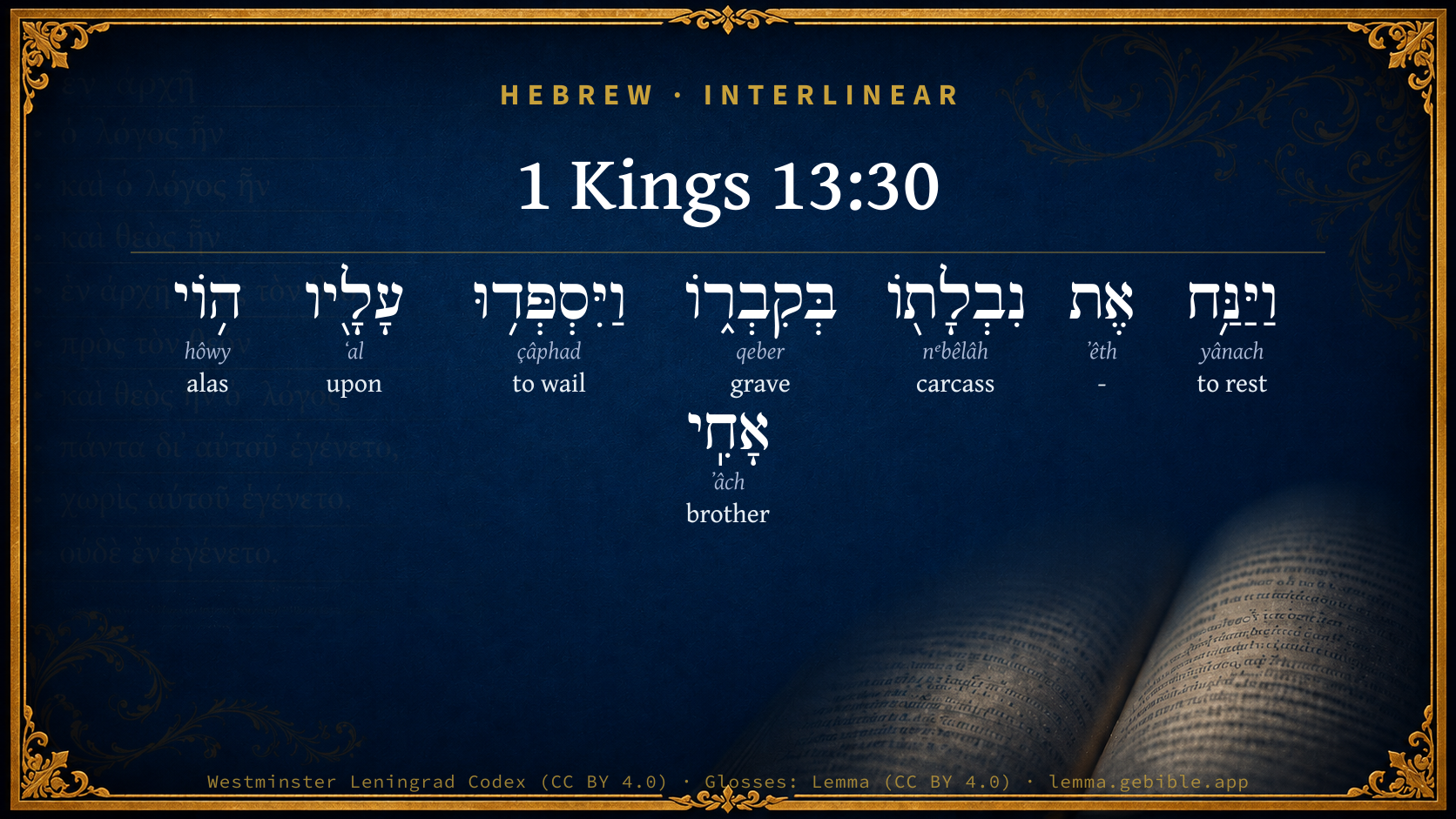
Hebrew (Westminster Leningrad Codex) 1 Kings 13:30 appears in the Hebrew Old Testament. The text above is from the Westminster Leningrad Codex. Each word links to its Strong’s number, a concise gloss, and parsing drawn from the Open Scriptures Hebrew Bible morphology. Click any word for its full Brown-Driver-Briggs (BDB) entry.
Download image
Cite this verse

1 Kings 13:30 (World English Bible). Public Domain. Lemma interlinear Bible study tool, https://lemma.gebible.app/v/1-kings/13/30.

Show BibTeX & RIS
BibTeX
RIS
English Translation
He laid his body in his own grave; and they mourned over him, [saying], Alas, my brother!
World English Bible · Public Domain
Highlights Full analysis ↓
Download a study sheet

One document with this verse’s original text, its word-by-word gloss line, the meaning frame, cross-references with their text, attributed commentary, and full source and license credits — printable, and it pastes into notes with its structure intact.

This verse Autodidact and up

Study sheet (.html) Plain text (.txt)

A passage Seminary Student

Up to 50 verses in one chapter. A passage sheet keeps up to 6 commentary sources and 12 cross-references per verse, in the order this page ranks them, and says so on the sheet whenever that leaves anything out. Ask for a single verse and you get the Autodidact verse sheet above.

Everything on this page stays free to read, with no account — the sheet is a download of what is already on screen, not access to it.

Want to remove ads? Support Godless Engineer
Compare translations 3

The same verse in 3 English versions, stacked beneath the original-language interlinear above. Click any original word for its lexicon entry.

Each is an independent rendering of the whole verse — the interlinear is not word-aligned to these translations.

Highlighted words mark where these versions differ — a whole-verse word diff, not a word-by-word alignment.

  • World English Bible Public Domain
    He laid his body in his own grave; and they mourned over him, [saying], Alas, my brother!
  • King James Version Public Domain
    And he laid his carcass in his own grave; and they mourned over him, saying, Alas, my brother!
  • unfoldingWord Literal Text CC BY-SA 4.0
    And he laid his corpse in his grave. And they mourned over him, “Alas, my brother!”

unfoldingWord Literal Text — © unfoldingWord, licensed CC BY-SA 4.0. Word-aligned USFM3 via Door43 (git.door43.org/unfoldingWord/en_ult).

Versions to compare (up to 4)

3 of 4 selected

Show all 18 translations

Every available English version of this verse, each an independent rendering of the whole verse.

  • World English Bible Public Domain
    He laid his body in his own grave; and they mourned over him, [saying], Alas, my brother!
  • Berean Standard Bible Public Domain
    Then he laid the body in his own tomb, and they lamented over him, “Oh, my brother!”
  • Majority Standard Bible Public Domain
    Then he laid the body in his own tomb, and they lamented over him, “Oh, my brother!”
  • King James Version Public Domain
    And he laid his carcass in his own grave; and they mourned over him, saying, Alas, my brother!
  • American Standard Version (1901) Public Domain
    And he laid his body in his own grave; and they mourned over him, `saying', Alas, my brother!
  • Revised Version (1885) Public Domain
    And he laid his carcase in his own grave; and they mourned over him, saying, Alas, my brother!
  • Geneva Bible (1599) Public Domain
    And hee layed his bodie in his owne graue, and they lamented ouer him, saying, Alas, my brother.
  • Douay-Rheims (1899) Public Domain
    And he laid his dead body in his own sepulchre: and they mourned over him, saying: Alas! alas! my brother.
  • Young's Literal Translation Public Domain
    and he placeth his carcase in his own grave, and they mourn for him, `Oh, my brother!'
  • Literal Standard Version CC BY-SA 4.0
    and he places his carcass in his own grave, and they mourn for him, “Oh, my brother!”
  • Unlocked Literal Bible CC BY-SA 4.0
    He laid the body in his own grave, and they mourned over him, saying, “Woe, my brother!”
  • unfoldingWord Literal Text CC BY-SA 4.0
    And he laid his corpse in his grave. And they mourned over him, “Alas, my brother!”
  • Darby Bible Public Domain
    And he laid his corpse in his own sepulchre; and they mourned over him [saying], Alas, my brother!
  • World Messianic Bible Public Domain
    He laid his body in his own grave; and they mourned over him, saying, “Alas, my brother!”
  • Webster's Bible Public Domain
    And he laid his carcass in his own grave; and they mourned over him, saying, Alas, my brother!
  • Free Bible Version CC BY-SA 4.0
    He laid the body in his own tomb, and they mourned over him, crying, “My poor brother!”
  • Bible in Basic English Public Domain
    And he put the body in the resting-place made ready for himself, weeping and sorrowing over it, saying, O my brother!
  • JPS Tanakh (1917) Public Domain
    And he laid his carcass in his own grave; and they made lamentation for him: 'Alas, my brother!'

Literal Standard Version (2020), Covenant Press — licensed CC BY-SA 4.0. Text via the HelloAO Bible API (eBible.org). Unlocked Literal Bible (unfoldingWord) — licensed CC BY-SA 4.0. Text via the HelloAO Bible API (eBible.org). unfoldingWord Literal Text — © unfoldingWord, licensed CC BY-SA 4.0. Word-aligned USFM3 via Door43 (git.door43.org/unfoldingWord/en_ult). Free Bible Version, Dr. Jonathan Gallagher — licensed CC BY-SA 4.0. Text via the HelloAO Bible API (eBible.org).

Word by word

More ways to search: Search by grammar → Find every occurrence → Compare this word →

Practice this passage: Drill this verse → Learn its vocabulary →

וַיִּסְפְּד֥וּ
çâphad
H5594
“and · to wail”
Conjunction + Verb, Qal, Sequential Imperfect, 3rd Person, Masculine, Plural
Part of Speech
Conjunction + Verb
Stem
Qal
Form
Sequential Imperfect
Person
3rd Person
Gender
Masculine
Number
Plural
Full BDB Definition

Origin: a primitive root

TWOT: 1530

to wail, lament, mourn - (Qal) - to wail, lament - wailers (participle) - (Niphal) to be lamented, be bewailed
  1. וַיַּנַּ֥ח yânach H3240 “and · to rest” Conjunction + Verb, Hiphil, Sequential Imperfect, 3rd Person, Masculine, Singular
  2. אֶת ʼêth H853 “-” Particle, Direct Object
  3. נִבְלָת֖וֹ nᵉbêlâh H5038 “carcass · his” Noun, Common, Feminine, Singular, Construct + Suffix, Personal, 3rd Person, Masculine, Singular
  4. בְּקִבְר֑וֹ qeber H6913 “in/at · grave · his” Preposition + Noun, Common, Masculine, Singular, Construct + Suffix, Personal, 3rd Person, Masculine, Singular
  5. עָלָ֖יו ʻal H5921 “upon · him” Preposition + Suffix, Personal, 3rd Person, Masculine, Singular
  6. ה֥וֹי hôwy H1945 “alas” Particle, Interjection
  7. אָחִֽי ʼâch H251 “brother · my” Noun, Common, Masculine, Singular, Construct + Suffix, Personal, 1st Person, Common, Singular

About this verse

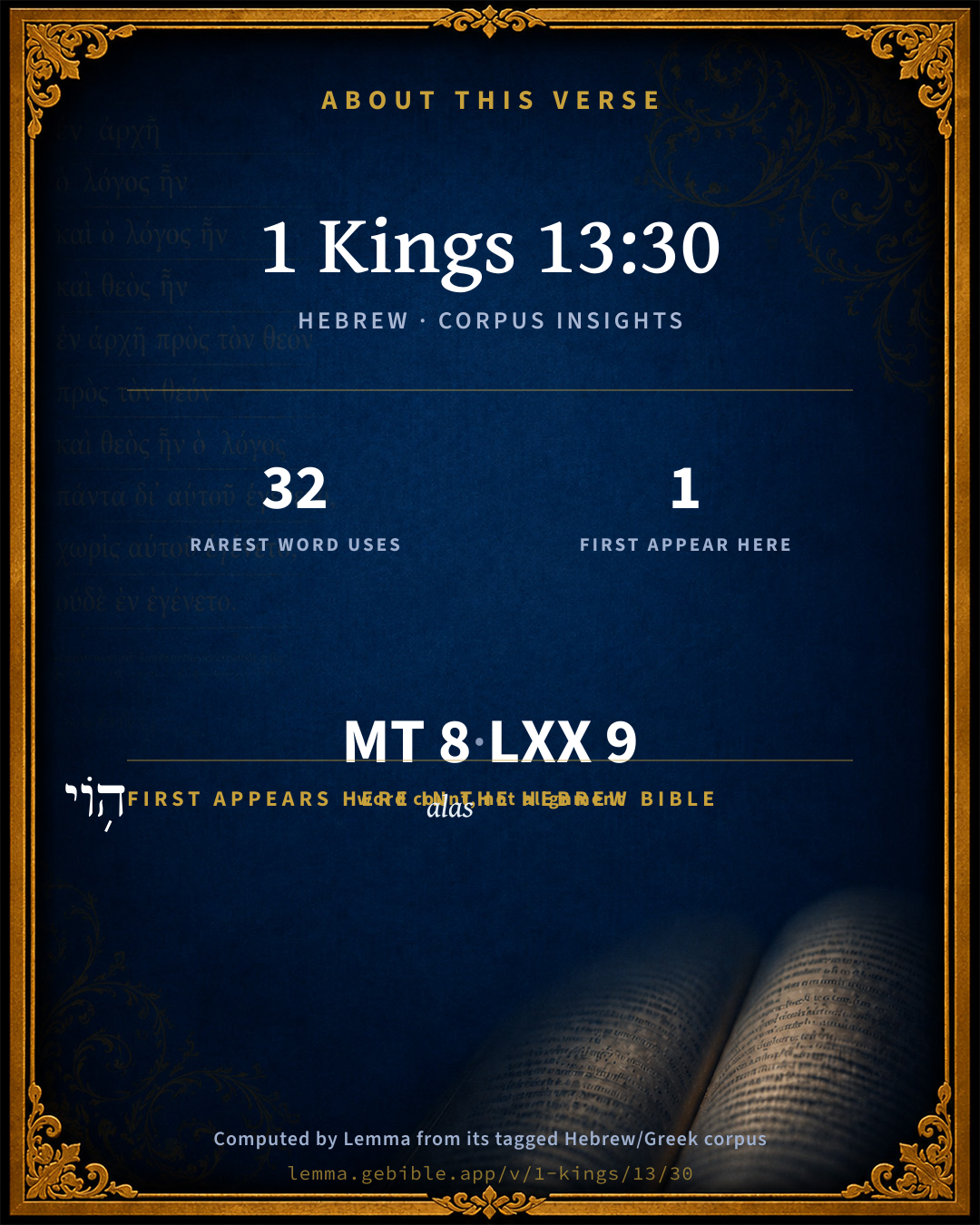
These counts appear in no published source. They are computed here, from the morphology-tagged text and Lemma’s own curated glosses. What Lemma adds →

8
words
8
distinct lemmas
Historical
section

First appearance in Scripture

This word makes its first canonical appearance in the Hebrew Bible here:

Shared distinctive vocabulary

וַיִּסְפְּד֥וּ to wail H5594 occurs in 30 verses of the Hebrew Bible. Also found in:

Grammatical profile

  • 2 verbs
  • 3 nouns
  • 1 preposition
  • 2 particles

Verb forms

  • וַיַּנַּ֥ח Hiphil · Sequential Imperfect
  • וַיִּסְפְּד֥וּ Qal · Sequential Imperfect

Hebrew & Septuagint length

In English translation the verse runs 17 words from the Hebrew and 7 from the Septuagint (LXX English) — the Septuagint runs noticeably shorter here. See the side-by-side →

A rough comparison of the two English renderings, which tokenize alike — not a word-level alignment.

Word counts can differ between the Hebrew and the Greek without any difference in meaning — e.g. the Hebrew direct-object marker אֵת has no separate Greek word, and Greek often adds the article ὁ.

In the original languages it is 8 Hebrew tokens and 9 Greek tokens — but the two are counted differently (Hebrew bundles its prefixes and suffixes into one token; the Greek is in lemma form), so that isn’t a like-for-like length.

Cross-references

3

Topical passages linked to 1 Kings 13:30 in the Treasury of Scripture Knowledge — connected by theme and wording, ordered by reader-vote popularity; previews shown in the World English Bible.

  • Jeremiah 22:18 Therefore thus says Yahweh concerning Jehoiakim the son of Josiah, king of Judah: they shall not lament for him, [saying], Ah my brother! or, Ah sister! They shall not lament for him, [saying] Ah lord! or, Ah his glory!
  • 1 Kings 14:13 All Israel shall mourn for him, and bury him; for he only of Jeroboam shall come to the grave, because in him there is found some good thing toward Yahweh, the God of Israel, in the house of Jeroboam.
  • Acts 8:2 Devout men buried Stephen, and lamented greatly over him.

Cross-references courtesy of OpenBible.info (CC BY 4.0).

Hebrew and Greek witnesses Masoretic Hebrew ↔ Greek Septuagint

The same verse in the two great witnesses to the Old Testament, shown verse-for-verse.

Here the Septuagint runs noticeably shorter than the Hebrew — LXX2012 (modern English Septuagint) 7 words vs World English Bible 17. A rough length comparison of the two English translations, not a word-level alignment — read both below.

These are two independent witnesses, not word-aligned to each other, and the Septuagint is shown in lemma (dictionary) form.

Hebrew 1 Kings 13:30 Masoretic · Westminster Leningrad Codex

וַיַּנַּ֥ח אֶת נִבְלָת֖וֹ בְּקִבְר֑וֹ וַיִּסְפְּד֥וּ עָלָ֖יו ה֥וֹי אָחִֽי

He laid his body in his own grave; and they mourned over him, [saying], Alas, my brother!

World English Bible · Public Domain

Greek LXX 1 Kings 13:30 Septuagint · lemma form

ἐν ὁ τάφος ἑαυτοῦ καί κόπτω αὐτός οὐαί ἀδελφός

and they bewailed him, saying, Alas, brother.

LXX2012 (modern English Septuagint) · Public Domain

Hebrew: Westminster Leningrad Codex (CC BY 4.0). Greek: Septuagint (public domain); English from LXX2012 (modern English Septuagint) (Public Domain). How the Septuagint differs from the Hebrew →

Targum (Aramaic paraphrase)

1

The Targum is the ancient Jewish Aramaic paraphrase of the Hebrew Scriptures — an interpretive translation, not the Hebrew text itself. Onkelos (literal) and Pseudo-Jonathan (expansive) render the Torah, and Jonathan the Prophets. Coverage is partial: where no permissively-licensed English translation exists for a verse, only the Aramaic is shown. This is verse-level text, not a word-by-word alignment to the Hebrew.

  1. Targum Jonathan Prophets (Joshua–Malachi)
    וְאָחֵית יַת נְבֵלְתָא בְּקִבְרֵיהּ וּסְפָדוּ עֲלוֹהִי וַי עַל אַחָא:

    (no public-domain English translation for this verse)

    Targum Jonathan — Aramaic: “Mikraot Gedolot” (public domain). English: “Sefaria Community Translation” (CC0 1.0 (public-domain dedication)); “London "Chaldee Paraphrase," 1871” (public domain). Text via Sefaria.

Commentary

Notes on 1 Kings 13:30 from classic Christian and Jewish commentators (each source and its license shown beneath its notes). The classic Christian expositions comment on the surrounding passage and are grouped to its opening verse, so a note may address several verses; the Jewish commentaries on the Tanakh (Rashi and others) are per-verse, so they appear only where the commentator wrote on this verse.

Lemma curates 59 commentaries, every one of them public domain or Creative Commons licensed, each selected and text-cleaned for this edition rather than reprinted as found. About our sources →

Trapp's Complete Commentary

John Trapp

1Ki 13:30 And he laid his carcase in his own grave; and they mourned over him, [saying], Alas, my brother!

Ver. 30. In his own grave.] Which was ready made, it seems. See the like, Mat 27:60. Charles V carried the materials of his tomb with him up and down in his warlike expeditions.

John Trapp, A Commentary or Exposition upon All the Books of the Old and New Testament (1647–1656) — public domain. Text from a community e-Sword module.

Tyndale Open Study Notes

Tyndale Open Resources

13:30 The old prophet probably had a modest grave. Such tombs were hewn out of soft limestone in a wadi (a stream bed) near the person’s home.

Tyndale Open Study Notes — © Tyndale Open Resources, licensed CC BY-SA 4.0. Text via the HelloAO Bible API.

Geneva Bible (1599)

Geneva Bible translators

Which he had prepared for himself.

Geneva Bible (1599) marginal notes — public domain. Text via Bolls.life.

Adam Clarke's Commentary

Verse 30. Alas, my brothers] This lamentation is very simple, very short, and very pathetic. Perhaps the old prophet said it as much in reference to himself, who had been the cause of his untimely death, as in reference to the man of God, whose corpse he now committed to the tomb. But the words may be no more than the burden of each line of the lamentation which was used on this occasion. See instances of this among the Asiatics in Clarke's note on "Jer 22:18".

Adam Clarke's Commentary on the Bible (1810–1826) — public domain. Text from a community e-Sword/MySword module.

Ellicott's Commentary for English Readers

(30-32) They mourned.—The mourning of the old prophet, and the burial of the body in his own sepulchre, probably show some touch of remorse and personal compassion for the victim of his treacherous policy, mingled with the desire of preserving the tomb, which was to be his own last resting-place, from desecration, when the prediction of the prophet of Judah should be accomplished. But, even setting aside the rather prosaic tradition of his attempts to remove any impression made on the mind of Jeroboam, which Josephus has preserved (Ant. viii., 9), it is evident that his policy was only too successful. The messenger of wrath had been enticed to familiar intercourse with the prophet of the new idolatry, and had been publicly proclaimed as his “brother:” probably his death had been used to discredit his warning. The result is seen in the significant notice of 1Ki_13:33 : “After this thing, Jeroboam returned not from his evil way.” Hence the seriousness of the disobedience, which played into the hands of wickedness, and the startling severity of the penalty.

A Bible Commentary for English Readers, edited by Charles John Ellicott (1878–1897) — public domain. Text from a community e-Sword module.

The Cambridge Bible for Schools and Colleges

gen. ed. J. J. S. Perowne

30. in his own grave] Treating him as though he had been one of his own family.

Alas, my brother] This seems to have been a form of lamentation used over the dead. Cf. Jer_22:18.

The Cambridge Bible for Schools and Colleges (gen. ed. J. J. S. Perowne; Cambridge University Press, 1878–1918) — public domain. Text from a community e-Sword module.

John Gill's Exposition

After this thing Jeroboam returned not from his evil way,.... From the idolatrous practices he had started, and was establishing; though he had seen his altar rent, and the ashes poured out as the man of God predicted, his own hand withered, and that restored again upon the prayer of the prophet; and though he had heard of the death he died for his disobedience to the command of God, and the several marvellous things that attended it; these were so far from reforming him, that he seemed to be the more hardened thereby:

but made again of the lowest of the people priests of the high places: and officiated there, and indeed those of the tribe of Levi would not serve there, and therefore were expelled their cities; see Ch2 11:14.

John Gill's Exposition of the Whole Bible (1746–1763) — public domain (CC PDM 1.0). Text via the HelloAO Bible API.

Albert Barnes' Notes on the Bible

He laid his carcase in his own grave - As Joseph of Arimathaea did the body of our Lord Mat 27:60. The possession of rock-hewn tombs by families, or individuals, was common among the Jews from their first entrance into the holy land to their final expulsion. A sepulchre usually consisted of an underground apartment, into which opened a number of long, narrow “loculi,” or cells, placed side by side, each adapted to receive one body. The cells were 6 or 7 feet long, 2 feet wide, and 3 feet high. They were commonly closed by a stone placed at the end of each. Many such tombs still exist in Palestine.

Albert Barnes' Notes on the Bible (1834–1885) — public domain. Text from a community e-Sword/MySword module.

Haydock's Catholic Bible Commentary

Brother. Such titles were customary, Jeremias xxii. 18. (Menochius)

George Leo Haydock (1774–1849), Haydock's Catholic Family Bible and Commentary, 1859 edition — public domain. Excludes Psalms (Douay-Rheims chapter numbering differs from Protestant) and Deuterocanonical books (Catholic canon only).

Matthew Poole's English Annotations

So that threatening, 1Ki 13:22, was fulfilled; and withal, the memory of his prophecy was revived and preserved among them, and his very carcass resting there might be a witness of their madness and desperate wickedness, in continuing their abominable idolatry after such an assurance of the dreadful effects of it.

They mourned over him; the old prophet, and his sons, and others, whom common humanity taught to lament the untimely death of so worthy a person.

Alas, my brother! was a usual form of expression in funeral lamentations. See Jer 22:18.

Matthew Poole's English Annotations on the Holy Bible (1683–1685) — public domain. Text from a community e-Sword/MySword module.

Whedon's Commentary on the Bible

Daniel D. Whedon

30. Alas, my brother — His mourning doubtless came from the depths of his heart. The mere facts of the intercourse of these two prophets are profoundly impressive. The old prophet of Beth-el could not but think that he had been instrumental in his brother’s fall.

Daniel D. Whedon (gen. ed.), Commentary on the Old and New Testaments (1874–1909) — public domain. Text from a community e-Sword module.

The Pulpit Commentary

And he laid his carcase in his own grave Mat_27:60. This was a mark of profound respect (Rth_1:17; Gen_23:6) and they mourned over him, saying, Alas, my brother. A customary formula in lamentation. (Jer_22:18) It hardly implies that "he was mourned and buried as a relative of the family" (Bahr). Seeing that the old prophet was responsible for his death, he could hardly have done less. "It is a cruel courtesy to kill a man and then help him to his grave" (Hall).

Vers. 30-34.

The Law of Extremity.

God has made us free to choose or refuse good or evil Will cannot be coerced and yet be free; coercion here, therefore, would be destruction. But while God does not compel us to choose the right, He induces by gracious promises, and admonishes by alternative penalties. Still we remain free to elect the good with its blessings, or the evil with its entailments of misery. But so loth is He to see His creatures wretched that He has opened a way of repentance and reformation for sinners. In this, mercy is carried to the extreme limit which consists with the welfare of the universe, which must ever depend upon the order and harmony of righteousness. At this point there comes in the law of extremity; and the sinner passing it has to encounter "judgment without mercy.

I THE OLD PROPHET SOUGHT MERCY.

1. His conduct expressed repentance.

(1) He went out for the corpse of the man of God, and brought it to his home, discerning the hand of God in the judgment. Looking now upon that ghastly form of death he saw his own sad work. He had caused a mischief he could not now repair. How inadequately men estimate beforehand the consequences of their wrong doing! (9.) He decently interred the body in his own grave. This was the only reparation now within his power for the injury he had caused, But how inadequate! What a bitter thought!

(3) He "mourned over him, saying, Alas, my brother!" This exclamation (yja ywh) was the refrain of a lamentation. (see Jer_22:18) Ward, in his "Manners and Customs of the Hindoos," gives two specimens of such lamentations. There are frequent allusions to these in the prophets (Jer_30:7; Eze_6:11; Joe_1:15; Amo_5:16, Amo_5:17; Rev_18:10-19) With the old prophet this was more than a conventional mourning, he mourned for himself before God.

2. His conduct also expressed faith.

(1) He commanded his sons, when he died, to lay his bones beside those of the man of God. He believed him to be a man of God in reality, notwithstanding this single act of disobedience for which he had suffered death. There are "sins unto death," viz., of the body, which do not involve the final death of the soul. He desired to be with him in the resurrection. The concern of the ancients respecting the disposition of their bodies after death arose out of their faith in a resurrection (see Gen_1:24 Gen_1:26; Exo_13:19; Heb_11:22; see also. 2Ki_13:20, 2Ki_13:21)

(2) He gave as the reason of his command the faith he had in the certainty of the prophecy of the man of God (ver. 32). And in further testimony of his faith put an inscription on the tomb. (see 2Ki_23:17) He desired to be associated in death with the denouncers of Jeroboam"s sin rather than with those involved in that sin. Nor would he be identified in the judgment with perverters of true worship.

(3) By this faith his bones were spared when those of the priests and votaries of Jeroboam were burnt upon the altar by Josiah. (see 2Ki_23:19) By a corresponding faith shall we be saved from the judgments of the more illustrious Son of David upon the man of sin of the mystical Babylon.

II BUT JEROBOAM ENCOUNTERED THE EXTREMITY OF WRATH.

1. He disregarded the goodness of God.

(1) The conditional promises by the hand of Ahijah were very gracious. (1Ki_11:37-39) What a magnificent opportunity he had! But he missed it.

(2) What opportunities have we wasted? Who can estimate their value? No opportunity of glorifying God should escape us.

2. He disregarded his remonstrances.

(1) The judgments upon Rehoboam were lessons to him. The same God who in them visited the sins of Solomon had also set him upon the throne of Israel, and would deal with him upon the same principles. But he sinned against this admonition.

(2) Then came the warning from the man of God at the altar. That God was in this warning was left without doubt by the signs (vers. 3-6). These staggered him for a moment; but there was no true repentance.

(3) Then came the final warning in the death of the man of God for being implicated, though by a deception, in his sin. This also was shown to be from God by miraculous signs (ver. 64). But this also he disregarded (ver. 33).

(4) Now, therefore, the law of extremity must take its course. He and his house are devoted to destruction (ver. 34). This last warning was written in letters of blood. God gave it to Him at the expense of His own servant. And He warns us at the expense of His own Son; and if we finally reject Christ the extremity of mercy is spurned, and we must encounter the extremity of wrath. J.A.M.

The Pulpit Commentary (1880–1919), ed. H.D.M. Spence-Jones & Joseph S. Exell — public domain. Text from a community e-Sword module.

John Wesley's Explanatory Notes

His grave - So that threatening, ver. 22, was fulfilled; and withal, the memory of his prophecy was revived and preserved among them, and his very carcase resting there, might be a witness of their madness and desperate wickedness, in continuing in their abominable idolatry, after such an assurance of the dreadful effects of it. They - The old prophet and his sons, and others, whom common humanity taught to lament the untimely death of so worthy a person. Alas, &c. - Which was an usual form of expression in funeral-Lamentations.

John Wesley, Explanatory Notes Upon the Whole Bible (1754–1765) — public domain. Text via the GEBible commentary corpus.

Rashi

Rabbi Shlomo Yitzchaki (Rashi)

In his own grave. In the graveyard belonging to the false prophet in the city.

Rashi on the Tanakh — English translations: “The Judaica Press complete Tanach with Rashi, translated by A. J. Rosenberg” (CC BY 4.0); “Pentateuch with Rashi's commentary by M. Rosenbaum and A.M. Silbermann, 1929-1934” (public domain); “The Metsudah Tanach series, Lakewood, N.J” (CC BY 4.0); and “The Book of Joshua, Metsudah Publications, 1997” (CC BY 4.0). Text via Sefaria.

Lesson kit

Teaching starters — assembled from the data on this page, not authored interpretation. Every prompt links to the verse data it draws on. Edit before teaching.

1 Kings, in the Historical, opens this verse with 8 words (8 distinct Hebrew lemmas). Its most distinctive word is çâphad (“to wail”). The Greek Septuagint runs shorter here. A historical commentator’s framing appears above. Read the whole chapter for the surrounding context.

Discussion questions

  1. What does “to wail” (çâphad) contribute to the verse as a whole?
  2. The word “alas” first appears here in Scripture. What is being introduced at this debut?
  3. Genesis 23:2 shares the word «to wail» with this verse. How do the two illuminate each other?
  4. Compared with the Hebrew, the Septuagint runs shorter here. What questions does that raise?
  5. These translations render this verse differently. What is at stake in choosing one wording over another?
  6. The verb «וַיַּנַּ֥ח» is Hiphil Sequential Imperfect. How does its form color the action?
  7. Reading how Trapp's Complete Commentary and Tyndale Open Study Notes read this verse, where do the two commentators agree and where do they part?

Things to notice

Reading settings

Reading text

Shown beneath each verse's original-language words.

Old Testament
Old Testament edition

Read the OT as the Masoretic Hebrew (MT) or the Greek Septuagint (LXX).

English shown for the Greek Septuagint (in the Hebrew ↔ Greek comparison).

Comparing translations? Open the Compare panel on any verse page to stack up to four side by side.