
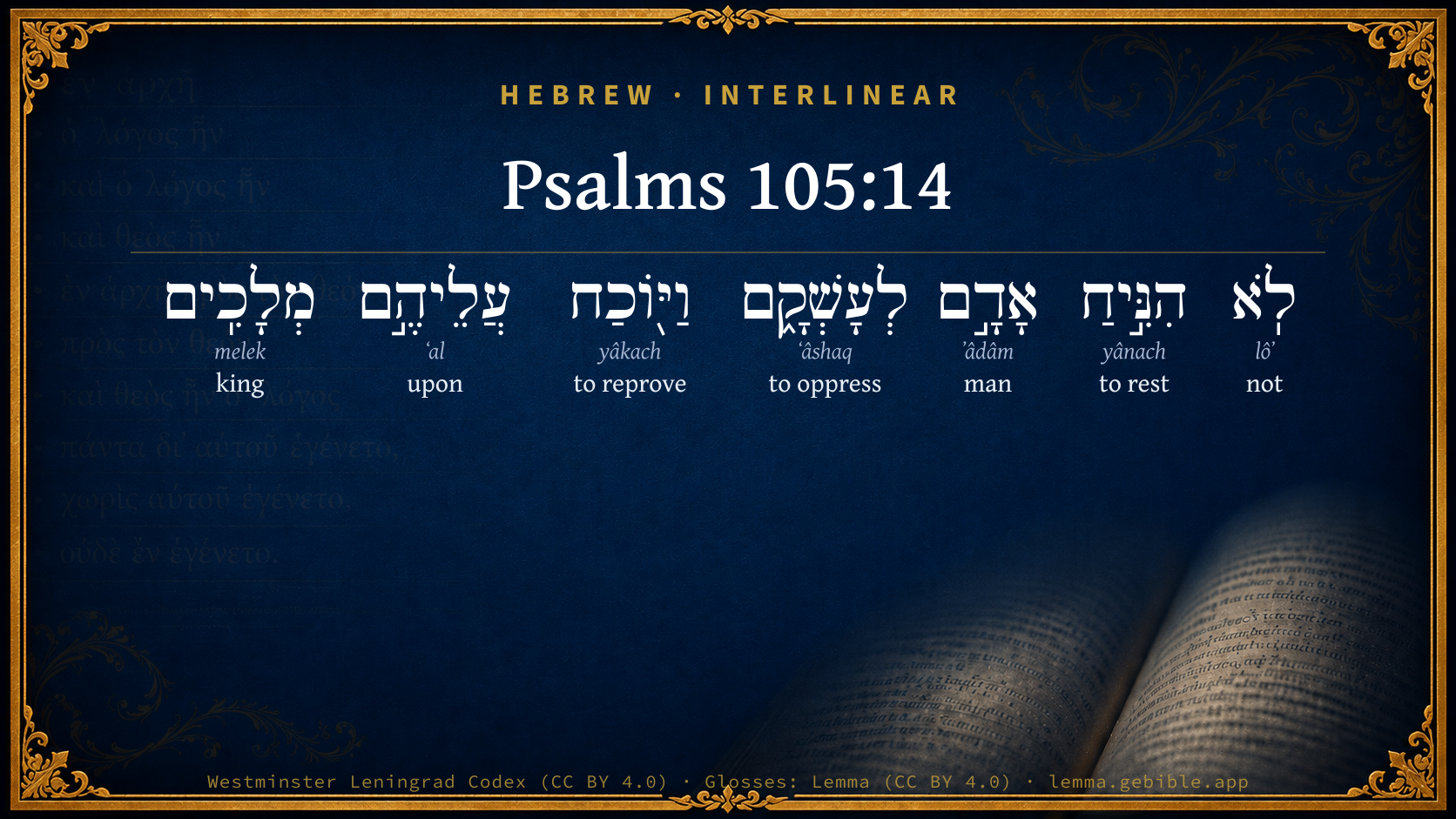
Psalms 105:14

Hebrew (Westminster Leningrad Codex) Psalms 105:14 appears in the Hebrew Old Testament. The text above is from the Westminster Leningrad Codex. Each word links to its Strong’s number, a concise gloss, and parsing drawn from the Open Scriptures Hebrew Bible morphology. Click any word for its full Brown-Driver-Briggs (BDB) entry.
Download image
Cite this verse

Psalms 105:14 (World English Bible). Public Domain. Lemma interlinear Bible study tool, https://lemma.gebible.app/v/psalms/105/14.

Show BibTeX & RIS
BibTeX
RIS
English Translation
He allowed no one to do them wrong. Yes, he reproved kings for their sakes,
World English Bible · Public Domain
Download a study sheet

One document with this verse’s original text, its word-by-word gloss line, the meaning frame, cross-references with their text, attributed commentary, and full source and license credits — printable, and it pastes into notes with its structure intact.

This verse Autodidact and up

Study sheet (.html) Plain text (.txt)

A passage Seminary Student

Up to 50 verses in one chapter. A passage sheet keeps up to 6 commentary sources and 12 cross-references per verse, in the order this page ranks them, and says so on the sheet whenever that leaves anything out. Ask for a single verse and you get the Autodidact verse sheet above.

Everything on this page stays free to read, with no account — the sheet is a download of what is already on screen, not access to it.

Want to remove ads? Support Godless Engineer
Compare translations 3

The same verse in 3 English versions, stacked beneath the original-language interlinear above. Click any original word for its lexicon entry.

Each is an independent rendering of the whole verse — the interlinear is not word-aligned to these translations.

Highlighted words mark where these versions differ — a whole-verse word diff, not a word-by-word alignment.

  • World English Bible Public Domain
    He allowed no one to do them wrong. Yes, he reproved kings for their sakes,
  • King James Version Public Domain
    He suffered no man to do them wrong: yea, he reproved kings for their sakes;
  • unfoldingWord Literal Text CC BY-SA 4.0
    He did not allow anyone to oppress them; he rebuked kings because of them.

unfoldingWord Literal Text — © unfoldingWord, licensed CC BY-SA 4.0. Word-aligned USFM3 via Door43 (git.door43.org/unfoldingWord/en_ult).

Versions to compare (up to 4)

3 of 4 selected

Show all 18 translations

Every available English version of this verse, each an independent rendering of the whole verse.

  • World English Bible Public Domain
    He allowed no one to do them wrong. Yes, he reproved kings for their sakes,
  • Berean Standard Bible Public Domain
    He let no man oppress them; He rebuked kings on their behalf:
  • Majority Standard Bible Public Domain
    He let no man oppress them; He rebuked kings on their behalf:
  • King James Version Public Domain
    He suffered no man to do them wrong: yea, he reproved kings for their sakes;
  • American Standard Version (1901) Public Domain
    He suffered no man to do them wrong; Yea, he reproved kings for their sakes,
  • Revised Version (1885) Public Domain
    He suffered no man to do them wrong; yea, he reproved kings for their sakes;
  • Geneva Bible (1599) Public Domain
    Yet suffered he no man to doe them wrong, but reprooued Kings for their sakes, saying,
  • Douay-Rheims (1899) Public Domain
    He suffered no man to hurt them: and he reproved kings for their sakes.
  • Young's Literal Translation Public Domain
    He hath not suffered any to oppress them And He reproveth for their sakes kings.
  • Literal Standard Version CC BY-SA 4.0
    He has not permitted any to oppress them || And He reproves kings for their sakes.
  • Unlocked Literal Bible CC BY-SA 4.0
    He did not allow anyone to oppress them; he rebuked kings for their sakes.
  • unfoldingWord Literal Text CC BY-SA 4.0
    He did not allow anyone to oppress them; he rebuked kings because of them.
  • Darby Bible Public Domain
    He suffered no man to oppress them, and reproved kings for their sakes,
  • World Messianic Bible Public Domain
    He allowed no one to do them wrong. Yes, he reproved kings for their sakes,
  • Webster's Bible Public Domain
    He suffered no man to do them wrong: yes, he reproved kings for their sakes;
  • Free Bible Version CC BY-SA 4.0
    He didn't let anyone treat them badly; warning kings to leave them alone:
  • Bible in Basic English Public Domain
    He would not let anyone do them wrong; he even kept back kings because of them,
  • JPS Tanakh (1917) Public Domain
    He suffered no man to do them wrong, yea, for their sake He reproved kings:

Literal Standard Version (2020), Covenant Press — licensed CC BY-SA 4.0. Text via the HelloAO Bible API (eBible.org). Unlocked Literal Bible (unfoldingWord) — licensed CC BY-SA 4.0. Text via the HelloAO Bible API (eBible.org). unfoldingWord Literal Text — © unfoldingWord, licensed CC BY-SA 4.0. Word-aligned USFM3 via Door43 (git.door43.org/unfoldingWord/en_ult). Free Bible Version, Dr. Jonathan Gallagher — licensed CC BY-SA 4.0. Text via the HelloAO Bible API (eBible.org).

Word by word

More ways to search: Search by grammar → Find every occurrence → Compare this word →

Practice this passage: Drill this verse → Learn its vocabulary →

About this verse

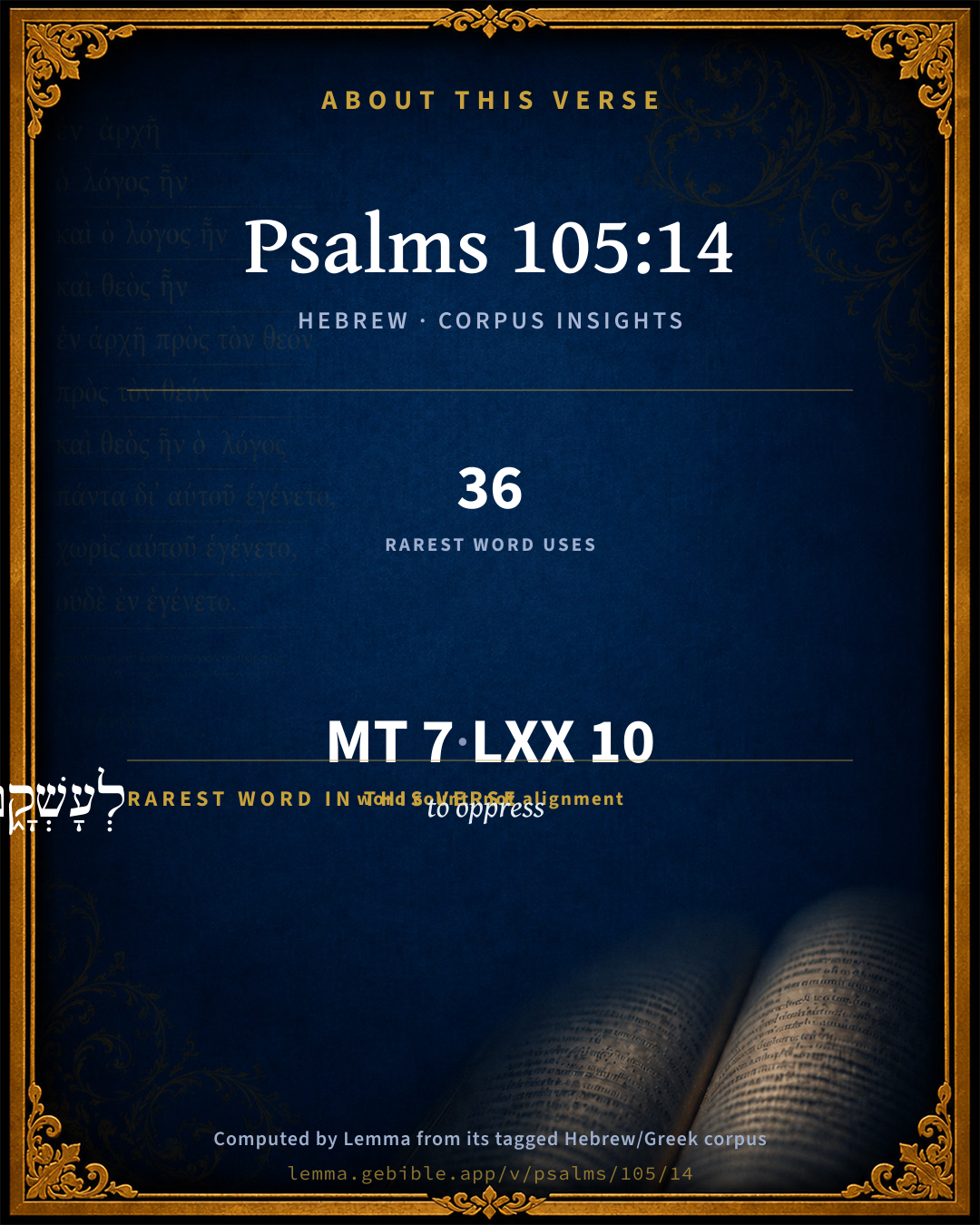
These counts appear in no published source. They are computed here, from the morphology-tagged text and Lemma’s own curated glosses. What Lemma adds →

7
words
7
distinct lemmas
Wisdom
section

Shared distinctive vocabulary

לְעָשְׁקָ֑ם to oppress H6231 occurs in 35 verses of the Hebrew Bible. Also found in:

Grammatical profile

  • 3 verbs
  • 2 nouns
  • 1 preposition
  • 1 particle

Verb forms

  • הִנִּ֣יחַ Hiphil · Perfect
  • לְעָשְׁקָ֑ם Qal · Infinitive Construct
  • וַיּ֖וֹכַח Hiphil · Sequential Imperfect

Hebrew & Septuagint length

In English translation the verse runs 15 words from the Hebrew and 14 from the Septuagint (LXX English) — closely comparable.

A rough comparison of the two English renderings, which tokenize alike — not a word-level alignment.

Word counts can differ between the Hebrew and the Greek without any difference in meaning — e.g. the Hebrew direct-object marker אֵת has no separate Greek word, and Greek often adds the article ὁ.

In the original languages it is 7 Hebrew tokens and 10 Greek tokens — but the two are counted differently (Hebrew bundles its prefixes and suffixes into one token; the Greek is in lemma form), so that isn’t a like-for-like length.

Cross-references

6

Topical passages linked to Psalms 105:14 in the Treasury of Scripture Knowledge — connected by theme and wording, ordered by reader-vote popularity; previews shown in the World English Bible.

  • Genesis 35:5 They traveled: and a terror of God was on the cities that were round about them, and they didn't pursue the sons of Jacob.
  • Exodus 7:16–17 You shall tell him, 'Yahweh, the God of the Hebrews, has sent me to you, saying, "Let my people go, that they may serve me in the wilderness:" and, behold, until now you haven't listened.
  • Genesis 12:14–17 It happened that when Abram had come into Egypt, the Egyptians saw that the woman was very beautiful.
  • Genesis 20:1–7 Abraham traveled from there toward the land of the South, and lived between Kadesh and Shur. He lived as a foriegner in Gerar.
  • Genesis 26:14–33 He had possessions of flocks, possessions of herds, and a great household. The Philistines envied him.
  • Genesis 31:24–29 God came to Laban, the Syrian, in a dream of the night, and said to him, "Take heed to yourself that you don't speak to Jacob either good or bad."

Cross-references courtesy of OpenBible.info (CC BY 4.0).

Hebrew and Greek witnesses Masoretic Hebrew ↔ Greek Septuagint

The same verse in the two great witnesses to the Old Testament, shown verse-for-verse.

You’re reading Greek Psalm 104 (Hebrew Psalm 105). The Septuagint counts the superscription, so verse numbers can differ from the Hebrew — chapter-level alignment, not verse-by-verse. Numbering follows Rahlfs.

These are two independent witnesses, not word-aligned to each other, and the Septuagint is shown in lemma (dictionary) form.

Hebrew Psalms 105:14 Masoretic · Westminster Leningrad Codex

לֹֽא הִנִּ֣יחַ אָדָ֣ם לְעָשְׁקָ֑ם וַיּ֖וֹכַח עֲלֵיהֶ֣ם מְלָכִֽים

He allowed no one to do them wrong. Yes, he reproved kings for their sakes,

World English Bible · Public Domain

Greek LXX Greek Psalm 104:14 Septuagint · lemma form

οὐ ἀποἵημι ἄνθρωπος ἀδικέω αὐτός καί ἐλέγχω ὑπέρ αὐτός βασιλεύς

He suffered no man to wrong them; and he rebuked kings for their sakes:

LXX2012 (modern English Septuagint) · Public Domain

On this verse, The Treasury of David discusses the Septuagint’s reading. Read the note in Commentary ↓

Hebrew: Westminster Leningrad Codex (CC BY 4.0). Greek: Septuagint (public domain); English from LXX2012 (modern English Septuagint) (Public Domain). How the Septuagint differs from the Hebrew →

Commentary

Notes on Psalms 105:14 from classic Christian and Jewish commentators (each source and its license shown beneath its notes). The classic Christian expositions comment on the surrounding passage and are grouped to its opening verse, so a note may address several verses; the Jewish commentaries on the Tanakh (Rashi and others) are per-verse, so they appear only where the commentator wrote on this verse.

Lemma curates 59 commentaries, every one of them public domain or Creative Commons licensed, each selected and text-cleaned for this edition rather than reprinted as found. About our sources →

Trapp's Complete Commentary

John Trapp

Psa 105:14 He suffered no man to do them wrong: yea, he reproved kings for their sakes;

Ver. 14. He suffered no man, &c.] So as utterly to oppress them; for otherwise they had their illusages; such as was the taking away of Sarah, casting out of Isaac, the rape of Dinah, &c. Strangers meet many times with hard measure.

Yea, he reproved kings] Gen 12:17; Gen 20:3. Kings and queens must not think themselves too good to nurse God’s little ones, yea, to do them homage, licking up the dust under their feet, Isa 49:23.

John Trapp, A Commentary or Exposition upon All the Books of the Old and New Testament (1647–1656) — public domain. Text from a community e-Sword module.

J. A. Alexander on Psalms

Joseph Addison Alexander

14. (Psa 105:14) He suffered no man to oppress them, and reproved, for their sake, kings. The precise sense of the first clause is, he suffered not man (or men in general) to oppress them. The protection of the patriarchs is certainly one of the most striking facts in sacred history. The kings mentioned in the last clause are the kings of Egypt and Gerar (Genesis 17, Gen 20:3), not without reference perhaps to those mentioned in Gen 14:1.

Joseph Addison Alexander, The Psalms Translated and Explained (1850) — public domain. Text from a community e-Sword module.

MacLaren's Expositions of Holy Scripture

Alexander MacLaren

Psalms

INVIOLABLE MESSIAHS AND PROPHETS

Psa 105:14 - Psa 105:15.

The original reference of these words is to the fathers of the Jewish people-the three wandering shepherds, Abraham, Isaac, and Jacob. The Psalmist transfers to them the great titles which properly belong to a later period of Jewish history. None of the three were ever in the literal sense of the word ‘anointed,’ but all the three had what anointing symbolised. None of them were in the literal or narrow sense of the word ‘prophets’-that is to say, predicters of future events-but one of them was called a ‘prophet’ even in his lifetime. And they all possessed that intimacy of communion with God which imparted the power of forth-speaking for Him. Insignificant as they were, they were bigger than the Pharaohs and Abimelechs and the other kinglets that strutted their little day beside them. Astonished as the monarch of Egypt would have been, or the king of the Philistines either, if he had been told that the wandering shepherd was of far more importance for the world than he was, it was true. ‘He suffered no man to do them wrong: yea, He reproved kings for their sakes, saying, Touch not Mine anointed, and do My prophets no harm.’

Further, as Judaism, with its anointings and prophecies was a narrower system following upon a wider one, so a wider one has succeeded it; and we step into the position occupied by these patriarchs-on whose heads no anointing oil had been poured, and into whose lips no supernatural gifts of prediction had been infused. It is no arrogance, but the simplest recognition of the essential facts of the case, if we take these words of the Psalmist’s and transfer them bodily to the whole mass of Christian people, and to each individual atom that makes up the mass. All are anointed; all are prophets; of all it is true that God suffers no man nor thing to do them wrong. And kings and dynasties and the politics of the world are all in the hands of One whose supreme purpose is that through men there may be made known to all mankind the significant tidings of His love. Therefore, His Church is founded upon a rock, and earth is the servant of the servants of God.

I. Every Christian is a ‘messiah.’

You know that the word ‘anointed’ is a translation of the Hebrew word ‘Messiah,’ or of the Greek word ‘Christ.’ The meaning of the symbolic ‘anointing’ was simply consecration to office by the divine will, and endowment with the capacity for that office by the divine gift. In the ancient system it was mainly employed-though not, perhaps, exclusively-as a means of designating, and when received in humble dependence on God, of fitting, a man for the two great offices of king and priest.

Oil was an appropriate symbol. Its gentle flow, its soothing, suppling effect, and in another aspect, its value as a means of invigoration and sustenance, and in yet another, as a source of light, peculiarly adapted it to be an emblem of the bestowment on a patient and trustful and submissive heart that was saying, ‘Lord, take me, and use me as Thou wilt,’ of that divine Spirit by whose silent, sweet, soft-flowing, strong influences men were prepared for God’s service.

Jesus was the Christ, the Messias, because that Divine Spirit dwelt in Him without measure. If we are Christians in the real sense of the word, then, however imperfectly, yet really, and by God’s grace increasingly, there is such a union between us and our Saviour as that into us there does flow the anointing of His Spirit. There being a community of life derived from the Source of Life, it is no presumption to say that every Christian man is a Christ.

The word has been used of late with unwise significations, but the truth that has been inadequately expressed by such uses is the great truth of Scripture; ‘He that is joined to the Lord is one Spirit,’ and there does flow the anointing oil from the head of the High Priest to the skirts of the garments. Every man and woman who has any hold of Jesus Christ at all, in the measure of his or her hold, is drawing from Him this ‘unction of the Holy One.’ So, brethren, rise to the solemnity, the awfulness, the joyfulness of your true position, and understand that you, too, are anointed, though not for the same purposes {and in humbler and derived fashion}, for which the Spirit dwelt without measure upon ‘the First-born among many brethren.’

Kings were anointed; and when that divine gift comes into a man’s heart, it, and as I believe, only it, makes him lord of himself, of circumstances, of time, and of the world. ‘All things are yours, and ye are Christ’s.’ There is one real royalty-the royalty of the man who rules because he submits. Every Christian soul may be described as Gideon’s brethren were described, ‘As thou art, so were they: each one resembled the children of a king,’ for if Christ’s Spirit is in the Christian’s spirit, the disciple will grow like his Master, and it will be growingly true of us, that ‘as He is, so are we in this world.’

Priests were anointed. And we, if we are Christian people, have the prerogative of direct access to the Divine Presence, and need neither Church nor sacraments to intervene or mediate between us and Him. The true democracy of Christianity lies in that word ‘Mine anointed.’

II. Further, every Christian man is a prophet.

I have already said that there is no historical warrant for supposing that the gift of prophecy, in its narrower sense, was ever bestowed upon any of these patriarchs. But prediction is only one corner of the prophetic office. The word is connected with a root which means ‘to boil, or bubble like a fountain,’ and it expresses, not so much the theme of the utterance as its nature. The welling up, from a full heart, of God’s thoughts and God’s truth, that is prophecy. The patriarchs were prophets, not in the sense that they had the gift of beholding and foretelling visions of the future, and all the wonder that should be, but in the higher sense-for it is the higher as well as broader-of being bearers of a divine word, breathed into them by that anointing Spirit, that it might be uttered forth by them. That sort of prophetic inspiration belongs to all Christians. It is the result of the relationship between Christ and Christians of which we have been speaking. Every one who has been anointed will be thus gifted.

God’s ‘messiahs’ will be God’s prophets. If we are in touch with God, and have our hearts and whole spiritual natures drawn and kept so near Him as that we are ever receiving from Him of His transcendent and mysterious life, then silence will be impossible. The lips will not be able to contain themselves, but will speak forth that of which the heart is full. And thus every Christian man, in the measure of his true Christianity, will be a prophet of the most High.

I do not need to point the lesson. A silent Christian is an anomaly, a contradiction in terms, as much as black light, or dark stars. If Christ is in you He will come out of you. If your hearts are full the crystal treasure will flow over the brim. It is easy to be dumb when you have nothing to say, and that is the condition of hundreds of people who fancy themselves to be, and are called by others, ‘Christians.’ ‘Mine anointed’ cannot help being ‘My prophets.’ If you are not prophets, if there never is any bubbling up of the fountain demanding utterance, ask yourselves whether there is any fountain there at all.

III. And so, lastly, every Christian man, in his double capacity of anointed and prophet, is watched over by God.

One is tempted to diverge into wider considerations, and speak of the relative importance of things secular and sacred {to adopt a doubtful distinction} in the history of the world, and how the former are for the sake of the latter. But I do not yield to the temptation. Let me rather take the thought here as it applies to our own little lives.

Abraham more than once in his lifetime, though sometimes by his own fault, was brought into very perilous places. There are one or two incidents which are familiar to most of us, I dare say, in his life which are evidently referred to in the phrase ‘He reproved kings for their sakes.’ The principle remains in full force to-day, and God says to every thing and person, Death included, ‘Do My prophets no harm.’ They may slay; they cannot harm. If I might use a very homely metaphor, sportsmen train retriever dogs to bring their game without ruffling a feather. God trains evils and sorrows to lay hold of us, and bring us to, and lay us down at, His feet untouched.

There is no real harm in so-called evil. That is the interpretation that Christianity gives to such words as this of my text, not because it is forced to weaken them by the obstinate facts of life, but because it has learned to strengthen them by the understanding of what is harm and what is good; what is gain and what is loss. Peter shall be delivered out of prison by the skin of his teeth when they are hammering at the scaffold on the other side of the wall, and the dawn is just beginning to show itself in the sky; whilst James shall have his head cut off. Was that because God loved Peter better than James? Was one harmed and the other not? Ah! Peter’s turn came all in good time. Peter and his brother Paul had both to bow their necks to the headsman’s sword one day, although one of them said, ‘Who shall harm you if ye be followers of that which is good?’ and the other said, when within sight of his death, ‘He shall deliver me from every evil work.’ Were they disappointed? Let us hear how Paul ends the same verse: ‘and shall save me into His heavenly kingdom.’ Ay! and he was ‘saved into the heavenly kingdom’ when outside the walls of Rome; where a gaudy church stands now, he died for his Master. No harm came to him. God said to Death, ‘Do My prophet no harm!’ and Death docilely did him good, and brought him to his Lord.

Only, dear friends! let us remember that the inviolableness of the ambassador depends on his function, and not on his person; and that if we want to be kept from all evil, we must do the work for which we have been sent here. So let us understand the meaning of our difficulties and sorrows. Let us set ourselves to our tasks, live up to the level of the high names which we have a right to claim, and be sure that there is no harm in the harm that befalls us; and that all evil things ‘work together for good to them that love God.’

Alexander MacLaren, Expositions of Holy Scripture (1904–1910) — public domain. Text from a community e-Sword module.

Geneva Bible (1599)

Geneva Bible translators

That is, the king of Egypt and the king of Gerar, Gen. 12:17 and 20:3.

Geneva Bible (1599) marginal notes — public domain. Text via Bolls.life.

John Calvin's Commentaries

14. He did not suffer men to hurt them Abraham and his children had not merely two or three enemies: they were harassed by whole nations. As then many rose up one after another in troops against them, the Psalmist says indefinitely, that men were withheld from hurting them; for אדם, adam, is the word here used, which is the one most generally employed to signify man He next amplifies the love of God towards his servants, in setting himself in opposition to kings for their sake. When God did not spare even the kings of Egypt and Gerar, it is evident how precious the welfare of Abraham and his offspring was in his sight. We have said a little before that the holy fathers were of no estimation in the eyes of the world. God therefore displayed his goodness so much the more signally in preferring them to kings. Now we here see, that the Jews were humbled in the person of their fathers, that they might not imagine that they found favor in the sight of God by any merit of their own.

John Calvin's Commentaries (1540-1563) — public domain. Text from the Calvin Translation Society English edition (1840s-50s) via the Christian Classics Ethereal Library (ccel.org). Calvin's coverage is partial (roughly two-thirds of the Bible); uncommented books and verses are honest gaps, never fabricated. The 19th-century editor's footnotes and remarks are omitted so the notes are faithfully Calvin's own voice.

Ellicott's Commentary for English Readers

(14) Wrong.—The allusion is doubtless to the incidents connected with Sarah and Rebekah at the courts of Egypt and Philistia. (See Gen_26:11.)

A Bible Commentary for English Readers, edited by Charles John Ellicott (1878–1897) — public domain. Text from a community e-Sword module.

John Gill's Exposition

He suffered no man to do them wrong,.... Though strangers and unsettled, and moving from place to place; and few in number, and weak and defenceless. Thus the herdsmen of Gerar were not suffered to do any harm to Isaac and his herdsmen; but, on the contrary, the king of the place, with some of his chief men, sought an alliance, and entered into one with Isaac. Thus Laban was not suffered to hurt Jacob, nor the Sichemites to hurt him and his sons; the terror of God falling on all the cities round about, Gen 26:20. The people of God are in this world exposed to the injuries of the men of it, being as sheep among wolves; and it is often in the power of their hands to hurt them, as it was in the power of Laban to hurt Jacob; nor do they want an inclination, there being a rooted enmity in the seed of the serpent to the seed of the woman: but God will not suffer them; though they would willingly, like Balaam, curse them, yet they cannot curse whom God has blessed; he will not suffer them to injure them.

Yea, he reproved kings for their sakes; as Pharaoh king of Egypt, and Abimelech king of Gerar; whom he reproved, both verbally and really, with words and stripes, Gen 12:17. Kings are to be reproved by men, when they do amiss, as Herod was by John Baptist; and may expect to be reproved by the King of kings, when they do wrong, especially to his people; who are themselves kings and priests unto God, and are esteemed by him above the kings of the earth, and made higher than they.

John Gill's Exposition of the Whole Bible (1746–1763) — public domain (CC PDM 1.0). Text via the HelloAO Bible API.

Albert Barnes' Notes on the Bible

He suffered no man to do them wrong - He protected them as they wandered from place to place, and as they were exposed to dangers. See the history of Abraham, Isaac, and Jacob, in their wanderings, as it is recorded in the book of Genesis.

Yea, he reproved kings for their sakes - That he might protect them; that he might keep them from danger and from sin. See the case of Pharaoh in the time of Abraham, Gen 12:17-20, and the case of Abimelech, Gen 20:3, Gen 20:6.

Albert Barnes' Notes on the Bible (1834–1885) — public domain. Text from a community e-Sword/MySword module.

Matthew Poole's English Annotations

Both verbally, and really, by his judgments. See Gen 12:17; 20:3.

Matthew Poole's English Annotations on the Holy Bible (1683–1685) — public domain. Text from a community e-Sword/MySword module.

The Treasury of David

Charles H. Spurgeon

Ver. 14. He suffered no man to do them wrong. Men cannot wrong us unless he suffers them to do so; the greatest of them must wait his permission before they can place a finger upon us. The wicked would devour us if they could, but they cannot even cheat us of a farthing without divine sufferance.

Yea, he reproved kings for their sakes. Pharaoh and Abimelech must both be made to respect the singular strangers who had come to sojourn in their land; the greatest kings are very second rate persons with God in comparison with his chosen servants.

Ver. 14. He suffered no man to do them, wrong. As many rose up, one after another, in troops against them, the Psalmist says indefinitely, that men were withheld from hurting them; for mda, Adam, is the word here used, which is the one most generally employed to signify man. John Calvin.

Ver. 14. I resolve the words into these three parts.

1. Here is the nearness and the dearness of the saints unto God. They are dearer to him than kings and states, simply considered; that is, otherwise than as they in their persons are also saints; for you see that for their sakes he reproved kings, and so sheweth that he prefers them to kings.

2. Here is the great danger to kings and states, to deal with his saints otherwise than well. Which appeareth many ways; for he doth not only in words give a charge not to touch them, but he carries it in a high way (for so God will do when he pleads their cause). Touch them not; as if he had said, Let me see if you dare so much as touch them; and it is with an intimation of the highest threatening if they should; upon your peril if you do so; for that is the scope of such a speech. And accordingly in deeds he made this good; for the text saith he suffered no man to do them wrong; not that he did altogether prevent all wrong and injuries, for they received many as they went through those lands; but at no time did lie let it go unpunished. In that sense he suffered them not. You know how he plagued Pharaoh, king of Egypt, with great plagues, and all his household, for Abraham's wife's sake, Gen. 7. And so Abimelech, king of Gerar, the Lord cometh upon him with a greatness, and his first word is in Ge 2:3, "Behold, thou art but a dead man, "afore he had first told him why or wherefore, though then he adds the reason; he brings him upon his knees, verse 4, bids him look to it, that he give satisfaction to Abraham, and restore his wife to him again, verse 7; and well he escaped so; and tells him also that he must be beholden to Abraham's prayers for his life. "He is a prophet, "saith he, "and he shall pray for thee, and thou shalt live."

3. The third is the care and protection which God had over them, set and amplified, 1, by the number and condition of the persons whom he defended; though "few men in number, "that is, soon reckoned, for their power and strength a few, or very small, eivs mikron, so the Septuagint in the parallel place, 1Ch 16:19; as also, 2, by what he did for them: He suffered no man, how great soever, to do them any wrong, how small soever; not without recompense and satisfaction; not to do it, though they had a mind to it. Though the people had an ill eye at them, Ge 26:11, God causeth Abimelech to make a law on purpose; Abimelech charged all his people in Isaac's behalf, and spake in the very words of the text, "He that toucheth this man or his wife shall be put to death." Thomas Goodwin.

Ver. 14. Dr. T. Goodwin has an excellent sermon on these verses, entitled "The Interest of England, "in which he condenses the history of the world, to show, that those nations which have persecuted and afflicted the people of God have invariably been broken in pieces. (Goodwin's Works, volume 12 pg 34-60, Nichol's edition).

Psalms 105:15*

Charles H. Spurgeon's The Treasury of David (1869–1885) — public domain. Psalms only. Text from a community e-Sword/MySword module.

Whedon's Commentary on the Bible

Daniel D. Whedon

14. Reproved kings—The allusion is specially to Pharaoh and Abimelech. Gen_12:17; Gen_20:3

Daniel D. Whedon (gen. ed.), Commentary on the Old and New Testaments (1874–1909) — public domain. Text from a community e-Sword module.

The Pulpit Commentary

He suffered no man to do them wrong: yea, he reproved kings for their sakes. The reference is to the punishment inflicted on the Pharaoh of Abraham"s time, (Gen_12:17) and on Abimelech of Gerar. (Gen_20:3, Gen_20:7, Gen_20:18)

The Pulpit Commentary (1880–1919), ed. H.D.M. Spence-Jones & Joseph S. Exell — public domain. Text from a community e-Sword module.

unfoldingWord translationNotes

Door43 World Missions Community

Connecting Statement:

The psalmist is writing about Israel.

for their sakes

"for their own well-being." This is referring to Israel.

Do not touch my anointed ones

Here "touch" means to harm, it's an exaggeration Yahweh used to strengthen his warning to not harm his people. AT: "Do not harm the people I have anointed" (See: Hyperbole and Generalization)

translationWords

oppress

rebuke

king

anoint

prophet

unfoldingWord translationNotes — © Distant Shores Media and the Door43 World Missions Community, licensed CC BY-SA 4.0. Source: git.door43.org/Door43/en_tn.

Rashi

Rabbi Shlomo Yitzchaki (Rashi)

and He reproved kings on their account (Gen. 12:17): “And the Lord plagued Pharaoh”; (ibid. 20:18), “For the Lord had closed up every womb of the house of Abimelech.”

Rashi on the Tanakh — English translations: “The Judaica Press complete Tanach with Rashi, translated by A. J. Rosenberg” (CC BY 4.0); “Pentateuch with Rashi's commentary by M. Rosenbaum and A.M. Silbermann, 1929-1934” (public domain); “The Metsudah Tanach series, Lakewood, N.J” (CC BY 4.0); and “The Book of Joshua, Metsudah Publications, 1997” (CC BY 4.0). Text via Sefaria.

Lesson kit

Teaching starters — assembled from the data on this page, not authored interpretation. Every prompt links to the verse data it draws on. Edit before teaching.

Psalms, in the Wisdom, opens this verse with 7 words (7 distinct Hebrew lemmas). Its most distinctive word is ʻâshaq (“to oppress”). A historical commentator’s framing appears above. Read the whole chapter for the surrounding context.

Discussion questions

  1. How does “to oppress” (ʻâshaq) shape what this verse is saying?
  2. How does Leviticus 6:2, which shares the word «to oppress», read alongside this verse?
  3. These translations render this verse differently. What is at stake in choosing one wording over another?
  4. «הִנִּ֣יחַ» is a Hiphil Perfect verb. How does that grammatical form shape the action described?
  5. Compare how Trapp's Complete Commentary and J. A. Alexander on Psalms read this verse. Where do they agree or differ?

Things to notice

Reading settings

Reading text

Shown beneath each verse's original-language words.

Old Testament
Old Testament edition

Read the OT as the Masoretic Hebrew (MT) or the Greek Septuagint (LXX).

English shown for the Greek Septuagint (in the Hebrew ↔ Greek comparison).

Comparing translations? Open the Compare panel on any verse page to stack up to four side by side.