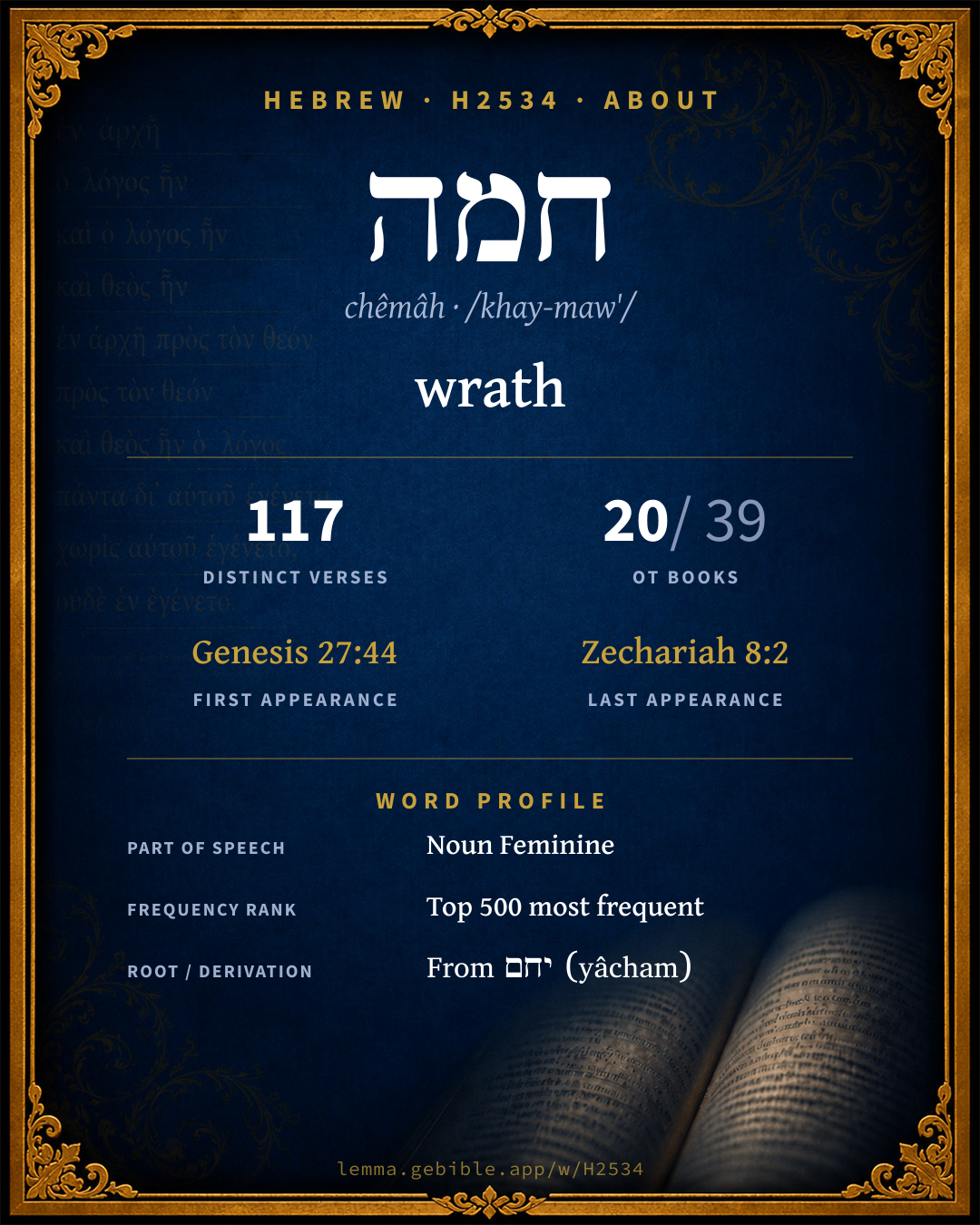
חֵמָה
wrath
also: heat, rage, hot displeasure, indignation fuller range ↓
Full lexicon entry — Brown-Driver-Briggs (BDB)
From Brown-Driver-Briggs (BDB)
Where this word appears
See every Construct-state word in the Hebrew Bible →
Grammar key — what these labels mean
Part of speech
- Noun
- A naming word — a person, place, thing, or idea.
Noun type
- Common
- A common noun — a general class of person, place, or thing (“king,” “city,” “water”), not a specific name.
State
- Construct
- A noun bound to a following noun in a possessive / “of” relationship (the construct chain).
- Absolute
- The independent form of a noun, not bound to a following word.
Gender
- Feminine
- Grammatically feminine.
Number
- Singular
- One.
- Plural
- More than one (in Hebrew, generally three or more).
21 verses where H2534 appears in the Construct state in the Book of Ezekiel. Filtered view — show all forms. Click any verse to open its interlinear word-by-word view. Verse text shown in the World English Bible for context — . Each verse’s Hebrew form is shown with its reference; the English is not keyword-highlighted, since the data carries no word-level English alignment. Use “Compare translations” on any verse to read it across multiple English versions. This concordance covers the Hebrew Bible; Septuagint (Greek Old Testament) occurrences are not indexed here.
Ezekiel
- Ezekiel 3:14 בַּ/חֲמַ֣ת prep + n c fs cs So the Spirit lifted me up, and took me away; and I went in bitterness, in the heat of my spirit; and the hand of Yahweh was strong on me.
- Ezekiel 5:13 חֲמָתִ֛/י חֲמָתִ֖/י n c fs cs + sfx pers 1cs n c fs cs + sfx pers 1cs Thus shall my anger be accomplished, and I will cause my wrath toward them to rest, and I shall be comforted; and they shall know that I, Yahweh, have spoken in my zeal, when I have accomplished my wrath on them.
- Ezekiel 6:12 חֲמָתִ֖/י n c fs cs + sfx pers 1cs He who is far off shall die of the pestilence; and he who is near shall fall by the sword; and he who remains and is besieged shall die by the famine: thus will I accomplish my wrath on them.
- Ezekiel 7:8 חֲמָתִ/י֙ n c fs cs + sfx pers 1cs Now will I shortly pour out my wrath on you, and accomplish my anger against you, and will judge you according to your ways; and I will bring on you all your abominations.
- Ezekiel 9:8 חֲמָתְ/ךָ֖ n c fs cs + sfx pers 2ms It happened, while they were smiting, and I was left, that I fell on my face, and cried, and said, Ah Lord Yahweh! will you destroy all the residue of Israel in your pouring out of your wrath on Jerusalem?
- Ezekiel 13:13 בַּֽ/חֲמָתִ֑/י בְּ/חֵמָ֥ה prep + n c fs cs + sfx pers 1cs prep + n c fs Therefore thus says the Lord Yahweh: I will even tear it with a stormy wind in my wrath; and there shall be an overflowing shower in my anger, and great hailstones in wrath to consume it.
- Ezekiel 13:15 חֲמָתִ/י֙ n c fs cs + sfx pers 1cs Thus will I accomplish my wrath on the wall, and on those who have daubed it with whitewash; and I will tell you, The wall is no more, neither those who daubed it;
- Ezekiel 14:19 חֲמָתִ֤/י n c fs cs + sfx pers 1cs Or if I send a pestilence into that land, and pour out my wrath on it in blood, to cut off from it man and animal;
- Ezekiel 16:42 חֲמָתִ/י֙ n c fs cs + sfx pers 1cs So will I cause my wrath toward you to rest, and my jealousy shall depart from you, and I will be quiet, and will be no more angry.
- Ezekiel 20:8 חֲמָתִ֣/י n c fs cs + sfx pers 1cs But they rebelled against me, and would not listen to me; they did not every man cast away the abominations of their eyes, neither did they forsake the idols of Egypt. Then I said I would pour out my wrath on them, to accomplish my anger against them in the midst of the land of Egypt.
- Ezekiel 20:13 חֲמָתִ֧/י n c fs cs + sfx pers 1cs But the house of Israel rebelled against me in the wilderness: they didn't walk in my statutes, and they rejected my ordinances, which if a man keep, he shall live in them; and my Sabbaths they greatly profaned. Then I said I would pour out my wrath on them in the wilderness, to consume them.
- Ezekiel 20:21 חֲמָתִ֣/י n c fs cs + sfx pers 1cs But the children rebelled against me; they didn't walk in my statutes, neither kept my ordinances to do them, which if a man do, he shall live in them; they profaned my Sabbaths. Then I said I would pour out my wrath on them, to accomplish my anger against them in the wilderness.
- Ezekiel 21:17 חֲמָתִ֑/י n c fs cs + sfx pers 1cs I will also strike my hands together, and I will cause my wrath to rest: I, Yahweh, have spoken it.
- Ezekiel 22:20 וּ/בַ/חֲמָתִ֔/י conj + prep + n c fs cs + sfx pers 1cs As they gather silver and brass and iron and lead and tin into the midst of the furnace, to blow the fire on it, to melt it; so will I gather you in my anger and in my wrath, and I will lay you there, and melt you.
- Ezekiel 22:22 חֲמָתִ֖/י n c fs cs + sfx pers 1cs As silver is melted in the midst of the furnace, so shall you be melted in the midst of it; and you shall know that I, Yahweh, have poured out my wrath on you.
- Ezekiel 24:13 חֲמָתִ֖/י n c fs cs + sfx pers 1cs In your filthiness is lewdness: because I have cleansed you and you weren't cleansed, you shall not be cleansed from your filthiness any more, until I have caused my wrath toward you to rest.
- Ezekiel 25:14 וְ/כַ/חֲמָתִ֑/י conj + prep + n c fs cs + sfx pers 1cs I will lay my vengeance on Edom by the hand of my people Israel; and they shall do in Edom according to my anger and according to my wrath; and they shall know my vengeance, says the Lord Yahweh.
- Ezekiel 30:15 חֲמָתִ֔/י n c fs cs + sfx pers 1cs I will pour my wrath on Sin, the stronghold of Egypt; and I will cut off the multitude of No.
- Ezekiel 36:6 וּ/בַ/חֲמָתִ/י֙ conj + prep + n c fs cs + sfx pers 1cs Therefore prophesy concerning the land of Israel, and tell the mountains and to the hills, to the watercourses and to the valleys, Thus says the Lord Yahweh: Behold, I have spoken in my jealousy and in my wrath, because you have borne the shame of the nations:
- Ezekiel 36:18 חֲמָתִ/י֙ n c fs cs + sfx pers 1cs Therefore I poured out my wrath on them for the blood which they had poured out on the land, and because they had defiled it with their idols;
- Ezekiel 38:18 חֲמָתִ֖/י n c fs cs + sfx pers 1cs It shall happen in that day, when Gog shall come against the land of Israel, says the Lord Yahweh, that my wrath shall come up into my nostrils.
About this entry
At a glance — auto-summarized from this page’s data, not written by a person. Every figure links to its source below. This summary describes the numbers; it doesn’t interpret them.
“wrath” is the headline sense of the Hebrew noun חמה (chêmâh). First canonically at Genesis 27:44, it enters the text early. With 117 verses in 20 books, it is a common word in the Hebrew Bible. It concentrates in Ezekiel, which alone accounts for 26% of its uses. Beyond “wrath” it also covers “heat”, “rage”, and “hot displeasure” — see its full sense range. The sections below give every sense, occurrence, and version rendering.
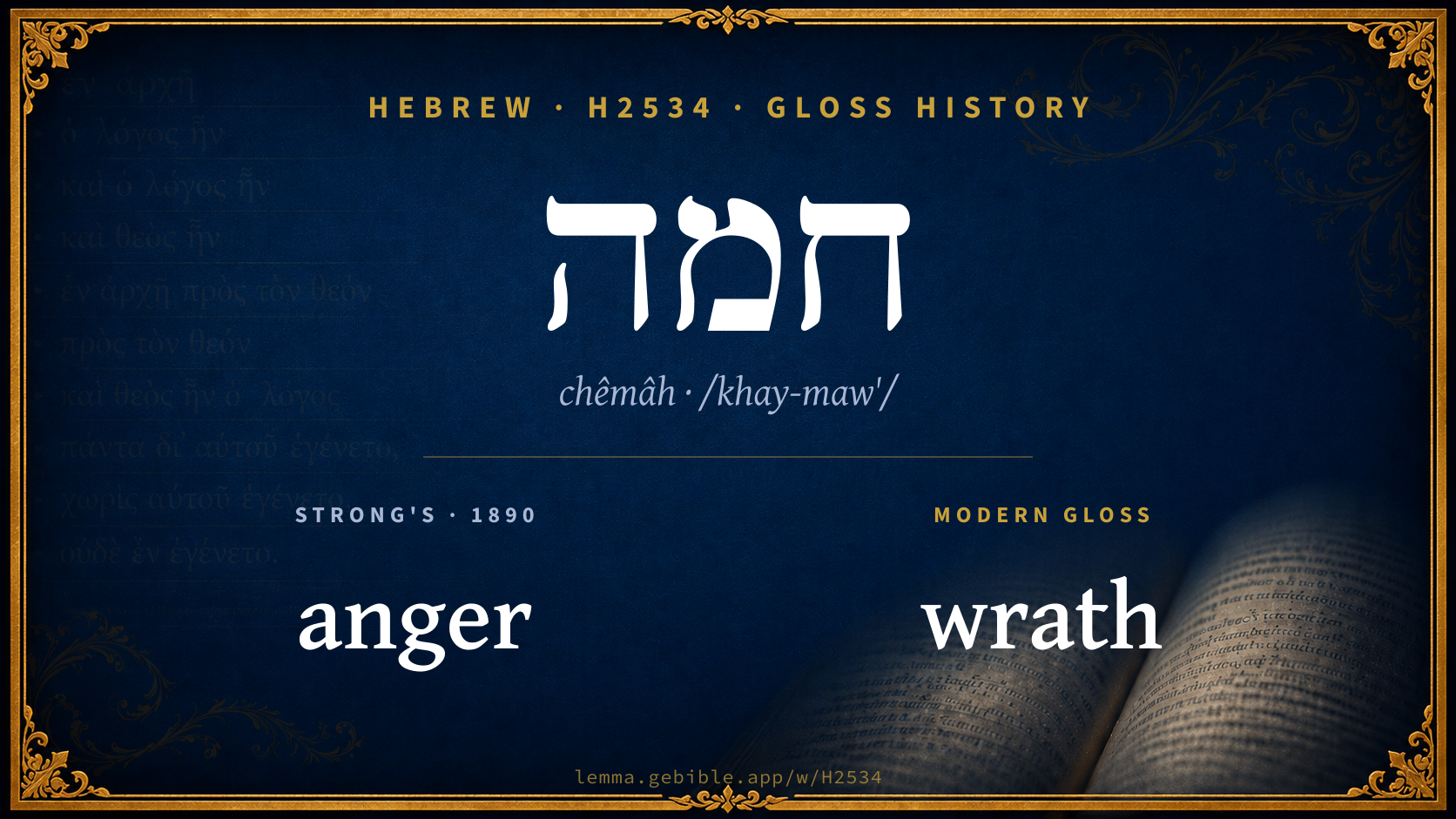
Gloss history
Strong's 1890 vs modern scholarship
About this word
Strong's H2534 catalogs a Hebrew word from the Hebrew Old Testament.
These counts are not copied from any lexicon or concordance. They are computed here, from the morphology-tagged Hebrew Old Testament. What Lemma adds →
- 117
- distinct verses
- The word appears in 117 distinct verses.
- 20 / 39
- OT books
- The word appears in 20 of 39 Old Testament books.
- #354
- by frequency
- Top 500 most frequent Hebrew words (rank 354 of 8,640 Hebrew words by occurrence).
View all 117 occurrences in the concordance →
By section of the Old Testament
By traditional corpus
Conventional, traditional groupings — biblical authorship is debated, so this is a traditional corpus grouping, not an authorship claim. Each share is this word’s portion of its verses in that division of the Hebrew canon. Each figure is a share of the word’s 117 distinct verses.
- Prophets (Nevi'im) 67 verses · 57%
- Writings (Ketuvim) 42 verses · 36%
- Torah (Pentateuch) 8 verses · 7%
How translations render this word
Counts come from each version’s own published word-to-Strong’s tagging or interlinear alignment — an approximate guide to how each version renders this word, not a word-level alignment the data otherwise carries. Because each total is that version’s own tagged count, the per-version totals vary from one another and need not match the appearance or distinct-verse counts above. These counts may also differ from a printed concordance because Lemma counts each distinctly tagged rendering and does not collapse phrase taggings into a single head-word total. This is a fixed set of word-tagged versions (KJV, ASV, BSB, ULT) and does not change with the reading translation you choose elsewhere. Each version’s license is shown beside its name below (and on Sources).
BDB lists this Strong’s number as 3 distinct words (homographs). Each count above pools all of them and is not split by sense — see the Senses section below. A low-frequency rendering may belong to a different one of those words, not the primary meaning.
- King James Version†: Fury 55×, Wrath 24×, Poison 5×
- American Standard Version†: Wrath 65×, Wrathful 5×, Fury 4×
- Berean Standard Bible†: Wrath 66×, Fury 21×, Anger 4×
- unfoldingWord Literal Text†: Wrath 32×, Heat 21×, Fury 15×
King James Version Public Domain
Renders H2534 across 123† tagged occurrences — most commonly:
Plus 24 renderings that appear only once — usually multi-word phrases or single function words the recovered tagging swept in, not distinct renderings. Not rendered by a distinct English word in 1 further occurrence.
American Standard Version Public Domain
Renders H2534 across 124† tagged occurrences — most commonly:
Plus 31 renderings that appear only once — usually multi-word phrases or single function words the recovered tagging swept in, not distinct renderings.
Berean Standard Bible Public Domain
Renders H2534 across 121† tagged occurrences — most commonly:
Plus 15 renderings that appear only once — usually multi-word phrases or single function words the recovered tagging swept in, not distinct renderings. Not rendered by a distinct English word in 4 further occurrences.
unfoldingWord Literal Text CC BY-SA 4.0
Renders H2534 across 121† tagged occurrences — most commonly:
Plus other, less common renderings. Plus 16 renderings that appear only once — usually multi-word phrases or single function words the recovered tagging swept in, not distinct renderings.
7 senses and sub-senses in the full BDB
What do BDB’s symbols mean?
BDB uses these scholarly abbreviations:
| Symbol | Meaning |
|---|---|
| 𝔊 | the Septuagint (the ancient Greek translation, LXX) |
| 𝔙 | the Vulgate (the Latin translation) |
| 𝔖 | the Syriac version (the Peshitta) |
| 𝔗 | the Targum (the Aramaic translation) |
| ψ | the Psalms |
| √ | root (the underlying root or stem) |
| ‖ | parallel passage (a synonymous or contrasted parallel) |
| † | the dagger: every passage where the word occurs is cited |
The 7 senses and sub-senses the full Brown-Driver-Briggs lexicon distinguishes for this word, in lexicon order (not ranked by frequency), with BDB’s own verbatim wording and sub-sense lettering. Shown in Hebrew script with BDB’s own scholarly abbreviations. The condensed entry is in the Lexicon Entry tab. See also the Forms in the corpus table below.
חמה I wrath, v. sub יחם
חמה II (once חֵמָא)121 n.f. heat, rage (for יְחֵמָה
- 1. heat:
- a. fever, חֲמַת מִיַּיִן Ho 7:5 fever from wine, wine-fever (on st. cstr. v. Ges§ 130, 1). e.g. Hosea 7:5
- b. venom, poison (fig.): חֲמַת זֹחֲלֵי עָפָר Dt 32:24; ח׳ תַּנִּינִים v 33; ח׳ נָחָשׁ ψ 58:5 cf. v 5; ח׳ עַכְשׁוּב ψ 140:4; poison of arrows (of י׳) Jb 6:4. e.g. Deuteronomy 32:24
- 2. burning anger, rage:
- a. of man: Gn 27:44 (J), 2 S 11:20 2 K 5:12 Est 1:12; 2:1; 3:5; 5:9 (against, עַל), 7:7, 10 ψ 37:8 (‖ אַף), 76:11 (yet on text v. Che), Pr 6:34; 15:1, 18 (אִישׁ חֵמָה man of rage = raging or wrathful man), 16:4; 19:19 (גְּדָל־ח׳ Qr = one great in rage, v. De Now), 27:4 (‖ אַף), Is 51:13(×2) Ez 23:25; אִישׁ חֵמוֹת Pr 22:24 (‖ בַּעַל אָ֑ף); בַּעַל חֵמָה 29:22 (‖ אִישׁ אַף); חֵמָה עַזָּה strong rage Pr 21:14 (‖ אַף); חֲמַת רוּחִי Ez 3:14 the rage of my spirit. e.g. Genesis 27:44
- b. of the he-goat in Daniel’s vision, בַּחֲמַת כֹּחוֹ Dn 8:6 in the fury of his power. e.g. Daniel 8:6
- c. of God (י׳), often Je Is 2 Ez ψ: Je 4:4 + 16 times Je; 2 K 22:13, 17 Is 27:4 (Hi Ew Di Du; on other interpr., and on text v. Di), 63:5 La 2:4 Ez 5:13 + 29 times Ez; Nu 25:11 (P), 2 Ch 12:7; 34:21, 25; 36:16 ψ 59:14; 79:6; 88:8; 89:47; 106:23 Jb 21:20; appar. also 19:29; 36:18 v Di; often ‖ אַף, Mi 5:14 Dt 9:19; 29:22 Is 42:25 (אַפּוֹ as appos., + עֱזוּז מִלְחָמָה), 63:3, 6 Dn 9:16 ψ 6:2; 78:38; 90:7; לְהָשִׁיב בְּחֵמָה אַפּוֹ Is 66:15 (‖ וְגַעֲרָתוֹ בְּלַהֲבֵי־אֵשׁ), Je 23:19; 30:23 of the whirlwind of י׳; ‖ אַף + קֶצֶף גָּדוֹל Dt 29:27 Je 21:5; 32:37; ‖ אַף + תֹּכְחוֹת חֵמָה Ez 5:15, cf. תּוֹכְחוֹת חֵמָה alone 25:17; ‖ חֲרוֹן אַפּוֹ Na 1:6 La 4:11; ‖ קֶצֶף Is 34:2 (of fury against, על), ψ 38:2; ‖ גְּעָרָה Is 51:20; ‖ גְּמוּל 59:18; ‖ קִנְאָה Ez 36:6, cf. חֵמָה גְדוֹלָה קִנֵּאתִי Zc 8:2 (‖ קִנְאָה גדולה); דַּם חֵמָה וְקִנְאָה Ez 16:38 (on text v. Co); חֲמַת קֶ֑רִי Lv 26:28 rage of meeting, i.e. encountering them in rage; כּוֹס חֲמָתוֹ(-תִי) Is 51:17, 22 the cup of his (my) fury; כּוֹס הַיַּיִן הַחֵמָה הַזּאֹת Je 25:15; בַּעַל חֵמָה a possessor of fury = furious Na 1:2 (‖ נֹקֵם, אֵל קִנּוֹא). [חֵמָה עַל = rage against one: Is 34:2 2 Ch 28:9.—Vbs. used with חֵמָה are: 2. a.: שׁוּב Gn 27:44, הֵשִׁיב Pr 15:1, עָלָה 2 S 11:20, בָּעַר Est 1:12, שָׁכַךְ 2:1; 7:10; 2. c.: הֵשִׁיב turn away wrath of י׳ Nu 25:11 ψ 106:23 Je 18:20 (but הָשִׁיב בְּחֵמָה אַפּוֹ Is 66:15 to recompense his anger in fury, give it as requital); ח׳ י׳ is kindled against one יצת ב Niph. 2 K 22:13, 17; it burns בָּֽעֲרָה Je 4:4; 21:12; 44:6 ψ 89:47; arises עלה 2 Ch 36:16, cf. as obj. of עלה Hiph. Ez 24:8; is poured out נִתְּכָה בְ 2 Ch 12:7; 34:21, 25 Je 7:20; נִתְּכָה עַל 42:18(×2); 44:6; נִתְּכָה כָאֵשׁ Na 1:6; י׳ pours it out שָׁפַךְ אֶל ψ 79:6; שָׁפַךְ עַל Is 42:25 Je 10:25 Ez 7:8; 9:8; 14:19; 16:38 (according to Co’s conject.), 20:8, 13, 21; 22:22; 30:15; 36:18; שָׁפַךְ כָּאֵשׁ La 2:4; חֵמָה שְׁפוּכָה Ez 20:33, 34; הֵנִיחַ ח׳ בְ bring to rest (i.e. satisfy) one’s fury upon Ez 5:13; 16:42; 24:13; כִּלָּה ח׳ La 4:11; + בְּ Ez 5:13 I have accomplished my fury upon them (in their case), 6:12; 13:15.] e.g. Jeremiah 4:4
Senses from the full Brown-Driver-Briggs lexicon (Brown, Driver, Briggs; Oxford 1906 — public domain), digitized via Sefaria, supplemented by the OpenScriptures HebrewLexicon (CC BY 4.0). Full attribution on Sources.
Word origin
I. wrath, v. sub יחם; חֵמָה Jb 29:6, v. חֶמְאָה; חַמָּה, חַמָּן, חַמּוֹן, חַמַּת v. sub חמם.
II. (once חֵמָא)121 n.f. heat, rage (for יְחֵמָה; NH id.; Aramaic יַחְמָא poison, ܚܶܡܬܳܐ heat, wrath, poison, BrockLex. 116, also Nö§ 105; Arabic حُمَةٌ poison, Lane 651; Assyrian imtu, spittle, breath, poison, DlHWB 78 Muss-ArnoltCD 62)—abs. חֵמָה Na 1:2 + 39 times; חֵמָא †Dn 11:44; cstr. חֲמַת Gn 27:44 + 25 times; sf. חֲמָתִי Je 4:4 + 36 times; חֲמָֽתְךָ Je 10:25 + 8 times; חֲמָתֶ֑ךָ ψ 88:8; 89:47; חֲמָתוֹ Is 51:17 + 8 times; חֲמָתָם Jb 6:4; pl. חֵמוֹת Pr 22:24, חֵמֹת ψ 76:11;—
— Brown-Driver-Briggs (Oxford 1906, public domain), digitized via Sefaria, supplemented by the OpenScriptures HebrewLexicon (CC BY 4.0). See Sources.
Derived from יחם (yâcham) (H3179) — to conceive.
Jastrow Dictionary
A second Hebrew/Aramaic lexicon for comparison, covering Aramaic and post-biblical (Talmudic, Targumic, Midrashic) usage that the biblical-Hebrew BDB does not. Matched by lemma rather than by Strong’s number, so a lemma may carry more than one Jastrow headword (shown separately below), and the entries cover usage well beyond the Bible.
חֲמָה
- to see, v. חמי.
חֵמָה
- 1. heat, anger. Snh. 82ᵇ משיב ח׳ בן וכ׳ he is an allayer of (divine) anger, the son of &c. Num. R. s. 20 נתמלא עליה ח׳ he became angry at her. Lam. R. to I, 6 חֲמָתוֹ של הב"ה the anger of the Lord; a. fr.
- 2. Ḥemah, allegorical name of one of the angels of justice. Ex. R. s. 41, end; a. e., v. אַף II.
חַמָּה
- 1. sun. Ber. 59ᵇ ח׳ בתקופתה the sun starting on his new cycle (of twenty eight years). Num. R. s. 14 י"ב הדשים לח׳ the twelve solar months. Ned. III, 7 רואי הח׳ those seeing (or feeling) the sun; שלא נתכוין … שהח׳ וכ׳ for he meant him whom the sun sees; a. v. fr.—Yeb. VIII, 4, a. fr. סריס ח׳ a eunuch from the time of seeing the sun, i.e. born without visible testicles; opp. to סריס אדם.
- 2. fever. Sabb. 137ᵃ, a. e., v. חָלַץ. Y. Sabb. XIX, end, 17ᵇ, v. אָחַז. Gen. R. s. 19, a. e., v. אַבְאָבִית. Y. Sabb. I, end, 4ᵇ (prov.) פת חמה חַמָּתָהּ בצדה hot bread has its heat by its side, i.e. eating hot bread causes fever; a. fr.
- 3. radish. Ab. Zar. 28ᵇ bot., v. חַמָּא.—V. חַמַּת.
חֲמִי
- (Arab. ḥama tueri) [to surround, guard, v. חוֹמָה,] to observe, see (in Y. dialect). Targ. Y. Gen. I, 4 (O. חזא); a. v. fr.—Targ. Prov. XXIII, 33 Ms. (ed. ויחַוְור׳).—Y. Peah III, 17ᵈ bot. אתא חמי (= תא חזי, h. בא וראה) come and see. Gen. R. s. 14 דאת חָמֵי לאפויי וכ׳ (not דאתח׳) that thou shalt see his face in the hereafter; Midr. Till. to Ps. II; Yalk. ib. 621 חמוי (corr. acc.). Ib. חַמְתֵיה (fr. חמה) he saw him. Pesik. Eth Korb. p. 57ᵇ (v. Bub. note 15) חַמְתִי אכיל חַמְתִי שתי did he (Moses) see me (the Lord) eat &c.?; Yalk. Num. 776 חַמְתֵיה וכ׳ did he see Him &c.?; a. fr.—Part. pass. חֲמֵי (v. חֲזִי) fit, worthy. Targ. Ps. XV, 1. Ib. LVIII, 2 (ed. חֲמִי); a. fr.—Fem. חַמְיָא. Targ. Y. Ex. XXII, 16.
- 1. (followed by (followed by מ־, cmp. סור) to turn (the eye) from. Targ. Prov. XXVIII, 27 (Ar. מהמי, h. text מעלים, v. Syr. המא P. Sm. 1017).
- 2. to cause to see, to show. Targ. Y. Gen. XLI, 28; a. e.—Lam. R. to I, 1 ואַחְמִין ליה וכ׳ and showed him a measure full of denars. Ib. רבתי (חד כות׳ 1) דכל עמא מַחְמִין לי וכ׳ that all people point at me with their fingers.
- same. Y. Kil. IX, 32ᵇ bot.; Y. Keth. XII, 35ᵃ bot. חַמֵּי (לה) לי let me see it (the tooth).
- to be seen, to appear. Targ. Y. Gen. VIII, 5; a. fr.—[Targ. Ps. XLII, 3 אִתַּחֲמֵי Ms. (Ittaf.) I shall appear before (h. text אֵרָאֶה, Var. a. ed. אֶחְמֵי)].—M. Kat. 25ᵇ אִתְחֲמִיאוּ וכ׳ stars were seen in day time. Y. Peah VIII, end, 21ᵇ דחמי ולא מִתְחֲמֵי He who sees but cannot be seen. Lam. R. introd. (R. Joḥ. 1) מִתְחַמְאִין, v. מַשְׁתָּיֵי; a. e.
A Dictionary of the Targumim, the Talmud Babli and Yerushalmi, and the Midrashic Literature (Marcus Jastrow; London, Luzac, 1903) — Public Domain. Digitized via Sefaria. Digitized via Sefaria. Full attribution on Sources.
Forms in the corpus
The 72 distinct written forms H2534 takes in the Hebrew Bible, most frequent first — each parse links to that state’s occurrences in the concordance. Hebrew forms include their vowel points and cantillation, so a single lemma takes many written forms.
The 60 most common forms are shown; 12 rarer forms follow in the full concordance.
Same root — word family
Other BDB entries built from the same root as H2534, grouped by Strong’s listed origin. These share a root / origin per the lexicon — not necessarily a shared meaning. Each links to that word’s own entry.
Derives from
Derived from this word
Proper names from this root
People and places named from this root — a name, not an additional meaning of the word.
Compare all same-root words → 1 of the same-root words is a proper name (a person or place). They share a root, not necessarily a meaning.
Septuagint verse parallels
This word appears in 112 verses that also exist in the Greek Old Testament (Septuagint), out of the 117 Hebrew verses it occurs in. You can read those verses in Greek by switching the Old Testament edition to the Septuagint.
Read these verses in the Septuagint
- Genesis 27:44
- Leviticus 26:28
- Numbers 25:11
- Deuteronomy 9:19
- 2 Samuel 11:20
- 2 Kings 5:12
- 2 Chronicles 12:7
- Esther 1:12
- Job 6:4
- Psalms 6:1
- Proverbs 6:34
- Isaiah 27:4
This is a verse-level parallel only — the same verses exist in both the Hebrew and Greek Old Testaments. No word-level Hebrew↔Greek correspondence is claimed: the data carries no such alignment, so no Greek word is shown as this Hebrew word’s translation. Coverage is not total — the Septuagint omits the deuterocanon and renumbers the Psalms, so some Hebrew verses have no direct Greek parallel.