
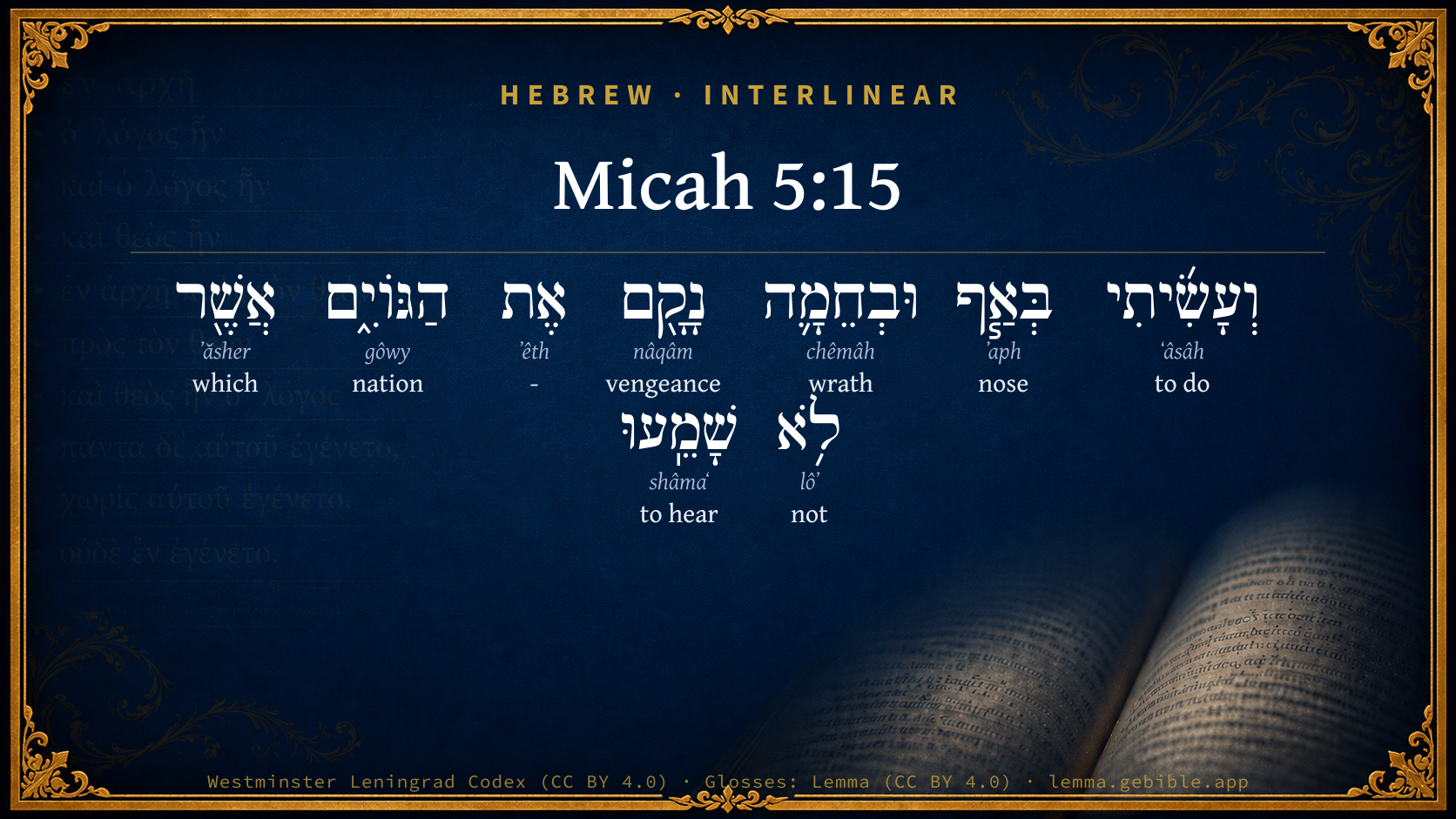
Micah 5:15

Hebrew (Westminster Leningrad Codex) Micah 5:15 appears in the Hebrew Old Testament. The text above is from the Westminster Leningrad Codex. Each word links to its Strong’s number, a concise gloss, and parsing drawn from the Open Scriptures Hebrew Bible morphology. Click any word for its full Brown-Driver-Briggs (BDB) entry.
Download image
Cite this verse

Micah 5:15 (World English Bible). Public Domain. Lemma interlinear Bible study tool, https://lemma.gebible.app/v/micah/5/15.

Show BibTeX & RIS
BibTeX
RIS
English Translation
I will execute vengeance in anger, And wrath on the nations that didn't listen."
World English Bible · Public Domain
Download a study sheet

One document with this verse’s original text, its word-by-word gloss line, the meaning frame, cross-references with their text, attributed commentary, and full source and license credits — printable, and it pastes into notes with its structure intact.

This verse Autodidact and up

Study sheet (.html) Plain text (.txt)

A passage Seminary Student

Up to 50 verses in one chapter. A passage sheet keeps up to 6 commentary sources and 12 cross-references per verse, in the order this page ranks them, and says so on the sheet whenever that leaves anything out. Ask for a single verse and you get the Autodidact verse sheet above.

Everything on this page stays free to read, with no account — the sheet is a download of what is already on screen, not access to it.

Want to remove ads? Support Godless Engineer
Compare translations 3

The same verse in 3 English versions, stacked beneath the original-language interlinear above. Click any original word for its lexicon entry.

Each is an independent rendering of the whole verse — the interlinear is not word-aligned to these translations.

Highlighted words mark where these versions differ — a whole-verse word diff, not a word-by-word alignment.

  • World English Bible Public Domain
    I will execute vengeance in anger, And wrath on the nations that didn't listen."
  • King James Version Public Domain
    And I will execute vengeance in anger and fury upon the heathen, such as they have not heard.
  • unfoldingWord Literal Text CC BY-SA 4.0
    And I will execute in nose and in wrath vengeance on the nations that have not listened.”

unfoldingWord Literal Text — © unfoldingWord, licensed CC BY-SA 4.0. Word-aligned USFM3 via Door43 (git.door43.org/unfoldingWord/en_ult).

Versions to compare (up to 4)

3 of 4 selected

Show all 15 translations

Every available English version of this verse, each an independent rendering of the whole verse.

  • World English Bible Public Domain
    I will execute vengeance in anger, And wrath on the nations that didn't listen."
  • Berean Standard Bible Public Domain
    I will take vengeance in anger and wrath upon the nations that have not obeyed Me.”
  • Majority Standard Bible Public Domain
    I will take vengeance in anger and wrath upon the nations that have not obeyed Me.”
  • King James Version Public Domain
    And I will execute vengeance in anger and fury upon the heathen, such as they have not heard.
  • American Standard Version (1901) Public Domain
    And I will execute vengeance in anger and wrath upon the nations which hearkened not.
  • Revised Version (1885) Public Domain
    And I will execute vengeance in anger and fury upon the nations which hearkened not.
  • Geneva Bible (1599) Public Domain
    And I will execute a vegeance in my wrath and indignation vpon the heathen, which they haue not heard.
  • Young's Literal Translation Public Domain
    And I have done vengeance in anger and in fury, With the nations who have not hearkened!
  • Literal Standard Version CC BY-SA 4.0
    And I have done vengeance in anger and in fury, || With the nations who have not listened!”
  • Unlocked Literal Bible CC BY-SA 4.0
    I will execute vengeance in anger and wrath on the nations that have not listened.”
  • unfoldingWord Literal Text CC BY-SA 4.0
    And I will execute in nose and in wrath vengeance on the nations that have not listened.”
  • Darby Bible Public Domain
    And I will execute vengeance in anger and in fury upon the nations, such as they have not heard of.
  • World Messianic Bible Public Domain
    I will execute vengeance in anger and wrath on the nations that didn’t listen.”
  • Free Bible Version CC BY-SA 4.0
    In anger and fury I will execute vengeance on those nations that do not obey me.
  • JPS Tanakh (1917) Public Domain
    (5-14) And I will execute vengeance in anger and fury upon the nations, because they hearkened not.

Literal Standard Version (2020), Covenant Press — licensed CC BY-SA 4.0. Text via the HelloAO Bible API (eBible.org). Unlocked Literal Bible (unfoldingWord) — licensed CC BY-SA 4.0. Text via the HelloAO Bible API (eBible.org). unfoldingWord Literal Text — © unfoldingWord, licensed CC BY-SA 4.0. Word-aligned USFM3 via Door43 (git.door43.org/unfoldingWord/en_ult). Free Bible Version, Dr. Jonathan Gallagher — licensed CC BY-SA 4.0. Text via the HelloAO Bible API (eBible.org).

Word by word

More ways to search: Search by grammar → Find every occurrence → Compare this word →

Practice this passage: Drill this verse → Learn its vocabulary →

About this verse

These counts appear in no published source. They are computed here, from the morphology-tagged text and Lemma’s own curated glosses. What Lemma adds →

9
words
9
distinct lemmas
Prophets
section

Notable vocabulary

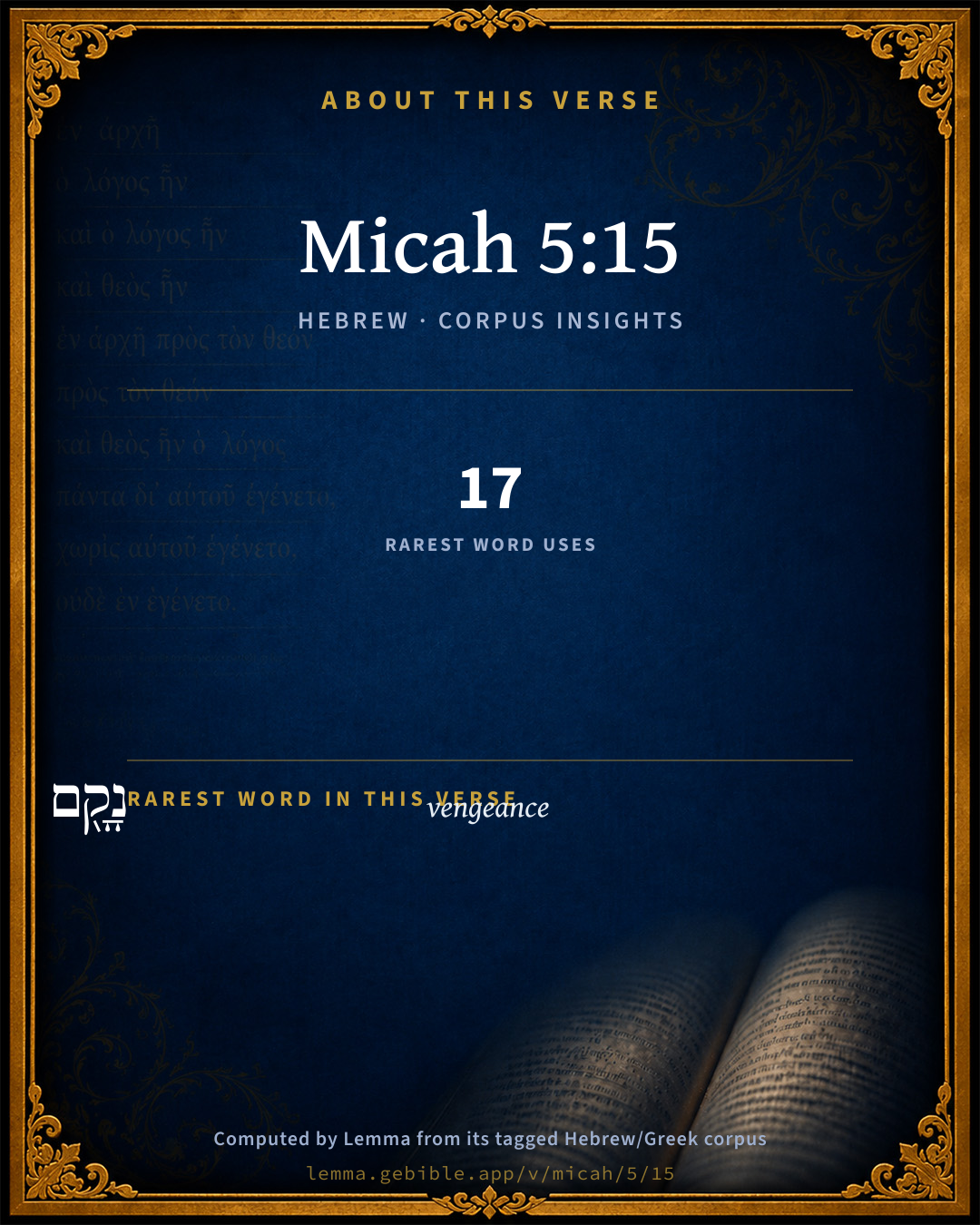
The rarest word here is נָקָ֖ם vengeance H5359 — appearing just 17 times in the whole Hebrew Bible.

Shared distinctive vocabulary

נָקָ֖ם vengeance H5359 occurs in 17 verses of the Hebrew Bible. Also found in:

Grammatical profile

  • 2 verbs
  • 4 nouns
  • 3 particles

Verb forms

  • וְעָשִׂ֜יתִי Qal · Sequential Perfect
  • שָׁמֵֽעוּ Qal · Perfect

Hebrew & Septuagint length

In English translation the verse runs 14 words from the Hebrew and 16 from the Septuagint (LXX English) — closely comparable.

A rough comparison of the two English renderings, which tokenize alike — not a word-level alignment.

Word counts can differ between the Hebrew and the Greek without any difference in meaning — e.g. the Hebrew direct-object marker אֵת has no separate Greek word, and Greek often adds the article ὁ.

Cross-references

4

Topical passages linked to Micah 5:15 in the Treasury of Scripture Knowledge — connected by theme and wording, ordered by reader-vote popularity; previews shown in the World English Bible.

  • Psalms 149:7 To execute vengeance on the nations, And punishments on the peoples;
  • Micah 5:8 The remnant of Jacob will be among the nations, In the midst of many peoples, Like a lion among the animals of the forest, Like a young lion among the flocks of sheep; Who, if he goes through, treads down and tears in pieces, And there is no one to deliver.
  • 2 Thessalonians 1:8 giving vengeance to those who don't know God, and to those who don't obey the Gospel of our Lord Jesus,
  • Isaiah 65:12 I will destine you to the sword, and you shall all bow down to the slaughter; because when I called, you did not answer; when I spoke, you did not hear; but you did that which was evil in my eyes, and chose that in which I didn't delight.

Cross-references courtesy of OpenBible.info (CC BY 4.0).

Hebrew and Greek witnesses Masoretic Hebrew ↔ Greek Septuagint

The same verse in the two great witnesses to the Old Testament, shown verse-for-verse.

These are two independent witnesses, not word-aligned to each other, and the Septuagint is shown in lemma (dictionary) form.

Hebrew Micah 5:15 Masoretic · Westminster Leningrad Codex

וְעָשִׂ֜יתִי בְּאַ֧ף וּבְחֵמָ֛ה נָקָ֖ם אֶת הַגּוֹיִ֑ם אֲשֶׁ֖ר לֹ֥א שָׁמֵֽעוּ

I will execute vengeance in anger, And wrath on the nations that didn't listen."

World English Bible · Public Domain

Greek LXX Micah 5:15 Septuagint · lemma form
and I will execute vengeance on the heathen in anger and wrath, because they listened not.

LXX2012 (modern English Septuagint) · Public Domain

On this verse, Jamieson, Fausset & Brown discusses the Septuagint’s reading. Read the note in Commentary ↓

Hebrew: Westminster Leningrad Codex (CC BY 4.0). Greek: Septuagint (public domain); English from LXX2012 (modern English Septuagint) (Public Domain). How the Septuagint differs from the Hebrew →

Commentary

Notes on Micah 5:15 from classic Christian and Jewish commentators (each source and its license shown beneath its notes). The classic Christian expositions comment on the surrounding passage and are grouped to its opening verse, so a note may address several verses; the Jewish commentaries on the Tanakh (Rashi and others) are per-verse, so they appear only where the commentator wrote on this verse.

Lemma curates 59 commentaries, every one of them public domain or Creative Commons licensed, each selected and text-cleaned for this edition rather than reprinted as found. About our sources →

Trapp's Complete Commentary

John Trapp

Mic 5:15 And I will execute vengeance in anger and fury upon the heathen, such as they have not heard.

And I will execute vengeance in anger] Upon those that refuse to be reformed, that know not God, and obey not the gospel of our Lord Jesus Christ, 2Th 1:8. Such as were the Jews’ enemies, the primitive persecutors, the stubborn Papists, some of whom have professed that they would rather take part with the Turks than with the Lutherans: as some rigid Lutherans again have protested openly, that they would return to the Papacy rather than to admit ever that sacramentary and predestinary pestilence (as they called it) of the Calvinists. But what a sad story is that related by Mr Burroughs, who had it from a worthy minister of those parts, that at Hamburgh was not long since held a consultation by some learned Lutherans, concerning the cause and cure of German calamities; and where it was concluded, that Germany suffered so much in these late wars, because their images in churches were not adorned enough, which therefore they would presently procure done. Had they consulted this text. they might soon have seen their mistake, and bethought them of better. But, "Lord, when thine hand is lifted up, they will not see: howbeit they shall see, and be ashamed for their envy towards thy people," Isa 26:11. Yea their ears shall be opened, and their instruction sealed, Job 33:16, that they might be accounted worthy to escape that vengeance, that shall be executed in anger and fury upon the heathens that have not heard the joyful sound, but, as so many sea-monsters, have with a deaf ear passed by the doctrine of salvation, the Gospel of peace.

John Trapp, A Commentary or Exposition upon All the Books of the Old and New Testament (1647–1656) — public domain. Text from a community e-Sword module.

Geneva Bible (1599)

Geneva Bible translators

It shall be so terrible that the like hath not been heard of.

Geneva Bible (1599) marginal notes — public domain. Text via Bolls.life.

Jamieson, Fausset & Brown

Robert Jamieson, A. R. Fausset & David Brown

vengeance . . . such as they have not heard--or, as the Hebrew order favors, "the nations that have not hearkened to My warnings." So the Septuagint (Psa 149:7).

Next: Micah Chapter 6

Jamieson, Fausset & Brown — Commentary Critical and Explanatory on the Whole Bible (1871) — public domain (CC PDM 1.0). Text via the HelloAO Bible API.

Adam Clarke's Commentary

Verse 15. I will execute vengeance - upon the heathen] And he did so; for the empires of the Assyrians, Chaldeans, and others, the sworn enemies of the Jews, have long since been utterly destroyed.

Adam Clarke's Commentary on the Bible (1810–1826) — public domain. Text from a community e-Sword/MySword module.

John Calvin's Commentaries

At last he adds, And I will execute vengeance in wrath and in fury He goes on with what I have just said of enemies; “I will then execute vengeance in wrath and in fury on the nations”. Here God mentions his wrath and his fury, that the faithful might feel greater confidence, that though now their enemies poured forth grievous threatening, yet this could not prevent God from aiding his people. — How so? Because if we compare the wrath and fury of God with all the terrors of men, doubtless the threats of men would appear as nothing but smoke. We now perceive the Prophet’s meaning in these words. And he says in the last place, I will execute vengeance on the nations who have not heard. Almost all interpreters join the relative, אשר, asher with the preceding word, גוים, guim, — I will then take vengeance on the nations who have not heard, that is, who have been rebellious against God: not to hear, as they explain, is obstinately to despise the power of God, and not to be moved by his promises or by his threatenings. But a fitter sense may perhaps be elicited, if we refer אשר, asher, to vengeance, — I will then execute vengeance on the nations which they have not heard, that is, I will take vengeance on all the nations in a manner unheard of and incredible: and by nations, he understands indiscriminately all the enemies of the Church, as we have elsewhere seen.

John Calvin's Commentaries (1540-1563) — public domain. Text from the Calvin Translation Society English edition (1840s-50s) via the Christian Classics Ethereal Library (ccel.org). Calvin's coverage is partial (roughly two-thirds of the Bible); uncommented books and verses are honest gaps, never fabricated. The 19th-century editor's footnotes and remarks are omitted so the notes are faithfully Calvin's own voice.

Ellicott's Commentary for English Readers

(15) Such as they have not heard.—Rather, which have not been obedient—i.e., which had not availed themselves of the opportunities of learning the true religion.

A Bible Commentary for English Readers, edited by Charles John Ellicott (1878–1897) — public domain. Text from a community e-Sword module.

The Cambridge Bible for Schools and Colleges

gen. ed. J. J. S. Perowne

15. the heathen, such as they have not heard] Rather, the nations which have not been obedient. Jehovah, being the God of the whole world, is de jure ‘King of the nations’ (Jer_10:7); and if the ‘nations’ have enthroned other gods in His places, and have almost forgotten Jehovah’s existence, they are still responsible to Him.

The Cambridge Bible for Schools and Colleges (gen. ed. J. J. S. Perowne; Cambridge University Press, 1878–1918) — public domain. Text from a community e-Sword module.

John Gill's Exposition

And I will execute vengeance in anger, and fury upon the Heathen,.... Or "nations" (o); not the Pagan nations only, but the Papal and Mahometan ones, even all that are enemies to Christ, and his church and people:

such as they have not heard; such terrible judgments, and dreadful expressions of divine wrath and fury, by earthquakes, hailstones, &c. as were never known or heard of in the world before; see Rev 16:18; or, "which have not heard" (p); the people that have not heard and hearkened to the word of God, to the voice of Christ in the Gospel, but have turned a deaf ear to it, and despised it. So the Targum,

"who have not received the doctrine of the law;''

but it is much more agreeable to understand it of the doctrine of the Gospel disobeyed by men, and therefore justly punished; see Th2 1:8.

(o) "gentes", Junius & Tremellius. (p) "quae non audierunt", Pagninus, Montanus; "quae non auscultaverint", Junius & Tremellius; "quae non obediverunt", Burkius.

Next: Micah Chapter 6

John Gill's Exposition of the Whole Bible (1746–1763) — public domain (CC PDM 1.0). Text via the HelloAO Bible API.

Matthew Poole's English Annotations

I will execute vengeance: God speaks to our capacity, he will proceed, or act, as the Hebrew word signifieth. He is supreme Judge, to whom vengeance belongeth, and when he hath passed the sentence, and his instruments execute it, he takes it to himself: so when the Babylonians avenged the wrongs by the Assyrian done to the Jews, and when Cyrus with his Persians and Medes avenged the injuries of Babylon, this prophecy was partly fulfilled, and in succeeding times it was further fulfilled, and is now fulfilling, and so will be, until the final destruction of the wicked.

In anger and fury: this spoken after the manner of man; it includes the greatness of God’s just displeasure, and the effects of it, which are resembled to what we do when furiously angry, act with utmost strength, and in the most terrible manner we can; so God will, with as great severity and terror as flesh and blood can bear, proceed against these heathens.

Upon the heathen; literally, the nations under the Assyrian monarchy first, next the nations under the Babylonish kingdom: in the full import of the words, all the nations that are enemies to the Lord, to his Christ, and to his peculiar people, who know not God, nor obey the gospel.

Such as they have not heard; with unparalleled terror; and so they shall be made warning-pieces to others.

Matthew Poole's English Annotations on the Holy Bible (1683–1685) — public domain. Text from a community e-Sword/MySword module.

Whedon's Commentary on the Bible

Daniel D. Whedon

15. The prophecy closes with a threat of vengeance.

Vengeance — The references to the divine vengeance must be understood like those to the divine jealousy (see on Joe_2:18). The resentment of Jehovah is aroused by the hostile attitude of the nations toward the “remnant” so dear to him. The greater the hostility, the intenser the resentment; the limit of his patience has now been reached, and he will blot out the enemies of his people forever.

Such as they have not heard — The blow will be more terrible than anything they have ever experienced or heard. R.V. follows more closely the original in 15b and translates “the nations which hearkened not,” that is, the nations which did not respond to the beneficent influence of the remnant (Mic_5:8).

Chapter 5 does not reveal the same abrupt transitions that are seen in chapter 4. A break seems to occur between Mic_5:9 and Mic_5:10, and yet Mic_5:10-15 are in a real sense a continuation of the description of the Messianic age; there certainly is nothing in them to militate seriously against the authorship of Micah. Hence, in discussing the fulfillment of the prophecy, the entire chapter may be considered as one piece, setting forth the birth and reign of the ideal king and the conditions resulting from his reign both within and without the nation. So far as the predictions concerning the conditions are concerned, the statements made in connection with Mic_4:1-5 (pp. 398ff.), may be repeated. They have not yet been fulfilled; literally they will probably never be fulfilled; in essence and spirit they will be fulfilled when the entire human race has had an opportunity to decide for or against Jesus the Messiah.

A few words need to be said, however, concerning the fulfillment of the more personal predictions, those pointing to the advent, place of birth, and reign of the Messianic king. That these predictions received their ultimate and highest fulfillment in Jesus is believed by all Christians. But this still leaves open the question whether the prophet, when uttering these words, actually had in mind the person, birth, and work of Jesus. The answer to this question must be determined by a careful interpretation of the utterances in the light of their contexts. If we take into consideration the statements concerning some of the things to be accomplished subsequent to the coming of the ideal ruler, it will be seen how difficult it is to maintain that the primary reference is to Jesus. Mic_5:5-6, for example, make it clear that Micah expected the king to arise before the downfall of the Assyrian world power, and that one of the great achievements of his reign would be the deliverance from this long-time enemy. Micah was firmly convinced, as a result of his intimate communion and fellowship with Jehovah, that a deliverer, who would establish the kingdom of God upon earth, would come, and, like other prophets, he expected him to come from the dynasty of David; but his thoughts as to when he would come, who he would be, where he would be born, how he would work out his great purpose, were influenced by the course of events in his own day. All prophecy, Messianic prophecy included, was intended to have a profound significance for the prophets’ contemporaries, and it is a convincing evidence of their close walk with God, or, in other words, of prophetic inspiration, that in the midst of darkness and apparent hopelessness these ancient saints should give utterance to such sublime expressions of faith. Micah may not have foreseen the Incarnation, but he did foresee the establishment of the kingdom of God upon earth; he may not have known the time when the salvation of the Lord would appear, but he knew that it would appear. Now Assyria might seem invincible, nevertheless Assyria must fall and Zion must triumph. Assyria did fall, but Zion did not triumph immediately; Chaldea took the place of the former, and oppression and distress continued. Many lost hope, but the prophets of God, in sublime faith, rose above the despair of the present and continued to revel in the glories of the future. Descendants of David sat upon the throne, some noble and true; around some of these centered anew the hopes of the prophets, but not one met the expectations of the men of God until Jesus, the Christ, fulfilled them in a manner more sublime and spiritual than even the greatest of the prophets had hoped for. Thus, while primarily the prophecy in Mic_5:2 ff., does not refer to Jesus the Messiah, it does refer to a Messiah, and in the history of the past nineteen centuries Christians find complete justification for their belief that this and similar predictions found their fulfillment in the coming and work of Jesus the Christ.

The direct mention of Beth-lehem as the birthplace of the ideal ruler in no way affects this interpretation. The prophets expected the Messianic king to spring from the dynasty of David, and, in addition to this, they were convinced that in influence and power he would be a second David. For this reason Isaiah says “of the stock of Jesse” rather than “of the stock of David,” and for the same reason Micah names as his birthplace Beth-lehem, the native town of David, rather than Jerusalem, where the successors of David were born. Such a promise would awaken memories of David, and would be suggestive of the character and splendor of his reign. A prediction similar in character is that in Isa_9:1 ff, which promises special blessings to the territory north of the Plain of Esdraelon, because these districts had suffered most severely in the prophet’s day, a prediction which received a new significance when Jesus proclaimed his gospel first in Galilee (Mat_4:13 ff.).

Daniel D. Whedon (gen. ed.), Commentary on the Old and New Testaments (1874–1909) — public domain. Text from a community e-Sword module.

The Pulpit Commentary

The time of Messiah is the era when judgment shall fall on the obdurate heathen. Such as they have not heard; rather, which have not hearkened, which are disobedient. Septuagint, "Because they hearkened not". (comp. Isa_66:15-18 Joe_3:9, etc.; Zep_3:8 Hag_2:22 2Th_1:7-10) It is implied that some of the heathen will hearken to the revelation of Jehovah by the Messiah.

The Pulpit Commentary (1880–1919), ed. H.D.M. Spence-Jones & Joseph S. Exell — public domain. Text from a community e-Sword module.

John Wesley's Explanatory Notes

Have not heard - In an unprecedented manner. Christ will give his Son either the hearts or necks of his enemies, and make them either his friends or his footstool.

John Wesley, Explanatory Notes Upon the Whole Bible (1754–1765) — public domain. Text via the GEBible commentary corpus.

Lesson kit

Teaching starters — assembled from the data on this page, not authored interpretation. Every prompt links to the verse data it draws on. Edit before teaching.

Micah, in the Prophets, opens this verse with 9 words (9 distinct Hebrew lemmas). Its most distinctive word is nâqâm (“vengeance”). A historical commentator’s framing appears above. Read the whole chapter for the surrounding context.

Discussion questions

  1. What does “vengeance” (nâqâm) contribute to the verse as a whole?
  2. How does Leviticus 26:25, which shares the word «vengeance», read alongside this verse?
  3. These translations render this verse differently; the difference is in the English rendering, not the original. What questions does that raise?
  4. «וְעָשִׂ֜יתִי» is a Qal Sequential Perfect verb. How does that grammatical form shape the action described?
  5. Compare how Trapp's Complete Commentary and Geneva Bible (1599) read this verse. Where do they agree or differ?

Things to notice

Reading settings

Reading text

Shown beneath each verse's original-language words.

Old Testament
Old Testament edition

Read the OT as the Masoretic Hebrew (MT) or the Greek Septuagint (LXX).

English shown for the Greek Septuagint (in the Hebrew ↔ Greek comparison).

Comparing translations? Open the Compare panel on any verse page to stack up to four side by side.