Nahum 1:6

Hebrew (Westminster Leningrad Codex) Nahum 1:6 appears in the Hebrew Old Testament. The text above is from the Westminster Leningrad Codex. Each word links to its Strong’s number, a concise gloss, and parsing drawn from the Open Scriptures Hebrew Bible morphology. Click any word for its full Brown-Driver-Briggs (BDB) entry.
Download image
Cite this verse

Nahum 1:6 (World English Bible). Public Domain. Lemma interlinear Bible study tool, https://lemma.gebible.app/v/nahum/1/6.

Show BibTeX & RIS
BibTeX
RIS
English Translation
Who can stand before his indignation? Who can endure the fierceness of his anger? His wrath is poured out like fire, and the rocks are broken apart by him.
World English Bible · Public Domain
Download a study sheet

One document with this verse’s original text, its word-by-word gloss line, the meaning frame, cross-references with their text, attributed commentary, and full source and license credits — printable, and it pastes into notes with its structure intact.

This verse Autodidact and up

Study sheet (.html) Plain text (.txt)

A passage Seminary Student

Up to 50 verses in one chapter. A passage sheet keeps up to 6 commentary sources and 12 cross-references per verse, in the order this page ranks them, and says so on the sheet whenever that leaves anything out. Ask for a single verse and you get the Autodidact verse sheet above.

Everything on this page stays free to read, with no account — the sheet is a download of what is already on screen, not access to it.

Want to remove ads? Support Godless Engineer
Compare translations 3

The same verse in 3 English versions, stacked beneath the original-language interlinear above. Click any original word for its lexicon entry.

Each is an independent rendering of the whole verse — the interlinear is not word-aligned to these translations.

Highlighted words mark where these versions differ — a whole-verse word diff, not a word-by-word alignment.

  • World English Bible Public Domain
    Who can stand before his indignation? Who can endure the fierceness of his anger? His wrath is poured out like fire, and the rocks are broken apart by him.
  • King James Version Public Domain
    Who can stand before his indignation? and who can abide in the fierceness of his anger? his fury is poured out like fire, and the rocks are thrown down by him.
  • unfoldingWord Literal Text CC BY-SA 4.0
    To the face of his indignation, who can stand? And who can arise against the burning of his nose? His wrath is poured out like fire, and the rocks are broken apart before him.

unfoldingWord Literal Text — © unfoldingWord, licensed CC BY-SA 4.0. Word-aligned USFM3 via Door43 (git.door43.org/unfoldingWord/en_ult).

Versions to compare (up to 4)

3 of 4 selected

Show all 18 translations

Every available English version of this verse, each an independent rendering of the whole verse.

  • World English Bible Public Domain
    Who can stand before his indignation? Who can endure the fierceness of his anger? His wrath is poured out like fire, and the rocks are broken apart by him.
  • Berean Standard Bible Public Domain
    Who can withstand His indignation? Who can endure His burning anger? His wrath is poured out like fire; even rocks are shattered before Him.
  • Majority Standard Bible Public Domain
    Who can withstand His indignation? Who can endure His burning anger? His wrath is poured out like fire; even rocks are shattered before Him.
  • King James Version Public Domain
    Who can stand before his indignation? and who can abide in the fierceness of his anger? his fury is poured out like fire, and the rocks are thrown down by him.
  • American Standard Version (1901) Public Domain
    Who can stand before his indignation? and who can abide in the fierceness of his anger? his wrath is poured out like fire, and the rocks are broken asunder by him.
  • Revised Version (1885) Public Domain
    Who can stand before his indignation? and who can abide in the fierceness of his anger? his fury is poured out like fire, and the rocks are broken asunder by him.
  • Geneva Bible (1599) Public Domain
    Who can stande before his wrath? or who can abide in the fiercenesse of his wrath? his wrath is powred out like fire, and the rockes are broken by him.
  • Douay-Rheims (1899) Public Domain
    Who can stand before the face of his indignation? and who shall resist in the fierceness of his anger? his indignation is poured out like fire: and the rocks are melted by him.
  • Young's Literal Translation Public Domain
    Before His indignation who doth stand? And who riseth up in the heat of His anger? His fury hath been poured out like fire, And the rocks have been broken by Him.
  • Literal Standard Version CC BY-SA 4.0
    Who stands before His indignation? And who rises up in the heat of His anger? His fury has been poured out like fire, || And the rocks have been broken by Him.
  • Unlocked Literal Bible CC BY-SA 4.0
    Who can stand before his wrath? Who can resist the fierceness of his anger? His wrath is poured out like fire, and the rocks are broken apart by him.
  • unfoldingWord Literal Text CC BY-SA 4.0
    To the face of his indignation, who can stand? And who can arise against the burning of his nose? His wrath is poured out like fire, and the rocks are broken apart before him.
  • Darby Bible Public Domain
    Who shall stand before his indignation? and who shall abide in the fierceness of his anger? His fury is poured out like fire, and the rocks are broken asunder by him.
  • World Messianic Bible Public Domain
    Who can stand before his indignation? Who can endure the fierceness of his anger? His wrath is poured out like fire, and the rocks are broken apart by him.
  • Webster's Bible Public Domain
    Who can stand before his indignation? and who can abide in the fierceness of his anger? his fury is poured out like fire, and the rocks are thrown down by him.
  • Free Bible Version CC BY-SA 4.0
    Who can withstand his fury? Who can endure the heat of his anger? His rage pours out like molten fire; he shatters rocks to pieces.
  • Bible in Basic English Public Domain
    Who may keep his place before his wrath? and who may undergo the heat of his passion? his wrath is let loose like fire and the rocks are broken open by him.
  • JPS Tanakh (1917) Public Domain
    Who can stand before His indignation? And who can abide in the fierceness of His anger? His fury is poured out like fire, and the rocks are broken asunder before Him.

Literal Standard Version (2020), Covenant Press — licensed CC BY-SA 4.0. Text via the HelloAO Bible API (eBible.org). Unlocked Literal Bible (unfoldingWord) — licensed CC BY-SA 4.0. Text via the HelloAO Bible API (eBible.org). unfoldingWord Literal Text — © unfoldingWord, licensed CC BY-SA 4.0. Word-aligned USFM3 via Door43 (git.door43.org/unfoldingWord/en_ult). Free Bible Version, Dr. Jonathan Gallagher — licensed CC BY-SA 4.0. Text via the HelloAO Bible API (eBible.org).

Word by word

More ways to search: Search by grammar → Find every occurrence → Compare this word →

Practice this passage: Drill this verse → Learn its vocabulary →

נִתְּכָ֣ה
nâthak
H5413
“to pour out”
Verb, Niphal, Perfect, 3rd Person, Feminine, Singular
Part of Speech
Verb
Stem
Niphal
Form
Perfect
Person
3rd Person
Gender
Feminine
Number
Singular
Full BDB Definition

Origin: a primitive root

TWOT: 1442

to pour out or forth, drop (or rain), be poured, be poured out, be melted, be molten - (Qal) to pour forth - (Niphal) to be poured, be poured out - (Hiphil) to pour out, melt - (Hophal) to be melted
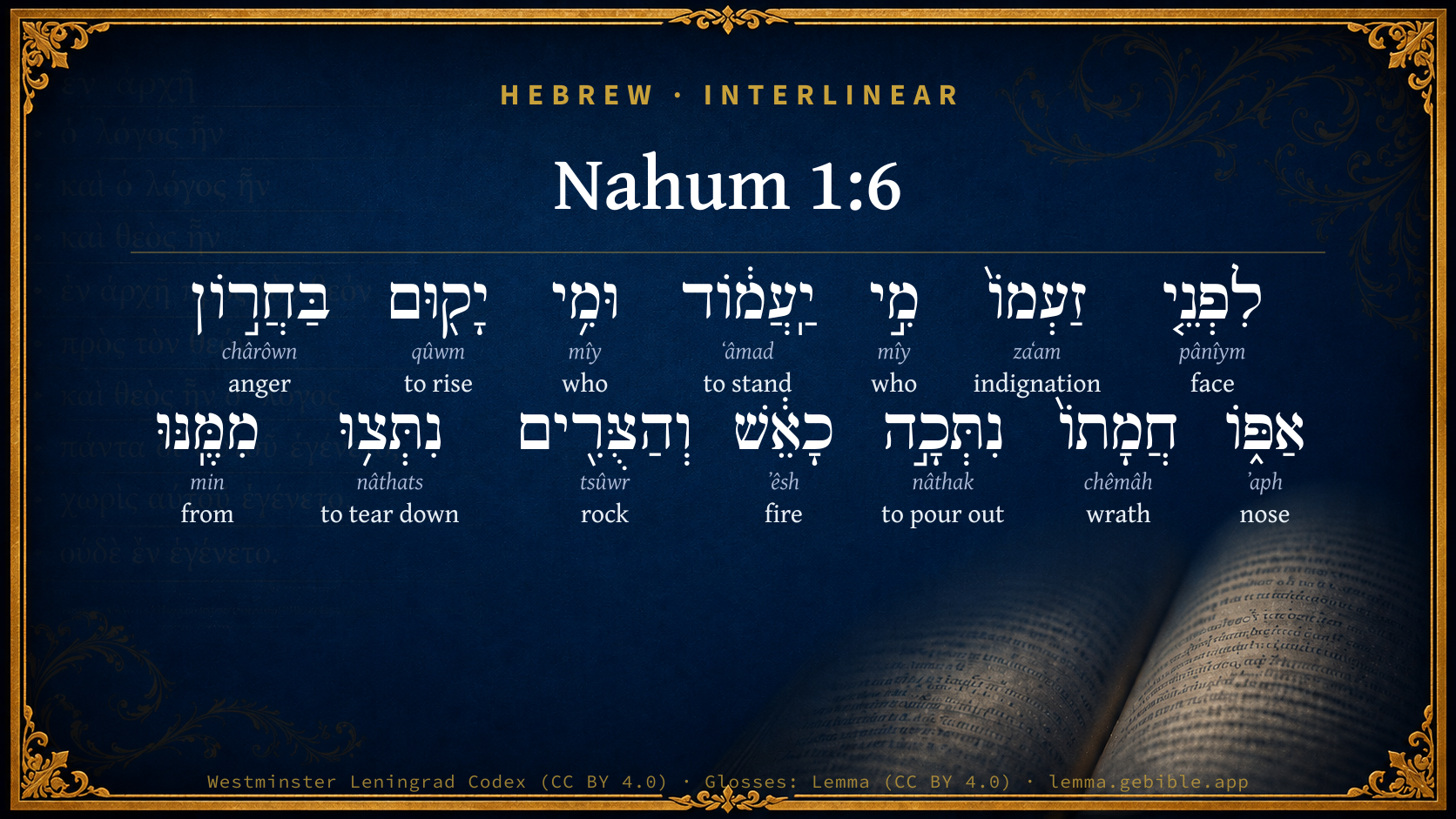
  1. לִפְנֵ֤י pânîym H6440 “to/for · face(s) of” Preposition + Noun, Common, Both, Plural, Construct
  2. זַעְמוֹ֙ zaʻam H2195 “indignation · his” Noun, Common, Masculine, Singular, Construct + Suffix, Personal, 3rd Person, Masculine, Singular
  3. מִ֣י mîy H4310 “who” Particle, Interrogative
  4. יַֽעֲמ֔וֹד ʻâmad H5975 “to stand” Verb, Qal, Imperfect, 3rd Person, Masculine, Singular
  5. וּמִ֥י mîy H4310 “and · who” Conjunction + Particle, Interrogative
  6. יָק֖וּם qûwm H6965 “to rise” Verb, Qal, Imperfect, 3rd Person, Masculine, Singular
  7. בַּחֲר֣וֹן chârôwn H2740 “in/at · anger of” Preposition + Noun, Common, Masculine, Singular, Construct
  8. אַפּ֑וֹ ʼaph H639 “nose · his” Noun, Common, Masculine, Singular, Construct + Suffix, Personal, 3rd Person, Masculine, Singular
  9. חֲמָתוֹ֙ chêmâh H2534 “wrath · his” Noun, Common, Feminine, Singular, Construct + Suffix, Personal, 3rd Person, Masculine, Singular
  10. כָאֵ֔שׁ ʼêsh H784 “like/as the · fire” Preposition, Determined + Noun, Common, Both, Singular, Absolute
  11. וְהַצֻּרִ֖ים tsûwr H6697 “and · the · rocks” Conjunction + Particle, Definite Article + Noun, Common, Masculine, Plural, Absolute
  12. נִתְּצ֥וּ nâthats H5422 “to tear down” Verb, Niphal, Perfect, 3rd Person, Common, Plural
  13. מִמֶּֽנּוּ min H4480 “from · him” Preposition + Suffix, Personal, 3rd Person, Masculine, Singular

About this verse

These counts appear in no published source. They are computed here, from the morphology-tagged text and Lemma’s own curated glosses. What Lemma adds →

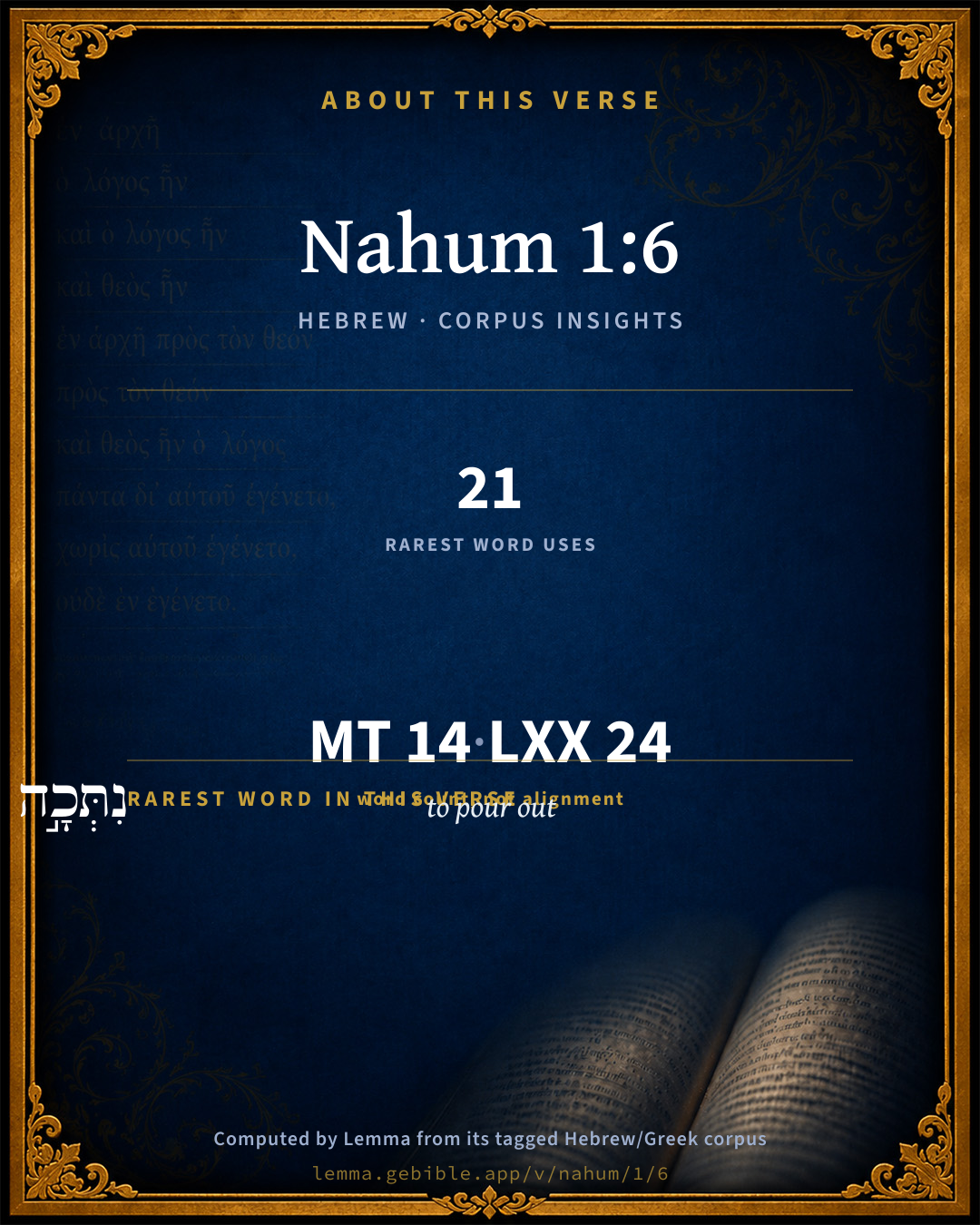
14
words
13
distinct lemmas
Prophets
section

Notable vocabulary

The rarest word here is נִתְּכָ֣ה to pour out H5413 — appearing just 21 times in the whole Hebrew Bible.

Shared distinctive vocabulary

נִתְּכָ֣ה to pour out H5413 occurs in 19 verses of the Hebrew Bible. Also found in:

Grammatical profile

  • 4 verbs
  • 7 nouns
  • 1 preposition
  • 2 particles

Verb forms

  • יַֽעֲמ֔וֹד Qal · Imperfect
  • יָק֖וּם Qal · Imperfect
  • נִתְּכָ֣ה Niphal · Perfect
  • נִתְּצ֥וּ Niphal · Perfect

Repetition

A word recurs within this verse — often emphatic in Hebrew:

Hebrew & Septuagint length

In English translation the verse runs 29 words from the Hebrew and 30 from the Septuagint (LXX English) — closely comparable.

A rough comparison of the two English renderings, which tokenize alike — not a word-level alignment.

Word counts can differ between the Hebrew and the Greek without any difference in meaning — e.g. the Hebrew direct-object marker אֵת has no separate Greek word, and Greek often adds the article ὁ.

In the original languages it is 14 Hebrew tokens and 24 Greek tokens — but the two are counted differently (Hebrew bundles its prefixes and suffixes into one token; the Greek is in lemma form), so that isn’t a like-for-like length.

Cross-references

16

Topical passages linked to Nahum 1:6 in the Treasury of Scripture Knowledge — connected by theme and wording, ordered by reader-vote popularity; previews shown in the World English Bible.

  • Jeremiah 10:10 But Yahweh is the true God; he is the living God, and an everlasting King: at his wrath the earth trembles, and the nations are not able to abide his indignation.
  • Malachi 3:2 "But who can endure the day of his coming? And who will stand when he appears? For he is like a refiner's fire, and like launderer's soap;
  • Deuteronomy 32:22–23 For a fire is kindled in my anger, Burns to the lowest Sheol, Devours the earth with its increase, Sets on fire the foundations of the mountains.
  • Psalms 76:7 You, even you, are to be feared. Who can stand in your sight when you are angry?
  • Nahum 1:2 Yahweh is a jealous God and avenges. Yahweh avenges and is full of wrath. Yahweh takes vengeance on his adversaries, and he maintains wrath against his enemies.
  • 1 Kings 19:11 He said, Go forth, and stand on the mountain before Yahweh. Behold, Yahweh passed by, and a great and strong wind tore the mountains, and broke in pieces the rocks before Yahweh; but Yahweh was not in the wind: and after the wind an earthquake; but Yahweh was not in the earthquake:
  • Psalms 2:12 Kiss the son, lest he be angry, and you perish in the way, For his wrath will soon be kindled. Blessed are all those who take refuge in him.
  • Psalms 90:11 Who knows the power of your anger, Your wrath according to the fear that is due to you?
  • Isaiah 10:16 Therefore will the Lord, Yahweh of Hosts, send among his fat ones leanness; and under his glory there shall be kindled a burning like the burning of fire.
  • Isaiah 27:4 Wrath is not in me: would that the briers and thorns were against me in battle! I would march on them, I would burn them together.
  • Lamentations 2:4 He has bent his bow like an enemy, he has stood with his right hand as an adversary, Has killed all that were pleasant to the eye: In the tent of the daughter of Zion he has poured out his wrath like fire.
  • Lamentations 4:11 Yahweh has accomplished his wrath, he has poured out his fierce anger; He has kindled a fire in Zion, which has devoured the foundations of it.
  • Ezekiel 30:16 I will set a fire in Egypt: Sin shall be in great anguish, and No shall be broken up; and Memphis [shall have] adversaries in the day-time.
  • Revelation 6:17 for the great day of his wrath has come; and who is able to stand?"
  • Revelation 16:1 I heard a loud voice out of the temple, saying to the seven angels, "Go and pour out the seven bowls of the wrath of God on the earth!"
  • Revelation 16:8 The fourth poured out his bowl on the sun, and it was given to him to scorch men with fire.

Cross-references courtesy of OpenBible.info (CC BY 4.0).

Hebrew and Greek witnesses Masoretic Hebrew ↔ Greek Septuagint

The same verse in the two great witnesses to the Old Testament, shown verse-for-verse.

These are two independent witnesses, not word-aligned to each other, and the Septuagint is shown in lemma (dictionary) form.

Hebrew Nahum 1:6 Masoretic · Westminster Leningrad Codex

לִפְנֵ֤י זַעְמוֹ֙ מִ֣י יַֽעֲמ֔וֹד וּמִ֥י יָק֖וּם בַּחֲר֣וֹן אַפּ֑וֹ חֲמָתוֹ֙ נִתְּכָ֣ה כָאֵ֔שׁ וְהַצֻּרִ֖ים נִתְּצ֥וּ מִמֶּֽנּוּ

Who can stand before his indignation? Who can endure the fierceness of his anger? His wrath is poured out like fire, and the rocks are broken apart by him.

World English Bible · Public Domain

Greek LXX Nahum 1:6 Septuagint · lemma form

ἀπό πρόσωπον ὀργή αὐτός τίς ὑποἵστημι καί τίς ἀντιἵστημι ἐν ὀργή θυμός αὐτός ὁ θυμός αὐτός τήκω ἀρχή καί ὁ πέτρα διαθρύπτω ἀπό αὐτός

Who shall stand before his anger? and who shall withstand in the anger of his wrath? his wrath brings to nothing kingdoms, and the rocks are burst asunder by him.

LXX2012 (modern English Septuagint) · Public Domain

On this verse, Haydock's Catholic Bible Commentary discusses the Septuagint’s reading. Read the note in Commentary ↓

Hebrew: Westminster Leningrad Codex (CC BY 4.0). Greek: Septuagint (public domain); English from LXX2012 (modern English Septuagint) (Public Domain). How the Septuagint differs from the Hebrew →

Targum (Aramaic paraphrase)

1

The Targum is the ancient Jewish Aramaic paraphrase of the Hebrew Scriptures — an interpretive translation, not the Hebrew text itself. Onkelos (literal) and Pseudo-Jonathan (expansive) render the Torah, and Jonathan the Prophets. Coverage is partial: where no permissively-licensed English translation exists for a verse, only the Aramaic is shown. This is verse-level text, not a word-by-word alignment to the Hebrew.

  1. Targum Jonathan Prophets (Joshua–Malachi)
    כַּד אִתְגְלֵי בִּרְחִמְתָּא לְמִתַּן אוֹרַיְתָא לְעַמֵיהּ כֵּן זָע עַלְמָא מִן קֳדָמוֹהִי בְּכֵן כַּד אִתְגְלֵי בִּרְגַז לְאִתְפְּרַע מִסָנְאֵי עַמֵיהּ קֳדָם פּוּרְעֲנוּתֵיהּ מַן יְקוּם וּמַן יְסוֹבַר בְּאַבְאָשׁוּת רוּגְזֵיהּ רוּגְזֵיהּ כְּאֶשְׁתָּא מַמְסַי וְטִינָרַיָא אִתְפְרָקָן מִן קֳדָמוֹהִי:

    (no public-domain English translation for this verse)

    Targum Jonathan — Aramaic: “Mikraot Gedolot” (public domain). English: “Sefaria Community Translation” (CC0 1.0 (public-domain dedication)); “London "Chaldee Paraphrase," 1871” (public domain). Text via Sefaria.

Commentary

Notes on Nahum 1:6 from classic Christian and Jewish commentators (each source and its license shown beneath its notes). The classic Christian expositions comment on the surrounding passage and are grouped to its opening verse, so a note may address several verses; the Jewish commentaries on the Tanakh (Rashi and others) are per-verse, so they appear only where the commentator wrote on this verse.

Lemma curates 59 commentaries, every one of them public domain or Creative Commons licensed, each selected and text-cleaned for this edition rather than reprinted as found. About our sources →

The Cambridge Bible for Schools and Colleges

gen. ed. J. J. S. Perowne

6. Nah_1:6 draws the general conclusion from the preceding. The description, Nah_1:2-5, is one of the manifestation of the Lord on the more terrible side of His being. For though His revelation of Himself at the Exodus and later (Jdg_5:4-5) had for its purpose the delivery of His people, this implied wrath and vengeance upon their enemies (Hab_3:12-13). Hence the exclamation, Who can stand before his indignation! cf. Mal_3:2.

His fury is poured out] A common figure, particularly in Jer., e.g. Jer_7:20, Jer_42:18, Jer_44:6; cf. 2Ch_12:7; 2Ch_34:21; 2Ch_34:25; and Dan_9:11; Dan_9:27. The expression “poured out like” may mean, is poured out and acts like fire, or the idea may be that of a fiery stream; Isa_30:33, “the breath of the Lord, like a stream of brimstone, doth kindle it.”

rocks are thrown down] or, rent in pieces. The word is used of throwing down an altar, Jdg_6:30, beating down a tower, Jdg_8:17, high places, city walls and cities themselves, 2Ki_23:8; 2Ki_25:10; Jer_39:8; Jer_4:26. The rending of the rocks is not ascribed to the fire but to Jehovah Himself (by Him, lit. from Him, because of Him); but several writers have suggested by it. The second half of Nah_1:6 continues the idea of the first half, the impossibility of standing before His anger: it is a flood of fire.

The Cambridge Bible for Schools and Colleges (gen. ed. J. J. S. Perowne; Cambridge University Press, 1878–1918) — public domain. Text from a community e-Sword module.

Trapp's Complete Commentary

John Trapp

Nah 1:6 Who can stand before his indignation? and who can abide in the fierceness of his anger? his fury is poured out like fire, and the rocks are thrown down by him.

Ver. 6. Who can stand before his indignation?] A glass bottle may as well stand before a cannon shot. There is no standing before a lion, much less before a devouring fire, least of all before an angry God. When our Saviour did but put forth a beam of his Deity, and said, "I am he," the stout soldiers fell to the ground, Joh 18:6, and there they had lain if he had not licensed them to rise again. Quid autem iudicaturus faciet, qui iudicandus hoc fecit? (Augustin.) The wicked shall not stand in judgment, saith David, Psa 1:5.

Who can abide in the fierceness of his anger?] Heb. in the inflammation of his nostrils, Collectumque premens volvit sub naribus ignem. Thus the prophet describeth God’s terrible executions of justice on the Church’s enemies, pulcherrimis metaphoris, hypotyposi evidentissima, et distributionis artificio insignissimo, by most elegant metaphors, evident demonstrations, and artificial distributions (Crocius in loc.).

His fury is poured out like fire] A metaphor either from metals melted or from showers of rain, such as God poured down upon Sodom (whereunto probably the prophet here alludeth, as Nah 1:8, to Noah’s flood), flaming showers, Jer 7:20; Jer 44:6.

And the rocks are thrown down by him] That is, by his fierce wrath, when it is at the full height; as the fire which at first burns a little within, upon a few boards and rafters, but when it prevaileth, bursteth out in a most terrible flame, as thunder; which we hear at first, a little roaring noise afar off, but stay awhile, and it is a dreadful crack, cleaving the very rocks. See Jer 4:28; Jer 4:24 Mat 27:51.

John Trapp, A Commentary or Exposition upon All the Books of the Old and New Testament (1647–1656) — public domain. Text from a community e-Sword module.

The Biblical Illustrator

Joseph S. Exell

Nah_1:6

Who can stand before His indignation?

Repentance through fear

This and similar passages address themselves directly to our fears. The term fear of God in Scripture, does not always bear the same meaning. Them is a filial fear, and them is a servile fear. Servile fear gives place to filial when God becomes known to us as our reconciled Father in Christ. We begin with the dread of God. The dread drives us to the Cross. Mistakes are often made as to that fear of God which we denominate servile. Christians are afraid of fear, looking with suspicion on any part which fear may have had in moving them to forsake evil ways, as if it were a base and ungenerous agent, which ought not to have had share in the great work of conversion. Whilst so much of the Bible speaks of fear, fear cannot be without its use in religion.

I. What misapprehension may there be in reference to the use of fear? Noah, in preparing the ark, is said to have been moved with fear. It was dread of impending wrath. Fears may rightly move us to genuine and acceptable repentance. We are so constituted as to be just as accessible through fear as through hope. We feel that with the great mass of men we can make no way without appealing to their fears. Men must commonly be wrought upon by fear through what they are incurring rather than through what they are losing. We must come down upon them with tidings of disaster. Let a man continue his struggles and his endeavours even though he feel actuated only by fear, and in due time other motives shall gain sway in his breast.

II. The legitimate use of such awful denunciations as these in the text. Or the way in which threatenings ought to be employed by the preacher. St. Paul says, Knowing the terrors of the Lord, we persuade men. Neither should the engine of terror be otherwise used by the present ministers of Christ. Threatenings are to be employed as inducements to the laying hold on the succour provided by Christ, (H. Melvill, B. D.)

The Biblical Illustrator, edited by Joseph S. Exell (c. 1880s–1900s) — public domain. Text from a community e-Sword module.

Tyndale Open Study Notes

Tyndale Open Resources

1:6 The Hebrew word translated rage is repeated from 1:2. Its repetition brackets 1:2-6 as a single poetic unit.

Tyndale Open Study Notes — © Tyndale Open Resources, licensed CC BY-SA 4.0. Text via the HelloAO Bible API.

Geneva Bible (1599)

Geneva Bible translators

If all creatures be at God’s commandment, and none is able to resist his wrath, shall man flatter himself, and think by any means to escape, when he provoketh his God to anger?

Geneva Bible (1599) marginal notes — public domain. Text via Bolls.life.

Jamieson, Fausset & Brown

Robert Jamieson, A. R. Fausset & David Brown

fury is poured out like fire--like the liquid fire poured out of volcanoes in all directions (see Jer 7:20).

rocks are thrown down--or, "are burnt asunder"; the usual effect of volcanic fire (Jer 51:25, Jer 51:56). As Hannibal burst asunder the Alpine rocks by fire to make a passage for his army [GROTIUS].

Jamieson, Fausset & Brown — Commentary Critical and Explanatory on the Whole Bible (1871) — public domain (CC PDM 1.0). Text via the HelloAO Bible API.

John Calvin's Commentaries

The Prophet shows here why he gave in the part noticed in the last lecture, such an awful description of God; it was that men might know, that when they shall come before his tribunal, no one will be able to stand unless supported by his favor. Of the Prophet’s main object we have sufficiently spoken, nor is it necessary to repeat here what has been stated. It is enough to bear this in mind, — that as the enemies of the Church relied on their power; and daringly and immoderately raged against it, the judgment of God is here set before them, that they might understand that an account was to be rendered to him whose presence they were not able to bear. But the question has more force than if the Prophet had simply said, that the whole world could not stand before God: for he assumes the character of one adjuring. After having shown how terrible God is, he exclaims, Who shall stand before his indignation? and who shall be able to bear his wrath? for his indignation, he says, is poured forth as fire. The Hebrew interpreters have here toiled in vain: as the verb נתך, nutae, means to pour forth it seems to them an inconsistent expression, that the wrath of God should be poured forth as fire; for this would be more suitably said of some metal than of fire. But to be poured forth here is nothing else than to be scattered far and wide. Poured forth then is thy wrath as fire; that is, it advances every moment, as when a fire seizes a whole forest; and when it grows strong, we know how great is its violence, and how suddenly it spreads here and there. But if a different meaning be preferred, I do not much object to it, “His wrath, which is like fire, is poured out.”

Some think that the Prophet alludes to lightnings, which, as it were, melt through the air, at least as they appear to us. But as the meaning of the Prophet is sufficiently evident, there is no need of anxiously inquiring how fire is poured out: for I have already mentioned, that the Prophet means no other thing than the wrath of God spreads itself, so that it immediately takes hold, not only of one city but also of the widest regions and of the whole world, and is therefore like fire, for it passes through here and there, and that suddenly.

He then says, that rocks are also broken or dissolved before him We must be aware how great our brittleness is. Since there is no hardness which melts not before God, how can men, who flow away of themselves like water, be so daring as to set themselves up against him? We hence see that the madness of men is here rebuked, who, trusting in their own strength, dare to contend even with God, because they forget their own frailty. This is the import of the whole. It now follows —

John Calvin's Commentaries (1540-1563) — public domain. Text from the Calvin Translation Society English edition (1840s-50s) via the Christian Classics Ethereal Library (ccel.org). Calvin's coverage is partial (roughly two-thirds of the Bible); uncommented books and verses are honest gaps, never fabricated. The 19th-century editor's footnotes and remarks are omitted so the notes are faithfully Calvin's own voice.

John Gill's Exposition

Who can stand before his indignation?.... No creature whatever; no man nor body of men; not Nineveh, and the inhabitants of it; nor the whole Assyrian empire:

and who can abide in the fierceness of his anger? not the great men of the earth; not kings or generals of armies; not kingdoms and nations, ever so numerous and powerful; but all must be consumed by him, who is a consuming fire; see Jer 10:10;

his fury is poured out like fire; or like metal that is melted by fire, and poured out by the force of it; or like fire of lightning poured out of the heavens, which is quick, powerful, and penetrating, and there is no resisting it:

and the rocks are thrown down by him; by the Lord, by his wrath and fury; kingdoms that seemed as strong and immovable as rocks and mountains are thrown down; as such have been by the force of fire bursting from the midst of them, as Etna, Vesuvius, and others.

John Gill's Exposition of the Whole Bible (1746–1763) — public domain (CC PDM 1.0). Text via the HelloAO Bible API.

Albert Barnes' Notes on the Bible

Who can stand before His indignation? - This question appeals to our own consciences, that we cannot . It anticipates the self-conviction at every day of God’s visitation, the forerunners of the lust. The word rendered “indignation” is reserved almost exclusively to denote the wrath of God. : “Who can trust in his own righteousness, and, for the abundance of his works or consciousness of his virtues, not be in need of mercy? ‘Enter not into judgment with Thy servant, O Lord, for in Thy sight shall no man living be justified;’ and in Job it is said truly, ‘Behold He put no trust in His servants, and His Angels He charged with folly. How much less in them that dwell in houses of’ clay, whose foundation is in the dust, which ewe crushed before the moth?’ Job 4:18-19. It were needless now to prove, that man’s own deserts suffice to no one, and that we are not saved but by the grace of God, ‘for all have sinned and come short of the glory of God’ Rom 3:23. Wherefore he saith, ‘before His indignation,’ standing face to Face before Him in wrath.”

Literally, “in the Face of:” guilt cannot look in the face of man, how much less, of God. The bliss of the righteous is the punishment of the wicked, to behold God face to Face. For “whoever trusts in his own works deserves His indignation. and thinking he stands, righteously does he fall.”

His fury is poured out - נתך is used of the pouring out of God’s wrath, Jer 7:20; Jer 42:18; 2Ch 12:7 (as more commonly שׁפך here its native meaning is brought out the more, by adding כאש.

Like fire - , sweeping away, like a torrent of molten fire, him who presumes that be can stand before His Face, as He did the cities of the plain Gen. 19, the image of the everlasting fire, which shall burn up His enemies on every side. “And rocks are thrown down” Psa 97:3; Psa 50:3; Psa 68:3; Psa 18:8. The rocks are like so many towers of nature, broken down and crushed “by Him” literally, “from Him.” It needs not any act of God’s. He wills and it is done. Those who harden themselves, are crushed and broken to pieces, the whole fabric they had built for themselves and their defenses, crumbling and shivered. If then they, whose hearts are hard as rocks, and bold against all peril, and even Satan himself, whose “heart is as firm as a stone, yea, as hard as a piece of the nether millstone” Job 41:24, shall be crushed then, who shall abide?

Albert Barnes' Notes on the Bible (1834–1885) — public domain. Text from a community e-Sword/MySword module.

Haydock's Catholic Bible Commentary

Like fire. Septuagint, "melts kingdoms."

George Leo Haydock (1774–1849), Haydock's Catholic Family Bible and Commentary, 1859 edition — public domain. Excludes Psalms (Douay-Rheims chapter numbering differs from Protestant) and Deuterocanonical books (Catholic canon only).

Matthew Poole's English Annotations

Who can stand before his indignation? since God can do all this, who among the Assyrians, who among the Ninevites, what kingdom or monarchy, is mighty enough to resist or defeat the counsel and power of this God, who will ere long rebuke, and pour out his indignation upon them.

Who can abide; be able to endure, or continue in flourishing, peaceful, safe, or joyful state? It is much the same with standing, before mentioned.

The fierceness of his anger; this explains the former; the heat of his anger is his indignation, and no creature can bear it.

His fury: fury in man speaks somewhat culpable and blameworthy, but in God it cannot be so, it is the intenseness of his just and wise displeasure.

Is poured out, with most righteous and wise direction by God himself who is as Nah 1:2, which see.

Like fire; not in the unsteadiness and unruliness, but in the vehemency, spreading nature, and irresistible force of it; as in Sodom’s overthrow.

The rocks are thrown down by him; though foundations do support other things, yet they cannot support themselves against their God when once angry.

Matthew Poole's English Annotations on the Holy Bible (1683–1685) — public domain. Text from a community e-Sword/MySword module.

Whedon's Commentary on the Bible

Daniel D. Whedon

6. In the face of these terrible manifestations of Jehovah, which may be likened to devouring fire (Deu_4:24), and which break asunder the rocks (Jer_23:29), no human being can stand.

Poured out like fire — The divine wrath in its destructiveness is often likened to a stream of fire (Jer_7:20; Isa_30:33; 2Ch_34:25).

Thrown down — R.V., “broken asunder.” A very slight alteration would give “are kindled,” which, in the light of the parallel clause, seems preferable.

Daniel D. Whedon (gen. ed.), Commentary on the Old and New Testaments (1874–1909) — public domain. Text from a community e-Sword module.

The Pulpit Commentary

Who can stand?. (Psa_76:7 Joe_2:11 Mal_3:2; comp. Rev_6:17) His fury is poured out like fire; (Deu_4:24) like the brimstone and fire that destroyed Sodom and Gomorrah, (Gen_19:24) or like the molten lava that issues from a volcano. (Jer_7:20) Septuagint (reading differently), o yumokei arcav : consumit principatus (Jerome). Are thrown down; rather, are rent asunder. (comp. 1Ki_19:11 Jer_23:29) If such is tile power of God, how shall Assyria resist it?

The Pulpit Commentary (1880–1919), ed. H.D.M. Spence-Jones & Joseph S. Exell — public domain. Text from a community e-Sword module.

unfoldingWord translationNotes

Door43 World Missions Community

General Information:

Nahum continues to describe Yahweh coming to judge his enemies and to save his people.

Who can stand before his wrath? Who can resist the fierceness of his anger?

These two rhetorical questions mean basically the same thing. They can be translated with statements. AT: "No one can stand before his wrath! No one can resist the fierceness of his anger!" (See: Parallelism and Rhetorical Question)

fierceness of his anger

"intensity of his anger" or "amount of his anger"

His wrath is poured out like fire

Nahum speaks of Yahweh's anger as if it were a liquid that he pours out and which burns like fire. This can be stated in active form. AT: "He pours out his wrath like fire" or "He expresses his fierce anger" (See: Metaphor)

the rocks are broken apart by him

This can be stated in active form. AT: "he breaks apart the rocks" or "he causes the rocks to break apart" (See: Active or Passive)

translationWords

wrath

anger

fire

unfoldingWord translationNotes — © Distant Shores Media and the Door43 World Missions Community, licensed CC BY-SA 4.0. Source: git.door43.org/Door43/en_tn.

Rashi

Rabbi Shlomo Yitzchaki (Rashi)

has reached Heb. נִתְּכָה, has reached the earth, as in (Exod. 9:33) “And rain did not reach (נְתַּךְ) the earth.”

have been broken up by Him—by His fear.

Rashi on the Tanakh — English translations: “The Judaica Press complete Tanach with Rashi, translated by A. J. Rosenberg” (CC BY 4.0); “Pentateuch with Rashi's commentary by M. Rosenbaum and A.M. Silbermann, 1929-1934” (public domain); “The Metsudah Tanach series, Lakewood, N.J” (CC BY 4.0); and “The Book of Joshua, Metsudah Publications, 1997” (CC BY 4.0). Text via Sefaria.

Lesson kit

Teaching starters — assembled from the data on this page, not authored interpretation. Every prompt links to the verse data it draws on. Edit before teaching.

Nahum, in the Prophets, opens this verse with 14 words (13 distinct Hebrew lemmas). Its most distinctive word is nâthak (“to pour out”). A historical commentator’s framing appears above. Read the whole chapter for the surrounding context.

Discussion questions

  1. The word nâthak carries the sense “to pour out.” How does it shape the verse?
  2. Exodus 9:33 shares the word «to pour out» with this verse. How do the two illuminate each other?
  3. “who” occurs 2× in this one verse. What is the effect of the repetition?
  4. These translations render this verse differently. What is at stake in choosing one wording over another?
  5. The verb «יַֽעֲמ֔וֹד» is Qal Imperfect. How does its form color the action?
  6. Reading how The Cambridge Bible for Schools and Colleges and Trapp's Complete Commentary read this verse, where do the two commentators agree and where do they part?

Things to notice

Reading settings

Reading text

Shown beneath each verse's original-language words.

Old Testament
Old Testament edition

Read the OT as the Masoretic Hebrew (MT) or the Greek Septuagint (LXX).

English shown for the Greek Septuagint (in the Hebrew ↔ Greek comparison).

Comparing translations? Open the Compare panel on any verse page to stack up to four side by side.