
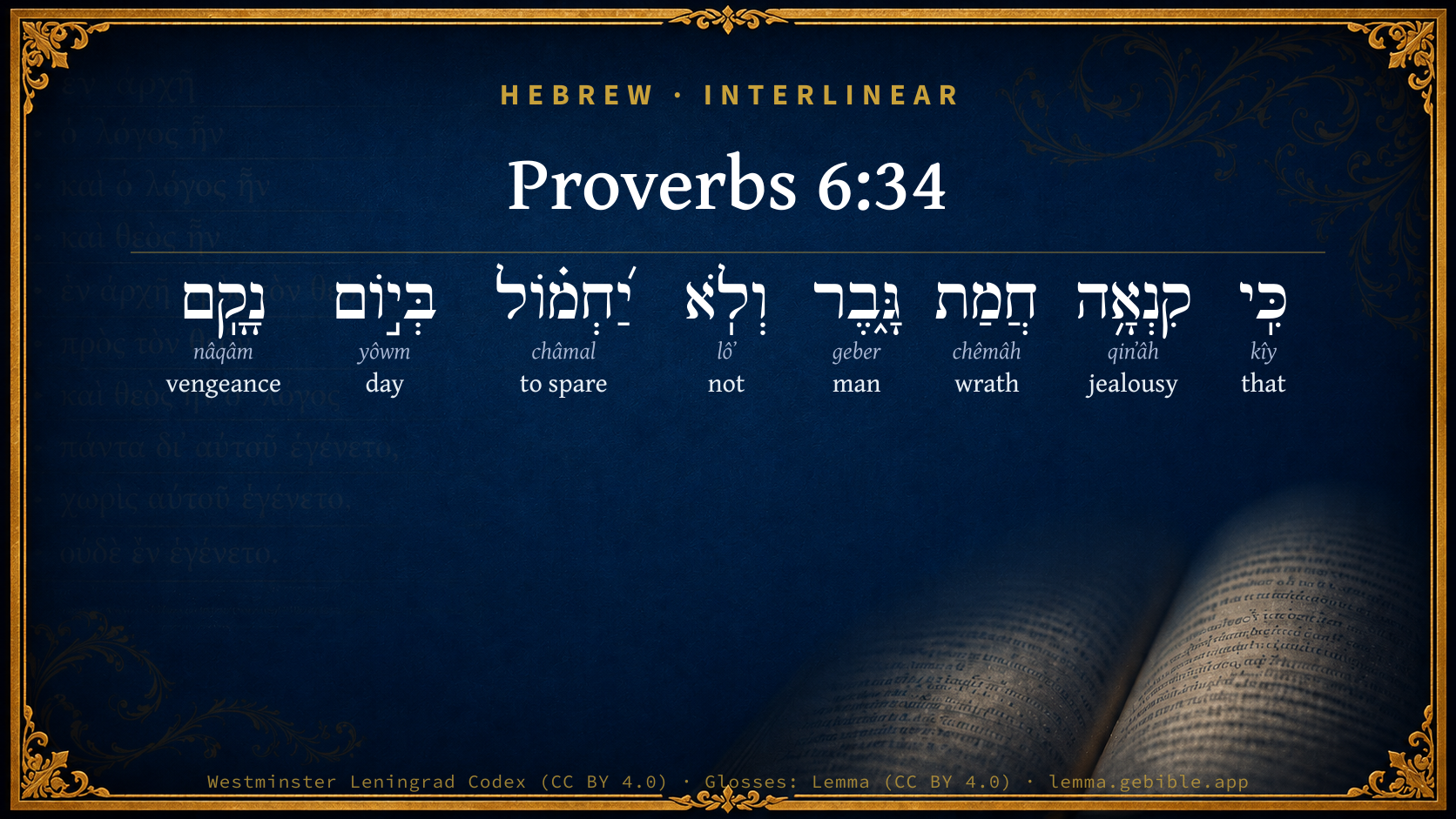
Proverbs 6:34

Hebrew (Westminster Leningrad Codex) Proverbs 6:34 appears in the Hebrew Old Testament. The text above is from the Westminster Leningrad Codex. Each word links to its Strong’s number, a concise gloss, and parsing drawn from the Open Scriptures Hebrew Bible morphology. Click any word for its full Brown-Driver-Briggs (BDB) entry.
Download image
Cite this verse

Proverbs 6:34 (World English Bible). Public Domain. Lemma interlinear Bible study tool, https://lemma.gebible.app/v/proverbs/6/34.

Show BibTeX & RIS
BibTeX
RIS
English Translation
For jealousy arouses the fury of the husband. He won't spare in the day of vengeance.
World English Bible · Public Domain
Download a study sheet

One document with this verse’s original text, its word-by-word gloss line, the meaning frame, cross-references with their text, attributed commentary, and full source and license credits — printable, and it pastes into notes with its structure intact.

This verse Autodidact and up

Study sheet (.html) Plain text (.txt)

A passage Seminary Student

Up to 50 verses in one chapter. A passage sheet keeps up to 6 commentary sources and 12 cross-references per verse, in the order this page ranks them, and says so on the sheet whenever that leaves anything out. Ask for a single verse and you get the Autodidact verse sheet above.

Everything on this page stays free to read, with no account — the sheet is a download of what is already on screen, not access to it.

Want to remove ads? Support Godless Engineer
Compare translations 3

The same verse in 3 English versions, stacked beneath the original-language interlinear above. Click any original word for its lexicon entry.

Each is an independent rendering of the whole verse — the interlinear is not word-aligned to these translations.

Highlighted words mark where these versions differ — a whole-verse word diff, not a word-by-word alignment.

  • World English Bible Public Domain
    For jealousy arouses the fury of the husband. He won't spare in the day of vengeance.
  • King James Version Public Domain
    For jealousy is the rage of a man: therefore he will not spare in the day of vengeance.
  • unfoldingWord Literal Text CC BY-SA 4.0
    For jealousy is the heat of a man, and he will not spare in the day of vengeance.

unfoldingWord Literal Text — © unfoldingWord, licensed CC BY-SA 4.0. Word-aligned USFM3 via Door43 (git.door43.org/unfoldingWord/en_ult).

Versions to compare (up to 4)

3 of 4 selected

Show all 18 translations

Every available English version of this verse, each an independent rendering of the whole verse.

  • World English Bible Public Domain
    For jealousy arouses the fury of the husband. He won't spare in the day of vengeance.
  • Berean Standard Bible Public Domain
    For jealousy enrages a husband, and he will show no mercy in the day of vengeance.
  • Majority Standard Bible Public Domain
    For jealousy enrages a husband, and he will show no mercy in the day of vengeance.
  • King James Version Public Domain
    For jealousy is the rage of a man: therefore he will not spare in the day of vengeance.
  • American Standard Version (1901) Public Domain
    For jealousy is the rage of a man; And he will not spare in the day of vengeance.
  • Revised Version (1885) Public Domain
    For jealousy is the rage of a man; and he will not spare in the day of vengeance.
  • Geneva Bible (1599) Public Domain
    For ielousie is the rage of a man: therefore he will not spare in the day of vengeance.
  • Douay-Rheims (1899) Public Domain
    Because the jealousy and rage of the husband will not spare in the day of revenge,
  • Young's Literal Translation Public Domain
    For jealousy `is' the fury of a man, And he doth not spare in a day of vengeance.
  • Literal Standard Version CC BY-SA 4.0
    For jealousy [is] the fury of a man, || And he does not spare in a day of vengeance.
  • Unlocked Literal Bible CC BY-SA 4.0
    For jealousy makes a man furious; he will show no mercy when he takes his revenge.
  • unfoldingWord Literal Text CC BY-SA 4.0
    For jealousy is the heat of a man, and he will not spare in the day of vengeance.
  • Darby Bible Public Domain
    For jealousy is the rage of a man, and he will not spare in the day of vengeance;
  • World Messianic Bible Public Domain
    For jealousy arouses the fury of the husband. He won’t spare in the day of vengeance.
  • Webster's Bible Public Domain
    For jealousy is the rage of a man: therefore he will not spare in the day of vengeance.
  • Free Bible Version CC BY-SA 4.0
    For jealousy makes a husband furious, and he won't hold back when he takes revenge.
  • Bible in Basic English Public Domain
    For bitter is the wrath of an angry husband; in the day of punishment he will have no mercy.
  • JPS Tanakh (1917) Public Domain
    For jealousy is the rage of a man, and he will not spare in the day of vengeance.

Literal Standard Version (2020), Covenant Press — licensed CC BY-SA 4.0. Text via the HelloAO Bible API (eBible.org). Unlocked Literal Bible (unfoldingWord) — licensed CC BY-SA 4.0. Text via the HelloAO Bible API (eBible.org). unfoldingWord Literal Text — © unfoldingWord, licensed CC BY-SA 4.0. Word-aligned USFM3 via Door43 (git.door43.org/unfoldingWord/en_ult). Free Bible Version, Dr. Jonathan Gallagher — licensed CC BY-SA 4.0. Text via the HelloAO Bible API (eBible.org).

Word by word

More ways to search: Search by grammar → Find every occurrence → Compare this word →

Practice this passage: Drill this verse → Learn its vocabulary →

About this verse

These counts appear in no published source. They are computed here, from the morphology-tagged text and Lemma’s own curated glosses. What Lemma adds →

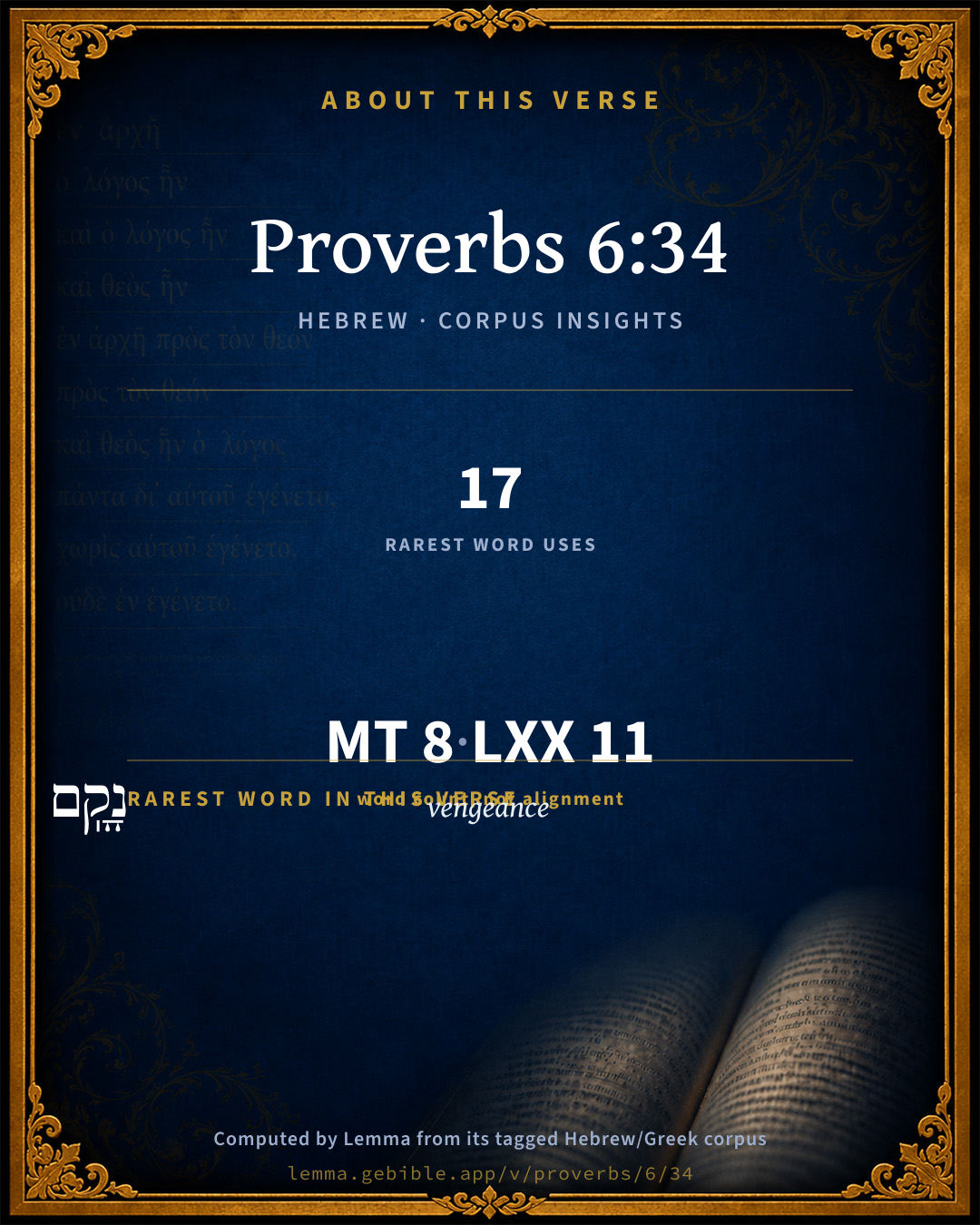
8
words
8
distinct lemmas
Wisdom
section

Notable vocabulary

The rarest word here is נָקָֽם vengeance H5359 — appearing just 17 times in the whole Hebrew Bible.

Shared distinctive vocabulary

נָקָֽם vengeance H5359 occurs in 17 verses of the Hebrew Bible. Also found in:

Grammatical profile

  • 1 verb
  • 5 nouns
  • 1 conjunction
  • 1 particle

Verb forms

  • יַ֝חְמ֗וֹל Qal · Imperfect

Hebrew & Septuagint length

In English translation the verse runs 16 words from the Hebrew and 19 from the Septuagint (LXX English) — closely comparable.

A rough comparison of the two English renderings, which tokenize alike — not a word-level alignment.

Word counts can differ between the Hebrew and the Greek without any difference in meaning — e.g. the Hebrew direct-object marker אֵת has no separate Greek word, and Greek often adds the article ὁ.

In the original languages it is 8 Hebrew tokens and 11 Greek tokens — but the two are counted differently (Hebrew bundles its prefixes and suffixes into one token; the Greek is in lemma form), so that isn’t a like-for-like length.

Cross-references

6

Topical passages linked to Proverbs 6:34 in the Treasury of Scripture Knowledge — connected by theme and wording, ordered by reader-vote popularity; previews shown in the World English Bible.

  • Numbers 5:14 and the spirit of jealousy comes on him, and he is jealous of his wife, and she is defiled: or if the spirit of jealousy comes on him, and he is jealous of his wife, and she isn't defiled:
  • Proverbs 27:4 Wrath is cruel, And anger is overwhelming; But who is able to stand before jealousy?
  • Song of Solomon 8:6 Set me as a seal on your heart, As a seal on your arm; For love is strong as death. Jealousy is as cruel as Sheol; Its flashes are flashes of fire, A very flame of Yahweh.
  • 1 Corinthians 10:22 Or do we provoke the Lord to jealousy? Are we stronger than he?
  • Numbers 25:11 Phinehas, the son of Eleazar, the son of Aaron the priest, has turned my wrath away from the children of Israel, in that he was jealous with my jealousy among them, so that I didn't consume the children of Israel in my jealousy.
  • Judges 19:29–30 When he was come into his house, he took a knife, and laid hold on his concubine, and divided her, limb by limb, into twelve pieces, and sent her throughout all the borders of Israel.

Cross-references courtesy of OpenBible.info (CC BY 4.0).

Hebrew and Greek witnesses Masoretic Hebrew ↔ Greek Septuagint

The same verse in the two great witnesses to the Old Testament, shown verse-for-verse.

These are two independent witnesses, not word-aligned to each other, and the Septuagint is shown in lemma (dictionary) form.

Hebrew Proverbs 6:34 Masoretic · Westminster Leningrad Codex

כִּֽי קִנְאָ֥ה חֲמַת גָּ֑בֶר וְלֹֽא יַ֝חְמ֗וֹל בְּי֣וֹם נָקָֽם

For jealousy arouses the fury of the husband. He won't spare in the day of vengeance.

World English Bible · Public Domain

Greek LXX Proverbs 6:34 Septuagint · lemma form

μεστός γάρ ζῆλος θυμός ἀνήρ αὐτός οὐ φείδομαι ἐν ἡμέρα κρίσις

For the soul of her husband is full of jealousy: he will not spare in the day of vengeance.

LXX2012 (modern English Septuagint) · Public Domain

On this verse, The Pulpit Commentary discusses the Septuagint’s reading. Read the note in Commentary ↓

Hebrew: Westminster Leningrad Codex (CC BY 4.0). Greek: Septuagint (public domain); English from LXX2012 (modern English Septuagint) (Public Domain). How the Septuagint differs from the Hebrew →

Commentary

Notes on Proverbs 6:34 from classic Christian and Jewish commentators (each source and its license shown beneath its notes). The classic Christian expositions comment on the surrounding passage and are grouped to its opening verse, so a note may address several verses; the Jewish commentaries on the Tanakh (Rashi and others) are per-verse, so they appear only where the commentator wrote on this verse.

Lemma curates 59 commentaries, every one of them public domain or Creative Commons licensed, each selected and text-cleaned for this edition rather than reprinted as found. About our sources →

Trapp's Complete Commentary

John Trapp

Pro 6:34 For jealousy [is] the rage of a man: therefore he will not spare in the day of vengeance.

Ver. 34. For jealousy is the rage.] Howbeit he may not kill the adulterer, though taken in the act, but prosecute the law against him, and appeal to the magistrate, who is the lord keeper of both tables - custos utriusque tabulae. But if no law will relieve a man, yet let him know that he shall do himself no disservice by making God his chancellor.

John Trapp, A Commentary or Exposition upon All the Books of the Old and New Testament (1647–1656) — public domain. Text from a community e-Sword module.

Geneva Bible (1599)

Geneva Bible translators

He showeth that man by nature seeketh his death, that hath abused his wife, and so concludeth, that neither God’s Law nor the law of nature admitteth any ransom for the adultery.

Geneva Bible (1599) marginal notes — public domain. Text via Bolls.life.

Jamieson, Fausset & Brown

Robert Jamieson, A. R. Fausset & David Brown

nor any terms of reconciliation be admitted.

regard--or, "accept" any ransom.

Next: Proverbs Chapter 7

Jamieson, Fausset & Brown — Commentary Critical and Explanatory on the Whole Bible (1871) — public domain (CC PDM 1.0). Text via the HelloAO Bible API.

Adam Clarke's Commentary

Verse 34. Jealousy is the rage of a man: therefore he will not spare] He will not, when he has detected the adulterer in the fact, wait for the slow progress of the law: it is then to him the day of vengeance; and in general, he avenges himself on the spot, as we see above.

Adam Clarke's Commentary on the Bible (1810–1826) — public domain. Text from a community e-Sword/MySword module.

Ellicott's Commentary for English Readers

(34) For jealousy is the rage of a man.—That is jealousy is furious, and cannot be appeased by bribes.

A Bible Commentary for English Readers, edited by Charles John Ellicott (1878–1897) — public domain. Text from a community e-Sword module.

The Cambridge Bible for Schools and Colleges

gen. ed. J. J. S. Perowne

34. therefore] Rather, and. Here is no question of compensation (Pro_6:35); the burning fire of jealousy will pursue thee unto death (Lev_20:10).

The Cambridge Bible for Schools and Colleges (gen. ed. J. J. S. Perowne; Cambridge University Press, 1878–1918) — public domain. Text from a community e-Sword module.

John Gill's Exposition

He will not regard any ransom,.... So that his case is much worse than, a thief's; if he is taken, he makes restitution according to law, and he is freed, and no more is said and done to him; and, at most, it is but parting with all the goods in his house; but in this case it will not do. In the Hebrew text it is, "he will not accept the face of any ransom" (z); that is, as the Targum paraphrases it,

"he will not accept the face of anyone that gives a gift:''

he will have no respect unto him for the sake of the gift; whatever gift is offered, be it what it will, for the ransom of his life from death, it will be disregarded;

neither will he rest content, though thou givest many gifts; increase them, and keep continually giving; nothing but the life of the adulterer will satisfy him, which he will either take away himself, or obtain it in a way of legal prosecution. How foolish therefore is the man that will expose his name and credit, his health and substance, his life in this world, and his soul in another, to utter ruin, for the sake of gratifying a sordid lust! This may be interpreted of God, who is a jealous God in matters of worship, and will not suffer idolatry to go unpunished, which is spiritual adultery.

(z) "non accipiet facies", Montanus; "non acceptabit faciem ullius redemptionis", Mercerus, Gejerus; "ullius lytri", Cocceius, Michaelis, Schultens.

Next: Proverbs Chapter 7

John Gill's Exposition of the Whole Bible (1746–1763) — public domain (CC PDM 1.0). Text via the HelloAO Bible API.

Matthew Poole's English Annotations

Is the rage of a man; it inflames a man with rage and fury against the adulterer.

In the day of vengeance; when he hath an opportunity to avenge himself upon the delinquent.

Matthew Poole's English Annotations on the Holy Bible (1683–1685) — public domain. Text from a community e-Sword/MySword module.

Whedon's Commentary on the Bible

Daniel D. Whedon

34. Jealousy… rage of a man — Or husband. He will have no pity or mercy. This and what follows are assigned as justifying the assertion in Pro_6:31.

Daniel D. Whedon (gen. ed.), Commentary on the Old and New Testaments (1874–1909) — public domain. Text from a community e-Sword module.

The Pulpit Commentary

For jealousy is the rage of a man: therefore he will not spare in the day of vengeance. The first hemistich is adduced as a reason for what has preceded, while the concluding hemistich and the following and last verses are a deduction strengthening what has been stated before, and also showing that the punishment will be inevitable. The general consensus of commentators and texts is to connect the two hemistiches of this verse. Thus the LXX, Mestolou yumora krisewv , "For the wrath of her husband filled with jealousy shall not spare in the day of judgment;" the Vulgate, Quia zelus et furor viri non parcet in die vindictae, "For the jealousy and rage of a man shall not spare in the day of vengeance;" the Syriac, Nam quia furor mariti plenus est zelotypia non parcet in die retributionis, "For because rage of a husband is full of jealousy he shall not spare in the day of retribution." So the Arabic, and the Tigarina Versio, and among the commentators Durandus. Dathe, Doderlein, Holden. But the Hebrew simply makes the statement, ki-kimah khamath-gaver, quia zelus excandescentia viri, i.e. , as in the Authorized Version, "for jealousy is the rage of a man," ki, equivalent to the Greek gar , "for" and kinah is the subject of the sentence. The Hebrew kinah is "jealousy" as in Pro_27:4, "Who is able to stand before envy?" or, as margin, "jealousy." The ordinary copulative verb "is" is best understood as connecting the subject and the predicate; "the rage of a man," Hebrew kamath-gaver, as above, i.e. "the glow of a man"s anger" (Delitzsch), or "a man"s fierce anger" (Zockler). Jealousy awakens and inflames the wrath and anger of a man or husband to its highest pitch. It evokes the strongest feelings for revenge. Man; Hebrew, gaver, equivalent to ish, "a man," in opposition to "a wife husband," as here. The word is chiefly found in poetry. Its derivation, from gavar, "to be strong," serves to bring out the idea also of the intensity or force of the jealousy it burns or rages with all the might of the man. The latter part of the verse in the Hebrew is simply, "and he will not spare (v"lo-yakh"mol) in the day of vengeance." The Authorized Version "therefore" serves to bring out the deduction, though it does net occur in the original. He will not spare; i.e. the injured husband will not show any clemency or mercy to the adulterer, the man who has wronged him so deeply. In the day of vengeance; Hebrew, b"yom nakam. The expression may refer to the time when the adulterer is brought before the judges, but more probably to every occasion on which the husband can exercise his vengeance. So Gejerus. For the expression, of. Isa_34:8, "The day of the Lord"s vengeance;" Job_20:28, "The day of his wrath;" and Pro_11:4, "The day of wrath." Jealousy is implacable. (see Son_8:6, "Jealousy is cruel as the grave

The Pulpit Commentary (1880–1919), ed. H.D.M. Spence-Jones & Joseph S. Exell — public domain. Text from a community e-Sword module.

John Wesley's Explanatory Notes

Rage - It enflames a man with rage. In the day - When he hath an opportunity to avenge himself.

John Wesley, Explanatory Notes Upon the Whole Bible (1754–1765) — public domain. Text via the GEBible commentary corpus.

Keil & Delitzsch

C. F. Keil & F. Delitzsch

One who has been stolen from is to be appeased, but not the injured husband.

34 For jealousy is the fury of a husband,

And he spareth not in the day of vengeance.

35 He regardeth not any ransom,

And is not contented though thou offerest to him gifts ever so great.

The connection marks קנאה as the subject; for it respects carnal intercourse with another's wife. Jealousy is not usually חמה, the glow of anger (from יחם, as שׁנה from ישׁן), but חמת־גּבר (constr. as שׂנת), the glow of a man's anger, who with the putting forth of all his manly strength will seek satisfaction to his wounded honour. גּבר, here significant for אישׁ, with the fundamental idea of strength, firmness; cf. Arab. jabr, to make fast, to put right again something broken in pieces, particularly a broken vessel, hence Algebra, properly the operation by which an incomplete magnitude is completed (Fl.). The following ולא־יחמּל (with the orthophonic Dagesh, as Pro 6:25 יחמּד, and with Makkeph) is connected with גבר, with definite reference to the man whom the faithless guest has made a cuckold. When the day comes in which the adultery brought to light demands and admits of vengeance, then, wounded in his right and in his honour, he knows no mercy; he pays no regard to any atonement or recompense by which the adulterer seeks to appease him and induce him not to inflict the punishment that is due: he does not consent, even though thou makest ever so great the gift whereby thou thinkest to gain him. The phrase נשׂא פנים, πρόσωπον λαμβάνειν, signifies elsewhere to receive the countenance, i.e., the appearance and the impression of a man, i.e., to let it impress one favourably; here it is used of the כּפר, i.e., the means by which covering, i.e., non-punishment, pardon of the crime, impunity of the guilty, is obtained. Regarding אבה, to consent to, vid., at Pro 1:10. שׂחד, Aram. שׂוּחד, is a gift, particularly bribery. That the language may again finally assume the form of an address, it beautifully rounds itself off.

Keil & Delitzsch — Biblical Commentary on the Old Testament (1861–1891) — public domain (CC PDM 1.0). Text via the HelloAO Bible API. (Old Testament only.)

unfoldingWord translationNotes

Door43 World Missions Community

furious

very angry

he will show no mercy

The "he" is the neighbor whose wife has committed adultery with another man. AT: "he will not limit the pain he will cause you" or "he will hurt you as much as he can" (See: Litotes)

when he takes his revenge

"in the moment of his revenge" or "when the moment arrives when he can take his revenge"

takes his revenge

If a person takes revenge, it is to cause hurt to the person who hurt him first.

compensation

payment by one who does wrong to the person to whom he has done wrong

he cannot be bought off

This can be stated in active form. AT: "you cannot pay him enough money to change his mind" (See: Active or Passive)

off, though

"off. This will be true even if"

translationWords

jealous

mercy

gift

unfoldingWord translationNotes — © Distant Shores Media and the Door43 World Missions Community, licensed CC BY-SA 4.0. Source: git.door43.org/Door43/en_tn.

Rashi

Rabbi Shlomo Yitzchaki (Rashi)

for jealousy For the jealousy of the Holy One, blessed be He, Who is the Mighty One over all, will be aroused to mete out retribution upon him, and He will not have pity on the day of vengeance.

Rashi on the Tanakh — English translations: “The Judaica Press complete Tanach with Rashi, translated by A. J. Rosenberg” (CC BY 4.0); “Pentateuch with Rashi's commentary by M. Rosenbaum and A.M. Silbermann, 1929-1934” (public domain); “The Metsudah Tanach series, Lakewood, N.J” (CC BY 4.0); and “The Book of Joshua, Metsudah Publications, 1997” (CC BY 4.0). Text via Sefaria.

Lesson kit

Teaching starters — assembled from the data on this page, not authored interpretation. Every prompt links to the verse data it draws on. Edit before teaching.

Proverbs, in the Wisdom, opens this verse with 8 words (8 distinct Hebrew lemmas). Its most distinctive word is nâqâm (“vengeance”). A historical commentator’s framing appears above. Read the whole chapter for the surrounding context.

Discussion questions

  1. What does “vengeance” (nâqâm) contribute to the verse as a whole?
  2. Leviticus 26:25 shares the word «vengeance» with this verse. How do the two illuminate each other?
  3. The translations on this page render this verse differently — a whole-verse word diff, not a word-by-word alignment. What might account for the different wordings?
  4. The verb «יַ֝חְמ֗וֹל» is Qal Imperfect. How does its form color the action?
  5. Reading how Trapp's Complete Commentary and Geneva Bible (1599) read this verse, where do the two commentators agree and where do they part?

Things to notice

Reading settings

Reading text

Shown beneath each verse's original-language words.

Old Testament
Old Testament edition

Read the OT as the Masoretic Hebrew (MT) or the Greek Septuagint (LXX).

English shown for the Greek Septuagint (in the Hebrew ↔ Greek comparison).

Comparing translations? Open the Compare panel on any verse page to stack up to four side by side.