Ezekiel 24:8

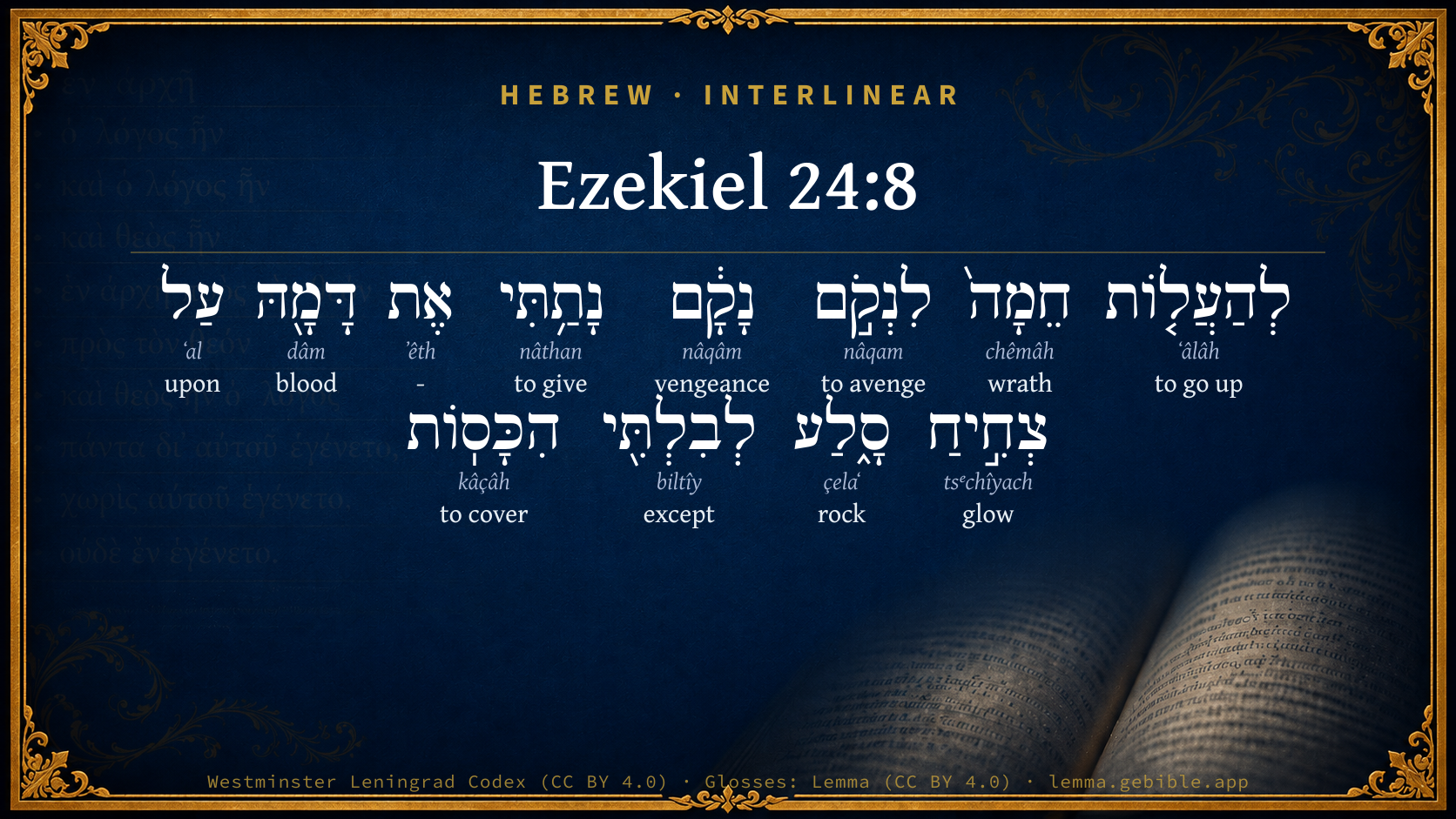
Hebrew (Westminster Leningrad Codex) Ezekiel 24:8 appears in the Hebrew Old Testament. The text above is from the Westminster Leningrad Codex. Each word links to its Strong’s number, a concise gloss, and parsing drawn from the Open Scriptures Hebrew Bible morphology. Click any word for its full Brown-Driver-Briggs (BDB) entry.
Download image
Cite this verse

Ezekiel 24:8 (World English Bible). Public Domain. Lemma interlinear Bible study tool, https://lemma.gebible.app/v/ezekiel/24/8.

Show BibTeX & RIS
BibTeX
RIS
English Translation
That it may cause wrath to come up to take vengeance, I have set her blood on the bare rock, that it should not be covered.
World English Bible · Public Domain
Download a study sheet

One document with this verse’s original text, its word-by-word gloss line, the meaning frame, cross-references with their text, attributed commentary, and full source and license credits — printable, and it pastes into notes with its structure intact.

This verse Autodidact and up

Study sheet (.html) Plain text (.txt)

A passage Seminary Student

Up to 50 verses in one chapter. A passage sheet keeps up to 6 commentary sources and 12 cross-references per verse, in the order this page ranks them, and says so on the sheet whenever that leaves anything out. Ask for a single verse and you get the Autodidact verse sheet above.

Everything on this page stays free to read, with no account — the sheet is a download of what is already on screen, not access to it.

Want to remove ads? Support Godless Engineer
Compare translations 3

The same verse in 3 English versions, stacked beneath the original-language interlinear above. Click any original word for its lexicon entry.

Each is an independent rendering of the whole verse — the interlinear is not word-aligned to these translations.

Highlighted words mark where these versions differ — a whole-verse word diff, not a word-by-word alignment.

  • World English Bible Public Domain
    That it may cause wrath to come up to take vengeance, I have set her blood on the bare rock, that it should not be covered.
  • King James Version Public Domain
    That it might cause fury to come up to take vengeance; I have set her blood upon the top of a rock, that it should not be covered.
  • unfoldingWord Literal Text CC BY-SA 4.0
    so it brings fury up to exact vengeance. I placed her blood on the smooth rock so it could not be covered.

unfoldingWord Literal Text — © unfoldingWord, licensed CC BY-SA 4.0. Word-aligned USFM3 via Door43 (git.door43.org/unfoldingWord/en_ult).

Versions to compare (up to 4)

3 of 4 selected

Show all 18 translations

Every available English version of this verse, each an independent rendering of the whole verse.

  • World English Bible Public Domain
    That it may cause wrath to come up to take vengeance, I have set her blood on the bare rock, that it should not be covered.
  • Berean Standard Bible Public Domain
    In order to stir up wrath and take vengeance, I have placed her blood on the bare rock, so that it would not be covered.’
  • Majority Standard Bible Public Domain
    In order to stir up wrath and take vengeance, I have placed her blood on the bare rock, so that it would not be covered.’
  • King James Version Public Domain
    That it might cause fury to come up to take vengeance; I have set her blood upon the top of a rock, that it should not be covered.
  • American Standard Version (1901) Public Domain
    That it may cause wrath to come up to take vengeance, I have set her blood upon the bare rock, that it should not be covered.
  • Revised Version (1885) Public Domain
    That it might cause fury to come up to take vengeance, I have set her blood upon the bare rock, that it should not be covered.
  • Geneva Bible (1599) Public Domain
    That it might cause wrath to arise, and take vengeance: euen I haue set her blood vpon an high rocke that it should not be couered.
  • Douay-Rheims (1899) Public Domain
    And that I might bring my indignation upon her, and take my vengeance: I have shed her blood upon the smooth rock, that it should not be covered.
  • Young's Literal Translation Public Domain
    To cause fury to come up to take vengeance, I have put her blood on a clear place of a rock -- not to be covered.
  • Literal Standard Version CC BY-SA 4.0
    To cause fury to come up to take vengeance, || I have put her blood on a clear place of a rock—not to be covered.
  • Unlocked Literal Bible CC BY-SA 4.0
    so it brings fury up to exact vengeance. I placed her blood on the smooth rock so it could not be covered.
  • unfoldingWord Literal Text CC BY-SA 4.0
    so it brings fury up to exact vengeance. I placed her blood on the smooth rock so it could not be covered.
  • Darby Bible Public Domain
    That it might cause fury to come up to execute vengeance, I have set her blood upon the bare rock, that it should not be covered.
  • World Messianic Bible Public Domain
    That it may cause wrath to come up to take vengeance, I have set her blood on the bare rock, that it should not be covered.”
  • Webster's Bible Public Domain
    That it might cause fury to come up to take vengeance; I have set her blood upon the top of a rock, that it should not be covered.
  • Free Bible Version CC BY-SA 4.0
    In my anger and to punish, I have spilled her blood openly on bare rock, so it wouldn't be covered up.
  • Bible in Basic English Public Domain
    In order that it might make wrath come up to give punishment, she has put her blood on the open rock, so that it may not be covered.
  • JPS Tanakh (1917) Public Domain
    that it might cause fury to come up, that vengeance might be taken, I have set her blood upon the bare rock, that it should not be covered.

Literal Standard Version (2020), Covenant Press — licensed CC BY-SA 4.0. Text via the HelloAO Bible API (eBible.org). Unlocked Literal Bible (unfoldingWord) — licensed CC BY-SA 4.0. Text via the HelloAO Bible API (eBible.org). unfoldingWord Literal Text — © unfoldingWord, licensed CC BY-SA 4.0. Word-aligned USFM3 via Door43 (git.door43.org/unfoldingWord/en_ult). Free Bible Version, Dr. Jonathan Gallagher — licensed CC BY-SA 4.0. Text via the HelloAO Bible API (eBible.org).

Word by word

More ways to search: Search by grammar → Find every occurrence → Compare this word →

Practice this passage: Drill this verse → Learn its vocabulary →

צְחִ֣יחַ
tsᵉchîyach
H6706
“glow of”
Noun, Common, Masculine, Singular, Construct
Part of Speech
Noun
Type
Common
Gender
Masculine
Number
Singular
State
Construct
Full BDB Definition

Origin: from H6705

TWOT: 1903b

shining or glaring surface, glow
  1. לְהַעֲל֤וֹת ʻâlâh H5927 “to go up” Preposition + Verb, Hiphil, Infinitive Construct
  2. חֵמָה֙ chêmâh H2534 “wrath” Noun, Common, Feminine, Singular, Absolute
  3. לִנְקֹ֣ם nâqam H5358 “to avenge” Preposition + Verb, Qal, Infinitive Construct
  4. נָקָ֔ם nâqâm H5359 “vengeance” Noun, Common, Masculine, Singular, Absolute
  5. נָתַ֥תִּי nâthan H5414 “to give” Verb, Qal, Perfect, 1st Person, Common, Singular
  6. אֶת ʼêth H853 “-” Particle, Direct Object
  7. דָּמָ֖הּ dâm H1818 “blood · her” Noun, Common, Masculine, Singular, Construct + Suffix, Personal, 3rd Person, Feminine, Singular
  8. עַל ʻal H5921 “upon” Preposition
  9. סָ֑לַע çelaʻ H5553 “rock” Noun, Common, Masculine, Singular, Absolute
  10. לְבִלְתִּ֖י biltîy H1115 “to/for · except” Preposition + Conjunction
  11. הִכָּסֽוֹת kâçâh H3680 “to cover” Verb, Niphal, Infinitive Construct

About this verse

These counts appear in no published source. They are computed here, from the morphology-tagged text and Lemma’s own curated glosses. What Lemma adds →

12
words
12
distinct lemmas
Prophets
section

Notable vocabulary

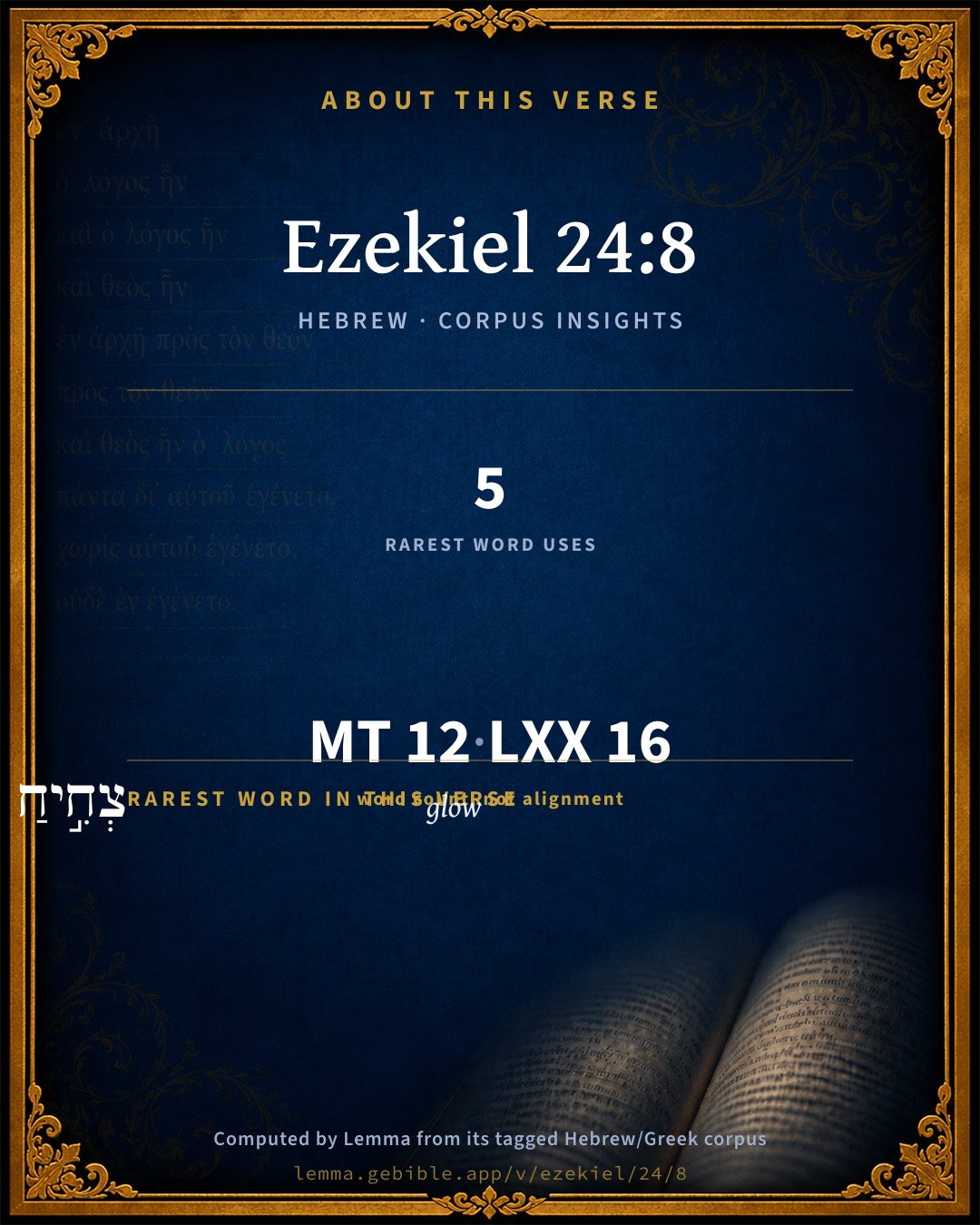
The rarest word here is צְחִ֣יחַ glow H6706 — appearing just 5 times in the whole Hebrew Bible.

Shared distinctive vocabulary

צְחִ֣יחַ glow H6706 occurs in 5 verses of the Hebrew Bible. Also found in:

Grammatical profile

  • 4 verbs
  • 5 nouns
  • 1 preposition
  • 1 conjunction
  • 1 particle

Verb forms

  • לְהַעֲל֤וֹת Hiphil · Infinitive Construct
  • לִנְקֹ֣ם Qal · Infinitive Construct
  • נָתַ֥תִּי Qal · Perfect
  • הִכָּסֽוֹת Niphal · Infinitive Construct

Hebrew & Septuagint length

In English translation the verse runs 26 words from the Hebrew and 26 from the Septuagint (LXX English) — the same length.

A rough comparison of the two English renderings, which tokenize alike — not a word-level alignment.

Word counts can differ between the Hebrew and the Greek without any difference in meaning — e.g. the Hebrew direct-object marker אֵת has no separate Greek word, and Greek often adds the article ὁ.

In the original languages it is 12 Hebrew tokens and 16 Greek tokens — but the two are counted differently (Hebrew bundles its prefixes and suffixes into one token; the Greek is in lemma form), so that isn’t a like-for-like length.

Cross-references

19

Topical passages linked to Ezekiel 24:8 in the Treasury of Scripture Knowledge — connected by theme and wording, ordered by reader-vote popularity; previews shown in the World English Bible.

  • Deuteronomy 32:21–22 They have moved me to jealousy with that which is not God; They have provoked me to anger with their vanities: I will move them to jealousy with those who are not a people; I will provoke them to anger with a foolish nation.
  • Deuteronomy 29:22–28 The generation to come, your children who shall rise up after you, and the foreigner who shall come from a far land, shall say, when they see the plagues of that land, and the sicknesses with which Yahweh has made it sick;
  • 2 Kings 22:17 Because they have forsaken me, and have burned incense to other gods, that they might provoke me to anger with all the work of their hands, therefore my wrath shall be kindled against this place, and it shall not be quenched.
  • 2 Chronicles 34:25 Because they have forsaken me, and have burned incense to other gods, that they might provoke me to anger with all the works of their hands; therefore is my wrath poured out on this place, and it shall not be quenched.
  • 2 Chronicles 36:16–17 but they mocked the messengers of God, and despised his words, and scoffed at his prophets, until the wrath of Yahweh arose against his people, until there was no remedy.
  • Jeremiah 7:18 The children gather wood, and the fathers kindle the fire, and the women knead the dough, to make cakes to the queen of the sky, and to pour out drink-offerings to other gods, that they may provoke me to anger.
  • Jeremiah 7:20 Therefore thus says the Lord Yahweh: Behold, my anger and my wrath shall be poured out on this place, on man, and on animal, and on the trees of the field, and on the fruit of the ground; and it shall burn, and shall not be quenched.
  • Jeremiah 15:1–4 Then said Yahweh to me, Though Moses and Samuel stood before me, yet my mind would not be toward this people: cast them out of my sight, and let them go forth.
  • Jeremiah 22:8–9 Many nations shall pass by this city, and they shall say every man to his neighbor, Why has Yahweh done thus to this great city?
  • Ezekiel 5:13 Thus shall my anger be accomplished, and I will cause my wrath toward them to rest, and I shall be comforted; and they shall know that I, Yahweh, have spoken in my zeal, when I have accomplished my wrath on them.
  • Ezekiel 8:17–18 Then he said to me, Have you seen [this], son of man? Is it a light thing to the house of Judah that they commit the abominations which they commit here? for they have filled the land with violence, and have turned again to provoke me to anger: and, behold, they put the branch to their nose.
  • Ezekiel 16:37–38 therefore see, I will gather all your lovers, with whom you have taken pleasure, and all those who you have loved, with all those who you have hated; I will even gather them against you on every side, and will uncover your nakedness to them, that they may see all your nakedness.
  • Ezekiel 22:30–31 I sought for a man among them, who should build up the wall, and stand in the gap before me for the land, that I should not destroy it; but I found none.
  • Ezekiel 23:45 Righteous men, they shall judge them with the judgment of adulteresses, and with the judgment of women who shed blood; because they are adulteresses, and blood is in their hands.
  • Matthew 7:2 For with whatever judgment you judge, you will be judged; and with whatever measure you measure, it will be measured to you.
  • 1 Corinthians 4:5 Therefore judge nothing before the time, until the Lord comes, who will both bring to light the hidden things of darkness, and reveal the counsels of the hearts. Then each man will get his praise from God.
  • Revelation 17:1–6 One of the seven angels who had the seven bowls came and spoke with me, saying, "Come here. I will show you the judgment of the great prostitute who sits on many waters,
  • Revelation 18:5–10 for her sins have reached to the sky, and God has remembered her iniquities.
  • Revelation 18:16 saying, 'Woe, woe, the great city, she who was dressed in fine linen, purple, and scarlet, and decked with gold and precious stones and pearls!

Cross-references courtesy of OpenBible.info (CC BY 4.0).

Hebrew and Greek witnesses Masoretic Hebrew ↔ Greek Septuagint

The same verse in the two great witnesses to the Old Testament, shown verse-for-verse.

These are two independent witnesses, not word-aligned to each other, and the Septuagint is shown in lemma (dictionary) form.

Hebrew Ezekiel 24:8 Masoretic · Westminster Leningrad Codex

לְהַעֲל֤וֹת חֵמָה֙ לִנְקֹ֣ם נָקָ֔ם נָתַ֥תִּי אֶת דָּמָ֖הּ עַל צְחִ֣יחַ סָ֑לַע לְבִלְתִּ֖י הִכָּסֽוֹת

That it may cause wrath to come up to take vengeance, I have set her blood on the bare rock, that it should not be covered.

World English Bible · Public Domain

Greek LXX Ezekiel 24:8 Septuagint · lemma form

ὁ ἀναβαίνω θυμός εἰς ἐκδίκησις ἐκδικέω δίδωμι ὁ αἷμα αὐτός ἐπί λεωπετρία ὁ μή καλύπτω αὐτός

that my wrath should come up for complete vengeance to be taken: I set her blood upon a smooth rock, so as not to cover it.

LXX2012 (modern English Septuagint) · Public Domain

Hebrew: Westminster Leningrad Codex (CC BY 4.0). Greek: Septuagint (public domain); English from LXX2012 (modern English Septuagint) (Public Domain). How the Septuagint differs from the Hebrew →

Targum (Aramaic paraphrase)

1

The Targum is the ancient Jewish Aramaic paraphrase of the Hebrew Scriptures — an interpretive translation, not the Hebrew text itself. Onkelos (literal) and Pseudo-Jonathan (expansive) render the Torah, and Jonathan the Prophets. Coverage is partial: where no permissively-licensed English translation exists for a verse, only the Aramaic is shown. This is verse-level text, not a word-by-word alignment to the Hebrew.

  1. Targum Jonathan Prophets (Joshua–Malachi)
    לְמֶעְבַד פּוּרְעֲנּוּת לְאִתְפְּרָעָא בִתְקוֹף גַלֵיתִי חוֹבֵיהוֹן עַל דַאֲשִׁידוּ דַם זַכַּאי בִּגְלֵי בְּדִיל דְלָא לְאִישְׁתַּבָּקָא:

    (no public-domain English translation for this verse)

    Targum Jonathan — Aramaic: “Mikraot Gedolot” (public domain). English: “Sefaria Community Translation” (CC0 1.0 (public-domain dedication)); “London "Chaldee Paraphrase," 1871” (public domain). Text via Sefaria.

Commentary

Notes on Ezekiel 24:8 from classic Christian and Jewish commentators (each source and its license shown beneath its notes). The classic Christian expositions comment on the surrounding passage and are grouped to its opening verse, so a note may address several verses; the Jewish commentaries on the Tanakh (Rashi and others) are per-verse, so they appear only where the commentator wrote on this verse.

Lemma curates 59 commentaries, every one of them public domain or Creative Commons licensed, each selected and text-cleaned for this edition rather than reprinted as found. About our sources →

Trapp's Complete Commentary

John Trapp

Eze 24:8 That it might cause fury to come up to take vengeance; I have set her blood upon the top of a rock, that it should not be covered.

Ver. 8. I have set her blood upon the top of a rock.] {a} Where it will be seen afar off and for a long time. As her sin was in propatulo, in open view, so, to cry quittance with her, shall her punishment likewise be; my visible vengeance shall follow her close at heels as a bloodhound.

{a} Agit cum illa ex lege talionis. - Pol.

John Trapp, A Commentary or Exposition upon All the Books of the Old and New Testament (1647–1656) — public domain. Text from a community e-Sword module.

Jamieson, Fausset & Brown

Robert Jamieson, A. R. Fausset & David Brown

That it might cause--God purposely let her so shamelessly pour the blood on the bare rock, "that it might" the more loudly and openly cry for vengeance from on high; and that the connection between the guilt and the punishment might be the more palpable. The blood of Abel, though the ground received it, still cries to heaven for vengeance (Gen 4:10-11); much more blood shamelessly exposed on the bare rock.

set her blood--She shall be paid back in kind (Mat 7:2). She openly shed blood, and her blood shall openly be shed.

Jamieson, Fausset & Brown — Commentary Critical and Explanatory on the Whole Bible (1871) — public domain (CC PDM 1.0). Text via the HelloAO Bible API.

Adam Clarke's Commentary

Verse 8. That it might cause fury] This very blood shall be against them, as the blood of Abel was against Cain.

Adam Clarke's Commentary on the Bible (1810–1826) — public domain. Text from a community e-Sword/MySword module.

Ellicott's Commentary for English Readers

(8) I have set.—Here God Himself is said to do that which has just been charged upon Jerusalem. There is no inconsistency between the statements; Jerusalem gloried in her crimes, and God made those crimes conspicuous as the cause of her punishment.

A Bible Commentary for English Readers, edited by Charles John Ellicott (1878–1897) — public domain. Text from a community e-Sword module.

The Cambridge Bible for Schools and Colleges

gen. ed. J. J. S. Perowne

8. I have set her blood] In Eze_24:7 it was Jerusalem herself who left her bloodshed uncovered; here, as usual in the prophet, this is an appointment of God, that he may bring up judgment because of it.

The Cambridge Bible for Schools and Colleges (gen. ed. J. J. S. Perowne; Cambridge University Press, 1878–1918) — public domain. Text from a community e-Sword module.

John Gill's Exposition

That it might cause fury to come up to take vengeance,.... Into the heart and mind of God, into his face, speaking after the manner of men; observing such gross and open wickedness, he determined within himself to show his resentment, manifest his wrath and displeasure, and take vengeance on such capital and impudent offenders:

I have set her blood upon the top of a rock, that it might not be covered; by way of just retaliation; that as her sin was publicly committed, and no repentance shown for it, so her punishment should be open and manifest to all the world, and no forgiveness should be granted her. The Targum is,

"I have revealed their sins, because they have shed innocent blood openly, that it might not be forgiven.''

John Gill's Exposition of the Whole Bible (1746–1763) — public domain (CC PDM 1.0). Text via the HelloAO Bible API.

Matthew Poole's English Annotations

This provoked the anger of the Lord, and raised his fury against them.

To come up, into the face of God, (after the manner of man,) as Eze 38:18.

To take vengeance; to God it appertains to take vengeance, to punish such sinners according to the nature of their sin.

I have set her blood upon the top of a rock; God will openly punish, and in such manner as shall not be soon forgotten; they set it on a rock when they shed it with cruelty, God will set it on a rock when he punisheth it with severity.

That it should not be covered; that it be not forgotten, or go unpunished; nor yet punished in a corner; all this inquisition and execution shall be public in the sight of many nations.

Matthew Poole's English Annotations on the Holy Bible (1683–1685) — public domain. Text from a community e-Sword/MySword module.

John Wesley's Explanatory Notes

I have set - I will openly punish, and in such a manner as shall not be soon forgotten.

John Wesley, Explanatory Notes Upon the Whole Bible (1754–1765) — public domain. Text via the GEBible commentary corpus.

Rashi

Rabbi Shlomo Yitzchaki (Rashi)

So that it might bring up fury before Me. I [therefore (Etz Chaim ms.)] commanded that blood not to be absorbed into the ground, in order that it might be remembered, so that My vengeance might be taken.

Rashi on the Tanakh — English translations: “The Judaica Press complete Tanach with Rashi, translated by A. J. Rosenberg” (CC BY 4.0); “Pentateuch with Rashi's commentary by M. Rosenbaum and A.M. Silbermann, 1929-1934” (public domain); “The Metsudah Tanach series, Lakewood, N.J” (CC BY 4.0); and “The Book of Joshua, Metsudah Publications, 1997” (CC BY 4.0). Text via Sefaria.

Lesson kit

Teaching starters — assembled from the data on this page, not authored interpretation. Every prompt links to the verse data it draws on. Edit before teaching.

Ezekiel, in the Prophets, opens this verse with 12 words (12 distinct Hebrew lemmas). Its most distinctive word is tsᵉchîyach (“glow”). A historical commentator’s framing appears above. Read the whole chapter for the surrounding context.

Discussion questions

  1. How does “glow” (tsᵉchîyach) shape what this verse is saying?
  2. How does Nehemiah 4:13, which shares the word «glow», read alongside this verse?
  3. These translations render this verse differently. What is at stake in choosing one wording over another?
  4. «לְהַעֲל֤וֹת» is a Hiphil Infinitive Construct verb. How does that grammatical form shape the action described?
  5. Compare how Trapp's Complete Commentary and Jamieson, Fausset & Brown read this verse. Where do they agree or differ?

Things to notice

Reading settings

Reading text

Shown beneath each verse's original-language words.

Old Testament
Old Testament edition

Read the OT as the Masoretic Hebrew (MT) or the Greek Septuagint (LXX).

English shown for the Greek Septuagint (in the Hebrew ↔ Greek comparison).

Comparing translations? Open the Compare panel on any verse page to stack up to four side by side.