
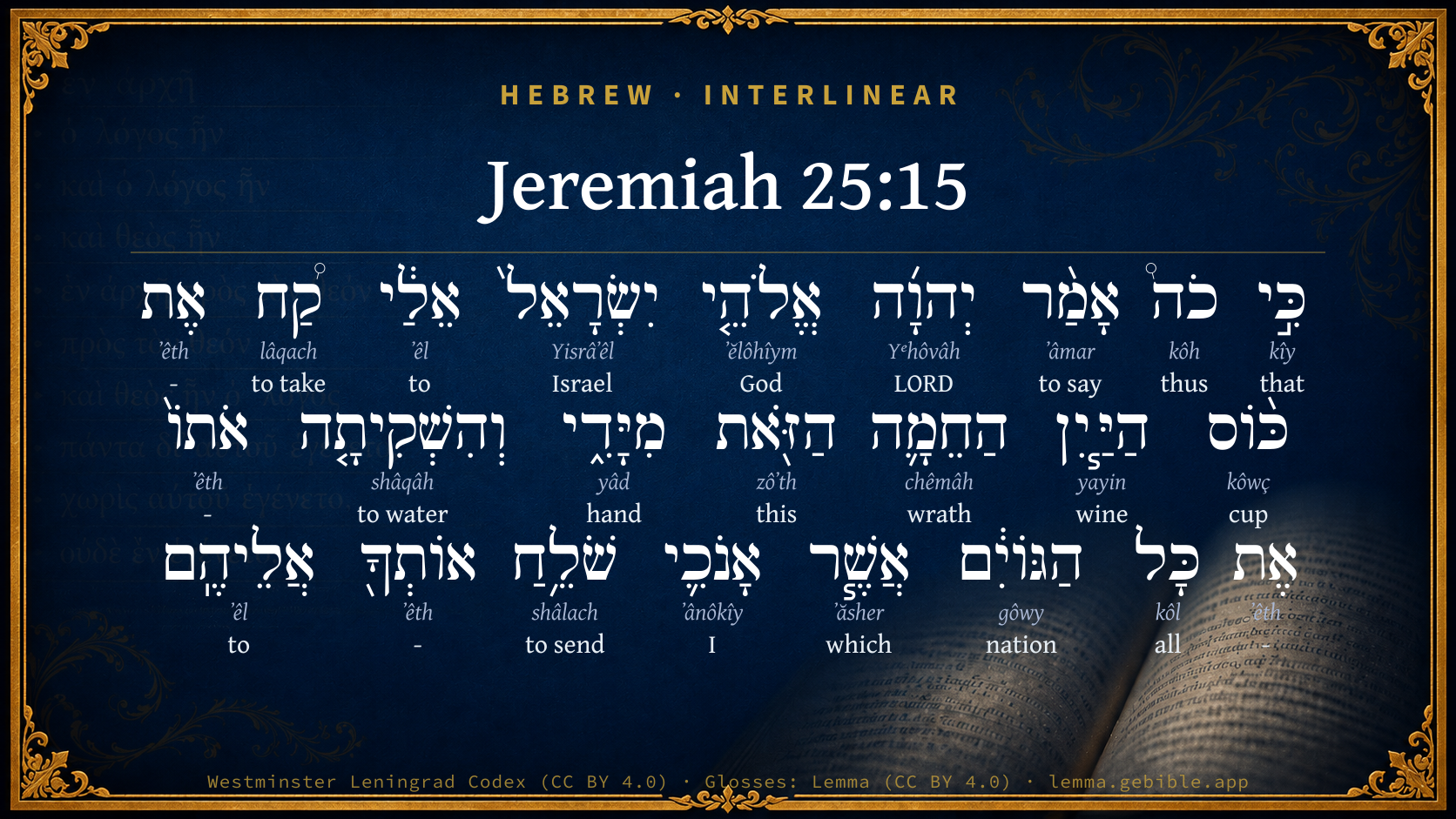
Jeremiah 25:15

Hebrew (Westminster Leningrad Codex) Jeremiah 25:15 appears in the Hebrew Old Testament. The text above is from the Westminster Leningrad Codex. Each word links to its Strong’s number, a concise gloss, and parsing drawn from the Open Scriptures Hebrew Bible morphology. Click any word for its full Brown-Driver-Briggs (BDB) entry.
Download image
Cite this verse

Jeremiah 25:15 (World English Bible). Public Domain. Lemma interlinear Bible study tool, https://lemma.gebible.app/v/jeremiah/25/15.

Show BibTeX & RIS
BibTeX
RIS
English Translation
For thus says Yahweh, the God of Israel, to me: take this cup of the wine of wrath at my hand, and cause all the nations, to whom I send you, to drink it.
World English Bible · Public Domain
Download a study sheet

One document with this verse’s original text, its word-by-word gloss line, the meaning frame, cross-references with their text, attributed commentary, and full source and license credits — printable, and it pastes into notes with its structure intact.

This verse Autodidact and up

Study sheet (.html) Plain text (.txt)

A passage Seminary Student

Up to 50 verses in one chapter. A passage sheet keeps up to 6 commentary sources and 12 cross-references per verse, in the order this page ranks them, and says so on the sheet whenever that leaves anything out. Ask for a single verse and you get the Autodidact verse sheet above.

Everything on this page stays free to read, with no account — the sheet is a download of what is already on screen, not access to it.

Want to remove ads? Support Godless Engineer
Compare translations 3

The same verse in 3 English versions, stacked beneath the original-language interlinear above. Click any original word for its lexicon entry.

Each is an independent rendering of the whole verse — the interlinear is not word-aligned to these translations.

Highlighted words mark where these versions differ — a whole-verse word diff, not a word-by-word alignment.

  • World English Bible Public Domain
    For thus says Yahweh, the God of Israel, to me: take this cup of the wine of wrath at my hand, and cause all the nations, to whom I send you, to drink it.
  • King James Version Public Domain
    For thus saith the LORD God of Israel unto me; Take the wine cup of this fury at my hand, and cause all the nations, to whom I send thee, to drink it.
  • unfoldingWord Literal Text CC BY-SA 4.0
    For thus says Yahweh, God of Israel, to me, “Take this cup of the wine of the wrath from my hand, and you will make all of the nations to which I am sending you drink it.

unfoldingWord Literal Text — © unfoldingWord, licensed CC BY-SA 4.0. Word-aligned USFM3 via Door43 (git.door43.org/unfoldingWord/en_ult).

Versions to compare (up to 4)

3 of 4 selected

Show all 18 translations

Every available English version of this verse, each an independent rendering of the whole verse.

  • World English Bible Public Domain
    For thus says Yahweh, the God of Israel, to me: take this cup of the wine of wrath at my hand, and cause all the nations, to whom I send you, to drink it.
  • Berean Standard Bible Public Domain
    This is what the LORD, the God of Israel, said to me: “Take from My hand this cup of the wine of wrath, and make all the nations to whom I send you drink from it.
  • Majority Standard Bible Public Domain
    This is what the LORD, the God of Israel, said to me: “Take from My hand this cup of the wine of wrath, and make all the nations to whom I send you drink from it.
  • King James Version Public Domain
    For thus saith the LORD God of Israel unto me; Take the wine cup of this fury at my hand, and cause all the nations, to whom I send thee, to drink it.
  • American Standard Version (1901) Public Domain
    For thus saith Jehovah, the God of Israel, unto me: take this cup of the wine of wrath at my hand, and cause all the nations, to whom I send thee, to drink it.
  • Revised Version (1885) Public Domain
    For thus saith the LORD, the God of Israel, unto me: Take the cup of the wine of this fury at my hand, and cause all the nations, to whom I send thee, to drink it.
  • Geneva Bible (1599) Public Domain
    For thus hath the Lord God of Israel spoken vnto me, Take the cuppe of wine of this mine indignation at mine hand, and cause all the nations, to whome I sende thee, to drinke it.
  • Douay-Rheims (1899) Public Domain
    For thus saith the Lord of hosts the God of Israel: Take the cup of wine of this fury at my hand: and thou shalt make all nations to drink thereof, unto which I shall send thee.
  • Young's Literal Translation Public Domain
    `For thus said Jehovah God of Israel unto me, Take the wine cup of this fury out of My hand, and thou hast caused all the nations to drink it unto whom I am sending thee;
  • Literal Standard Version CC BY-SA 4.0
    For thus said YHWH, God of Israel, to me: “Take the wine cup of this fury out of My hand, and you have caused all the nations to drink it to whom I am sending you;
  • Unlocked Literal Bible CC BY-SA 4.0
    For Yahweh, God of Israel, said this to me, “Take this cup of the wine of fury from my hand and make all the nations to which I am sending you drink it.
  • unfoldingWord Literal Text CC BY-SA 4.0
    For thus says Yahweh, God of Israel, to me, “Take this cup of the wine of the wrath from my hand, and you will make all of the nations to which I am sending you drink it.
  • Darby Bible Public Domain
    For thus hath Jehovah the God of Israel said unto me: Take the cup of the wine of this fury at my hand, and cause all the nations to whom I send thee to drink it.
  • World Messianic Bible Public Domain
    For the LORD, the God of Israel, says to me: “Take this cup of the wine of wrath from my hand, and cause all the nations to whom I send you to drink it.
  • Webster's Bible Public Domain
    For thus saith the LORD God of Israel to me; Take the wine cup of this fury at my hand, and cause all the nations, to whom I send thee, to drink it.
  • Free Bible Version CC BY-SA 4.0
    This is what the Lord, the God of Israel, told me: Take this cup I'm handing to you. It contains the wine of my anger. You are to make all the nations I send you to drink from it.
  • Bible in Basic English Public Domain
    For this is what the Lord, the God of Israel, has said to me: Take the cup of the wine of this wrath from my hand, and make all the nations to whom I send you take of it.
  • JPS Tanakh (1917) Public Domain
    For thus saith the LORD, the God of Israel, unto me: Take this cup of the wine of fury at My hand, and cause all the nations, to whom I send thee, to drink it.

Literal Standard Version (2020), Covenant Press — licensed CC BY-SA 4.0. Text via the HelloAO Bible API (eBible.org). Unlocked Literal Bible (unfoldingWord) — licensed CC BY-SA 4.0. Text via the HelloAO Bible API (eBible.org). unfoldingWord Literal Text — © unfoldingWord, licensed CC BY-SA 4.0. Word-aligned USFM3 via Door43 (git.door43.org/unfoldingWord/en_ult). Free Bible Version, Dr. Jonathan Gallagher — licensed CC BY-SA 4.0. Text via the HelloAO Bible API (eBible.org).

Word by word

More ways to search: Search by grammar → Find every occurrence → Compare this word →

Practice this passage: Drill this verse → Learn its vocabulary →

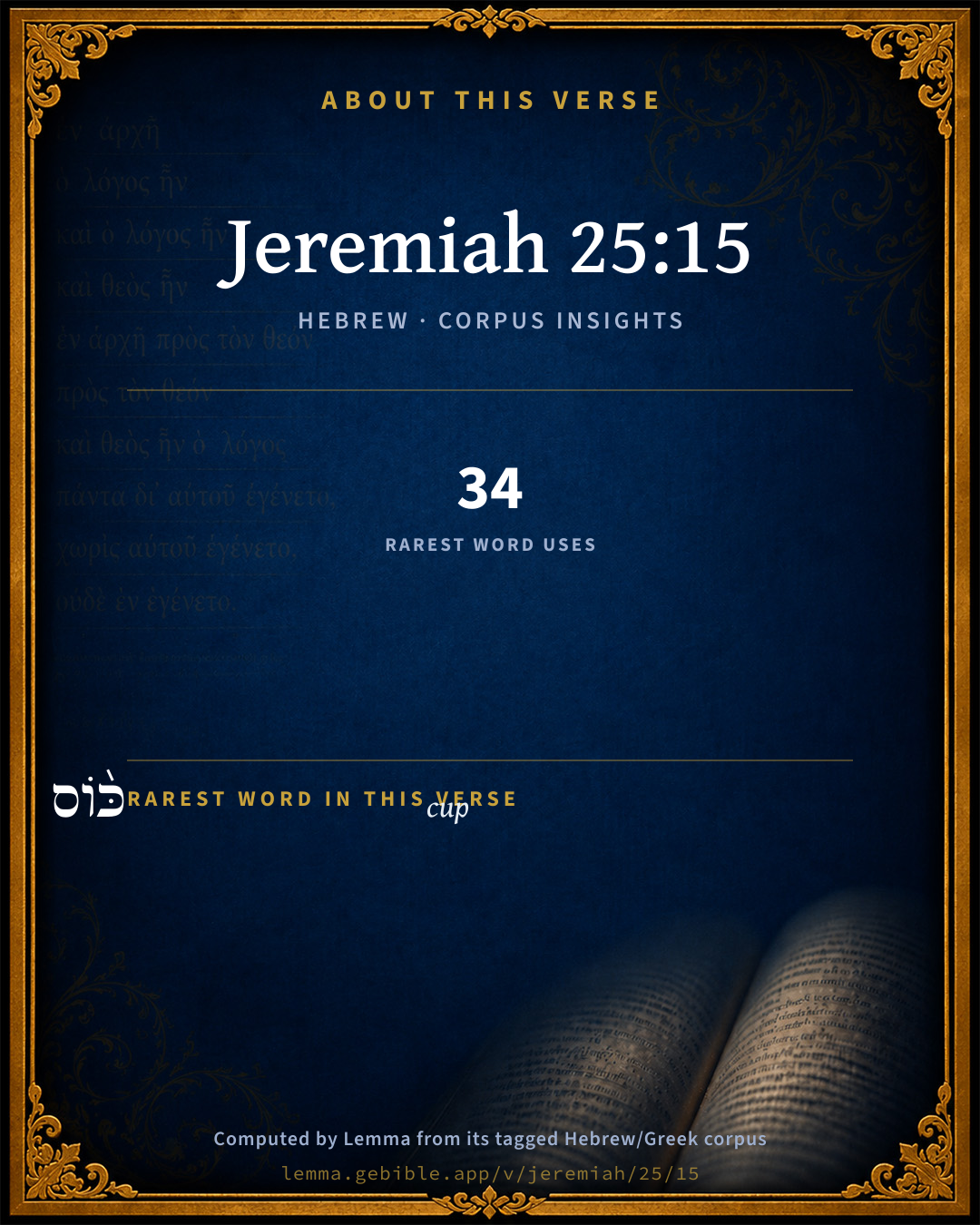
כּ֨וֹס
kôwç
H3563
“cup of”
Noun, Common, Feminine, Singular, Construct
Part of Speech
Noun
Type
Common
Gender
Feminine
Number
Singular
State
Construct
Full BDB Definition

Origin: from an unused root meaning to hold together

TWOT: 965 , 966

cup (noun feminine) - a kind of owl (an unclean bird) (noun masculine)
  1. כִּ֣י kîy H3588 “that” Conjunction
  2. כֹה֩ kôh H3541 “thus” Adverb
  3. אָמַ֨ר ʼâmar H559 “to say” Verb, Qal, Perfect, 3rd Person, Masculine, Singular
  4. יְהוָ֜ה Yᵉhôvâh H3068 “LORD” Noun, Proper
  5. אֱלֹהֵ֤י ʼĕlôhîym H430 “God(s) of” Noun, Common, Masculine, Plural, Construct
  6. יִשְׂרָאֵל֙ Yisrâʼêl H3478 “Israel” Noun, Proper
  7. אֵלַ֔י ʼêl H413 “to · me” Preposition + Suffix, Personal, 1st Person, Common, Singular
  8. קַ֠ח lâqach H3947 “take” Verb, Qal, Imperative, 2nd Person, Masculine, Singular
  9. אֶת ʼêth H853 “-” Particle, Direct Object
  10. הַיַּ֧יִן yayin H3196 “the · wine” Particle, Definite Article + Noun, Common, Masculine, Singular, Absolute
  11. הַחֵמָ֛ה chêmâh H2534 “the · wrath” Particle, Definite Article + Noun, Common, Feminine, Singular, Absolute
  12. הַזֹּ֖את zôʼth H2063 “the · this” Particle, Definite Article + Pronoun, Demonstrative, Feminine, Singular
  13. מִיָּדִ֑י yâd H3027 “from · hand · my” Preposition + Noun, Common, Both, Singular, Construct + Suffix, Personal, 1st Person, Common, Singular
  14. וְהִשְׁקִיתָ֤ה shâqâh H8248 “and · to water” Conjunction + Verb, Hiphil, Sequential Perfect, 2nd Person, Masculine, Singular
  15. אֹתוֹ֙ ʼêth H853 “- · him” Particle, Direct Object + Suffix, Personal, 3rd Person, Masculine, Singular
  16. אֶת ʼêth H853 “-” Particle, Direct Object
  17. כָּל kôl H3605 “all of” Noun, Common, Masculine, Singular, Construct
  18. הַגּוֹיִ֔ם gôwy H1471 “the · nations” Particle, Definite Article + Noun, Common, Masculine, Plural, Absolute
  19. אֲשֶׁ֧ר ʼăsher H834 “which” Particle, Relative
  20. אָנֹכִ֛י ʼânôkîy H595 “I” Pronoun, Personal, 1st Person, Common, Singular
  21. שֹׁלֵ֥חַ shâlach H7971 “sending” Verb, Qal, Participle Active, Masculine, Singular, Absolute
  22. אוֹתְךָ֖ ʼêth H853 “- · you” Particle, Direct Object + Suffix, Personal, 2nd Person, Masculine, Singular
  23. אֲלֵיהֶֽם ʼêl H413 “to · them” Preposition + Suffix, Personal, 3rd Person, Masculine, Plural

About this verse

These counts appear in no published source. They are computed here, from the morphology-tagged text and Lemma’s own curated glosses. What Lemma adds →

24
words
20
distinct lemmas
Prophets
section

Shared distinctive vocabulary

כּ֨וֹס cup H3563 occurs in 29 verses of the Hebrew Bible. Also found in:

Grammatical profile

  • 4 verbs
  • 9 nouns
  • 2 pronouns
  • 2 prepositions
  • 1 conjunction
  • 1 adverb
  • 5 particles

Verb forms

  • אָמַ֨ר Qal · Perfect
  • קַ֠ח Qal · Imperative
  • וְהִשְׁקִיתָ֤ה Hiphil · Sequential Perfect
  • שֹׁלֵ֥חַ Qal · Participle Active

Repetition

A word recurs within this verse — often emphatic in Hebrew:

  • אֵלַ֔י to H413 ×2

Cross-references

9

Topical passages linked to Jeremiah 25:15 in the Treasury of Scripture Knowledge — connected by theme and wording, ordered by reader-vote popularity; previews shown in the World English Bible.

  • Psalms 75:8 For in the hand of Yahweh there is a cup, Full of foaming wine mixed with spices. He pours it out. Indeed the wicked of the earth drink and drink it to its very dregs.
  • Isaiah 51:17 Awake, awake, stand up, Jerusalem, that have drunk at the hand of Yahweh the cup of his wrath; you have drunken the bowl of the cup of staggering, and drained it.
  • Job 21:20 Let his own eyes see his destruction. Let him drink of the wrath of the Almighty.
  • Revelation 14:10 he also will drink of the wine of the wrath of God, which is prepared unmixed in the cup of his anger. He will be tormented with fire and sulfur in the presence of the holy angels, and in the presence of the Lamb.
  • Isaiah 51:22 Thus says your Lord Yahweh, and your God who pleads the cause of his people, Behold, I have taken out of your hand the cup of staggering, even the bowl of the cup of my wrath; you shall no more drink it again:
  • Jeremiah 51:7 Babylon has been a golden cup in Yahweh's hand, who made all the earth drunken: the nations have drunk of her wine; therefore the nations are mad.
  • Psalms 11:6 On the wicked he will rain blazing coals; Fire, sulfur, and scorching wind shall be the portion of their cup.
  • Jeremiah 13:12–14 Therefore you shall speak to them this word: Thus says Yahweh, the God of Israel, Every bottle shall be filled with wine: and they shall tell you, Do we not certainly know that every bottle shall be filled with wine?
  • Revelation 14:19 The angel thrust his sickle into the earth, and gathered the vintage of the earth, and threw it into the great winepress of the wrath of God.

Cross-references courtesy of OpenBible.info (CC BY 4.0).

Hebrew and Greek witnesses Masoretic Hebrew ↔ Greek Septuagint

The same verse in the two great witnesses to the Old Testament, shown verse-for-verse.

These are two independent witnesses, not word-aligned to each other, and the Septuagint is shown in lemma (dictionary) form.

Hebrew Jeremiah 25:15 Masoretic · Westminster Leningrad Codex

כִּ֣י כֹה֩ אָמַ֨ר יְהוָ֜ה אֱלֹהֵ֤י יִשְׂרָאֵל֙ אֵלַ֔י קַ֠ח אֶת כּ֨וֹס הַיַּ֧יִן הַחֵמָ֛ה הַזֹּ֖את מִיָּדִ֑י וְהִשְׁקִיתָ֤ה אֹתוֹ֙ אֶת כָּל הַגּוֹיִ֔ם אֲשֶׁ֧ר אָנֹכִ֛י שֹׁלֵ֥חַ אוֹתְךָ֖ אֲלֵיהֶֽם

For thus says Yahweh, the God of Israel, to me: take this cup of the wine of wrath at my hand, and cause all the nations, to whom I send you, to drink it.

World English Bible · Public Domain

Greek LXX Structure differs

In the Septuagint, Jeremiah is about an eighth shorter than the Hebrew and arranges its material differently — the Oracles Against the Nations (Hebrew chapters 46–51) appear in the middle of the Greek book, after 25:13. Because the chapter and verse boundaries do not line up, a verse-for-verse comparison with the Hebrew is not shown.

A verse-for-verse comparison isn’t shown here because the chapters and verses don’t line up. Switch to the LXX edition with the MT / LXX toggle above to read the Greek directly.

On this verse, Ellicott's Commentary for English Readers discusses the Septuagint’s reading. Read the note in Commentary ↓

Hebrew: Westminster Leningrad Codex (CC BY 4.0). Greek: Septuagint (public domain); English from a public-domain English Septuagint. How the Septuagint differs from the Hebrew →

Targum (Aramaic paraphrase)

1

The Targum is the ancient Jewish Aramaic paraphrase of the Hebrew Scriptures — an interpretive translation, not the Hebrew text itself. Onkelos (literal) and Pseudo-Jonathan (expansive) render the Torah, and Jonathan the Prophets. Coverage is partial: where no permissively-licensed English translation exists for a verse, only the Aramaic is shown. This is verse-level text, not a word-by-word alignment to the Hebrew.

  1. Targum Jonathan Prophets (Joshua–Malachi)
    אֲרֵי כִדְנַן אֲמַר יְיָ אֱלָהָא דְיִשְׂרָאֵל לִי קַבֵּיל יַת כָּסָא דַחֲמַר לְוָטָא הָדֵין מִן קֳדָמַי וְתַשְׁרֵי יָתֵיהּ יַת כָּל עַמְמַיָא דַאֲנָא שְׁלַח יָתָךְ עֲלֵיהוֹן:

    (no public-domain English translation for this verse)

    Targum Jonathan — Aramaic: “Mikraot Gedolot” (public domain). English: “Sefaria Community Translation” (CC0 1.0 (public-domain dedication)); “London "Chaldee Paraphrase," 1871” (public domain). Text via Sefaria.

Commentary

Notes on Jeremiah 25:15 from classic Christian and Jewish commentators (each source and its license shown beneath its notes). The classic Christian expositions comment on the surrounding passage and are grouped to its opening verse, so a note may address several verses; the Jewish commentaries on the Tanakh (Rashi and others) are per-verse, so they appear only where the commentator wrote on this verse.

Lemma curates 59 commentaries, every one of them public domain or Creative Commons licensed, each selected and text-cleaned for this edition rather than reprinted as found. About our sources →

The Cambridge Bible for Schools and Colleges

gen. ed. J. J. S. Perowne

15–29. The wine-cup of the Lord’s fury to be drunk by all the nations.

For confusion and dismay, expressed under the figure of intoxication, see below. Overthrow at the hands of the Chaldaeans is to be the fate of the nations.

The genuineness of the passage as a whole has been challenged by Schwally and Du., but on insufficient grounds, although it has probably received a certain editorial expansion. Co. considers the whole ch. to have a genuine Jeremianic basis, and Gi. agrees as to Jer_25:15-19, but brackets Jer_25:20-31 as later insertions, adducing among other reasons the placing of Judah and her neighbours on a level of comparison, contrary to the spirit of the genuine portions of Jeremiah, and the vagueness of the expressions, “all the kings of Tyre,” “of Zidon,” etc. (Jer_25:22).

the cup of the wine of this fury] The likening of disaster to a bitter and intoxicating draught is frequent in the Bible. See chs. Jer_13:12 f., Jer_49:12, Jer_51:7; Job_21:20; Psa_60:3; Psa_75:8; Isa_51:17; Isa_51:22; Eze_23:31; Hab_2:15; Rev_14:8; Rev_17:4; Rev_18:3.

The Cambridge Bible for Schools and Colleges (gen. ed. J. J. S. Perowne; Cambridge University Press, 1878–1918) — public domain. Text from a community e-Sword module.

Trapp's Complete Commentary

John Trapp

Jer 25:15 For thus saith the LORD God of Israel unto me; Take the wine cup of this fury at my hand, and cause all the nations, to whom I send thee, to drink it.

Ver. 15. Take the wine cup of this fury.] {a} Or, Take this smoking wine cup. A "cup" is oft put for "affliction," and wine for extreme confusion and wrath. Poison in wine works more furiously than in water. {Psa 75:8}

And cause all the nations.] According to that power which I have put into thine hands. {Jer 1:10} Vengeance is still in readiness for the disobedient, {2Co 10:6} as ready every whit in God’s hand, as in the minister’s mouth, who threateneth it.

{a} Utitur demonstratione seu ostento divino.

John Trapp, A Commentary or Exposition upon All the Books of the Old and New Testament (1647–1656) — public domain. Text from a community e-Sword module.

Joseph Benson's Commentary

Jer 25:15-16. Thus saith the Lord, Take the wine-cup of this fury, &c. — “Those circumstances which constitute the good and evil of human life are often represented in Scripture as the ingredients of a cup, which God, as master of a feast, mixes up, and distributes to the several guests as he thinks fit. Hence, when our Saviour asks James and John, whether they were able to drink of the cup which he was to drink of, he means, whether they had resolution and patience to undergo the like sufferings as his Father had allotted for him. And in the like sense he prays, If it be possible let this cup pass from me. Accordingly, by this image of the wine-cup of God’s wrath, we are to understand those dreadful judgments which an incensed God was about to inflict on the objects of his displeasure. And Jeremiah the prophet, who announced them, is considered as acting the part of a cup-bearer, carrying the cup round to those who were appointed to drink of it; the effects of which were to appear in the intoxication, that is, the terror and astonishment, the confusion and desolation, that should prevail among them.” — Blaney. See notes on Psa 11:6; Psa 75:8; Isa 51:21.

Joseph Benson's Commentary on the Old and New Testaments (1811–1818) — public domain. Text from a community e-Sword module.

Keil & Delitzsch

C. F. Keil & F. Delitzsch

The cup of God's fury. - Jer 25:15. "For thus hath Jahveh, the God of Israel, said to me: Take this cup of the wine of fury at my hand, and give it to drink to all the peoples to whom I send thee, Jer 25:16. That they may drink, and reel, and be mad, because of the sword that I send amongst them. Jer 25:17. And I took the cup at the hand of Jahveh, and made all the peoples drink it to whom Jahveh had sent me: Jer 25:18. Jerusalem and the cities of Judah, and her kings, her princes, to make them a desolation and an astonishment, an hissing and a curse, as it is this day; Jer 25:19. Pharaoh the king of Egypt, and his servants, and his princes, and all his people; Jer 25:20. And all the mixed races and all the kings of the land of Uz, and all the kings of the land of the Philistines, Ashkelon, Gaza, Ekron, and the remnant of Ashdod; Jer 25:21. Edom, and Moab, and the sons of Ammon; Jer 25:22. All the kings of Tyre, all the kings of Sidon, and the kings of the islands beyond the sea; Jer 25:23. Dedan, and Tema, and Buz, and all with the corners of their hair polled; Jer 25:24. And all the kings of Arabia, and all the kings of the mixed races that dwell in the wilderness; Jer 25:25. All the kings of Zimri, and all the kings of Elam, and all the kings of Media; Jer 25:26. And all the kings of the north, near and far, one with another, and all the kingdoms of the world, which are upon the face of the earth; and the king of Sheshach shall drink after them. Jer 25:27. And say to them: Thus hath Jahveh, the God of Israel, said: Drink and be drunken, and spue, and fall and rise not up again, because of the sword which I send among you. Jer 25:28. And if it be that they refuse to take the cup out of thine hand to drink, then say to them: Thus hath Jahveh of hosts said: Drink ye shall. Jer 25:29. For, behold, on the city upon which my name is named I begin to bring evil, and ye think to go unpunished? Ye shall not go unpunished; for I call the sword against all inhabitants of the earth, saith Jahveh of hosts."

To illustrate more fully the threatening against Judah and all peoples, Jer 25:9., the judgment the Lord is about to execute on all the world is set forth under the similitude of a flagon filled with wrath, which the prophet is to hand to all the kings and peoples, one after another, and which he does give them to drink. The symbolical action imposed upon the prophet and, acc. to Jer 25:17, performed by him, serves to give emphasis to the threatening, and is therefore introduced by כּי; of which Graf erroneously affirms that it conveys a meaning only when Jer 25:11-14 are omitted. Giving the peoples to drink of the cup of wrath is a figure not uncommon with the prophets for divine chastisements to be inflicted; cf. Jer 49:12; Jer 51:7; Isa 51:17, Isa 51:22; Eze 23:31., Hab 2:15; Psa 60:5; Psa 75:9, etc. The cup of wine which is wrath (fury). החמּה is an explanatory apposition to "wine." The wine with which the cup is filled is the wrath of God. הזּאת belongs to כּוּס, which is fem., cf. Eze 23:32, Eze 23:34; Lam 4:21, whereas אותו belongs to the wine which is wrath. In Jer 25:16, where the purpose with which the cup of wrath is to be presented is given, figure is exchanged for fact: they shall reel and become mad because of the sword which the Lord sends amidst them. To reel, sway to and fro, like drunken men. התהלל, demean oneself insanely, be mad. The sword as a weapon of war stands often for war, and the thought is: war with its horrors will stupefy the peoples, so that they perish helpless and powerless.

Keil & Delitzsch — Biblical Commentary on the Old Testament (1861–1891) — public domain (CC PDM 1.0). Text via the HelloAO Bible API. (Old Testament only.)

The Expositor's Bible

CHAPTER XVI

JEHOVAH AND THE NATIONS

Jer_25:15-38

"Jehovah hath a controversy with the nations."- Jer_25:31

As the son of a king only learns very gradually that his fathers authority and activity extend beyond the family and the household, so Israel in its childhood thought of Jehovah as exclusively concerned with itself.

Such ideas as omnipotence and universal Providence did not exist; therefore they could not be denied; and the limitations of the national faith were not essentially inconsistent with later Revelation. But when we reach the period of recorded prophecy we find that, under the guidance of the Holy Spirit, the prophets had begun to recognise Jehovahs dominion over surrounding peoples. There was, as yet, no deliberate and formal doctrine of omnipotence, but, as Israel became involved in the fortunes first of one foreign power and then of another, the prophets asserted that the doings of these heathen states were overruled by the God of Israel. The idea of Jehovahs Lordship of the Nations enlarged with the extension of international relations, as our conception of the God of Nature has expanded with the successive discoveries of science. Hence, for the most part, the prophets devote special attention to the concerns of Gentile peoples. Hosea, Micah, Haggai, Zechariah, and Malachi are partial exceptions. Some of the minor prophets have for their main subject the doom of a heathen empire. Jonah and Nahum deal with Nineveh, Habakkuk with Chaldea, and Edom is specially honoured by being almost the sole object of the denunciations of Obadiah. Daniel also deals with the fate of the kingdoms of the world, but in the Apocalyptic fashion of the Pseudepigrapha. Jewish criticism rightly declined to recognise this book as prophetic, and relegated it to the latest collection of canonical scriptures.

Each of the other prophetical books contains a longer or shorter series of utterances concerning the neighbours of Israel, its friends and foes, its enemies and allies. The fashion was apparently set by Amos, who shows Gods judgment upon Damascus, the Philistines, Tyre, Edom, Ammon, and Moab. This list suggests the range of the prophets religious interest in the Gentiles. Assyria and Egypt were, for the present, beyond the sphere of Revelation, just as China and India were to the average Protestant of the seventeenth century. When we come to the Book of Isaiah, the horizon widens in every direction. Jehovah is concerned with Egypt and Ethiopia, Assyria and Babylon. In very short books like Joel and Zephaniah we could not expect exhaustive treatment of this subject. Yet even these prophets deal with the fortunes of the Gentiles: Joel, variously held one of the latest or one of the earliest of canonical books, pronounces a Divine judgment on Tyre and Sidon and the Philistines, on Egypt and Edom; and Zephaniah, an elder contemporary of Jeremiah, devotes sections to the Philistines, Moab and Ammon, Ethiopia and Assyria.

The fall of Nineveh revolutionised the international system of the East. The judgment on Asshur was accomplished, and her name disappears from these catalogues of doom. In other particulars Jeremiah, as well as Ezekiel, follows closely in the footsteps of his predecessors. He deals, like them, with the group of Syrian and Palestinian states-Philistines, Moab, Ammon, Edom, and Damascus He dwells with repeated emphasis on Egypt, and Arabia is represented by Kedar and Hazor. In one section the prophet travels into what must have seemed to his contemporaries the very far East, as far as Elam. On the other hand, he is comparatively silent about Tyre, in which Joel, Amos, the Book of Isaiah, and above all Ezekiel display a lively interest. Nebuchadnezzars campaigns were directed against Tyre as much as against Jerusalem; and Ezekiel, living in Chaldea, would have attention forcibly directed to the Phoenician capital, at a time when Jeremiah was absorbed in the fortunes of Zion.

But in the passage which we have chosen as the subject for this introduction to the prophecies of the nations, Jeremiah takes a somewhat wider range:-

"Thus saith unto me Jehovah, the God of Israel:

Take at My hand this cup of the wine of fury,

And make all the nations, to whom I send thee, drink it.

They shall drink, and reel to and fro, and be mad

Because of the sword that I will send among them."

First and foremost of these nations, preeminent in punishment as in privilege, stand "Jerusalem and the cities of Judah, with its kings and princes."

This bad eminence is a necessary application of the principle laid down by Amo_3:2 :-

"You only have I known of all the families of the earth:

Therefore I will visit upon you all your iniquities."

But as Jeremiah says later on, addressing the Gentile nations, -

"I begin to work evil at the city which is called by My name.

Should ye go scot free?

Ye shall not go scot free."

And the prophet puts the cup of Gods fury to their lips also, and amongst them, Egypt, the bete noir of Hebrew seers, is most conspicuously marked out for destruction: "Pharaoh king of Egypt, and his servants and princes and all his people, and all the mixed population of Egypt." Then follows, in epic fashion, a catalogue of "all the nations" as Jeremiah knew them: "All the kings of the land of Uz, all the kings of the land of the Philistines; Ashkelon, Gaza, Ekron, and the remnant of Ashdod; Edom, Moab, and the Ammonites; all the kings of Tyre, all the kings of Zidon, and the kings of their colonies beyond the sea; Dedan and Tema and Buz, and all that have the corners of their hair polled, and all the kings of Arabia, and all the kings of the mixed populations that dwell in the desert; all the kings of Zimri, all the kings of Elam, and all the kings of the Medes." Jeremiahs definite geographical information is apparently exhausted, but he adds by way of summary and conclusion: "And all the kings of the north, far and near, one after the other; and all the kingdoms of the world, which are on the face of the earth."

There is one notable omission in the list. Nebuchadnezzar, the servant of Jehovah, {Jer_25:9} was the Divinely appointed scourge of Judah and its neighbours and allies. Elsewhere {Jer_27:8} the nations are exhorted to submit to him, and here apparently Chaldea is exempted from the general doom, just as Ezekiel passes no formal sentence on Babylon. It is true that "all the kingdoms of the earth" would naturally include Babylon, possibly were even intended to do so. But the Jews were not long content with so veiled a reference to their conquerors and oppressors. Some patriotic scribe added the explanatory note, "And the king of Sheshach (i.e., Babylon) shall drink after them." Sheshach is obtained from Babel by the cipher Athbash, according to which an alphabet is written out and a reversed alphabet written out underneath it, and the letters of the lower row used for those of the upper and vice versa.

The use of cypher seems to indicate that the note was added in Chaldea during the Exile, when it was not safe to circulate documents which openly denounced Babylon. Jeremiahs enumeration of the peoples and rulers of his world is naturally more detailed and more exhaustive than the list of the nations against which he prophesied. It includes the Phoenician states, details the Philistine cities, associates with Elam the neighbouring nations of Zimri and the Medes, and substitutes for Kedar and Hazor Arabia and a number of semi-Arab states, Uz, Dedan, Tema, and Buz. Thus Jeremiahs world is the district constantly shown in Scripture atlases in a map comprising the scenes of Old Testament history, Egypt, Arabia, and Western Asia, south of a line from the northeast corner of the Mediterranean to the southern end of the Caspian Sea, and west of a line from the latter point to the northern end of the Persian Gulf. How much of history has been crowded into this narrow area! Here science, art, and literature won those primitive triumphs which no subsequent achievements could surpass or even equal. Here, perhaps for the first time, men tasted the Dead Sea apples of civilisation, and learnt how little accumulated wealth and national splendour can do for the welfare of the masses. Here was Eden, where God walked in the cool of the day to commune with man; and here also were many Mount Moriahs, where man gave his firstborn for his transgression, the fruit of his body for the sin of his soul, and no angel voice stayed his hand.

And now glance at any modern map and see for how little Jeremiahs world counts among the great Powers of the nineteenth century. Egypt indeed is a bone of contention between European states, but how often does a daily paper remind its readers of the existence of Syria or Mesopotamia? We may apply to this ancient world the title that Byron gave to Rome, "Lone mother of dead empires," and call it:-

"The desert, where we steer

Stumbling oer recollections."

It is said that Scipios exultation over the fall of Carthage was marred by forebodings that Time had a like destiny in store for Rome. Where Cromwell might have quoted a text from the Bible, the Roman soldier applied to his native city the Homeric lines:-

"Troy shall sink in fire,

And Priams city with himself expire."

The epitaphs of ancient civilisations are no mere matters of archaeology; like the inscriptions on common graves, they carry a Memento mori for their successors.

But to return from epitaphs to prophecy: in the list which we have just given, the kings of many of the nations are required to drink the cup of wrath, and the section concludes with a universal judgment upon the princes and rulers of this ancient world under the familiar figure of shepherds, supplemented here by another, that of the "principal of the flock," or, as we should say, "bellwethers." Jehovah would break out upon them to rend and scatter like a lion from his covert. Therefore:-

"Howl, ye shepherds, and cry!

Roll yourselves in the dust, ye bellwethers!

The time has fully come for you to be slaughtered.

I will cast you down with a crash, like a vase of porcelain.

Ruin hath overtaken the refuge of the shepherds,

And the way of escape of the bellwethers."

Thus Jeremiah announces the coming ruin of an ancient world, with all its states and sovereigns, and we have seen that the prediction has been amply fulfilled. We can only notice two other points with regard to this section.

First, then, we have no right to accuse the prophet of speaking from a narrow national standpoint. His words are not the expression of the Jewish adversus omnes alios hostile odium; if they were, we should not hear so much of Judahs sin and Judahs punishment. He applied to heathen states as he did to his own the divine standard of national righteousness, and they too were found wanting. All history confirms Jeremiahs judgment. This brings us to our second point. Christian thinkers have been engrossed in the evidential aspect of these national catastrophes. They served to fulfil prophecy, and therefore the squalor of Egypt and the ruins of Assyria today have seemed to make our way of salvation more safe and certain. But God did not merely sacrifice these holocausts of men and nations to the perennial craving of feeble faith for signs. Their fate must of necessity illustrate His justice and wisdom and love. Jeremiah tells us plainly that Judah and its neighbours had filled up the measure of their iniquity before they were called upon to drink the cup of wrath; national sin justifies Gods judgments. Yet these very facts of the moral failure and decadence of human societies perplex and startle us. Individuals grow old and feeble and die, but saints and heroes do not become slaves of vice and sin in their last days. The glory of their prime is not buried in a dishonoured grave. Nay rather, when all else fails, the beauty of holiness grows more pure and radiant. But of what nation could we say:-

"Let me die the death of the righteous,

Let my last end be like his"?

Apparently the collective conscience is a plant of very slow growth; and hitherto no society has been worthy to endure honourably or even to perish nobly. In Christendom itself the ideals of common action are still avowedly meaner than those of individual conduct. International and collective morality is still in its infancy, and as a matter of habit and system modern states are often wantonly cruel and unjust towards obscure individuals and helpless minorities. Yet surely it shall not always be so; the daily prayer of countless millions for the coming of the Kingdom of God cannot remain unanswered.

William Robertson Nicoll, ed., The Expositor's Bible (London: Hodder & Stoughton, 1887–1910) — public domain. 65 of 66 books (1 Corinthians is not separately keyed, as that volume carries no machine-parseable verse references); section-level commentary keyed to the opening verse. Introductory and overview sections not keyed to a specific passage are excluded.

Tyndale Open Study Notes

Tyndale Open Resources

25:15-38 The Lord is the sovereign king of all the nations, and their rebellion was about to result in judgment. • to whom I send you: Jeremiah did not physically travel to each nation. The message he delivered from the Lord spread mostly through written material, much of it in the book of Jeremiah, which has been read throughout the world.

25:15 The messages of wrath that the Lord gave to Jeremiah were represented as a cup full of the wine of the Lord’s anger (Rev 14:10). Jeremiah was to make the nations drink from it; God wanted them to hear the messages of condemnation and to experience the promised judgment.

Tyndale Open Study Notes — © Tyndale Open Resources, licensed CC BY-SA 4.0. Text via the HelloAO Bible API.

Geneva Bible (1599)

Geneva Bible translators

Signifying, the extreme affliction, that God had appointed for everyone, as Ps. 75:8; Isa. 51:17, and this cup, which the wicked drink, is more bitter than that which he giveth to his children, for he measureth the one by mercy, and the other by justice.

Geneva Bible (1599) marginal notes — public domain. Text via Bolls.life.

Matthew Henry's Commentary

Under the similitude of a cup going round, which all the company must drink of, is here represented the universal desolation that was now coming upon that part of the world which Nebuchadrezzar, who just now began to reign and act, was to be the instrument of, and which should at length recoil upon his own country. The cup in the vision is to be a sword in the accomplishment of it: so it is explained, Jer 25:16. It is the sword that I will send among them, the sword of war, that should be irresistibly strong and implacably cruel.

I. As to the circumstances of this judgment, observe,

1. Whence this destroying sword should come - from the hand of God. It is the sword of the Lord (Jer 47:6), bathed in heaven, Isa 34:5. Wicked men are made use of as his sword, Psa 17:13. It is the wine-cup of his fury. It is the just anger of God that sends this judgment. The nations have provoked him by their sins, and they must fall under the tokens of his wrath. These are compared to some intoxicating liquor, which they shall be forced to drink of, as, formerly, condemned malefactors were sometimes executed by being compelled to drink poison. The wicked are said to drink the wrath of the Almighty, Job 21:20; Rev 14:10. Their share of troubles in his world is represented by the dregs of a cup of red wine full of mixture, Psa 75:8. See Psa 11:6. The wrath of God in this world is but as a cup, in comparison of the full streams of it in the other world.

2. By whose hand it should be sent to them - by the hand of Jeremiah as the judge set over the nations (Jer 1:10), to pass his sentence upon them, and by the hand of Nebuchadrezzar as the executioner. What a much greater figure then does the poor prophet make than what the potent prince makes, if we look upon their relation to God, though in the eye of the world it was the reverse of it! Jeremiah must take the cup at God's hand, and compel the nations to drink it. He foretells no hurt to them but what God appoints him to foretell; and what is foretold by a divine authority will certainly be fulfilled by a divine power.

3. On whom it should be sent - on all the nations within the verge of Israel's acquaintance and the lines of their communication. Jeremiah took the cup, and made all the nations to drink of it, that is, he prophesied concerning each of the nations here mentioned that they should share in this great desolation that was coming. Jerusalem and the cities of Judah are put first (Jer 25:18); for judgment begins at the house of God (Pe1 4:17), at the sanctuary, Eze 9:6. Whether Nebuchadrezzar had his eye principally upon Jerusalem and Judah in this expedition or no does not appear; probably he had; for it was as considerable as any of the nations here mentioned. However God had his eye principally to them. And this part of the prophecy was already begun to be accomplished; this is denoted by that melancholy parenthesis (as it is this day), for in the fourth year of Jehoiakim things had come into a very bad posture, and all the foundations were out of course. Pharaoh king of Egypt comes next, because the Jews trusted to that broken reed (v. 19); the remains of them fled to Egypt, and there Jeremiah particularly foretold the destruction of that country, Jer 43:10, Jer 43:11. All the other nations that bordered upon Canaan must pledge Jerusalem in this bitter cup, this cup of trembling. The mingled people, the Arabians (so some), some rovers of divers nations that lived by rapine (so others); the kings of the land of Uz, joined to the country of the Edomites. The Philistines had been vexatious to Israel, but now their cities and their lords become a prey to this mighty conqueror. Edom, Moab, Ammon, Tyre, and Zidon, are places well known to border upon Israel; the Isles beyond, or beside, the sea, are supposed to be those parts of Phoenicia and Syria that lay upon the coast of the Mediterranean Sea. Dedan and the other countries mentioned (Jer 25:23, Jer 25:24) seem to have lain upon the confines of Idumea and Arabia the desert. Those of Elam are the Persians, with whom the Medes are joined, now looked upon as inconsiderable and yet afterwards able to make reprisals upon Babylon for themselves and all their neighbours. The kings of the north, that lay nearer to Babylon, and others that lay at some distance, will be sure to be seized on and made a prey of by the victorious sword of Nebuchadrezzar. Nay, he shall push on his victories with such incredible fury and success that all the kingdoms of the world that were then and there known should become sacrifices to his ambition. Thus Alexander is said to have conquered the world, and the Roman empire is called the world, Luk 2:1. Or it may be taken as reading the doom of all the kingdoms of the earth; one time or other, they shall feel the dreadful effects of war. The world has been, and will be, a great cockpit, while men's lusts war as they do in their members, Jam 4:1. But, that the conquerors may see their fate with the conquered, it concludes, The king of Sheshach shall drink after them, that is, the king of Babylon himself, who has given his neighbours all this trouble and vexation, shall at length have it return upon his own head. That by Sheshach is meant Babylon is plain from Jer 51:41; but whether it was another name of the same city or the name of another city of the same kingdom is uncertain. Babylon's ruin was foretold, Jer 25:12, Jer 25:13. Upon this prophecy of its being the author of the ruin of so many nations it is very fitly repeated here again.

4. What should be the effect of it. The desolations which the sword should make in all these kingdoms are represented by the consequences of excessive drinking (Jer 25:16): They shall drink, and be moved, and be mad. They shall be drunken, and spue, and fall and rise no more, Jer 25:27. Now this may serve, (1.) To make us loathe the sin of drunkenness, that the consequences of it are made use of to set forth a most woeful and miserable condition. Drunkenness deprives men, for the present, of the use of their reason, makes them mad. It takes from them likewise that which, next to reason, is the most valuable blessing, and that is health; it makes them sick, and endangers the bones and the life. Men in drink often fall and rise no more; it is a sin that is its own punishment. How wretchedly are those intoxicated and besotted that suffer themselves at any time to be intoxicated, especially to be by the frequent commission of the sin besotted with wine or strong drink! (2.) To make us dread the judgments of war. When God sends the sword upon a nation, with warrant to make it desolate, it soon becomes like a drunken man, filled with confusion at the alarms of war, put into a hurry; its counsellors mad, and at their wits' end, staggering in all the measures they take, all the motions they make, sick at heart with continual vexation, vomiting up the riches they have greedily swallowed down (Job 20:15), falling down before the enemy, and as unable to get up again, or do any thing to help themselves, as a man dead drunk is, Hab 2:16.

5. The undoubted certainty of it, with the reason given for it, Jer 25:28, Jer 25:29. They will refuse to take the cup at thy hand; not only they will be loth that the judgment should come, but they will be loth to believe that ever it will come; they will not give credit to the prediction of so despicable a man as Jeremiah. But he must tell them that it is the word of the Lord of hosts, he hath said it; and it is in vain for them to struggle with Omnipotence: You shall certainly drink. And he must give them this reason, It is a time of visitation, it is a reckoning day, and Jerusalem has been called to an account already: I begin to bring evil on the city that is called by my name; its relation to me will not exempt it from punishment, and should you be utterly unpunished? No; If this be done in the green tree, what shall be done in the dry? If those who have some good in them smart so severely for the evil that is found in them, can those expect to escape who have worse evils, and no good, found among them? If Jerusalem be punished for learning idolatry of the nations, shall not the nations be punished, of whom they learned it? No doubt they shall: I will call for a sword upon all the inhabitants of the earth, for they have helped to debauch the inhabitants of Jerusalem.

II. Upon this whole matter we may observe, 1. That there is a God that judges in the earth, to whom all the nations of the earth are accountable, and by whose judgment they must abide. 2. That God can easily bring to ruin the greatest nations, the most numerous and powerful, and such as have been most secure. 3. That those who have been vexatious and mischievous to the people of God will be reckoned with for it at last. Many of these nations had in their turns given disturbance to Israel, but now comes destruction on them. The year of the redeemer will come, even the year of recompenses for the controversy of Zion. 4. That the burden of the word of the Lord will at last become the burden of his judgments. Isaiah had prophesied long since against most of these nations (ch. 13, etc.) and now at length all his prophecies will have their complete fulfilling. 5. That those who are ambitious of power and dominion commonly become the troublers of the earth and the plagues of their generation. Nebuchadrezzar was so proud of his might that he had no sense of right. These are the men that turn the world upside down, and yet expect to be admired and adored. Alexander thought himself a great prince when others thought him no better than a great pirate. 6. That the greatest pomp and power in this world are of very uncertain continuance. Before Nebuchadrezzar's greater force kings themselves must yield and become captives.

Matthew Henry's Commentary on the Whole Bible (1708–1710) — public domain (CC PDM 1.0). Text via the HelloAO Bible API.

Jamieson, Fausset & Brown

Robert Jamieson, A. R. Fausset & David Brown

wine cup--Compare Jer 13:12-13, as to this image, to express stupefying judgments; also Jer 49:12; Jer 51:7. Jeremiah often embodies the imagery of Isaiah in his prophecies (Lam 4:21; Isa 51:17-22; Rev 16:19; Rev 18:6). The wine cup was not literally given by Jeremiah to the representatives of the different nations; but only in symbolical vision.

Jamieson, Fausset & Brown — Commentary Critical and Explanatory on the Whole Bible (1871) — public domain (CC PDM 1.0). Text via the HelloAO Bible API.

Adam Clarke's Commentary

Verse 15. Take the wine cup of this fury] For an ample illustration of this passage and simile, See Clarke on Isa 51:21.

Adam Clarke's Commentary on the Bible (1810–1826) — public domain. Text from a community e-Sword/MySword module.

John Calvin's Commentaries

Jeremiah now explains more at large what might on account of its brevity have appeared obscure. He had spoken of all nations, but his discourse was abrupt; for he had not yet openly told us that he had been sent by God as a herald to summon all kings and nations before his tribunal, and to declare what was to be. As, then, the Prophet had referred to nothing of this kind, his discourse was ambiguous. But he now declares that a cup from God’s hand had been delivered to him, which he was to give to all nations to drink. We hence see that there is here nothing new, but that the Prophet is, as it were, the interpreter of his previous prophecy, which was briefly stated.

Moreover, that what he said might have more weight, he relates a vision, Thus said Jehovah the God of Israel unto me, Take the cup of the wine of this fury from my hand We have said in other places that the fulfillment of prophetic truth was not without reason dwelt upon, and that the servants of God were so armed, as though the execution of all that they alleged was ready at hand. They were said to demolish cities and to overthrow kingdoms even for this reason, because such was the torpidity of men, that they gave no credit to God, except they were brought to see the event as it were before their eyes. But as this subject has been handled more fully elsewhere, I shall only touch upon it here. He then says, that a cup had been delivered to him by God’s hand; by which words he intimates, that he did not come forth of his own will to terrify the Jews and other nations, but that he faithfully proclaimed what had been committed to him; and he also intimates, that God spoke nothing now but what he meant shortly to execute; and this is what is to be understood by the word cup.

He calls it the cup of the wine of fury, or of wrath. This metaphor often occurs in the prophets, but in a different sense. For God is said sometimes to inebriate men when he stupifies them, and drives them at one time to madness, and at another time deprives them of common sense and understanding, so that they become like beasts; but he is said also to inebriate them, when, by outward calamities, he fills them with astonishment. So now the Prophet calls calamity the cup of wrath, even that calamity, which like fire was to inflame the minds of all those who received no benefit from chastisements. Madness, indeed, means no other thing than the despair of those who perceive God’s hand stretched out against them, and thus rage and clamor, and curse heaven and earth, themselves and God. This is what we are to understand by wrath He compares this wrath to wine, because they who are thus smitten by God’s hand are carried away as it were beyond themselves, and repent not, nor think of their sins with calmness of mind, but abandon themselves to a furious rage. We now then understand why the Prophet says, that the cup of the wine of wrath had been given to him.

Then he adds, An, make all the nations to whom I send thee to drink it Here, again, he confirms what I lately referred to, that his office was farther extended than to teach in the middle of the Church, but that he had also been chosen to proclaim as a herald God’s judgments on all nations. He was, indeed, sent to the Jews otherwise than to heathen nations, for he was set over them as a teacher, and that for their salvation, provided they were not irreclaimable; but he was sent to the heathens expressly to threaten them with what was nigh at hand. He was, however, sent both to the Jews and to all other nations, as he will hereafter more distinctly shew in due order.

We now see the design and object of what is here said; — to add authority to his last prophecy, Jeremiah, in the first place, sets forth the vision which had been presented to him; and then he testifies that he brought nothing of his own, but only obeyed God and faithfully performed his commands; and thirdly, he intimates that he was not only appointed a teacher in the Church of God, but was also a witness of his vengeance on all nations. It follows, —

John Calvin's Commentaries (1540-1563) — public domain. Text from the Calvin Translation Society English edition (1840s-50s) via the Christian Classics Ethereal Library (ccel.org). Calvin's coverage is partial (roughly two-thirds of the Bible); uncommented books and verses are honest gaps, never fabricated. The 19th-century editor's footnotes and remarks are omitted so the notes are faithfully Calvin's own voice.

Ellicott's Commentary for English Readers

(15) For thus saith the Lord God.—In the LXX. this is preceded by Jeremiah 46-51, which are in their turn in a different order from that of the Hebrew.

The wine cup of this fury.—Literally, the cup of wine, even this fury, or, better, this wrath.

A Bible Commentary for English Readers, edited by Charles John Ellicott (1878–1897) — public domain. Text from a community e-Sword module.

John Gill's Exposition

For thus saith the Lord God of Israel unto me,.... The prophet:

take the wine cup of this fury at my hand; in a vision the Lord appeared to Jeremiah with a cup of wine in his hand, which he bid him take of him. It is usual in Scripture for the judgments of God on men to be signified by a cup of hot and intoxicating liquor, Isa 51:17; particularly in Psa 75:8; to which reference may be had; as John seems to refer to the passage here in Rev 14:10; called a cup, because they are in measure, and but small in comparison of what will be inflicted in the world to come; and a cup of "fury", because they proceed from the wrath of God, stirred up by the sins of men. Jarchi interprets this cup of the prophecy of vengeance, which the Lord delivered to Jeremiah; and not amiss:

and cause all the nations to whom I send thee to drink it; prophesy unto them what wrath and ruin shall come upon them.

John Gill's Exposition of the Whole Bible (1746–1763) — public domain (CC PDM 1.0). Text via the HelloAO Bible API.

Albert Barnes' Notes on the Bible

Saith - Or, hath said. This prophecy - placed by the Septuagint after those against the nations - forms an impressive statement of the manner in which the new kingdom of Babylon was to execute Yahweh’s wrath upon the nations far and near.

Albert Barnes' Notes on the Bible (1834–1885) — public domain. Text from a community e-Sword/MySword module.

Haydock's Catholic Bible Commentary

Fury. Chastisement, Isaias li. 17. --- All, who might be then at Jerusalem. Sanctius thinks Jeremias travelled into all these countries: most believe it was only done in vision. He might write to them. (Calmet) --- The cup metaphorically denotes God’s wrath, Psalm lxxiv. 9. (Worthington)

George Leo Haydock (1774–1849), Haydock's Catholic Family Bible and Commentary, 1859 edition — public domain. Excludes Psalms (Douay-Rheims chapter numbering differs from Protestant) and Deuterocanonical books (Catholic canon only).

Matthew Poole's English Annotations

God’s judgments are often in Scripture expressed under the notion of a cup of hot and intoxicating drink, and their suffering is set out under the notion of drinking such a cup, as Psa 75:8; Job 21:20; Isa 51:17; Psa 11:6; 60:3; Lam 4:21; Eze 23:32,34. God made Jeremiah to see the appearance of such a cup in a vision, and bade him to carry it to the nations to whom he sent him, to signify to them that his wrath should be poured out on them, and they should drink of it.

Matthew Poole's English Annotations on the Holy Bible (1683–1685) — public domain. Text from a community e-Sword/MySword module.

Whedon's Commentary on the Bible

Daniel D. Whedon

15. Wine cup — “A flagon filled with wrath.” See Jer_49:12; Jer_51:7; Isa_51:17; Isa_51:22, etc.

Cause… the nations… to drink — Not literally the representatives of the nations assembled at Jerusalem, as Michaelis explains, but symbolically, in prophetic vision. “As the wrath of God is no essence that may be drunk by the bodily act, so, manifestly, the cup is no material cup, and the drinking is no act of outer physical reality.”

— Keil.

Daniel D. Whedon (gen. ed.), Commentary on the Old and New Testaments (1874–1909) — public domain. Text from a community e-Sword module.

The Pulpit Commentary

For thus saith, etc. Out of this verse and the following, to the end of the chapter, the Septuagint makes the thirty-second chapter, Jeremiah 25 being completed by the prophecy against Elam. (Jer_49:34-39) The symbolic act which the prophet is directed to perform is mentioned in order to explain the word of threatening just uttered. So, at least, we must understand it, if we accept the arrangement of the Hebrew text. But the connection is certainly improved if we follow Graf, and omit vers. 11b-14; ver. 15 thus becomes an explanation of the threat against Judah and the other nations in vers. 9-11a. The wine, up of this fury; or, this wine-cup of fury. The wine with which the cup is filled is the wrath of God. The figure is not an infrequent one with the prophets and the psalmists. (comp. Jer_49:12 Jer_51:7 Isa_51:17, 22 Eze_23:31-34 Hab_1:16 Psa_60:3 Psa_75:8)

The wine-cup of fury.

I THE WRATH OF GOD IS LIKE INTOXICATING WINE.

1. It is powerful. The wine is strong drink. We are too ready to close our eyes to this aspect of the Divine nature. The love of God is so treated by some that it leaves no room for anger. But God is not weakly indulgent; if he were so, even his love would be found wanting, for there is no wrath more terrible than that of outraged love.

2. The anger of God produces terrible effects. The wine intoxicates. It cannot be a matter of no concern to us to know how God feels towards us. All affections tend to actions. The anger of a man is not likely to waste itself in aimless fury; it will flow out in deeds. God is a King whose wrath will find expression in acts of sovereignty, a Father whose anger must necessarily affect his treatment, of his children. If there are men at whose anger we may smile, there are others who cannot be safely despised. But who dare disregard the wrath of God? Once it is outpoured it must be overwhelming, must take possession of men.

3. It will not only produce outward distress, but inward confusion and helplessness, so" that they shall reel to and fro, and behave themselves madly." Therefore the man who is smitten by Divine wrath has not those internal sources of comfort and strength with which we try to hear up under outward calamity.

II THERE ARE TIMES WHEN THE WINE-CUP OF FURY IS POURED OUT. It is not always flowing. Though "God is angry with the wicked every day," he is forbearing, and restrains his wrath till it cannot longer be justly withheld. Then we may suppose that the longer it has been accumulating the worse will be its outflow. Men have been treasuring up wrath against the day of wrath. Such seasons of the outpouring of the cup of fury may be noted in history; e.g. in the invasions of Nebuchadnezzar, the destruction of Jerusalem by Titus, the sacking of Rome by Alaric. It is important to note that this happens in seasons. It is not always harvest. But the spring sowing prepares for the autumn reaping. We may be now preparing for an outburst of wrath. How foolish not to guard against it because it has not yet come! Delay of judgment is no excuse for doubt about it, for this is part of the Divine method of action.

III ALL THE GUILTY MUST DRINK OF THE WINE-CUP OF FURY. Jeremiah summons the various nations to partake of it. The Jews are not spared though they are the "elect people." The heathen are not excluded though they do not recognize God truly. God is still the impartial Father of all, and must execute judgment upon all classes, while, of course, he has due regard to the light and opportunities of each. "Religious" people will have to drink of the dreadful cup, if they are morally corrupt. Worldly people will also have to receive it, though they may profess to have nothing to do with God and his laws. There is no escape in the day of judgment. Men may refuse to taste of God"s love; they cannot refuse to partake of his wrath (ver. 28).

IV THE BITTER CUP WHICH CHRIST DRANK IS AN ANTIDOTE TO THE WINS-CUP OF FURY. God could never have been angry with his beloved Son. He must have regarded it as he was in his pure goodness; could not have imputed to him sins of which he was not guilty, nor have looked wrathfully upon him when he was regarding him with nothing but love and approval. But Christ was so one with us, so took our place as our High Priest, that he must have felt, as the most guilty man never felt, the horror of the wrath of God against the sinful world of which he stood forth as the Representative. He drank to the dregs the bitter cup of spiritual woe as well as that of his bodily passion. The gospel of his grace proclaims to us that they who are liable to the outpourings of a Divine judgment on their sins may find through Christ"s sacrifice peace with God. By faith in Christ we are reconciled to God, and find that his anger is put away forever in the free pardon of our sins.

The Pulpit Commentary (1880–1919), ed. H.D.M. Spence-Jones & Joseph S. Exell — public domain. Text from a community e-Sword module.

John Wesley's Explanatory Notes

The cup - God made Jeremiah to see the appearance of such a cup in a vision.

John Wesley, Explanatory Notes Upon the Whole Bible (1754–1765) — public domain. Text via the GEBible commentary corpus.

unfoldingWord translationNotes

Door43 World Missions Community

Take this cup of the wine of fury

Yahweh speaks of his extreme anger as if it were wine that fills a cup. AT: "Take this cup of wine that represents my fury" (See: Metaphor)

make all the nations ... drink it

The word "nations" represents the people of the nations. Yahweh speaks of people experiencing his fury as if they were to drink the wine that is in the cup. AT: "make all the people of the nations ... drink the wine" (See: Metonymy and Metaphor)

they will drink and then stagger about and rant madly

Yahweh speaks of the people being terrified about his fury as if they were drunk from drinking the wine from the cup. (See: Metaphor)

before the sword that I am sending out among them

Here the word "sword" represents war. AT: "because of the wars that I am causing to happen among them" (See: Metonymy)

translationWords

Israel

wine

send

sword

unfoldingWord translationNotes — © Distant Shores Media and the Door43 World Missions Community, licensed CC BY-SA 4.0. Source: git.door43.org/Door43/en_tn.

Rashi

Rabbi Shlomo Yitzchaki (Rashi)

cup of the wine of fury The prophecy of retribution

and you shall give...to drink it Prophesy to them that it will no longer be retracted for any repentance.

Rashi on the Tanakh — English translations: “The Judaica Press complete Tanach with Rashi, translated by A. J. Rosenberg” (CC BY 4.0); “Pentateuch with Rashi's commentary by M. Rosenbaum and A.M. Silbermann, 1929-1934” (public domain); “The Metsudah Tanach series, Lakewood, N.J” (CC BY 4.0); and “The Book of Joshua, Metsudah Publications, 1997” (CC BY 4.0). Text via Sefaria.

Lesson kit

Teaching starters — assembled from the data on this page, not authored interpretation. Every prompt links to the verse data it draws on. Edit before teaching.

Jeremiah, in the Prophets, opens this verse with 24 words (20 distinct Hebrew lemmas). Its most distinctive word is kôwç (“cup”). A historical commentator’s framing appears above. Read the whole chapter for the surrounding context.

Discussion questions

  1. How does “cup” (kôwç) shape what this verse is saying?
  2. Genesis 40:11 shares the word «cup» with this verse. How do the two illuminate each other?
  3. “to” occurs 2× in this one verse. What is the effect of the repetition?
  4. These translations render this verse differently. What is at stake in choosing one wording over another?
  5. The verb «אָמַ֨ר» is Qal Perfect. How does its form color the action?
  6. Reading how The Cambridge Bible for Schools and Colleges and Trapp's Complete Commentary read this verse, where do the two commentators agree and where do they part?

Things to notice

Reading settings

Reading text

Shown beneath each verse's original-language words.

Old Testament
Old Testament edition

Read the OT as the Masoretic Hebrew (MT) or the Greek Septuagint (LXX).

English shown for the Greek Septuagint (in the Hebrew ↔ Greek comparison).

Comparing translations? Open the Compare panel on any verse page to stack up to four side by side.