
Ezekiel 24:13

Hebrew (Westminster Leningrad Codex) Ezekiel 24:13 appears in the Hebrew Old Testament. The text above is from the Westminster Leningrad Codex. Each word links to its Strong’s number, a concise gloss, and parsing drawn from the Open Scriptures Hebrew Bible morphology. Click any word for its full Brown-Driver-Briggs (BDB) entry.
Download image
Cite this verse

Ezekiel 24:13 (World English Bible). Public Domain. Lemma interlinear Bible study tool, https://lemma.gebible.app/v/ezekiel/24/13.

Show BibTeX & RIS
BibTeX
RIS
English Translation
In your filthiness is lewdness: because I have cleansed you and you weren't cleansed, you shall not be cleansed from your filthiness any more, until I have caused my wrath toward you to rest.
World English Bible · Public Domain
Download a study sheet

One document with this verse’s original text, its word-by-word gloss line, the meaning frame, cross-references with their text, attributed commentary, and full source and license credits — printable, and it pastes into notes with its structure intact.

This verse Autodidact and up

Study sheet (.html) Plain text (.txt)

A passage Seminary Student

Up to 50 verses in one chapter. A passage sheet keeps up to 6 commentary sources and 12 cross-references per verse, in the order this page ranks them, and says so on the sheet whenever that leaves anything out. Ask for a single verse and you get the Autodidact verse sheet above.

Everything on this page stays free to read, with no account — the sheet is a download of what is already on screen, not access to it.

Want to remove ads? Support Godless Engineer
Compare translations 3

The same verse in 3 English versions, stacked beneath the original-language interlinear above. Click any original word for its lexicon entry.

Each is an independent rendering of the whole verse — the interlinear is not word-aligned to these translations.

Highlighted words mark where these versions differ — a whole-verse word diff, not a word-by-word alignment.

  • World English Bible Public Domain
    In your filthiness is lewdness: because I have cleansed you and you weren't cleansed, you shall not be cleansed from your filthiness any more, until I have caused my wrath toward you to rest.
  • King James Version Public Domain
    In thy filthiness is lewdness: because I have purged thee, and thou wast not purged, thou shalt not be purged from thy filthiness any more, till I have caused my fury to rest upon thee.
  • unfoldingWord Literal Text CC BY-SA 4.0
    Your shameful behavior is in your uncleanness. Because I tried to cleanse you but still you would not be cleansed from your uncleanness, you will not be cleansed anymore until I have satisfied my fury upon you.

unfoldingWord Literal Text — © unfoldingWord, licensed CC BY-SA 4.0. Word-aligned USFM3 via Door43 (git.door43.org/unfoldingWord/en_ult).

Versions to compare (up to 4)

3 of 4 selected

Show all 18 translations

Every available English version of this verse, each an independent rendering of the whole verse.

  • World English Bible Public Domain
    In your filthiness is lewdness: because I have cleansed you and you weren't cleansed, you shall not be cleansed from your filthiness any more, until I have caused my wrath toward you to rest.
  • Berean Standard Bible Public Domain
    Because of the indecency of your uncleanness I tried to cleanse you, but you would not be purified from your filthiness. You will not be pure again until My wrath against you has subsided.
  • Majority Standard Bible Public Domain
    Because of the indecency of your uncleanness I tried to cleanse you, but you would not be purified from your filthiness. You will not be pure again until My wrath against you has subsided.
  • King James Version Public Domain
    In thy filthiness is lewdness: because I have purged thee, and thou wast not purged, thou shalt not be purged from thy filthiness any more, till I have caused my fury to rest upon thee.
  • American Standard Version (1901) Public Domain
    In thy filthiness is lewdness: because I have cleansed thee and thou wast not cleansed, thou shalt not be cleansed from thy filthiness any more, till I have caused my wrath toward thee to rest.
  • Revised Version (1885) Public Domain
    In thy filthiness is lewdness: because I have purged thee and thou wast not purged, thou shalt not be purged from thy filthiness any more, till I have satisfied my fury upon thee.
  • Geneva Bible (1599) Public Domain
    Thou remainest in thy filthines and wickednes: because I would haue purged thee, and thou wast not purged, thou shalt not be purged from thy filthines, till I haue caused my wrath to light vpon thee.
  • Douay-Rheims (1899) Public Domain
    Thy uncleanness is execrable: be- cause I desired to cleanse thee, and thou art not cleansed from thy filthiness: neither shalt thou be cleansed, before I cause my indignation to rest in thee.
  • Young's Literal Translation Public Domain
    In thine uncleanness `is' wickedness, Because I have cleansed thee, And thou hast not been cleansed, From thine uncleanness thou art not cleansed again, Till I have caused My fury to rest on thee.
  • Literal Standard Version CC BY-SA 4.0
    Wickedness [is] in your uncleanness, || Because I have cleansed you, || And you have not been cleansed, || You are not cleansed from your uncleanness again, || Until I have caused My fury to rest on you.
  • Unlocked Literal Bible CC BY-SA 4.0
    Your shameful behavior is in your uncleanness. Because I tried to cleanse you but still you would not be cleansed from your uncleanness, you will not be cleansed anymore until I have satisfied my fury upon you.
  • unfoldingWord Literal Text CC BY-SA 4.0
    Your shameful behavior is in your uncleanness. Because I tried to cleanse you but still you would not be cleansed from your uncleanness, you will not be cleansed anymore until I have satisfied my fury upon you.
  • Darby Bible Public Domain
    In thy filthiness is lewdness, for I have purged thee, and thou art not pure. Thou shalt no more be purged from thy filthiness, till I have satisfied my fury upon thee.
  • World Messianic Bible Public Domain
    “‘“In your filthiness is lewdness. Because I have cleansed you and you weren’t cleansed, you won’t be cleansed from your filthiness any more, until I have caused my wrath toward you to rest.
  • Webster's Bible Public Domain
    In thy filthiness is lewdness: because I have purged thee, and thou wast not purged, thou shalt not be purged from thy filthiness any more, till I have caused my fury to rest upon thee.
  • Free Bible Version CC BY-SA 4.0
    Because of your immorality you had made yourself unclean and I tried to clean you, but you refused to let me clean away your filth. So now you won't be pure again until I've finished being angry with you.
  • Bible in Basic English Public Domain
    As for your unclean purpose: because I have been attempting to make you clean, but you have not been made clean from it, you will not be made clean till I have let loose my passion on you in full measure.
  • JPS Tanakh (1917) Public Domain
    Because of thy filthy lewdness, because I have purged thee and thou wast not purged, thou shalt not be purged from thy filthiness any more, till I have satisfied My fury upon thee.

Literal Standard Version (2020), Covenant Press — licensed CC BY-SA 4.0. Text via the HelloAO Bible API (eBible.org). Unlocked Literal Bible (unfoldingWord) — licensed CC BY-SA 4.0. Text via the HelloAO Bible API (eBible.org). unfoldingWord Literal Text — © unfoldingWord, licensed CC BY-SA 4.0. Word-aligned USFM3 via Door43 (git.door43.org/unfoldingWord/en_ult). Free Bible Version, Dr. Jonathan Gallagher — licensed CC BY-SA 4.0. Text via the HelloAO Bible API (eBible.org).

Word by word

More ways to search: Search by grammar → Find every occurrence → Compare this word →

Practice this passage: Drill this verse → Learn its vocabulary →

זִמָּ֑ה
zimmâh
H2154
“wickedness”
Noun, Common, Feminine, Singular, Absolute
Part of Speech
Noun
Type
Common
Gender
Feminine
Number
Singular
State
Absolute
Full BDB Definition

Origin: from H2161

TWOT: 556b

plan, device, wickedness, evil plan, mischievous purpose - plan, purpose - evil device, wickedness - not chaste, incest, licentiousness, adultery, idolatry, harlotry
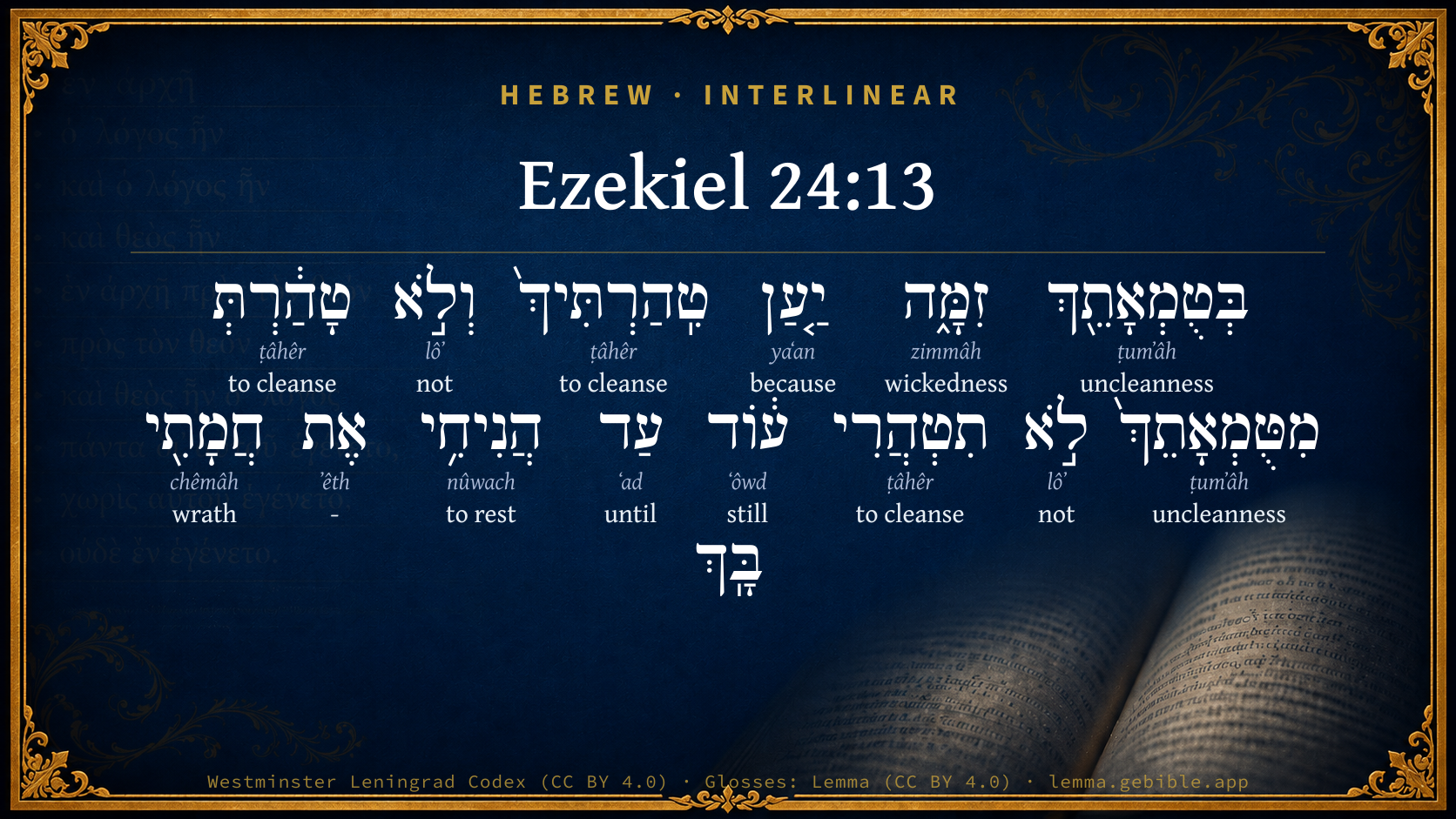
  1. בְּטֻמְאָתֵ֖ךְ ṭumʼâh H2932 “in/at · uncleanness · your” Preposition + Noun, Common, Feminine, Singular, Construct + Suffix, Personal, 2nd Person, Feminine, Singular
  2. יַ֤עַן yaʻan H3282 “because” Conjunction
  3. טִֽהַרְתִּיךְ֙ ṭâhêr H2891 “to cleanse · you” Verb, Piel, Perfect, 1st Person, Common, Singular + Suffix, Personal, 2nd Person, Feminine, Singular
  4. וְלֹ֣א lôʼ H3808 “and · not” Conjunction + Particle, Negative
  5. טָהַ֔רְתְּ ṭâhêr H2891 “to cleanse” Verb, Qal, Perfect, 2nd Person, Feminine, Singular
  6. מִטֻּמְאָתֵךְ֙ ṭumʼâh H2932 “from · uncleanness · your” Preposition + Noun, Common, Feminine, Singular, Construct + Suffix, Personal, 2nd Person, Feminine, Singular
  7. לֹ֣א lôʼ H3808 “not” Particle, Negative
  8. תִטְהֲרִי ṭâhêr H2891 “to cleanse” Verb, Qal, Imperfect, 2nd Person, Feminine, Singular
  9. ע֔וֹד ʻôwd H5750 “still” Adverb
  10. עַד ʻad H5704 “until” Preposition
  11. הֲנִיחִ֥י nûwach H5117 “to rest · me” Verb, Hiphil, Infinitive Construct + Suffix, Personal, 1st Person, Common, Singular
  12. אֶת ʼêth H853 “-” Particle, Direct Object
  13. חֲמָתִ֖י chêmâh H2534 “wrath · my” Noun, Common, Feminine, Singular, Construct + Suffix, Personal, 1st Person, Common, Singular

About this verse

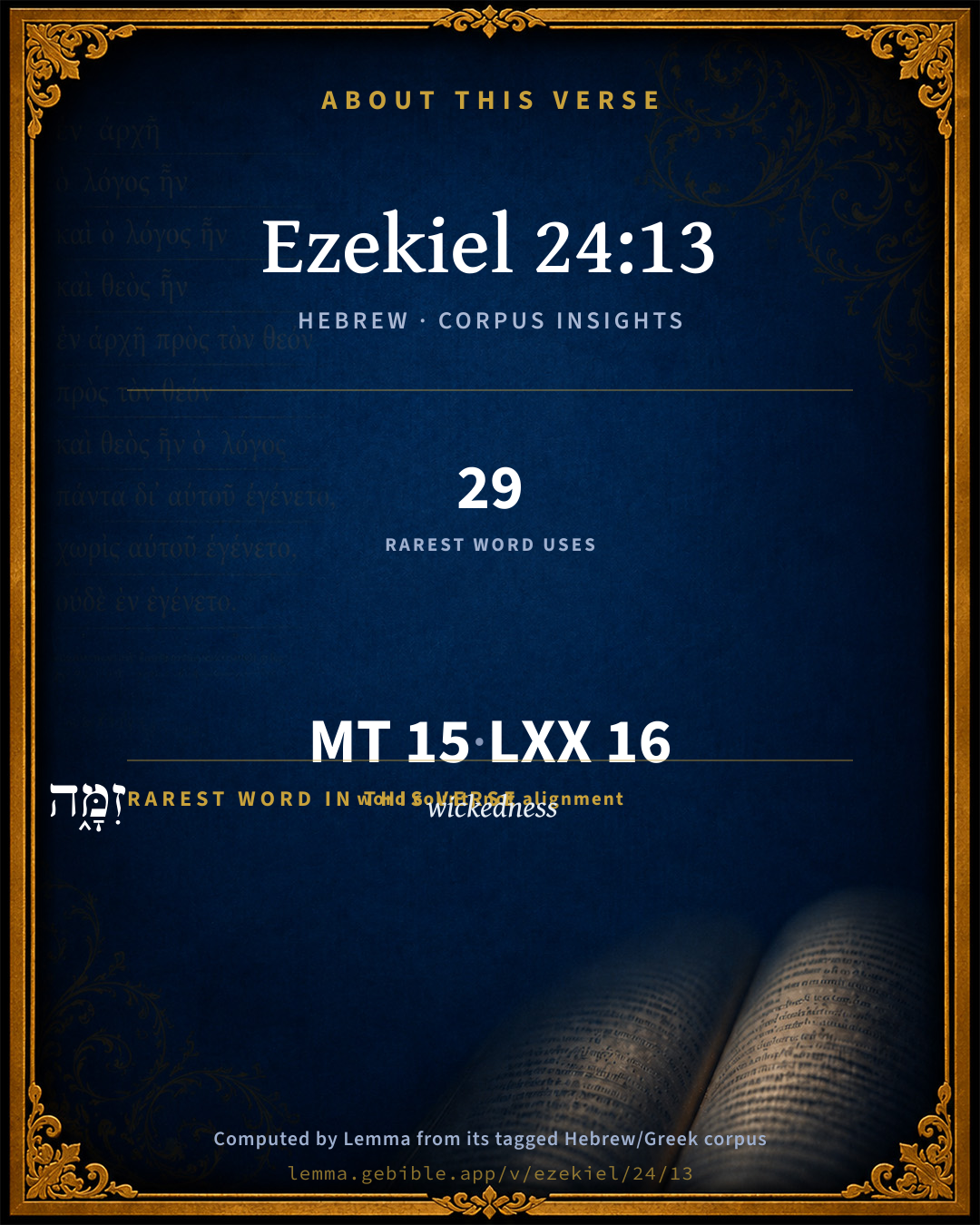
These counts appear in no published source. They are computed here, from the morphology-tagged text and Lemma’s own curated glosses. What Lemma adds →

15
words
10
distinct lemmas
Prophets
section

Shared distinctive vocabulary

זִמָּ֑ה wickedness H2154 occurs in 27 verses of the Hebrew Bible. Also found in:

Grammatical profile

  • 4 verbs
  • 4 nouns
  • 2 prepositions
  • 1 conjunction
  • 1 adverb
  • 3 particles

Verb forms

  • טִֽהַרְתִּיךְ֙ Piel · Perfect
  • טָהַ֔רְתְּ Qal · Perfect
  • תִטְהֲרִי Qal · Imperfect
  • הֲנִיחִ֥י Hiphil · Infinitive Construct

Repetition

Words recur within this verse — often emphatic in Hebrew:

  • טִֽהַרְתִּיךְ֙ to cleanse H2891 ×3
  • בְּטֻמְאָתֵ֖ךְ uncleanness H2932 ×2
  • וְלֹ֣א not H3808 ×2

Hebrew & Septuagint length

In English translation the verse runs 34 words from the Hebrew and 25 from the Septuagint (LXX English) — closely comparable.

A rough comparison of the two English renderings, which tokenize alike — not a word-level alignment.

Word counts can differ between the Hebrew and the Greek without any difference in meaning — e.g. the Hebrew direct-object marker אֵת has no separate Greek word, and Greek often adds the article ὁ.

In the original languages it is 15 Hebrew tokens and 16 Greek tokens — but the two are counted differently (Hebrew bundles its prefixes and suffixes into one token; the Greek is in lemma form), so that isn’t a like-for-like length.

Cross-references

22

Topical passages linked to Ezekiel 24:13 in the Treasury of Scripture Knowledge — connected by theme and wording, ordered by reader-vote popularity; previews shown in the World English Bible.

  • Ezekiel 5:13 Thus shall my anger be accomplished, and I will cause my wrath toward them to rest, and I shall be comforted; and they shall know that I, Yahweh, have spoken in my zeal, when I have accomplished my wrath on them.
  • Ezekiel 22:24 Son of man, tell her, You are a land that is not cleansed, nor rained on in the day of indignation.
  • Ezekiel 8:18 Therefore will I also deal in wrath; my eye shall not spare, neither will I have pity; and though they cry in my ears with a loud voice, yet will I not hear them.
  • Ezekiel 16:42 So will I cause my wrath toward you to rest, and my jealousy shall depart from you, and I will be quiet, and will be no more angry.
  • Zephaniah 3:2 She didn't obey the voice. She didn't receive correction. She didn't trust in Yahweh. She didn't draw near to her God.
  • 2 Corinthians 7:1 Having therefore these promises, beloved, let us cleanse ourselves from all defilement of flesh and spirit, perfecting holiness in the fear of God.
  • Jeremiah 6:28–30 They are all grievous rebels, going about with slanders; they are brass and iron: they all of them deal corruptly.
  • Ezekiel 24:11 Then set it empty on the coals of it, that it may be hot, and the brass of it may burn, and that the filthiness of it may be molten in it, that the rust of it may be consumed.
  • Hosea 7:1 When I would heal Israel, Then the iniquity of Ephraim is uncovered, Also the wickedness of Samaria; For they commit falsehood, And the thief enters in, And the gang of robbers ravages outside.
  • Hosea 7:9–16 Strangers have devoured his strength, And he doesn't realize it. Indeed, gray hairs are here and there on him, And he doesn't realize it.
  • Zephaniah 3:7 I said, "Just fear me. Receive correction, so that her dwelling won't be cut off, according to all that I have appointed concerning her." But they rose early and corrupted all their doings.
  • Romans 2:8–9 but to those who are self-seeking, and don't obey the truth, but obey unrighteousness, will be wrath and indignation,
  • Revelation 22:11 He who acts unjustly, let him act unjustly still. He who is filthy, let him be filthy still. He who is righteous, let him do righteousness still. He who is holy, let him be holy still."
  • 2 Chronicles 36:14–16 Moreover all the chiefs of the priests, and the people, trespassed very greatly after all the abominations of the nations; and they polluted the house of Yahweh which he had made holy in Jerusalem.
  • Isaiah 5:4–6 What could have been done more to my vineyard, that I have not done in it? Why, when I looked for it to yield grapes, did it yield wild grapes?
  • Isaiah 9:13–17 Yet the people have not turned to him who struck them, neither have they sought Yahweh of Hosts.
  • Jeremiah 25:3–7 From the thirteenth year of Josiah the son of Amon, king of Judah, even to this day, these twenty-three years, the word of Yahweh has come to me, and I have spoken to you, rising up early and speaking; but you have not listened.
  • Jeremiah 31:18 I have surely heard Ephraim bemoaning himself [thus], You have chastised me, and I was chastised, as a calf unaccustomed [to the yoke]: turn you me, and I shall be turned; for you are Yahweh my God.
  • Ezekiel 23:36–48 Yahweh said moreover to me: Son of man, will you judge Oholah and Oholibah? then declare to them their abominations.
  • Amos 4:6–12 "I also have given you cleanness of teeth in all your cities, And lack of bread in every town; Yet you haven't returned to me," says Yahweh.
  • Matthew 23:37–38 "Jerusalem, Jerusalem, who kills the prophets, and stones those who are sent to her! How often would I have gathered your children together, even as a hen gathers her chickens under her wings, and you would not!
  • Luke 13:7–9 He said to the vine dresser, 'Behold, these three years I have come looking for fruit on this fig tree, and found none. Cut it down. Why does it waste the soil?'

Cross-references courtesy of OpenBible.info (CC BY 4.0).

Hebrew and Greek witnesses Masoretic Hebrew ↔ Greek Septuagint

The same verse in the two great witnesses to the Old Testament, shown verse-for-verse.

These are two independent witnesses, not word-aligned to each other, and the Septuagint is shown in lemma (dictionary) form.

Hebrew Ezekiel 24:13 Masoretic · Westminster Leningrad Codex

בְּטֻמְאָתֵ֖ךְ זִמָּ֑ה יַ֤עַן טִֽהַרְתִּיךְ֙ וְלֹ֣א טָהַ֔רְתְּ מִטֻּמְאָתֵךְ֙ לֹ֣א תִטְהֲרִי ע֔וֹד עַד הֲנִיחִ֥י אֶת חֲמָתִ֖י בָּֽךְ

In your filthiness is lewdness: because I have cleansed you and you weren't cleansed, you shall not be cleansed from your filthiness any more, until I have caused my wrath toward you to rest.

World English Bible · Public Domain

Greek LXX Ezekiel 24:13 Septuagint · lemma form

ἀντί ὅς μιαίνω σύ καί τίς ἐάν μή καθαρίζω ἔτι ἕως ὅς ἐνπίμπλημι ὁ θυμός ἐγώ

Her scum shall become shameful, because you did defile yourself: and what if you shall be purged no more until I have accomplished my wrath?

LXX2012 (modern English Septuagint) · Public Domain

Hebrew: Westminster Leningrad Codex (CC BY 4.0). Greek: Septuagint (public domain); English from LXX2012 (modern English Septuagint) (Public Domain). How the Septuagint differs from the Hebrew →

Targum (Aramaic paraphrase)

1

The Targum is the ancient Jewish Aramaic paraphrase of the Hebrew Scriptures — an interpretive translation, not the Hebrew text itself. Onkelos (literal) and Pseudo-Jonathan (expansive) render the Torah, and Jonathan the Prophets. Coverage is partial: where no permissively-licensed English translation exists for a verse, only the Aramaic is shown. This is verse-level text, not a word-by-word alignment to the Hebrew.

  1. Targum Jonathan Prophets (Joshua–Malachi)
    בִּדְאִסְתְּאַבְתְּ בַּעֲצַת חֶטְאִין חֲלַף דְדַכֵּיתִיךְ וְלָא דְכֵית מִסוֹאַבְתִּיךְ לָא תִדְכִּין עוֹד עַד דַאֲנִיחַ חֵמְתִי בִיךְ:

    (no public-domain English translation for this verse)

    Targum Jonathan — Aramaic: “Mikraot Gedolot” (public domain). English: “Sefaria Community Translation” (CC0 1.0 (public-domain dedication)); “London "Chaldee Paraphrase," 1871” (public domain). Text via Sefaria.

Commentary

Notes on Ezekiel 24:13 from classic Christian and Jewish commentators (each source and its license shown beneath its notes). The classic Christian expositions comment on the surrounding passage and are grouped to its opening verse, so a note may address several verses; the Jewish commentaries on the Tanakh (Rashi and others) are per-verse, so they appear only where the commentator wrote on this verse.

Lemma curates 59 commentaries, every one of them public domain or Creative Commons licensed, each selected and text-cleaned for this edition rather than reprinted as found. About our sources →

Trapp's Complete Commentary

John Trapp

Eze 24:13 In thy filthiness [is] lewdness: because I have purged thee, and thou wast not purged, thou shalt not be purged from thy filthiness any more, till I have caused my fury to rest upon thee.

Ver. 13. In thy filthiness is lewdness,] i.e., Thou art desperately stiff and stubborn; thy disease is complicated, and threateneth death.

Because I have purged thee,] i.e., Called upon thee by my prophets to "cleanse thyself of all filthiness of flesh and spirit"; sought also to purge thee by the soap of afflictions, and by the cudgel of calamities. {Isa 1:16; Isa 27:9 cf. Isa 1:5-7}

And thou wast not purged.] From thy sin, which had gotten into thy very frame and constitution, was weaved into the texture of thine heart.

Thou shalt not be purged.] But shalt perish in thy sins - which is worse than to die in a ditch - "and pine away in thine iniquities." {Eze 24:23} He who is filthy, shall be filthy still; a fearful sentence.

Till I have caused my fury to rest upon thee.] Till I have purged thee in hell fire, which will be ever doing, but never be done; donec omnia tela vindictae meae in te exhausero, till I have emptied my quiver, spent my wrath upon thee.

John Trapp, A Commentary or Exposition upon All the Books of the Old and New Testament (1647–1656) — public domain. Text from a community e-Sword module.

The Biblical Illustrator

Joseph S. Exell

Eze_24:13

Thou shalt not be purged from thy filthiness.

Obstinacy in sin

1. Obstinacy in sin provokes God to the destruction of sinners. Her scum shall be in the fire. Jerusalem shall be burnt, and why? In thy filthiness is lewdness; thou art obstinate, hardened in thy wickedness. All sin offends, some sins provoke to judgments, obstinacy provokes to destruction (Jer_44:15).

2. In Scripture language, that is said to be done which God or men endeavour to do, though it be not done. I have purged thee. God using means, and endeavouring, by His prophets, mercies, threats, and judgments, to purge Jerusalem from her sin, is called purging, though Jerusalem were not purged.

3. A people may have the means, and not improve the same for their good.

4. People may so slip the time of repenting, and turning to God, as that it may be too late for them to go about the same; they may sin away the time of mercy. Time present is the acceptable time (2Co_6:2).

5. Those who have had means, and not profited thereby, God will deal most severely with--there is no mercy, but altogether judgment for them. The fig tree in the vineyard had stood there three years, and was not better at last than at first; the influences of heaven, and fatness of the earth, had done it no good; and behold the severity of the owner: Cut it down; why cumbereth it the ground? (Luk_13:7). (W. Greenhill, M. A.)

The Biblical Illustrator, edited by Joseph S. Exell (c. 1880s–1900s) — public domain. Text from a community e-Sword module.

Tyndale Open Study Notes

Tyndale Open Resources

24:13-14 All that remained for Jerusalem was judgment without pity because of her wicked deeds and her refusal to turn back to the Lord.

Tyndale Open Study Notes — © Tyndale Open Resources, licensed CC BY-SA 4.0. Text via the HelloAO Bible API.

Geneva Bible (1599)

Geneva Bible translators

I labored by sending my Prophets to call thee to repentance, but thou wouldest not.

Geneva Bible (1599) marginal notes — public domain. Text via Bolls.life.

Jamieson, Fausset & Brown

Robert Jamieson, A. R. Fausset & David Brown

lewdness--determined, deliberate wickedness; from a Hebrew root, "to purpose."

I have purged thee--that is, I have left nothing untried which would tend towards purging thee, by sending prophets to invite thee to repentance, by giving thee the law with all its promises, privileges, and threats.

thou shalt not be purged . . . any more--that is, by My gracious interpositions; thou shalt be left to thine own course to take its fatal consequences.

Jamieson, Fausset & Brown — Commentary Critical and Explanatory on the Whole Bible (1871) — public domain (CC PDM 1.0). Text via the HelloAO Bible API.

Adam Clarke's Commentary

Verse 13. In thy filthiness is lewdness] זמה zimmah, a word that denominates the worst kinds of impurity; adultery, incest, c., and the purpose, wish, design, and ardent desire to do these things. Hers were not accidental sins, they were abominations by design, and they were the worse in her, because God had cleansed her, had separated the Israelites from idolatry and idolatrous nations, and by his institutions removed from them all idolatrous incentives. But they formed alliances with the heathen, and adopted all their abominations therefore God would not spare them. See Eze 24:14.

Adam Clarke's Commentary on the Bible (1810–1826) — public domain. Text from a community e-Sword/MySword module.

The Cambridge Bible for Schools and Colleges

gen. ed. J. J. S. Perowne

13. In thy … lewdness] Or, because of thy lewd filthiness, cf. Eze_16:27, thy lewd way.

shalt not be purged … more] i.e. shalt never be purged, till, &c., or purged so as to be again clean, till, &c.

caused … to rest] appeased, Eze_5:13, Eze_8:18, Eze_16:42.

The Cambridge Bible for Schools and Colleges (gen. ed. J. J. S. Perowne; Cambridge University Press, 1878–1918) — public domain. Text from a community e-Sword module.

John Gill's Exposition

In thy filthiness is lewdness,.... Consummate wickedness joined with impudence, and an obstinate persisting in it; though her sins were so abominable and filthy, yet she was not ashamed of them, nor could be reclaimed from them; but, like a lewd woman, or an old harlot, was bold and impudent:

because I have purged thee, and thou wast not purged; made use of means for the purgation of them, by his prophets, and by exhortations and instructions given by them, and by various corrections and chastisements; but all in vain, and to no purpose, they were all without effect:

thou shall not be purged from thy filthiness any more till I have caused my fury to rest upon thee; there was no other way left to purge her from her sins, but by the fire of his wrath, and the fury of his anger, in her utter destruction.

John Gill's Exposition of the Whole Bible (1746–1763) — public domain (CC PDM 1.0). Text via the HelloAO Bible API.

Haydock's Catholic Bible Commentary

Thy. Hebrew, "In thy crime there is design," or malice. This rendered the Jews so hateful (Calmet) and irreclaimable. (Haydock) --- God had given them abundant instructions (Calmet) and graces; but all was contemned. (Haydock) --- When the fire of tribulation does not amend sinners, they are sentenced to hell fire. (Worthington)

George Leo Haydock (1774–1849), Haydock's Catholic Family Bible and Commentary, 1859 edition — public domain. Excludes Psalms (Douay-Rheims chapter numbering differs from Protestant) and Deuterocanonical books (Catholic canon only).

Matthew Poole's English Annotations

In thy filthiness, in thy sinning, is lewdness; deliberate resolution grown up to obstinacy and boldness, with impudence that will not be corrected.

I have purged thee; used all sorts of proper means to purge, advice, reproof, chastisements, threats of sorer sufferings, by prophets, by the rod, sometimes gentler, sometimes rougher, 2Ch 36:15; Jer 18:11,12.

Thou wast not purged; wouldst not part from thy sins, and purify thy heart and ways, Jer 25:3-7.

Thou shalt not be purged; all further use of means shall be forborne; I will preach no more by prophets to call thee to repentance, but to condemn thee for pot repenting; God will from henceforth refer them to his sore destroying judgments, which are his fury, and which shall cease when this sinful kingdom, destroyed, can no longer provoke God as they had done formerly.

Till I have caused my fury to rest upon thee: see Eze 5:13; 6:12; 16:42; 21:17.

Matthew Poole's English Annotations on the Holy Bible (1683–1685) — public domain. Text from a community e-Sword/MySword module.

Whedon's Commentary on the Bible

Daniel D. Whedon

13. In thy filthiness is lewdness — Or, R.V., margin, “For thy filthy lewdness.” (See Eze_16:27.) This includes not only the act, but the evil purpose.

Caused… to rest — Rather, satisfied. (See Eze_5:13; Eze_16:42.)

Daniel D. Whedon (gen. ed.), Commentary on the Old and New Testaments (1874–1909) — public domain. Text from a community e-Sword module.

The Pulpit Commentary

Ineffectual discipline.

Men who are providentially entrusted with the care and training of the young, or with the probation of undisciplined members of society, often have reason to complain that their endeavors seem to be utter failures, that there is no response to the appeal which by language and by action they are constantly addressing to those who are placed beneath their charge. It is very instructive to all such to observe what was the result of Jehovah"s dealing with Judah and Jerusalem. It is not to be disputed that the results in question were perfectly known to the Omniscient before they came to pass. Yet it seemed good to him, in dealing with moral agents, to afford them the means of repentance, and to furnish them with inducements to repentance. Lamentable is the record of what without irreverence we may term the Divine experience: "I have purged thee, and thou wast not purged.

I DIVINE DISCIPLINE. There is presumed the need for such discipline. It is because the metal is mixed with dross that it is cast into the furnace. It is because the patient is sick that medicine is administered. It is because the wheat and the chaff are intermingled that the winnowing-fan is employed. And it is because the heart and life of the individual or the nation are contaminated with evil that the chastening hand of God intervenes to purge away the mischief the dross, the chaff. The means employed is usually affliction in some one or more of the many forms it assumes. One heart is reached in one way, another by a way altogether different; one nation is humbled by pestilence or famine, another by defeat in war and privation of territory.

II THE MOTIVE AND PURPOSE OF DIVINE DISCIPLINE. To the careless observer it may seem as if such experiences as those described were evidences of malevolence in the Governor of the world. But in fact it is otherwise. "Whom he loveth he chasteneth, and scourgeth every child whom he receiveth." The son does not always understand his father"s treatment of him, and does not always accept that treatment with submission and gratitude; neither does he always profit by it as he might do. Yet the treatment may be wise and well adapted for purposes alike of probation and of education; and the time may come when, looking back with enlarged experience and maturer judgment, he may approve his father"s action. So is it with God"s dealing with his great family. The Father of the spirits of all flesh has at heart the welfare of his offspring, his household. He knows that uninterrupted prosperity would not be beneficial, that many lessons could never be acquired amid circumstances of ease and enjoyment, that character could not by such experience be formed to ripeness and moral strength. It is through trials and afflictions that true men are fashioned. And the same is the case with nations. Israel had to wander and to fight in the wilderness. England has only reached her present position by means of many generations of conflict and many epochs of adversity. God has "purged" his people, not because he is indifferent to their sufferings, but because he is solicitous for their welfare, which only through sufferings can be achieved.

III THE APPARENT FAILURE OF DIVINE DISCIPLINE. There is a pathetic tone in the assertion, "I have purged thee, and thou wast not purged." The explanation of this failure is to be found in the mysterious fact of human liberty. An eminent philosopher has said that he would be content to be wound up like a clock every morning, if that would ensure his going right throughout the day. Determinism is mechanism; it reduces man to the level of a machine. But this is not the true, the Divine idea of man. God evidently designs to do something better with man than to constrain him. He even gives to man the prerogative of resisting the high motives which he in wisdom and mercy brings to bear upon him. And when he perceives that the purposes of discipline are not fulfilled, he laments, "I have purged thee, and thou wast not purged." Yet it is not for us to say that even in such cases there has been real failure. Ends may be answered of which we cannot judge; good may be done which we cannot see; preparation may be making for advanced stages which we are now incapable of comprehending. Doubtless in many cases the "purging" which is ineffectual here and now will be brought about hereafter, and perhaps above. It is open to us to believe, with the poet

That nothing walks with aimless feet, That not one life shall be destroyed Or cast as rubbish to the void, When God has made his work complete. T.

The Pulpit Commentary (1880–1919), ed. H.D.M. Spence-Jones & Joseph S. Exell — public domain. Text from a community e-Sword module.

John Wesley's Explanatory Notes

Lewdness - Or obstinacy and boldness. Purged thee - Used all means to purge thee.

John Wesley, Explanatory Notes Upon the Whole Bible (1754–1765) — public domain. Text via the GEBible commentary corpus.

unfoldingWord translationNotes

Door43 World Missions Community

General Information:

Yahweh continues telling a parable to Ezekiel about a cooking pot that represents Jerusalem. This parable continues through Ezekiel 24:14. (See: Parables)

until I have satisfied my fury upon you.

This speaks of Yahweh punishing the people in his anger as if it were his "fury" that were punishing them. AT: "until I am finished punishing you and am no longer furious with you" or "until I have punished you and I am longer angry with you" (See: Metonymy)

translationWords

shame

clean

clean

free

unfoldingWord translationNotes — © Distant Shores Media and the Door43 World Missions Community, licensed CC BY-SA 4.0. Source: git.door43.org/Door43/en_tn.

Rashi

Rabbi Shlomo Yitzchaki (Rashi)

With your defilement With defilement of lewdness you will perish.

Since I purified you by reproving you through the prophets, and you did not become purified, etc.

Rashi on the Tanakh — English translations: “The Judaica Press complete Tanach with Rashi, translated by A. J. Rosenberg” (CC BY 4.0); “Pentateuch with Rashi's commentary by M. Rosenbaum and A.M. Silbermann, 1929-1934” (public domain); “The Metsudah Tanach series, Lakewood, N.J” (CC BY 4.0); and “The Book of Joshua, Metsudah Publications, 1997” (CC BY 4.0). Text via Sefaria.

Lesson kit

Teaching starters — assembled from the data on this page, not authored interpretation. Every prompt links to the verse data it draws on. Edit before teaching.

Ezekiel, in the Prophets, opens this verse with 15 words (10 distinct Hebrew lemmas). Its most distinctive word is zimmâh (“wickedness”). A historical commentator’s framing appears above. Read the whole chapter for the surrounding context.

Discussion questions

  1. What does “wickedness” (zimmâh) contribute to the verse as a whole?
  2. How does Leviticus 18:17, which shares the word «wickedness», read alongside this verse?
  3. What does the repetition of “to cleanse” (3× in this one verse) do in this verse?
  4. These translations render this verse differently. What is at stake in choosing one wording over another?
  5. «טִֽהַרְתִּיךְ֙» is a Piel Perfect verb. How does that grammatical form shape the action described?
  6. Compare how Trapp's Complete Commentary and The Biblical Illustrator read this verse. Where do they agree or differ?

Things to notice

Reading settings

Reading text

Shown beneath each verse's original-language words.

Old Testament
Old Testament edition

Read the OT as the Masoretic Hebrew (MT) or the Greek Septuagint (LXX).

English shown for the Greek Septuagint (in the Hebrew ↔ Greek comparison).

Comparing translations? Open the Compare panel on any verse page to stack up to four side by side.