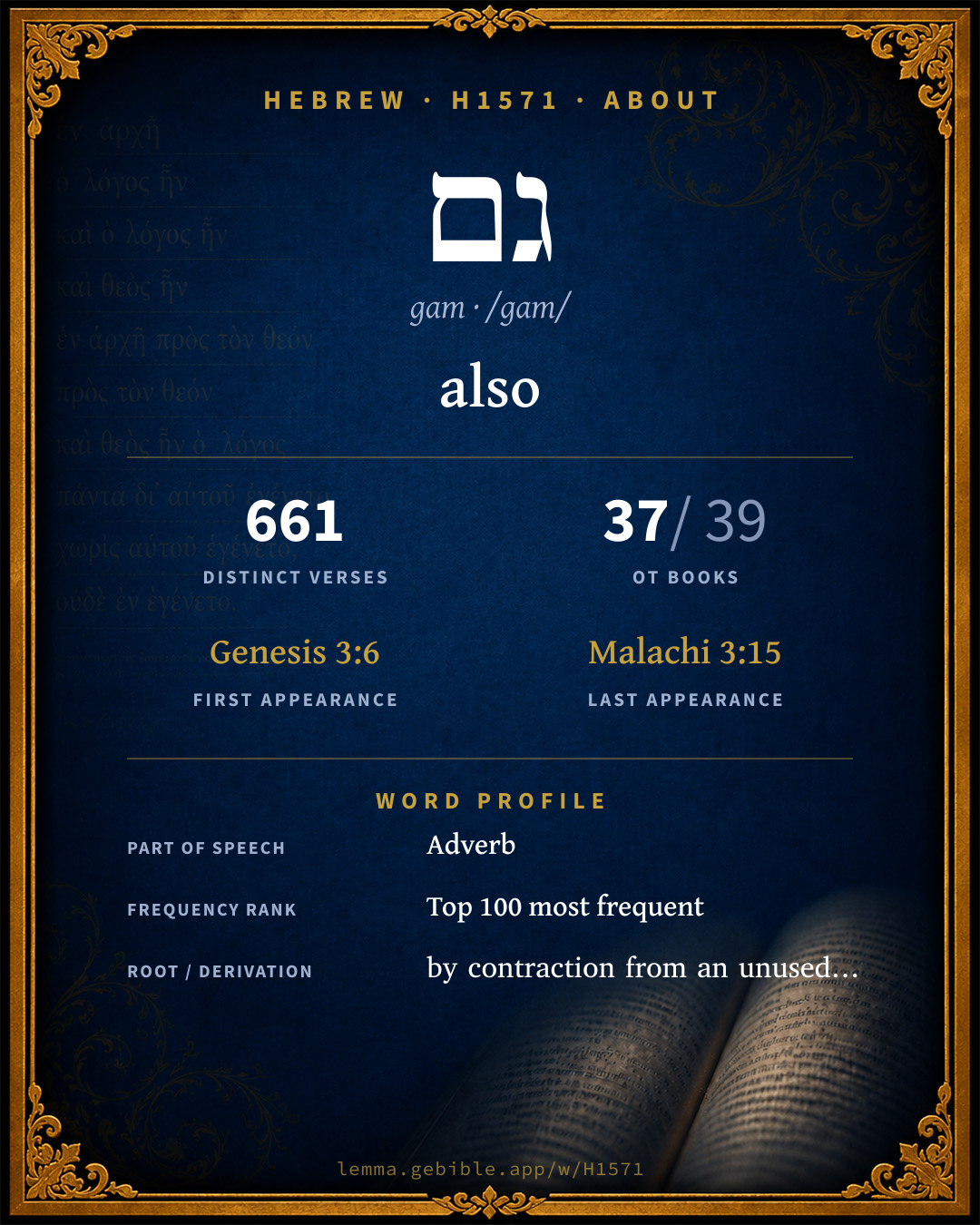
גַּם
also
also: even, indeed, moreover, yea fuller range ↓
Full lexicon entry — Brown-Driver-Briggs (BDB)
From Brown-Driver-Briggs (BDB)
Where this word appears
Grammar key — what these labels mean
Part of speech
- Particle
- A short function word — article, negation, interrogative, the sign of the direct object, and the like.
- Adverb
- A word that modifies a verb, adjective, or other adverb.
Every verse where H1571 appears in the Book of 2 Kings — 16 distinct verses. Click any verse to open its interlinear word-by-word view. Verse text shown in the World English Bible for context — . Each verse’s Hebrew form is shown with its reference; the English is not keyword-highlighted, since the data carries no word-level English alignment. Use “Compare translations” on any verse to read it across multiple English versions. This concordance covers the Hebrew Bible; Septuagint (Greek Old Testament) occurrences are not indexed here.
2 Kings
- 2 Kings 2:3 גַּם ptcl acc The sons of the prophets who were at Bethel came forth to Elisha, and said to him, "Do you know that Yahweh will take away your master from your head today?" He said, "Yes, I know it; hold your peace."
- 2 Kings 2:5 גַּם ptcl acc The sons of the prophets who were at Jericho came near to Elisha, and said to him, "Do you know that Yahweh will take away your master from your head today?" He answered, "Yes, I know it. Hold your peace."
- 2 Kings 8:1 וְ/גַם conj + ptcl acc Now Elisha had spoken to the woman, whose son he had restored to life, saying, Arise, and go you and your household, and sojourn wherever you can sojourn: for Yahweh has called for a famine; and it shall also come on the land seven years.
- 2 Kings 9:27 גַּם ptcl acc But when Ahaziah the king of Judah saw this, he fled by the way of the garden-house. Jehu followed after him, and said, Smite him also in the chariot: [and they struck him] at the ascent of Gur, which is by Ibleam. He fled to Megiddo, and died there.
- 2 Kings 13:6 וְ/גַם֙ conj + ptcl acc Nevertheless they didn't depart from the sins of the house of Jeroboam, with which he made Israel to sin, but walked therein: and there remained the Asherah also in Samaria.)
- 2 Kings 16:3 וְ/גַ֤ם conj + ptcl acc But he walked in the way of the kings of Israel, yes, and made his son to pass through the fire, according to the abominations of the nations, whom Yahweh cast out from before the children of Israel.
- 2 Kings 17:19 גַּם ptcl acc Also Judah didn't keep the commandments of Yahweh their God, but walked in the statutes of Israel which they made.
- 2 Kings 17:41 גַּם ptcl acc So these nations feared Yahweh, and served their engraved images; their children likewise, and their children's children, as did their fathers, so do they to this day.
- 2 Kings 21:11 גַֽם adv Because Manasseh king of Judah has done these abominations, and has done wickedly above all that the Amorites did, who were before him, and has made Judah also to sin with his idols;
- 2 Kings 21:16 וְ/גַם֩ conj + ptcl acc Moreover Manasseh shed innocent blood very much, until he had filled Jerusalem from one end to another; besides his sin with which he made Judah to sin, in doing that which was evil in the sight of Yahweh.
- 2 Kings 22:19 וְ/גַ֧ם conj + ptcl acc because your heart was tender, and you did humble yourself before Yahweh, when you heard what I spoke against this place, and against the inhabitants of it, that they should become a desolation and a curse, and have torn your clothes, and wept before me; I also have heard you, says Yahweh.
- 2 Kings 23:15 וְ/גַ֨ם גַּ֣ם conj + ptcl acc ptcl acc Moreover the altar that was at Bethel, and the high place which Jeroboam the son of Nebat, who made Israel to sin, had made, even that altar and the high place he broke down; and he burned the high place and beat it to dust, and burned the Asherah.
- 2 Kings 23:19 וְ/גַם֩ conj + ptcl acc All the houses also of the high places that were in the cities of Samaria, which the kings of Israel had made to provoke [Yahweh] to anger, Josiah took away, and did to them according to all the acts that he had done in Bethel.
- 2 Kings 23:24 וְ/גַ֣ם conj + ptcl acc Moreover those who had familiar spirits, and the wizards, and the teraphim, and the idols, and all the abominations that were seen in the land of Judah and in Jerusalem, did Josiah put away, that he might confirm the words of the law which were written in the book that Hilkiah the priest found in the house of Yahweh.
- 2 Kings 23:27 גַּ֤ם ptcl acc Yahweh said, I will remove Judah also out of my sight, as I have removed Israel, and I will cast off this city which I have chosen, even Jerusalem, and the house of which I said, My name shall be there.
- 2 Kings 24:4 וְ/גַ֤ם conj + ptcl acc and also for the innocent blood that he shed; for he filled Jerusalem with innocent blood: and Yahweh would not pardon.
About this entry
At a glance — auto-summarized from this page’s data, not written by a person. Every figure links to its source below. This summary describes the numbers; it doesn’t interpret them.
גם (gam) is a Hebrew verb most often rendered “also.” Debuting at Genesis 3:6, it then recurs through the corpus. The Hebrew Bible uses it across 661 verses — among the most common. It also covers “even”, “indeed”, and “moreover”, alongside “also” — see its full sense range. Related forms include מגמה. For the data behind this summary, explore the sense tree and the renderings breakdown below.
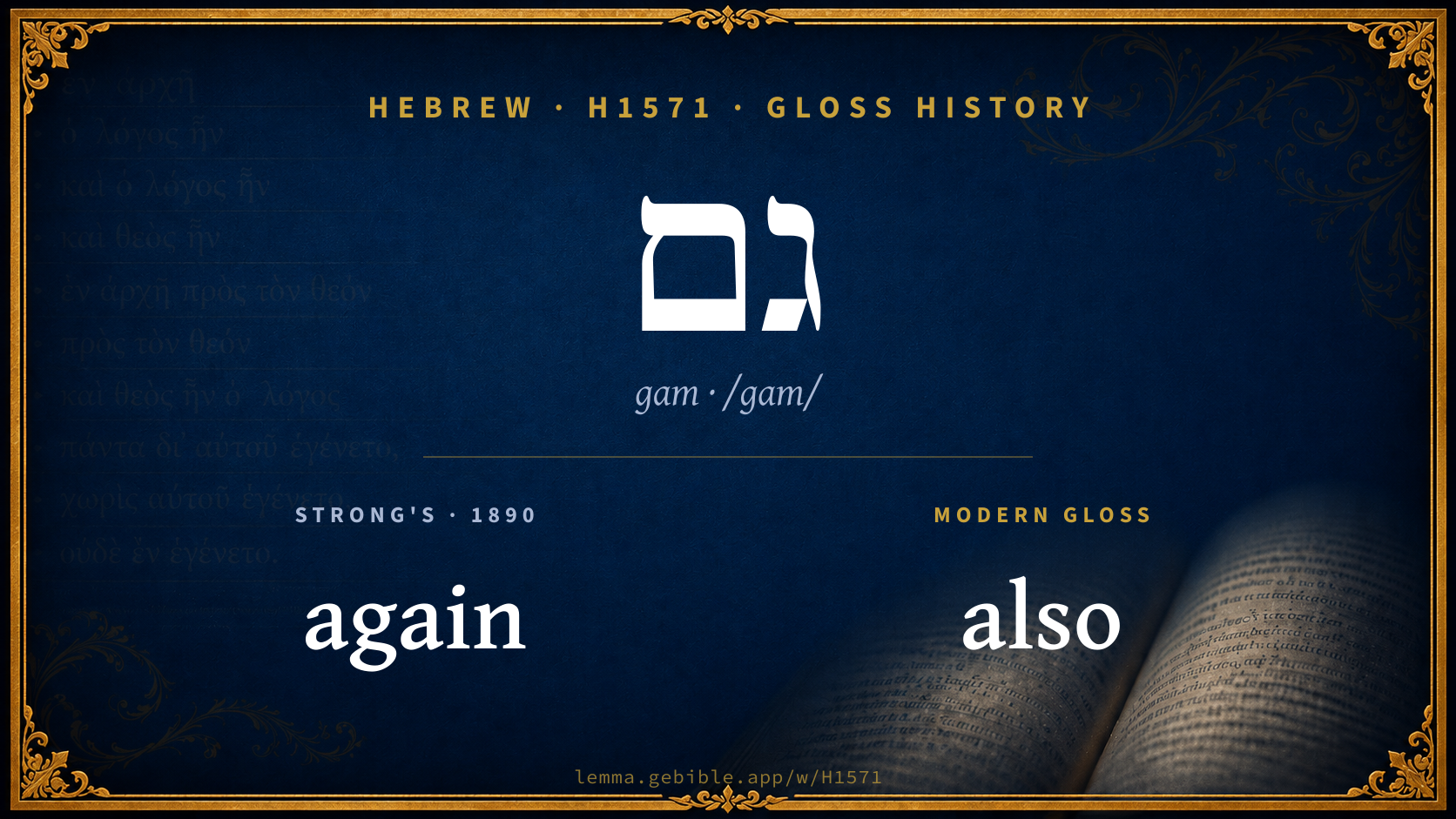
Gloss history
Strong's 1890 vs modern scholarship
About this word
Strong's H1571 catalogs a Hebrew word from the Hebrew Old Testament.
These counts are not copied from any lexicon or concordance. They are computed here, from the morphology-tagged Hebrew Old Testament. What Lemma adds →
- 661
- distinct verses
- The word appears in 661 distinct verses.
- 37 / 39
- OT books
- The word appears in 37 of 39 Old Testament books.
- #62
- by frequency
- Top 100 most frequent Hebrew words (rank 62 of 8,640 Hebrew words by occurrence).
View all 661 occurrences in the concordance →
Most concentrated in
- Genesis 76 verses 11%
- Ecclesiastes 47 verses 7%
- Jeremiah 47 verses 7%
By section of the Old Testament
By traditional corpus
Conventional, traditional groupings — biblical authorship is debated, so this is a traditional corpus grouping, not an authorship claim. Each share is this word’s portion of its verses in that division of the Hebrew canon. Each figure is a share of the word’s 661 distinct verses.
- Prophets (Nevi'im) 300 verses · 45%
- Writings (Ketuvim) 215 verses · 33%
- Torah (Pentateuch) 146 verses · 22%
How translations render this word
Counts come from each version’s own published word-to-Strong’s tagging or interlinear alignment — an approximate guide to how each version renders this word, not a word-level alignment the data otherwise carries. Because each total is that version’s own tagged count, the per-version totals vary from one another and need not match the appearance or distinct-verse counts above. These counts may also differ from a printed concordance because Lemma counts each distinctly tagged rendering and does not collapse phrase taggings into a single head-word total. This is a fixed set of word-tagged versions (KJV, ASV, BSB, ULT) and does not change with the reading translation you choose elsewhere. Each version’s license is shown beside its name below (and on Sources).
BDB lists this Strong’s number as 2 distinct words (homographs). Each count above pools all of them and is not split by sense — see the Senses section below. A low-frequency rendering may belong to a different one of those words, not the primary meaning.
- King James Version†: Also 3×
- American Standard Version†: Also 2×, As 2×, He also 2×
- Berean Standard Bible†: And 100×, Even 90×, Also 70×
- unfoldingWord Literal Text†: Also 417×, Even 130×, And 84×
King James Version Public Domain
Renders H1571 across 34† tagged occurrences — most commonly:
Plus 31 renderings that appear only once — usually multi-word phrases or single function words the recovered tagging swept in, not distinct renderings.
American Standard Version Public Domain
Renders H1571 across 35† tagged occurrences — most commonly:
Plus 27 renderings that appear only once — usually multi-word phrases or single function words the recovered tagging swept in, not distinct renderings.
Berean Standard Bible Public Domain
Renders H1571 across 624† tagged occurrences — most commonly:
Plus other, less common renderings. Plus 73 renderings that appear only once — usually multi-word phrases or single function words the recovered tagging swept in, not distinct renderings. Not rendered by a distinct English word in 142 further occurrences.
unfoldingWord Literal Text CC BY-SA 4.0
Renders H1571 across 800† tagged occurrences — most commonly:
Plus other, less common renderings. Plus 34 renderings that appear only once — usually multi-word phrases or single function words the recovered tagging swept in, not distinct renderings.
Senses in the full BDB
What do BDB’s symbols mean?
BDB uses these scholarly abbreviations:
| Symbol | Meaning |
|---|---|
| 𝔊 | the Septuagint (the ancient Greek translation, LXX) |
| 𝔙 | the Vulgate (the Latin translation) |
| 𝔖 | the Syriac version (the Peshitta) |
| 𝔗 | the Targum (the Aramaic translation) |
| ψ | the Psalms |
| √ | root (the underlying root or stem) |
| ‖ | parallel passage (a synonymous or contrasted parallel) |
| † | the dagger: every passage where the word occurs is cited |
The 6 senses and sub-senses the full Brown-Driver-Briggs lexicon distinguishes for this word, in lexicon order (not ranked by frequency), with BDB’s own verbatim wording and sub-sense lettering. Shown in Hebrew script with BDB’s own scholarly abbreviations. The condensed entry is in the Lexicon Entry tab. See also the Forms in the corpus table below.
- 1. also, moreover, emphasizing sometimes the thought of an entire sentence, but more usually the word immediately following, as Gn 3:6 וַתִּתֵּן גַּם לְאִישָׁהּ and gave also to her husband, v 27 and take also of the tree of life, 7:3; 19:21; 24:19; 26:21; 29:27; 30:15; 32:21 (גַּם הִגֵּה …: so Est 7:9) 48:11 Ex 8:28; 12:32 b Dt 1:37 1 S 28:20 2 S 11:12 2 K 9:27 Is 7:13 +. Often before pronouns, Gn 4:4 וְהֶבֶל הֵבִיא גַם הוּא and Abel, he also brought, 20:5 וְהִיא־גַס־הִוא (so only here) and she herself also, v 6 27:31 וַיַּעַשׂ גַּם הוּא, 30:3 Dt 3:20 Ju 3:31; 6:35; 9:19 1 S 19:20–24 Je 12:6; 48:26 etc. (cf. MI 6 ויאמר גם הא): especially in genealogies of J (BuUrg. 220) Gn 4:22, 26; 10:21; 19:38; 22:20, 24 cf. Ju 8:31. גַּם sq. pron. also begins a sentence with emph. in an elevated style, thou (they) also, Is 14:10 Je 12:6(×2); 48:7 Ez 16:52 Na 3:11(×2). After a pron. in an oblique case (Ges§ 135, 2) Gn 27:34 1 S 19:23 2 S 17:5 Je 25:14; 27:7 +. וְגַם and also (more often than גַּם alone attaching a sentence) Gn 6:4; 14:16; 15:14; 17:16; 20:12; 24:14, 46; 30:6; 37:7; 38:24; 42:28 Ex 2:19; 3:9; 4:14 Jos 7:11 (5 times) 1 S 4:17 1 K 21:19 + often; with a negative = neither Ex 5:2; 34:3 al.—גַּם … גַּם (like et … et) both … and Gn 44:16; 47:3, 19 Nu 18:3 Je 51:12 ψ 49:3 +: גַּם … גַּם … גַּם Gn 24:25 Ju 8:22 Ec 9:6: with a negative neither … nor Nu 23:25 1 S 20:27 1 K 3:26, and (3 times) Gn 43:8 Ex 4:10 1 S 28:6. So (but seldom) גַּם … וְגַם Gn 24:44 Ex 10:25 f. 1 S 2:26; 12:14; 26:25: with neg. 1 S 21:9.—N.B. In poetry independence and emphasis is sometimes given by גַּם to a new idea, where in English we should be satisfied with and: ψ 107:5; 137:1 Jb 24:19 Ct 7:14 La 4:15. e.g. Genesis 3:6
- 2. with stress on a particular word, even, Ex 4:9 Nu 22:33 גַּם אוֹתְךָ even thee I had slain, and kept her alive, 2 S 17:10 Je 2:33 ψ 132:12 Pr 14:13 even in laughter the heart is sorrowful, v 20 17:28; 20:11 Ru 2:15 Ne 3:35; and so often after כִּי, Dt 12:31 for even their sons they burn in the fire to their gods, 1 S 22:17 Is 26:12 Je 6:11; 12:6; 14:5 Ho 9:12 כִּי־גַם־אוֹי לָהֶם for even woe is it to them when I depart from them; הֲגַם †Gn 16:13 1 S 10:11, 12 = 19:24 1 K 17:20 ψ 78:20 Jb 41:1 Est 7:8. Other cases:—1 S 24:12 רְאֵה גַּם רְאֵה see yea see! (but HupQu. Job vi. גַּם רָאֹה: cf. infr.) ψ 118:11; Jb 2:10 גַּם אֶת־הַטּוֹב נְקַבֵּל shall we receive good (emph.) from God and not evil? 21:7; interposed once between a subst. and adj. Gn 20:4 gentemne etiam justam interficies? emphasizing כֹּל, Dt 28:61 Ju 9:49 b 1 S 22:7 גַּם־לְכֻלְּכֶם to all (emph.) of you will he give …? 2 S 19:31 גַּם אֶת־הַכֹּל יִקָּ֑ח yea, the whole let him take! Is 26:12; אֶחָד 2 S 17:12 b and we will not leave … גַּם אֶחָד even one (similarly v 13 b), ψ 14:3 (= 53:4) אֵין גַּם אֶחָד; an inf. or cogn. accus. attached to a verb, †Gn 31:15; 46:4 Nu 11:15; 16:13 1 S 1:6. גַּם שְׁנֵיהֶם lit. even both i.e. the one as well as the other (Germ. alle beide) is said idiomatically, †Gn 27:45 (שְׁנֵיכֶם), Dt 22:22; 23:19 1 S 25:43 (שְׁתֵּיהֶן), Pr 17:15; 20:10, 12 Ru 1:5. e.g. Exodus 4:9
- 3. introducing a climax, yea, especially in a rhetorical style, Gn 27:33 Dt 23:3, 4 Ju 5:4(×2) Is 13:3; 14:8; 43:13 yea, from to-day I am the same, 44:12 גַּם רָעֵב yea, he is hungry, and has no strength, 47:3; 48:8(×3); 57:7 Je 46:16; 48:2; 51:44 Ho 7:9 ψ 41:10; 84:7; 139:12; Is 66:8 כִּי־חָ֫לָה גַּם־יָֽלְדָה, צִיּוֹן אֶת־בָּנֶיהָ, Je 5:28; 12:2 Ez 24:5 Jb 21:7 Ct 8:1: emphasizing an extreme, or aggravated, case, yea, even, Is 49:15 yea, these may forget, Je 8:17 yea, the stork knoweth, etc., Is 23:12 גַּם שָׁם even there no rest shall be for thee (so ψ 139:10), 49:25; 57:6 Je 23:11 b Mal 3:15 ψ 84:4. e.g. Genesis 27:33
- 4. expressing correspondence, especially in the matter of retribution (the גַּם correlativum), so frequently גַּם אֲנִי, גַּם אָנֹכִי I also (on my part):—Gn 20:6 I also [as well as thyself] know that thou hast done this innocently, Jos 24:18 Ju 2:21 1 S 1:28 (cf. Dr) 28:22 גַּם אַתָּה thou also (as I have done v 21), 2 S 12:13 י׳ also [responding to thy confession] hath removed thy sin, 2 K 2:3, 5 Is 31:2; 66:3–4 (גם … גם, emphasizing the action of both parties), Je 2:36; 4:12 now will I also [in correspondence with their deeds] speak judgments with them, 7:11; 51:49 (גם … גם), Ez 5:8, 11; 16:43 (וְגַם = therefore also), 23:35 Ho 4:6 because thou hast forgotten the direction of thy God, I also (on my part) will forget thy children, ψ 52:7 (thou lovest evil, etc.) גַּם אֵל יִתָּצְךָ God also (on his part) will pluck thee up, 71:22; 133:1 Pr 1:26 Jb 7:11; 12:3; 16:4; so וְגַם Ju 2:3 Am 4:6, 7 Mi 6:13 Mal 2:9. In the apodosis (uncommon): Gn 13:16 if a man could number the dust of the earth, גַּם זַרְעֲךָ יִמָּנֶה thy seed also should be numbered, Je 31:36, 37; 33:21, 26 Zc 8:6. The correspondence is sometimes of the nature of a climax: Gn 27:33; 30:8 I have wrestled, גַּם יָכֹלְתִּי (cf. 1 K 22:22 וְגַם תּוּכָ֔ל, Je 50:24), Is 66:8. e.g. Genesis 20:6
- 5. connecting two ideas which express (or imply) a contradiction, גַּם acquires sometimes an adversative force (cf. אַף 1 end), yet, but, though: ψ 95:9 they tried me, but also (Che) saw my work (viz. of judgment), 129:2 Je 6:15 = 8:12 Ez 20:23 Ec 4:8, 16; 5:18 Ne 6:1. So וְגַם Ez 16:28; 20:15 Ec 3:13; 6:7 Ne 5:8. e.g. Psalms 95:9
- 6. גַּם כִּי (with impf.) yea, when La 3:8, even when Pr 22:6; yea though (stating an imagined case) Is 1:15 Ho 8:10; 9:16 ψ 23:4 (so גַּם אִם Ec 8:17); also (is it) that Ru 2:21 (v כִּי 1 d). כִּי גַם = for even (v. supr. 2); = though even, although (conceding a fact) Ec 4:14 (v De) 8:12. e.g. Lamentations 3:8
Senses from the full Brown-Driver-Briggs lexicon (Brown, Driver, Briggs; Oxford 1906 — public domain), digitized via Sefaria, supplemented by the OpenScriptures HebrewLexicon (CC BY 4.0). Full attribution on Sources.
Word origin
adv. denoting addition, also, moreover, yea (Moab. id.: also Zinj. (Lzb250 Cooke166) prob. akin to √ جَمَّ; cf. جَمًّا (accus.) in a mass, altogether)—
— Brown-Driver-Briggs (Oxford 1906, public domain), digitized via Sefaria, supplemented by the OpenScriptures HebrewLexicon (CC BY 4.0). See Sources.
Origin: by contraction from an unused root
Jastrow Dictionary
A second Hebrew/Aramaic lexicon for comparison, covering Aramaic and post-biblical (Talmudic, Targumic, Midrashic) usage that the biblical-Hebrew BDB does not. Matched by lemma rather than by Strong’s number, so a lemma may carry more than one Jastrow headword (shown separately below), and the entries cover usage well beyond the Bible.
גַּם I
- [junction,]
- 1. too, also. Snh. 108ᵇ; Taan. 21ᵃ ג׳ זו לטובה this, too, is for the best. איש גם זו, v. גִּמְזוֹ.
- 2. the particle gam in the Bible text. B. Kam. 94ᵃ ג׳ לב"ה קשיא the gam (Deut. XXIII, 19) is unaccounted for according to Beth Hillel’s opinion; Tem. 30ᵇ. Esth. R. to I, 9 (ref. to גם ib.) אין ג׳ אלא ריבוי gam intimates an amplification, a. e.—Pl. גַּמִּים, גַּמִּין Gen. R. s. 1; Y. Ber. IX, 14ᵇ bot. אתין וג׳ ריבויין the eths and the gams intimate an extended qualification (by implication), v. אֵת. e.g. Deuteronomy 23:19
גַּם II
- (preced.) joint, angle, esp. two sides of a rectangle. Erub. 55ᵃ כמין גם Ar. (ed. גאם) in the shape of a right angle. Zeb. 53ᵇ גמא (Yalk. Lev. 441 גאם). Pes. 8ᵇ שורה אחת כמין ג׳ one row of wine vessels, in the shape of &c., i.e. the front and the whole upper layer. Y. ib. I, 27ᵇ bot. קולפו כמין גם.—Kel. XIV, 8 (מפתח) של גם שנשבר מתוך גומו a key whose bit is joined (opp. to של ארכובה of one piece) broken at its junction. [Sabb. 105ᵃ על הגם Ar., ed. על הגַּס, q. v.]—Pl. גַּמִּים, גַּמִּין. Y. Pes. l. c. קולפו כמין שני ג׳ he takes off for examination two front and two upper layers, v. supra. Ib. if the vessels are arranged like steps קולפו ג׳ ג׳ he must examine by front and upper layers on each landing. B. Mets. 28ᵃ מדת גַּמָּיו the combined measure of both dimensions of a piece of goods, square measure, opp. מדת ארכו ומדת רחבו the measure of each dimension specified.—Sabb. 103ᵇ גַּמִּין, v. גי"מל.—[Commentators explain our w. = Greek Gamma, Γ, whence the Var. גַּמָּא.]
A Dictionary of the Targumim, the Talmud Babli and Yerushalmi, and the Midrashic Literature (Marcus Jastrow; London, Luzac, 1903) — Public Domain. Digitized via Sefaria. Digitized via Sefaria. Full attribution on Sources.
Forms in the corpus
The 42 distinct written forms H1571 takes in the Hebrew Bible, most frequent first — each parse links to that state’s occurrences in the concordance. Hebrew forms include their vowel points and cantillation, so a single lemma takes many written forms.
| Form | Parsing | Example | Uses |
|---|---|---|---|
| גַּם | Particle, Accusative | Amos 7:6 | 302 |
| וְ/גַם | Particle, Accusative | Amos 4:6 | 114 |
| גַם | Adverb | Deuteronomy 3:20 | 60 |
| גַּ֣ם | Particle, Accusative | Ecclesiastes 2:7 | 43 |
| וְ/גַ֣ם | Particle, Accusative | Amos 4:7 | 19 |
| וְ/גַם֙ | Particle, Accusative | Deuteronomy 7:20 | 19 |
| גַּ֚ם | Particle, Accusative | Deuteronomy 10:10 | 18 |
| גַּ֤ם | Particle, Accusative | Deuteronomy 28:61 | 18 |
| וְ/גַ֨ם | Particle, Accusative | Deuteronomy 26:13 | 17 |
| גַּ֥ם | Particle, Accusative | Ecclesiastes 4:14 | 15 |
| וְ/גַ֖ם | Particle, Accusative | Daniel 11:22 | 13 |
| וְ/גַ֥ם | Particle, Accusative | Exodus 5:2 | 12 |
| וְ/גַ֤ם | Particle, Accusative | Deuteronomy 2:15 | 11 |
| וְ֠/גַם | Particle, Accusative | Ecclesiastes 9:11 | 11 |
| גַּֽם | Particle, Accusative | Ecclesiastes 9:1 | 10 |
| וְ/גַ֛ם | Particle, Accusative | Ecclesiastes 9:11 | 10 |
| וְ/גַ֧ם | Particle, Accusative | Exodus 19:22 | 8 |
| גַּ֛ם | Particle, Accusative | Deuteronomy 3:3 | 7 |
| גַּ֧ם | Particle, Accusative | 1 Samuel 17:36 | 7 |
| גַּ֖ם | Particle, Accusative | Deuteronomy 9:19 | 6 |
| גַּ֗ם | Particle, Accusative | Genesis 32:20 | 5 |
| גַֽם | Adverb | 2 Kings 21:11 | 4 |
| הֲ/גַ֥ם | Adverb | Genesis 16:13 | 4 |
| וְ/גַם֩ | Particle, Accusative | Genesis 14:16 | 4 |
| גַ֤ם | Adverb | Deuteronomy 12:31 | 3 |
| גַּם֩ | Particle, Accusative | Ecclesiastes 9:12 | 3 |
| וְ/גַ֕ם | Particle, Accusative | 1 Chronicles 29:24 | 3 |
| וְ/גַ֗ם | Particle, Accusative | 2 Samuel 1:4 | 3 |
| וְ/גַֽם | Particle, Accusative | 2 Chronicles 15:16 | 3 |
| שֶׁ/גַּם | Adverb | Ecclesiastes 1:17 | 3 |
| גַּ֠ם | Particle, Accusative | Esther 9:15 | 2 |
| הֲ֠/גַם | Adverb | Esther 7:8 | 2 |
| בְּ/שַׁ/גַּ֖ם | Adverb | Genesis 6:3 | 1 |
| גַּ֕ם | Particle, Accusative | Isaiah 48:8 | 1 |
| גַּ֝ם | Particle, Accusative | Psalms 129:2 | 1 |
| גַּ֞ם | Particle, Accusative | Nehemiah 5:14 | 1 |
| גַּ֭ם | Particle, Accusative | Proverbs 18:9 | 1 |
| גַּם֮ | Particle, Accusative | 1 Samuel 2:15 | 1 |
| הֲ/גַ֖ם | Adverb | Job 41:9 | 1 |
| הֲ/גַם | Adverb | Psalms 78:20 | 1 |
| וְ/גַ֡ם | Particle, Accusative | 1 Kings 16:7 | 1 |
| וְ֝/גַ֗ם | Particle, Accusative | Psalms 8:7 | 1 |
Same root — word family
Other BDB entries built from the same root as H1571, grouped by Strong’s listed origin. These share a root / origin per the lexicon — not necessarily a shared meaning. Each links to that word’s own entry.
Derived from this word
Compare all same-root words → They share a root, not necessarily a meaning.
Septuagint verse parallels
This word appears in 615 verses that also exist in the Greek Old Testament (Septuagint), out of the 661 Hebrew verses it occurs in. You can read those verses in Greek by switching the Old Testament edition to the Septuagint.
Read these verses in the Septuagint
- Genesis 3:6
- Exodus 1:10
- Leviticus 25:45
- Numbers 4:22
- Deuteronomy 1:28
- Joshua 1:15
- Judges 1:3
- Ruth 1:5
- 1 Samuel 1:6
- 2 Samuel 1:4
- 1 Kings 1:6
- 2 Kings 2:3
This is a verse-level parallel only — the same verses exist in both the Hebrew and Greek Old Testaments. No word-level Hebrew↔Greek correspondence is claimed: the data carries no such alignment, so no Greek word is shown as this Hebrew word’s translation. Coverage is not total — the Septuagint omits the deuterocanon and renumbers the Psalms, so some Hebrew verses have no direct Greek parallel.