1 Corinthians 10:19

Greek (Tischendorf 8th ed.) 1 Corinthians 10:19 appears in the Greek New Testament. The text above is from the Tischendorf 8th edition. Each word links to its Strong’s number and a concise gloss. Click any word for its full Thayer’s Greek Lexicon entry.
Download image
Cite this verse

1 Corinthians 10:19 (World English Bible). Public Domain. Lemma interlinear Bible study tool, https://lemma.gebible.app/v/1-corinthians/10/19.

Show BibTeX & RIS
BibTeX
RIS
English Translation
What am I saying then? That a thing sacrificed to idols is anything, or that an idol is anything?
World English Bible · Public Domain
Download a study sheet

One document with this verse’s original text, its word-by-word gloss line, the meaning frame, cross-references with their text, attributed commentary, and full source and license credits — printable, and it pastes into notes with its structure intact.

This verse Autodidact and up

Study sheet (.html) Plain text (.txt)

A passage Seminary Student

Up to 50 verses in one chapter. A passage sheet keeps up to 6 commentary sources and 12 cross-references per verse, in the order this page ranks them, and says so on the sheet whenever that leaves anything out. Ask for a single verse and you get the Autodidact verse sheet above.

Everything on this page stays free to read, with no account — the sheet is a download of what is already on screen, not access to it.

Want to remove ads? Support Godless Engineer
Compare translations 3

The same verse in 3 English versions, stacked beneath the original-language interlinear above. Click any original word for its lexicon entry.

Each is an independent rendering of the whole verse — the interlinear is not word-aligned to these translations.

Highlighted words mark where these versions differ — a whole-verse word diff, not a word-by-word alignment.

  • World English Bible Public Domain
    What am I saying then? That a thing sacrificed to idols is anything, or that an idol is anything?
  • King James Version Public Domain
    What say I then? that the idol is any thing, or that which is offered in sacrifice to idols is any thing?
  • unfoldingWord Literal Text CC BY-SA 4.0
    What am I saying then: that sacrificed to idols is anything, or that an idol is anything?

unfoldingWord Literal Text — © unfoldingWord, licensed CC BY-SA 4.0. Word-aligned USFM3 via Door43 (git.door43.org/unfoldingWord/en_ult).

Versions to compare (up to 4)

3 of 4 selected

Show all 19 translations

Every available English version of this verse, each an independent rendering of the whole verse.

  • World English Bible Public Domain
    What am I saying then? That a thing sacrificed to idols is anything, or that an idol is anything?
  • Berean Standard Bible Public Domain
    Am I suggesting, then, that food sacrificed to an idol is anything, or that an idol is anything?
  • Majority Standard Bible Public Domain
    Am I suggesting, then, that an idol is anything, or that food sacrificed to an idol is anything?
  • King James Version Public Domain
    What say I then? that the idol is any thing, or that which is offered in sacrifice to idols is any thing?
  • American Standard Version (1901) Public Domain
    What say I then? that a thing sacrificed to idols is anything, or that an idol is anything?
  • Revised Version (1885) Public Domain
    What say I then? that a thing sacrificed to idols is anything, or that an idol is anything?
  • Geneva Bible (1599) Public Domain
    What say I then? that the idole is any thing? or that that which is sacrificed to idoles, is any thing?
  • Douay-Rheims (1899) Public Domain
    What then? Do I say, that what is offered in sacrifice to idols, is any thing? Or, that the idol is any thing?
  • Young's Literal Translation Public Domain
    what then do I say? that an idol is anything? or that a sacrifice offered to an idol is anything? --
  • Literal Standard Version CC BY-SA 4.0
    What do I say then? That an idol is anything? Or that a sacrifice offered to an idol is anything?
  • Unlocked Literal Bible CC BY-SA 4.0
    What am I saying then? That an idol is anything? Or that food sacrificed to an idol is anything?
  • unfoldingWord Literal Text CC BY-SA 4.0
    What am I saying then: that sacrificed to idols is anything, or that an idol is anything?
  • Darby Bible Public Domain
    What then do I say? that what is sacrificed to an idol is anything, or that an idol is anything?
  • World Messianic Bible Public Domain
    What am I saying then? That a thing sacrificed to idols is anything, or that an idol is anything?
  • Webster's Bible Public Domain
    What then do I say? that the idol is any thing, or that which is offered in sacrifice to idols is any thing?
  • Free Bible Version CC BY-SA 4.0
    What am I saying then? That anything sacrificed to idols means anything, or that an idol has any real existence? Of course not!
  • Bible in Basic English Public Domain
    Do I say, then, that what is offered to images is anything, or that the image is anything?
  • Text-Critical English NT CC BY 4.0
    What am I saying then? That an idol is anything, or that food sacrificed to an idol is anything?
  • Tyndale New Testament (1534) Public Domain
    What saye I then? that the ymage is eny thinge? or that it which is offered to ymages is eny thinge?

Literal Standard Version (2020), Covenant Press — licensed CC BY-SA 4.0. Text via the HelloAO Bible API (eBible.org). Unlocked Literal Bible (unfoldingWord) — licensed CC BY-SA 4.0. Text via the HelloAO Bible API (eBible.org). unfoldingWord Literal Text — © unfoldingWord, licensed CC BY-SA 4.0. Word-aligned USFM3 via Door43 (git.door43.org/unfoldingWord/en_ult). Free Bible Version, Dr. Jonathan Gallagher — licensed CC BY-SA 4.0. Text via the HelloAO Bible API (eBible.org).

Word by word

More ways to search: Search by grammar → Find every occurrence → Compare this word →

Practice this passage: Drill this verse → Learn its vocabulary →

εἰδωλόθυτόν
eidōlóthyton
G1494
“idol meat”
Adjective, Nominative, Singular, Neuter
Part of Speech
Adjective
Case
Nominative
Number
Singular
Gender
Neuter
Full Thayer's Definition

Origin: neuter of a compound of G1497 and a presumed derivative of G2380

TDNT: 08:18,2

1. sacrificed to idols, the flesh left over from the heathen sacrifices a. it was either eaten at the feasts or sold (by the poor and the miserly) in the market
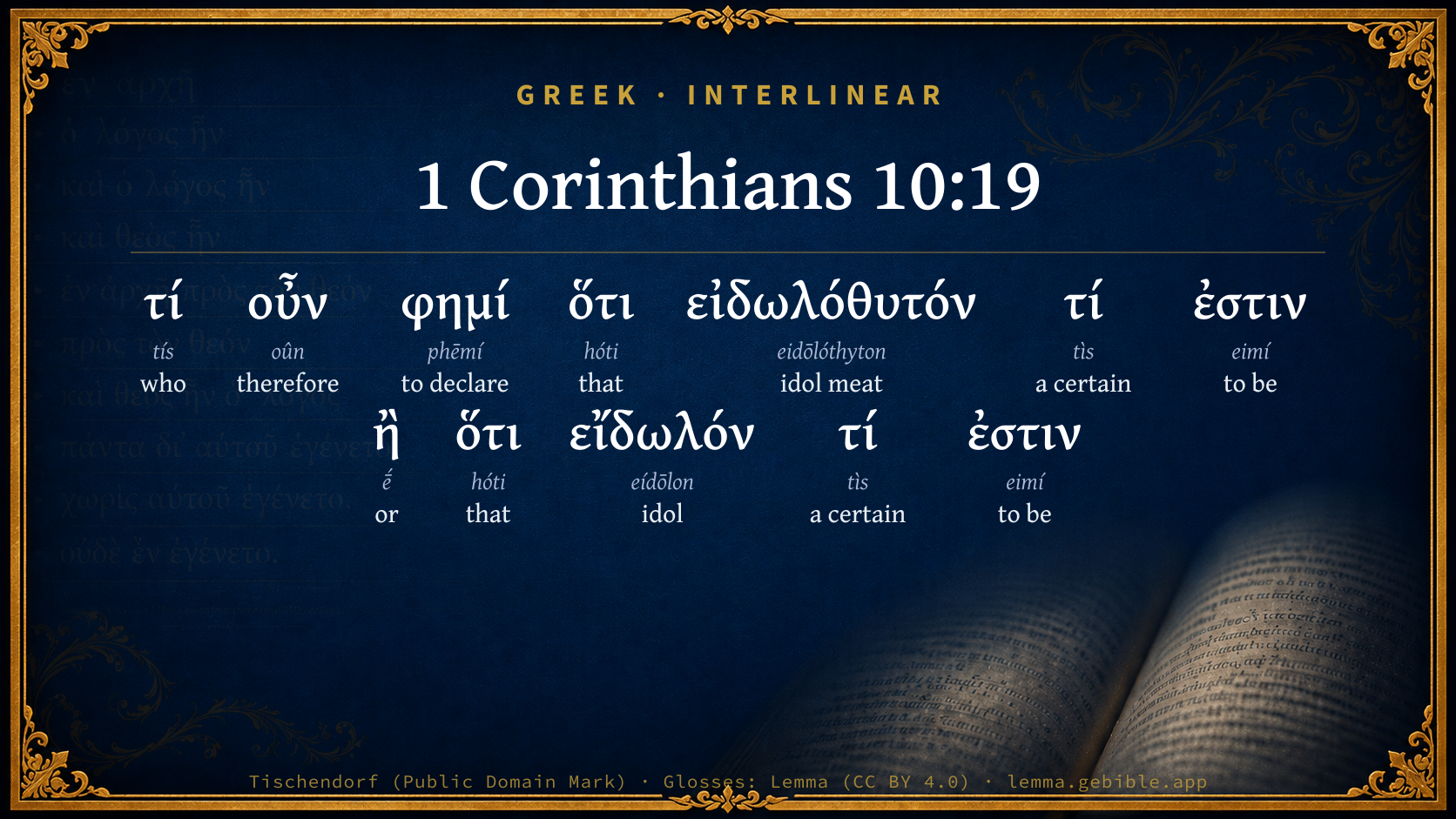
  1. τί tís G5101 “who” Interrogative pronoun, Accusative, Singular, Neuter
  2. οὖν oûn G3767 “therefore” Conjunction
  3. φημί phēmí G5346 “to declare” Verb, Present, Active, Indicative, 1st person, Singular
  4. ὅτι hóti G3754 “that” Conjunction
  5. τί tìs G5100 “a certain” Indefinite pronoun, Nominative, Singular, Neuter
  6. ἐστιν eimí G1510 “to be” Verb, Present, Active, Indicative, 3rd person, Singular
  7. ἢ ḗ G2228 “or” Particle
  8. ὅτι hóti G3754 “that” Conjunction
  9. εἴδωλόν eídōlon G1497 “idol” Noun, Nominative, Singular, Neuter
  10. τί tìs G5100 “a certain” Indefinite pronoun, Nominative, Singular, Neuter
  11. ἐστιν eimí G1510 “to be” Verb, Present, Active, Indicative, 3rd person, Singular

About this verse

These counts appear in no published source. They are computed here, from the morphology-tagged text and Lemma’s own curated glosses. What Lemma adds →

12
words
9
distinct lemmas
Pauline Epistles
section

Notable vocabulary

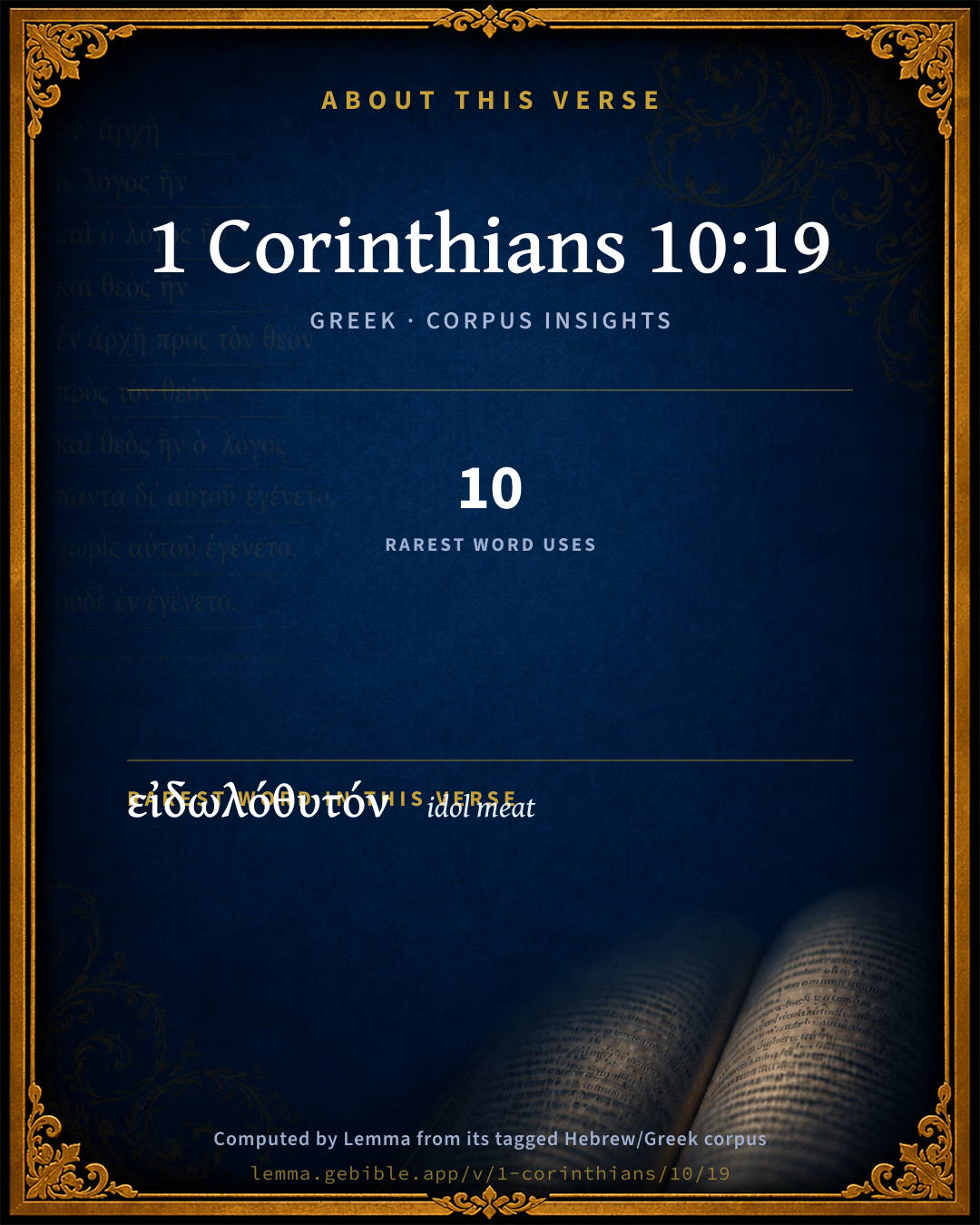
The rarest word here is εἰδωλόθυτόν idol meat G1494 — appearing just 10 times in the whole Greek New Testament.

Shared distinctive vocabulary

εἰδωλόθυτόν idol meat G1494 occurs in 10 verses of the Greek New Testament. Also found in:

Repetition

Words recur within this verse:

  • τί a certain G5100 ×2
  • ἐστιν to be G1510 ×2
  • ὅτι that G3754 ×2

Cross-references

8

Topical passages linked to 1 Corinthians 10:19 in the Treasury of Scripture Knowledge — connected by theme and wording, ordered by reader-vote popularity; previews shown in the World English Bible.

  • 1 Corinthians 8:4 Therefore concerning the eating of things sacrificed to idols, we know that no idol is anything in the world, and that there is no other God but one.
  • Deuteronomy 32:21 They have moved me to jealousy with that which is not God; They have provoked me to anger with their vanities: I will move them to jealousy with those who are not a people; I will provoke them to anger with a foolish nation.
  • Isaiah 40:17 All the nations are as nothing before him; they are accounted by him as less than nothing, and vanity.
  • Isaiah 41:29 Behold, all of them, their works are vanity [and] nothing; their molten images are wind and confusion.
  • 1 Corinthians 1:28 and God chose the lowly things of the world, and the things that are despised, and the things that are not, that he might bring to nothing the things that are:
  • 1 Corinthians 3:7 So then neither he who plants is anything, nor he who waters, but God who gives the increase.
  • 1 Corinthians 13:2 If I have the gift of prophecy, and know all mysteries and all knowledge; and if I have all faith, so as to remove mountains, but don't have love, I am nothing.
  • 2 Corinthians 12:11 I have become foolish in boasting. You compelled me, for I ought to have been commended by you, for in nothing was I inferior to the very best apostles, though I am nothing.

Cross-references courtesy of OpenBible.info (CC BY 4.0).

Commentary

Notes on 1 Corinthians 10:19 from classic Christian and Jewish commentators (each source and its license shown beneath its notes). The classic Christian expositions comment on the surrounding passage and are grouped to its opening verse, so a note may address several verses; the Jewish commentaries on the Tanakh (Rashi and others) are per-verse, so they appear only where the commentator wrote on this verse.

Lemma curates 59 commentaries, every one of them public domain or Creative Commons licensed, each selected and text-cleaned for this edition rather than reprinted as found. About our sources →

Joseph Benson's Commentary

1Co 10:19-22. What say I then — Do I, in saying this, allow that an idol is any thing divine? Or that which is offered in sacrifice to idols is any thing — Is a sacrifice to a real deity? Or is made either better or worse, or to differ from ordinary meat, by being thus offered to idols? You well know that I intend to maintain nothing of this kind: so far from it, that I aver the things which the Gentiles sacrifice — To supposed deities; they sacrifice to devils — For, though I grant the idol is nothing, yet those spirits that sometimes dwell in the images of these idols, and give answers from them, are something: they are demons, most wicked and unclean spirits, defiling every person and thing that has any relation to them. We may observe here, “The word δαιμωνια, demons, is used in the LXX. to denote the ghosts of men deceased; and Josephus (Bell., lib. 1Co 7:6) says, demons are the spirits of wicked men. It is therefore probable, that the writers of the New Testament use the word demons in the same sense, especially as it is well known that the greatest part of the heathen gods were dead men. The heathen worshipped two kinds of demons: the one kind were the souls of kings and heroes, deified after death, but who could have no agency in human affairs; the other kind of demons were those evil spirits who, under the names of Jupiter, Apollo, Trophonius, &c., moving the heathen priests and priestesses to deliver oracles, greatly promoted idolatry.” — Macknight. Such in reality, as if he had said, are the gods of the heathen, and with such only can ye hold communion in those sacrifices. And not to God — The heathen in general had no idea of God; that is, of an unoriginated, eternal, immutable, and infinitely perfect being, the Creator and Governor of all things. And I would not ye should have fellowship with devils — Or with their votaries, either in their worship, their principles, their practices, or their hopes; — ye who have at your baptism solemnly renounced the devil and all his adherents. For certainly it is not a small sin, nor a thing to be made light of, to have fellowship with them. Ye cannot of right — Or in reason, you ought not, it is contrary to your Christian profession so to do; drink the cup of the Lord, and the cup of devils — Ye cannot have communion with both; cannot reasonably make profession of the worship of God, (which you do in the Lord’s supper in the highest instance,) and also of the worship of devils, (as you do in the idol feasts,) these being so contrary one to the other. Do we provoke the Lord to jealousy — Namely, by joining devils in competition with him? or by thus caressing his rivals? Are we stronger than He? — Able to resist or to bear his wrath? Can we secure ourselves against his judgments, when he comes forth to punish for such sins?

Joseph Benson's Commentary on the Old and New Testaments (1811–1818) — public domain. Text from a community e-Sword module.

Tyndale Open Study Notes

Tyndale Open Resources

10:19-20 Idols have no reality or life (see 8:4-6), and sacrifices made to them accomplish nothing. The sacrifices pagans make to idols are actually unknowingly made to demons (see Deut 32:16-17; Ps 106:37; Rev 9:20). Those who share in their religious meals are thereby uniting themselves with demons.

Tyndale Open Study Notes — © Tyndale Open Resources, licensed CC BY-SA 4.0. Text via the HelloAO Bible API.

Bengel's Gnomon

Johann Albrecht Bengel

1Co 10:19. Τί, what) In the Protasis, he has derived his argument from the sacred rites of the Christians and Jews; and now about to give the apodosis, he uses προθεραπεία, precaution in the way of anticipation, and sets down by implication the apodosis itself with pious caution, εὐλαβῶς, in 1Co 10:20: he who eats things offered to idols, cultivates communion with demons. An idol[88] is a piece of wood, and nothing else; what is offered to an idol is a piece of flesh, and nothing else; but that cup and that bread, which have been spoken of at 1Co 10:16, are not a mere cup and mere bread.

[88] By inverting the order, the margin of both editions intimates, that εἰδωλόθυτον is to be placed first, and that εἴδωλον should be second in the order; but the Germ. Ver. follows the reading of the text.—E. B.

BC corrected later, D Vulg., d Memph., Theb. Versions, have the order εἰδωλόθυτον—εἴδωλον. A omits ἢ ὅτι εἴδωλόν τι ἔστιν.—ED.

Bengel's Gnomon of the New Testament — English translation (T&T Clark, Edinburgh, 1860) — public domain. Text from a community e-Sword module.

Meyer's Critical & Exegetical Commentary

Heinrich August Wilhelm Meyer

1Co_10:19-20. By these two analogues, 1Co_10:16-18, the apostle has now justified his warning given above against the sacrificial feasts as a warning against idolatry (1Co_10:14). But from the case of the Jewish sacrificial eating last adduced, his readers might easily draw the inference: You declare, then, the idolatrous offerings and the idols to be what the heathen count them? For whereas the apostle adduced the κοινωνία of the Jewish θυσιαστήριον, and that as an analogue of the heathen θυσιαστήρια, he seemed thereby to recognise the κοινωνία of these too, and consequently also the real divine existence of the idols thus adored. He therefore himself puts the possible false inference in the shape of a question (1Co_10:19), and then annuls it in 1Co_10:20 by adducing the wholly different results to which 1Co_10:18 in reality gives rise. The inference, namely, is drawn only from 1Co_10:18, not from 1Co_10:16-18 (de Wette, Osiander, Hofmann, al[1684]), as 1Co_10:20 (θύουσιν, correlative to the θυσιαστηρίου of 1Co_10:18) shows.

τὶ οὖν φημι;] what do I maintain then? namely, in following up 1Co_10:18. Upon this way of exciting attention by a question, comp Dissen, a[1686] Demosth. de cor. p. 347. Krüger, Anab. i. 4. 14.

τὶ ἐστιν] is something, i.e. has reality, namely, as εἰδωλόθυτον, so that it is really flesh which is consecrated to a god, as the heathen think, and as εἴδωλον, so that it really is a divine being answering to the conception which the heathen have of it; as if, for instance, there were such a being as Jupiter in existence, who actually possessed the attributes and so forth ascribed to him by the heathen. To accent the words τι ἔστιν (Billroth, Tischendorf, comp Ewald) would give the sense: that any idol-sacrifice (and: any idol) exists, in the capacity, that is to say, of idol-sacrifice and of idol. Either rendering harmonizes with 1Co_8:4. In opposition to the latter of the two, it must not be said, with Rückert, that ἔστι would need to come immediately after ὅτι, for the last place, too, is the seat of emphasis (Kühner, II. p. 625); nor yet, with de Wette, that the one half (εἰδωλόθυτον) is not so suitable, for the context surely makes it perfectly plain that Paul is not speaking of absolute existence. But since both renderings are equally good as regards sense and expression, we can only decide between them on this ground, that with the second the τί would be superfluous, whereas with the firstwhich, following the Vulgate, is the common oneit has significance, which should give it the preference. At the same time, we must not insert any pregnancy of meaning like that in 1Co_3:7 (of influence and effect) into the τί, as Hofmann does without warrant from the context; but it is the simple aliquid, the opposite of the non-real, of the non-ens.

ἀλλʼ] refers to the negative sense of the preceding question. Hence: No; on the contrary, I maintain, etc. See Hartung, Partikell. II. p. 37; Baeumlein, p. 10 f.

ἃ θύουσιν] see the critical remarks. The subject is self-evident: the sacrificers (the heathen, who sacrifice). Kühner, II. p. 35 f.

The assertion, again, that the heathen sacrifices are presented to demons and not to a real God (Θεῷ), follows (οὖν, in 1Co_10:19) from the fellowship in which the Jew who ate of the sacrifices stood to the altar on which they were offered; inasmuch as confessedly it was only the Jewish θυσιαστήριον with its sacrifice that belonged to a real God, and consequently the heathen θυσιαστήρια and their offerings could not have reference to a God, but only to beings of an opposite kind, i.e. demons.

δαιμονίοις] does not mean idols, false or imaginary gods (Bos, Mosheim, Valckenaer, Zachariae, Rosenmüller, Heydenreich, Flatt, Pott, Neander), which is contrary to the uniform usage of the LXX. and the N. T.,[1688] and would, moreover, yield a thought quite out of keeping with the context; for it was the apostles aim to point to a connection with an antichristian reality. The word means, as always in the N. T., demons, diabolic spirits. That the heathen worships quoad eventum (of course not quoad intentionem) were offered to devils, was a view derived by all the later Jews with strict logical consistency from the premisses of a pure monotheism and its opposite. See the LXX. rendering of Deu_32:17; Psa_106:37,a reminiscence of which we have in Pauls expression here,

Psa_95:5; Bar_4:7; Tob_3:8; Tob_6:14, and the Rabbinical writers quoted in Eisenmengers entdeckt. Judenth. I. pp. 805 ff., 816 ff. So Paul, too, makes the real existences answering to the heathen conceptions of the gods, to be demons, which is essentially connected with the Christian idea that heathendom is the realm of the devil; for, according to this idea, the various individual beings regarded by the heathen as gods can be nothing else but diabolic spirits, who collectively make up the whole imperial host of the ἄρχων τοῦ κόσμου τούτου (Eph_2:2; Eph_6:12), who is himself the ἀρχηγός.[1689] Comp Hahn, Theol. des N. Test. I. p. 366 f.; Weiss, bibl. Theol. p. 279. The ancient church, too, followed Paul in remaining true to this idea. See Grotius on this passage. Usteri, Lehrbegr. p. 421 ff. As to the consistency of this view with that expressed in 1Co_8:4, see the remarks on the latter verse. Rückert therefore (with Grotius) is wrong in altering the representation to this effect, that according to Paul the demons had given the heathen to believe that there were gods to whom men should sacrifice, in order to obtain for themselves under their name divine worship and offerings, and that in so far the sacrifices of the heathen were presented to demons. The LXX. rendering of Deu_32:17 and Psa_95:5 should of itself have been enough to prevent any such paraphrase of the direct dative-relation.

οὐ θέλω δὲ κ.τ.λ[1691]] that I, however, do not wish, still dependent upon ὅτι, the reply to ΤῚ ΟὖΝ ΦΗΜΙ being only thus completed. The ΚΟΙΝΩΝΟΎς points back to ΚΟΙΝΩΝ. in 1Co_10:18. The article in ΤῶΝ ΔΑΙΜ. denotes this class of beings.

[1684] l. and others; and other passages; and other editions.

[1686] d refers to the note of the commentator or editor named on the particular passage.

[1688] Act_17:18 is uttered by Greeks according to their sense of the word; but in Rev_9:20 we are to understand demons as meant.

[1689] Mosheim objects that if Paul held this belief, he must have pronounced the sacrificial meat to be positively unclean. But it had surely received no character indelebilis through its being set apart for the altar. If not partaken of in its quality as sacrificial meat, it had lost its relation to the demons, and had become ordinary meat, just as Jewish sacrificial flesh, too, retained the consecration of the altar only for him who ate it as such.

[1691] .τ.λ. καὶ τὰ λοιπά.

Meyer — Critical and Exegetical Commentary on the New Testament — English translation by Peter Christie, edited by Frederick Crombie (T&T Clark, 1880) — public domain. Text from a community e-Sword module.

Expositor's Greek Testament

ed. W. Robertson Nicoll

1Co 10:19-20 . Paul’s appeal to the meaning of the Lord’s Supper is leading up to a prohibition of attendance at the idol-feasts. Against this veto the men of “knowledge” will argue that idolatry is illusion (1Co 8:4 ff.), its rites having no such ground in reality as belongs to Christian observances; the festival has no religious meaning to them, and does not touch their conscience (contrast 1Co 8:7 ); if friendship or social feeling invites their presence, why should they not go? Paul admits the non-reality of the idol in itself; but he discerns other terrible presences behind the image “demons” are virtually worshipped at the idol-feast, and with these the celebrants are brought into contact. “What then do I affirm (the φημὶ of 1Co 10:15 resumed)? that an idol-sacrifice is anything ( has reality )? or that an idol is anything? (to say this would be to contradict 1Co 8:4 ). No, but that ( ἀλλʼ ὅτι ) what the Gentiles sacrifice they sacrifice to demons , and not to God; and I would not that you should be communicants of the demons!” How could the Cor [1529] , as “men of sense, judge” of a situation like this? The riot and debauch attending heathen festivals showed that foul spirits of evil presided over them: cf. 1Co 10:6 ff., referring to the worship of Baal-Peor, with which the allusion here made to Deu 32:17 ( cf. Psa 106:37 f.) is in keeping. “That the worship of heathen cults was offered quoad eventum not indeed quoad intentionem to devils was, consistently with their strict monotheism, the general view of later Jews” (Mr [1530] ). Heathenism P. regarded as the domain of Satan (2Co 4:4 , Eph 2:2 ; Eph 6:12 ; cf. Luk 4:6 , 1Jn 5:19 ), under whose rule the demons serve as the angels under that of God (2Co 12:7 , 1Ti 4:1 ; cf. Mat 12:24 ; Mat 25:41 , etc.); idolatry was, above everything, inspired by Satan. δαιμόνιον (= δαίμων , of which it is neut. adj [1531] ) was primarily synon. with θεῖον “ δαίμων is related to θεὸς as numen to persona divina ” (Cr [1532] ); τὸ δαιμόνιον οὐδέν ἐστιν ἀλλʼ ἢ θεὸς ἢ θεοῦ ἔργον (Arist., Rhet ., ii. 23. 8); hence Socrates called the mysterious guiding voice within him δαιμόνιόν τι . Ed [1533] observes a tendency, beginning with Eurip. and Plato and accentuated in the Stoics, “to use the word in a depreciatory sense”; already in Homer it often suggested the uncanny , the supernatural as an object of dread. The word was ready to hand for the LXX translators, who used it to render various Heb. epithets for heathen gods. Later Judaism, which peopled the unseen with good and evil spirits, made δαιμόνια a general term for the latter, apart from any specific refer. to idols (see, already, Tob 3:8 , etc.); hence its prominence in the Gospels, and the origin of the word demoniac ( ὁ δαιμονιζόμενος ): on the whole subject, see Cr [1534] s.v ., also Everling’s Paulinische Angelologie u. Dãmonologie . For κοινωνοὶ τ . δαιμονίων , cf. Isa 44:2 , where the “fellows” of the idol signify a kind of religious guild, brought into mystic union with their god through the sacrificial meal (see Cheyne ad loc [1535] ); also Isa 65:11 . 1Co 10:20 c is calculated to bring home to the Cor [1536] the fearful danger of trifling with idolatry.

[1529] Corinth, Corinthian or Corinthians.

[1530] Meyer’s Critical and Exegetical Commentary (Eng. Trans.).

[1531] adjective.

[1532] Cremer’s Biblico-Theological Lexicon of N.T. Greek (Eng. Trans.).

[1533] T. C. Edwards’ Commentary on the First Ep. to the Corinthians . 2

[1534] Cremer’s Biblico-Theological Lexicon of N.T. Greek (Eng. Trans.).

[1535] ad locum , on this passage.

[1536] Corinth, Corinthian or Corinthians.

The Expositor's Greek Testament, edited by W. Robertson Nicoll (1897–1910) — public domain. Text from a community e-Sword module.

Hodge's Commentary on Romans, Ephesians & First Corinthians

Charles Hodge

1Co_10:19

What say I then? that the idol is any thing, or that which is offered in sacrifice to idols is any thing?

This is evidently intended to guard against a false inference from this mode of reasoning. It was not to be inferred from what he had said, that he regarded the professed objects of heathen worship as having the same objective existence as the God whom Jews and Christians worshipped; or that he considered the heathen sacrifices as having any inherent power. The idol was nothing, and that which was offered to the idol was nothing. This however does not alter the case. For although there are no such beings as those whom the heathen conceive their gods to be, and although their sacrifices are not what they consider them, still their worship is real idolatry, and has a destructive influence on the soul. How this is, is explained in the following verse.

Charles Hodge — Commentary on Romans (1835), First Corinthians (1857), and Ephesians (1856) — public domain. Text from a community e-Sword module.

Jamieson, Fausset & Brown

Robert Jamieson, A. R. Fausset & David Brown

What say I then?--The inference might be drawn from the analogies of the Lord's Supper and Jewish sacrifices, that an idol is really what the heathen thought it to be, a god, and that in eating idol-meats they had fellowship with the god. This verse guards against such an inference: "What would I say then? that a thing sacrificed to an idol is any real thing (in the sense that the heathen regard it), or that an idol is any real thing?" (The oldest manuscripts read the words in this order. Supply "Nay") "But [I say] that the things which the Gentiles sacrifice, they sacrifice to devils (demons)." Paul here introduces a new fact. It is true that, as I said, an idol has no reality in the sense that the heathen regard it, but it has a reality in another sense; heathendom being under Satan's dominion as "prince of this world," he and his demons are in fact the powers worshipped by the heathen, whether they are or are not conscious of it (Deu 32:17; Lev 17:7; Ch2 11:15; Psa 106:37; Rev 9:20). "Devil" is in the Greek restricted to Satan; "demons" is the term applied to his subordinate evil spirits. Fear, rather than love, is the motive of heathen worship (compare the English word "panic," from PAN, whose human form with horns and cloven hoofs gave rise to the vulgar representations of Satan which prevail now); just as fear is the spirit of Satan and his demons (Jam 2:19).

Jamieson, Fausset & Brown — Commentary Critical and Explanatory on the Whole Bible (1871) — public domain (CC PDM 1.0). Text via the HelloAO Bible API.

Adam Clarke's Commentary

Verse 19. What say I then?] A Jewish phrase for, I conclude; and this is his conclusion: that although an idol is nothing, has neither power nor influence, nor are things offered to idols any thing the worse for being thus offered; yet, as the things sacrificed by the Gentiles are sacrificed to demons and not to God, those who partake of them have fellowship with demons: those who profess Christianity cannot have fellowship both with Christ and the devil.

Adam Clarke's Commentary on the Bible (1810–1826) — public domain. Text from a community e-Sword/MySword module.

John Calvin's Commentaries

19. What do I say then? It might seem at first view as if the Apostle either argued inconclusively, or ascribed to idols something of existence and of power. Now it might readily be objected — “What comparison is there between the living God and idols? God connects us with himself by the sacraments. Be it so. How comes it that idols, which are nothing, (1 Corinthians 8:4,) have so much power, as to be able to do the like? Do you think that idols are anything, or can do anything?” He answers, that he does not look to the idols themselves; but rather has in view the intention of those who sacrifice to idols. For that was the source of the pollution that he had indirectly pointed out. He confesses, therefore, that an idol is nothing. He confesses that it is a mere delusion when the Gentiles take it upon them to go through solemn rites of dedication, and that the creatures of God are not polluted by such fooleries. But as the design of them is superstitious and condemnable, and as the work is base, he infers, that all who connect themselves with them as associates, are involved in pollution.

John Calvin's Commentaries (1540-1563) — public domain. Text from the Calvin Translation Society English edition (1840s-50s) via the Christian Classics Ethereal Library (ccel.org). Calvin's coverage is partial (roughly two-thirds of the Bible); uncommented books and verses are honest gaps, never fabricated. The 19th-century editor's footnotes and remarks are omitted so the notes are faithfully Calvin's own voice.

Ellicott's Commentary for English Readers

(19) What say I then?—It might have been argued from the preceding verse that the Apostle admitted the heathen offerings and the idols to which they were offered to be as real as were the offerings and Being to whom the altar was erected by Israel, whereas in 1Co_8:4 he had asserted the contrary.

A Bible Commentary for English Readers, edited by Charles John Ellicott (1878–1897) — public domain. Text from a community e-Sword module.

The Cambridge Bible for Schools and Colleges

gen. ed. J. J. S. Perowne

19. What say I then? that the idol is any thing] St Paul does not mean to say here, any more than in ch. 1Co_8:4, that an idol, or the god represented by it, has any real objective existence, or that the sacrifices offered to such idols are the property of any such being as that they are intended to represent. But for all that, it may stand as the representative of that which has a very real existence indeed; he kingdom of evil, and those beings which maintain it.

The Cambridge Bible for Schools and Colleges (gen. ed. J. J. S. Perowne; Cambridge University Press, 1878–1918) — public domain. Text from a community e-Sword module.

John Gill's Exposition

What say I then?.... Or may be objected to, or inferred from, what I say;

that an idol is anything, or that which is sacrificed to idols is anything? to which must be answered, as the Syriac version reads, "no", by no means; by running the parallel between Christians having communion with the body and blood of Christ, in the Lord's supper, through eating the bread and drinking the wine, the Israelites partaking of the altar, by eating of the sacrifices of it, and men's joining with idols and idolaters, by eating things sacrificed to idols; it follows not that an idol has anything of deity in it, and is to be set upon a level with God, when, as he had said before, an idol was nothing, and what he now said did not at all contradict that; or that things offered to idols are to be had in the same account, or to be equalled to, or be thought to have any thing in them, as the elements of the bread and wine in the Lord's supper, or the sacrifices that were offered by the Israelites on the altar, according to the divine command; he meant no such thing, but only argued from the greater to the lesser, and his sense is more fully declared in the next words.

John Gill's Exposition of the Whole Bible (1746–1763) — public domain (CC PDM 1.0). Text via the HelloAO Bible API.

Trapp's Complete Commentary

John Trapp

19 What say I then? that the idol is any thing, or that which is offered in sacrifice to idols is any thing?

Ver. 19. What say I then] He prevents a mistake. See 1Co 8:4. Ministers must in their discourses meet with all objections as much as may be.

John Trapp, A Commentary or Exposition upon All the Books of the Old and New Testament (1647–1656) — public domain. Text from a community e-Sword module.

Albert Barnes' Notes on the Bible

What say I then? - This is in the present tense; τί οὖν φημι ti oun phēmi, what do I say? What is my meaning? What follows from this? Do I mean to say that an idol is anything; that it has a real existence? Does my reasoning lead to that conclusion; and am I to be understood as affirming that an idol is of itself of any consequence? It must be recollected that the Corinthian Christians are introduced by Paul 1Co 8:4 as saying that they knew that an idol was nothing in the world. Paul did not directly contradict that; but his reasoning had led him to the necessity of calling the propriety of their attending on the feasts of idols in question; and he introduces the matter now by asking these questions, thus leading the mind to it rather than directly affirming it at once. “Am I in this reasoning to be understood as affirming that an idol is anything, or that the meat there offered differs from other meat? No; you know, says Paul, that this is not my meaning. I admit that an idol in itself is nothing; but I do not admit, therefore, that it is right for you to attend in their temples; for though the “idol” itself - the block of wood or stone - is nothing, yet the offerings are really made to devils; and I would not have you engage in such a service;” 1Co 10:20-21.

That the idol is anything? - That the block of wood or stone is a real living object of worship, to be dreaded or loved? See the note at 1Co 8:4.

Or that which is offered in sacrifice to idols is anything? - Or that the meat which is offered “differs” from that which is not offered; that the mere act of offering it changes its qualities? I do not admit or suppose this.

Albert Barnes' Notes on the Bible (1834–1885) — public domain. Text from a community e-Sword/MySword module.

Haydock's Catholic Bible Commentary

What then? do I say, &c. He puts this objection, as if it were contradictory to what he had taught before, (chap. viii. ver. 4.) that an idol is nothing, &c. but he answers this objection by saying that all things, that is, all meats are lawful in themselves, but not always expedient, nor edifying, when they give scandal to weak brethren, or when the infidels themselves think that such as eat things offered to idols, join with them in honouring their idols. (Witham) --- The meaning of this passage is: whilst I advise you to abstain from eating of any thing consecrated to idols, I do not advise you as supposing that these offerings have any power in themselves to defile your souls, in the same manner as by eating of the body and blood of Christ we receive strength to overcome our spiritual enemies. St. Paul here anticipates an objection that might be made by some to whom he was writing. (Estius)

George Leo Haydock (1774–1849), Haydock's Catholic Family Bible and Commentary, 1859 edition — public domain. Excludes Psalms (Douay-Rheims chapter numbering differs from Protestant) and Deuterocanonical books (Catholic canon only).

Matthew Poole's English Annotations

I do not by this contradict what I before said, nor now affirm that an idol is any thing, or the sacrifices offered to it any thing. An idol hath nothing in it of a Deity, nor can it either sanctify or pollute any thing that is set before it; the error is in your action, as you communicate with such as are idolaters; it is your own action that polluteth you, not the idol, nor yet the meat set before it.

Matthew Poole's English Annotations on the Holy Bible (1683–1685) — public domain. Text from a community e-Sword/MySword module.

Whedon's Commentary on the Bible

Daniel D. Whedon

19. What say I then?—What is the import, then, of what I am now saying? Do I attribute any real existence to the imaginary gods and demigods represented by the idol, as Jupiter, Venus, Apollo? Or that the sacrifice is any thing more than a fiction?

Daniel D. Whedon (gen. ed.), Commentary on the Old and New Testaments (1874–1909) — public domain. Text from a community e-Sword module.

The Pulpit Commentary

What say I then? What is it, then, which I am maintaining (fhmi)? That the idol is anything. St. Paul repudiates an inference which he had already denied. (1Co_8:4) Is anything. Has any intrinsic value, meaning, or importance. In itself, the idol offering is a mere dead, indifferent thing. Of itself, the idol is an eidolon a shadowy, unreal thing, one of the elilim; but in another aspect it was "really something," and so alone could the rabbis account for phenomena which seemed to imply the reality of infernal miracles ("Avoda Zarah," fol. 54, 2; 55, 1; and see note in "Life of St. Paul," 2:74).

The Pulpit Commentary (1880–1919), ed. H.D.M. Spence-Jones & Joseph S. Exell — public domain. Text from a community e-Sword module.

John Wesley's Explanatory Notes

What say I then - Do I in saying this allow that an idol is anything divine? I aver, on the contrary, that what the heathens sacrifice, they sacrifice to devils. Such in reality are the gods of the heathens; and with such only can you hold communion in those sacrifices.

John Wesley, Explanatory Notes Upon the Whole Bible (1754–1765) — public domain. Text via the GEBible commentary corpus.

Godbey's Commentary on the New Testament

William B. Godbey

THE COMMUNION

19. As the blood in the human system is the vitalizer of the whole body, circulating into every member, so the blood of Christ circulates into every member of His mystical body, in Heaven and in earth, imparting to all His own vitality. Hence close communion is out of harmony with the life of Christ, common to all the members of His body and interpenetrating all, great and small. This blood, which is the life, is emblematized by the wine which should be participated in alike by all the members of our Lord’s body. The bread also emblematizes the body of Christ, and is consequently to be the common participation of all. Since bread is the staff of physical life on which every human body subsists, so it typifies Christ, the Creator and Nourisher of every human spirit. Hence the Eucharist is the visible bond of union, identifying the saints of all ages and nations with the one body of Christ.

William B. Godbey, Commentary on the New Testament (1896–1900) — public domain. Text from a community e-Sword module.

McGarvey & Pendleton's Commentaries

J. W. McGarvey

What say I then? that a thing sacrificed to idols is anything, or that an idol is anything? ["But, Paul," say the Corinthians, "your reasoning can not apply to feasts or sacrificial meat offered to idols; for you have already admitted ( 1Co_8:4 ) that an idol is a nonentity. By sacrifice a man may establish a communal relationship with God, for God is; but he can establish no such relationship with an idol, for an idol is not-it has no existence." The understanding of the Corinthians with regard to idols was true, but it was not the whole truth, for there was some reality back of the idol.]

J. W. McGarvey (with Philip Y. Pendleton), Commentaries on the New Testament (The Fourfold Gospel, 1914; Acts; and the epistles) — public domain. Text from a community e-Sword/MySword module.

The People's New Testament

B. W. Johnson

19. What say I then? He had said an idol was nothing (8:4). Does he not now imply an idol is something?

B. W. Johnson's The People's New Testament with Notes (1889–1891) — public domain. Electronic text from the Christian Classics Ethereal Library (CCEL) ThML edition.

Cambridge Greek Testament for Schools and Colleges

19. εἰδωλόθυτον and εἴδωλον are transposed in rec. with Peshito. Text BDE, Vetus Lat. and Vulg.

19. τί οὖν φημί; ὅτι εἰδωλόθυτόν τί ἐστιν; St Paul does not mean to say here, any more than in ch. 1Co 8:4, that an idol, or the god represented by it, has any real objective existence, or that the sacrifices offered to such idols are the property of any such being as that they are intended to represent. But for all that, it may stand as the representative of that which has a very real existence indeed; the kingdom of evil, and those beings which maintain it.

Cambridge Greek Testament for Schools and Colleges (Cambridge University Press, 1896; 21 vols, various authors incl. Carr, Maclear, Plummer, Farrar, Lumby, Moule, M. R. James, Simcox) — public domain. Text from a community e-Sword module.

Alford’s Greek Testament

Henry Alford

19.] τί οὖν φημι; what am I then assuming? so Xen. Anab. i. 14. 4, τί οὖν κελεύω ποιῆσαι;

ὅτι εἰδωλόθ. τί ἐστιν] that a thing sacrificed to an idol is any (real) thing (so sacrificed)? (i.e. has any real existence as a thing sacrificed? The accentuation τι ἔστιν; would come nearer to the sense of ch. 8:4, ὅτι οὐδὲν εἴδωλον ἐν κόσμῳ,—‘that there is any (such thing as an) offering to an idol?’ and in a matter so ambiguous it is impossible to decide between the two) or that an idol is any thing (real? e.g. that Jupiter is Jupiter in the sense of a living power)?—(Not so:—this ellipsis of the negative, taken up by ἀλλά, is found in classical Greek: e.g. Xen. Mem. i. 2. 2, πῶς οὖν αὐτὸς ὢν τοιοῦτος ἄλλους ἂν ἀσεβεῖς … ἐποίησεν; ἀλλʼ ἔπαυσε μὲν τούτων πολλούς, ἀρετῆς ποιήσας ἐπιθυμεῖν, &c. See Hartung, Partikellehre, ii. 37.) But (I say) that the things which they (i.e. the Gentiles) sacrifice, they sacrifice to devils, and not to God (δαιμ., not ‘false-gods,’ nor in the sense in which it is used in the mouth of idolaters themselves, Act 17:18, and Xen. Mem. i. 1. 1, deities (see Stanley’s note, in which this idea is ingeniously combined with the Christian sense given below),—but, as always in LXX and N. T. when used by worshippers of the true God, ‘devils,’ ‘evil spirits.’ The words are from Deut. (ref.), see also Psa 95:5 (Baruch 4:7, θύσαντες δαιμονίοις κ. οὐ θεῷ). Heathendom being under the dominion of Satan (ὁ ἄρχων τοῦ κόσμου τούτου), he and his angels are in fact the powers honoured and worshipped by the heathen, however little they may be aware of it): but (the inference being suppressed ‘and ye therefore by partaking in their sacrifices would be partakers with devils: but’) I would not have you become partakers with devils (τῶν generic).

Henry Alford, The Greek Testament (1849–1861) — public domain. Text from a community e-Sword module.

International Critical Commentary

19. τί οὖν φημι; ‘What then do I declare?’ This refers back to the φημί in v. 15 and guards against apparent inconsistency with 8:4. ‘Do I declare that a thing sacrificed to an idol is something, or that an idol is something?’ In neither case was there reality. The εἰδωλόθυτον professed to be an offering made to a god, and the εἴδωλον professed to represent a god. Both were shams. The εἰδωλόθυτον was just a piece of flesh and nothing more, and its being sacrificed to a being that had no existence did not alter its quality; the meat was neither the better nor the worse for that. The εἴδωλον was just so much metal, or wood, or stone, and its being supposed to represent a being that had no existence did not alter its value; it was neither more nor less useful than before. As a sacrifice to a god, and as the image of a god, the εἰδωλόθυτον and the εἴδωλον had no reality, for there was no such being as Aphrodite or Serapis. Nevertheless, there was something behind both, although not what was believed to be there.

AV., following KL, Syrr., has ‘idol’ first; and, without authority, inserts the article, ‘the idol.’ א B C D E P, Vulg. Copt. Arm. Aeth. have ὅτι εἰδωλόθυτον … ὅτι εἴδωλον. The accentuation of Tisch., ὅτι εἰδωλόθυτον τι ἔστιν, ἢ ὅτι εἴδωλόν τι ἔστιν, is probably wrong: better, τί ἐστιν in each case; ‘that it is something’ (aliquid) is the meaning, not ‘that any such thing exists.’ The omission of ἢ ὅτι εἴδωλόν τί ἐστιν (א* A C*) is no doubt owing to homoeoteleuton, τί ἐστιν to τί ἐστιν.

International Critical Commentary — older volumes (1896–1929), various authors — public domain. Text from a community e-Sword module.

Godet's Commentaries

Frédéric Louis Godet

Vv. 19, 20. “What say I then? that the meat offered to the idol is anything? Or that an idol is anything?...20. But the things which they sacrifice, they sacrifice to demons, and not to God. Now I would not that ye should be in communion with demons.”

The way in which Paul had just cited the two previous examples evidently assumed that he ascribed a diabolical influence to the sacrificial feasts of the heathen; now this idea seemed to be in contradiction to chap. 1Co 8:4; 1Co 8:6, where it had been declared that the gods of the heathen are not real divinities, and that the meat offered on their altar is consequently neither more nor less than simple meat, like any other. Paul therefore anticipates the objection which he foresees: “Art thou not now, contrary to thy previous declarations, allowing a disturbing influence to meats devoted to idols, and consequently, a Divine reality to the idols themselves?” In the order of questions, I follow the reading of the Vatic. and the Cantabrig., for it seems to me logical that Paul should begin with the question relating to the meat offered, to ascend therefrom to the question relating to the idol. I admit, however, that the opposite order may also be justified.

The omission of the question relating to the idol in the Sinaït., etc., is one of those many lacunae, especially in this MS., which are caused by the recurrence of the same letters at the distance of a few words. In the first question: That the meat offered to the idol is anything? the word anything signifies anything exceptional, having power to exercise a particular influence. In the second question: That an idol is anything? the anything signifies anything real. Sometimes the word τί has been taken as an adjective: “That any idol whatever is, that is to say exists” (εἴδωλόν τι ἔστιν, instead of εἴδωλόν τί ἐστιν). But the τί would be superfluous in this sense. It is more natural to take it as the predicate in the two questions.

Vv. 20. The apostle does not even take the trouble of stating the negative answer which he gives to these two questions; he passes directly to the affirmation which concerns him: Jupiter, Apollo, Venus, certainly, are not real beings; but Satan is something. Behind all that mythological phantasmagoria there lie concealed malignant powers, which, without being divinities, are nevertheless very real, and very active, and which have succeeded in fascinating the human imagination, and in turning aside the religious sentiment of the heathen nations to beings of the fancy; hence the idolatrous worships, worships addressed to those diabolical powers and not to God.

The subst. τὰ ἔθνη, the Gentiles, is omitted by the Vatic. and the Greco-Lats.; it is certainly an explanatory addition. This neuter substantive, once introduced, dragged into the T. R. the singular θύει, instead of the plural θύουσιν.

The subject of this latter verb is understood; it is self-evident.

The term δαιμόνιον, demon, which occurs nowhere else in Paul’s writings except in 1Ti 4:1, has quite another meaning in the New Testament than in the classics. In the latter it is synonymous with θεῖον, something Divine. Plato in the Symposium, says that “demon is something intermediate between God and mortals;” and, in another passage: “That the demons interpret to the gods the things of men, and to men the things of the gods.” Imported into biblical language by the version of the LXX., the word there denotes the fallen angels, so often spoken of in Scripture. Thus Deu 32:17, the LXX. translate the words: jizebekou laschschédim..., ἔθυσαν δαιμονίοις καὶ οὐ θεῷ (sched probably denoting in Hebrew idols, from schad, to rule). The Jews identified heathen divinities with the demons themselves; thus it is that the LXX. translate in Isa 65:11, the phrase: “to prepare a table for the host of heaven,” by: “to prepare a table for the demon.” The pagan Plutarch (De defectu orac., chap. 13) ascribes to wicked spirits all that was barbarous and cruel, for example, human sacrifices in heathen religions. We may compare also Psa 96:5 : “For all the gods of the heathen are demons” (in Hebrew idols), and Baruch, chap. 4: “They sacrifice to demons, not to God.” It is in this Jewish acceptation that the term is used here. But the words of the apostle do not imply the idea that every false god worshipped by the heathen corresponds to a particular demon; they signify merely that heathen religions emanate from those malignant spirits, and that consequently the man who takes part in such worship puts himself under their influence. “How was it possible,” says Heinrici, “to sit at such a feast, to be sprinkled with the holy water, to obey the prescription of sacred silence, to take part in the joy of the hymns and dances which filled the interval between the sacrifice and the banquet, and finally to be given up to the joy of the feast which crowned the festive day to the glory of the false god, without acting as a worshipper of the heathen divinity?” The diabolical character of idolatry could be masked to a certain extent in Greek heathenism by the charm or majesty of the forms; but is it not clearly unveiled in modern heathen religions, particularly in Hindoo and African forms of worship, in which God’s holy image has come at last to give place completely to hideous and ignoble figures? Besides, the inspiring sentiment of these worships is solely that of fear.

The δέ is progressive: “Now I would not.” This authoritative form is accounted for by the solicitude of love. A father cannot allow his children to deliver themselves into bad hands.

Frédéric Louis Godet — Commentaries on Luke, John, Romans, and 1 Corinthians — English translation (T&T Clark, Edinburgh, 1870s–1890s) — public domain. Text from a community e-Sword module.

Lesson kit

Teaching starters — assembled from the data on this page, not authored interpretation. Every prompt links to the verse data it draws on. Edit before teaching.

1 Corinthians, in the Pauline Epistles, opens this verse with 12 words (9 distinct Greek lemmas). Its most distinctive word is eidōlóthyton (“idol meat”). A historical commentator’s framing appears above. Read the whole chapter for the surrounding context.

Discussion questions

  1. How does “idol meat” (eidōlóthyton) shape what this verse is saying?
  2. Acts 15:29 shares the word «idol meat» with this verse. How do the two illuminate each other?
  3. “a certain” occurs 2× in this one verse. What is the effect of the repetition?
  4. These translations render this verse differently. What is at stake in choosing one wording over another?
  5. Reading how Joseph Benson's Commentary and Tyndale Open Study Notes read this verse, where do the two commentators agree and where do they part?

Things to notice

  • These translations choose different wording for 10 words in this verse.
  • “a certain” occurs 2× in this single verse.
  • 9 distinct Greek lemmas span 12 words in this verse.

Reading settings

Reading text

Shown beneath each verse's original-language words.

Old Testament
Old Testament edition

Read the OT as the Masoretic Hebrew (MT) or the Greek Septuagint (LXX).

English shown for the Greek Septuagint (in the Hebrew ↔ Greek comparison).

Comparing translations? Open the Compare panel on any verse page to stack up to four side by side.