Numbers 24:15

Hebrew (Westminster Leningrad Codex) Numbers 24:15 appears in the Hebrew Old Testament. The text above is from the Westminster Leningrad Codex. Each word links to its Strong’s number, a concise gloss, and parsing drawn from the Open Scriptures Hebrew Bible morphology. Click any word for its full Brown-Driver-Briggs (BDB) entry.
Download image
Cite this verse

Numbers 24:15 (World English Bible). Public Domain. Lemma interlinear Bible study tool, https://lemma.gebible.app/v/numbers/24/15.

Show BibTeX & RIS
BibTeX
RIS
English Translation
He took up his parable, and said, Balaam the son of Beor says, The man whose eye was closed says;
World English Bible · Public Domain
Download a study sheet

One document with this verse’s original text, its word-by-word gloss line, the meaning frame, cross-references with their text, attributed commentary, and full source and license credits — printable, and it pastes into notes with its structure intact.

This verse Autodidact and up

Study sheet (.html) Plain text (.txt)

A passage Seminary Student

Up to 50 verses in one chapter. A passage sheet keeps up to 6 commentary sources and 12 cross-references per verse, in the order this page ranks them, and says so on the sheet whenever that leaves anything out. Ask for a single verse and you get the Autodidact verse sheet above.

Everything on this page stays free to read, with no account — the sheet is a download of what is already on screen, not access to it.

Want to remove ads? Support Godless Engineer
Compare translations 3

The same verse in 3 English versions, stacked beneath the original-language interlinear above. Click any original word for its lexicon entry.

Each is an independent rendering of the whole verse — the interlinear is not word-aligned to these translations.

Highlighted words mark where these versions differ — a whole-verse word diff, not a word-by-word alignment.

  • World English Bible Public Domain
    He took up his parable, and said, Balaam the son of Beor says, The man whose eye was closed says;
  • King James Version Public Domain
    And he took up his parable, and said, Balaam the son of Beor hath said, and the man whose eyes are open hath said:
  • unfoldingWord Literal Text CC BY-SA 4.0
    And he lifted up his discourse and said, “The declaration of Balaam the son of Beor, and the declaration of the man opened of eye,

unfoldingWord Literal Text — © unfoldingWord, licensed CC BY-SA 4.0. Word-aligned USFM3 via Door43 (git.door43.org/unfoldingWord/en_ult).

Versions to compare (up to 4)

3 of 4 selected

Show all 18 translations

Every available English version of this verse, each an independent rendering of the whole verse.

  • World English Bible Public Domain
    He took up his parable, and said, Balaam the son of Beor says, The man whose eye was closed says;
  • Berean Standard Bible Public Domain
    Then Balaam lifted up an oracle, saying, “This is the prophecy of Balaam son of Beor, the prophecy of a man whose eyes are open,
  • Majority Standard Bible Public Domain
    Then Balaam lifted up an oracle, saying, “This is the prophecy of Balaam son of Beor, the prophecy of a man whose eyes are open,
  • King James Version Public Domain
    And he took up his parable, and said, Balaam the son of Beor hath said, and the man whose eyes are open hath said:
  • American Standard Version (1901) Public Domain
    And he took up his parable, and said, Balaam the son of Beor saith, And the man whose eye was closed saith;
  • Revised Version (1885) Public Domain
    And he took up his parable, and said, Balaam the son of Beor saith, And the man whose eye was closed saith:
  • Geneva Bible (1599) Public Domain
    And he vttered his parable, and sayd, Balaam the sonne of Beor hath sayde, and the man whose eyes were shut vp, hath sayd,
  • Douay-Rheims (1899) Public Domain
    Therefore taking up his parable, again he said: Balaam the son of Beor hath said: The man whose eye is stopped up, hath said:
  • Young's Literal Translation Public Domain
    And he taketh up his simile, and saith: `An affirmation of Balaam son of Beor -- And an affirmation of the man whose eyes `are' shut --
  • Literal Standard Version CC BY-SA 4.0
    And he takes up his allegory and says: “An affirmation of Balaam son of Beor, || And an affirmation of the man whose eyes [are] shut;
  • Unlocked Literal Bible CC BY-SA 4.0
    Balaam began this prophecy. He said, “Balaam son of Beor speaks, The man whose eyes are wide open.
  • unfoldingWord Literal Text CC BY-SA 4.0
    And he lifted up his discourse and said, “The declaration of Balaam the son of Beor, and the declaration of the man opened of eye,
  • Darby Bible Public Domain
    And he took up his parable, and said, Balaam the son of Beor saith, and the man of opened eye saith,
  • World Messianic Bible Public Domain
    He took up his parable, and said, “Balaam the son of Beor says, the man whose eyes are open says;
  • Webster's Bible Public Domain
    And he took up his parable, and said, Balaam the son of Beor hath said, and the man whose eyes are open hath said:
  • Free Bible Version CC BY-SA 4.0
    Then Balaam gave a declaration, saying, “This is the prophecy of Balaam, son of Beor, the prophecy of a man whose eyes are wide open
  • Bible in Basic English Public Domain
    Then he went on with his story and said, These are the words of Balaam, the son of Beor, the words of him whose eyes are open:
  • JPS Tanakh (1917) Public Domain
    And he took up his parable, and said: The saying of Balaam the son of Beor, and the saying of the man whose eye is opened;

Literal Standard Version (2020), Covenant Press — licensed CC BY-SA 4.0. Text via the HelloAO Bible API (eBible.org). Unlocked Literal Bible (unfoldingWord) — licensed CC BY-SA 4.0. Text via the HelloAO Bible API (eBible.org). unfoldingWord Literal Text — © unfoldingWord, licensed CC BY-SA 4.0. Word-aligned USFM3 via Door43 (git.door43.org/unfoldingWord/en_ult). Free Bible Version, Dr. Jonathan Gallagher — licensed CC BY-SA 4.0. Text via the HelloAO Bible API (eBible.org).

Word by word

More ways to search: Search by grammar → Find every occurrence → Compare this word →

Practice this passage: Drill this verse → Learn its vocabulary →

שְׁתֻ֥ם
shâtham
H8365
“opened”
Verb, Qal, Participle Passive, Masculine, Singular, Construct
Part of Speech
Verb
Stem
Qal
Form
Participle Passive
Gender
Masculine
Number
Singular
State
Construct
Full BDB Definition

Origin: a primitive root

TWOT: 2481

(Qal) to open - meaning dubious
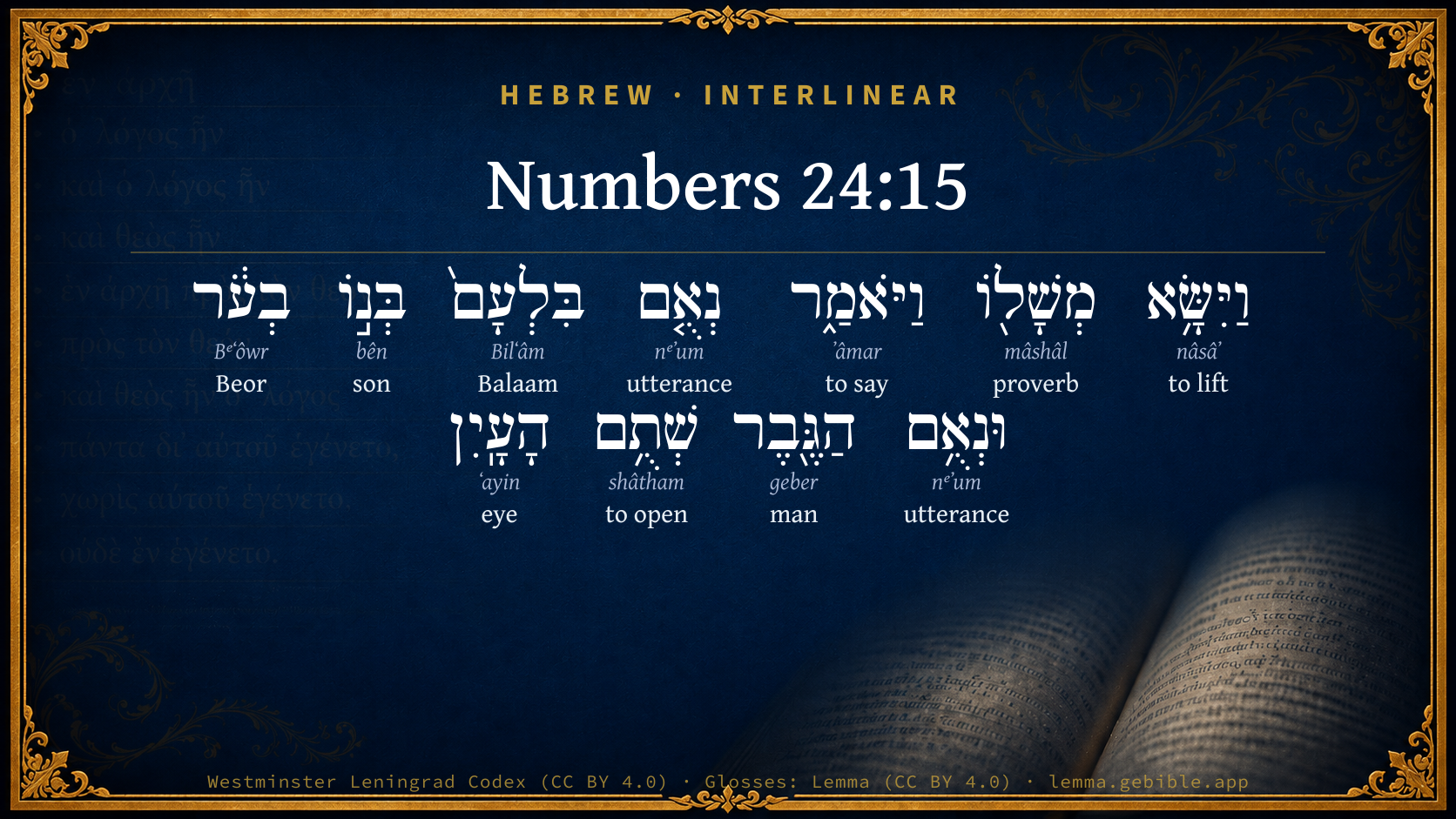
  1. וַיִּשָּׂ֥א nâsâʼ H5375 “and · to lift” Conjunction + Verb, Qal, Sequential Imperfect, 3rd Person, Masculine, Singular
  2. מְשָׁל֖וֹ mâshâl H4912 “proverb · his” Noun, Common, Masculine, Singular, Construct + Suffix, Personal, 3rd Person, Masculine, Singular
  3. וַיֹּאמַ֑ר ʼâmar H559 “and · to say” Conjunction + Verb, Qal, Sequential Imperfect, 3rd Person, Masculine, Singular
  4. נְאֻ֤ם nᵉʼum H5002 “utterance of” Noun, Common, Masculine, Singular, Construct
  5. בִּלְעָם֙ Bilʻâm H1109 “Balaam” Noun, Proper
  6. בְּנ֣וֹ bên H1121 “son · his” Noun, Common, Masculine, Singular, Construct + Suffix, Personal, 3rd Person, Masculine, Singular
  7. בְעֹ֔ר Bᵉʻôwr H1160 “Beor” Noun, Proper
  8. וּנְאֻ֥ם nᵉʼum H5002 “and · utterance of” Conjunction + Noun, Common, Masculine, Singular, Construct
  9. הַגֶּ֖בֶר geber H1397 “the · man” Particle, Definite Article + Noun, Common, Masculine, Singular, Absolute
  10. הָעָֽיִן ʻayin H5869 “the · eye” Particle, Definite Article + Noun, Common, Both, Singular, Absolute

About this verse

These counts appear in no published source. They are computed here, from the morphology-tagged text and Lemma’s own curated glosses. What Lemma adds →

11
words
10
distinct lemmas
Pentateuch
section

Notable vocabulary

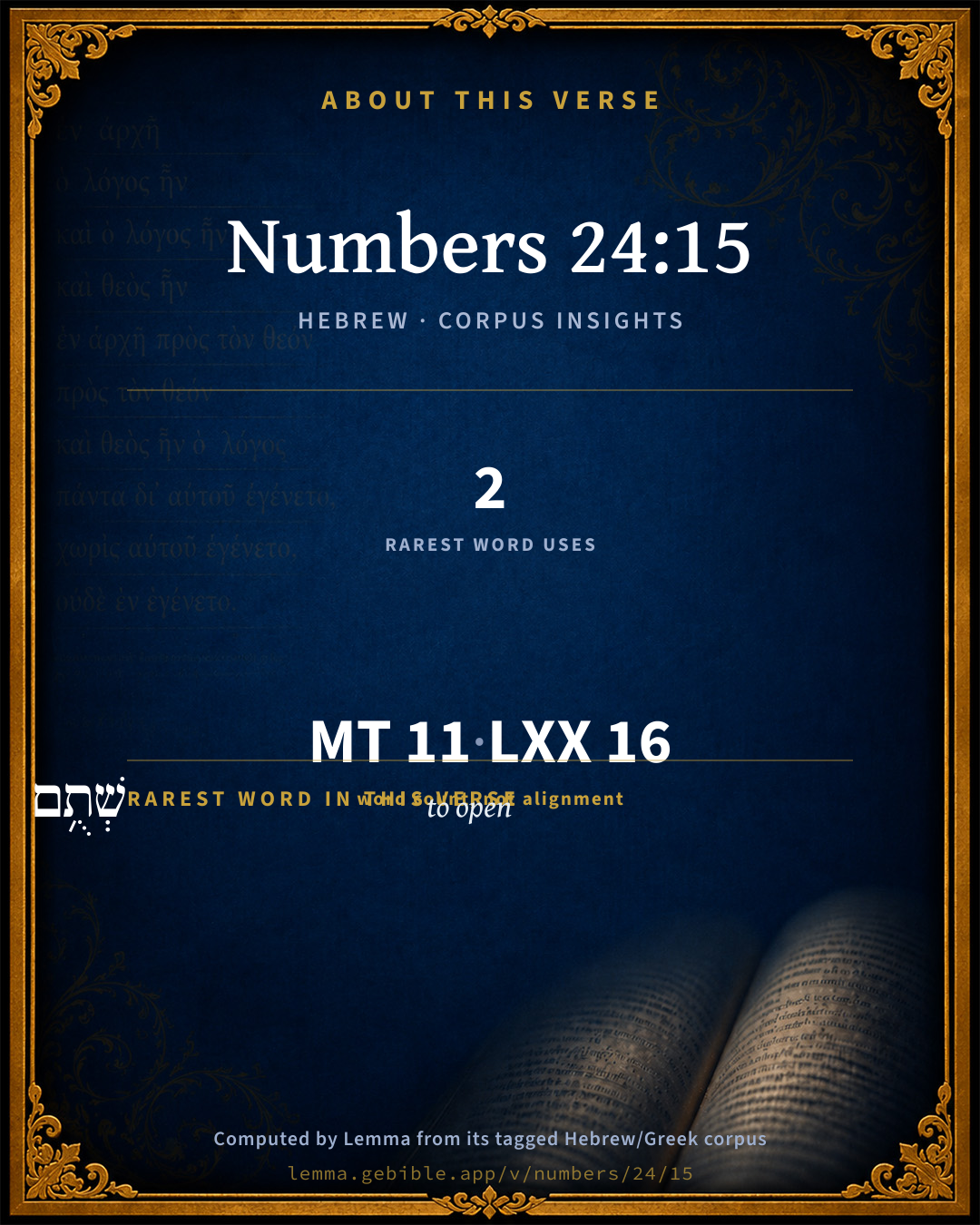
The rarest word here is שְׁתֻ֥ם to open H8365 — appearing just 2 times in the whole Hebrew Bible.

Shared distinctive vocabulary

שְׁתֻ֥ם to open H8365 occurs in 2 verses of the Hebrew Bible. Also found in:

Grammatical profile

  • 3 verbs
  • 8 nouns

Verb forms

  • וַיִּשָּׂ֥א Qal · Sequential Imperfect
  • וַיֹּאמַ֑ר Qal · Sequential Imperfect
  • שְׁתֻ֥ם Qal · Participle Passive

Repetition

A word recurs within this verse — often emphatic in Hebrew:

  • נְאֻ֤ם utterance H5002 ×2

Hebrew & Septuagint length

In English translation the verse runs 20 words from the Hebrew and 20 from the Septuagint (LXX English) — the same length.

A rough comparison of the two English renderings, which tokenize alike — not a word-level alignment.

Word counts can differ between the Hebrew and the Greek without any difference in meaning — e.g. the Hebrew direct-object marker אֵת has no separate Greek word, and Greek often adds the article ὁ.

In the original languages it is 11 Hebrew tokens and 16 Greek tokens — but the two are counted differently (Hebrew bundles its prefixes and suffixes into one token; the Greek is in lemma form), so that isn’t a like-for-like length.

Cross-references

5

Topical passages linked to Numbers 24:15 in the Treasury of Scripture Knowledge — connected by theme and wording, ordered by reader-vote popularity; previews shown in the World English Bible.

  • Numbers 23:7 He took up his parable, and said, From Aram has Balak brought me, The king of Moab from the mountains of the East: Come, curse me Jacob, Come, defy Israel.
  • Numbers 24:3–4 He took up his parable, and said, Balaam the son of Beor says, The man whose eye was closed says;
  • Numbers 23:18 He took up his parable, and said, Rise up, Balak, and hear; Listen to me, you son of Zippor:
  • Job 27:1 Job again took up his parable, and said,
  • Matthew 13:35 that it might be fulfilled which was spoken through the prophet, saying, "I will open my mouth in parables; I will utter things hidden from the foundation of the world."

Cross-references courtesy of OpenBible.info (CC BY 4.0).

Hebrew and Greek witnesses Masoretic Hebrew ↔ Greek Septuagint

The same verse in the two great witnesses to the Old Testament, shown verse-for-verse.

These are two independent witnesses, not word-aligned to each other, and the Septuagint is shown in lemma (dictionary) form.

Hebrew Numbers 24:15 Masoretic · Westminster Leningrad Codex

וַיִּשָּׂ֥א מְשָׁל֖וֹ וַיֹּאמַ֑ר נְאֻ֤ם בִּלְעָם֙ בְּנ֣וֹ בְעֹ֔ר וּנְאֻ֥ם הַגֶּ֖בֶר שְׁתֻ֥ם הָעָֽיִן

He took up his parable, and said, Balaam the son of Beor says, The man whose eye was closed says;

World English Bible · Public Domain

Greek LXX Numbers 24:15 Septuagint · lemma form

καί ἀναλαμβάνω ὁ παραβολή αὐτός εἶπον φημί βαλααμ υἱός βεωρ φημί ὁ ἄνθρωπος ὁ ἀληθινῶς ὁράω

And he took up his parable and said, Balaam the son of Beor says, the man who sees truly says,

LXX2012 (modern English Septuagint) · Public Domain

Hebrew: Westminster Leningrad Codex (CC BY 4.0). Greek: Septuagint (public domain); English from LXX2012 (modern English Septuagint) (Public Domain). How the Septuagint differs from the Hebrew →

Targum (Aramaic paraphrase)

2

The Targum is the ancient Jewish Aramaic paraphrase of the Hebrew Scriptures — an interpretive translation, not the Hebrew text itself. Onkelos (literal) and Pseudo-Jonathan (expansive) render the Torah, and Jonathan the Prophets. Coverage is partial: where no permissively-licensed English translation exists for a verse, only the Aramaic is shown. This is verse-level text, not a word-by-word alignment to the Hebrew.

  1. Targum Onkelos Torah (Genesis–Deuteronomy)
    וּנְטַל מַתְלֵיהּ וַאֲמַר אֵימַר בִּלְעָם בְּרֵיהּ בְעוֹר וְאֵימַר גַבְרָא דְשַׁפִּיר חָזֵי

    (no public-domain English translation for this verse)

    Targum Onkelos — Aramaic: “Onkelos Genesis” (public domain); “Onkelos Exodus” (public domain); “Onkelos Leviticus” (public domain); “Onkelos Numbers” (public domain); “Onkelos Deuteronomy” (public domain). English: “Sefaria Community Translation” (CC0 1.0 (public-domain dedication)); “J.W. Etheridge. The Targums of Onkelos and Jonathan Ben Uzziel on the Pentateuch. London: Longmans, Green, 1862” (public domain). Text via Sefaria.

  2. Targum Pseudo-Jonathan Torah (Genesis–Deuteronomy)
    וּנְטַל מְתַל נְבוּתֵיהּ וַאֲמַר אֵימַר בִּלְעָם בַּר בְּעוֹר וְאֵימַר גַבְרָא דְיַקִיר מִן אָבוֹי דְרַזְיָא סְתִימַיָא מַה דְאִתְכַּסֵי מִן נְבִיָיא הֲוָה מִתְגְלֵי לֵיהּ

    And he took up the parable of his prophecy, and said Bileam the son of Beor speaketh; the man speaketh who is more honourable than his father, because the mysteries hidden from prophets have been revealed to him;

    Targum Pseudo-Jonathan — Aramaic: “Targum Jonathan on Genesis” (public domain); “Targum Jonathan on Exodus” (public domain); “Targum Jonathan on Leviticus” (public domain); “Targum Jonathan on Numbers” (public domain); “Targum Jonathan on Deuteronomy” (public domain). English: “The Targum of Jonathan ben Uzziel, trans. J. W. Etheridge, London, 1862” (public domain). Text via Sefaria.

Commentary

Notes on Numbers 24:15 from classic Christian and Jewish commentators (each source and its license shown beneath its notes). The classic Christian expositions comment on the surrounding passage and are grouped to its opening verse, so a note may address several verses; the Jewish commentaries on the Tanakh (Rashi and others) are per-verse, so they appear only where the commentator wrote on this verse.

Lemma curates 59 commentaries, every one of them public domain or Creative Commons licensed, each selected and text-cleaned for this edition rather than reprinted as found. About our sources →

Matthew Henry's Commentary

The office of prophets was both to bless and to prophesy in the name of the Lord. Balaam, as a prophet, per force had blessed Israel; here he foretels future events.

I. His preface is much the same as that, Num 24:3, Num 24:4. He personates a true prophet admirably well, God permitting and directing him to do so, because, whatever he was, the prophecy itself was a true prophecy. He boasts, 1. That his eyes are open (Num 24:15), for prophets were in old time called seers (Sa1 9:9), because they must speak what they had seen, and therefore, before they opened their lips, it was necessary that they should have their eyes open. 2. That he has heard the words of God, which many do that do not heed them, nor hear God in them. 3. That he knew the knowledge of the Most High; this is added here. A man may be full of the knowledge of God and yet utterly destitute of the grace of God, may receive the truth in the light of it and yet be a stranger to the love of it. 4. That he saw the vision of the Almighty, but not so as to be changed into the same image. He calls God the Most High, and the Almighty; no man could speak more honourably of him, nor seem to put a greater value upon his acquaintance with him, and yet he had no true fear of him, love to him, or faith in him, so far may a man go towards heaven, and yet come short.

II. Here is his prophecy concerning him that should be the crown and glory of his people Israel, who is, 1. David in the type, who not now, not quickly, but in process of time, should smite the corners of Moab. (Num 24:17), and take possession of Mount Seir, and under whom the forces of Israel should do valiantly, Num 24:18. This was fulfilled when David smote Moab, and measured them with a line, so that the Moabites became David' servants, Sa2 8:2. And at the same time the Edomites likewise were brought into obedience to Israel, Num 24:14. But, 2. Our Lord Jesus, the promised Messiah, is chiefly pointed at in the antitype, and of him it is an illustrious prophecy; it was the will of God that notice should thus be given of his coming, a great while before, not only to the people of the Jews, but to other nations, because his gospel and kingdom were to extend themselves so far beyond the borders of the land of Israel. It is here foretold, (1.) That while: "I shall see him, but not now; I do see him in vision, but at a very great distance, through the interposing space of 1500 years at least." Or understand it thus: - Balaam, a wicked man, shall see Christ, but shall not see him nigh, nor see him as Job, who saw him as his Redeemer, and saw him for himself, Job 19:25, Job 19:27. When he comes in the clouds every eye shall see him, but many will see him (as the rich man in hell saw Abraham) afar off. (2.) That he shall come out of Jacob, and Israel, as a star and a sceptre, the former denoting his glory and lustre, and the bright and morning star, the latter his power and authority; it is he that shall have dominion. Perhaps this prophecy of Balaam (one of the children of the east) concerning a star that should arise out of Jacob, as the indication of a sceptre arising in Israel, being preserved by a tradition of that country, gave occasion to the wise men, who were of the east too, upon the sight of an unusual star over the land of Judea, to enquire for him that was born king of the Jews, Mat 2:2. (3.) That his kingdom shall be universal, and victorious over all opposition, which was typified by David's victories over Moab and Edom. But the Messiah shall destroy, or, as some read it, shall rule over, all the children of Seth. (Num 24:17), that is, all the children of men, who descend from Seth, the son of Adam, the descendants of the rest of Adam's sons being cut off by the deluge. Christ shall be king, not only of Jacob and Israel, but of all the world; so that all the children of Seth shall be either governed by his golden sceptre or dashed in pieces by his iron rod. He shall set up a universal rule, authority, and power, of his own, and shall put down all opposing rule, Co1 15:24. He shall unwall all the children of Seth; so some read it. He shall take down all their defences and carnal confidences, so that they shall either admit his government or lie open to his judgments. (4.) That his Israel shall do valiantly; the subjects of Christ, animated by his might, shall maintain a spiritual was with the powers of darkness, and be more than conquerors. The people that do know their God shall be strong, and do exploits, Dan 11:32.

III. Here is his prophecy concerning the Amalekites and Kenites, part of whose country, it is probable, he had now in view. 1. The Amalekites were now the chief of the nations (Num 24:20), therefore Agag was spoken of (Num 24:7) as an eminent prince, and they were the first that engaged Israel when they came out of Egypt; but the time will come when that nation, as great as it looks now, will be totally ruined and rooted out: His latter end shall be that he perish for ever. Here Balaam confirms that doom of Amalek which Moses had read (Exo 17:14, Exo 17:16), where God had sworn that he would have perpetual war with Amalek. Note, Those whom God is at war with will certainly perish for ever; for when God judges he will overcome. 2. The Kenites were now the securest of the nations; their situation was such as that nature was their engineer, and had strongly fortified them: "Thou puttest thy nest (like the eagle) in a rock, Num 24:21. Thou thinkest thyself safe, and yet the Kenites shall be wasted (Num 24:22) and gradually brought to decay, till they be carried away captive by the Assyrians," which was done at the captivity of the ten tribes. Note, Bodies politic, like natural bodies, though of the strongest constitutions, will gradually decay, and come to ruin at last; even a nest in a rock will be no perpetual security.

IV. Here is a prophecy that looks as far forward as the Greeks and Romans, for theirs is supposed to be meant by the coast of Chittim, v. 24.

1. The introduction to this parable; this article of his prophecy is very observable (v. 23): Alas! who shall live when God doeth this? Here he acknowledges all the revolutions of states and kingdoms to be the Lord's doing: God doeth this; whoever are the instruments, he is the supreme director. But he speaks mournfully concerning them, and has a very melancholy prospect of these events: Who shall live? Either, (1.) These events are so distant, and so far off to come, that it is hard to say who shall live till they come; but, whoever shall live to see them, there will be amazing turns. Or, (2.) They will be so dismal, and make such desolations, that scarcely any will escape or be left alive; who shall live when death rides in triumph? Rev 6:8. Those that live then will be as brands plucked out of the fire, and will have their lives given them as a prey. God fit us for the worst of times!

2. The prophecy itself is observable. Both Greece and Italy lie much upon the sea, and therefore their armies were sent forth mostly in ships. Now he seems here to foretell, (2.) That the forces of the Grecians should humble and bring down the Assyrians, who were united with the Persians, which was fulfilled when the eastern country was overcome, or overrun rather, by Alexander. (2.) That theirs and the Roman forces should afflict the Hebrews, or Jews, who were called the children of Eber; this was fulfilled in part when the Grecian empire was oppressive to the Jewish nation, but chiefly when the Roman empire ruined it and put a period to it. But, (3.) That Chittim, that is, the Roman empire, in which the Grecian was at length swallowed up, should itself perish for ever, when the stone cut out of the mountain without hands shall consume all these kingdoms, and particularly the feet of iron and clay, Dan 2:34. Thus (says Dr. Lightfoot) Balaam, instead of cursing the church, curses Amalek the first, and Rome the last, enemy of the church. And so let all thy enemies perish, O Lord!

Matthew Henry's Commentary on the Whole Bible (1708–1710) — public domain (CC PDM 1.0). Text via the HelloAO Bible API.

Joseph Benson's Commentary

Num 24:15. He took up his parable — A weighty and solemn speech, delivered in figurative and majestic language, is often termed a parable in Scripture. Such are these prophecies of Balaam; we cannot peruse them without being struck, not only with their beauty, but with their uncommon force and energy.

Joseph Benson's Commentary on the Old and New Testaments (1811–1818) — public domain. Text from a community e-Sword module.

Whedon's Commentary on the Bible

Daniel D. Whedon

THE FOURTH PROPHECY, Num_24:15-24.

In these prophecies there is a gradual unfolding of the divine purposes respecting Israel and his foes. In the first, there is a denial of any ability to curse those blessed of Jehovah. In the second, it becomes certain that Israel will triumph over all his enemies. In the third, the positive side of Israel’s future appears, his prosperity is vividly portrayed, and all who bless him are pronounced blessed, and his cursers are cursed. In the fourth, the names of the hostile nations to be conquered by Israel in the future are recorded, with the prediction of his prosperity even to the most distant ages. It is divided into four distinct parts, each beginning with the words, “And he uttered his prophecy and said,” which precede each of the seven prophecies, in all corresponding to the seven altars and seven victims. Since this number indicates perfection, we are taught that Balaam made a perfect trial of his skill before his failure was acknowledged.

Daniel D. Whedon (gen. ed.), Commentary on the Old and New Testaments (1874–1909) — public domain. Text from a community e-Sword module.

Keil & Delitzsch

C. F. Keil & F. Delitzsch

Balaam's fourth and last prophecy is distinguished from the previous ones by the fact that, according to the announcement in Num 24:14, it is occupied exclusively with the future, and foretells the victorious supremacy of Israel over all its foes, and the destruction of all the powers of the world. This prophecy is divided into four different prophecies by the fourfold repetition of the words, "he took up his parable" (Num 24:15, Num 24:20, Num 24:21, and Num 24:23). The first of these refers to the two nations that were related to Israel, viz., Edom and Moab (Num 24:17-19); the second to Amalek, the arch-enemy of Israel (Num 24:20); the third to the Kenites, who were allied to Israel (Num 24:21 and Num 24:22); and the fourth proclaims the overthrow of the great powers of the world (Num 24:23 and Num 24:24). - The introduction in Num 24:15 and Num 24:16 is the same as that of the previous prophecy in Num 24:3 and Num 24:4, except that the words, "he which knew the knowledge of the Most High," are added to the expression, "he that heard the words of God," to show that Balaam possessed the knowledge of the Most High, i.e., that the word of God about to be announced had already been communicated to him, and was not made known to him now for the first time; though without implying that he had received the divine revelation about to be uttered at the same time as those which he had uttered before.

Keil & Delitzsch — Biblical Commentary on the Old Testament (1861–1891) — public domain (CC PDM 1.0). Text via the HelloAO Bible API. (Old Testament only.)

Tyndale Open Study Notes

Tyndale Open Resources

24:15-25 This prophecy provides more specific details than the first three. Based on another vision from the Almighty (24:16), it lists some of the enemies that Israel would defeat in the future and predicts the emergence of an outstanding leader who would play a major role in these military victories (24:17).

Tyndale Open Study Notes — © Tyndale Open Resources, licensed CC BY-SA 4.0. Text via the HelloAO Bible API.

Jamieson, Fausset & Brown

Robert Jamieson, A. R. Fausset & David Brown

he took his parable--or prophecy, uttered in a poetical style.

Jamieson, Fausset & Brown — Commentary Critical and Explanatory on the Whole Bible (1871) — public domain (CC PDM 1.0). Text via the HelloAO Bible API.

Adam Clarke's Commentary

Verse 15. The man whose eyes are open] See Clarke on Nu 24:3. It seems strange that our version should have fallen into such a mistake as to render שתם shethum, open, which it does not signify, when the very sound of the word expresses the sense. The Vulgate has very properly preserved the true meaning, by rendering the clause cujus obturatus est oculus, he whose eyes are shut. The Targum first paraphrased the passage falsely, and most of the versions followed it.

Adam Clarke's Commentary on the Bible (1810–1826) — public domain. Text from a community e-Sword/MySword module.

The Cambridge Bible for Schools and Colleges

gen. ed. J. J. S. Perowne

15, 16. See Num_24:3-4.

15–19. Balaam’s second prophetic message. This consists of seven couplets and a triplet.

The Cambridge Bible for Schools and Colleges (gen. ed. J. J. S. Perowne; Cambridge University Press, 1878–1918) — public domain. Text from a community e-Sword module.

John Gill's Exposition

And he took up his parable, and said,.... In this and the following verse; the same preface, in the same words, is made to his prophecy as before; see Gill on Num 24:3, Num 24:4; only one clause is added, "and knew the knowledge of the Most High"; that Balaam had some knowledge of God is certain from the names by which he calls him, being such that he made himself known by to the patriarchs, and by which he is frequently called in the sacred writings; but then this knowledge of his was merely notional and speculative, and not spiritual and supernatural, and was such as men may have who are destitute of the grace of God: he was one that professed to know him in words, but in works denied him, see Co1 13:2 and he also was admitted to much nearness to God, and converse with him, of which he boasted; but then this was not for his own sake, or as a mark of friendship to him, but for the sake of the people of Israel, and to prevent his doing them mischief. His prophecy follows.

and he also was admitted to much nearness to God, and converse with him, of which he boasted; but then this was not for his own sake, or as a mark of friendship to him, but for the sake of the people of Israel, and to prevent his doing them mischief. His prophecy follows.

Numbers 24:17

num 24:17

num 24:17

num 24:17I shall see him, but not now,.... Meaning not Israel, for he now saw him encamped, and at no great distance; but one that should descend from him, a famous and excellent person, and who is no other than the Messiah, as appears by what follows; him he should see, not spiritually with an eye of faith, nor corporeally with his bodily eyes in his state of incarnation, but at the day of judgment; and now, indeed, he saw him by a spirit of prophecy:

I shall behold him, but not nigh; signifying, that the coming of this illustrious Person, who should smite the borders of Moab, was not near, and therefore Balak had no reason to indulge any present fears; and that when he was come either into the world to save men, or to judgment, Balaam would have no nearness to him, nor interest in him; he would see him at the last day, but not for himself, as Job says he should, Job 19:25.

there shall come a star out of Jacob, and a sceptre shall rise out of Israel; which Aben Ezra interprets of David, though he says many interpret it of the Messiah; and there are some writers, both Jewish and Christian, that understand it partly of David, and partly of Christ, and chiefly of him, and of David as a type of him; the fulfilment of which was only in part in David, but principally and completely in Christ. Maimonides (c) parts the prophecy between them: the whole undoubtedly agrees with Christ, and belongs unto him: the "star" and "sceptre" may be considered as names and titles of the Messiah; he is called the "morning star", Rev 22:16 for his glory, brightness, and splendour, and for the light that comes by him, and the influence of his grace, and the blessings of it on the sons of men; and hence a false Messiah took the name of Bar Cochab, the son of a star, to answer to this prophecy; and he may be called a "sceptre", that is, a sceptre bearer, because of his royalty; he not only has the name of a king, but has a kingdom, both of nature, providence, and grace, and rules with a sceptre of grace, mercy, and righteousness; and as he was to spring from Jacob or Israel, so he did, being a son of Abraham, a descendant of Jacob, of the tribe of Judah, and family of David, Mat 1:1, but I rather think that the star is to be considered as a sign and circumstance of his coming, and that the words may be rendered, "when a star steers its course from Jacob", or "unto Jacob, then a sceptre", or "sceptre bearer":

shall rise out of Israel, or "rise up unto Israel"; for the particle sometimes signifies "unto" (d); and that the appearance of a star in Israel was a sign of the Messiah's coming is certain from Mat 2:1 of which the Magi were informed by Zoroastres (e) their founder, who, being of Jewish extract, had got it from this prophecy of Balaam; and it is as evident that the Jews expected the appearance of an extraordinary star at the time of the Messiah's coming; for so they say more than once, in an ancient book of theirs (f), that when the"Messiah shall be revealed, a bright and shining star shall arise in the east;''which expectation must be founded on this prophecy:

and shall smite the corners of Moab; not only the corners of their houses and cities, but the extreme parts and borders of the land, even all the sides, and the whole of it; or the princes and great men of the land, sometimes called "corners", see Zac 10:4 and so the Targums of Onkelos and Jonathan:

and shall kill the princes of Moab or the mighty ones of Moab, as the Jerusalem Targum; this was literally fulfilled in David, Sa2 8:2 Psa 60:1 and figuratively and mystically in Christ, by subduing his enemies, signified by Moabites, as being the enemies of Israel; either by reducing them through the power of his grace to obedience to him, or by smiting and breaking them in pieces with a rod of iron; and which will be more plainly and fully accomplished when he shall destroy those Moabites, the antichristian nations, Rev 19:15.

and destroy all the children of Sheth; some take Sheth to be the name of some famous king among the Moabites, as Grotius; others, the name of some city of Moab, which David utterly destroyed, as R. Nathan (g); others suppose some particular nations are meant, as either the Edomites, so called because they put confidence in their foundations, and fortified places, so Vitringa (h); or the Egyptians, from Seth or Sethos, one of their kings, who was known by the name Egyptus, as a late learned writer (i) of ours conjectures; but rather by the children of Seth are meant all nations, as Jarchi observes, for all come from Seth, the son of the first man; and so the words may be rendered, as they are by Onkelos,"he shall rule over all the children of men;''which will be fulfilled in Christ, when he shall have put down all rule and authority, and all will be subject to him, and his kingdom be from sea to sea, and his dominion from the river to the ends of the earth; unless rather by the children of Seth are meant the special people of God, in distinction from others, and in allusion to the distinction between the Sethites and Cainites, the one being the people of God, the other not; and so it may be interpreted of Christ's gathering them to him, by clucking as it were for them, as a hen gathers her chickens; so the word is used in Jewish writings, and of God himself; for it is said (k) the holy blessed God clucks over them, as hens do, which is the simile our Lord himself uses, Mat 23:37 the Targums of Onkelos and Jonathan interpret this prophecy of the Messiah by name; and so do many other Jewish writers, both ancient (l) and modern (m).

(c) Hilchot Melachim, c. 11. sect. 1. (d) Vid. Nold. Concord. Ebr. part. p. 545. (e) Abulpharag. Hist. Dynast. p. 54. (f) Zohar in Exod. fol. 3. 3, 4. & in Numb fol. 85. 4. & 86. 1. (g) Apud Lyram in loc. (h) Comment. in Isa. xxii. 5. (i) Clayton's Chronology of the Hebrew Bible, &c. p. 445. (k) T. Bab. Taanith, c. 4. in En Jacob, par. 1. fol. 143. 4. (l) Debarim Rabba, fol. 234. 4. Pesikta in Kettoreth Hassammim in Numb. fol. 27. 3. & 28. 1. (m) Abarbinel. Mashmiah Jeshuah, fol. 4. 2, 3. Abendana in loc. R. Isaac Chizzuk Emunah, p. 71, 72.

John Gill's Exposition of the Whole Bible (1746–1763) — public domain (CC PDM 1.0). Text via the HelloAO Bible API.

Kretzmann's Popular Commentary

Paul E. Kretzmann

Of The Star of Jacob. —

v. 15. And he took up his parable and said, Balaam, the son of Beor, hath said, and the man whose eyes are open hath said;

v. 16. he hath said which heard the words of God, and. knew the knowledge of the Most High, who had been given this wonderful knowledge in a Revelation which saw the vision of the Almighty, falling into a trance, but having his eyes open, v. 4:

v. 17. I shall see Him, but not now; I shall behold Him, but not nigh. What Balaam saw here in a vision would not happen in the near future, as men count time, but at a far distant period. There shall come a Star out of Jacob, as the symbol of the power and majesty of a great ruler, and a Scepter shall rise out of Israel, Gen 49:10, also a picture of a future mighty king in Israel, namely, the Messiah, Jesus Christ, the Lord; and shall smite the corners of Moab, strike down its people on both sides, and destroy all the children of Sheth, of confusion, for the Moabites were noted as men of wild and unrestrained warfare. Although this prophecy, in type, was fulfilled when Israel gained dominion over this and other heathen nations, its ideal fulfillment came in Jesus Christ, whose spiritual power has been extended to include also heathen nations everywhere, for men from all nations have bowed their heads under His scepter.

v. 18. And Edom shall be a possession, Seir also shall be a possession for his enemies; and Israel shall do valiantly, shall gain strength and dominion. The fulfillment of this prophecy began with the conquest of Edom at the time of David, 2Sa 8:14; 1Ki 11:15-16, but was not fully completed until the coming of the most majestic Ruler, at whose footstool God has laid all His enemies, Psalms 110.

v. 19. Out of Jacob shall come He that shall have dominion, for out of that people, as concerning the flesh, Christ came, Rom 9:5, and shall destroy him that remaineth of the city; no matter where the remnant of the people might be in hiding, the spirit of this mighty King would find them; they must yield to Him or face everlasting punishment. In accordance with the peculiarity of prophecy, which combines visions of far-distant events with those that are comparatively near at hand, the prophet now reveals the future of other heathen nations.

v. 20. And when he, Balaam, in his condition of ecstasy, looked on Amaiek, he took up his parable and said, Amaiek -was the first of the nations, namely, to take up weapons of warfare against Israel; but his latter end shall be that he perish forever, he should be utterly destroyed, 1Sa 15:7-8.

v. 21. And he looked on the Kenites, a nation which had shown itself friendly to Israel, Num 10:29-32; Gen 15:19, and took up his parable and said, Strong is thy dwelling-place, and thou puttest thy nest in a rock; their habitations were chiefly in the mountainous regions of the Sinaitic Peninsula.

v. 22. Nevertheless the Kenite shall be wasted, until Asshur shall carry thee away captive; or: Should the Kenite be destroyed, until Asshur shall lead thee away captive? The answer is an emphatic "No. " The outward association of this people with the children of Israel gained security for them even when the Kenites were led away into the Assyrian captivity.

v. 23. And he took up his parable and said, Alas, who shall live when God doeth this! The judgment of God upon the disobedient and idolatrous enemies of His people would be so terrible that men would despair of their lives in seeing its severity.

v. 24. And ships shall come from the coast of Chittim, and shall afflict Asshur, and shall afflict Eber, and he also shall perish forever. Both the Semitic nations of the East, which included the inhabitants of Assyria, and those of the West, which occupied the country between Assyria and Palestine, Gen 10:21, would be overthrown by a powerful nation coming from the Northwest, with ships coming from Greece, by way of Cyprus. The historic relations are not yet definitely shown, but the prophecy of doom stands out with great distinctness; for the gist of the utterance is that God will destroy all the enemies that oppose His will, and give victory to His people.

v. 25. And Balaam rose up and went and returned to his place, not to Mesopotamia, as history shows, but to the land of the Midianites. Far from being overcome by the power of the Lord, he apparently hardened his heart and gave the Midianites the advice to effect the overthrow of the Israelites by means of idolatry, Num 31:8-16. And Balak also went his way.

Paul E. Kretzmann, Popular Commentary of the Bible (1921–1924) — public domain. Text from a community e-Sword module.

unfoldingWord translationNotes

Door43 World Missions Community

Balaam son of Beor

Beor was Balaam's father. See how you translated this in Numbers 22:5.

whose eyes are wide open

This idiom means he sees and understands clearly. See how you translated this in Numbers 24:3. (See: Idiom)

who has knowledge from the Most High

The abstract term "knowledge" can be stated as an action. AT: "who knows things that God Most High has revealed to him" (See: Abstract Nouns)

bows down

This is a sign of submission to God. (See: Symbolic Action)

translationWords

prophet

know

Most High

vision

Almighty

bow

unfoldingWord translationNotes — © Distant Shores Media and the Door43 World Missions Community, licensed CC BY-SA 4.0. Source: git.door43.org/Door43/en_tn.

Ramban (Nachmanides)

Rabbi Moshe ben Nachman (Ramban / Nachmanides)

He referred to himself now as one who heareth the words of G-d, and as one who seeth the vision of the Almighty, as he had done in the third prophecy, but he added now [the phrase] and knoweth the knowledge of the Most High. Now one who speaks in this manner, saying “I know the knowledge of a certain person” means to say that he understands him, and what is in his heart, [even] those matters which he does not utter verbally, and similarly this [man Balaam] intended to say that he knows and will now say what is in the “mind” [i.e., intention] of G-d the Most High to do in His world at the end of all days. This is similar to that which it says, for the day of vengeance is in My heart, and the Rabbis have said [with reference to that day, that its precise timing is a matter which “His] heart has not divulged to the mouth.” Now Scripture states here, And ‘he took up his parable,’ and said and it does not mention that this was [said] by prophecy, as it says about the [previous] three occasions, for since he said, The saying of him who heareth the words of G-d … who seeth the vision of the A lmighty it is self-understood that the hand of G-d was upon. him, just as at the third time, where it says: and the spirit of G-d came upon him; and he himself said so. (Verse 4) and it says there, and the spirit of G-d came upon him (Verse 2). So here too, in his fourth prophecy, where it says who heareth the words of G-d, who seeth the vision of the Almighty, it was also through the spirit of G-d which came upon him, even though it does not say so expressly.

Ramban (Nachmanides) on the Tanakh — English translation: “Commentary on the Torah by Ramban (Nachmanides). Translated and annotated by Charles B. Chavel. New York, Shilo Pub. House, 1971-1976” (CC BY 4.0). Text via Sefaria.

Lesson kit

Teaching starters — assembled from the data on this page, not authored interpretation. Every prompt links to the verse data it draws on. Edit before teaching.

Numbers, in the Pentateuch, opens this verse with 11 words (10 distinct Hebrew lemmas). Its most distinctive word is shâtham (“to open”). A historical commentator’s framing appears above. Read the whole chapter for the surrounding context.

Discussion questions

  1. How does “to open” (shâtham) shape what this verse is saying?
  2. Numbers 24:3 shares the word «to open» with this verse. How do the two illuminate each other?
  3. “utterance” occurs 2× in this one verse. What is the effect of the repetition?
  4. These translations render this verse differently; the difference is in the English rendering, not the original. What questions does that raise?
  5. The verb «וַיִּשָּׂ֥א» is Qal Sequential Imperfect. How does its form color the action?
  6. Reading how Matthew Henry's Commentary and Joseph Benson's Commentary read this verse, where do the two commentators agree and where do they part?

Things to notice

Reading settings

Reading text

Shown beneath each verse's original-language words.

Old Testament
Old Testament edition

Read the OT as the Masoretic Hebrew (MT) or the Greek Septuagint (LXX).

English shown for the Greek Septuagint (in the Hebrew ↔ Greek comparison).

Comparing translations? Open the Compare panel on any verse page to stack up to four side by side.