Numbers 24:3

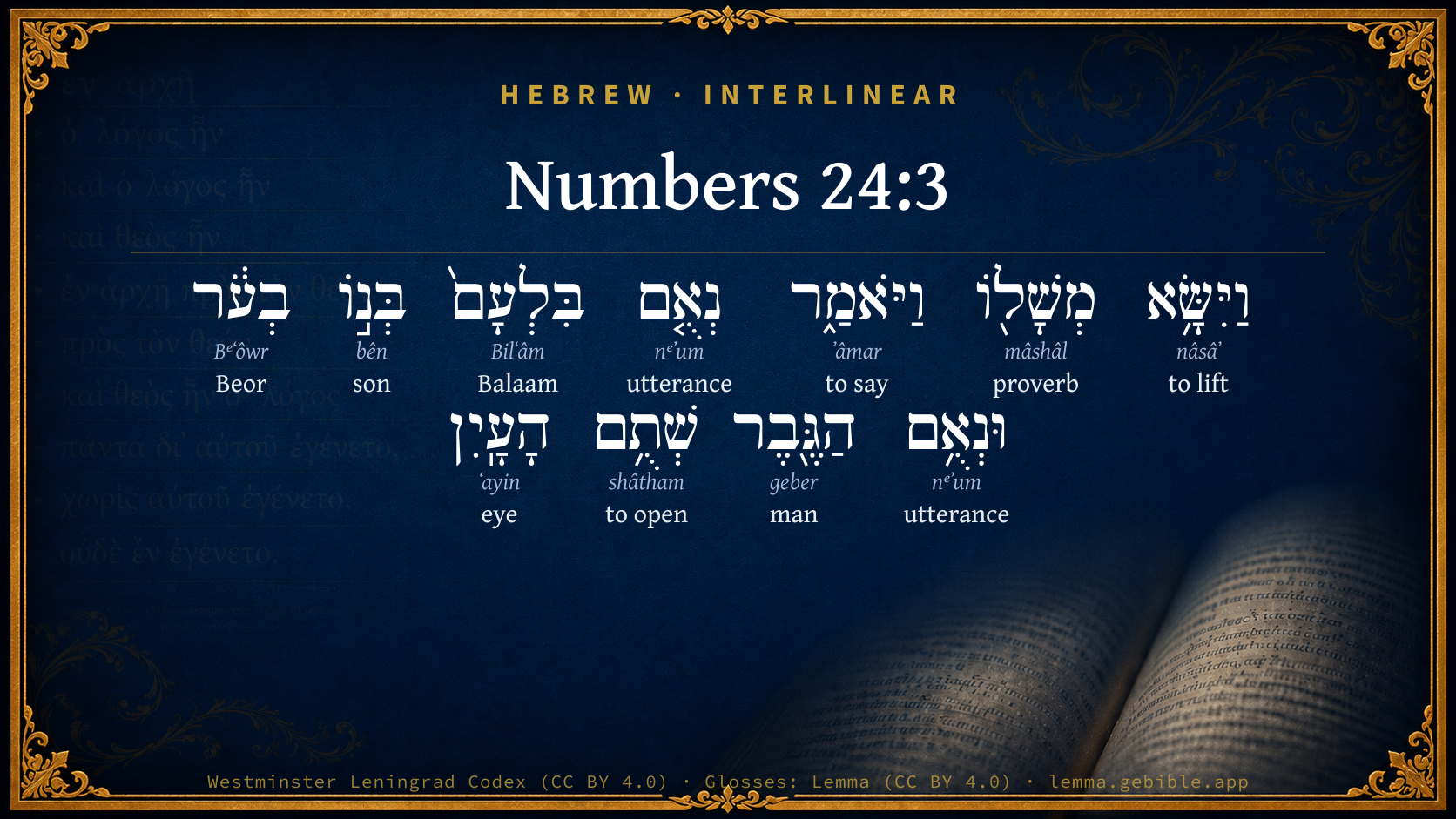
Hebrew (Westminster Leningrad Codex) Numbers 24:3 appears in the Hebrew Old Testament. The text above is from the Westminster Leningrad Codex. Each word links to its Strong’s number, a concise gloss, and parsing drawn from the Open Scriptures Hebrew Bible morphology. Click any word for its full Brown-Driver-Briggs (BDB) entry.
Download image
Cite this verse

Numbers 24:3 (World English Bible). Public Domain. Lemma interlinear Bible study tool, https://lemma.gebible.app/v/numbers/24/3.

Show BibTeX & RIS
BibTeX
RIS
English Translation
He took up his parable, and said, Balaam the son of Beor says, The man whose eye was closed says;
World English Bible · Public Domain
Highlights
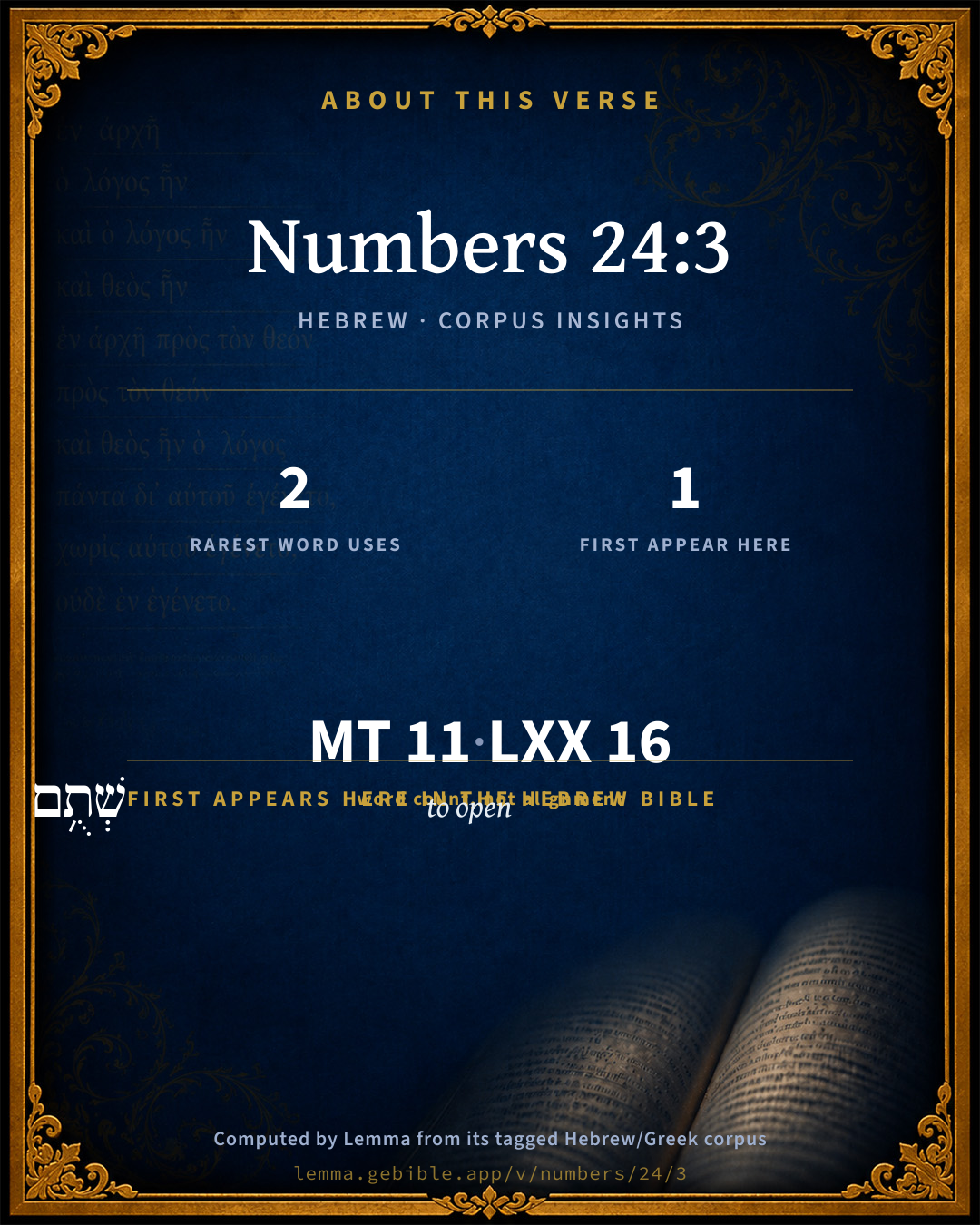
  • 1 first appearance in the Hebrew Bible
Full analysis ↓
Download a study sheet

One document with this verse’s original text, its word-by-word gloss line, the meaning frame, cross-references with their text, attributed commentary, and full source and license credits — printable, and it pastes into notes with its structure intact.

This verse Autodidact and up

Study sheet (.html) Plain text (.txt)

A passage Seminary Student

Up to 50 verses in one chapter. A passage sheet keeps up to 6 commentary sources and 12 cross-references per verse, in the order this page ranks them, and says so on the sheet whenever that leaves anything out. Ask for a single verse and you get the Autodidact verse sheet above.

Everything on this page stays free to read, with no account — the sheet is a download of what is already on screen, not access to it.

Want to remove ads? Support Godless Engineer
Compare translations 3

The same verse in 3 English versions, stacked beneath the original-language interlinear above. Click any original word for its lexicon entry.

Each is an independent rendering of the whole verse — the interlinear is not word-aligned to these translations.

Highlighted words mark where these versions differ — a whole-verse word diff, not a word-by-word alignment.

  • World English Bible Public Domain
    He took up his parable, and said, Balaam the son of Beor says, The man whose eye was closed says;
  • King James Version Public Domain
    And he took up his parable, and said, Balaam the son of Beor hath said, and the man whose eyes are open hath said:
  • unfoldingWord Literal Text CC BY-SA 4.0
    And he lifted up his discourse and said, “The declaration of Balaam the son of Beor, and the declaration of the man opened of eye,

unfoldingWord Literal Text — © unfoldingWord, licensed CC BY-SA 4.0. Word-aligned USFM3 via Door43 (git.door43.org/unfoldingWord/en_ult).

Versions to compare (up to 4)

3 of 4 selected

Show all 18 translations

Every available English version of this verse, each an independent rendering of the whole verse.

  • World English Bible Public Domain
    He took up his parable, and said, Balaam the son of Beor says, The man whose eye was closed says;
  • Berean Standard Bible Public Domain
    and he lifted up an oracle, saying: “This is the prophecy of Balaam son of Beor, the prophecy of a man whose eyes are open,
  • Majority Standard Bible Public Domain
    and he lifted up an oracle, saying: “This is the prophecy of Balaam son of Beor, the prophecy of a man whose eyes are open,
  • King James Version Public Domain
    And he took up his parable, and said, Balaam the son of Beor hath said, and the man whose eyes are open hath said:
  • American Standard Version (1901) Public Domain
    And he took up his parable, and said, Balaam the son of Beor saith, And the man whose eye was closed saith;
  • Revised Version (1885) Public Domain
    And he took up his parable, and said, Balaam the son of Beor saith, And the man whose eye was closed saith:
  • Geneva Bible (1599) Public Domain
    And he vttered his parable, and sayd, Balaam the sonne of Beor hath sayde, and the man, whose eyes were shut vp, hath sayd,
  • Douay-Rheims (1899) Public Domain
    He took up his parable and said: Balaam the son of Beor hath said: The man hath said, whose eye ire stopped up:
  • Young's Literal Translation Public Domain
    and he taketh up his simile, and saith: `An affirmation of Balaam son of Beor -- And an affirmation of the man whose eyes are shut --
  • Literal Standard Version CC BY-SA 4.0
    and he takes up his allegory and says: “An affirmation of Balaam son of Beor, || And an affirmation of the man whose eyes are shut,
  • Unlocked Literal Bible CC BY-SA 4.0
    He received this prophecy and said, “Balaam son of Beor is about to speak, the man whose eyes are wide open.
  • unfoldingWord Literal Text CC BY-SA 4.0
    And he lifted up his discourse and said, “The declaration of Balaam the son of Beor, and the declaration of the man opened of eye,
  • Darby Bible Public Domain
    And he took up his parable, and said, Balaam the son of Beor saith, and the man of opened eye saith,
  • World Messianic Bible Public Domain
    He took up his parable, and said, “Balaam the son of Beor says, the man whose eyes are open says;
  • Webster's Bible Public Domain
    And he took up his parable, and said, Balaam the son of Beor hath said, and the man whose eyes are open hath said:
  • Free Bible Version CC BY-SA 4.0
    He gave a declaration, saying:
  • Bible in Basic English Public Domain
    And moved by the spirit, he said, These are the words of Balaam, son of Beor, the words of the man whose eyes are open:
  • JPS Tanakh (1917) Public Domain
    And he took up his parable, and said: The saying of Balaam the son of Beor, and the saying of the man whose eye is opened;

Literal Standard Version (2020), Covenant Press — licensed CC BY-SA 4.0. Text via the HelloAO Bible API (eBible.org). Unlocked Literal Bible (unfoldingWord) — licensed CC BY-SA 4.0. Text via the HelloAO Bible API (eBible.org). unfoldingWord Literal Text — © unfoldingWord, licensed CC BY-SA 4.0. Word-aligned USFM3 via Door43 (git.door43.org/unfoldingWord/en_ult). Free Bible Version, Dr. Jonathan Gallagher — licensed CC BY-SA 4.0. Text via the HelloAO Bible API (eBible.org).

Word by word

More ways to search: Search by grammar → Find every occurrence → Compare this word →

Practice this passage: Drill this verse → Learn its vocabulary →

שְׁתֻ֥ם
shâtham
H8365
“opened”
Verb, Qal, Participle Passive, Masculine, Singular, Construct
Part of Speech
Verb
Stem
Qal
Form
Participle Passive
Gender
Masculine
Number
Singular
State
Construct
Full BDB Definition

Origin: a primitive root

TWOT: 2481

(Qal) to open - meaning dubious
  1. וַיִּשָּׂ֥א nâsâʼ H5375 “and · to lift” Conjunction + Verb, Qal, Sequential Imperfect, 3rd Person, Masculine, Singular
  2. מְשָׁל֖וֹ mâshâl H4912 “proverb · his” Noun, Common, Masculine, Singular, Construct + Suffix, Personal, 3rd Person, Masculine, Singular
  3. וַיֹּאמַ֑ר ʼâmar H559 “and · to say” Conjunction + Verb, Qal, Sequential Imperfect, 3rd Person, Masculine, Singular
  4. נְאֻ֤ם nᵉʼum H5002 “utterance of” Noun, Common, Masculine, Singular, Construct
  5. בִּלְעָם֙ Bilʻâm H1109 “Balaam” Noun, Proper
  6. בְּנ֣וֹ bên H1121 “son · his” Noun, Common, Masculine, Singular, Construct + Suffix, Personal, 3rd Person, Masculine, Singular
  7. בְעֹ֔ר Bᵉʻôwr H1160 “Beor” Noun, Proper
  8. וּנְאֻ֥ם nᵉʼum H5002 “and · utterance of” Conjunction + Noun, Common, Masculine, Singular, Construct
  9. הַגֶּ֖בֶר geber H1397 “the · man” Particle, Definite Article + Noun, Common, Masculine, Singular, Absolute
  10. הָעָֽיִן ʻayin H5869 “the · eye” Particle, Definite Article + Noun, Common, Both, Singular, Absolute

About this verse

These counts appear in no published source. They are computed here, from the morphology-tagged text and Lemma’s own curated glosses. What Lemma adds →

11
words
10
distinct lemmas
Pentateuch
section

Notable vocabulary

The rarest word here is שְׁתֻ֥ם to open H8365 — appearing just 2 times in the whole Hebrew Bible.

First appearance in Scripture

This word makes its first canonical appearance in the Hebrew Bible here:

  • שְׁתֻ֥ם to open H8365

Shared distinctive vocabulary

שְׁתֻ֥ם to open H8365 occurs in 2 verses of the Hebrew Bible. Also found in:

Grammatical profile

  • 3 verbs
  • 8 nouns

Verb forms

  • וַיִּשָּׂ֥א Qal · Sequential Imperfect
  • וַיֹּאמַ֑ר Qal · Sequential Imperfect
  • שְׁתֻ֥ם Qal · Participle Passive

Repetition

A word recurs within this verse — often emphatic in Hebrew:

  • נְאֻ֤ם utterance H5002 ×2

Hebrew & Septuagint length

In English translation the verse runs 20 words from the Hebrew and 19 from the Septuagint (LXX English) — closely comparable.

A rough comparison of the two English renderings, which tokenize alike — not a word-level alignment.

Word counts can differ between the Hebrew and the Greek without any difference in meaning — e.g. the Hebrew direct-object marker אֵת has no separate Greek word, and Greek often adds the article ὁ.

In the original languages it is 11 Hebrew tokens and 16 Greek tokens — but the two are counted differently (Hebrew bundles its prefixes and suffixes into one token; the Greek is in lemma form), so that isn’t a like-for-like length.

Cross-references

5

Topical passages linked to Numbers 24:3 in the Treasury of Scripture Knowledge — connected by theme and wording, ordered by reader-vote popularity; previews shown in the World English Bible.

  • Numbers 23:7 He took up his parable, and said, From Aram has Balak brought me, The king of Moab from the mountains of the East: Come, curse me Jacob, Come, defy Israel.
  • Numbers 24:16 He says, who hears the words of God, Knows the knowledge of the Most High, Who sees the vision of the Almighty, Falling down, and having his eyes open:
  • Numbers 22:31 Then Yahweh opened the eyes of Balaam, and he saw the angel of Yahweh standing in the way, with his sword drawn in his hand; and he bowed his head, and fell on his face.
  • Numbers 24:4 He says, who hears the words of God, Who sees the vision of the Almighty, Falling down, and having his eyes open:
  • Numbers 23:18 He took up his parable, and said, Rise up, Balak, and hear; Listen to me, you son of Zippor:

Cross-references courtesy of OpenBible.info (CC BY 4.0).

Hebrew and Greek witnesses Masoretic Hebrew ↔ Greek Septuagint

The same verse in the two great witnesses to the Old Testament, shown verse-for-verse.

These are two independent witnesses, not word-aligned to each other, and the Septuagint is shown in lemma (dictionary) form.

Hebrew Numbers 24:3 Masoretic · Westminster Leningrad Codex

וַיִּשָּׂ֥א מְשָׁל֖וֹ וַיֹּאמַ֑ר נְאֻ֤ם בִּלְעָם֙ בְּנ֣וֹ בְעֹ֔ר וּנְאֻ֥ם הַגֶּ֖בֶר שְׁתֻ֥ם הָעָֽיִן

He took up his parable, and said, Balaam the son of Beor says, The man whose eye was closed says;

World English Bible · Public Domain

Greek LXX Numbers 24:3 Septuagint · lemma form

καί ἀναλαμβάνω ὁ παραβολή αὐτός εἶπον φημί βαλααμ υἱός βεωρ φημί ὁ ἄνθρωπος ὁ ἀληθινῶς ὁράω

And he took up his parable and said, Balaam son of Beor says, the man who sees truly says,

LXX2012 (modern English Septuagint) · Public Domain

On this verse, Haydock's Catholic Bible Commentary discusses the Septuagint’s reading. Read the note in Commentary ↓

Hebrew: Westminster Leningrad Codex (CC BY 4.0). Greek: Septuagint (public domain); English from LXX2012 (modern English Septuagint) (Public Domain). How the Septuagint differs from the Hebrew →

Targum (Aramaic paraphrase)

2

The Targum is the ancient Jewish Aramaic paraphrase of the Hebrew Scriptures — an interpretive translation, not the Hebrew text itself. Onkelos (literal) and Pseudo-Jonathan (expansive) render the Torah, and Jonathan the Prophets. Coverage is partial: where no permissively-licensed English translation exists for a verse, only the Aramaic is shown. This is verse-level text, not a word-by-word alignment to the Hebrew.

  1. Targum Onkelos Torah (Genesis–Deuteronomy)
    וּנְטַל מַתְלֵיהּ וַאֲמַר אֵימַר בִּלְעָם בְּרֵיהּ בְעוֹר וְאֵימַר גַבְרָא דְשַׁפִּיר חָזֵי

    (no public-domain English translation for this verse)

    Targum Onkelos — Aramaic: “Onkelos Genesis” (public domain); “Onkelos Exodus” (public domain); “Onkelos Leviticus” (public domain); “Onkelos Numbers” (public domain); “Onkelos Deuteronomy” (public domain). English: “Sefaria Community Translation” (CC0 1.0 (public-domain dedication)); “J.W. Etheridge. The Targums of Onkelos and Jonathan Ben Uzziel on the Pentateuch. London: Longmans, Green, 1862” (public domain). Text via Sefaria.

  2. Targum Pseudo-Jonathan Torah (Genesis–Deuteronomy)
    וּנְטַל מְתַל נְבוּתֵיהּ וַאֲמַר אֵימַר בִּלְעָם בַּר בְּעוֹר וְאֵימַר גַבְרָא דְיַקִיר מִן אָבוּי דְרַזְיָא סְתִימַיָא מַה דְאִתְכַּסֵי מִן נְבִיָיא הֲוָה מִתְגְלֵי לֵיהּ וְעַל דְלָא הֲוָה גָזִיר נָפִיל עַל אַנְפּוֹי עַד זְמַן דְשָׁרֵי מַלְאָכָא לְקִיבְּלֵיהּ

    But he took up the parable of his prophecy, and said: Bileam, son of Beor, speaketh; the man speaketh who is more honourable than his father, (because) the dark mysteries hidden from the prophets have been revealed to him; and who, because he was not circumcised, fell upon his face when the angel stood over against him:

    Targum Pseudo-Jonathan — Aramaic: “Targum Jonathan on Genesis” (public domain); “Targum Jonathan on Exodus” (public domain); “Targum Jonathan on Leviticus” (public domain); “Targum Jonathan on Numbers” (public domain); “Targum Jonathan on Deuteronomy” (public domain). English: “The Targum of Jonathan ben Uzziel, trans. J. W. Etheridge, London, 1862” (public domain). Text via Sefaria.

Commentary

Notes on Numbers 24:3 from classic Christian and Jewish commentators (each source and its license shown beneath its notes). The classic Christian expositions comment on the surrounding passage and are grouped to its opening verse, so a note may address several verses; the Jewish commentaries on the Tanakh (Rashi and others) are per-verse, so they appear only where the commentator wrote on this verse.

Lemma curates 59 commentaries, every one of them public domain or Creative Commons licensed, each selected and text-cleaned for this edition rather than reprinted as found. About our sources →

Ellicott's Commentary for English Readers

(3) Balaam the son of Beor hath said.—The Hebrew word (neum) is imperfectly rendered by hath said. It is the word which is commonly used in the prophetical books of Scripture to denote a Divine saying, and is rarely used when a human author is named. It occurs in the Pentateuch only in Gen_22:16, Num_14:28, and in this chapter, where it is found in Num_24:3-4; Num_24:15-16.

The man whose eyes are open.—There is great diversity of opinion respecting the meaning of the word which is here rendered open, and which, as it is here written, occurs in no other place. If shatham is identified with satham, it means to close, not to open. The meaning, however, of this verse is sufficiently explained by that which follows, whichever rendering of the word shethum is adopted. Balaam appears to have been thrown into an ecstatic state, as was Saul, and as were many of the ancient prophets; and whilst the eye of the outer senses was closed, the eye of the inner senses was preternaturally opened.

A Bible Commentary for English Readers, edited by Charles John Ellicott (1878–1897) — public domain. Text from a community e-Sword module.

Trapp's Complete Commentary

John Trapp

Num 24:3 And he took up his parable, and said, Balaam the son of Beor hath said, and the man whose eyes are open hath said:

Ver. 3. Whose eyes are open.] And therefore can speak it of a certainty: for what is more sure than sight? q.d., Israel shall be blessed, and I will stand to it. He is blessed, "yea, and he shall be blessed." {Gen 27:33}

John Trapp, A Commentary or Exposition upon All the Books of the Old and New Testament (1647–1656) — public domain. Text from a community e-Sword module.

Keil & Delitzsch

C. F. Keil & F. Delitzsch

Num 24:3 and Num 24:4 contain the preface to the prophecy: "The divine saying of Balaam the son of Beor, the divine saying of the man with closed eye, the divine saying of the hearer of divine words, who sees the vision of the Almighty, falling down and with opened eyes." For the participial noun נאם the meaning divine saying (effatum, not inspiratum, Domini) is undoubtedly established by the expression יהוה נאם, which recurs in Num 14:28 and Gen 22:16, and is of constant use in the predictions of the prophets; and this applies even to the few passages where a human author is mentioned instead of Jehovah, such as Num 24:3, Num 24:4, and Num 24:15, Num 24:16; also Sa2 23:1; Pro 30:1; and Psa 36:2, where a נאם is ascribed to the personified wickedness. Hence, when Balaam calls the following prophecy a נאם, this is done for the purpose of designating it as a divine revelation received from the Spirit of God. He had received it, and now proclaimed it as a man העין שׁתם, with closed eye. שׁתם does not mean to open, a meaning in support of which only one passage of the Mishnah can be adduced, but to close, like סתם in Dan 8:26, and שׁתם in Lam 3:8, with the שׁ softened into ס or שׂ (see Roediger in Ges. thes., and Dietrich's Hebrew Lexicon). "Balaam describes himself as the man with closed eye with reference to his state of ecstasy, in which the closing of the outer senses went hand in hand with the opening of the inner" (Hengstenberg). The cessation of all perception by means of the outer senses, so far as self-conscious reflection is concerned, was a feature that was common to both the vision and the dream, the two forms in which the prophetic gift manifested itself (Num 12:6), and followed from the very nature of the inward intuition. In the case of prophets whose spiritual life was far advanced, inspiration might take place without any closing of the outward senses. But upon men like Balaam, whose inner religious life was still very impure and undeveloped, the Spirit of God could only operate by closing their outward senses to impressions from the lower earthly world, and raising them up to visions of the higher and spiritual world.

(Note: Hence, as Hengstenberg observes (Balaam, p. 449), we have to picture Balaam as giving utterance to his prophecies with the eyes of his body closed; though we cannot argue from the fact of his being in this condition, that an Isaiah would be in precisely the same. Compare the instructive information concerning analogous phenomena in the sphere of natural mantik and ecstasy in Hengstenberg (pp. 449ff.), and Tholuck's Propheten, pp. 49ff.)

What Balaam heard in this ecstatic condition was אל אמרי, the sayings of God, and what he saw שׁדּי מחזה, the vision of the Almighty. The Spirit of God came upon him with such power that he fell down (נפל), like Saul in Sa1 19:24; not merely "prostrating himself with reverential awe at seeing and hearing the things of God" (Knobel), but thrown to the ground by the Spirit of God, who "came like an armed man upon the seer," and that in such a way that as he fell his (spirit's) eyes were opened. This introduction to his prophecy is not an utterance of boasting vanity; but, as Calvin correctly observes, "the whole preface has no other tendency than to prove that he was a true prophet of God, and had received the blessing which he uttered from a celestial oracle."

The blessing itself in Num 24:5. contains two thoughts: (1) the glorious prosperity of Israel, and the exaltation of its kingdom (Num 24:5-7); (2) the terrible power, so fatal to all its foes, of the people which was set to be a curse or a blessing to all the nations (Num 24:8, Num 24:9).

Keil & Delitzsch — Biblical Commentary on the Old Testament (1861–1891) — public domain (CC PDM 1.0). Text via the HelloAO Bible API. (Old Testament only.)

Tyndale Open Study Notes

Tyndale Open Resources

24:3-9 The third oracle contains another description of God’s plan to bless Israel.

Tyndale Open Study Notes — © Tyndale Open Resources, licensed CC BY-SA 4.0. Text via the HelloAO Bible API.

Geneva Bible (1599)

Geneva Bible translators

His eyes were shut up before in respect of the clear visions which he saw after: some read, were open.

Geneva Bible (1599) marginal notes — public domain. Text via Bolls.life.

Jamieson, Fausset & Brown

Robert Jamieson, A. R. Fausset & David Brown

the man whose eyes are open--that is, a seer (Sa1 9:9), a prophet, to whom the visioned future was disclosed--sometimes when falling into a sleep (Gen 15:12-15), frequently into "a trance."

Jamieson, Fausset & Brown — Commentary Critical and Explanatory on the Whole Bible (1871) — public domain (CC PDM 1.0). Text via the HelloAO Bible API.

Adam Clarke's Commentary

Verse 3. He took up his parable] His prophetic declaration couched in highly poetic terms, and in regular metre, as the preceding were.

The man whose eyes are open] I believe the original שתם shethum, should be translated shut, not open; for in the next verse, where the opening of his eyes is mentioned, a widely different word is used, גלה galah, which signifies to open or reveal. At first the eyes of Balaam were shut, and so closely too that he could not see the angel who withstood him, till God opened his eyes; nor could he see the gracious intentions of God towards Israel, till the eyes of his understanding were opened by the powers of the Divine Spirit. This therefore he mentions, we may suppose, with humility and gratitude, and to the credit of the prophecy which he is now about to deliver, that the Moabites may receive it as the word of God, which must be fulfilled in due season. His words, in their meaning, are similar to those of the blind man in the Gospel: "Once I was blind, but now I see."

Adam Clarke's Commentary on the Bible (1810–1826) — public domain. Text from a community e-Sword/MySword module.

The Cambridge Bible for Schools and Colleges

gen. ed. J. J. S. Perowne

3, 4. The opening triplet is as follows:

The oracle of Balaam son of Beor.

The oracle of the man whose eye is (?) closed.

The oracle of one that heareth the words of God.

The form of it should be compared with 2Sa_23:1, where the same word ‘oracle’ is used. The text appears to be corrupt. The word rendered ‘closed’ is very doubtful; and ‘opened’ (R.V. marg.) is no less questionable. With the former rendering the reference is to the eyes closed in a trance; with the latter, to the eyes of the mind opened to receive the vision.

3–9. Balaam’s first prophetic message. In its present form this consists of nine couplets and two triplets. But the text has undergone corruption, and perhaps there were originally eleven couplets.

The Cambridge Bible for Schools and Colleges (gen. ed. J. J. S. Perowne; Cambridge University Press, 1878–1918) — public domain. Text from a community e-Sword module.

John Gill's Exposition

And he took up his parable,.... His parable of prophecy, as the Targums, his prophetic speech, which, with a loud voice, he expressed in the hearing of Balak and his nobles:

and said, Balaam the son of Beor hath said; the preface to his prophecy is pompous, and seems to be full of pride and vanity, and so the Targums of Jonathan and Jerusalem represent him;"the man who is more excellent than his father hath said, to whom hidden secrets, even what was hidden from the prophets is revealed to him;''and the Jews have a saying (t) that he that has an evil eye, a haughty spirit, and a large soul, or is covetous, is one of the disciples of Balaam the wicked:

and the man whose eyes are open hath said; or, as some (u) render it, whose eyes were shut, but now open; either the eyes of his body, which were shut when the angel met him, and the ass saw him and not he, but afterwards were open, and he saw him also; or the eyes of his understanding blinded with ambition and covetousness, but were open to see his mistake, at least so far as to be sensible that he could never prevail upon God to allow him to curse Israel; or rather open, by the spirit of prophecy coming on him, whereby he saw and foretold things to come.

(t) Pirke Abot, c. 5. sect. 19. (u) So V. L. Montanus, Tigurine version, &c.

John Gill's Exposition of the Whole Bible (1746–1763) — public domain (CC PDM 1.0). Text via the HelloAO Bible API.

Albert Barnes' Notes on the Bible

Whose eyes are open - i. e., opened in inward vision, to discern things that were hidden from ordinary beholders.

Albert Barnes' Notes on the Bible (1834–1885) — public domain. Text from a community e-Sword/MySword module.

Haydock's Catholic Bible Commentary

Up. The same term only occurs again, (Lamentations iii. 8,) where it may have the same sense, though the Septuagint &c., give it here a quite opposite meaning, "the man whose eyes are open," the prophet. But Balaam alludes to his not being able to see the angel as soon as his ass, as he does, ver. 4., and chap. xxii. 31. (Calmet)

George Leo Haydock (1774–1849), Haydock's Catholic Family Bible and Commentary, 1859 edition — public domain. Excludes Psalms (Douay-Rheims chapter numbering differs from Protestant) and Deuterocanonical books (Catholic canon only).

Matthew Poole's English Annotations

The eyes, either,

1. Of his body, as in the following verse; or,

2. Of his mind, which God had opened in a peculiar and prophetical manner, whence prophets are called seers, 1Sa 9:9. He implies that before he was blind and stupid, having eyes, but not seeing nor understanding. Some render the words having his eyes shut, as the Hebrew verb satham signifies, the letters schin and samech being frequently exchanged; and so the meaning is, that he received this revelation either in a dream, when men’s eyes are simply shut; or in an ecstasy or trance, when men’s eyes, though open, are in a manner shut, to wit, as to the use and exercise of them.

Matthew Poole's English Annotations on the Holy Bible (1683–1685) — public domain. Text from a community e-Sword/MySword module.

Whedon's Commentary on the Bible

Daniel D. Whedon

3. Parable — See Num_23:7, note.

Whose eyes are open — Thus, says Furst, the Syriac and several rabbins read; but Keil, the Vulgate, the Revised Version, and others say that the Hebrew means whose eyes are closed, that is, seeing only with the inner eye. The Seventy say the man who truly sees. “Balaam describes himself as the man with closed eyes with reference to his state of ecstasy, in which the closing of the outer senses went hand in hand with the opening of the inner.” — Hengstenberg.

Daniel D. Whedon (gen. ed.), Commentary on the Old and New Testaments (1874–1909) — public domain. Text from a community e-Sword module.

The Pulpit Commentary

Balaam...hath said. Rather, "the utterance of Balaam." is constantly used, as in Num_14:28, for a Divine utterance, effatum Dei, but it does not by itself, apart from the context, claim a superhuman origin. The man whose eyes are open. yih rbGh. The authorities are divided between the rendering in the text and the opposite rendering given in the margin. is used in Dan_8:26, and in Lam_3:8, in the sense of "shut;" but, on the other hand, a passage in the Mishnah distinctly uses and in opposite senses. The Vulgate, on the one hand, has obturatus; the Septuagint, on the other, has o alhyinwv orwn , and this is the sense given by the Targums. Strange to say, it makes no real difference whether we read "open" or "shut," because in any case it was the inward vision that was quickened, while the outward senses were closed.

The Pulpit Commentary (1880–1919), ed. H.D.M. Spence-Jones & Joseph S. Exell — public domain. Text from a community e-Sword module.

John Wesley's Explanatory Notes

Whose eyes are open - Hebrew. Who had his eyes shut, but now open. The eyes of his mind, which God had opened in a peculiar and prophetical manner, whence prophets are called Seers, 1 Sam. ix, 9. It implies that before he was blind and stupid, having eyes, but not seeing nor understanding.

John Wesley, Explanatory Notes Upon the Whole Bible (1754–1765) — public domain. Text via the GEBible commentary corpus.

Rashi

Rabbi Shlomo Yitzchaki (Rashi)

בנו בער — The grammatical form בנו is exactly like that in (Psalms 114:8) “To a spring of (מעינו) water” (see Rashi on Numbers 23:18). But a Midrashic statement is: Both of them (Balak and Balaam) were superior to their fathers, for it states (Numbers 23:18): “Balak — his son was Zippor”, i.e. that his father (Zippor) was his son (his inferior) in respect to royalty, and Balaam was greater than his father in prophecy (because it states here, בלעם בנו בעור i.e. Balaam — his son was Beor): he was, so to speak, a Maneh, son of a Half-Maneh (Sanhedrin 105a, Midrash Tanchuma, Balak 13, cf. Taanit 28b).

שתום העין WITH THE PENETRATING EYE — his eye was bored out and had been extracted and its eye socket could be seen to be open. The word שתום used in the sense of “boring a hole” is a Mishnaic usage: sufficient time that we can bore a hole (ישתום) in the cask and stop it up, and it (the clay of which the stopper is made) can dry (Avodah Zarah 69a). And our Rabbis said, Because he had said, (Numbers 23:10) ומספר את רבע ישראל, meaning that the Holy One, blessed be He, occupies Himself with counting the issue of the marital life of the Israelites, awaiting the time when a righteous man will be born, he therefore said to himself, “Does He who is holy and whose ministers are holy direct his mind to matters such as these?” On this account Balaam’s eye was blinded (Niddah 31a). But some explain that שתום העין means “open-eyed”, just as Onkelos translated (“who can see well”). And since it says, שתום העין "with an open eye” and it does not say, “with open eyes”, we may learn that in one of his eyes he was blind (Sanhedrin 105a).

Rashi on the Tanakh — English translations: “The Judaica Press complete Tanach with Rashi, translated by A. J. Rosenberg” (CC BY 4.0); “Pentateuch with Rashi's commentary by M. Rosenbaum and A.M. Silbermann, 1929-1934” (public domain); “The Metsudah Tanach series, Lakewood, N.J” (CC BY 4.0); and “The Book of Joshua, Metsudah Publications, 1997” (CC BY 4.0). Text via Sefaria.

Ramban (Nachmanides)

Rabbi Moshe ben Nachman (Ramban / Nachmanides)

SHETHUM HA’AYIN.’ The commentators have not found the root of this word [shethum] anywhere else in Scripture. Onkelos translated it: “who sees well,” as [if to say] “open-eyed,” and in the language of the Sages we find: “sufficient time sheyishtom and to close it up” — meaning to say: [enough time to open a hole in the barrel of wine] — and to stop it up again. Perhaps the word [shethum] is a composite one [consisting of the two words shethui mah — “whatever is put” before the eye], from the root ‘shithi’ (My setting) these My signs, on the basis of the root shatham found in the Mishnah, Ramban explains it on the basis of Biblical language. [and here it means] that Balaam is a person [of whom one can use the phrase] “whatever is put” [before him] — because he understands everything that he puts his eye upon.

Ramban (Nachmanides) on the Tanakh — English translation: “Commentary on the Torah by Ramban (Nachmanides). Translated and annotated by Charles B. Chavel. New York, Shilo Pub. House, 1971-1976” (CC BY 4.0). Text via Sefaria.

Lesson kit

Teaching starters — assembled from the data on this page, not authored interpretation. Every prompt links to the verse data it draws on. Edit before teaching.

Numbers, in the Pentateuch, opens this verse with 11 words (10 distinct Hebrew lemmas). Its most distinctive word is shâtham (“to open”). A historical commentator’s framing appears above. Read the whole chapter for the surrounding context.

Discussion questions

  1. What does “to open” (shâtham) contribute to the verse as a whole?
  2. This is the first place “to open” appears in Scripture (first appears here). What does its debut here establish?
  3. How does Numbers 24:15, which shares the word «to open», read alongside this verse?
  4. What does the repetition of “utterance” (2× in this one verse) do in this verse?
  5. The translations on this page render this verse differently — a whole-verse word diff, not a word-by-word alignment. What might account for the different wordings?
  6. «וַיִּשָּׂ֥א» is a Qal Sequential Imperfect verb. How does that grammatical form shape the action described?
  7. Compare how Ellicott's Commentary for English Readers and Trapp's Complete Commentary read this verse. Where do they agree or differ?

Things to notice

Reading settings

Reading text

Shown beneath each verse's original-language words.

Old Testament
Old Testament edition

Read the OT as the Masoretic Hebrew (MT) or the Greek Septuagint (LXX).

English shown for the Greek Septuagint (in the Hebrew ↔ Greek comparison).

Comparing translations? Open the Compare panel on any verse page to stack up to four side by side.