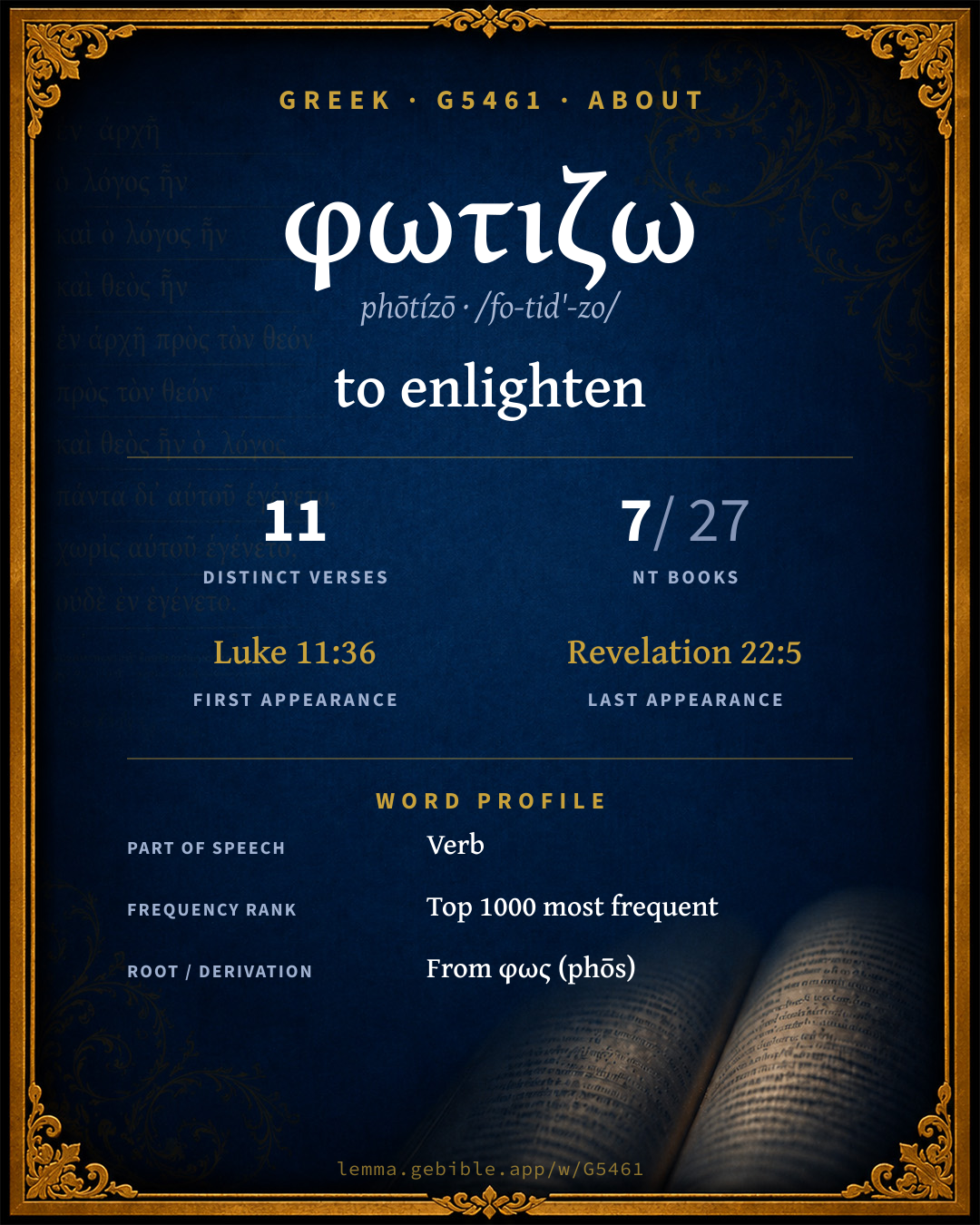
φωτίζω
to enlighten
‘to enlighten’ is one of 4 main senses fuller range ↓
Full lexicon entry — Thayer's Greek Lexicon
From Thayer's Greek Lexicon
Where this word appears
See every Aorist-tense verb in the Greek New Testament →
Grammar key — what these labels mean
Part of speech
- Verb
- An action or state-of-being word.
Tense
- Future
- Action expected in future time.
- Aorist
- Action viewed as a simple whole, without regard to duration — often past (perfective aspect).
- Present
- Ongoing or general action in present time (imperfective aspect).
- Perfect
- A completed past action with continuing present results.
Voice
- Active
- The subject performs the action.
- Passive
- The subject receives the action.
Mood
- Indicative
- States a fact or asks a factual question (the mood of reality).
- Infinitive
- A verbal noun (“to write”), unmarked for person or number.
- Participle
- A verbal adjective (“writing,” “having written”).
- Subjunctive
- Expresses probability, purpose, or possibility (the mood of contingency).
Case
- Genitive
- The case of source, possession, or “of” — answers “whose / from what.”
- Accusative
- The case of the direct object and of extent.
- Nominative
- The case of the subject (and the predicate nominative).
Person
- 3rd person
- The one spoken about (“he / she / it / they”).
Gender
- Masculine
- Grammatically masculine.
Number
- Singular
- One.
- Plural
- More than one.
Grammatical forms 10 distinct
- Verb, Future, Active, Indicative, 3rd person, Singular 2 times (18%)
- Verb, Aorist, Active, Indicative, 3rd person, Singular 1 time (9%)
- Verb, Aorist, Active, Infinitive 1 time (9%)
- Verb, Aorist, Active, Participle, Genitive, Singular, Masculine 1 time (9%)
- Verb, Aorist, Passive, Indicative, 3rd person, Singular 1 time (9%)
- Verb, Aorist, Passive, Participle, Accusative, Plural, Masculine 1 time (9%)
- Verb, Aorist, Passive, Participle, Nominative, Plural, Masculine 1 time (9%)
- Verb, Present, Active, Indicative, 3rd person, Singular 1 time (9%)
+2 more forms (2 occurrences)
Parsed forms decoded from the imported morphology (Robinson–Tischendorf, public domain), counted across 11 parsed occurrences — not distinct verses.
Every verse where G5461 appears — 11 distinct verses across 7 books. Click any verse to open its interlinear word-by-word view. Verse text shown in the World English Bible for context — . Each verse’s Greek form is shown with its reference; the English is not keyword-highlighted, since the data carries no word-level English alignment. Use “Compare translations” on any verse to read it across multiple English versions. This concordance covers the Greek New Testament; Septuagint (Greek Old Testament) occurrences of this word are not indexed here.
Luke 1 verse
John 1 verse
1 Corinthians 1 verse
Ephesians 2 verses
- Ephesians 1:18 πεφωτισμένους perf pass ptcp acc pl masc having the eyes of your hearts enlightened, that you may know what is the hope of his calling, and what are the riches of the glory of his inheritance in the saints,
- Ephesians 3:9 φωτίσαι aor act inf and to make all men see what is the administration of the mystery which for ages has been hidden in God, who created all things through Jesus Christ;
2 Timothy 1 verse
Hebrews 2 verses
- Hebrews 6:4 φωτισθέντας aor pass ptcp acc pl masc For concerning those who were once enlightened and tasted of the heavenly gift, and were made partakers of the Holy Spirit,
- Hebrews 10:32 φωτισθέντες aor pass ptcp nom pl masc But remember the former days, in which, after you were enlightened, you endured a great struggle with sufferings;
Revelation 3 verses
- Revelation 18:1 ἐφωτίσθη aor pass ind 3sg After these things, I saw another angel coming down out of the sky, having great authority. The earth was illuminated with his glory.
- Revelation 21:23 ἐφώτισεν aor act ind 3sg The city has no need for the sun, neither of the moon, to shine, for the very glory of God illuminated it, and its lamp is the Lamb.
- Revelation 22:5 φωτιεῖ fut act ind 3sg There will be no night, and they need no lamp light; for the Lord God will illuminate them. They will reign forever and ever.
About this entry
At a glance — auto-summarized from this page’s data, not written by a person. Every figure links to its source below. This summary describes the numbers; it doesn’t interpret them.
φωτιζω — transliterated phōtízō — is a Greek verb carrying the sense “to enlighten.” Thayer's distinguishes 4 senses for it. The Greek New Testament uses it across 11 verses — uncommon. More than a quarter of its appearances fall in Revelation. Debuting at Luke 11:36, it then recurs through the corpus. Each statement above links to its evidence; the full detail follows below.
Gloss history
Strong's 1890 vs modern scholarship
About this word
Strong's G5461 catalogs a Greek word from the Greek New Testament.
These counts are not copied from any lexicon or concordance. They are computed here, from the morphology-tagged Greek New Testament. What Lemma adds →
- 11
- distinct verses
- The word appears in 11 distinct verses.
- 7 / 27
- NT books
- The word appears in 7 of 27 New Testament books.
- #978
- by frequency
- Top 1000 most frequent Greek words (rank 978 of 5,347 Greek words by occurrence).
View all 11 occurrences in the concordance →
Most concentrated in
- Revelation 3 verses 27%
- Ephesians 2 verses 18%
- Hebrews 2 verses 18%
By section of the New Testament
By traditional corpus
Conventional, traditional groupings — biblical authorship is debated, so this is a traditional corpus grouping, not an authorship claim. Some books belong to more than one corpus (Luke is in both the Gospels and the Lukan corpus, and so on), so these shares overlap and need not total 100%. Each figure is a share of the word’s 11 distinct verses.
- Johannine 4 verses · 36%
- Pauline corpus 4 verses · 36%
- Revelation 3 verses · 27%
- Gospels 2 verses · 18%
- Hebrews 2 verses · 18%
- Lukan (Luke–Acts) 1 verse · 9%
How translations render this word
Counts come from each version’s own published word-to-Strong’s tagging or interlinear alignment — an approximate guide to how each version renders this word, not a word-level alignment the data otherwise carries. Because each total is that version’s own tagged count, the per-version totals vary from one another and need not match the appearance or distinct-verse counts above. These counts may also differ from a printed concordance because Lemma counts each distinctly tagged rendering and does not collapse phrase taggings into a single head-word total. This is a fixed set of word-tagged versions (KJV, ASV, BSB, ULT) and does not change with the reading translation you choose elsewhere. Each version’s license is shown beside its name below (and on Sources).
- King James Version: Light 3×
- American Standard Version: Light 3×
- Berean Standard Bible: Gives light to 1×, Have once been enlightened 1×, Illuminate 1×
- unfoldingWord Literal Text: Having been enlightened 2×
King James Version Public Domain
Renders G5461 across 15 tagged occurrences — most commonly:
Plus 12 renderings that appear only once — usually multi-word phrases or single function words the recovered tagging swept in, not distinct renderings.
American Standard Version Public Domain
Renders G5461 across 15 tagged occurrences — most commonly:
Plus 12 renderings that appear only once — usually multi-word phrases or single function words the recovered tagging swept in, not distinct renderings.
Berean Standard Bible Public Domain
Renders G5461 across 10 tagged occurrences — most commonly:
Not rendered by a distinct English word in 1 further occurrence.
unfoldingWord Literal Text CC BY-SA 4.0
Renders G5461 across 13 tagged occurrences — most commonly:
Plus 11 renderings that appear only once — usually multi-word phrases or single function words the recovered tagging swept in, not distinct renderings.
Senses in Thayer's
The 4 senses Thayer's distinguishes for this word, in lexicon order (not ranked by frequency or importance). The full entry — with sub-senses — is in the Lexicon Entry tab.
- to give light, to shine
- to enlighten, light up, illumine
- to bring to light, render evident
- to enlighten, spiritually, imbue with saving knowledge
Word origin
Derived from φως (phōs) (G5457) — light.
From G5457 ; to shed rays that is to shine or (transitively) to brighten up (literally or figuratively): - enlighten illuminate (bring to give) light make to see.
— Strong’s Exhaustive Concordance (1890), public domain.
Forms in the corpus
The 11 distinct written forms G5461 takes in the Greek New Testament, most frequent first — each parse links to that tense’s occurrences in the concordance.
Same root — word family
Other Thayer's entries built from the same root as G5461, grouped by Strong’s listed origin. These share a root / origin per the lexicon — not necessarily a shared meaning. Each links to that word’s own entry.
Derives from
Shares the same root
- φαινω phaínō G5316 to shine
- φεγγος phéngos G5338 light
- φημι phēmí G5346 to declare
- φωστηρ phōstḗr G5458 light-giver
- φωσφορος phōsphóros G5459 morning star
- φωτεινος phōteinós G5460 light
Derived from this word
Proper names from this root
People and places named from this root — a name, not an additional meaning of the word.
Compare all same-root words → Showing 4 of 10 — not the complete family. 1 of the same-root words is a proper name (a person or place). They share a root, not necessarily a meaning.
Septuagint usage
The same Greek word φωτιζω appears 29 times in the Greek Old Testament (Septuagint), across 27 verses in 12 books.
- 29
- LXX occurrences
- Tagged occurrences of this Greek word in the Septuagint.
- 27
- verses
- Distinct Septuagint verses containing this word.
- 12 / 39
- OT books
- The word appears in 12 of the 39 Old Testament books.
Sample Septuagint occurrences
- Exodus 38:13 φωτίζω
- Numbers 4:9 φωτίζω
- 1 Samuel 29:10 φωτίζω
- 2 Kings 12:3 φωτίζω
- Ezra 2:63 φωτίζω
- Psalms 12:4 φωτίζω
- Proverbs 4:18 φωτίζω
- Ecclesiastes 8:1 φωτίζω
- Isaiah 60:1 φωτίζω
- Daniel 4:5 φωτίζω
- Hosea 10:12 φωτίζω
- Micah 7:8 φωτίζω
Septuagint occurrences (same lexeme)
Every verse where the same Strong’s number (G5461) appears in the Greek Septuagint. Verse text shown in the World English Bible for context; the Greek form is the matched word — the English is not keyword-highlighted.
- Exodus 38:13 φωτίζω For the east side eastward fifty cubits.
- Numbers 4:9 φωτίζω They shall take a blue cloth, and cover the lampstand of the light, and its lamps, and its snuffers, and its snuff dishes, and all its oil vessels, with which they minister to it.
- Numbers 8:2 φωτίζω "Speak to Aaron, and tell him, 'When you light the lamps, the seven lamps shall give light in front of the lampstand.'"
- 1 Samuel 29:10 φωτίζω Therefore now rise up early in the morning with the servants of your lord who have come with you; and as soon as you are up early in the morning, and have light, depart.
- 2 Kings 12:3 φωτίζω However the high places were not taken away; the people still sacrificed and burnt incense in the high places.
- 2 Kings 17:27 φωτίζω Then the king of Assyria commanded, saying, Carry there one of the priests whom you brought from there; and let them go and dwell there, and let him teach them the law of the god of the land.
- 2 Kings 17:28 φωτίζω So one of the priests whom they had carried away from Samaria came and lived in Bethel, and taught them how they should fear Yahweh.
- Ezra 2:63 φωτίζω The governor said to them, that they should not eat of the most holy things, until there stood up a priest with Urim and with Thummim.
- Ezra 9:8 φωτίζω Now for a little moment grace has been shown from Yahweh our God, to leave us a remnant to escape, and to give us a nail in his holy place, that our God may lighten our eyes, and give us a little reviving in our bondage.
- Ezra 17:65 φωτίζω
- Ezra 19:12 φωτίζω
- Ezra 19:19 φωτίζω
- Psalms 12:4 φωτίζω Who have said, "With our tongue we will prevail. Our lips are our own. Who is lord over us?"
- Psalms 17:29 φωτίζω
- Psalms 18:9 φωτίζω He bowed the heavens also, and came down. Thick darkness was under his feet.
- Psalms 33:6 φωτίζω By Yahweh's word the heavens were made; All their host by the breath of his mouth.
- Psalms 75:5 φωτίζω Don't lift up your horn on high. Don't speak with a stiff neck."
- Psalms 104:39 φωτίζω
- Psalms 118:130 φωτίζω
- Psalms 138:12 φωτίζω
- Proverbs 4:18 φωτίζω But the path of the righteous is like the dawning light, That shines more and more until the perfect day.
- Ecclesiastes 8:1 φωτίζω Who is like the wise man? And who knows the interpretation of a thing? A man's wisdom makes his face shine, and the hardness of his face is changed.
- Isaiah 60:1 φωτίζω Arise, shine; for your light is come, and the glory of Yahweh is risen on you.
- Isaiah 60:19 φωτίζω The sun shall be no more your light by day; neither for brightness shall the moon give light to you: but Yahweh will be to you an everlasting light, and your God your glory.
- Daniel 4:5 φωτίζω I saw a dream which made me afraid; and the thoughts on my bed and the visions of my head troubled me.
- Hosea 10:12 φωτίζω Sow to yourselves in righteousness, Reap according to kindness. Break up your fallow ground; For it is time to seek Yahweh, Until he comes and rains righteousness on you.
- Micah 7:8 φωτίζω Don't rejoice against me, my enemy. When I fall, I will arise. When I sit in darkness, Yahweh will be a light to me.
These are occurrences of the same Greek lexeme (G5461) in the Septuagint — not a translation of any one Hebrew word. The store carries no word-level Hebrew↔Greek alignment, so no Hebrew original is asserted here. Counts come from the recovered LXX Strong's tagging — high-frequency vocabulary is well covered, while rare or late forms may be untagged — so they reflect tagged occurrences and may slightly undercount.