Jeremiah 31:38

Hebrew (Westminster Leningrad Codex) Jeremiah 31:38 appears in the Hebrew Old Testament. The text above is from the Westminster Leningrad Codex. Each word links to its Strong’s number, a concise gloss, and parsing drawn from the Open Scriptures Hebrew Bible morphology. Click any word for its full Brown-Driver-Briggs (BDB) entry.
Download image
Cite this verse

Jeremiah 31:38 (World English Bible). Public Domain. Lemma interlinear Bible study tool, https://lemma.gebible.app/v/jeremiah/31/38.

Show BibTeX & RIS
BibTeX
RIS
English Translation
Behold, the days come, says Yahweh, that the city shall be built to Yahweh from the tower of Hananel to the gate of the corner.
World English Bible · Public Domain
Download a study sheet

One document with this verse’s original text, its word-by-word gloss line, the meaning frame, cross-references with their text, attributed commentary, and full source and license credits — printable, and it pastes into notes with its structure intact.

This verse Autodidact and up

Study sheet (.html) Plain text (.txt)

A passage Seminary Student

Up to 50 verses in one chapter. A passage sheet keeps up to 6 commentary sources and 12 cross-references per verse, in the order this page ranks them, and says so on the sheet whenever that leaves anything out. Ask for a single verse and you get the Autodidact verse sheet above.

Everything on this page stays free to read, with no account — the sheet is a download of what is already on screen, not access to it.

Want to remove ads? Support Godless Engineer
Compare translations 3

The same verse in 3 English versions, stacked beneath the original-language interlinear above. Click any original word for its lexicon entry.

Each is an independent rendering of the whole verse — the interlinear is not word-aligned to these translations.

Highlighted words mark where these versions differ — a whole-verse word diff, not a word-by-word alignment.

  • World English Bible Public Domain
    Behold, the days come, says Yahweh, that the city shall be built to Yahweh from the tower of Hananel to the gate of the corner.
  • King James Version Public Domain
    Behold, the days come, saith the LORD, that the city shall be built to the LORD from the tower of Hananeel unto the gate of the corner.
  • unfoldingWord Literal Text CC BY-SA 4.0
    “Look, the days are coming—this is Yahweh’s declaration—when the city will be rebuilt for me, from the Tower of Hananel to the Corner Gate.

unfoldingWord Literal Text — © unfoldingWord, licensed CC BY-SA 4.0. Word-aligned USFM3 via Door43 (git.door43.org/unfoldingWord/en_ult).

Versions to compare (up to 4)

3 of 4 selected

Show all 18 translations

Every available English version of this verse, each an independent rendering of the whole verse.

  • World English Bible Public Domain
    Behold, the days come, says Yahweh, that the city shall be built to Yahweh from the tower of Hananel to the gate of the corner.
  • Berean Standard Bible Public Domain
    “The days are coming,” declares the LORD, “when this city will be rebuilt for Me, from the tower of Hananel to the Corner Gate.
  • Majority Standard Bible Public Domain
    “The days are coming,” declares the LORD, “when this city will be rebuilt for Me, from the tower of Hananel to the Corner Gate.
  • King James Version Public Domain
    Behold, the days come, saith the LORD, that the city shall be built to the LORD from the tower of Hananeel unto the gate of the corner.
  • American Standard Version (1901) Public Domain
    Behold, the days come, saith Jehovah, that the city shall be built to Jehovah from the tower of Hananel unto the gate of the corner.
  • Revised Version (1885) Public Domain
    Behold, the days come, saith the LORD, that the city shall be built to the LORD from the tower of Hananel unto the gate of the corner.
  • Geneva Bible (1599) Public Domain
    Behold, the dayes come, saith the Lord, that the citie shalbe built to the Lord from the tower of Hananeel, vnto the gate of the corner.
  • Douay-Rheims (1899) Public Domain
    If these ordinances shall fail before me, saith the Lord: then also the seed of Israel shall fail, so as not to be a nation before me for ever.
  • Young's Literal Translation Public Domain
    Lo, days `are coming', an affirmation of Jehovah, And the city hath been built to Jehovah, From the tower of Hananeel to the gate of the corner.
  • Literal Standard Version CC BY-SA 4.0
    “Behold, days [are coming],” || A declaration of YHWH, || “And the city has been built for YHWH, || From the Tower of Hananeel to the Corner Gate.
  • Unlocked Literal Bible CC BY-SA 4.0
    “Look, the days are coming—this is Yahweh's declaration—when the city will be rebuilt for me, from the Tower of Hananel to the Corner Gate.
  • unfoldingWord Literal Text CC BY-SA 4.0
    “Look, the days are coming—this is Yahweh’s declaration—when the city will be rebuilt for me, from the Tower of Hananel to the Corner Gate.
  • Darby Bible Public Domain
    Behold, the days come, saith Jehovah, that the city shall be built to Jehovah, from the tower of Hananeel unto the corner-gate.
  • World Messianic Bible Public Domain
    “Behold, the days come,” says the LORD, “that the city will be built to the LORD from the tower of Hananel to the gate of the corner.
  • Webster's Bible Public Domain
    Behold, the days come, saith the LORD, that the city shall be built to the LORD from the tower of Hananeel to the gate of the corner.
  • Free Bible Version CC BY-SA 4.0
    The time is coming, declares the Lord, when this city will be rebuilt for the Lord, all the way from the tower of Hananel to the Corner Gate.
  • Bible in Basic English Public Domain
    See, the days are coming, says the Lord, for the building of the Lord's town, from the tower of Hananel to the doorway of the angle.
  • JPS Tanakh (1917) Public Domain
    Behold, the days come, saith the LORD, that the city shall be built to the LORD from the tower of Hananel unto the gate of the corner.

Literal Standard Version (2020), Covenant Press — licensed CC BY-SA 4.0. Text via the HelloAO Bible API (eBible.org). Unlocked Literal Bible (unfoldingWord) — licensed CC BY-SA 4.0. Text via the HelloAO Bible API (eBible.org). unfoldingWord Literal Text — © unfoldingWord, licensed CC BY-SA 4.0. Word-aligned USFM3 via Door43 (git.door43.org/unfoldingWord/en_ult). Free Bible Version, Dr. Jonathan Gallagher — licensed CC BY-SA 4.0. Text via the HelloAO Bible API (eBible.org).

Word by word

More ways to search: Search by grammar → Find every occurrence → Compare this word →

Practice this passage: Drill this verse → Learn its vocabulary →

חֲנַנְאֵ֖ל
Chănanʼêl
H2606
“Hananeel”
Noun, Proper
Part of Speech
Noun
Type
Proper
Full BDB Definition

Origin: from H2603 and H410

TWOT: None

Hananeel = "God has favoured" - the name of a tower in Jerusalem
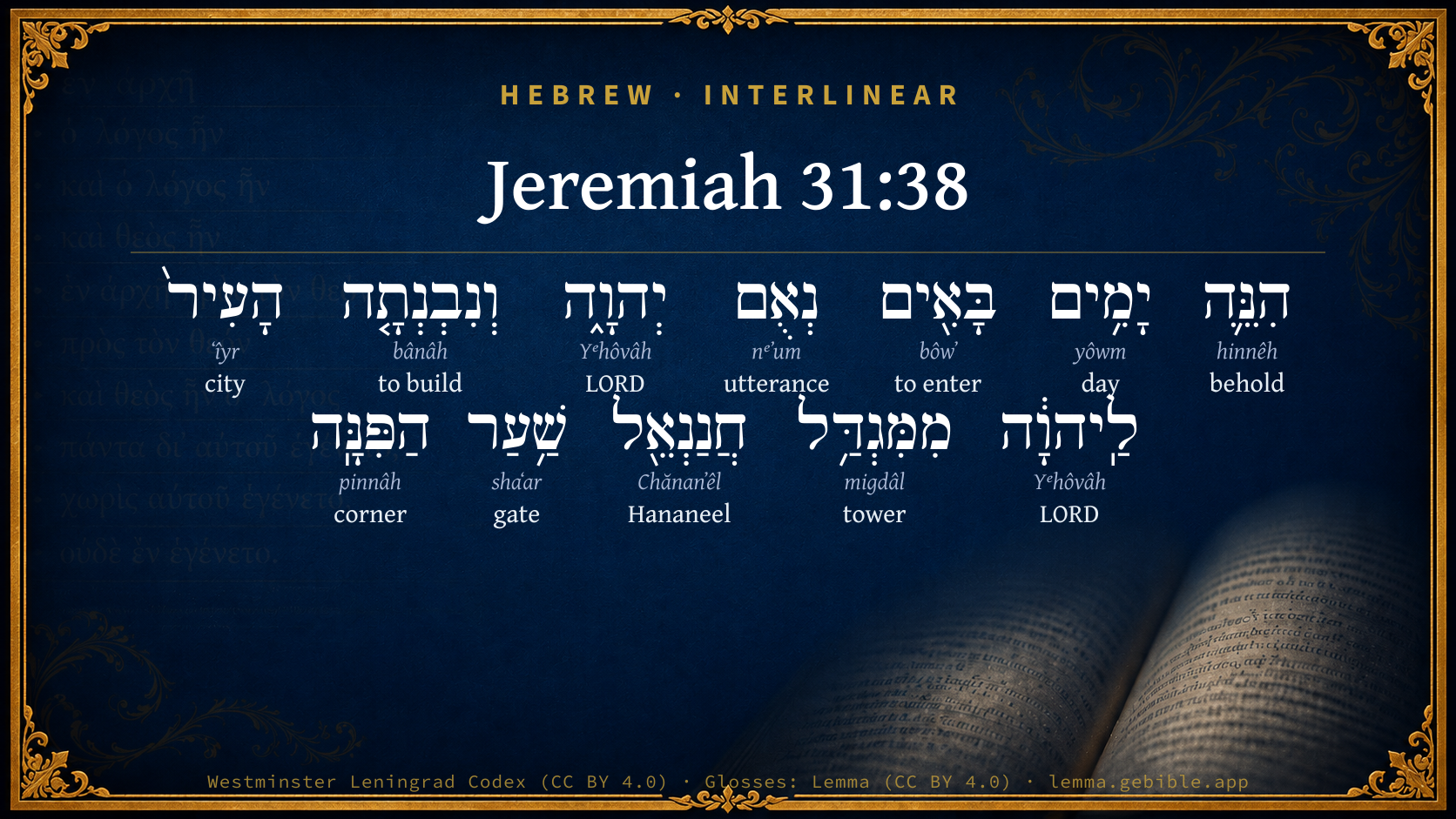
  1. הִנֵּ֛ה hinnêh H2009 “behold” Particle, Demonstrative
  2. יָמִ֥ים yôwm H3117 “days” Noun, Common, Masculine, Plural, Absolute
  3. בָּאִ֖ים bôwʼ H935 “entering” Verb, Qal, Participle Active, Masculine, Plural, Absolute
  4. נְאֻם nᵉʼum H5002 “utterance of” Noun, Common, Masculine, Singular, Construct
  5. יְהוָ֑ה Yᵉhôvâh H3068 “LORD” Noun, Proper
  6. וְנִבְנְתָ֤ה bânâh H1129 “and · to build” Conjunction + Verb, Niphal, Sequential Perfect, 3rd Person, Feminine, Singular
  7. הָעִיר֙ ʻîyr H5892 “the · city” Particle, Definite Article + Noun, Common, Feminine, Singular, Absolute
  8. לַֽיהוָ֔ה Yᵉhôvâh H3068 “to/for · LORD” Preposition + Noun, Proper
  9. מִמִּגְדַּ֥ל migdâl H4026 “from · tower of” Preposition + Noun, Common, Both, Singular, Construct
  10. שַׁ֥עַר shaʻar H8179 “gate of” Noun, Common, Masculine, Singular, Construct
  11. הַפִּנָּֽה pinnâh H6438 “the · corner” Particle, Definite Article + Noun, Common, Feminine, Singular, Absolute

About this verse

These counts appear in no published source. They are computed here, from the morphology-tagged text and Lemma’s own curated glosses. What Lemma adds →

12
words
11
distinct lemmas
Prophets
section

Notable vocabulary

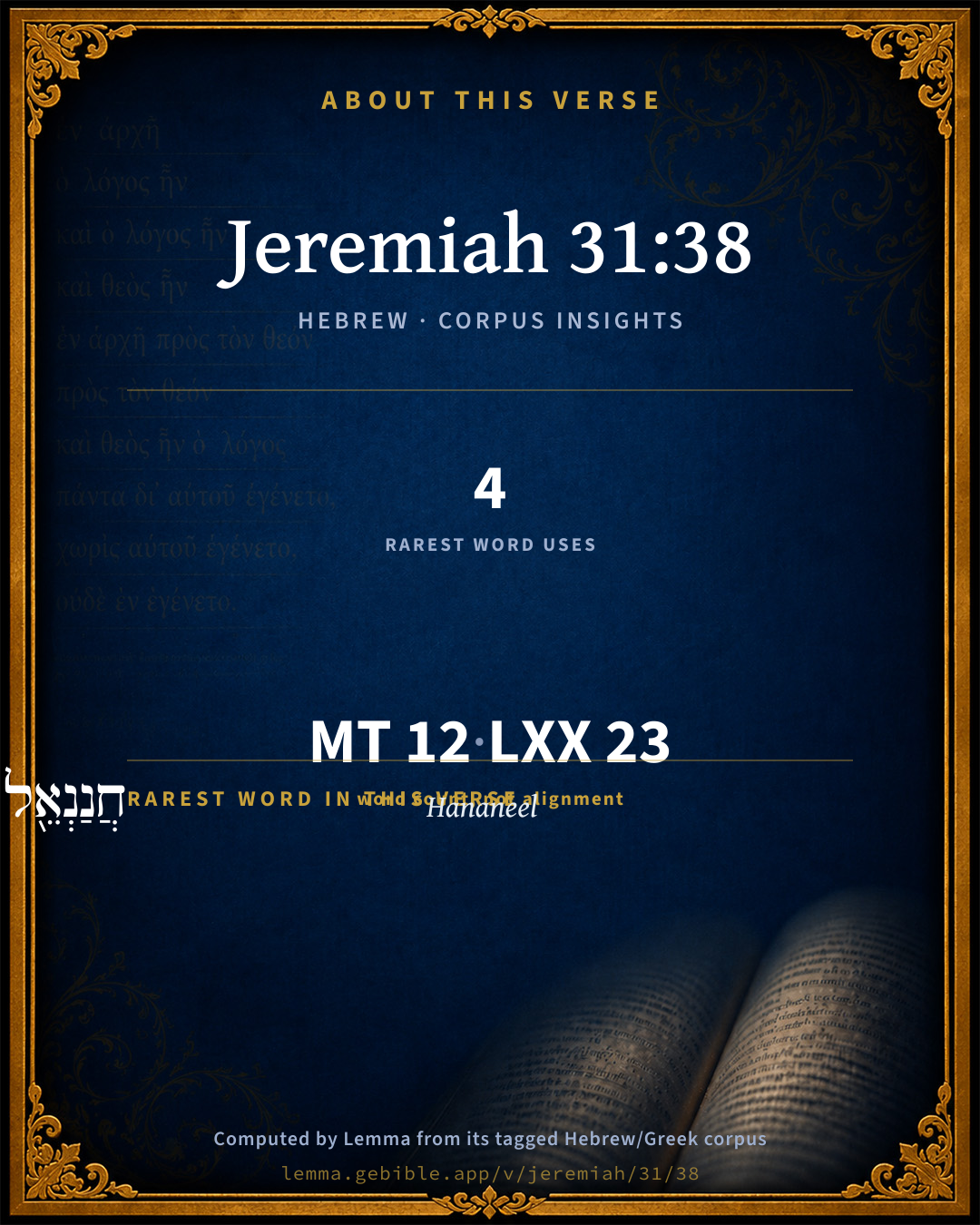
The rarest word here is חֲנַנְאֵ֖ל Hananeel H2606 — appearing just 4 times in the whole Hebrew Bible.

Shared distinctive vocabulary

חֲנַנְאֵ֖ל Hananeel H2606 occurs in 4 verses of the Hebrew Bible. Also found in:

Grammatical profile

  • 2 verbs
  • 9 nouns
  • 1 particle

Verb forms

  • בָּאִ֖ים Qal · Participle Active
  • וְנִבְנְתָ֤ה Niphal · Sequential Perfect

Repetition

A word recurs within this verse — often emphatic in Hebrew:

  • יְהוָ֑ה LORD H3068 ×2

Hebrew & Septuagint length

In the original languages it is 12 Hebrew tokens and 23 Greek tokens — but the two are counted differently (Hebrew bundles its prefixes and suffixes into one token; the Greek is in lemma form), so that isn’t a like-for-like length.

Cross-references

11

Topical passages linked to Jeremiah 31:38 in the Treasury of Scripture Knowledge — connected by theme and wording, ordered by reader-vote popularity; previews shown in the World English Bible.

  • Zechariah 14:10 All the land will be made like the Arabah, from Geba to Rimmon south of Jerusalem; and she will be lifted up, and will dwell in her place, from Benjamin's gate to the place of the first gate, to the corner gate, and from the tower of Hananel to the king's wine-presses.
  • 2 Kings 14:13 Jehoash king of Israel took Amaziah king of Judah, the son of Jehoash the son of Ahaziah, at Beth-shemesh, and came to Jerusalem, and broke down the wall of Jerusalem from the gate of Ephraim to the corner gate, four hundred cubits.
  • Jeremiah 30:18 Thus says Yahweh: Behold, I will turn again the captivity of Jacob's tents, and have compassion on his dwelling-places; and the city shall be built on its own hill, and the palace shall be inhabited after its own manner.
  • 2 Chronicles 26:9 Moreover Uzziah built towers in Jerusalem at the corner gate, and at the valley gate, and at the turning [of the wall], and fortified them.
  • Jeremiah 31:27 Behold, the days come, says Yahweh, that I will sow the house of Israel and the house of Judah with the seed of man, and with the seed of animal.
  • Nehemiah 2:17–3:1 Then said I to them, You see the evil case that we are in, how Jerusalem lies waste, and the gates of it are burned with fire: come, and let us build up the wall of Jerusalem, that we be no more a reproach.
  • Nehemiah 12:30–40 The priests and the Levites purified themselves; and they purified the people, and the gates, and the wall.
  • Isaiah 44:28 Who says of Cyrus, [He is] my shepherd, and shall perform all my pleasure, even saying of Jerusalem, She shall be built; and of the temple, Your foundation shall be laid.
  • Jeremiah 23:5 Behold, the days come, says Yahweh, that I will raise to David a righteous Branch, and he shall reign as king and deal wisely, and shall execute justice and righteousness in the land.
  • Ezekiel 48:30–35 These are the exits of the city: On the north side four thousand and five hundred [reeds] by measure;
  • Daniel 9:25 Know therefore and discern, that from the going forth of the commandment to restore and to build Jerusalem to the Anointed One, the prince, shall be seven weeks, and sixty-two weeks: it shall be built again, with street and moat, even in troubled times.

Cross-references courtesy of OpenBible.info (CC BY 4.0).

Hebrew and Greek witnesses Masoretic Hebrew ↔ Greek Septuagint

The same verse in the two great witnesses to the Old Testament, shown verse-for-verse.

These are two independent witnesses, not word-aligned to each other, and the Septuagint is shown in lemma (dictionary) form.

Hebrew Jeremiah 31:38 Masoretic · Westminster Leningrad Codex

הִנֵּ֛ה יָמִ֥ים בָּאִ֖ים נְאֻם יְהוָ֑ה וְנִבְנְתָ֤ה הָעִיר֙ לַֽיהוָ֔ה מִמִּגְדַּ֥ל חֲנַנְאֵ֖ל שַׁ֥עַר הַפִּנָּֽה

Behold, the days come, says Yahweh, that the city shall be built to Yahweh from the tower of Hananel to the gate of the corner.

World English Bible · Public Domain

Greek LXX Structure differs

In the Septuagint, Jeremiah is about an eighth shorter than the Hebrew and arranges its material differently — the Oracles Against the Nations (Hebrew chapters 46–51) appear in the middle of the Greek book, after 25:13. Because the chapter and verse boundaries do not line up, a verse-for-verse comparison with the Hebrew is not shown.

A verse-for-verse comparison isn’t shown here because the chapters and verses don’t line up. Switch to the LXX edition with the MT / LXX toggle above to read the Greek directly.

Hebrew: Westminster Leningrad Codex (CC BY 4.0). Greek: Septuagint (public domain); English from a public-domain English Septuagint. How the Septuagint differs from the Hebrew →

Targum (Aramaic paraphrase)

1

The Targum is the ancient Jewish Aramaic paraphrase of the Hebrew Scriptures — an interpretive translation, not the Hebrew text itself. Onkelos (literal) and Pseudo-Jonathan (expansive) render the Torah, and Jonathan the Prophets. Coverage is partial: where no permissively-licensed English translation exists for a verse, only the Aramaic is shown. This is verse-level text, not a word-by-word alignment to the Hebrew.

  1. Targum Jonathan Prophets (Joshua–Malachi)
    הָא יוֹמַיָא אָתָן אֲמַר יְיָ וְתִתְבְּנֵי קַרְתָּא דִירוּשְׁלֵם קֳדָם יְיָ מִמִגְדַל פִּקוּס וְעַד תְּרַע זִוְיָתָא:

    On that day, said the Lord, the city of Jerusalem shall be built up from the Tower of Pikus to the Corner Gate.

    Targum Jonathan — Aramaic: “Mikraot Gedolot” (public domain). English: “Sefaria Community Translation” (CC0 1.0 (public-domain dedication)); “London "Chaldee Paraphrase," 1871” (public domain). Text via Sefaria.

Commentary

Notes on Jeremiah 31:38 from classic Christian and Jewish commentators (each source and its license shown beneath its notes). The classic Christian expositions comment on the surrounding passage and are grouped to its opening verse, so a note may address several verses; the Jewish commentaries on the Tanakh (Rashi and others) are per-verse, so they appear only where the commentator wrote on this verse.

Lemma curates 59 commentaries, every one of them public domain or Creative Commons licensed, each selected and text-cleaned for this edition rather than reprinted as found. About our sources →

Trapp's Complete Commentary

John Trapp

Jer 31:38 Behold, the days come, saith the LORD, that the city shall be built to the LORD from the tower of Hananeel unto the gate of the corner.

Ver. 38. Behold the days come, saith the Lord, &c] The word come is not in the text; it is read, but not written. The vowel points are in the text, but not the letters; which those, who are against the antiquity of the points, would do well to consider; since the Jews never suffered any additions to the Bible. {Hebrew Text Note}

That the city shall be built to the Lord.] Jerusalem shall be re-edified, the Church eternally re-established by Christ.

From the tower of Hananeel.] Neh 3:1; Neh 12:39 Zec 14:10.

Unto the gate of the corner.] 2Ki 14:13 Zec 14:10.

John Trapp, A Commentary or Exposition upon All the Books of the Old and New Testament (1647–1656) — public domain. Text from a community e-Sword module.

Joseph Benson's Commentary

Jer 31:38-40. Behold, the days come, that the city shall be built to the Lord — Or, for the Lord, namely, for his use and service. Blaney renders it, Under the direction of the Lord, from the tower of Hananeel, &c. — “Here follows a description of the circumference of a new city to be built on the site of Jerusalem; but that it does not mean the city which was rebuilt after the return of the Jews from the Babylonish captivity is evident from two principal circumstances; first, because the limits are here extended farther, so as to include a greater space than was contained within the walls at that time; and secondly, it is here said, that it should never be razed or destroyed any more. This new city, therefore, must be referred to those after-times when the general restoration of Israel is appointed to take place.” Thus Blaney, with whom many other commentators agree. That this prophecy “was not fulfilled,” says Dr. Dodd, “from the return out of Babylon to the days of Christ, we are assured from sacred history; where we read that mount Goath, or Golgotha, (which word in Hebrew signifies the heap of Gotha,) was situated without Jerusalem. The same may be said of the valley of dead bodies and of the ashes,” namely, the valley of Hinnom, so described, from its having been made a common burying place, and a receptacle for the rubbish and filth of the city. “As to Gareb we know nothing certain. We may also add, that the last clause of this chapter, it shall not be plucked up, &c., any more for ever, cannot refer to the Jerusalem which was rebuilt after the captivity, and which was plucked up and thrown down by the Romans. We must necessarily recur, therefore, either to some future building of that city, or to the church of Christ, against which we are assured the gates of hell shall never prevail,” and which is elsewhere called the city of God, and the new Jerusalem. Taking the passage in this mystical sense, as a description of the church, in its most enlarged and perfect state, in the latter days: we can be at no loss to explain the clause in the last verse which expresses that all parts of the city, even the valley of Hinnom, and all the fields, unto the brook Kidron, &c., shall be holy unto the Lord. For, undoubtedly, at this time the church shall be thoroughly purged from all corruption, both with regard to the doctrine taught in it, and the principles and practices of its members, who shall all be both well instructed in divine things, and truly holy in their hearts and lives.

Joseph Benson's Commentary on the Old and New Testaments (1811–1818) — public domain. Text from a community e-Sword module.

Tyndale Open Study Notes

Tyndale Open Resources

31:38 The Lord revealed his plan for Jerusalem to be rebuilt. The Tower of Hananel stood at the northeast corner of the old city, while the Corner Gate had been at the northwest corner (2 Kgs 14:13; 2 Chr 26:9).

Tyndale Open Study Notes — © Tyndale Open Resources, licensed CC BY-SA 4.0. Text via the HelloAO Bible API.

Geneva Bible (1599)

Geneva Bible translators

As it was performed, Neh. 3:1. By this description he showeth that the city should be as ample, and beautiful as ever it was: but he alludeth to the spiritual Jerusalem, whose beauty should be incomparable.

Geneva Bible (1599) marginal notes — public domain. Text via Bolls.life.

Jamieson, Fausset & Brown

Robert Jamieson, A. R. Fausset & David Brown

tower of Hananeel--The city shall extend beyond its former bounds (Neh 3:1; Neh 12:39; Zac 14:10).

gate of . . . corner-- (Kg2 14:13; Ch2 26:9).

Jamieson, Fausset & Brown — Commentary Critical and Explanatory on the Whole Bible (1871) — public domain (CC PDM 1.0). Text via the HelloAO Bible API.

Adam Clarke's Commentary

Verse 38. The city shall be built to the Lord] This cannot mean the city built after the return from Babylon, for two reasons:

1. This is to be much greater in extent;

2. It is to be permanent, never to be thrown down, Jer 31:40. It must therefore mean, if taken literally at all, the city that is to be built by them when they are brought in with the fulness of the Gentiles.

The tower of Hananeel] This stood in the northeast part of the city; from thence the wall proceeded to the corner gate, (probably the same as the old gate,) thus named from its running out into an angle in that part.

Adam Clarke's Commentary on the Bible (1810–1826) — public domain. Text from a community e-Sword/MySword module.

John Calvin's Commentaries

Here the Prophet speaks of the rebuilding of the city. I doubt not but that his object was to shew them that the largeness and splendor of the city after the return of the people would not be less than it had been under David in its most flourishing condition. We must, however, first speak of the words before we proceed to the subject.

Behold, the days are coming, saith Jehovah, and built shall be the city It was not as yet destroyed; but the Prophet intimated that its utter ruin was nigh at hand; he therefore makes now their hope to depend on God’s mercy alone, as to the deliverance of the people from exile: Built then shall be the city to Jehovah from the tower of Hananeel, etc. This tower was, no doubt, placed in the wall of the city. Almost the same prediction is found in Zechariah 14:10, though there is some diversity in the words; but both the Prophets refer to the same thing. Zechariah’s object was to animate the people under this circumstance, because the beauty, greatness, and extent of the city did not at first correspond with what it had formerly been. He then promises that its glory would at length be the same as it had been; and he names there the tower of Hananeel Jeremiah adds, to the gate of the corner The corner, הפנה ephene, is in the singular number; but in Zechariah it is הפנים ephenim, in the plural; and it is thought that corners or corner is thus called metaphorically, because a corner shews two faces while it stands out, and thus two parts appear; but whether it be the gate of the corner or of the corners, it makes but little difference.

John Calvin's Commentaries (1540-1563) — public domain. Text from the Calvin Translation Society English edition (1840s-50s) via the Christian Classics Ethereal Library (ccel.org). Calvin's coverage is partial (roughly two-thirds of the Bible); uncommented books and verses are honest gaps, never fabricated. The 19th-century editor's footnotes and remarks are omitted so the notes are faithfully Calvin's own voice.

Ellicott's Commentary for English Readers

(38) From the tower of Hananeel unto the gate of the corner.—There seems to us something almost like an anti-climax in this sudden transition from the loftiest Gospel promises to the obscure localities of the ancient Jerusalem. With Jeremiah, however, as before with Isaiah (Isa_65:17-25), and on a much larger scale with Ezekiel (Ezekiel 40-48), this was the natural outgrowth of the vividness with which the restored city came before his mental vision. He saw a goodly city rise as from the ruins of the old, truly and not in name only consecrated to Jehovah, and describes, as best he can, how it differed from them. The tower of Hananeel appears from Neh_3:1; Neh_12:39, to have been identical, or connected, with the tower of Meah, and to have been between the fish-gate and the sheep-gate, at the north-east corner of the city walls. It is named again, as one of the conspicuous landmarks of the city, in Zec_14:10. The “corner-gate” at the north-west corner, and near the present Jaffa-gate, appears in 2Ki_14:13; 2Ch_26:9; Zec_14:10; Neh_3:24; Neh_3:32. The wall in this quarter had apparently been battered during the siege of Jerusalem, and the prophet naturally sees the rebuilding of the wall as among the first-fruits of the restoration.

A Bible Commentary for English Readers, edited by Charles John Ellicott (1878–1897) — public domain. Text from a community e-Sword module.

The Cambridge Bible for Schools and Colleges

gen. ed. J. J. S. Perowne

38. Behold, the days come] The word come is omitted in the earliest form of the Heb. text, but probably by an error in copying, as the phrase is a favourite one with Jeremiah. See note on Jer_23:5.

that the city shall be built] The words which follow no doubt express an enlargement of the bounds of the city, but from our ignorance of the exact position of the places named, we cannot speak more definitely. From the mention made of “the tower of Hananel” in Neh_3:1; Neh_12:39; and of “the corner-gate” in 2Ki_14:13; 2Ch_26:9 (cp. Zec_14:10 for both places) we find that the former was at or near the N.E. and the latter the N.W. corner of the city wall.

to the Lord] for His honour.

38–40. These vv. may safely be assumed to belong to post-exilic days, when topographical questions connected with the extent of the city assumed importance. Cp. Zechariah 14. For the position of places here mentioned, see Quart. Statement of Pal. Explor. Fund, Jan. 1912, p. 28.

The Cambridge Bible for Schools and Colleges (gen. ed. J. J. S. Perowne; Cambridge University Press, 1878–1918) — public domain. Text from a community e-Sword module.

John Gill's Exposition

Behold, the days come, saith the Lord,.... The word come is not in the text; it is read, but not written. The vowel points are in the text, but not the letters; which those, who are against the antiquity of the points, would do well to consider; since the Jews never suffered any additions to the Bible. Jarchi says this prophecy refers to future times in the latter redemption, and never was fulfilled in the second temple; and indeed, under the figure of rebuilding Jerusalem, seems to be intended the building of the Gospel church, which was to continue to the end of time; for both holiness and perpetuity are ascribed to it:

that the city shall be built to the Lord; the city of Jerusalem; which was to be rebuilt upon the return of the Jews from the Babylonish captivity, as by the order, and under the direction and protection of the Lord, so for his service and worship; the temple in it should be built up again, and divine worship restored; and both that and the city, with the inhabitants of it, be devoted to his service; a type of the Gospel church, built up an habitation for God, where he is worshipped, feared, and glorified:

from the tower of Hananeel unto the gate of the corner; of the tower of Hananeel mention is made in Neh 3:1. The Targum calls it the tower of Pikkus. Lightfoot places it on the south side of the city, bending to the east; but most place it on the east side of it: here probably the building of the city began in Nehemiah's time, and proceeded to the gate of the corner, which lay northeast; of which see Kg2 14:13; Jerom interprets the tower of Hananeel the tower of obedience, or of the grace and gifts of God, which latter is not much amiss; since the word "Hansheel" may be interpreted "God gives grace"; and the spiritual building of the church proceeds from the grace of God, upon the foundation of the apostles and prophets, Christ being the chief corner stone, Eph 2:20.

John Gill's Exposition of the Whole Bible (1746–1763) — public domain (CC PDM 1.0). Text via the HelloAO Bible API.

Albert Barnes' Notes on the Bible

To the Lord - Or, for Yahweh: for His dwelling in the hearts of a people prepared to be His temple.

Albert Barnes' Notes on the Bible (1834–1885) — public domain. Text from a community e-Sword/MySword module.

Haydock's Catholic Bible Commentary

Come, is only in the margin of the Hebrew, but is found properly in some manuscripts. (Kennicott) --- Corner. On the south, opposite to the former, 2 Esdras iii. 1.

George Leo Haydock (1774–1849), Haydock's Catholic Family Bible and Commentary, 1859 edition — public domain. Excludes Psalms (Douay-Rheims chapter numbering differs from Protestant) and Deuterocanonical books (Catholic canon only).

Matthew Poole's English Annotations

That is, it shall be built round, as largely as ever. We read of this

tower of Hananeel, Neh 3:1; 12:39; Zec 14:10; it was in the south, or rather the eastern part of the city. We read of the

gate of the corner, 2Ki 14:13; Zec 14:10; most agree that it is in the north-cast part of the city.

Matthew Poole's English Annotations on the Holy Bible (1683–1685) — public domain. Text from a community e-Sword/MySword module.

Whedon's Commentary on the Bible

Daniel D. Whedon

38. To the Lord — Not to his honour merely, but for his possession and dwellingplace. From the tower of Hananeel, etc. — The tower of Hananeel was situated at the northeast corner of the city wall, (see Neh_3:1; Zec_4:10,) while the gate of the corner probably answered to the present Jaffa gate, near the northwest corner of the city. The expression describes the whole northside, and is equal almost to its whole extent.

Daniel D. Whedon (gen. ed.), Commentary on the Old and New Testaments (1874–1909) — public domain. Text from a community e-Sword module.

The Pulpit Commentary

Vers. 38-40. The connection is not very clear. The main point of these verses is that Jerusalem, when rebuilt, shall be altogether "the Lord"s." Its circumference shall even be extended with the single object of including spots at present unclean, but then to become holy like the rest of the city. According to Hengstenberg and Keil, Jerusalem is here a figure of the kingdom of God in the latter days.

The tower of Hananeel. This lay at the northeast corner of the city. (Neh_3:1 Neh_12:39) The gate of the corner. At the north, west corner. (2Ki_14:13 2Ch_26:9) Both this and the tower of Hananeel are mentioned together again in the prophecy of the glorification of Jerusalem, in Zec_14:10.

Vers. 38-40. The new Jerusalem.

The law or condition of the spiritual life of the future having been referred to, the organized embodiment or community to which they will give rise is next described. This will be

I THE ANTITYPE OF THE OLD JERUSALEM.

1. An organized community. With permanent constitution and laws, and subject to a central authority. Comprehending and unifying the manifold relations of human life. A true "city of God" on earth.

2. With an earthly manifestation. It would not be a mere idea, but would realize itself, in part at least, in sensible forms and external manifestations. It would be the incarnation of spiritual principles and their practical realization.

3. And a sacred character. This would be its distinguishing characteristic, as it had been that of the former city. There would be a wall of consecration, and a special aim and direction given to the life, of which it would be the dwelling place and home. It would be built "to the Lord," and would in its entirety be "holy to the Lord.

II CONTRASTED WITH IT.

1. More complete in its surroundings and defences. Jehoash had destroyed the wall in the north and northeast, in the reign of Amaziah. On this side, therefore, the old city was most defenceless. A large portion of this was rebuilt by Nehemiah, (Neh_3:1) but probably not the whole. The new city will be entirely rebuilt and thoroughly defended, "a city compact and built together.

2. More comprehensive. Outlying places would be included, and the bounds of the city vastly extended. The whole earth will be included in the city of salvation.

3. More inclusively consecrated. The hill Gareb (perhaps that of the lepers), and the hill Goath (possibly Golgotha), and the valley of Hinnom, the foul Gehenna even these which had confronted the old city as a reproach, would be cleansed, transformed, and included. The sources of disease and the occasions of defilement would thus be entirely removed.

4. More permanent in its duration. It is to be preserved from all injury, and is to stand forever.

III WHOLLY DISTINCT FROM IT. At no time in the history of Israel were these predictions fulfilled with regard to the earthly Jerusalem. Portions of the description might appear to correspond with what took place in the time of Nehemiah and others, but in its entirety it is evident that the city here spoken of is utterly distinct from the geographical and historical Jerusalem. It is associated with it according to the law of Divine continuity, but in itself it is a new creation. The "wall great and high" is of no earthly material; the extension is not one of yards or miles, but of nations and ages; the consecration of the unclean places is but typical of the regenerative force of Christianity, which reclaims the moral wastes of the world, and purifies the carnal affections and sinful tendencies of human nature; and no material city could ever "stand for aye." Only the kingdom and Church of Christ could satisfy the conditions of such a prophecy. M.

The Pulpit Commentary (1880–1919), ed. H.D.M. Spence-Jones & Joseph S. Exell — public domain. Text from a community e-Sword module.

John Wesley's Explanatory Notes

The city - Shall be built round, as largely as ever.

John Wesley, Explanatory Notes Upon the Whole Bible (1754–1765) — public domain. Text via the GEBible commentary corpus.

unfoldingWord translationNotes

Door43 World Missions Community

Look, the days are coming

"Pay attention! What I am about to talk about will happen soon"

days are coming ... when the city will be rebuilt

Future time is spoken of as if the "days are coming." See how you translated this metaphor in Jeremiah 7:32. AT: "in the future ... the city will be rebuilt" or "there will be a time ... when the city will be rebuilt" (See: Metaphor)

this is Yahweh's declaration

Yahweh speaks of himself by name to express the certainty of what he is declaring. See how you translated this in Jeremiah 1:8. AT: "this is what Yahweh has declared" or "this is what I, Yahweh, have declared" (See: First, Second, or Third Person)

the city will be rebuilt for me

This can be translated in active form. AT: "they will rebuild the city for me" or "I will have them rebuild the city" (See: Active or Passive)

Tower of Hananel ... Corner Gate ... hill of Gareb ... Goah ... Kidron Valley ... Horse Gate

These are the names of places. (See: How to Translate Names)

The whole valley ... will be set apart for Yahweh

This can be translated in active form. AT: "They will set apart the whole valley ... for me" or "I will have them make the whole valley ... holy for me" (See: Active or Passive)

set apart

"made holy"

The city will not be pulled up or overthrown again

The city is spoken of as if it were a plant that someone could pull out of the ground or a building that someone could break down. This can be translated in active form. AT: "I will not allow anyone to pull up or overthrow the city again" or "No one will tear the city down or destroy it again" (See: Metaphor and Active or Passive)

translationWords

watchtower

gate

bury

unfoldingWord translationNotes — © Distant Shores Media and the Door43 World Missions Community, licensed CC BY-SA 4.0. Source: git.door43.org/Door43/en_tn.

Lesson kit

Teaching starters — assembled from the data on this page, not authored interpretation. Every prompt links to the verse data it draws on. Edit before teaching.

Jeremiah, in the Prophets, opens this verse with 12 words (11 distinct Hebrew lemmas). Its most distinctive word is Chănanʼêl (“Hananeel”). A historical commentator’s framing appears above. Read the whole chapter for the surrounding context.

Discussion questions

  1. What does “Hananeel” (Chănanʼêl) contribute to the verse as a whole?
  2. Nehemiah 3:1 shares the word «Hananeel» with this verse. How do the two illuminate each other?
  3. “LORD” occurs 2× in this one verse. What is the effect of the repetition?
  4. These translations render this verse differently. What is at stake in choosing one wording over another?
  5. The verb «בָּאִ֖ים» is Qal Participle Active. How does its form color the action?
  6. Reading how Trapp's Complete Commentary and Joseph Benson's Commentary read this verse, where do the two commentators agree and where do they part?

Things to notice

Reading settings

Reading text

Shown beneath each verse's original-language words.

Old Testament
Old Testament edition

Read the OT as the Masoretic Hebrew (MT) or the Greek Septuagint (LXX).

English shown for the Greek Septuagint (in the Hebrew ↔ Greek comparison).

Comparing translations? Open the Compare panel on any verse page to stack up to four side by side.