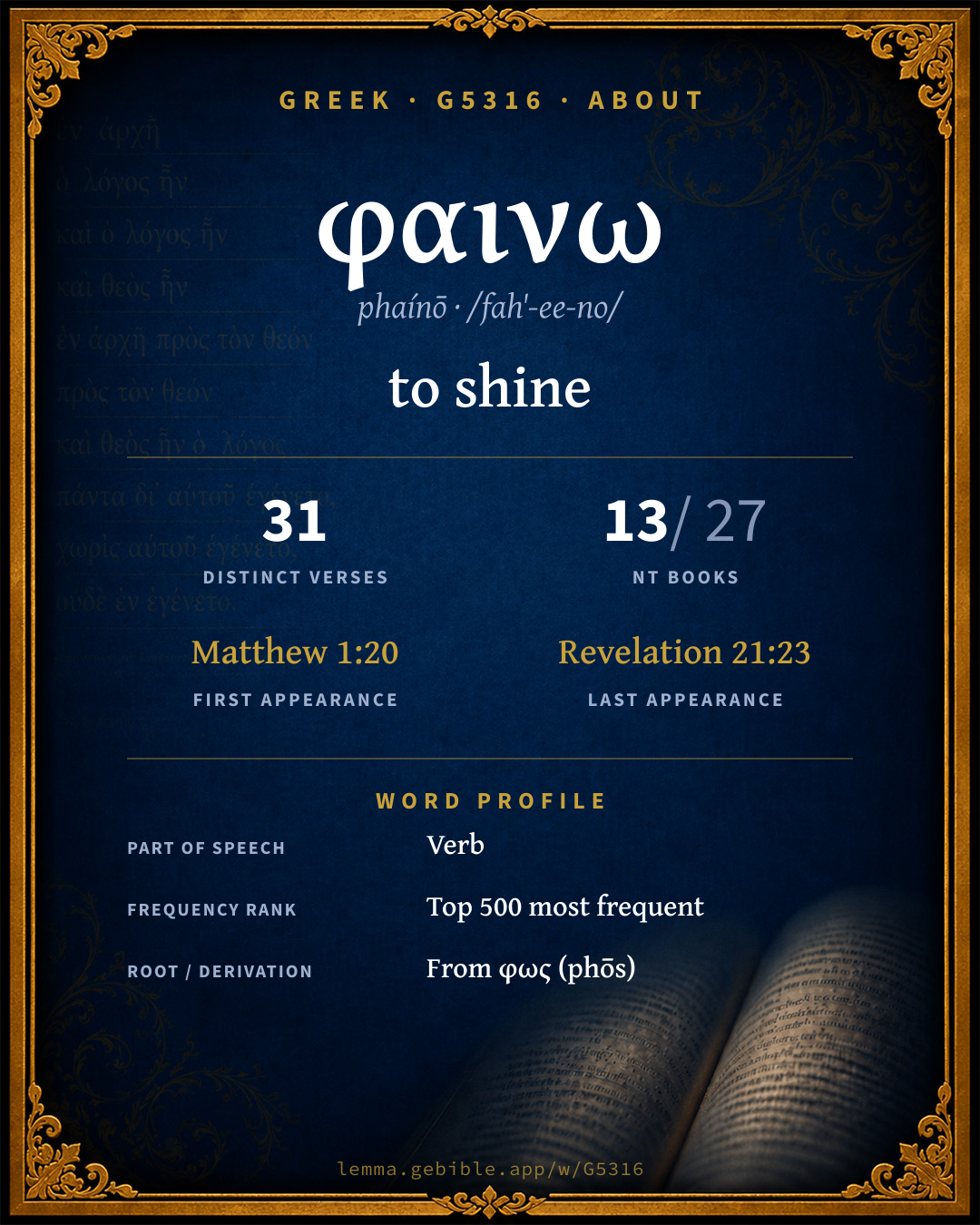
φαίνω
to shine
‘to shine’ is one of 2 main senses fuller range ↓
Full lexicon entry — Thayer's Greek Lexicon
From Thayer's Greek Lexicon
Where this word appears
See every Present-tense verb in the Greek New Testament →
Grammar key — what these labels mean
Part of speech
- Verb
- An action or state-of-being word.
Tense
- Aorist
- Action viewed as a simple whole, without regard to duration — often past (perfective aspect).
- Present
- Ongoing or general action in present time (imperfective aspect).
- Future
- Action expected in future time.
Voice
- Passive
- The subject receives the action.
- Middle or Passive
- A form that may be middle or passive — resolved by context.
- Active
- The subject performs the action.
- Middle deponent
- Middle in form but active in meaning.
Mood
- Indicative
- States a fact or asks a factual question (the mood of reality).
- Subjunctive
- Expresses probability, purpose, or possibility (the mood of contingency).
- Participle
- A verbal adjective (“writing,” “having written”).
Case
- Nominative
- The case of the subject (and the predicate nominative).
- Dative
- The case of the indirect object, means, or location — “to / for / with / in.”
- Genitive
- The case of source, possession, or “of” — answers “whose / from what.”
Person
- 3rd person
- The one spoken about (“he / she / it / they”).
- 2nd person
- The one addressed (“you”).
- 1st person
- The speaker (“I / we”).
Gender
- Masculine
- Grammatically masculine.
- Neuter
- Grammatically neuter.
- Feminine
- Grammatically feminine.
Number
- Singular
- One.
- Plural
- More than one.
Grammatical forms 18 distinct
- Verb, Aorist, Passive, Indicative, 3rd person, Singular 5 times (16%)
- Verb, Present, Middle or Passive, Indicative, 3rd person, Singular 4 times (13%)
- Verb, Aorist, Passive, Subjunctive, 3rd person, Singular 3 times (10%)
- Verb, Present, Active, Indicative, 3rd person, Singular 3 times (10%)
- Verb, Aorist, Passive, Subjunctive, 3rd person, Plural 2 times (6%)
- Verb, Present, Passive, Indicative, 2nd person, Plural 2 times (6%)
- Verb, Aorist, Passive, Indicative, 3rd person, Plural 1 time (3%)
- Verb, Aorist, Passive, Subjunctive, 1st person, Plural 1 time (3%)
+10 more forms (10 occurrences)
Parsed forms decoded from the imported morphology (Robinson–Tischendorf, public domain), counted across 31 parsed occurrences — not distinct verses.
Every verse where G5316 appears — 31 distinct verses across 13 books. Click any verse to open its interlinear word-by-word view. Verse text shown in the World English Bible for context — . Each verse’s Greek form is shown with its reference; the English is not keyword-highlighted, since the data carries no word-level English alignment. Use “Compare translations” on any verse to read it across multiple English versions. This concordance covers the Greek New Testament; Septuagint (Greek Old Testament) occurrences of this word are not indexed here.
Matthew 13 verses
- Matthew 1:20 ἐφάνη aor pass ind 3sg But when he thought about these things, behold, an angel of the Lord appeared to him in a dream, saying, "Joseph, son of David, don't be afraid to take to yourself Mary, your wife, for that which is conceived in her is of the Holy Spirit.
- Matthew 2:7 φαινομένου pres mid/pass ptcp gen sg masc Then Herod secretly called the wise men, and learned from them exactly what time the star appeared.
- Matthew 2:13 φαίνεται pres mid/pass ind 3sg Now when they had departed, behold, an angel of the Lord appeared to Joseph in a dream, saying, "Arise and take the young child and his mother, and flee into Egypt, and stay there until I tell you, for Herod will seek the young child to destroy him."
- Matthew 2:19 φαίνεται pres mid/pass ind 3sg But when Herod was dead, behold, an angel of the Lord appeared in a dream to Joseph in Egypt, saying,
- Matthew 6:5 φανῶσιν aor pass subj 3pl "When you pray, you shall not be as the hypocrites, for they love to stand and pray in the synagogues and in the corners of the streets, that they may be seen by men. Most assuredly, I tell you, they have received their reward.
- Matthew 6:16 φανῶσιν aor pass subj 3pl "Moreover when you fast, don't be like the hypocrites, with sad faces. For they disfigure their faces, that they may be seen by men to be fasting. Most assuredly I tell you, they have received their reward.
- Matthew 6:18 φανῇς aor pass subj 2sg so that you are not seen by men to be fasting, but by your Father who is in secret, and your Father, who sees in secret, will reward you.
- Matthew 9:33 ἐφάνη aor pass ind 3sg When the demon was cast out, the mute man spoke. The multitudes marveled, saying, "Nothing like this has ever been seen in Israel!"
- Matthew 13:26 ἐφάνη aor pass ind 3sg But when the blade sprang up and brought forth fruit, then the darnel appeared also.
- Matthew 23:27 φαίνονται pres mid/pass ind 3pl "Woe to you, scribes and Pharisees, hypocrites! For you are like whitened tombs, which outwardly appear beautiful, but inwardly are full of dead men's bones, and of all uncleanness.
- Matthew 23:28 φαίνεσθε pres pass ind 2pl Even so you also outwardly appear righteous to men, but inwardly you are full of hypocrisy and iniquity.
- Matthew 24:27 φαίνεται pres mid/pass ind 3sg For as the lightning comes forth from the east, and is seen even to the west, so will be the coming of the Son of Man.
- Matthew 24:30 φανήσεται fut pass ind 3sg and then the sign of the Son of Man will appear in the sky. Then all the tribes of the earth will mourn, and they will see the Son of Man coming on the clouds of the sky with power and great glory.
Mark 2 verses
- Mark 14:64 φαίνενεται pres mid/pass ind 3sg You have heard the blasphemy! What do you think?" They all condemned him to be worthy of death.
- Mark 16:9 ἐφάνη aor pass ind 3sg Now when he had risen early on the first day of the week, he appeared first to Mary Magdalene, from whom he had cast out seven demons.
Luke 2 verses
John 2 verses
Romans 1 verse
2 Corinthians 1 verse
Philippians 1 verse
Hebrews 1 verse
James 1 verse
1 Peter 1 verse
2 Peter 1 verse
1 John 1 verse
Revelation 4 verses
- Revelation 1:16 φαίνει pres act ind 3sg He had seven stars in his right hand. Out of his mouth proceeded a sharp two-edged sword. His face was like the sun shining at its brightest.
- Revelation 8:12 φάνῃ aor pass subj 3sg The fourth angel sounded, and one third of the sun was struck, and one third of the moon, and one third of the stars; so that one third of them would be darkened, and the day wouldn't shine for one third of it, and the night in the same way.
- Revelation 18:23 φάνῃ aor pass subj 3sg The light of a lamp will shine no more at all in you. The voice of the bridegroom and of the bride will be heard no more at all in you; for your merchants were the princes of the earth; for with your sorcery all the nations were deceived.
- Revelation 21:23 φαίνωσιν pres act subj 3pl The city has no need for the sun, neither of the moon, to shine, for the very glory of God illuminated it, and its lamp is the Lamb.
About this entry
At a glance — auto-summarized from this page’s data, not written by a person. Every figure links to its source below. This summary describes the numbers; it doesn’t interpret them.
φαινω (phaínō) is a Greek verb most often rendered “to shine.” It first appears in Matthew 1:20. The Greek New Testament uses it across 31 verses — moderately common. Matthew dominates its distribution — 13 of 31 verses. Ranging over 2 senses, it is not a single-sense word. The sections below give every sense, occurrence, and version rendering.
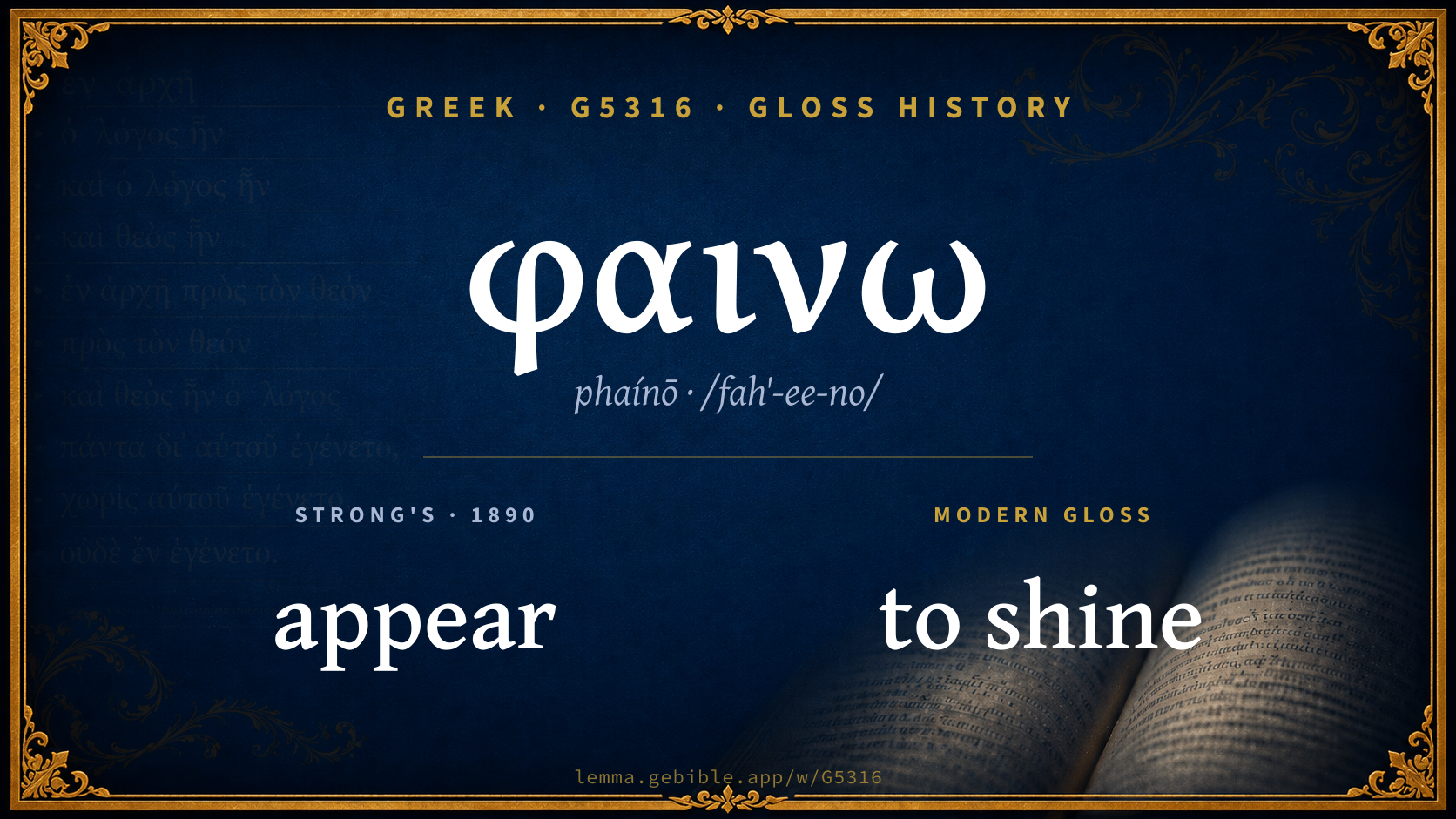
Gloss history
Strong's 1890 vs modern scholarship
About this word
Strong's G5316 catalogs a Greek word from the Greek New Testament.
These counts are not copied from any lexicon or concordance. They are computed here, from the morphology-tagged Greek New Testament. What Lemma adds →
- 31
- distinct verses
- The word appears in 31 distinct verses.
- 13 / 27
- NT books
- The word appears in 13 of 27 New Testament books.
- #448
- by frequency
- Top 500 most frequent Greek words (rank 448 of 5,347 Greek words by occurrence).
View all 31 occurrences in the concordance →
Most concentrated in
- Matthew 13 verses 42%
- Revelation 4 verses 13%
- Mark 2 verses 6%
By section of the New Testament
By traditional corpus
Conventional, traditional groupings — biblical authorship is debated, so this is a traditional corpus grouping, not an authorship claim. Some books belong to more than one corpus (Luke is in both the Gospels and the Lukan corpus, and so on), so these shares overlap and need not total 100%. Each figure is a share of the word’s 31 distinct verses.
- Gospels 19 verses · 61%
- Johannine 7 verses · 23%
- General (Catholic) Epistles 4 verses · 13%
- Revelation 4 verses · 13%
- Pauline corpus 3 verses · 10%
- Lukan (Luke–Acts) 2 verses · 6%
- Hebrews 1 verse · 3%
How translations render this word
Counts come from each version’s own published word-to-Strong’s tagging or interlinear alignment — an approximate guide to how each version renders this word, not a word-level alignment the data otherwise carries. Because each total is that version’s own tagged count, the per-version totals vary from one another and need not match the appearance or distinct-verse counts above. These counts may also differ from a printed concordance because Lemma counts each distinctly tagged rendering and does not collapse phrase taggings into a single head-word total. This is a fixed set of word-tagged versions (KJV, ASV, BSB, ULT) and does not change with the reading translation you choose elsewhere. Each version’s license is shown beside its name below (and on Sources).
- King James Version: Shineth 5×, Appear 3×, Appeared 3×
- American Standard Version: Appeared 4×, Shineth 4×, Appear 3×
- Berean Standard Bible: Appeared 4×, Shining 3×, Had appeared 2×
- unfoldingWord Literal Text: Appear 3×, Appears 3×, Shines 3×
King James Version Public Domain
Renders G5316 across 32 tagged occurrences — most commonly:
Plus 19 renderings that appear only once — usually multi-word phrases or single function words the recovered tagging swept in, not distinct renderings.
American Standard Version Public Domain
Renders G5316 across 33 tagged occurrences — most commonly:
Plus 15 renderings that appear only once — usually multi-word phrases or single function words the recovered tagging swept in, not distinct renderings.
Berean Standard Bible Public Domain
Renders G5316 across 31 tagged occurrences — most commonly:
Plus 20 renderings that appear only once — usually multi-word phrases or single function words the recovered tagging swept in, not distinct renderings.
unfoldingWord Literal Text CC BY-SA 4.0
Renders G5316 across 40 tagged occurrences — most commonly:
Plus 22 renderings that appear only once — usually multi-word phrases or single function words the recovered tagging swept in, not distinct renderings.
Senses in Thayer's
The 2 senses Thayer's distinguishes for this word, in lexicon order (not ranked by frequency or importance). The full entry — with sub-senses — is in the Lexicon Entry tab.
- to bring forth into the light, cause to shine, shed light
- shine
Word origin
Derived from φως (phōs) (G5457) — light.
Prolongation for the base of G5457 ; to lighten ( shine ) that is show (transitive or intransitive literal or figurative): - appear seem be seen shine X think.
— Strong’s Exhaustive Concordance (1890), public domain.
Forms in the corpus
The 20 distinct written forms G5316 takes in the Greek New Testament, most frequent first — each parse links to that tense’s occurrences in the concordance.
Same root — word family
Other Thayer's entries built from the same root as G5316, grouped by Strong’s listed origin. These share a root / origin per the lexicon — not necessarily a shared meaning. Each links to that word’s own entry.
Derives from
Shares the same root
- φεγγος phéngos G5338 light
- φημι phēmí G5346 to declare
- φωστηρ phōstḗr G5458 light-giver
- φωσφορος phōsphóros G5459 morning star
- φωτεινος phōteinós G5460 light
- φωτιζω phōtízō G5461 to enlighten
Derived from this word
- φανερος phanerós G5318 evident
- φανος phanós G5322 torch
- φανταζω phantázō G5324 to show
- φελονης phelónēs G5341 cloak
- φωνη phōnḗ G5456 voice
- φως phōs G5457 light
Proper names from this root
People and places named from this root — a name, not an additional meaning of the word.
Compare all same-root words → Showing 4 of 14 — not the complete family. 1 of the same-root words is a proper name (a person or place). They share a root, not necessarily a meaning.
Septuagint usage
The same Greek word φαινω appears 36 times in the Greek Old Testament (Septuagint), across 36 verses in 13 books.
- 36
- LXX occurrences
- Tagged occurrences of this Greek word in the Septuagint.
- 36
- verses
- Distinct Septuagint verses containing this word.
- 13 / 39
- OT books
- The word appears in 13 of the 39 Old Testament books.
Sample Septuagint occurrences
- Genesis 1:15 φαίνω
- Exodus 25:37 φαίνω
- Numbers 23:3 φαίνω
- 1 Samuel 18:3 φαίνω
- 2 Samuel 11:27 φαίνω
- 1 Kings 22:32 φαίνω
- 1 Chronicles 21:7 φαίνω
- Ezra 7:20 φαίνω
- Psalms 76:19 φαίνω
- Proverbs 11:31 φαίνω
- Isaiah 32:2 φαίνω
- Ezekiel 32:7 φαίνω
Septuagint occurrences (same lexeme)
Every verse where the same Strong’s number (G5316) appears in the Greek Septuagint. Verse text shown in the World English Bible for context; the Greek form is the matched word — the English is not keyword-highlighted.
- Genesis 1:15 φαίνω and let them be for lights in the expanse of sky to give light on the earth," and it was so.
- Genesis 1:17 φαίνω God set them in the expanse of sky to give light to the earth,
- Genesis 21:11 φαίνω The thing was very grievous in Abraham's sight on account of his son.
- Genesis 30:37 φαίνω Jacob took to himself rods of fresh poplar, almond, plane tree, peeled white streaks in them, and made the white appear which was in the rods.
- Genesis 35:22 φαίνω It happened, while Israel lived in that land, that Reuben went and lay with Bilhah, his father's concubine, and Israel heard of it. Now the sons of Jacob were twelve.
- Genesis 38:10 φαίνω The thing which he did was evil in the sight of Yahweh, and he killed him also.
- Genesis 42:15 φαίνω Hereby you shall be tested. By the life of Pharaoh you shall not go forth from here, unless your youngest brother come here.
- Genesis 45:5 φαίνω Now don't be grieved, nor angry with yourselves, that you sold me here, for God sent me before you to preserve life.
- Exodus 25:37 φαίνω You shall make its lamps seven, and they shall light its lamps to give light to the space in front of it.
- Numbers 23:3 φαίνω Balaam said to Balak, Stand by your burnt offering, and I will go: perhaps Yahweh will come to meet me; and whatever he shows me I will tell you. He went to a bare height.
- Numbers 23:4 φαίνω God met Balaam: and he said to him, I have prepared the seven altars, and I have offered up a bull and a ram on every altar.
- 1 Samuel 18:3 φαίνω Then Jonathan and David made a covenant, because he loved him as his own soul.
- 1 Samuel 20:26 φαίνω Nevertheless Saul didn't say anything that day: for he thought, Something has happened to him. He is not clean. Surely he is not clean.
- 2 Samuel 11:27 φαίνω When the mourning was past, David sent and took her home to his house, and she became his wife, and bore him a son. But the thing that David had done displeased Yahweh.
- 1 Kings 22:32 φαίνω It happened, when the captains of the chariots saw Jehoshaphat, that they said, Surely it is the king of Israel; and they turned aside to fight against him: and Jehoshaphat cried out.
- 1 Chronicles 21:7 φαίνω God was displeased with this thing; therefore he struck Israel.
- Ezra 7:20 φαίνω Whatever more shall be needful for the house of your God, which you shall have occasion to bestow, bestow it out of the king's treasure-house.
- Ezra 14:1 φαίνω
- Ezra 23:8 φαίνω
- Psalms 76:19 φαίνω
- Psalms 96:4 φαίνω For great is Yahweh, and greatly to be praised! He is to be feared above all gods.
- Proverbs 11:31 φαίνω Behold, the righteous shall be repaid in the earth; How much more the wicked and the sinner!
- Proverbs 21:2 φαίνω Every way of a man is right in his own eyes, But Yahweh weighs the hearts.
- Proverbs 23:5 φαίνω Why do you set your eyes on that which is not? For it certainly sprouts wings like an eagle and flies in the sky.
- Proverbs 24:25 φαίνω But it will go well with those who convict the guilty, And a rich blessing will come on them.
- Proverbs 26:5 φαίνω Answer a fool according to his folly, Lest he be wise in his own eyes.
- Proverbs 26:16 φαίνω The sluggard is wiser in his own eyes Than seven men who answer with discretion.
- Proverbs 27:7 φαίνω A full soul loathes a honeycomb; But to a hungry soul, every bitter thing is sweet.
- Isaiah 32:2 φαίνω A man shall be as a hiding-place from the wind, and a covert from the tempest, as streams of water in a dry place, as the shade of a great rock in a weary land.
- Isaiah 47:3 φαίνω Your nakedness shall be uncovered, yes, your shame shall be seen: I will take vengeance, and will spare no man.
- Isaiah 60:2 φαίνω For, behold, darkness shall cover the earth, and gross darkness the peoples; but Yahweh will arise on you, and his glory shall be seen on you.
- Ezekiel 32:7 φαίνω When I shall extinguish you, I will cover the heavens, and make the stars of it dark; I will cover the sun with a cloud, and the moon shall not give its light.
- Ezekiel 32:8 φαίνω All the bright lights of the sky will I make dark over you, and set darkness on your land, says the Lord Yahweh.
- Daniel 1:13 φαίνω Then let our faces be looked on before you, and the face of the youths who eat of the king's dainties; and as you see, deal with your servants.
- Daniel 1:15 φαίνω At the end of ten days their faces appeared fairer, and they were fatter in flesh, than all the youths who ate of the king's dainties.
- Daniel 12:3 φαίνω Those who are wise shall shine as the brightness of the expanse; and those who turn many to righteousness as the stars forever and ever.
These are occurrences of the same Greek lexeme (G5316) in the Septuagint — not a translation of any one Hebrew word. The store carries no word-level Hebrew↔Greek alignment, so no Hebrew original is asserted here. Counts come from the recovered LXX Strong's tagging — high-frequency vocabulary is well covered, while rare or late forms may be untagged — so they reflect tagged occurrences and may slightly undercount.