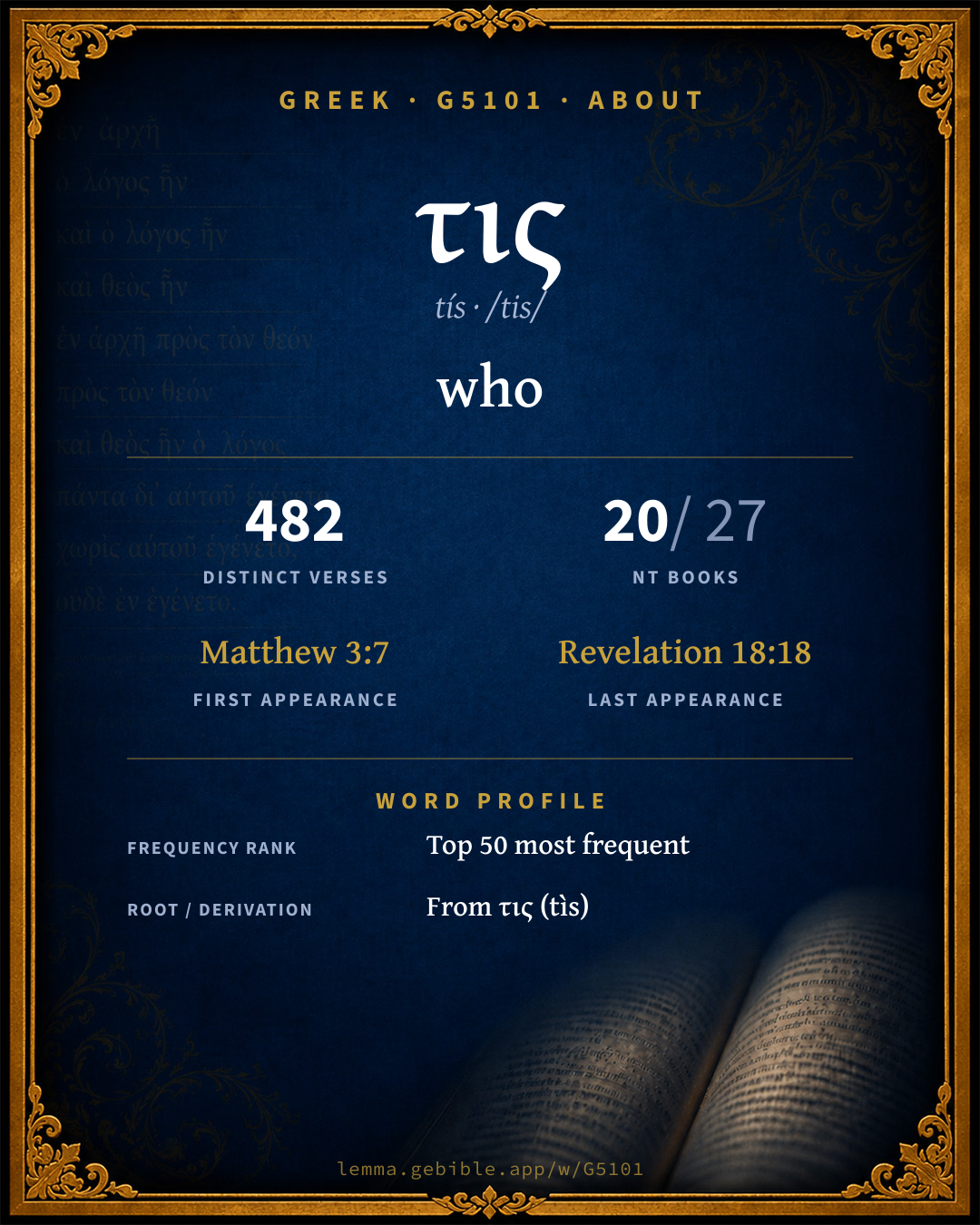
τίς
who
Full lexicon entry — Thayer's Greek Lexicon
From Thayer's Greek Lexicon
Where this word appears
See every Accusative-case word in the Greek New Testament →
Grammar key — what these labels mean
Part of speech
- Interrogative pronoun
- Asks a question (“who?”, “what?”).
- Indefinite pronoun
- Refers to someone or something unspecified (“someone,” “anything”).
Case
- Accusative
- The case of the direct object and of extent.
- Nominative
- The case of the subject (and the predicate nominative).
- Genitive
- The case of source, possession, or “of” — answers “whose / from what.”
- Dative
- The case of the indirect object, means, or location — “to / for / with / in.”
Gender
- Neuter
- Grammatically neuter.
- Masculine
- Grammatically masculine.
- Feminine
- Grammatically feminine.
Number
- Singular
- One.
- Plural
- More than one.
Grammatical forms 18 distinct
- Interrogative pronoun, Accusative, Singular, Neuter 230 times (43%)
- Interrogative pronoun, Nominative, Singular, Masculine 127 times (24%)
- Interrogative pronoun, Nominative, Singular, Neuter 85 times (16%)
- Interrogative pronoun, Accusative, Singular, Masculine 21 times (4%)
- Interrogative pronoun, Nominative, Singular, Feminine 20 times (4%)
- Interrogative pronoun, Genitive, Singular, Masculine 11 times (2%)
- Interrogative pronoun, Dative, Singular, Neuter 10 times (2%)
- Interrogative pronoun, Dative, Singular, Masculine 9 times (2%)
+10 more forms (20 occurrences)
Parsed forms decoded from the imported morphology (Robinson–Tischendorf, public domain), counted across 533 parsed occurrences — not distinct verses.
Page 3 of 3 — showing verses 401–482 of 482 distinct verses where G5101 appears, across 20 books. Click any verse to open its interlinear word-by-word view. Verse text shown in the World English Bible for context — . Each verse’s Greek form is shown with its reference; the English is not keyword-highlighted, since the data carries no word-level English alignment. Use “Compare translations” on any verse to read it across multiple English versions. This concordance covers the Greek New Testament; Septuagint (Greek Old Testament) occurrences of this word are not indexed here.
1 Corinthians 21 verses
- 1 Corinthians 4:7 τίς τί τί int.pron nom sg masc int.pron acc sg neut int.pron acc sg neut For who makes you different? And what do you have that you didn't receive? But if you did receive it, why do you boast as if you had not received it?
- 1 Corinthians 4:21 τί int.pron acc sg neut What do you want? Shall I come to you with a rod, or in love and a spirit of gentleness?
- 1 Corinthians 5:12 τί int.pron nom sg neut For what have I to do with also judging those who are outside? Don't you judge those who are within?
- 1 Corinthians 7:16 τί τί int.pron acc sg neut int.pron acc sg neut For how do you know, wife, whether you will save your husband? Or how do you know, husband, whether you will save your wife?
- 1 Corinthians 9:7 τίς τίς τίς int.pron nom sg masc int.pron nom sg masc int.pron nom sg masc What soldier ever serves at his own expense? Who plants a vineyard, and doesn't eat of its fruit? Or who feeds a flock, and doesn't drink from the flock's milk?
- 1 Corinthians 9:18 τίς int.pron nom sg masc What then is my reward? That, when I preach the Gospel, I may present the Gospel of Christ without charge, so as not to abuse my authority in the Gospel.
- 1 Corinthians 10:19 τί int.pron acc sg neut What am I saying then? That a thing sacrificed to idols is anything, or that an idol is anything?
- 1 Corinthians 10:30 τί int.pron acc sg neut If I partake with thankfulness, why am I denounced for that for which I give thanks?
- 1 Corinthians 11:22 τί int.pron acc sg neut What, don't you have houses to eat and to drink in? Or do you despise God's assembly, and put them to shame who don't have? What shall I tell you? Shall I praise you? In this I don't praise you.
- 1 Corinthians 14:6 τί int.pron acc sg neut But now, brothers, if I come to you speaking with other languages, what would I profit you, unless I speak to you either by way of revelation, or of knowledge, or of prophesying, or of teaching?
- 1 Corinthians 14:8 τίς int.pron nom sg masc For if the trumpet gave an uncertain sound, who would prepare himself for war?
- 1 Corinthians 14:15 τί int.pron nom sg neut What is it then? I will pray with the spirit, and I will pray with the understanding also. I will sing with the spirit, and I will sing with the understanding also.
- 1 Corinthians 14:16 τί int.pron acc sg neut Otherwise if you bless with the spirit, how will he who fills the place of the unlearned say the "Amen" at your giving of thanks, seeing he doesn't know what you say?
- 1 Corinthians 14:26 Τί int.pron nom sg neut What is it then, brothers? When you come together, each one of you has a psalm, has a teaching, has a revelation, has another language, has an interpretation. Let all things be done to build each other up.
- 1 Corinthians 15:2 τίνι int.pron dat sg masc by which also you are saved, if you hold firmly the word which I preached to you--unless you believed in vain.
- 1 Corinthians 15:29 τί τί int.pron acc sg neut int.pron acc sg neut Or else what will they do who are baptized for the dead? If the dead aren't raised at all, why then are they baptized for the dead?
- 1 Corinthians 15:30 τί int.pron acc sg neut Why do we also stand in jeopardy every hour?
- 1 Corinthians 15:32 τί int.pron nom sg neut If I fought with animals at Ephesus for human purposes, what does it profit me? If the dead are not raised, then "let us eat and drink, for tomorrow we die."
2 Corinthians 7 verses
- 2 Corinthians 2:2 τίς int.pron nom sg masc For if I make you sorry, then who will make me glad but he who is made sorry by me?
- 2 Corinthians 2:16 τίς int.pron nom sg masc to the one a stench from death to death; to the other a sweet aroma from life to life. Who is sufficient for these things?
- 2 Corinthians 6:14 τίς τίς int.pron nom sg fem int.pron nom sg fem Don't be unequally yoked with unbelievers, for what fellowship have righteousness and iniquity? Or what communion has light with darkness?
- 2 Corinthians 6:15 τίς τίς int.pron nom sg fem int.pron nom sg fem What agreement has Christ with Belial? Or what portion has a believer with an unbeliever?
- 2 Corinthians 6:16 τίς int.pron nom sg fem What agreement has a temple of God with idols? For you are a temple of the living God. Even as God said, "I will dwell in them, and walk in them; and I will be their God, and they will be my people."
- 2 Corinthians 11:29 τίς τίς int.pron nom sg masc int.pron nom sg masc Who is weak, and I am not weak? Who is caused to stumble, and I don't burn with indignation?
- 2 Corinthians 12:13 τί int.pron nom sg neut For what is there in which you were made inferior to the rest of the assemblies, unless it is that I myself was not a burden to you? Forgive me this wrong.
Galatians 5 verses
- Galatians 3:1 τίς int.pron nom sg masc Foolish Galatians, who has bewitched you not to obey the truth, before whose eyes Jesus Christ was openly set forth among you as crucified?
- Galatians 3:19 τί int.pron nom sg neut What then is the law? It was added because of transgressions, until the seed should come to whom the promise has been made. It was ordained through angels by the hand of a mediator.
- Galatians 4:30 τί int.pron acc sg neut However what does the Scripture say? "Throw out the handmaid and her son, for the son of the handmaid will not inherit with the son of the free woman."
- Galatians 5:7 τίς int.pron nom sg masc You were running well! Who interfered with you that you should not obey the truth?
- Galatians 5:11 τί int.pron acc sg neut But I, brothers, if I still preach circumcision, why am I still persecuted? Then the stumbling-block of the cross has been removed.
Ephesians 8 verses
- Ephesians 1:18 τίς τίς int.pron nom sg fem int.pron nom sg masc having the eyes of your hearts enlightened, that you may know what is the hope of his calling, and what are the riches of the glory of his inheritance in the saints,
- Ephesians 1:19 τί int.pron nom sg neut and what is the exceeding greatness of his power toward us who believe, according to that working of the strength of his might
- Ephesians 3:9 τίς int.pron nom sg fem and to make all men see what is the administration of the mystery which for ages has been hidden in God, who created all things through Jesus Christ;
- Ephesians 3:18 τί int.pron nom sg neut may be strengthened to comprehend with all the saints what is the breadth and length and height and depth,
- Ephesians 4:9 τί int.pron nom sg neut Now this, "He ascended," what is it but that he also first descended into the lower parts of the earth?
- Ephesians 5:10 τί int.pron nom sg neut proving what is well-pleasing to the Lord.
- Ephesians 5:17 τί int.pron nom sg neut Therefore don't be foolish, but understand what the will of the Lord is.
- Ephesians 6:21 τί int.pron acc sg neut But that you also may know my affairs, how I am doing, Tychicus, the beloved brother and faithful servant in the Lord, will make known to you all things;
Philippians 2 verses
- Philippians 1:18 τί int.pron nom sg neut What does it matter? Only that in every way, whether in pretense or in truth, Christ is proclaimed. I rejoice in this, yes, and will rejoice.
- Philippians 1:22 τί int.pron acc sg neut But if I live on in the flesh, this will bring fruit from my work; yet I don't make known what I will choose.
Colossians 2 verses
- Colossians 1:27 τί int.pron nom sg neut to whom God was pleased to make known what are the riches of the glory of this mystery among the Gentiles, which is Christ in you, the hope of glory;
- Colossians 2:20 τί int.pron acc sg neut If you died with Christ from the elements of the world, why, as though living in the world, do you subject yourselves to ordinances,
1 Thessalonians 3 verses
- 1 Thessalonians 2:19 τίς int.pron nom sg fem For what is our hope, or joy, or crown of rejoicing? Isn't it even you, before our Lord Jesus at his coming?
- 1 Thessalonians 3:9 τίνα int.pron acc sg fem For what thanksgiving can we render again to God for you, for all the joy with which we rejoice for your sakes before our God;
- 1 Thessalonians 4:2 τίνας int.pron acc pl fem For you know what charge we gave you through the Lord Jesus.
1 Timothy 1 verse
2 Timothy 1 verse
Hebrews 10 verses
- Hebrews 1:5 τίνι int.pron dat sg masc For to which of the angels did he say at any time, "You are my Son, Today have I become your father?" and again, "I will be to him a Father, And he will be to me a Son?"
- Hebrews 1:13 τίνα int.pron acc sg masc But of which of the angels has he said at any time, "Sit at my right hand, Until I make your enemies the footstool of your feet?"
- Hebrews 2:6 τί int.pron nom sg neut But one has somewhere testified, saying, "What is man, that you think of him? Or the son of man, that you care for him?
- Hebrews 3:16 τίνες int.pron nom pl masc For who, when they heard, rebelled? No, didn't all those who came out of Egypt by Moses?
- Hebrews 3:17 τίσιν int.pron dat pl masc With whom was he displeased forty years? Wasn't it with those who sinned, whose bodies fell in the wilderness?
- Hebrews 3:18 τίσιν int.pron dat pl masc To whom did he swear that they wouldn't enter into his rest, but to those who were disobedient?
- Hebrews 7:11 τίς int.pron nom sg fem Now if there was perfection through the Levitical priesthood (for under it the people have received the law), what further need was there for another priest to arise after the order of Melchizedek, and not be called after the order of Aaron?
- Hebrews 11:32 τί int.pron acc sg neut What more shall I say? For the time would fail me if I told of Gideon, Barak, Samson, Jephthah, David, Samuel, and the prophets;
- Hebrews 12:7 τίς int.pron nom sg masc It is for discipline that you endure. God deals with you as with children, for what son is there whom his father doesn't discipline?
- Hebrews 13:6 τί int.pron acc sg neut So that with good courage we say, "The Lord is my helper. I will not fear. What can man do to me?"
James 4 verses
- James 2:14 Τί int.pron nom sg neut What good is it, my brothers, if a man says he has faith, but has no works? Can faith save him?
- James 2:16 τί int.pron nom sg neut and one of you tells them, "Go in peace, be warmed and filled;" and yet you didn't give them the things the body needs, what good is it?
- James 3:13 Τίς int.pron nom sg masc Who is wise and understanding among you? Let him show by his good conduct that his deeds are done in gentleness of wisdom.
- James 4:12 τίς int.pron nom sg masc Only one is the lawgiver, who is able to save and to destroy. But who are you to judge another?
1 Peter 4 verses
- 1 Peter 1:11 τίνα int.pron acc sg masc searching for who or what kind of time the Spirit of Christ, which was in them, pointed to, when he predicted the sufferings of Christ, and the glories that would follow them.
- 1 Peter 3:13 τίς int.pron nom sg masc Now who is he who will harm you, if you become imitators of that which is good?
- 1 Peter 4:17 τί int.pron nom sg neut For the time has come for judgment to begin at the house of God. If it begins first with us, what will happen to those who don't obey the Gospel of God?
- 1 Peter 5:8 τίνα int.pron acc sg masc Be sober and self-controlled. Be watchful. Your adversary the devil, walks around like a roaring lion, seeking whom he may devour.
1 John 4 verses
- 1 John 2:22 τίς int.pron nom sg masc Who is the liar but he who denies that Jesus is the Christ? This is the Antichrist, he who denies the Father and the Son.
- 1 John 3:2 τί int.pron nom sg neut Beloved, now we are children of God, and it is not yet revealed what we will be. But we know that, when he is revealed, we will be like him; for we will see him just as he is.
- 1 John 3:12 τίνος int.pron gen sg neut unlike Cain, who was of the evil one, and killed his brother. Why did he kill him? Because his works were evil, and his brother's righteous.
- 1 John 5:5 τίς int.pron nom sg masc Who is he who overcomes the world, but he who believes that Jesus is the Son of God?
Revelation 13 verses
- Revelation 2:7 τί int.pron acc sg neut He who has an ear, let him hear what the Spirit says to the assemblies. To him who overcomes I will give to eat of the tree of life, which is in the Paradise of my God.
- Revelation 2:11 τί int.pron acc sg neut He who has an ear, let him hear what the Spirit says to the assemblies. He who overcomes won't be harmed by the second death.
- Revelation 2:17 τί int.pron acc sg neut He who has an ear, let him hear what the Spirit says to the assemblies. To him who overcomes, to him I will give of the hidden manna, and I will give him a white stone, and on the stone a new name written, which no one knows but he who receives it.
- Revelation 2:29 τί int.pron acc sg neut He who has an ear, let him hear what the Spirit says to the assemblies.
- Revelation 3:6 τί int.pron acc sg neut He who has an ear, let him hear what the Spirit says to the assemblies.
- Revelation 3:13 τί int.pron acc sg neut He who has an ear, let him hear what the Spirit says to the assemblies.
- Revelation 3:22 τί int.pron acc sg neut He who has an ear, let him hear what the Spirit says to the assemblies."
- Revelation 5:2 τίς int.pron nom sg masc I saw a mighty angel proclaiming with a loud voice, "Who is worthy to open the book, and to break its seals?"
- Revelation 6:17 τίς int.pron nom sg masc for the great day of his wrath has come; and who is able to stand?"
- Revelation 7:13 τίνες int.pron nom pl masc One of the elders answered, saying to me, "These who are arrayed in white robes, who are they, and from where did they come?"
- Revelation 13:4 τίς τίς int.pron nom sg masc int.pron nom sg masc They worshiped the dragon, because he gave his authority to the beast, and they worshiped the beast, saying, "Who is like the beast? Who is able to make war with him?"
- Revelation 15:4 τίς int.pron nom sg masc Who wouldn't fear you, Lord, And glorify your name? For you only are holy. For all the nations will come and worship before you. For your righteous acts have been revealed."
- Revelation 18:18 τίς int.pron nom sg fem and cried out as they looked at the smoke of her burning, saying, 'What is like the great city?'
About this entry
At a glance — auto-summarized from this page’s data, not written by a person. Every figure links to its source below. This summary describes the numbers; it doesn’t interpret them.
τις — transliterated tís — is a Greek word carrying the sense “who.” Debuting at Matthew 3:7, it then recurs through the corpus. Spanning 482 verses in 20 books, it ranks among the common words of the Greek New Testament. Each statement above links to its evidence; the full detail follows below.
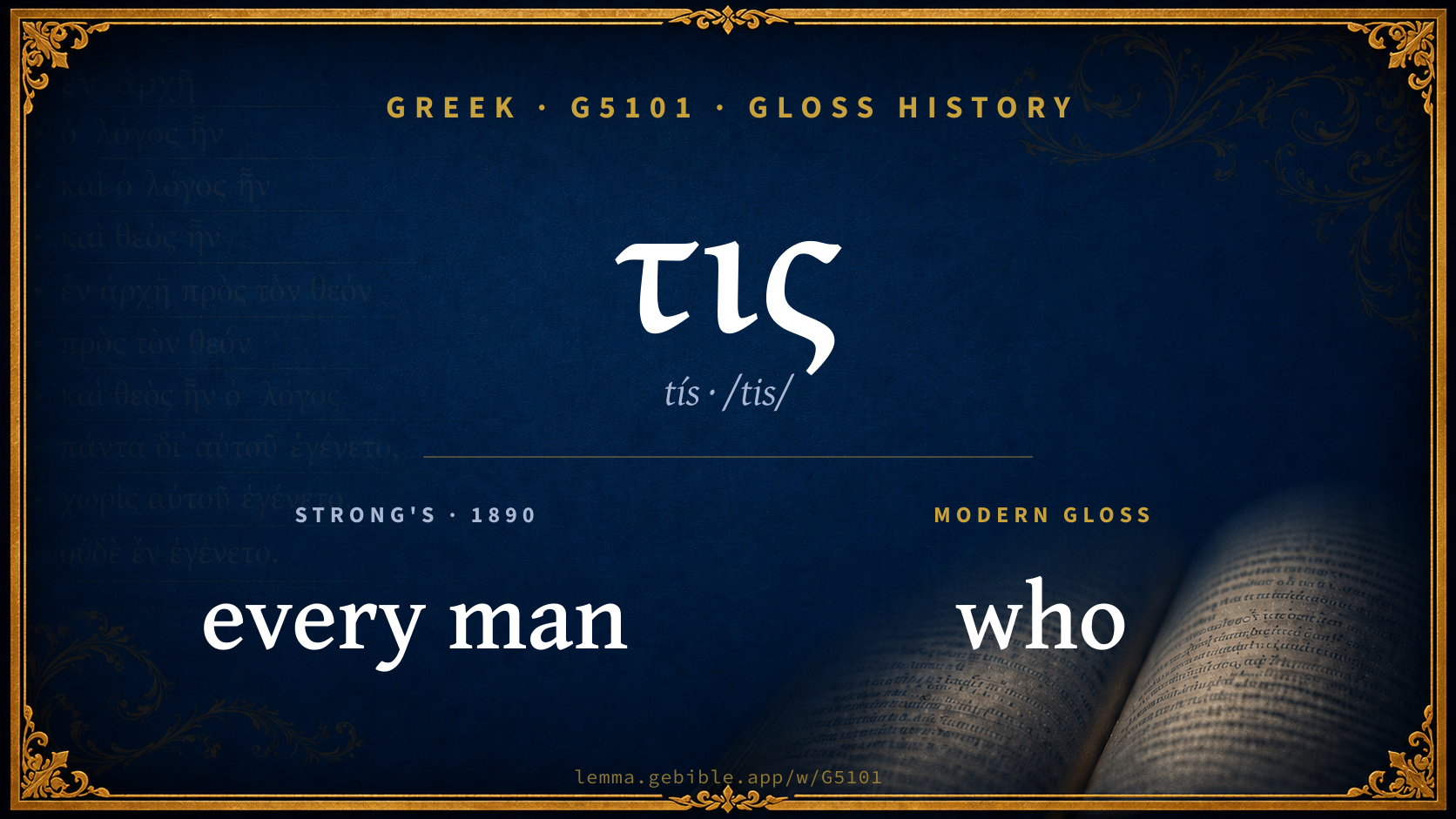
Gloss history
Strong's 1890 vs modern scholarship
About this word
Strong's G5101 catalogs a Greek word from the Greek New Testament.
These counts are not copied from any lexicon or concordance. They are computed here, from the morphology-tagged Greek New Testament. What Lemma adds →
- 482
- distinct verses
- The word appears in 482 distinct verses.
- 20 / 27
- NT books
- The word appears in 20 of 27 New Testament books.
- #36
- by frequency
- Top 50 most frequent Greek words (rank 36 of 5,347 Greek words by occurrence).
View all 482 occurrences in the concordance →
By section of the New Testament
By traditional corpus
Conventional, traditional groupings — biblical authorship is debated, so this is a traditional corpus grouping, not an authorship claim. Some books belong to more than one corpus (Luke is in both the Gospels and the Lukan corpus, and so on), so these shares overlap and need not total 100%. Each figure is a share of the word’s 482 distinct verses.
- Gospels 308 verses · 64%
- Lukan (Luke–Acts) 154 verses · 32%
- Pauline corpus 86 verses · 18%
- Johannine 83 verses · 17%
- Revelation 13 verses · 3%
- General (Catholic) Epistles 12 verses · 2%
- Hebrews 10 verses · 2%
How translations render this word
Counts come from each version’s own published word-to-Strong’s tagging or interlinear alignment — an approximate guide to how each version renders this word, not a word-level alignment the data otherwise carries. Because each total is that version’s own tagged count, the per-version totals vary from one another and need not match the appearance or distinct-verse counts above. These counts may also differ from a printed concordance because Lemma counts each distinctly tagged rendering and does not collapse phrase taggings into a single head-word total. This is a fixed set of word-tagged versions (KJV, ASV, BSB, ULT) and does not change with the reading translation you choose elsewhere. Each version’s license is shown beside its name below (and on Sources).
- King James Version: What 260×, Who 101×, Why 67×
- American Standard Version: What 246×, Who 107×, Why 76×
- Berean Standard Bible: What 232×, Who 118×, Why 78×
- unfoldingWord Literal Text: What 271×, Who 118×, Why 93×
King James Version Public Domain
Renders G5101 across 523 tagged occurrences — most commonly:
Plus 13 renderings that appear only once — usually multi-word phrases or single function words the recovered tagging swept in, not distinct renderings. Not rendered by a distinct English word in 14 further occurrences.
American Standard Version Public Domain
Renders G5101 across 541 tagged occurrences — most commonly:
Plus other, less common renderings. Plus 29 renderings that appear only once — usually multi-word phrases or single function words the recovered tagging swept in, not distinct renderings.
Berean Standard Bible Public Domain
Renders G5101 across 502 tagged occurrences — most commonly:
Plus 14 renderings that appear only once — usually multi-word phrases or single function words the recovered tagging swept in, not distinct renderings. Not rendered by a distinct English word in 58 further occurrences.
unfoldingWord Literal Text CC BY-SA 4.0
Renders G5101 across 611 tagged occurrences — most commonly:
Plus other, less common renderings. Plus 13 renderings that appear only once — usually multi-word phrases or single function words the recovered tagging swept in, not distinct renderings.
Senses in Thayer's
The 1 sense Thayer's distinguishes for this word, in lexicon order (not ranked by frequency or importance). The full entry — with sub-senses — is in the Lexicon Entry tab.
- who, which, what
Word origin
Derived from τις (tìs) (G5100) — a certain.
Probably emphatic of G5100 ; an interrogitive pronoun who which or what (in direct or indirect questions): - every man how (much) + no (-ne thing) what (manner thing) where ([-by -fore -of -unto -with -withal]) whether which who (-m -se) why.
— Strong’s Exhaustive Concordance (1890), public domain.
Forms in the corpus
The 13 distinct written forms G5101 takes in the Greek New Testament, most frequent first — each parse links to that case’s occurrences in the concordance.