

2 Corinthians 6:14
Greek (Tischendorf 8th ed.) 2 Corinthians 6:14 appears in the Greek New Testament. The text above is from the Tischendorf 8th edition. Each word links to its Strong’s number and a concise gloss. Click any word for its full Thayer’s Greek Lexicon entry.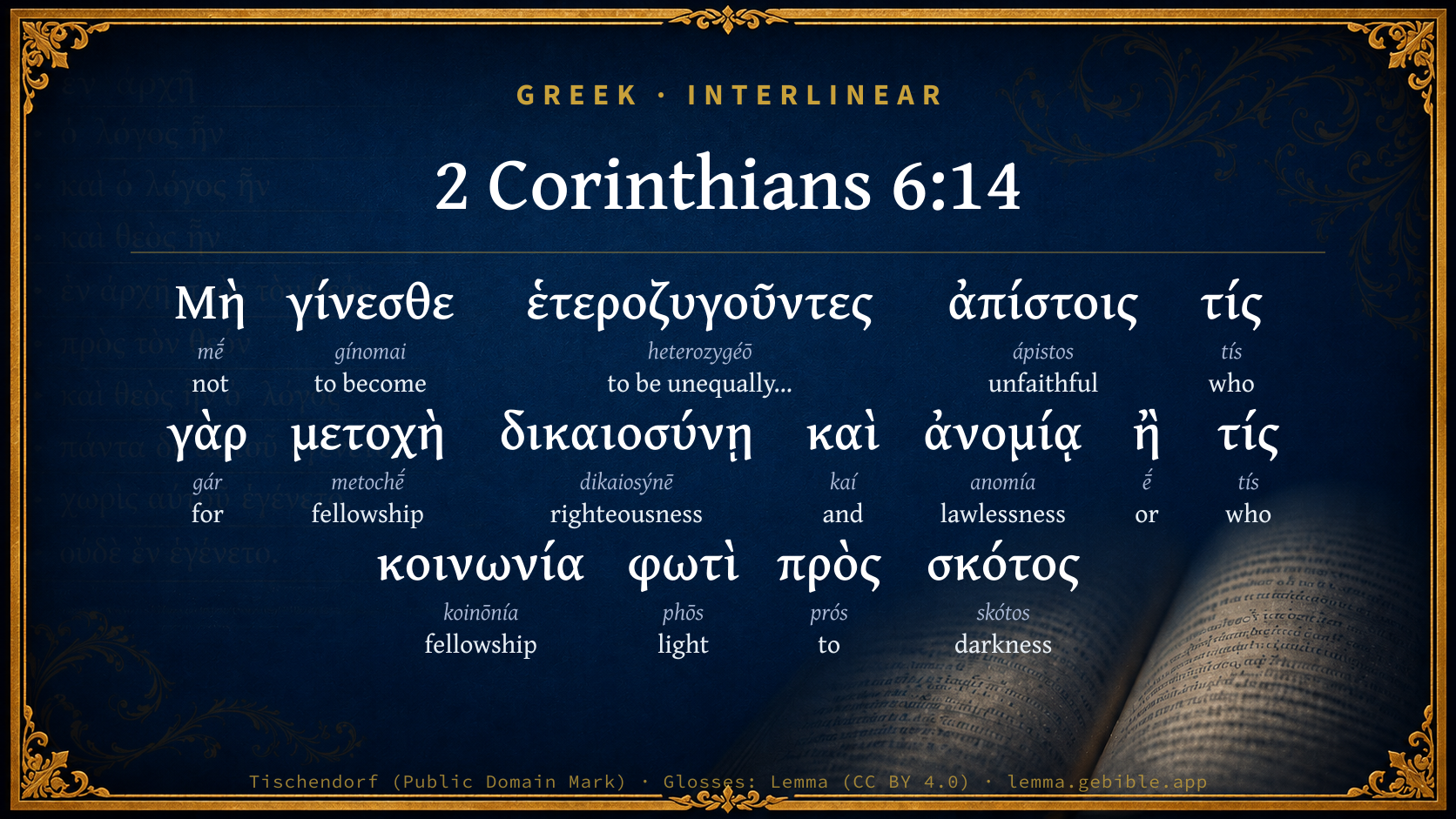
Don't be unequally yoked with unbelievers, for what fellowship have righteousness and iniquity? Or what communion has light with darkness?
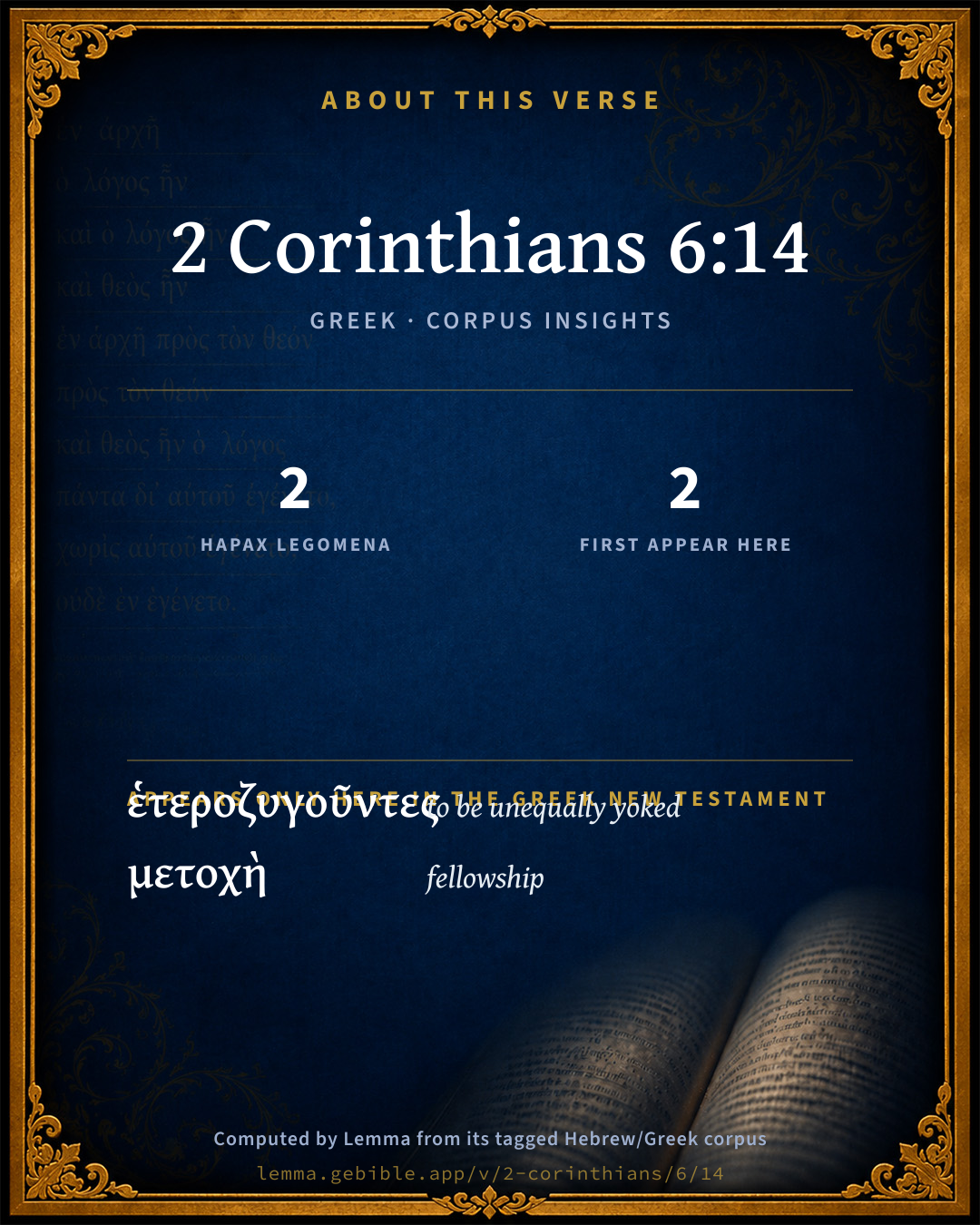
- 2 hapax legomena — only here in the Greek New Testament
- 2 first appearances in the Greek New Testament
Download a study sheet
One document with this verse’s original text, its word-by-word gloss line, the meaning frame, cross-references with their text, attributed commentary, and full source and license credits — printable, and it pastes into notes with its structure intact.
This verse Autodidact and up
A passage Seminary Student
Up to 50 verses in one chapter. A passage sheet keeps up to 6 commentary sources and 12 cross-references per verse, in the order this page ranks them, and says so on the sheet whenever that leaves anything out. Ask for a single verse and you get the Autodidact verse sheet above.
Everything on this page stays free to read, with no account — the sheet is a download of what is already on screen, not access to it.
Compare translations 3
The same verse in 3 English versions, stacked beneath the original-language interlinear above. Click any original word for its lexicon entry.
Each is an independent rendering of the whole verse — the interlinear is not word-aligned to these translations.
Highlighted words mark where these versions differ — a whole-verse word diff, not a word-by-word alignment.
-
World English Bible Public Domain
Don't be unequally yoked with unbelievers, for what fellowship have righteousness and iniquity? Or what communion has light with darkness?
-
King James Version Public Domain
Be ye not unequally yoked together with unbelievers: for what fellowship hath righteousness with unrighteousness? and what communion hath light with darkness?
-
unfoldingWord Literal Text CC BY-SA 4.0
Do not be yoked together with unbelievers, for what partnership righteousness and lawlessness? Or what fellowship light with darkness?
unfoldingWord Literal Text — © unfoldingWord, licensed CC BY-SA 4.0. Word-aligned USFM3 via Door43 (git.door43.org/unfoldingWord/en_ult).
Show all 19 translations
Every available English version of this verse, each an independent rendering of the whole verse.
-
World English Bible Public Domain
Don't be unequally yoked with unbelievers, for what fellowship have righteousness and iniquity? Or what communion has light with darkness?
-
Berean Standard Bible Public Domain
Do not be unequally yoked with unbelievers. For what partnership can righteousness have with wickedness? Or what fellowship does light have with darkness?
-
Majority Standard Bible Public Domain
Do not be unequally yoked with unbelievers. For what partnership can righteousness have with wickedness? Or what fellowship does light have with darkness?
-
King James Version Public Domain
Be ye not unequally yoked together with unbelievers: for what fellowship hath righteousness with unrighteousness? and what communion hath light with darkness?
-
American Standard Version (1901) Public Domain
Be not unequally yoked with unbelievers: for what fellowship have righteousness and iniquity? or what communion hath light with darkness?
-
Revised Version (1885) Public Domain
Be not unequally yoked with unbelievers: for what fellowship have righteousness and iniquity? or what communion hath light with darkness?
-
Geneva Bible (1599) Public Domain
Be not vnequally yoked with the infidels: for what fellowship hath righteousnesse with vnrighteousnesse? and what communion hath light with darkenesse?
-
Douay-Rheims (1899) Public Domain
Bear not the yoke with unbelievers. For what participation hath justice with injustice? Or what fellowship hath light with darkness?
-
Young's Literal Translation Public Domain
Become not yoked with others -- unbelievers, for what partaking `is there' to righteousness and lawlessness?
-
Literal Standard Version CC BY-SA 4.0
Do not become yoked with others—unbelievers, for what partaking [is there] to righteousness and lawlessness?
-
Unlocked Literal Bible CC BY-SA 4.0
Do not be tied together with unbelievers. For what association does righteousness have with lawlessness? For what fellowship does light have with darkness?
-
unfoldingWord Literal Text CC BY-SA 4.0
Do not be yoked together with unbelievers, for what partnership righteousness and lawlessness? Or what fellowship light with darkness?
-
Darby Bible Public Domain
Be not diversely yoked with unbelievers; for what participation [is there] between righteousness and lawlessness? or what fellowship of light with darkness?
-
World Messianic Bible Public Domain
Don’t be unequally yoked with unbelievers, for what fellowship do righteousness and iniquity have? Or what fellowship does light have with darkness?
-
Webster's Bible Public Domain
Be ye not unequally yoked together with unbelievers: for what fellowship hath righteousness with unrighteousness? and what communion hath light with darkness?
-
Free Bible Version CC BY-SA 4.0
Don't join together with people who don't believe—for what connection does goodness have with wickedness? What do light and darkness have in common?
-
Bible in Basic English Public Domain
Do not keep company with those who have not faith: for what is there in common between righteousness and evil, or between light and dark?
-
Text-Critical English NT CC BY 4.0
Do not be unequally yoked with unbelievers. For what partnership is there between righteousness and lawlessness? What fellowship does light have with darkness?
-
Tyndale New Testament (1534) Public Domain
and beare not a straugers yoke wyth the vnbelevers. For what fellishippe hath rightewesnes with vnrightewesnes? What company hath light with darcknes?
Literal Standard Version (2020), Covenant Press — licensed CC BY-SA 4.0. Text via the HelloAO Bible API (eBible.org). Unlocked Literal Bible (unfoldingWord) — licensed CC BY-SA 4.0. Text via the HelloAO Bible API (eBible.org). unfoldingWord Literal Text — © unfoldingWord, licensed CC BY-SA 4.0. Word-aligned USFM3 via Door43 (git.door43.org/unfoldingWord/en_ult). Free Bible Version, Dr. Jonathan Gallagher — licensed CC BY-SA 4.0. Text via the HelloAO Bible API (eBible.org).
Word by word
More ways to search: Search by grammar → Find every occurrence → Compare this word →
Practice this passage: Drill this verse → Learn its vocabulary →
- Appears 1× in the Greek New Testament
- First appears here
- Part of Speech
- Verb
- Tense
- Present
- Voice
- Active
- Mood
- Participle
- Case
- Nominative
- Number
- Plural
- Gender
- Masculine
Full Thayer's Definition
- Μὴ mḗ G3361 “not” Particle, Negative
- γίνεσθε gínomai G1096 “to become” Verb, Present, Middle or Passive deponent, Imperative, 2nd person, Plural
- ἑτεροζυγοῦντες heterozygéō G2086 “to be unequally yoked” Verb, Present, Active, Participle, Nominative, Plural, Masculine
- ἀπίστοις ápistos G571 “unfaithful” Adjective, Dative, Plural, Masculine
- τίς tís G5101 “who” Interrogative pronoun, Nominative, Singular, Feminine
- γὰρ gár G1063 “for” Conjunction
- μετοχὴ metochḗ G3352 “fellowship” Noun, Nominative, Singular, Feminine
- δικαιοσύνῃ dikaiosýnē G1343 “righteousness” Noun, Dative, Singular, Feminine
- καὶ kaí G2532 “and” Conjunction
- ἀνομίᾳ anomía G458 “lawlessness” Noun, Dative, Singular, Feminine
- ἢ ḗ G2228 “or” Particle
- τίς tís G5101 “who” Interrogative pronoun, Nominative, Singular, Feminine
- κοινωνία koinōnía G2842 “fellowship” Noun, Nominative, Singular, Feminine
- φωτὶ phōs G5457 “light” Noun, Dative, Singular, Neuter
- πρὸς prós G4314 “to” Preposition
- σκότος skótos G4655 “darkness” Noun, Accusative, Singular, Neuter
About this verse
These counts appear in no published source. They are computed here, from the morphology-tagged text and Lemma’s own curated glosses. What Lemma adds →
- 16
- words
- 15
- distinct lemmas
- Pauline Epistles
- section
Notable vocabulary
2 hapax legomena — words that appear only here in the entire Greek New Testament:
First appearance in Scripture
These words make their first canonical appearance in the Greek New Testament here:
Shared distinctive vocabulary
ἀνομίᾳ lawlessness G458 occurs in 12 verses of the Greek New Testament. Also found in:
Repetition
A word recurs within this verse:
- τίς who G5101 ×2
Cross-references
42Topical passages linked to 2 Corinthians 6:14 in the Treasury of Scripture Knowledge — connected by theme and wording, ordered by reader-vote popularity; previews shown in the World English Bible.
- 1 Corinthians 15:33 Don't be deceived! "Evil companionships corrupt good morals."
- 1 Corinthians 10:21 You can't both drink the cup of the Lord and the cup of demons. You can't both partake of the table of the Lord, and of the table of demons.
- James 4:4 You adulterers and adulteresses, don't you know that friendship with the world is enmity with God? Whoever therefore wants to be a friend of the world makes himself an enemy of God.
- Ephesians 5:6–14 Let no one deceive you with empty words. For because of these things, the wrath of God comes on the children of disobedience.
- Leviticus 19:19 "'You shall keep my statutes. "'You shall not crossbreed different kinds of animals. "'you shall not sow your field with two kinds of seed; "'neither shall there come upon on you a garment made of two kinds of material.
- 1 Peter 2:9–10 But you are a chosen race, a royal priesthood, a holy nation, a people for God's own possession, that you may show forth the excellencies of him who called you out of darkness into his marvelous light:
- Psalms 26:4–5 I have not sat with deceitful men, Neither will I go in with hypocrites.
- Deuteronomy 22:9–11 You shall not sow your vineyard with two kinds of seed, lest the whole fruit be forfeited, the seed which you have sown, and the increase of the vineyard.
- Psalms 139:21–22 Yahweh, don't I hate those who hate you? Am I not grieved with those who rise up against you?
- Ephesians 4:17–20 This I say therefore, and testify in the Lord, that you no longer walk as the rest of the Gentiles also walk, in the futility of their mind,
- 1 Thessalonians 5:4–8 But you, brothers, aren't in darkness, that the day should overtake you like a thief.
- 1 Corinthians 5:9 I wrote to you in my letter to have no company with sexual sinners;
- Psalms 106:35 But mixed themselves with the nations, And learned their works.
- Deuteronomy 7:2–3 and when Yahweh your God shall deliver them up before you, and you shall strike them; then you shall utterly destroy them: you shall make no covenant with them, nor show mercy to them;
- 1 Kings 18:21 Elijah came near to all the people, and said, "How long will you waver between the two sides? If Yahweh is God, follow him; but if Baal, then follow him." The people answered him not a word.
- Proverbs 22:24 Don't befriend a hot-tempered man, And don't associate with one who harbors anger:
- Proverbs 29:27 A dishonest man detests the righteous, And the upright in their ways detest the wicked.
- Malachi 2:11 Judah has dealt treacherously, and an abomination is committed in Israel and in Jerusalem; for Judah has profaned the holiness of Yahweh which he loves, and has married the daughter of a foreign god.
- John 15:18–19 If the world hates you, you know that it has hated me before it hated you.
- Philippians 2:15 that you may become blameless and harmless, children of God without blemish in the midst of a crooked and perverse generation, among whom you are seen as lights in the world,
- Romans 13:12–14 The night is far gone, and the day is near. Let's therefore throw off the works of darkness, and let's put on the armor of light.
- Ezra 9:11–12 which you have commanded by your servants the prophets, saying, The land, to which you go to possess it, is an unclean land through the uncleanness of the peoples of the lands, through their abominations, which have filled it from one end to another with their filthiness:
- John 7:7 The world can't hate you, but it hates me, because I testify about it, that its works are evil.
- 1 John 1:5–7 This is the message which we have heard from him and announce to you, that God is light, and in him is no darkness at all.
- Psalms 119:63 I am a friend of all those who fear you, Of those who observe your precepts.
- Malachi 2:15 Did he not make one, although he had the residue of the Spirit? Why one? He sought a godly seed. Therefore take heed to your spirit, and let none deal treacherously against the wife of his youth.
- 1 Peter 4:2–4 that you no longer should live the rest of your time in the flesh for the lusts of men, but for the will of God.
- 1 Corinthians 7:39 A wife is bound by law for as long as her husband lives; but if the husband is dead, she is free to be married to whoever she desires, only in the Lord.
- Exodus 34:16 and you take of their daughters to your sons, and their daughters play the prostitute after their gods, and make your sons play the prostitute after their gods.
- Psalms 44:20–21 If we have forgotten the name of our God, Or spread forth our hands to a strange god;
- Psalms 101:3–5 I will set no vile thing before my eyes. I hate the deeds of faithless men. They will not cling to me.
- Psalms 26:9–10 Don't gather my soul with sinners, Nor my life with bloodthirsty men;
- 2 Chronicles 19:2 Jehu the son of Hanani the seer went out to meet him, and said to king Jehoshaphat, Should you help the wicked, and love those who hate Yahweh? for this thing wrath is on you from before Yahweh.
- Ezra 9:1–2 Now when these things were done, the princes drew near to me, saying, The people of Israel, and the priests and the Levites, have not separated themselves from the peoples of the lands, [doing] according to their abominations, even of the Canaanites, the Hittites, the Perizzites, the Jebusites, the Ammonites, the Moabites, the Egyptians, and the Amorites.
- Ezra 10:19 They gave their hand that they would put away their wives; and being guilty, [they offered] a ram of the flock for their guilt.
- Nehemiah 13:1–3 On that day they read in the book of Moses in the audience of the people; and therein was found written, that an Ammonite and a Moabite should not enter into the assembly of God forever,
- Psalms 16:3 As for the saints who are in the earth, They are the excellent ones in whom is all my delight.
- Proverbs 8:18–19 With me are riches, honor, Enduring wealth, and prosperity.
- 1 Samuel 5:2–3 The Philistines took the ark of God, and brought it into the house of Dagon, and set it by Dagon.
- 1 John 3:12–14 unlike Cain, who was of the evil one, and killed his brother. Why did he kill him? Because his works were evil, and his brother's righteous.
- Nehemiah 13:23–26 In those days also saw I the Jews who had married women of Ashdod, of Ammon, [and] of Moab:
- Acts 4:23 Being let go, they came to their own company, and reported all that the chief priests and the elders had said to them.
Cross-references courtesy of OpenBible.info (CC BY 4.0).
Lesson kit
Teaching starters — assembled from the data on this page, not authored interpretation. Every prompt links to the verse data it draws on. Edit before teaching.
2 Corinthians, in the Pauline Epistles, opens this verse with 16 words (15 distinct Greek lemmas). Its most distinctive word is heterozygéō (“to be unequally yoked”). A historical commentator’s framing appears above. Read the whole chapter for the surrounding context.
Discussion questions
- How does “to be unequally yoked” (heterozygéō) shape what this verse is saying?
- 2 words here appear nowhere else in the Greek New Testament. Why might the author reach for such rare wording?
- 2 words make their first appearance in Scripture here. What does this debut establish?
- How does Matthew 7:23, which shares the word «lawlessness», read alongside this verse?
- What does the repetition of “who” (2× in this one verse) do in this verse?
- These translations render this verse differently; the difference is in the English rendering, not the original. What questions does that raise?
- Compare how The Biblical Illustrator and Joseph Benson's Commentary read this verse. Where do they agree or differ?
Things to notice
- 2 words in this verse appear nowhere else in the Greek New Testament.
- 2 words make their first canonical appearance in Scripture here.
- These translations choose different wording for 11 words in this verse.
- “who” occurs 2× in this single verse.
- 15 distinct Greek lemmas span 16 words in this verse.
Commentary
Notes on 2 Corinthians 6:14 from classic Christian and Jewish commentators (each source and its license shown beneath its notes). The classic Christian expositions comment on the surrounding passage and are grouped to its opening verse, so a note may address several verses; the Jewish commentaries on the Tanakh (Rashi and others) are per-verse, so they appear only where the commentator wrote on this verse.
Lemma curates 59 commentaries, every one of them public domain or Creative Commons licensed, each selected and text-cleaned for this edition rather than reprinted as found. About our sources →
The Biblical Illustrator
Joseph S. Exell
The Biblical Illustrator, edited by Joseph S. Exell (c. 1880s–1900s) — public domain. Text from a community e-Sword module.
Joseph Benson's Commentary
Joseph Benson's Commentary on the Old and New Testaments (1811–1818) — public domain. Text from a community e-Sword module.
Whedon's Commentary on the Bible
Daniel D. Whedon
Daniel D. Whedon (gen. ed.), Commentary on the Old and New Testaments (1874–1909) — public domain. Text from a community e-Sword module.
The Pulpit Commentary
The Pulpit Commentary (1880–1919), ed. H.D.M. Spence-Jones & Joseph S. Exell — public domain. Text from a community e-Sword module.
The Preacher's Complete Homiletical Commentary
Joseph S. Exell (gen. ed.)
The Preacher's Complete Homiletical Commentary (gen. ed. Joseph S. Exell; Funk & Wagnalls, c. 1892) — public domain (pre-1929). A full-Bible homiletical/sermon-outline anthology covering 65 of 66 books (2 John is absent from the source module). Text from a community e-Sword module.
The Annotated Bible
Arno C. Gaebelein
Arno C. Gaebelein, The Annotated Bible (1913–1922) — public domain. Text from a community e-Sword module.
The Expositor's Bible
William Robertson Nicoll, ed., The Expositor's Bible (London: Hodder & Stoughton, 1887–1910) — public domain. 65 of 66 books (1 Corinthians is not separately keyed, as that volume carries no machine-parseable verse references); section-level commentary keyed to the opening verse. Introductory and overview sections not keyed to a specific passage are excluded.
Tyndale Open Study Notes
Tyndale Open Resources
Tyndale Open Study Notes — © Tyndale Open Resources, licensed CC BY-SA 4.0. Text via the HelloAO Bible API.
Bengel's Gnomon
Johann Albrecht Bengel
Bengel's Gnomon of the New Testament — English translation (T&T Clark, Edinburgh, 1860) — public domain. Text from a community e-Sword module.
Meyer's Critical & Exegetical Commentary
Heinrich August Wilhelm Meyer
Meyer — Critical and Exegetical Commentary on the New Testament — English translation by Peter Christie, edited by Frederick Crombie (T&T Clark, 1880) — public domain. Text from a community e-Sword module.
Expositor's Greek Testament
ed. W. Robertson Nicoll
The Expositor's Greek Testament, edited by W. Robertson Nicoll (1897–1910) — public domain. Text from a community e-Sword module.
Geneva Bible (1599)
Geneva Bible translators
Geneva Bible (1599) marginal notes — public domain. Text via Bolls.life.
Jamieson, Fausset & Brown
Robert Jamieson, A. R. Fausset & David Brown
Jamieson, Fausset & Brown — Commentary Critical and Explanatory on the Whole Bible (1871) — public domain (CC PDM 1.0). Text via the HelloAO Bible API.
Adam Clarke's Commentary
Adam Clarke's Commentary on the Bible (1810–1826) — public domain. Text from a community e-Sword/MySword module.
John Calvin's Commentaries
John Calvin's Commentaries (1540-1563) — public domain. Text from the Calvin Translation Society English edition (1840s-50s) via the Christian Classics Ethereal Library (ccel.org). Calvin's coverage is partial (roughly two-thirds of the Bible); uncommented books and verses are honest gaps, never fabricated. The 19th-century editor's footnotes and remarks are omitted so the notes are faithfully Calvin's own voice.
Ellicott's Commentary for English Readers
A Bible Commentary for English Readers, edited by Charles John Ellicott (1878–1897) — public domain. Text from a community e-Sword module.
The Cambridge Bible for Schools and Colleges
gen. ed. J. J. S. Perowne
The Cambridge Bible for Schools and Colleges (gen. ed. J. J. S. Perowne; Cambridge University Press, 1878–1918) — public domain. Text from a community e-Sword module.
John Gill's Exposition
John Gill's Exposition of the Whole Bible (1746–1763) — public domain (CC PDM 1.0). Text via the HelloAO Bible API.
Trapp's Complete Commentary
John Trapp
John Trapp, A Commentary or Exposition upon All the Books of the Old and New Testament (1647–1656) — public domain. Text from a community e-Sword module.
Albert Barnes' Notes on the Bible
Albert Barnes' Notes on the Bible (1834–1885) — public domain. Text from a community e-Sword/MySword module.
Haydock's Catholic Bible Commentary
George Leo Haydock (1774–1849), Haydock's Catholic Family Bible and Commentary, 1859 edition — public domain. Excludes Psalms (Douay-Rheims chapter numbering differs from Protestant) and Deuterocanonical books (Catholic canon only).
Matthew Poole's English Annotations
Matthew Poole's English Annotations on the Holy Bible (1683–1685) — public domain. Text from a community e-Sword/MySword module.
John Wesley's Explanatory Notes
John Wesley, Explanatory Notes Upon the Whole Bible (1754–1765) — public domain. Text via the GEBible commentary corpus.
Scofield Reference Notes
C. I. Scofield
The Scofield Reference Bible (1917 edition), notes by C. I. Scofield — public domain. Text from a community e-Sword module.
Burkitt's Expository Notes on the New Testament
William Burkitt
William Burkitt's Expository Notes on the New Testament (1700–1703) — public domain. Text from a community e-Sword module.
Godbey's Commentary on the New Testament
William B. Godbey
William B. Godbey, Commentary on the New Testament (1896–1900) — public domain. Text from a community e-Sword module.
McGarvey & Pendleton's Commentaries
J. W. McGarvey
J. W. McGarvey (with Philip Y. Pendleton), Commentaries on the New Testament (The Fourfold Gospel, 1914; Acts; and the epistles) — public domain. Text from a community e-Sword/MySword module.
The People's New Testament
B. W. Johnson
B. W. Johnson's The People's New Testament with Notes (1889–1891) — public domain. Electronic text from the Christian Classics Ethereal Library (CCEL) ThML edition.
unfoldingWord translationNotes
Door43 World Missions Community
unfoldingWord translationNotes — © Distant Shores Media and the Door43 World Missions Community, licensed CC BY-SA 4.0. Source: git.door43.org/Door43/en_tn.
Cambridge Greek Testament for Schools and Colleges
Cambridge Greek Testament for Schools and Colleges (Cambridge University Press, 1896; 21 vols, various authors incl. Carr, Maclear, Plummer, Farrar, Lumby, Moule, M. R. James, Simcox) — public domain. Text from a community e-Sword module.
Alford’s Greek Testament
Henry Alford
Henry Alford, The Greek Testament (1849–1861) — public domain. Text from a community e-Sword module.
International Critical Commentary
International Critical Commentary — older volumes (1896–1929), various authors — public domain. Text from a community e-Sword module.
Vincent's Word Studies in the New Testament
Marvin R. Vincent
Marvin R. Vincent, Word Studies in the New Testament (1887–1900) — public domain. Text from a community e-Sword/MySword module.