1 Thessalonians 2:19

Greek (Tischendorf 8th ed.) 1 Thessalonians 2:19 appears in the Greek New Testament. The text above is from the Tischendorf 8th edition. Each word links to its Strong’s number and a concise gloss. Click any word for its full Thayer’s Greek Lexicon entry.
Download image
Cite this verse

1 Thessalonians 2:19 (World English Bible). Public Domain. Lemma interlinear Bible study tool, https://lemma.gebible.app/v/1-thessalonians/2/19.

Show BibTeX & RIS
BibTeX
RIS
English Translation
For what is our hope, or joy, or crown of rejoicing? Isn't it even you, before our Lord Jesus at his coming?
World English Bible · Public Domain
Download a study sheet

One document with this verse’s original text, its word-by-word gloss line, the meaning frame, cross-references with their text, attributed commentary, and full source and license credits — printable, and it pastes into notes with its structure intact.

This verse Autodidact and up

Study sheet (.html) Plain text (.txt)

A passage Seminary Student

Up to 50 verses in one chapter. A passage sheet keeps up to 6 commentary sources and 12 cross-references per verse, in the order this page ranks them, and says so on the sheet whenever that leaves anything out. Ask for a single verse and you get the Autodidact verse sheet above.

Everything on this page stays free to read, with no account — the sheet is a download of what is already on screen, not access to it.

Want to remove ads? Support Godless Engineer
Compare translations 3

The same verse in 3 English versions, stacked beneath the original-language interlinear above. Click any original word for its lexicon entry.

Each is an independent rendering of the whole verse — the interlinear is not word-aligned to these translations.

Highlighted words mark where these versions differ — a whole-verse word diff, not a word-by-word alignment.

  • World English Bible Public Domain
    For what is our hope, or joy, or crown of rejoicing? Isn't it even you, before our Lord Jesus at his coming?
  • King James Version Public Domain
    For what is our hope, or joy, or crown of rejoicing? Are not even ye in the presence of our Lord Jesus Christ at his coming?
  • unfoldingWord Literal Text CC BY-SA 4.0
    For what our hope or joy or crown of boasting? Or not also you before our Lord Jesus at his coming?

unfoldingWord Literal Text — © unfoldingWord, licensed CC BY-SA 4.0. Word-aligned USFM3 via Door43 (git.door43.org/unfoldingWord/en_ult).

Versions to compare (up to 4)

3 of 4 selected

Show all 19 translations

Every available English version of this verse, each an independent rendering of the whole verse.

  • World English Bible Public Domain
    For what is our hope, or joy, or crown of rejoicing? Isn't it even you, before our Lord Jesus at his coming?
  • Berean Standard Bible Public Domain
    After all, who is our hope, our joy, our crown of boasting, if it is not you yourselves in the presence of our Lord Jesus at His coming?
  • Majority Standard Bible Public Domain
    After all, who is our hope, our joy, our crown of boasting, if it is not you yourselves in the presence of our Lord Jesus at His coming?
  • King James Version Public Domain
    For what is our hope, or joy, or crown of rejoicing? Are not even ye in the presence of our Lord Jesus Christ at his coming?
  • American Standard Version (1901) Public Domain
    For what is our hope, or joy, or crown of glorying? Are not even ye, before our Lord Jesus at his coming?
  • Revised Version (1885) Public Domain
    For what is our hope, or joy, or crown of glorying? Are not even ye, before our Lord Jesus at his coming?
  • Geneva Bible (1599) Public Domain
    For what is our hope or ioye, or crowne of reioycing? are not euen you it in the presence of our Lord Iesus Christ at his comming?
  • Douay-Rheims (1899) Public Domain
    For what is our hope, or joy, or crown of glory? Are not you, in the presence of our Lord Jesus Christ at his coming?
  • Young's Literal Translation Public Domain
    for what `is' our hope, or joy, or crown of rejoicing? are not even ye before our Lord Jesus Christ in his presence?
  • Literal Standard Version CC BY-SA 4.0
    for what [is] our hope, or joy, or garland of rejoicing? Are not even you before our Lord Jesus Christ at His coming?
  • Unlocked Literal Bible CC BY-SA 4.0
    For what is our hope, or joy, or crown of pride in front of our Lord Jesus at his coming? Is it not you just as much as others?
  • unfoldingWord Literal Text CC BY-SA 4.0
    For what our hope or joy or crown of boasting? Or not also you before our Lord Jesus at his coming?
  • Darby Bible Public Domain
    For what [is] our hope, or joy, or crown of boasting? [are] not *ye* also before our Lord Jesus at his coming?
  • World Messianic Bible Public Domain
    For what is our hope, or joy, or crown of rejoicing? Isn’t it even you, before our Lord Yeshua at his coming?
  • Webster's Bible Public Domain
    For what is our hope, or joy, or crown of rejoicing? Are not even ye in the presence of our Lord Jesus Christ at his coming?
  • Free Bible Version CC BY-SA 4.0
    For what gives us hope, what makes us happy, what we are really proud of as we stand before our Lord Jesus Christ when he comes back—is having you there too!
  • Bible in Basic English Public Domain
    For what is our hope or joy or crown of glory? Are not even you, before our Lord Jesus, at his coming?
  • Text-Critical English NT CC BY 4.0
    For what is our hope or joy or crown of boasting in the presence of our Lord Jesus at his coming? Is it not you?
  • Tyndale New Testament (1534) Public Domain
    For what is oure hope or ioye or croune of reioysynge? are not ye it in the presence of oure lorde Iesus Christ at his comynge?

Literal Standard Version (2020), Covenant Press — licensed CC BY-SA 4.0. Text via the HelloAO Bible API (eBible.org). Unlocked Literal Bible (unfoldingWord) — licensed CC BY-SA 4.0. Text via the HelloAO Bible API (eBible.org). unfoldingWord Literal Text — © unfoldingWord, licensed CC BY-SA 4.0. Word-aligned USFM3 via Door43 (git.door43.org/unfoldingWord/en_ult). Free Bible Version, Dr. Jonathan Gallagher — licensed CC BY-SA 4.0. Text via the HelloAO Bible API (eBible.org).

Word by word

More ways to search: Search by grammar → Find every occurrence → Compare this word →

Practice this passage: Drill this verse → Learn its vocabulary →

καυχήσεως
kaúchēsis
G2746
“glorying”
Noun, Genitive, Singular, Feminine
Part of Speech
Noun
Case
Genitive
Number
Singular
Gender
Feminine
Full Thayer's Definition

Origin: from G2744

TDNT: 13:45,4

1. the act of glorying
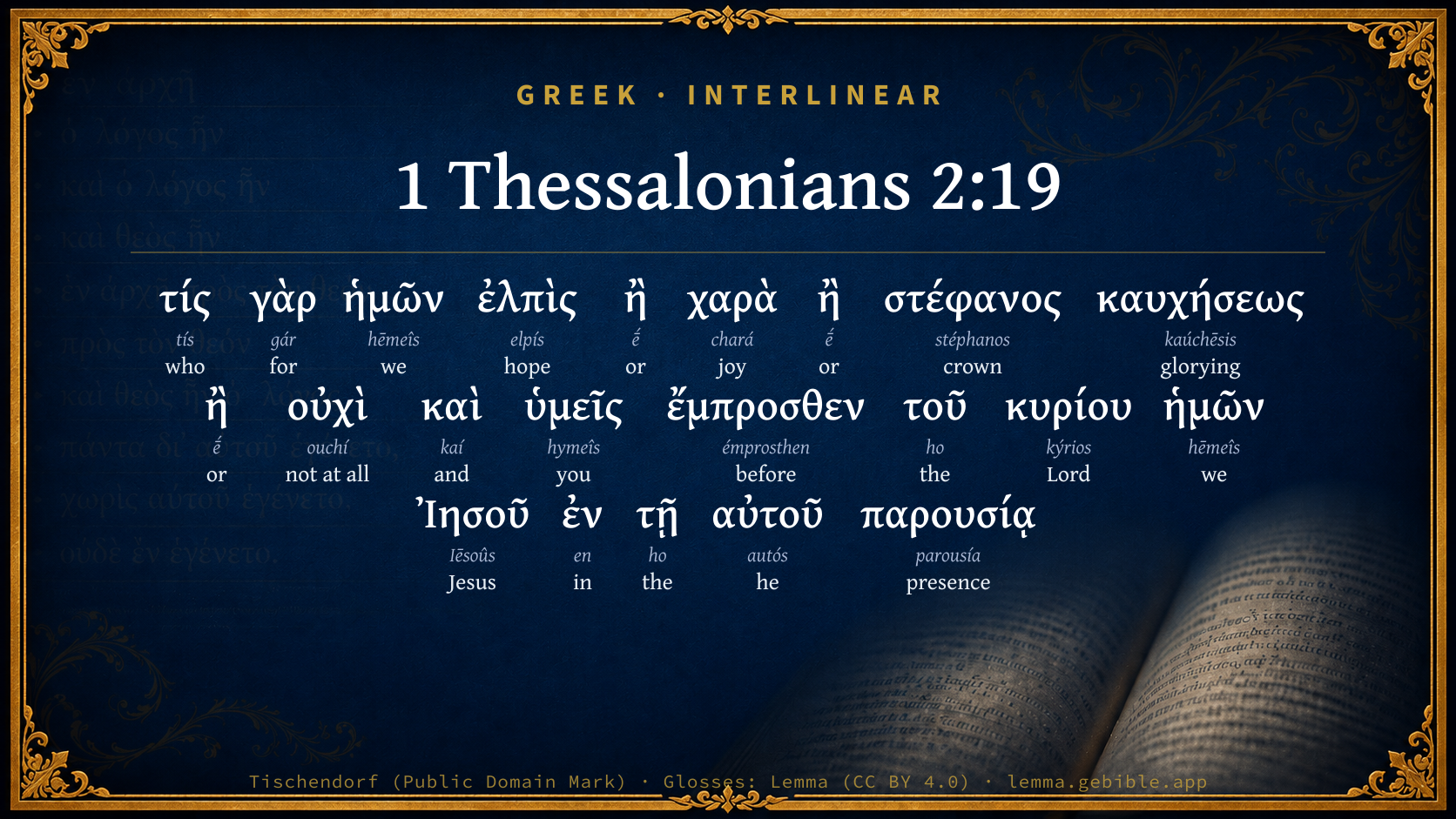
  1. τίς tís G5101 “who” Interrogative pronoun, Nominative, Singular, Feminine
  2. γὰρ gár G1063 “for” Conjunction
  3. ἡμῶν hēmeîs G2249 “we” Personal pronoun, 1st person, Genitive, Plural
  4. ἐλπὶς elpís G1680 “hope” Noun, Nominative, Singular, Feminine
  5. ἢ ḗ G2228 “or” Particle
  6. χαρὰ chará G5479 “joy” Noun, Nominative, Singular, Feminine
  7. ἢ ḗ G2228 “or” Particle
  8. στέφανος stéphanos G4735 “crown” Noun, Nominative, Singular, Masculine
  9. ἢ ḗ G2228 “or” Particle
  10. οὐχὶ ouchí G3780 “not at all” Particle, Interrogative
  11. καὶ kaí G2532 “and” Conjunction
  12. ὑμεῖς hymeîs G5210 “you” Personal pronoun, 2nd person, Nominative, Plural
  13. ἔμπροσθεν émprosthen G1715 “before” Preposition
  14. τοῦ ho G3588 “the” Article, Genitive, Singular, Masculine
  15. κυρίου kýrios G2962 “Lord” Noun, Genitive, Singular, Masculine
  16. ἡμῶν hēmeîs G2249 “we” Personal pronoun, 1st person, Genitive, Plural
  17. Ἰησοῦ Iēsoûs G2424 “Jesus” Noun, Genitive, Singular, Masculine
  18. ἐν en G1722 “in” Preposition
  19. τῇ ho G3588 “the” Article, Dative, Singular, Feminine
  20. αὐτοῦ autós G846 “he” Personal pronoun, Genitive, Singular, Masculine
  21. παρουσίᾳ parousía G3952 “presence” Noun, Dative, Singular, Feminine

About this verse

These counts appear in no published source. They are computed here, from the morphology-tagged text and Lemma’s own curated glosses. What Lemma adds →

22
words
18
distinct lemmas
Pauline Epistles
section

Notable vocabulary

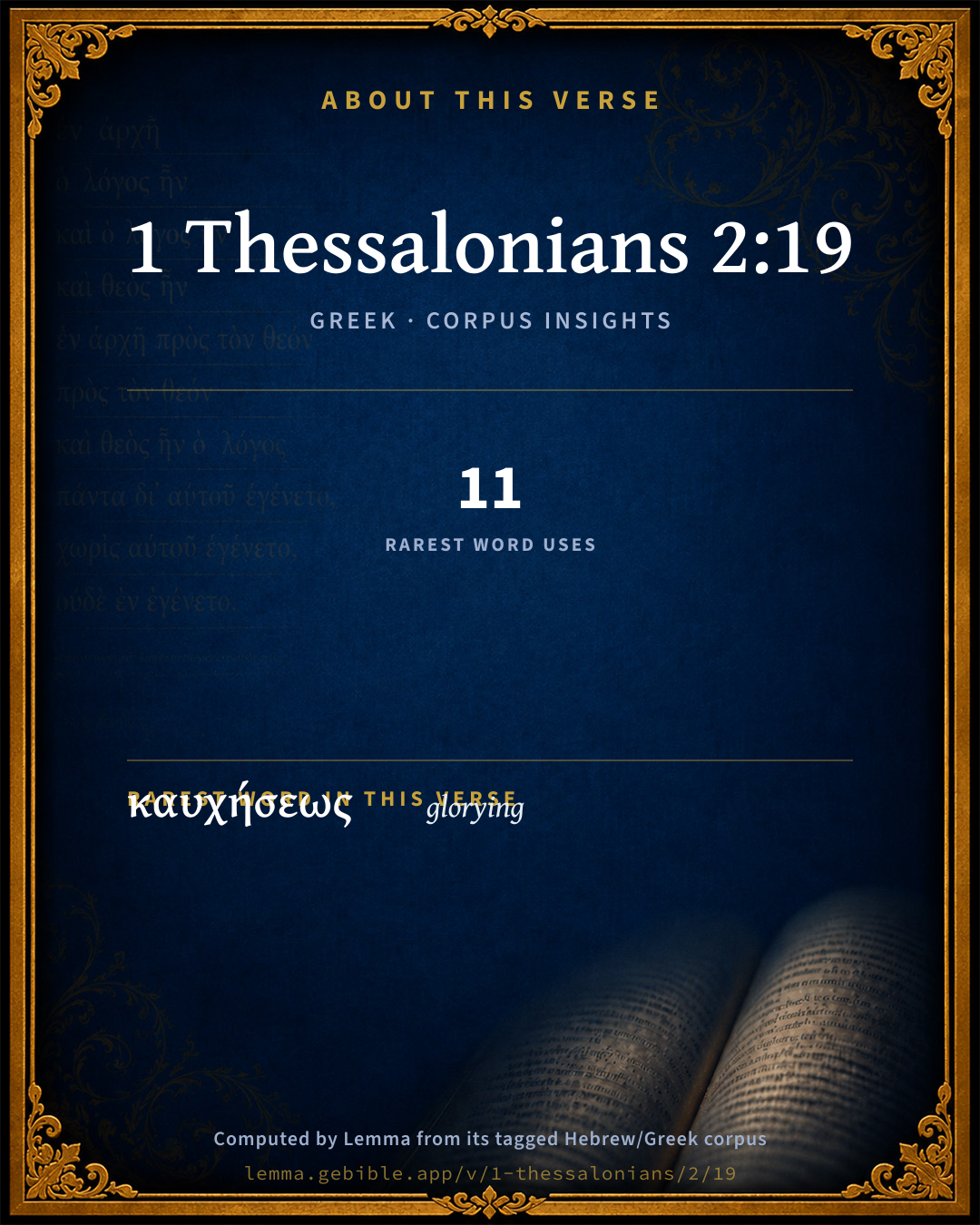
The rarest word here is καυχήσεως glorying G2746 — appearing just 11 times in the whole Greek New Testament.

Shared distinctive vocabulary

καυχήσεως glorying G2746 occurs in 11 verses of the Greek New Testament. Also found in:

Repetition

Words recur within this verse:

Cross-references

26

Topical passages linked to 1 Thessalonians 2:19 in the Treasury of Scripture Knowledge — connected by theme and wording, ordered by reader-vote popularity; previews shown in the World English Bible.

  • Philippians 4:1 Therefore, my brothers, beloved and longed for, my joy and crown, so stand firm in the Lord, my beloved.
  • 1 Thessalonians 3:13 to the end he may establish your hearts blameless in holiness before our God and Father, at the coming of our Lord Jesus with all his saints.
  • Philippians 2:16 holding up the word of life; that I may have something to boast in the day of Christ, that I didn't run in vain nor labor in vain.
  • 1 Thessalonians 5:23 May the God of peace himself sanctify you completely. May your whole spirit, soul, and body be preserved blameless at the coming of our Lord Jesus Christ.
  • 2 Corinthians 1:14 as also you acknowledged us in part, that we are your boasting, even as you also are ours, in the day of our Lord Jesus.
  • Matthew 16:27 For the Son of Man will come in the glory of his Father with his angels, and then he will render to everyone according to his deeds.
  • 1 Corinthians 15:23 But each in his own order: Christ the first fruits, then those who are Christ's, at his coming.
  • 1 John 2:28 Now, little children, remain in him, that when he appears, we may have boldness, and not be ashamed before him at his coming.
  • Revelation 22:12 "Behold, I come quickly. My reward is with me, to repay to each man according to his work.
  • 1 Thessalonians 4:15 For this we tell you by the word of the Lord, that we who are alive, who are left to the coming of the Lord, will in no way precede those who have fallen asleep.
  • 2 Timothy 4:1–2 I charge you therefore before God and the Lord Jesus Christ, who will judge the living and the dead at his appearing and his Kingdom:
  • Titus 2:13 looking for the blessed hope and appearing of the glory of our great God and Savior, Jesus Christ;
  • Revelation 1:7 Behold, he is coming with the clouds, and every eye will see him, including those who pierced him. All the tribes of the earth will mourn over him. Even so, Amen.
  • Proverbs 12:4 A worthy woman is the crown of her husband, But a disgraceful wife is as rottenness in his bones.
  • Proverbs 17:6 Children's children are the crown of old men; The glory of children are their parents.
  • Isaiah 62:3 You shall also be a crown of beauty in the hand of Yahweh, and a royal diadem in the hand of your God.
  • 2 Thessalonians 1:7–2:1 and to give relief to you that are afflicted with us, when the Lord Jesus is revealed from heaven with his mighty angels in flaming fire,
  • 1 Timothy 6:14–15 that you keep the commandment without spot, blameless, until the appearing of our Lord Jesus Christ;
  • 1 Peter 5:4 When the chief Shepherd is revealed, you will receive the crown of glory that doesn't fade away.
  • Jude 1:24 Now to him who is able to keep them from stumbling, and to present you faultless before the presence of his glory in great joy,
  • Proverbs 16:13 Righteous lips are the delight of kings. They value one who speaks the truth.
  • 1 Corinthians 4:5 Therefore judge nothing before the time, until the Lord comes, who will both bring to light the hidden things of darkness, and reveal the counsels of the hearts. Then each man will get his praise from God.
  • 1 Thessalonians 2:20 For you are our glory and our joy.
  • Revelation 4:10–11 the twenty-four elders fall down before him who sits on the throne, and worship him who lives forever and ever, and throw their crowns before the throne, saying,
  • Proverbs 4:9 She will give to your head a garland of grace. She will deliver a crown of splendor to you."
  • Romans 15:16–19 that I should be a servant of Christ Jesus to the Gentiles, ministering as a priest the Gospel of God, that the offering up of the Gentiles might be made acceptable, sanctified by the Holy Spirit.

Cross-references courtesy of OpenBible.info (CC BY 4.0).

Where the printed editions differ

1 variant

Places in this verse where the major printed Greek editions disagree on the wording in a way that affects the translation — a comparison of editions, not a manuscript-by-manuscript collation. The editions are the modern critical texts (Nestlé-Aland 28/27, SBL, Westcott-Hort, Tregelles, Tyndale House) and the traditional texts behind the KJV (the Textus Receptus and the Byzantine/Majority text). It is not a claim about which reading is original.

  1. Extra text
    Χριστοῦ

    “Christ”

    In TR Not in NA28NA27TynSBLWHTregByz

    Χριστοῦ (Christou) 'Christ' is only in traditional manuscripts (TR)

Textual data: Translators Amalgamated Greek New Testament (STEPBible TAGNT) · CC BY 4.0.

Commentary

Notes on 1 Thessalonians 2:19 from classic Christian and Jewish commentators (each source and its license shown beneath its notes). The classic Christian expositions comment on the surrounding passage and are grouped to its opening verse, so a note may address several verses; the Jewish commentaries on the Tanakh (Rashi and others) are per-verse, so they appear only where the commentator wrote on this verse.

Lemma curates 59 commentaries, every one of them public domain or Creative Commons licensed, each selected and text-cleaned for this edition rather than reprinted as found. About our sources →

The Biblical Illustrator

Joseph S. Exell

1Th_2:19-20

What is our hope, or Joy, or crown of rejoicing?

Those we lead to Christ an element of our final reward

Paul wrote this letter from Corinth. He had, probably, just witnessed the Grecian games and the crowning of the victors. Then, says he, What is our crown? Are not even ye? They were also his glory. God desires and expects honour. We have a right to desire it. His prayer was that his pupils might be perfect in Christ at His coming. The coming is associated with the resurrection. Then the apostles hope was to see his pupils complete in Christ at the resurrection.

I. Paul was not concerned about his own salvation. That was as far behind him as that spot on the way to Damascus. His hope, his joy, was in the salvation of others.

II. He expected to know them in the resurrection. For this would be the source of his joy. They, for whom he laboured, would then be his crown. The indefinite thought that somewhere in the universe were a crowd of persons who had been saved through his labour would not have satisfied. There follows the inference that identity will not be destroyed. To destroy identity is to destroy the person. Nor is there continuity of existence save in memory. We go into the other world with the totality of our natures. There can be no reward save there is a consciousness of work done, and this consciousness will depend on the memory being intact. Otherwise, God may give joy, but that will not be reward; He may torture, but that will not be punishment.

III. Then it will be known to these saved ones what Paul had wrought for them. Else, how could their salvation be his joy and his crown? He would need more than the unselfish thought of what he had done. God will have glory. Christ was never more unselfish than when on the cross, despising the shame, yet He thought of the joy that was set before Him. An element in Pauls joy will be the honour and praise given him by those who will be conscious of the good he did them.

IV. Paul was not a mere instrument, but a co-worker with God. He was a factor in the power that saved his pupils. He speaks of God and the Holy Spirit, and also of himself, and claims for himself a crown of rejoicing in the work wrought Then God, Paul, and you are to work out the salvation of men.

V. Paul will take his crown in the presence of the Lord. Christ will recognize him as a factor. Christ will not be jealous. The elder brother goes out to find file prodigal. Observe--

1. Selfish motives are admissible in our Christian work. The Lord, perhaps, never had a more self-sacrificing servant than Paul. He cultivated such familiarity with the spiritual world as to make it present. He thought Christ might come any minute. His was a personal hope, a personal joy, a personal crown. Heaven to us is a pretty place, talked about in Revelation, or by Milton. It is not to us sufficiently real to dry our tears.

2. The selfish interests we aim at in this world are but trifles, compared with the crown, the joy, the hope, we may have. We take from this life nothing but our characters, and there await us cycles of eternities upon eternities, and yet what time we devote to our wardrobes, to trifles. Think of our translation to that other world; think of meeting men, women, and children leaping for joy, harp in hand, singing praises to God, and, at the same time, acknowledging us, with grateful hearts, as factors in the power that secured their salvation.

3. What dignity this gives the work of the Church. We are living in a time when the dignity of Christianity seems endangered. (T. T. Duryea, D. D.)

The grand reward anticipated by the genuine gospel minister

It is natural for men to work for rewards, to have an eye in all their labours to compensation. There is a selfish and a disinterested aim after rewards. The selfish is not only seen in the mere worldling, whose rewards are confined to the present life, but also in the religious professor, who here works, sacrifices, and prays in order to get for himself a blessed heaven at last. The disinterested reference to rewards is peculiar to the genuinely Christian worker, and is exemplified in the text. Notice--

I. The nature of the good which he regarded as a reward for his labours. It was not wealth or enjoyment on earth, nor his own heaven in the future, but the spiritual excellence of those for whom he laboured; their deliverance from moral evil; their restoration to the image of God. He sought nothing higher as a recompense. This was his highest hope--his joy. Nothing thrilled him with a keener delight than to see sin crushed and virtue triumphant. This was his crown of glorying. The pleasure which the victor in the Grecian games felt in the garland he had won was nothing compared to Pauls.

II. The period when this good would be manifested to his admiring eyes. Are not ye, etc., which implies--

1. His belief in the final advent of Christ. Paul never doubted this, nor did the early disciples. They were not inspired as to its specific time; hence the latter mistook and thought it just at hand.

2. His belief that at that period when he should meet and recognize all his converts, and they would be presented to the Great Head without spot or wrinkle, filled him with joy. (D. Thomas, D. D.)

The ministers joy

1. Numerous causes of depression are connected with the lives of faithful ministers. Their office necessarily brings them into collision with the passions of others. Hostility to the truth frequently assumes the character of personal spite against the preacher, who is misrepresented, contemned, and persecuted.

2. During these seasons the apostles were able to state their possession of supports and consolations which had imparted to them animation and perseverance (2Co_4:8-9; 2Co_4:16; 2Co_6:9-10). These are comforts permanently provided for the work of the ministry, and not the least is that of the text.

I. There is a strong religious affection cherished by ministers of the Gospel towards their relieving hearers. This is well illustrated by previous expressions in this Epistle.

1. The relation of ministers to their people must of necessity always involve the exercise of kindly solicitude on their behalf. This is clear from Scriptural designations of their vocation. It is impossible to fulfil that vocation without feeling towards those whom they feed as shepherds, protect as watchmen, instruct as teachers, lead as guides, an affectionate interest.

2. This affection is also founded, as is all intelligent affection, on the possession of some common property. Both have been called in one hope of their calling, received the same Divine grace in their hearts, brought from the same spiritual bondage, washed in the same fountain, justified by the same righteousness, etc.

3. This affection becomes still more powerful when pastors have reason to conclude that to their instrumentality believers have been indebted for their introduction to spiritual life. Thus it was here. This connection is more close than others. It is not the relation of a friend to a friend, but of a father to a son (3Jn_1:2-4).

II. There is an important event which it becomes ministers and their believing hearers to anticipate. Those who are united in the bond of Christian attachment ought to hold in remembrance that their communion on earth must soon terminate. But we have not to stay our contemplation of the future with the point of death. We have to look beyond to a period of high restoration. Throughout the Epistle the thought of the Lords coming is associated with the well-being of the saints.

1. Let the minister habitually anticipate this, and he cannot but be careful that he may answer the claims and fulfil the obligations of his office.

2. Let private Christians regard this, and they, too, will earnestly cultivate the graces appropriate to their station.

III. The event anticipated will involve the mutual recognition of those who have been spiritually related on earth. This involves the general principle that all pious friendships will be restored to be perpetuated forever.

1. The ultimate recognition of the saints is a truth adapted to administer substantial consolation amidst the numerous and painful separations inflicted by death. What gratitude should arise towards that religion which affords such a hope!

2. This doctrine is applied to the recognition of preachers and believers. That connection which on earth is the parent of so much pure enjoyment will then be restored.

IV. This recognition will to ministers be connected with elevated joy (2Co_1:13-14; Php_2:15-16; Php_4:1). In contemplating the reasons for ministerial joy we may name--

1. The consideration of the unspeakable misery which believers have avoided, and the happiness to which they are exalted.

2. Saved believers will be a public testimony to the universe of official faithfulness and success. What a transcendent honour to be acknowledged in the presence of the Father and the holy angels. Here we do not witness all the results of our ministry.

3. The salvation of others will add new and permanent value to ministerial reward. (James Parsons.)

Culture of character the work of the Christian pastor

How thoroughly Pauls work is charged with personal feeling. There are times in which this personal feeling should be allowed its proper expression.

I. The aim of a true ministry. To get men ready to stand in the presence of Christ. The apostle lived in expectation of the appearance of the Saviour. That great hope was his own perpetual inspiration, and by the teaching of it he ever urges his disciples to live holier and more consecrated lives.

II. The joy it gives the minister to work with this for his aim. There is a passionate kind of joy known by the man who is the means of many conversions. There is surely a deeper, holier joy known by him who watches over the growth of holy character, and the settling of holy principle, and the arrangements of a holy life--those further stages of the work of conversion. There must have been a great thrill of joy in the heart of the old alchemist as he watched the metals simmering, and changing form; and as he fancied he caught, again and again, signs that the long-sought elixir was yielding to the fires. How intense must be the joy of the sculptor who works at the rough quarry block, and sees under each chisel stroke a new proof that the image of his soul is gaining form before him! The artist must know true joy in his work as the bare canvas gradually fills with the creations of his genius. The architect watches stone laid on stone, and fair proportions and graceful forms growing up before him with ever-new delight, We know there is no joy on earth like that of the mother who watches the babe unfold in strength and intelligence; and on up through the stages of childhood and youth that mother watches with a perpetual soul thrill as intelligence and character are developed and perfected. I have sometimes tried to conceive the inconceivable, and imagine I stood beside Jehovah, and felt the thrill of His great joy as He watched creation unfold all its fitnesses and beauties before His Divine commands: as chaos broke up into movement, and rocks gathered round their centre, and water floods separated themselves from the land. Who shall tell the joy of Him who watched the stages of that wondrous growth? It is but suggested in the words, And God saw everything that He had made, and behold it was very good. But all these fail before the joy to God, and to the good, that is found in watching the new creation of a soul, the regeneration and sanctification of a soul. All these can be but images and suggestions of the far greater joy he knows who watches the growth of souls, and can say, What is our joy?…are not even ye in the presence of the Lord Jesus at His coming? God must have more joy in the sanctifying of a soul, for He gave His only Son to accomplish that end.

III. The hope the minister may cherish that in some his aim will be realized. When we stand in the presence of Christ we shall each have several persons to thank for helping us forward on the road to holiness and God. (R. Tuck, B. A.)

The ministers joy

I. The reasons upon which Christs faithful ministers are so seriously engaged in saving souls, making it the great object of their desire and hope, the scope of their prayers, and the business of their lives.

1. The Divine command and charge laid upon them (Act_20:28; Col_4:17; 2Ti_4:1-2; 1Co_9:16).

2. The Spirit and Grace of Christ. They preach no unknown Saviour, but one in whom and in whose work they have a special interest (Rom_10:1; Gal_4:19; Act_20:31; 2Co_12:15).

3. The example of Christ, who came to seek and save the lost; and whose meat was to do the will of His Father, etc.

4. The worth of souls.

5. The danger they are in from the world without and corruption within.

6. The price paid for souls (Act_20:28).

7. The strict account they will have to give of their ministry (Eze_3:17-18).

8. Future glory.

II. The joy they will have in the souls they win in the presence of Jesus Christ.

1. Every recovered soul will be a jewel added to their crown.

2. Their converts will be eternally safe.

3. They will spend eternity in their company whom they have loved most below.

4. They will receive the special commendation of the Lord.

Conclusion.

1. How important the work of labouring for souls.

2. The prospect should animate pastors and people in times of depression.

3. How heavy will be the doom of those who have despised the preached gospel. (D. Wilcox.)

The pastors joy and crown

(Farewell sermon). Let us consider--

I. What you are to me in the present.

1. Some of you are my hope. Joy comes of anticipations realized, but we hope for that we see not. Some of you are my hope because there are possibilities which have never been developed, aspiration s which have never been fulfilled, blessings not yet experienced. At the same time you have not yet turned your backs upon them. You and I are hoping that the seed may yet bear fruit.

(1) Some of you young men have not yet become corrupted by a life of sin; but you have not yet given your hearts to God. Turn my hope into joy by deciding for Christ.

(2) Some of you maidens have not yet yielded to the fashions and frivolities of the world, and have indeed been drawn after Christ; but you have not yet embraced Him. Make my hope joy by doing so now.

(3) Whether old or young you are my hope if you are convinced that what I say is and has been true. No longer halt, then, between two opinions.

2. Some of you are my joy. My hopes have been realized. You have tasted and seen that the Lord is good. Cleave to Him and work for Him so that you may continue to be my joy, and be something more by and by.

II. What you may be to me in the future. We must all appear before the judgment seat of Christ: I as your pastor to render an account of my ministry. Whether I have done my work well or ill it cannot be altered now; but if you have been unprofitable hearers you may remember in days to come what you have heard, and by giving yourselves to Christ be my crown of rejoicing. Then I shall be able to point to you and others and say, Here am I and the children Thou hast given me. And if any shall say, He did not feed the flock, comfort the sorrowful, etc., I shall be able to point to you in refutation. (R. Davey.)

The pastors crown of rejoicing

I. The text points to the future. Instead of indulging in fond regrets, lamenting over the severance of old ties, and giving himself up to the fascination of sentimental reminiscences, Paul looks onward to the future--hopefully, cheerfully, anticipating renewed friendship, calculating on continued usefulness. But beyond the horizon of time, Pauls eager gaze penetrates eternity. He and his brother believers did not forget the first Advent, but they seem to have been more mightily moved by the hope of the second. When this hope will be consummated they could not tell, neither can we; but it will be some day.

II. The text recognizes an everlasting bond of union between a Christian pastor and his flock.

1. Moral influences work forever. Mind affects mind, and will affects will, and character, character in everlasting consequences of action and reaction. People cannot live and work together without making one another different. All relationships may be said to be interminable, because the influence for good or evil is perpetually operative.

2. But the relation between pastor and people is noticed in Scripture in a way no other is. Nothing is said about the meeting of kings and subjects, brothers and sisters, etc. This relationship of ministerial labour and oversight is alone placed in the eternal light; because a preacher has to do a work which no others do. He toils for eternity; and the result of his employment will not appear till time shall end. Many kinds of efforts produce immediate results; but with our sacred occupation the harvest is the end of the world.

III. The text suggests the conditions on which the apostolic hope expressed may be fulfilled. This hope is sublimely disinterested. Paul here stands before us, a true philanthropist, who loses himself in the good of others, whose heaven is to lead others to heaven. The hope of the salvation of others is his own great hope; their joy his own joy; their crowns his own crown. The conditions upon which such a lofty hope can be fulfilled are these--

1. The conversion of men to Christ through repentance and faith. The feelings with which one regards a pupil or adopted child may be very tender and grow into the semblance of paternal affection, but it is only a semblance at best. A fathers love and joy no stranger intermeddleth with. And so there is pure ministerial satisfaction in being an instructor of Christianity; but to be really a father in God, to beget a soul for Christ through the gospel--that is a joy which no man knoweth save he who receiveth it. The thought of that fills an apostolic mind with ecstasy.

2. The edification, improvement, growth in holiness of those so converted, whether by the minister himself or his brethren. To educate ones child is a most precious task; to have under ones pastoral care a person who attributes to you his conversion is a similar and yet nobler employment. To carry on step by step the purifying and ennobling process; to help to polish pillars in the house of God that are to go out no more forever; to add any touches to the likeness of Christ drawn in the lives of His people--that is to enter into the noblest kind of partnership, to share in the consummation of the grandest of purposes. And it all bears on the anticipated felicity at the coming of the Lord Jesus.

3. The consolation of the afflicted in this world of trial. No man entered more deeply into the feelings of others than did Paul. Perhaps the strongest of all ministerial power is sympathy in affliction; and the prospect of spending eternity together with the sons and daughters of sorrow in that world where tears are wiped from all faces will form no small part of our crown of rejoicing. (J. Stoughton, D. D.)

The way to the crown

The crown of a mans life is that which he desires above all things. A crown of rejoicing is that which gives him the greatest joy. The apostles life joy was bound up with the salvation of souls. If that failed his life was joyless.

I. The sweetest joy that earth gives is the joy of doing good.

1. Here is a high hill, its sides rocky, its surface sterile, its contour uncomely. Nobody wants it or values it. Presently a wise man walks over it, purchases it, cuts away at its sides, and after long and expensive toil lays bare a wealth of precious minerals. So there is many a deed of kindness that waits to be done; yet no one does it. It seems an unpleasant, hard, costly thing; yet he who at last does it finds in it a treasure. In every kindness there is a joy locked up for your own soul, and the more difficult it is the sweeter the joy. It is sweet to take a loaf of bread to the starving, although it may leave you hungry; to deny yourself of some ornament to clothe the naked; to lose your own sleep to watch beside the suffering. Pearls are found in the unsightly oyster, so pearls of joy are found in tasks from which we shrink.

2. But the sweetest joy is that of saving souls. A man once saved a childs life by snatching it from under the feet of a galloping horse, and ever after that one deed illumined that mans life. He lay for years in prison cells, but the joys of that heroic hour shone ever in upon his gloom. If it is so blessed to save from physical, how much more to save from eternal death! When Dr. Lyman Beecher was dying some one asked him what was the greatest of all things. He answered, It is not theology; it is not controversy; it is saving souls. As the Christian approaches the sunset of life he feels that this is the only work worth doing, A preacher may draw crowds, and be rewarded with academic titles, and achieve great fame; but if souls are not saved his ministry is a failure.

II. Those whom we lead to Christ will be our crown of joy in heaven.

1. Reference is here made to the ancient games. At the end of the race the victor is crowned. So at the end of the apostles course he should receive a crown jemmed with saved souls. He who gives a cup of cold water in the name of a disciple will be rewarded, and he who saves souls will receive the most glorious rewards.

2. There seems also to have been in the apostles mind the thought that his spiritual children would be grouped round him as a glory, as children gather round a parent. Jesus is the Saviour around whom all the saved shall gather. But that one family will be broken up into countless groups gathered about those who have led them to Jesus. All whom we have helped to the Saviour will greet us as we pass inside heavens gates. Every Christian pastor or worker will, in heaven, be like a tree with many or few branches on which all the fruits of his life will hang. Conclusion: Our joy in heaven will be measured by our deeds of kindness on earth. The gold and silver we have spent in benefitting our race, will be transmuted into crowns of glory. Those who are spending themselves for Christ are weaving fadeless garlands for their brows. They who are saving souls are gathering and polishing jewels for their heavenly crowns. (J. R. Miller.)

Believers the joy of ministers

I. Inquire when Christian professors may be styled the hope, the joy, and the crown of their ministers.

1. When they appear to be truly converted to God.

2. When they grow in grace and in the knowledge of Christ.

3. When they walk worthy of their heavenly calling, and bring forth the fruits of righteousness, such as closet duties, family religion, love for Divine ordinances, and Christian ministers, and consistent deportment in the world.

II. The solemn time in which they shall be the hope, the joy, and the crown of their ministers.

1. The second coming of Christ.

2. Ministers and hearers must then meet.

3. Their hope is to meet them at the right hand of God.

4. Their joy to see them partakers of Divine glory.

5. Their crown of rejoicing to behold them as the seals to their ministry. (C. Evans, D. D.)

Consistent Christians a ministers joy

I do not know when I ever felt more gratified than on one occasion, when sitting at a Church meeting, having to report the death of a young brother who was in the service of an eminent employer, a little note came from him to say, My servant, Edward--is dead. I send you word at once, that you may send me another young man; for if your members are such as he was, I never wish to have better servants around me. I read the letter at the Church meeting, and another was soon found. It is a cheering thing for the Christian minister to know that his converts are held in repute. Of another member of my Church an ungodly employer said, I do not think anything of him; he is of no use to anybody; he cannot tell a lie! (C. H. Spurgeon.)

Hope, joy, crown

There are some who are our hope, who are not our joy; and others who are our hope and joy too, for a time, who will never be our crown; who hold not out to the end, and therefore will never be our rejoicing in the presence of the Lord at His coming. Some are under serious impressions, and excite a hope and joy, like that felt at the sight of blossoms in the spring, and yet are afterwards blighted. There are some that have made even a public profession, and yet, like the thorny and stony ground hearers, produce no fruit. The object desired, therefore, is not only your setting out, but your holding on, walking in the truth, and holding fast your profession to the end. Then, indeed, you will not only be our hope and joy, but our crown of rejoicing. (Andrew Fuller.)

Pauls crown and glory

That one word glory gathers up all the rays of light which stream from the others into its focus. They are his halo of glory now and evermore. Believers, or at least those who are specially engaged in His service, are described in 2Co_8:23 as the glory of Christ. They are also in a lower sense the glory of Christs ministers. The pastor will find in his congregation either his glory or his shame. It was the boast of the Jews that to them had been given three crowns--the crown of the law, the crown of the priesthood, and the royal crown. These they highly prized, but they often added, better than these is the crown of a good name. Pauls crown of a good name in the presence of Christ Jesus was his converts. The same crown is offered to us all, and is in keeping for us all if we are found faithful. History tells us that when in Philip IIs reign a rebel claimed and gained the crown of Granada, he bore at the ceremony of coronation in his right hand a banner bearing the inscription More I could not desire, less would not have contented me. These words cease to be presumptuous and become the utterance of truest wisdom only, when they refer to the crown of heavenly rejoicing, and when they are the legend of the banner under which he fights in the sacramental host of Gods elect. In view of the truth that converts are the crown of boasting in store for all faithful witnesses for Christ, the words are invested with a solemn significance We live if ye stand fast in the Lord. Now, little children, abide ye in Him, that when He shall appear, we may have confidence, and not be ashamed before Him at His coming. (J. Hutchison, D. D.)

Heavenly recognition

It is natural for those who are travelling to an unknown land, in which they are soon to make their residence, to enquire frequently anent its manners, its customs, and its modes of intercourse; it is therefore not surprising that Christians, travellers to the kingdom of God, frequently endeavour to lift the veil which covers futurity, and to learn what are the holy delights of that heavenly world in which they hope to dwell forever. To these inquiries, Pauls statement to the Thessalonians affords the most precious consolation: it teaches that the friendship founded on piety is imperishable--that those who were friends to the Redeemer, as well as to each other, shall have mutual knowledge and recollection in the future world, which shall result in intercourse with each other and the whole triumphant Church.

I. The doctrine of heavenly recognition.

1. The enjoyments and occupations of heaven are uniformly represented as social; but where is the charm of society without mutual knowledge?

2. Heaven is uniformly represented as perfecting all our faculties. Is it then probable that it will diminish, nay, entirely abolish memory, one of the most important of them?

3. The chief grace that will be exercised in the regions of the blest, next to love to God, will be love to our companions in glory. But what kind of love is that which is felt for an object which we know not?

4. In the general judgment which is appointed to vindicate the ways of God to man, it is certain that every individual will be known to the vast assembly as distinct from all other persons. Is it probable that God, after thus making the blessed acquainted with each other, should immediately afterward obliterate this knowledge?

5. It is certain that we shall see and know the glorious manhood of our blessed Saviour, elevated above all the heavenly powers; and if we shall know one body, why not mere? During His abode on earth, He afforded to three favoured disciples a glimpse of His Divine glory. He was transfigured, and Moses and Elias descended in celestial brilliancy: the disciples knew them distinct from the Saviour, and each as distinct from the other; and if they knew them on the solitary mount, why should they not know them in the New Jerusalem?

6. We find the apostle Paul very frequently consoling himself under the sufferings and persecutions which he had to endure, by the prospect of meeting in heaven those who had been converted by his ministry on earth.

II. The teaching of this doctrine.

1. What a delightful idea does it give of the felicity of the celestial world! Surely nothing, except the vision and enjoyment of God and the Lamb, can equal the joys of knowing and being known to all the Church triumphant above--of living in an eternal brotherhood--of forming an indissoluble connection with all the good men that ever have existed, or that ever shall exist, till the trump of the archangel shall shake the earth to its centre. Who can even conceive the raptures of such an intercourse?

2. The doctrine that in heaven we shall know each other, and all the pious who have preceded us, affords one of the sweetest consolations to the Christian against the natural fear of death. To a soul that has made its peace with God, death has nothing so terrible as those agonizing adieus which are to be given to those whom we love; but the anguish arising from this source is removed when the dying believer can strain his closing eyes upon those who surround his bed of death, and say to them, Suffer me to go and join yon heavenly company with the bright hope that you will ere long come to me, and we shall be beyond the reach of death, in the presence of our Lord Jesus Christ.

3. The doctrine of future recognition teaches relatives and friends how they should act in order that the sentiments of affection which they entertain for each other may have their greatest force, and they be saved from the severest pains. Form your attachments for eternity; build them on the basis of religion; strive to cement the ties of relationship by the more indissoluble bonds of grace; and then your future will be ineffably blessed and glorious. (H. Kollock, D. D.)

.

The Biblical Illustrator, edited by Joseph S. Exell (c. 1880s–1900s) — public domain. Text from a community e-Sword module.

Tyndale Open Study Notes

Tyndale Open Resources

2:19 In the Greek and Roman world, a crown was given to those who received great civic honor or who were victorious in athletic games.

Tyndale Open Study Notes — © Tyndale Open Resources, licensed CC BY-SA 4.0. Text via the HelloAO Bible API.

Bengel's Gnomon

Johann Albrecht Bengel

1Th 2:19. Τίς γὰρ) So, τίς γὰρ, LXX., 1Sa 11:12.—ἐλπίς, κ.τ.λ.) our hope, etc.: comp. the end of this verse. It is great praise.—στέφανος καυχήσεως, a crown of [rejoicing] glorying) So LXX., Pro 16:31.—καὶ ὑμεῖς, even ye) He does not exclude others: he chiefly reckons these among the number.—ἐν, in) Regarding this particle, comp. ch. 1Th 3:13; Rom 2:16, note [In the day expresses something more than against the day]. So far is hope extended! [So far does his hope reach! even to the day of Christ.]

Bengel's Gnomon of the New Testament — English translation (T&T Clark, Edinburgh, 1860) — public domain. Text from a community e-Sword module.

Meyer's Critical & Exegetical Commentary

Heinrich August Wilhelm Meyer

1Th_2:19. A reason not for περισσοτέρως ἐσπουδάσαμεν τὸ πρόσωπον ὑμῶν ἰδεῖν, 1Th_2:17 (Hofmann), but of the twice formed resolution of the apostle to return to Thessalonica, 1Th_2:18. This earnest desire to return is founded on the esteem of the apostle for his readers, on account of their promising Christian qualities. Grotius: Construi haec sic debent: τίς γὰρ ἡμῶν ἐλπὶς … ἔμπροσθεν τοῦ κυρίου … ἢ οὐχὶ καὶ ὑμεῖς; Certainly correct as regards the matter and the thought, as ἔμπροσθεν … παρουσίᾳ is to be referred to the preceding predicates, but ought not to be connected with ἢ οὐχὶ καὶ ὑμεῖς, as a second independent question. So also Olshausen, who renders it thus: or do not ye also (as I myself and all the rest of the faithful) appear before Christ at His coming, i.e. without hesitation, without any doubt, ye will surely be also recognised by Christ as His, and therefore will not fall away again at any time from the faith. But the reason and justification for this strange position of the words consist in this, that Paul originally conjoined the words τίς γὰρ … ὑμεῖς in thought, and originally wrote them by themselves; but then to present the predicates already put down as considered not in a worldly, but in a specifically Christian sense, he introduces, as a closer definition and explanation of the whole clause τίς … ὑμεῖς, the words ἔμπροσθεν … παρουσίᾳ. There is, accordingly, no need for the supposition of Laurent (Neutestam. Studien, Gotha 1866, p. 28 f.), that Paul only at a later period, after he had read through the whole Epistle once, placed these words in the margin, or ordered them to be inserted. Accordingly, the apostle says: For who is our hope or joy or crown of rejoicing, or are not even ye this? before our Lord Jesus at His coming; i.e., if any one deserves to be called our hope, etc., ye deserve it. As the addition ἔμπροσθεν κ.τ.λ. proves that the apostle thinks on the judgment connected with the coming of Christ.

Paul, however, calls the Thessalonians ἐλπὶς ἡμῶν (comp. Liv. xxviii. 39), not because he anticipates a reward for himself on account of the conversion of the Thessalonians effected by him (Estius, Fromond., Joachim Lange, Hofmann, and most critics), or at least a remission of the punishment for his early persecution of the Christian church (for the emphasis rests not on ἡμῶν, but on the predicates ἐλπὶς κ.τ.λ.), but because he has the confident hope that the Thessalonians will not be put to shame at the trial to be expected at the advent, but will rather be found pure and blameless, as those who embraced the faith with eagerness, and heroically persevered in it in spite of all contentions.

ἢ χαρά] or joy, as by the conversion and Christian conduct of the Thessalonians the kingdom of God has been promoted.

ἢ στέφανος καυχήσεως] or crown of glory (comp. עֲטֶרֶת תִּפְּאֶרֶת, Eze_16:12; Eze_23:42; Pro_16:31, and also the LXX.; Php_4:1; Soph. Aj. 460; Macrob. in somn. Scip. i. 1), inasmuch as this greatness and glory, occasioned by the labours of the apostle for the church, is, as it were, the victorious reward of his strivings.

ἢ οὐχί] not nonne (Erasmus, Schott, and others), but an non, for ἤ here introduces the second member of a double question.

καὶ ὑμεῖς] also ye: for, besides the Thessalonians, there were other churches planted by Paul worthy of the same praise. According to de Wette, to whom Koch and Bisping attach themselves, ἢ ὑμεῖς should properly have followed στέφ. καυχήσ.: no one is more our hope than you; but with καί the apostle corrects himself, not to say too much, and not to offend other churches. But just because ἢ ὑμεῖς imports too much, why should not the apostle have designed to put ἢ οὐχὶ καὶ ὑμεῖς from the very first!

ἐν τῇ αὐτοῦ παρουσίᾳ] at his coming (return) to establish the Messianic kingdom (comp. 1Th_3:13, 1Th_4:15, 1Th_5:23, et al.; Usteri, Lehrbegr. p. 341 ff.); an epexegesis to ἔμπροσθεν τοῦ κυρίου ἡμῶν Ἰησοῦ.

Meyer — Critical and Exegetical Commentary on the New Testament — English translation by Peter Christie, edited by Frederick Crombie (T&T Clark, 1880) — public domain. Text from a community e-Sword module.

Expositor's Greek Testament

ed. W. Robertson Nicoll

1Th 2:19 . Of course we wanted to come back, for ( γάρ ), etc. The touch of fine exaggeration which follows is true to the situation. Paul’s absence from the young church was being misinterpreted in a sinister way, as if it implied that the Achaian Christians had ousted the Thessalonians from his affections. You it is , he protests, who but you ( καὶ superfluous after ἤ , as in Epict. i. 6, 39; Rom 14:10 , but really heightening the following word, as in Rom 5:7 ; almost = “indeed” or “even”) you are my pride and delight! στέφανος , of a public honour granted (as to Demosthenes and Zeno) for distinguished public service. The metaphor occurs often in the inscriptions ( cf. also Pirke Aboth, iv. 9). Paul coveted no higher distinction at the arrival of the Lord than the glory of having won over the Thessalonian church. Cf. Crashaw’s lines to St. Teresa in heaven:

“Thou shalt look round about, and see Thousands of crown’d souls throng to be Themselves thy crown”.

Παρουσία = royal visit ( cf. Wilcken’s Griech. Ostraka , i. 274 f.), and hence applied ( cf. Mat 24 .) to the arrival of the messiah, though the evidence for the use of the term in pre-Christian Judaism is scanty (Test. Jud. xxii. 3; Test. Levi. viii. 15; for the idea of the divine “coming” cf. Slav. En. , xxxii. 1, xlii. 5). This is the first time the term is used by Paul, but it was evidently familiar to the readers. Later on, possibly through Paul’s influence, it became an accepted word for the second advent in early Christianity.

The Expositor's Greek Testament, edited by W. Robertson Nicoll (1897–1910) — public domain. Text from a community e-Sword module.

International Critical Commentary

19-20. τίς γὰρ ἡμῶν κτλ In reply to the insinuation that he does not return because he does not care for his converts, Paul insists, with a compliment to their excellence, that he wanted to come to them because they are really his glory and his joy. As he thinks of them now and as he looks forward to the day when Jesus is to come, when the Christian race in over, and the Thessalonians receive the triumphant wreath, he sees in them his hope and joy, and in their victory his ground of boasting. His words are broken with emotion: “For (γά introducing the motive of the ardent desire to return) who is our hope and joy and chaplet of boasting?” The answer is given in v. 20; but Paul anticipates by an interjected affirmative question: “Or is it not you as well as (και) my other converts ?” The και before ὑμεῖ is significant (cf. Chrys.): “Can you imagine that the Jews are right in asserting that we do not care for you as well as for our other converts?” This said, he finishes the original question with the emphasis more on hope than on joy: “before our Lord Jesus when he comes?” And finally he repeats the answer implied in ἢ οὐχὶ καὶ ὑμεῖ, but without και, in v. 20: “Indeed (γά = certe, as Calvin notes) it is really (ἐστ) you who are our glory and our joy.”

τί = “who” (Rom 8:35); on τίς γά, cf. 1Co 2:14, 1Co 2:7, 1Co 2:2:16 = Rom 11:34. As the hope is present, ἐστ is to be supplied; ἡμῶ goes with the three nominatives. η is usually disjunctive but sometimes the equivalent of a copula (Bl 7711); it appears in all the Pauline letters; cf. ἢ οὐκ οἴδατ (Rom 11:2, 1Co 6:2 ff.) or ἐπιγινώσκετ (2Co 13:5); א here omits ἤ. οὐχι is used frequently by Paul, chiefly in interrogative sentences (cf. Rom 3:29).—στέφανο (Php 4:1; 2Ti 4:8, 1Co 9:25) is here not the royal crown (2 Reg. 12:30, 1Ch 20:2: Zec 6:11, Zec 6:14, Psa 20:3; see Mayor on Jas 1:12 and Swete on Mar 15:17, Rev 2:10) but the victor’s wreath or chaplet; Deiss, (Light., 312) notes a second-century a.d. inscription in the theatre at Ephesus: ἠγωνίσατο ἀγῶνας τρεῖς, ἐστέφη δύ καυχήσεω (obj. gen.) is the act of boasting. עטרת תפארת is rendered variously in Lxx: στέφανος καυχήσεω (Eze 16:12, Eze 23:42, Pro 16:31), τρυφῆ (Pro 4:9), κάλλου (Isa 62:3), δόξη (Jer 13:18) and ἀγαλλιάματο (Sir. 6:31; so A in our passage).

ἔμπροσθεν κτλ. Paul’s hope for his converts will be realised when they come “before our Lord Jesus,” that is, ἔμπροσθεν τοῦ βήματος τοῦ Χριστου (2Co 5:10; cf. 1Th 1:3, 1Th 3:13 and contrast 3:9), as ἐν τῇ παρουσίᾳ αὐτου explains. When Jesus comes, arrives, is present, they will receive not ὀργη (as the Jews of v. 16) but σωτηρί (5:9).

παρουσί is used untechnically in 1Co 16:17, 2Co 7:6-7, 2Co 10:10, Php 1:26, Php 2:12 (cf. Neh 2:6, Judith 10:18, 2 Mac. 8:12, 5:21, 3 Mal 3:17). Whether the technical use (2:19, 3:13, 4:15, 5:23, II 2:1, 8, 1Co 15:23; cf. below II 2:9 of ὁ ἄνομο) is a creation of the early church (Mill. 145 ff.; Dibelius) or is taken over from an earlier period (Dob.) is uncertain. (Test. xii, Jud. xxii. 3 ἕως τῆς παρουσίας θεοῦ τῆς δικαιοσύνη is omitted by the Armenian; cf. Charles). Deiss. (Light, 372 ff.) notes that in the Eastern world παρουσί is almost technical for the arrival or visit of a king (cf. also Mat 21:5, Zec 9:9, Mal 3:1) and that while the earthly king expected on his arrival to receive a στέφανος παρουσία, Christ gives a στέφανο to believers ἐν τῇ παρουσίᾳ αὐτου—ὁ κύριος ἡμῶν Ἰησοῦ (3:11, 13, II 1:8, Rom 16:20, 1Co 5:4, 2Co 1:14) is less frequent in Paul than ὁ κύριος ἡμῶν Ἰ. (1:3, 5:9, 23, 28, II 2:1, 14, 16, 3:18, Rom 5:1, Rom 5:11, Rom 5:15:6, 30, 1Co 2:2, 1Co 2:7 ff, 1Co 2:15:57, 2Co 1:3, 2Co 8:9, Gal 6:14, Gal 6:18, Eph 1:3, Eph 1:17, Eph 1:5:20, Eph 1:6:24, Col 1:3); hence GF add here Χριστου

ὑμεῖς γάρ ἐστε κτλ. “Indeed it is really you who are the objects of our honour and our joy.” ἐστ is significantly expressed, not to contrast the present with the future (Flatt; see Lillie, ad loc.) or with the past, but to contrast the reality of Paul’s affection for his converts with the falsity of the insinuations of the Jews. χαρα is repeated from v. 19. δόξ is new, and may mean “glory” or “honour.” In the latter case, the point may be that he does not demand honour from them (v. 6) but does them honour.

Weiss B. Weiss in TU. XIV, 3 (1896).

Lft Lightfoot.

Lxx The Old Testament in Greek (ed. H. B. Swete, 1887-94).

Ruther W. G. Rutherford, St. Paul’s Epistles to the Thess. and Corinthians. A New Translation (1908).

Calv Calvin.

A A (e a p r). Cod. Alexandrinus, saec. v, now in the British Museum. Edited by Woide in 1786. Facsimile by E. M. Thompson, 1879. Contains I and II complete.

C C (e a p r). Cod. Ephraemi Rescriptus, saec. v, now in the National Library at Paris. The N. T. fragments were edited by Tischendorf in 1843. Contains I 1:2 ευχαριστουμεν—2:8 εγενηθητε.

D D (p). Cod. Claromontanus, saec. vi, Graeco-Latin, now in the National library at Paris. Edited by Tischendorf in 1852. Contains I and II complete.

Vulg Vulgate.

Ephr Ephraem Syrus.

De W De Wette.

Lün Lünemann.

Ell Ellicott.

Mill George Milligan.

Born Bornemann.

Lillie John Lillie, Epistles of Paul to the Thessalonians, Translated from the Greek, with Notes (1856).

Dob Ernst von Dobschütz,

Soph. E. A. Sophocles, Greek Lexicon of the Roman and Byzantine Periods (revised by J. H. Thayer, 1887, 1900).

Chrys Chrysostom.

K K (a p). Cod. Mosquensis, saec. ix, now at Moscow. Collated by Matthaei, 1782. Contains I and II complete.

L L (a p). Cod. Angelicus, saec. ix, now in the Angelican Library at Rome. Collated among others by Tischendorf (1843) and Tregelles (1845). Contains I and II complete.

B B (e a p r). Cod. Vaticanus, saec. iv, now in the Vatican Library. Photographic reproduction by Cozza-Luzi, Rome, 1889, and by the Milan firm of Hoepli, 1904. Contains I and II complete.

E E Cod. Sangermanensis, saec. ix, now at St. Petersburg. A copy of D.

Bl F. Blass, Grammatik des neutestamentlichen Griechisch (1896, 19022).

BMT E. D. Burton, Syntax of the Moods and Tenses in N. T. Greek (18983).

Tisch Tischendorf.

Zim F. Zimmer, Der Text der Thessalonicherbriefe (1893).

אԠא (e a p r). Cod. Sinaiticus, saec. iv, now at St. Petersburg. Edited by Tischendorf, its discoverer, in 1862. Photographic reproduction by H. and K. Lake, Oxford, 1911. Contains I and II complete.

WH The New Testament in the Original Greek (1881; I, Text, II, Introduction and Appendix).

ICC International Critical Commentary.

P P (a p r). Cod. Porphyrianus, saec. ix, now at St. Petersburg. Edited by Tischendorf (1865). Contains I and II except I 3:5 μηκετι—ημεις οι 4:17.

G G (p). Cod. Boernerianus, saec. ix, now in the Royal Library at Dresden. “It is closely related to F, according to some the archetype of F” (Souter). Edited by Matthaei, 1791. Im Lichtdruck nachgebildet, Leipzig (Hiersemann), 1909. Contains I and II complete.

Grot Hugo de Groot (Grotius).

Find G. G. Findlay.

Wohl Wohlenberg.

Moff James Moffatt.

F F (p). Cod. Augiensis, saec. ix, Graeco-Latin, now in the Library of Trinity College, Cambridge. An exact transcript by Scrivener, 1859. Contains I and II complete.

Boh Coptic version in the Bohairic dialect.

Ambst Ambrosiaster.

Pesh Syriac Vulgate.

Arm Armenian version.

Viteau J. Viteau, Etude sur le Grec du N. T. (I, 1893, II, 1896).

Moult James Hope Moulton, A Grammar of N. T. Greek, I (1906).

WS P. W. Schmiedel, 8th ed. of Winer’s Grammatik (1894 ff.).

Deiss. A. Deissmann, Bibelstudien (1895).

Deiss. A. Deissmann, Neue Bibelstudien (1897).

HDB Hastings’ Dictionary of the Bible (1898-1904).

Kennedy, H. A. A. Kennedy, St. Paul’s Conceptions of the Last Things (1904).

SH Comm. on Romans in ICC. by W. Sanday an A. C. Headlam.

EB The Encyclopædia Biblica (London, 1899-1903; ed. J. S. Black and T. K. Cheyne).

Th. Mops Theodore of Mopsuestia, in epistolas Pauli commentarii (ed. H. B. Swete, 1880-82).

Einl Einleitung in das N. T.

Deiss. A. Deissmann, Light from the Ancient East (1910) = Licht vom Osten (19093).

f f Latin of the bilingual F

e e Latin of the bilingual E

d d Latin of the bilingual D

g g Latin of the bilingual G

H H (p). Cod. Saec. vi. Most of the forty-one leaves now known are in the National Library at Paris; the remainder are at Athos, Moscow, St. Petersburg, Kiev, and Turin. The fragments at Kiev contain 2Co 4:2-7, 1Th 2:9-13 (μνημονευετε … εστιν αληθως) and 4:4-11 (εαντον σκενος … φιλοτιμισθαι); cf. H. Omont, Notice sur un très ancien manuscrit, etc. 1889.

RTP Review of Theology and Philosophy.

JTS The Journal of Theological Studies.

ZWT Zeitschrift für Wissenschaftliche Theologie.

Witk St. Witkowski, Epistulæ Privatæ Græcæ (1906).

PRE Real-Encyclopädie für protest. Theologie u. Kirche (3d ed. Hauck, 1896-1909).

International Critical Commentary — older volumes (1896–1929), various authors — public domain. Text from a community e-Sword module.

Jamieson, Fausset & Brown

Robert Jamieson, A. R. Fausset & David Brown

For--giving the reason for his earnest desire to see them.

Are not even ye in the presence of . . . Christ--"Christ" is omitted in the oldest manuscripts. Are not even ye (namely, among others; the "even" or "also," implies that not they alone will be his crown) our hope, joy, and crown of rejoicing before Jesus, when He shall come (Co2 1:14; Phi 2:16; Phi 4:1)? The "hope" here meant is his hope (in a lower sense), that these his converts might be found in Christ at His advent (Th1 3:13). Paul's chief "hope" was JESUS CHRIST (Ti1 1:1).

Jamieson, Fausset & Brown — Commentary Critical and Explanatory on the Whole Bible (1871) — public domain (CC PDM 1.0). Text via the HelloAO Bible API.

Adam Clarke's Commentary

Verse 19. For what is our hope] I can have no prospects from earth; I have forsaken all for the Gospel; and esteem every thing it can afford as dross and dung, that I may gain Christ. Why then should I continually labour at the risk of my life, preaching the Gospel? Is it not to get your souls saved, that ye may be my crown of rejoicing in the day of Christ? For this I labour; and, having planted the Gospel among you, I wish to take every opportunity of watering it, that it may grow up unto eternal life.

Adam Clarke's Commentary on the Bible (1810–1826) — public domain. Text from a community e-Sword/MySword module.

John Calvin's Commentaries

19 For what is our hope. He confirms that ardor of desire, of which he had made mention, inasmuch as he has his happiness in a manner treasured up in them. “Unless I forget myself, I must necessarily desire your presence, for ye are our glory and joy.” Farther, when he calls them his hope and the crown of his glory, we must not understand this as meaning that he gloried in any one but God alone, but because we are allowed to glory in all God’s favors, in their own place, in such a manner that he is always our object of aim, as I have explained more at large in the first Epistle to the Corinthians. We must, however, infer from this, that Christ’s ministers will, on the last day, according as they have individually promoted his kingdom, be partakers of glory and triumph. Let them therefore now learn to rejoice and glory in nothing but the prosperous issue of their labors, when they see that the glory of Christ is promoted by their instrumentality. The consequence will be, that they will be actuated by that spirit of affection to the Church with which they ought. The particle also denotes that the Thessalonians were not the only persons in whom Paul triumphed, but that they held a place among many. The causal particle γάρ, (for,) which occurs almost immediately afterwards, is employed here not in its strict sense, by way of affirmation—”assuredly you are.”

John Calvin's Commentaries (1540-1563) — public domain. Text from the Calvin Translation Society English edition (1840s-50s) via the Christian Classics Ethereal Library (ccel.org). Calvin's coverage is partial (roughly two-thirds of the Bible); uncommented books and verses are honest gaps, never fabricated. The 19th-century editor's footnotes and remarks are omitted so the notes are faithfully Calvin's own voice.

Ellicott's Commentary for English Readers

(19) “We were most anxious to come and stablish you for we should lose all our hope and joy and honours if Christ should come and we should have lost you.”

Our hope—i.e., the object on which our hopes are centered.

Crown of rejoicing.—Or, of boasting; “crown that we are proud to wear,” like victors in the games For the meaning of such phrases, see Note on 1Th_1:3

Even ye—(not necessarily excluding other converts) just you, and others like you.

In the presence.—“It is the thought of presenting you to Him that thrills us with hope, joy, pride—the thought of wearing such a decoration before Him.” (Comp. 2Co_11:2.)

A Bible Commentary for English Readers, edited by Charles John Ellicott (1878–1897) — public domain. Text from a community e-Sword module.

The Cambridge Bible for Schools and Colleges

gen. ed. J. J. S. Perowne

19. For what is our hope, or joy, or crown of rejoicing?] Not rejoicing, but glorying (R. V.), or boasting. “Crown of glorying” is a Hebrew idiom (Isa_62:3; Pro_16:31, &c.); it is the crown which expresses one’s exultation,—not the king’s “diadem” (as in Rev_19:12), but the wreath of the victor in the games (1Co_9:24-25). So he calls the Philippians his “joy and crown—a boast to me in the day of Christ, that I have not run in vain” (Php_2:16; Php_4:1). And here: “Who will furnish our crown at Christ’s coming—who, indeed, but you?”

Are not even ye] This clause is best read, with Westcott and Hort, as a rhetorical parenthesis—are not even ye?—then the main question is resumed and completed: “before our Lord Jesus at His coming?”

It is then that the Apostle will wear the crown which the Thessalonians furnish for him. His wealth is in hope. He loves them for what they are, but still more for what they will be in the “unveiling of the sons of God” (Rom_8:19),—“set faultless before the presence of His glory with exceeding joy” (Jude 24). Then how proud (in the just sense of that word) will their Apostle be of them! See the prayers of ch. 1Th_3:13 and 1Th_5:23-24; also Col_1:28-29, where the goal of Paul’s labours is that he “may present every man perfect in Christ.”

our Lord Jesus Christ] should be our Lord Jesus (R. V.). On a point like this we should always consult a critical text, such as that of the Revisers. Copyists were peculiarly liable to error in the names of Christ.

Observe the return in glory, and as Judge, of the same Lord Jesus Whom the Jews wickedly killed, 1Th_2:15 : “I saw in the midst of the throne … a Lamb, as though it had been slain,” Rev_5:6. He had said to His judges: “Ye shall see the Son of Man sitting at the right hand of power and coming in the clouds of heaven” (Mat_26:64). This title identifies the Divine Judge and Conqueror over sin and death with the historical and human Jesus (comp. Joh_5:27; Act_17:31). The combination Lord Jesus is more frequent in these Epistles than anywhere else in the N.T., a circumstance due to their prevailing reference to the Second Coming. For further notes on the title see ch. 1Th_1:10 and 2Th_1:7.

his coming] Lit., presence—Greek, parousia—i.e. “presence” in its active sense (different from the “presence,” or “face,” of 1Th_2:17 and 2Th_2:9)—His arrival.

Here is the earliest example of a word, parousia, that has passed into the language of theology, denoting the promised Advent of Christ in glory, when He will come to complete His work of redemption and to judge mankind. His own teaching on the subject is recorded in Matthew 24; Matthew 25; Mark 13; Luk_12:35-59; Luk_17:20-37; Luk_19:11-27; Luk_21:5-36; Joh_5:27-29; Joh_14:1-3; Joh_16:22, &c. Seven times the Apostle uses this solemn word in these two letters—once besides, in 1Co_15:23. From the three writings we lean nearly all that he has to teach on this mysterious subject. The parousia is spoken of by Christ, in answer to His disciples, in Matthew 24; and is referred to also in the Epistles of James, Peter, and John.

The Cambridge Bible for Schools and Colleges (gen. ed. J. J. S. Perowne; Cambridge University Press, 1878–1918) — public domain. Text from a community e-Sword module.

John Gill's Exposition

For what is our hope, or joy,.... The apostle here gives a reason why they were so concerned at parting with the Thessalonians, and were so desirous of seeing them again, and attempted it so often, cause they were their "hope"; not the foundation of it, which was Christ; nor the thing hoped for, which was eternal life; nor the ground of their hope, which was the blood, righteousness, and sacrifice of Christ; but they were persons whom they hoped well of, and of whom their hope was steadfast; as of their election of God, of their redemption by Christ, of their effectual calling, of their perseverance in faith and holiness, notwithstanding all reproach and persecution; and of meeting the Lord, and being together with him for ever: and they were also their "joy"; their conversion was a matter of joy to them, because of the glory of God, Father, Son, and Spirit, displayed therein; because of the abundant grace bestowed on these persons; and because that hereby the kingdom of Satan was weakened, and the kingdom of Christ enlarged and his churches increased and beautified; and their own ministry was blessed and confirmed, and their hearts and hands strengthened, and they encouraged to go on in it: and they continued to be their joy, inasmuch as they stood fast in the Lord, walked on in the truth, and had their conversations as became the Gospel of Christ; and they were persuaded would be their joy hereafter, at the second coming of Christ; when they should give up their account of them with joy, and not with grief: and it is added,

or crown of rejoicing; or of "glorying", or "boasting"; not that they gloried in them, for they gloried not in men, but in the Lord, in his righteousness, riches, wisdom, strength, and grace, in the person, blood, and cross of Christ; but they gloried of them, as trophies of divine grace, as a prey taken out of the hand of the mighty, and as lawful captives delivered from the power of Satan, and of darkness, and translated into the kingdom of Christ. The Alexandrian copy reads, as we render it,

crown of rejoicing: which is but a stronger phrase, to press the joy they had in their conversion and perseverance, in allusion to crowns wore at times of rejoicing, as at marriage feasts, and the like: hence we read (i) of the crowns of the bridegrooms, and of the brides, which were forbidden the use of in the war of Vespasian; the latter were made of gold, in the form of the city of Jerusalem, and from thence called golden cities (k); and the former, some say, were made of salt and sulphur, to put them in mind of the destruction of the Sodomites, for their unnatural lusts (l); others of a salt stone as clear as crystal, or of the stone Bdellium, painted in the colour of sulphur (m); and some were made of myrtles and roses, but in the war of Vespasian only those made of reeds were used (n); these crowns at weddings seem to be the "beautiful crowns" in Eze 23:42 where the Septuagint use the same phrase as here, , "a crown of rejoicing", or "glorying": the Hebrew phrase , may be rendered "a crown of glory", as the phrase here is by the Vulgate Latin and Arabic versions; but does not mean the crown of glory, life, righteousness, and immortality, the apostle expected at the hands of Christ another day; nor that his being an instrument of the conversion of these persons was the ground of such an expectation, or was what entitled him to such a crown; since he knew that conversion work was owing to the powerful grace of God, and the crown of eternal life was his free gift; but that it would be an honour to him, and give him abundant joy and pleasure at the coming of Christ, to be encircled with such a number of souls he had been useful to, and who were his spiritual children; just as children's children are the crown of old men, Pro 17:6 all this is put by way of question, which strongly affirms,

are not even ye; or "ye also", as well as others, as the Corinthians and Philippians; see Co2 1:7.

In the presence of our Lord Jesus Christ at his coming? to judge the quick and dead, when both they and these should meet him, and stand before him with confidence, being clothed with his righteousness, and clad with robes of immortality and glory.

(i) Misna Sota. c. 9. sect. 14. (k) Maimon. in Misna Sota, & in Sabbat, c. 6. sect. 1. (l) Ez Hechaim M. S. apud Wagenseil in Sota ib. (m) Bartenora in Misna Sota, c. 9. sect. 14. (n) T. Bab. Sota, fol. 49. 2.

John Gill's Exposition of the Whole Bible (1746–1763) — public domain (CC PDM 1.0). Text via the HelloAO Bible API.

Trapp's Complete Commentary

John Trapp

19 For what is our hope, or joy, or crown of rejoicing? Are not even ye in the presence of our Lord Jesus Christ at his coming?

Ver. 19. For what is our hope, &c.] A very lively and lofty expression, such as the apostle ordinarily useth in speaking of heavenly glory. Nec Christus, nec caelum patitur hyperbolen, A man can hardly hyperbolize in speaking of heaven.

John Trapp, A Commentary or Exposition upon All the Books of the Old and New Testament (1647–1656) — public domain. Text from a community e-Sword module.

Albert Barnes' Notes on the Bible

For what is our hope - That is, “I had a strong desire to see you; to assist you; to enjoy your friendship; for you are my hope and joy, and my absence does not arise from a want of affection.” The meaning, when he says that they were his “hope,” is, that their conversion and salvation was one of the grounds of his hope of future blessedness. It was an evidence that he was a faithful servant of God, and that he would be rewarded in heaven.

Or joy - The source of joy here and in heaven.

Or crown of rejoicing - Margin, as in Greek, “glorying;” that is, boasting, or exulting. The allusion is, probably, to the victors at the Grecian games; and the sense is, that he rejoiced in their conversion as the victor there did in the garland which he had won; notes, 1Co 9:24-27.

Are not even ye - Or, will not you be?

In the presence of our Lord Jesus Christ at his coming - “When the Lord Jesus appears at the end of the world, then our highest source of happiness and honor will be your conversion and salvation.” Then their salvation would be a proof of his fidelity. It would fill his soul with the highest happiness, that he had been the means of saving them from ruin.

Albert Barnes' Notes on the Bible (1834–1885) — public domain. Text from a community e-Sword/MySword module.

Matthew Poole's English Annotations

Here the apostle gives the reason of his desire to see them. He first calls them his hope; that is, the master of his hope, that among others they should be saved in the day of Christ. Secondly, his joy: he at present rejoiced in their ready and sincere receiving the gospel preached by him. Thirdly, his crown of rejoicing, which signifies the triumph and height of joy: and seeing he mentions the presence and coming of Jesus Christ, he looks to the crown that he should receive at that day, which he speaks of, 1Co 9:25; and these Thessalonians, among others, would help to make up this crown of rejoicing to him. And in the words we may observe an eminent gradation, as also that the crown of ministers will arise not only from Christ, but from their people also.

Matthew Poole's English Annotations on the Holy Bible (1683–1685) — public domain. Text from a community e-Sword/MySword module.

Whedon's Commentary on the Bible

Daniel D. Whedon

19. For—Momentous reason for this intense anxiety. His young converted Church was his all; his hope, joy, crown of rejoicing. He asserts this more vividly by question than could be done by affirmation. For his question is again an appeal to them, (note 1Th_2:1,) and he expects and inwardly hears their joyful answer.

Presence… Christ… coming—The presence of that coming is present to his and their thought. If they are saved in that glorious presence, it will be his crown to have instrumentally saved them. They will stand as glorious witnesses of his faithfulness to the divine Master, as he can testify how they turned from dumb idols to his glorious service. Such is the apostle’s joy and interest in his converts; type of the interest and joy of every minister of Jesus over his work. Trials and privations that minister may suffer now; too great, indeed, for endurance, but that he may count his results as his crown in the day of Christ’s presence and coming.

Daniel D. Whedon (gen. ed.), Commentary on the Old and New Testaments (1874–1909) — public domain. Text from a community e-Sword module.

The Pulpit Commentary

For what is our hope, or joy, or crown of rejoicing? or, glorying. The apostle calls the Thessalonians his "hope," not because he anticipates any reward from their conversion, or because their conversion would counterbalance his former persecution of the Christians, but because he hoped to meet them in glory; he calls them his "joy," because he would rejoice with them in their final salvation; and he calls them his "crown of rejoicing," because he regards them as trophies of the victory of the gospel which he preached. Similarly he calls the Philippians "his joy and crown". (Php_4:1) Are not even ye; or rather, are not ye also? ye as well as other Christians? In the presence of beforeour Lord Jesus Christ at his coming; at the restoration of his Messianic kingdom.

The Pulpit Commentary (1880–1919), ed. H.D.M. Spence-Jones & Joseph S. Exell — public domain. Text from a community e-Sword module.

John Wesley's Explanatory Notes

Ye also - As well as our other children.

John Wesley, Explanatory Notes Upon the Whole Bible (1754–1765) — public domain. Text via the GEBible commentary corpus.

Burkitt's Expository Notes on the New Testament

William Burkitt

Here, in the close of the chapter, St. Paul acquaints the Thessalonians with the true reason why he had such an endearing affection for them, and such a fervent desire to be present with them. They were his hope, his joy, his crown of rejoicing; that is, they were then the cause of his hope, no the ground and foundation of his hope; that Christ alone was; but their conversion by his ministry was, in concurence with other things, a good ground of hope concerning his own salvation; ye are now my hope, my joy, and crown of rejoicing.

Where note, a very remarkable gradation in the words; he calls them his hope, his joy, and his crown of rejoicing. His hope, that is, the matter of his hope, that they shall be saved; his joy, that is the occasion of his joy, in their conversion by his ministry; and his crown of rejoicing in Christ’s presence at his coming, that is, the fruit and success of his ministry amongst them, would add to his crown, and redound to his glory in the day of Christ.

Learn hence, 1. That there are degrees of glory in heaven, probably according to the measures and degrees of service we have done for God on earth; there is, no doubt, an equality of glory there, as to the essentials, but not with respect to the accidentals; besides the joy and satisfaction which the ministers of Christ are partakers of, in heaven, in common with other glorified saints, they have an additional joy and glory from the success of their pious and painful labours, which God has crowned with the conversion and edification of many souls.

Lord! Who would not study, spend, and be spent in the service of such a master? Is it not worth all our labour and sufferings, to appear in the presence of Christ, accompanied with all those souls whom we have instrumentally either brought home, or built up in the most holy faith, either converted, comforted, or confirmed in the way to heaven? To hear one spiritual child say, "Lord, this is the instrument by whom I believed;" another, "This is the minister by whom I was established;" a third, "This is he that quickened me by his example, and provoked me to love, and to good works: O blessed be God, that I ever saw his face, and heard his voice!"

But, Lord, what will it be to hear thy blessed voice saying to us, "Well done good and faithful servants, enter into the joy of me your Lord; I have kept an exact account of all your fervent prayers for your people, of all your instructive and persuasive sermons, of all your sighs and groans poured forth before me, on behalf of those whom ye would have persuaded to be happy, but could not! Every tear from your eye, and drop of sweat from your face, shall now meet with an eternal recompence; you shall now find me, according to my promise, not unrighteous to forget your work and labour of love."

O what a master do the ministers of Christ serve! Who would not sacrifice all that is dear for him, who has the assurance of such an exceeding and eternal weight of glory from him?

Learn, 2. That the saints of God in heaven will know one another there: Why else doth St. Paul here comfort himself, that these Thessalonians, whom he converted to Christ, would be his crown of rejoicing in the day of Christ? Surely, this must needs suppose and imply his distinct knowledge of them in that day; if he did not know them, how could he rejoice in them? Doubtless we may allow, in that state, all that knowlege which is accumulative and perfective, whatever may heighten our felicity, and increase our satisfaction, as this must needs be allowed to do.

Lord, make us faithful to the death, faithful to thee, faithful to our own souls, faithful to our people; and then, as they are now our hope and joy, so will they be our crown of rejoicing in the presence of the Lord Jesus at his coming. Amen.

William Burkitt's Expository Notes on the New Testament (1700–1703) — public domain. Text from a community e-Sword module.

McGarvey & Pendleton's Commentaries

J. W. McGarvey

For what is our hope, or joy, or crown of glorying? Are not even ye, before our Lord Jesus at his coming?

J. W. McGarvey (with Philip Y. Pendleton), Commentaries on the New Testament (The Fourfold Gospel, 1914; Acts; and the epistles) — public domain. Text from a community e-Sword/MySword module.

The People's New Testament

B. W. Johnson

19. What is our crown of rejoicing? As the victor in the games could point to his crown as the proof of his powers, so Paul could point to the Gentile churches as the proof of ministry. At his coming. Paul took pride in the thought how great a work the Lord at his coming would behold which he had wrought in the gospel.

B. W. Johnson's The People's New Testament with Notes (1889–1891) — public domain. Electronic text from the Christian Classics Ethereal Library (CCEL) ThML edition.

Cambridge Greek Testament for Schools and Colleges

19. The T.R., following GL, most minn., and all versions except latt and vg (purer copies), adds Χριστου to Ιησου. Later mss. habitually fill out the names of Christ.

Cambridge Greek Testament for Schools and Colleges (Cambridge University Press, 1896; 21 vols, various authors incl. Carr, Maclear, Plummer, Farrar, Lumby, Moule, M. R. James, Simcox) — public domain. Text from a community e-Sword module.

Alford’s Greek Testament

Henry Alford

19.] accounts for this his earnest desire to see them, by the esteem in which he held them. The words ἔμπρ. τ. κυρ. ἡμ. Ἰησ. κ.τ.λ. must not be transposed in the rendering (“construi hæc sic debent, τίς γ. ἡμ. ἐλπ … ἔμπρ. τ. κυρ … ἢ οὐχὶ κ. ὑμ.” Grot.): for the Apostle, after having asked and answered the question τίς γὰρ κ.τ.λ., breaks off, and specifies that wherein this hope and joy mainly consisted, viz. the glorious prospect of their being found in the Lord at His appearing. But he does not look forward to this as anticipating a reward for the conversion of the Thessalonians (Est., al.), or that their conversion will compensate for his having persecuted the Church before, but from generous desire to be found at that day with the fruits of his labour, and that they might be his boast and he theirs before the Lord: see 2Co 1:14; Php 2:16.

On στέφ. καυχ., see reff. and Soph. Aj. 460.

ἢ οὐχὶ καὶ ὑμεῖς] The ἤ, as Ellic., ‘introduces a second and negative interrogation, explanatory and confirmatory of what is implied in the first:’ see Winer, edn. 6, § 57. 1. b.

καί, ‘as well as others my converts.’

ἐν τῇ αὐτ. παρ, further specifies the ἔμπρ. τοῦ κυρίου.

Henry Alford, The Greek Testament (1849–1861) — public domain. Text from a community e-Sword module.

Vincent's Word Studies in the New Testament

Marvin R. Vincent

Hope. Used of the object of hope, as Col 1:5; 1Ti 1:1; Heb 6:18.

Joy - crown [χαρα - στεφανος] . Comp. Phi 4:1. The phrase crown of rejoicing or boasting, in Pro 16:31; Eze 16:12; Eze 23:42. Comp. Isa 61:3, stefanov kallouv crown of beauty, and Soph. Aj. 465. stef eujkleiav crown of renown. The Thessalonians were "a chaplet of victory of which Paul might justly make his boast in the day of the Lord" (Ellicott). For stefanov see on Rev 4:4.

Coming [παρουσια] . See on Mt 24:8, and on ejpifaneia appearing, 1Ti 6:14 and 2Th 2:8.

Marvin R. Vincent, Word Studies in the New Testament (1887–1900) — public domain. Text from a community e-Sword/MySword module.

Lesson kit

Teaching starters — assembled from the data on this page, not authored interpretation. Every prompt links to the verse data it draws on. Edit before teaching.

1 Thessalonians, in the Pauline Epistles, opens this verse with 22 words (18 distinct Greek lemmas). Its most distinctive word is kaúchēsis (“glorying”). A historical commentator’s framing appears above. Read the whole chapter for the surrounding context.

Discussion questions

  1. The word kaúchēsis carries the sense “glorying.” How does it shape the verse?
  2. How does Romans 3:27, which shares the word «glorying», read alongside this verse?
  3. What does the repetition of “or” (3× in this one verse) do in this verse?
  4. These translations render this verse differently; the difference is in the English rendering, not the original. What questions does that raise?
  5. Compare how The Biblical Illustrator and Tyndale Open Study Notes read this verse. Where do they agree or differ?

Things to notice

Reading settings

Reading text

Shown beneath each verse's original-language words.

Old Testament
Old Testament edition

Read the OT as the Masoretic Hebrew (MT) or the Greek Septuagint (LXX).

English shown for the Greek Septuagint (in the Hebrew ↔ Greek comparison).

Comparing translations? Open the Compare panel on any verse page to stack up to four side by side.