1 Thessalonians 4:2

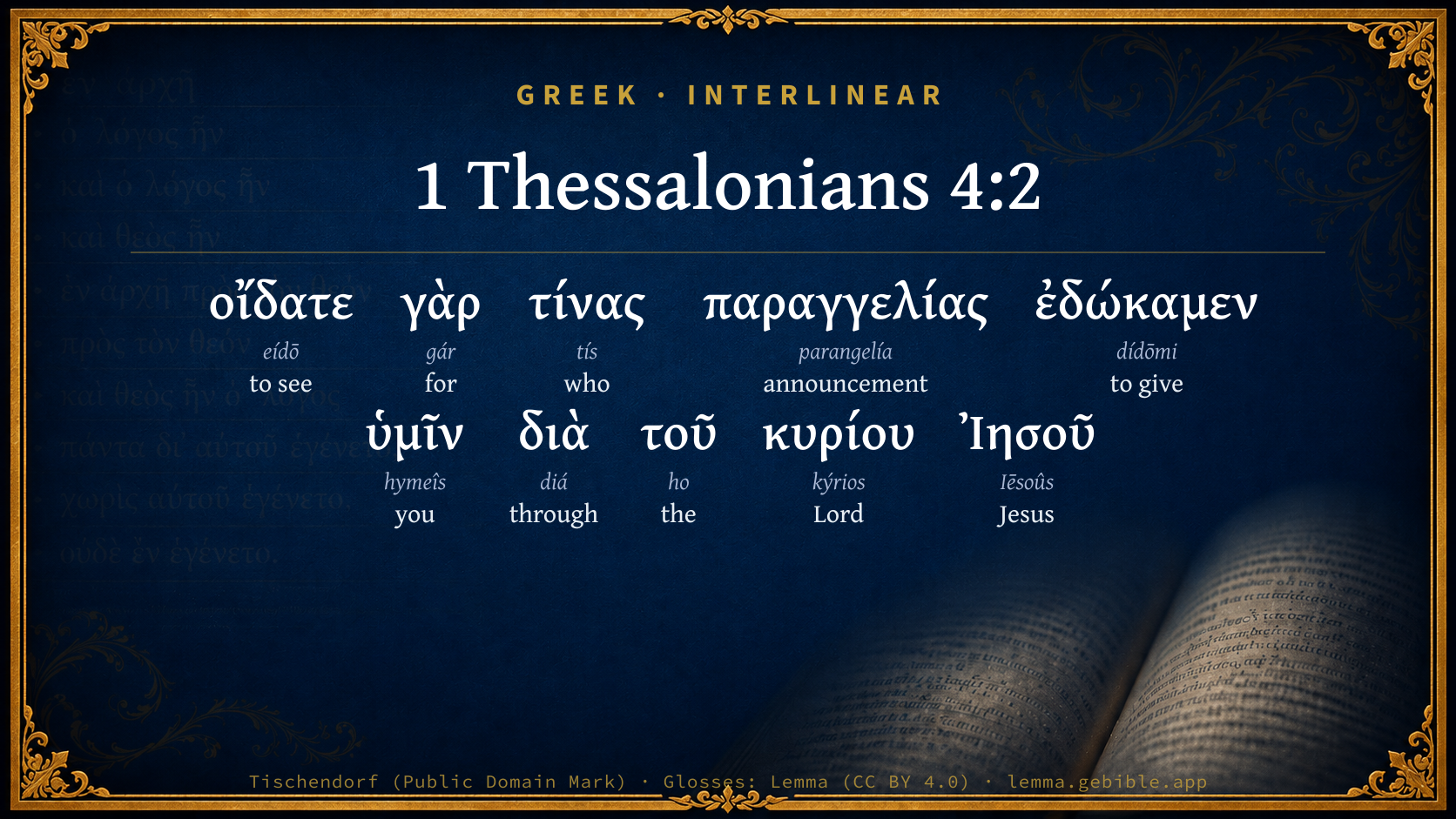
Greek (Tischendorf 8th ed.) 1 Thessalonians 4:2 appears in the Greek New Testament. The text above is from the Tischendorf 8th edition. Each word links to its Strong’s number and a concise gloss. Click any word for its full Thayer’s Greek Lexicon entry.
Download image
Cite this verse

1 Thessalonians 4:2 (World English Bible). Public Domain. Lemma interlinear Bible study tool, https://lemma.gebible.app/v/1-thessalonians/4/2.

Show BibTeX & RIS
BibTeX
RIS
English Translation
For you know what charge we gave you through the Lord Jesus.
World English Bible · Public Domain
Download a study sheet

One document with this verse’s original text, its word-by-word gloss line, the meaning frame, cross-references with their text, attributed commentary, and full source and license credits — printable, and it pastes into notes with its structure intact.

This verse Autodidact and up

Study sheet (.html) Plain text (.txt)

A passage Seminary Student

Up to 50 verses in one chapter. A passage sheet keeps up to 6 commentary sources and 12 cross-references per verse, in the order this page ranks them, and says so on the sheet whenever that leaves anything out. Ask for a single verse and you get the Autodidact verse sheet above.

Everything on this page stays free to read, with no account — the sheet is a download of what is already on screen, not access to it.

Want to remove ads? Support Godless Engineer
Compare translations 3

The same verse in 3 English versions, stacked beneath the original-language interlinear above. Click any original word for its lexicon entry.

Each is an independent rendering of the whole verse — the interlinear is not word-aligned to these translations.

Highlighted words mark where these versions differ — a whole-verse word diff, not a word-by-word alignment.

  • World English Bible Public Domain
    For you know what charge we gave you through the Lord Jesus.
  • King James Version Public Domain
    For ye know what commandments we gave you by the Lord Jesus.
  • unfoldingWord Literal Text CC BY-SA 4.0
    For you know what commands we gave you through the Lord Jesus.

unfoldingWord Literal Text — © unfoldingWord, licensed CC BY-SA 4.0. Word-aligned USFM3 via Door43 (git.door43.org/unfoldingWord/en_ult).

Versions to compare (up to 4)

3 of 4 selected

Show all 19 translations

Every available English version of this verse, each an independent rendering of the whole verse.

  • World English Bible Public Domain
    For you know what charge we gave you through the Lord Jesus.
  • Berean Standard Bible Public Domain
    For you know the instructions we gave you by the authority of the Lord Jesus.
  • Majority Standard Bible Public Domain
    For you know the instructions we gave you by the authority of the Lord Jesus.
  • King James Version Public Domain
    For ye know what commandments we gave you by the Lord Jesus.
  • American Standard Version (1901) Public Domain
    For ye know what charge we gave you through the Lord Jesus.
  • Revised Version (1885) Public Domain
    For ye know what charge we gave you through the Lord Jesus.
  • Geneva Bible (1599) Public Domain
    For ye knowe what commandements we gaue you by the Lord Iesus.
  • Douay-Rheims (1899) Public Domain
    For you know what precepts I have given to you by the Lord Jesus.
  • Young's Literal Translation Public Domain
    for ye have known what commands we gave you through the Lord Jesus,
  • Literal Standard Version CC BY-SA 4.0
    for you have known what commands we gave you through the Lord Jesus;
  • Unlocked Literal Bible CC BY-SA 4.0
    For you know what instructions we gave you through the Lord Jesus.
  • unfoldingWord Literal Text CC BY-SA 4.0
    For you know what commands we gave you through the Lord Jesus.
  • Darby Bible Public Domain
    For ye know what charges we gave you through the Lord Jesus.
  • World Messianic Bible Public Domain
    For you know what instructions we gave you through the Lord Yeshua.
  • Webster's Bible Public Domain
    For ye know what commandments we gave you by the Lord Jesus.
  • Free Bible Version CC BY-SA 4.0
    You remember the instructions we gave you on behalf of the Lord Jesus.
  • Bible in Basic English Public Domain
    Because you have in mind the orders we gave you through the Lord Jesus.
  • Text-Critical English NT CC BY 4.0
    For you know the commands we gave you by the authority of the Lord Jesus.
  • Tyndale New Testament (1534) Public Domain
    Ye remember what commaundmentes we gave you in oure lorde Iesu Christ.

Literal Standard Version (2020), Covenant Press — licensed CC BY-SA 4.0. Text via the HelloAO Bible API (eBible.org). Unlocked Literal Bible (unfoldingWord) — licensed CC BY-SA 4.0. Text via the HelloAO Bible API (eBible.org). unfoldingWord Literal Text — © unfoldingWord, licensed CC BY-SA 4.0. Word-aligned USFM3 via Door43 (git.door43.org/unfoldingWord/en_ult). Free Bible Version, Dr. Jonathan Gallagher — licensed CC BY-SA 4.0. Text via the HelloAO Bible API (eBible.org).

Word by word

More ways to search: Search by grammar → Find every occurrence → Compare this word →

Practice this passage: Drill this verse → Learn its vocabulary →

About this verse

These counts appear in no published source. They are computed here, from the morphology-tagged text and Lemma’s own curated glosses. What Lemma adds →

10
words
10
distinct lemmas
Pauline Epistles
section

Notable vocabulary

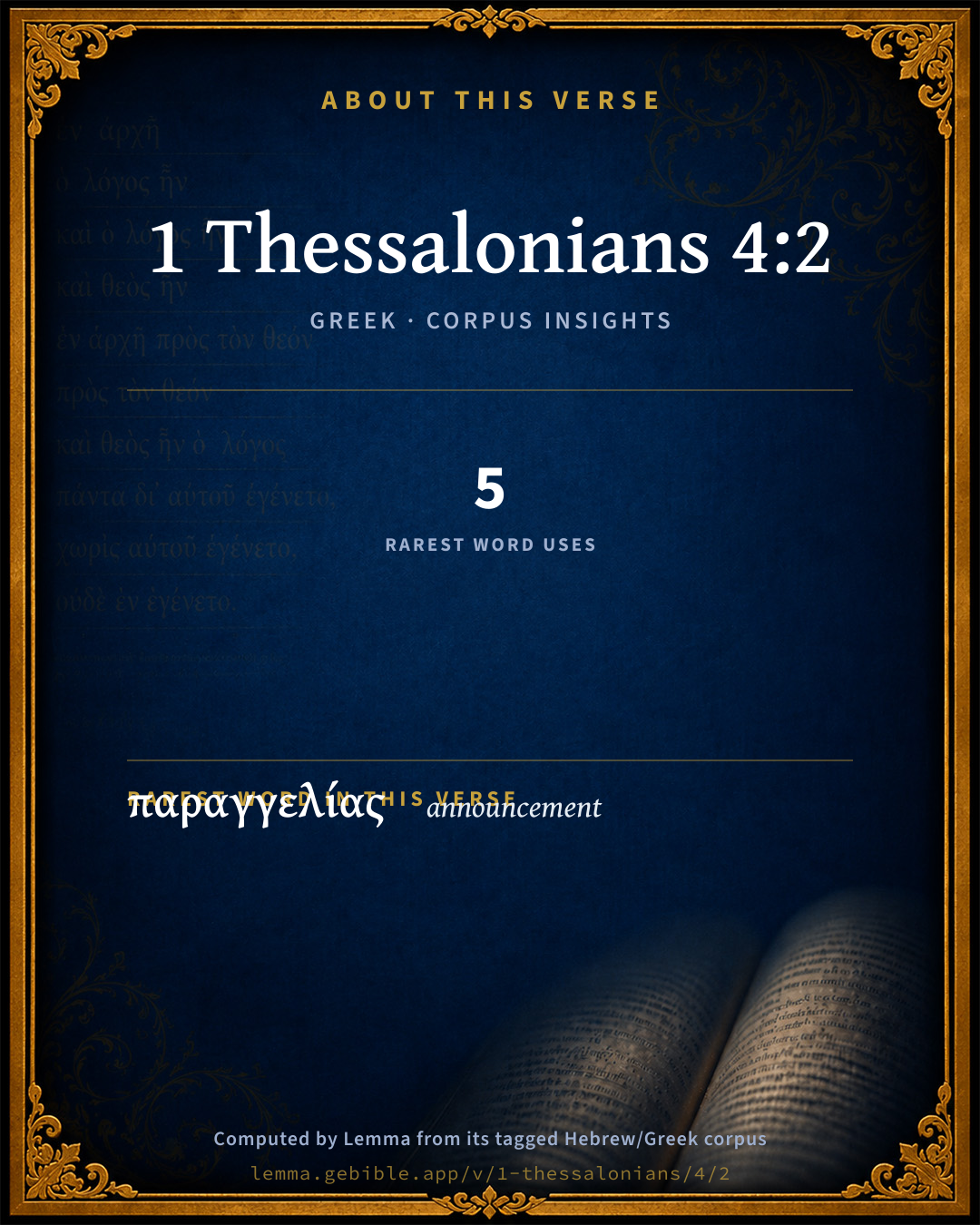
The rarest word here is παραγγελίας announcement G3852 — appearing just 5 times in the whole Greek New Testament.

Shared distinctive vocabulary

παραγγελίας announcement G3852 occurs in 5 verses of the Greek New Testament. Also found in:

Cross-references

5

Topical passages linked to 1 Thessalonians 4:2 in the Treasury of Scripture Knowledge — connected by theme and wording, ordered by reader-vote popularity; previews shown in the World English Bible.

  • Matthew 28:20 teaching them to observe all things that I commanded you. Behold, I am with you always, even to the end of the age." Amen.
  • Ezekiel 3:17 Son of man, I have made you a watchman to the house of Israel: therefore hear the word at my mouth, and give them warning from me.
  • 1 Corinthians 9:21 to those who are without law, as without law (not being without law toward God, but under law toward Christ), that I might win those who are without law.
  • 2 Thessalonians 3:6 Now we command you, brothers, in the name of our Lord Jesus Christ, that you withdraw yourselves from every brother who walks in rebellion, and not after the tradition which they received from us.
  • 2 Thessalonians 3:10 For even when we were with you, we commanded you this: "If anyone will not work, neither let him eat."

Cross-references courtesy of OpenBible.info (CC BY 4.0).

Commentary

Notes on 1 Thessalonians 4:2 from classic Christian and Jewish commentators (each source and its license shown beneath its notes). The classic Christian expositions comment on the surrounding passage and are grouped to its opening verse, so a note may address several verses; the Jewish commentaries on the Tanakh (Rashi and others) are per-verse, so they appear only where the commentator wrote on this verse.

Lemma curates 59 commentaries, every one of them public domain or Creative Commons licensed, each selected and text-cleaned for this edition rather than reprinted as found. About our sources →

The Biblical Illustrator

Joseph S. Exell

1Th_4:2

For ye know what commandments we gave you by the Lord Jesus

The Lord Jesus and His commandments

I.

Jesus is Lord.

1. By Divine appointment He shall reign.

2. By creative acts He has a right to rule over things and beings whom He has made.

3. By redemptive work: Ye are not your own.

4. By the glad acknowledgment of His saints: Unto Him that loved us.

5. By the ultimate recognition of the universe: At the name of Jesus every knee shall bow, etc.

II. As Lord Jesus has a right to command.

1. This right is uniformly asserted. Christ never prefers a request, makes a suggestion, or expresses a wish; it is always Come, Go, Do this, If I, your Lord and Master ye aught.

2. This right has been blasphemously usurped. They are impious usurpers who determine other means of salvation, or rules of moral conduct other than those He has laid down. One is your Master.

III. His commands have been plainly revealed. Ye know.

1. Directly by Himself. Love one another, etc.

2. Instrumentally by His accredited ambassadors. We gave you from the Lord Jesus. Their deliverances, however, are only applications of Christs principles to particular persons and places.

3. Permanently in the Bible.

(1) How clearly.

(2) How accessibly. Ignorance is without excuse.

IV. Obedience to His commandments is the criterion of discipleship. Commands are given--

1. Not to be thought about.

2. Not to be the subjects of promise in regard to the doing of them.

3. But to be obeyed. Ye are My disciples if ye do. This doing must be--

(1) Universal. Whatsoever I command you.

(2) Prompt. There is no time to lose.

(3) Cheerful. We are subjects of so good a King.

Conclusion:

1. Christ as Lord is approachable. He is the mighty God, but, He is the Man Christ Jesus. Sovereigns are difficult of access, are surrounded by the pomp of circumstance, excite embarrassment and nervousness when they do not terrify. But we may come boldly to the throne of grace.

2. His commandments are not grievous. They are reducible to a few plain principles which a child may learn by heart. If we grasp them we practically grasp all. And then they are simply the conditions upon which alone our well-being can be secured.

3. What He has bidden us do He has done Himself. It makes all the difference on a field of battle whether the commanding officer says Go or Come. Christ says, I must go … if any man will come after Me. I have left you not only commands but an example, an embodied command.

4. In loving loyalty to Christ there is great reward. Lo, I am with you, now; Well done, by and by. (J. W. Burn.)

The authority of Christ

Christ does not appeal to men as the heathen philosophers did. They ask opinions, court criticism, and even the wily and garrulous Socrates gives men an opportunity of differing from him; but Christ, with the authoritative tone and earnestness of the Son of God, says, This is absolute; believe it and be saved, or reject it and be damned. He says that He came from the Father, that He speaks the Word of the Father, and that He is returning to the Father. So there is nothing between Him and God; immediately behind Him, though invisible, lies infinitude, and He sets Himself up as the medium on which the voice of the infinite is broken into human sounds. (J. Parker, D. D.)

Gods commandments a protection and a delight

Reconciliation to God is like entering the gate of a beautiful avenue which conducts to a splendid mansion. But that avenue is long, and in some places it skirts the edge of dangerous cliffs; and therefore to save the traveller from falling over where he would be dashed to pieces, it is fenced all the way by a quick set edge. That hedge is the Commandments. They are planted there that we may do no harm; but like a fence of the fragrant briar, they regale the pilgrim who keeps the path, and they only hurt him when he tries to break through. Temperance, justice, truthfulness, purity of speech and behaviour, obedience to parents, mutual affection, Sabbath keeping, Divine worship--all these are righteous requirements; and in keeping of them there is great reward. Happy is he who only knows the precept in the perfume which it sheds, and who, never having kicked against the pricks, has never proved the sharpness of the thorns. (J. Hamilton, D. D.)

Gods commandments reasonable

There is mention made of one who willingly fetched water near two miles every day for a whole year to pour on a dead stick at the command of a superior, when no reason could be given for so doing. How ready then should every one be to do Christ service, whose commands are backed with reason, and whose precepts are attended with encouragements. (J. Spencer.)

The Biblical Illustrator, edited by Joseph S. Exell (c. 1880s–1900s) — public domain. Text from a community e-Sword module.

Bengel's Gnomon

Johann Albrecht Bengel

1Th 4:2. Παραγγελίας, commandments) Paul uses this word at this very early time, when writing to the Thessalonians, whose piety took it in the right spirit, as did also the piety of Timothy, to whom he gives his commands with the greatest sternness. The same word occurs, 1Th 4:11; 2Th 3:4; 2Th 3:6; 2Th 3:10; 2Th 3:12. In addressing other churches subsequently, when his authority was established, he uses it very seldom.

Bengel's Gnomon of the New Testament — English translation (T&T Clark, Edinburgh, 1860) — public domain. Text from a community e-Sword module.

Meyer's Critical & Exegetical Commentary

Heinrich August Wilhelm Meyer

1Th_4:2. A strengthening of παρελάβετε παρʼ ἡμῶν, 1Th_4:1, by appealing to the knowledge of the readers: for it is well known to you, ye will thus be the more willing to περισσεύειν. This appeal to their own knowledge is accordingly by no means useless, and still less un-Pauline (Schrader, Baur), as it is elsewhere not rare with Paul; comp. Gal_4:13; 1Co_15:1 ff., etc.

παραγγελίαι] not evangelii praedicatio, in qua singula praecepta semine quasi inclusa latitant (Pelt), against which is the context and the plural form; but commands (comp. Act_5:28; Act_16:24; 1Ti_1:5; 1Ti_1:18), and that to a Christian life. The stress is on τίνας, to which τοῦτο, 1Th_4:3, corresponds.

διὰ τοῦ κυρίου Ἰησοῦ] through the Lord Jesus, by means of Him, i.e. Paul did not command διʼ ἑαυτοῦ, but Christ Himself was represented by him as the Giver of the παραγγελίαι. Comp. Bernhardy, Syntax, p. 235 f. Schott blends the ideas in a strange manner: Auxilio sive beneficio Christi, siquidem Paulus, ab ipso domino ad provinciam apostoli obeundam vocatus, διʼ ἁποκαλύψεως Χριστοῦ inter illos docuerat. So also de Wette: by means of the revelation given in the Lord, so that the general divine truth is communicated through Him. Falsely Pelt, διά is equivalent to ἐν; and Grotius, accepta is to be supplied.

Meyer — Critical and Exegetical Commentary on the New Testament — English translation by Peter Christie, edited by Frederick Crombie (T&T Clark, 1880) — public domain. Text from a community e-Sword module.

Expositor's Greek Testament

ed. W. Robertson Nicoll

1Th 4:2 . Almost a parenthesis, as Bahnsen points out in his study of 1 12 ( Zeitschrift f. wiss. Theol. , 1904, 332 358). The injunctions ( παραγγελίαι in semimilitary sense, as 1Ti 1:18 ) relate to chastity (1Th 4:3-8 ) and charity, (1Th 4:9-10 ), with a postscript against excitement and idleness (11, 12). παραγγ . for the cognate use of this term ( cf. 1Th 4:8 ) in the inscriptions of Dionysopolis ( παραγγέλλω πᾶσιν μὴ καταφρονεῖν τοῦ θεοῦ ) cf. Exp. Ti. , x. 159. διὰ κ . τ . λ ., the change from the ἐν of 1Th 4:1 does not mean that the Thessalonians before their conversion got such injunctions from Paul on the authority of Christ, while afterwards they simply needed to be reminded of the obligations of their union ( ἐν ) with the Lord. No strict difference can be drawn between both phrases ( cf. Heitmüller’s Im Namen Jesu , 71 f.), though the διά lays rather more stress on the authority. For Jesus to command διά the apostles seems to us more natural than to say that the apostles issue commands διὰ τοῦ Κυρίου , but the sense is really the same. The apostles give their orders on the authority of their commission and revelations from the Lord whom they interpret to His followers ( cf. Rom 15:30 ; Rom 12:2 ). But this interpretation must have appealed to the sayings of Jesus which formed part of the παράδοσις ( cf. Weizsäcker’s Apostolic Age , i. 97, 120, ii. 39). Thus 8 a is an echo of the saying preserved in Luk 10:16 .

The Expositor's Greek Testament, edited by W. Robertson Nicoll (1897–1910) — public domain. Text from a community e-Sword module.

Cambridge Greek Testament for Schools and Colleges

2. οἵδατε γὰρ τίνας παραγγελίας ἐδώκαμεν ὑμῖν. For you know what charges we gave you. See notes on this characteristic οἴδατε, 1Th 1:5, 1Th 2:1, above. Οἴδατε τὰς παραγγελίας ἅς κ.τ.λ. (cf. 1Th 2:1; 2Ti 1:12; 2Ti 3:15; 2Co 9:2) would have meant, “You are acquainted with the charges we gave you”—you could describe them; but οἴδατε τίνας παραγγ. (with dependent interrogative; cf. 2Ti 3:14, εἰδὼς παρὰ τίνων ἔμαθες) is, “You know what the charges are”—you could define them &c.; cf. note on οἴδατε οἶοι, 1Th 1:5. The παραγγελίαι originally given by the Apostles (cf. 2Th 3:4; 2Th 3:6; 2Th 3:10; Eph 4:20 to Eph 5:2; Tit 2:11-14) were not bare rules of conduct (ἐντολαί), but injunctions drawn from the nature of the Gospel and urged affectionately and solemnly, doctrine and precepts forming one παράκλησις (1Th 2:3) or παραγγελία (1Ti 1:5). In classical Greek παραγγέλλω, παραγγελία, are used of commands or watch words transmitted along (παρά) a line of troops (see Xenophon, Anab. i. 8. 3; Cyrop. ii. 1Th 4:2), then of military orders in general, of pedagogic precepts, &c.; in distinction from κελεύω (which St Paul never uses), παραγγέλλω connotes moral authority and earnestness in the command,—a “charge” not a mere “order,” “præcepta” (Vulg.) rather than “mandata” (Beza). The 1st plur. ἐδώκαμεν is rare, but not unknown, in Attic Greek; see Winer-Moulton, p. 102.

The defining διὰ τοῦ κυρίου Ἰησοῦ recalls ἐν κυρίῳ Ἰησοῦ of 1Th 4:1 (see note): διά points to the name and authority of “the Lord Jesus” as the sanction “through” which the “charges” were enforced (scarcely “prompted by the Lord Jesus,” as Lightfoot puts it), while ἐν κ. Ἰ. implied that the apostolic precepts moved “in the sphere of” His rule: cf., not overlooking the difference of title, διὰ τοῦ χριστοῦ in 2Co 1:5, and Rom 1:8; Rom 5:11; somewhat similarly, διὰ θεοῦ in 1Co 1:9, Gal 4:7, &c.; and παρακαλεῖν διά, Rom 12:1; Rom 15:30, 1Co 1:10, 2Co 10:1.

Cambridge Greek Testament for Schools and Colleges (Cambridge University Press, 1896; 21 vols, various authors incl. Carr, Maclear, Plummer, Farrar, Lumby, Moule, M. R. James, Simcox) — public domain. Text from a community e-Sword module.

Jamieson, Fausset & Brown

Robert Jamieson, A. R. Fausset & David Brown

by the Lord Jesus--by His authority and direction, not by our own. He uses the strong term, "commandments," in writing to this Church not long founded, knowing that they would take it in a right spirit, and feeling it desirable that they should understand he spake with divine authority. He seldom uses the term in writing subsequently, when his authority was established, to other churches. Co1 7:10; Co1 11:17; and Ti1 1:5 (Th1 4:18, where the subject accounts for the strong expression) are the exceptions. "The Lord" marks His paramount authority, requiring implicit obedience.

Jamieson, Fausset & Brown — Commentary Critical and Explanatory on the Whole Bible (1871) — public domain (CC PDM 1.0). Text via the HelloAO Bible API.

Adam Clarke's Commentary

Verse 2. Ye know what commandments we gave you] This refers to his instructions while he was among them; and to instructions on particular subjects, which he does not recapitulate, but only hints at.

Adam Clarke's Commentary on the Bible (1810–1826) — public domain. Text from a community e-Sword/MySword module.

Ellicott's Commentary for English Readers

(2) For ye know.—He calls on the Thessalonians’ memory to support his statement, “ye received;” at the same time awakening their interest to catch the special point next to come, by laying stress on “what commandments.”

By the Lord Jesus.—Not as if the Lord were the person who took the commandments from St. Paul to the Thessalonians, but the person by means of whose inspiration St. Paul was enabled to give such commandments.

A Bible Commentary for English Readers, edited by Charles John Ellicott (1878–1897) — public domain. Text from a community e-Sword module.

The Cambridge Bible for Schools and Colleges

gen. ed. J. J. S. Perowne

2. For ye know what commandments we gave you by the Lord jesus] Lit., charges … through the Lord Jesus; similarly in 1Th_4:11, “as we charged you,” and in 2Th_3:4, &c. The Greek word signifies an announcement, then a command or advice publicly delivered. In 1Ti_1:5; 1Ti_1:18 the whole practical teaching of Christianity is called a “charge.” Here the Apostle is referring to particular items of conduct as matter of so many “charges.” These charges were given “through the Lord Jesus,” since His name and authority were used to support them (comp. 2Th_3:6, “in the name of our Lord Jesus Christ”); while they were given “in the Lord Jesus” (1Th_4:1), as they appealed to the Christian standing of the readers and their conscious relationship to Christ, Whose coming in glory they expected.

The Apostle is “writing no new commandment;” he recalls to his readers’ remembrance what he had so often urged upon them (see note on ch. 1Th_1:5). It is on one prominent subject of those well-remembered charges that he has now to dwell:—

The Cambridge Bible for Schools and Colleges (gen. ed. J. J. S. Perowne; Cambridge University Press, 1878–1918) — public domain. Text from a community e-Sword module.

John Gill's Exposition

For ye know what commandments we gave you,.... When among them; such as those of faith and love, the ordinances of the Gospel, baptism, and the Lord's supper, and all such as relate to the worship and service of God, to the discipline of Christ's house, to their behaviour one towards another, and their conduct in the world: and which were delivered to them, not as from themselves, and by their own authority, but

by the Lord Jesus; in his name, and by his authority, and as ordered by him; for their commission ran to teach men all things, whatsoever Christ commanded: now since they knew what these commandments were, and whose they were, and the obligation they lay under to regard them, the apostle makes use of it as a reason or argument to engage them to obedience to them; for he that knows his Lord's will, and does it not, shall be beaten with many stripes, Luk 12:47.

John Gill's Exposition of the Whole Bible (1746–1763) — public domain (CC PDM 1.0). Text via the HelloAO Bible API.

Trapp's Complete Commentary

John Trapp

2 For ye know what commandments we gave you by the Lord Jesus.

Ver. 2. For ye know what, &c.] It is expected therefore that ye do them; else the more heinous will be your sin, and the more heavy your reckoning, Isa 59:11-12. What brought such roarings and trouble on them, and that when salvation was looked for? Our iniquities testify to our faces, and we know them.

John Trapp, A Commentary or Exposition upon All the Books of the Old and New Testament (1647–1656) — public domain. Text from a community e-Sword module.

Albert Barnes' Notes on the Bible

For ye know what commandments - It was but a short time since Paul was with them, and they could not but recollect the rules of living which he had laid down.

By the Lord Jesus - By the authority of the Lord Jesus. Some of those rules, or commandments, the apostle refers to, probably, in the following verses.

Albert Barnes' Notes on the Bible (1834–1885) — public domain. Text from a community e-Sword/MySword module.

Matthew Poole's English Annotations

This explains what he said before; what they had received of him about their walking he here calls commandments, not so much his own as the Lord’s, as the word itself imports here used, and is expressed in the text.

By the Lord Jesus: though the apostle had authority, yet it was but derivative from Christ; and therefore not to walk as the apostle had commanded would be disobedience to Christ himself. And he minds them of what they knew, that their knowledge might be exemplified in practice; for as faith, so knowledge, is dead which doth not influence the life; and they knew that he commanded them not in his own name, but in the name of Christ.

Matthew Poole's English Annotations on the Holy Bible (1683–1685) — public domain. Text from a community e-Sword/MySword module.

Whedon's Commentary on the Bible

Daniel D. Whedon

2. For ye know—Again appealing to their memories as to the how enjoined by the commandments which he gave in his preaching while with them. By—Rather, through Jesus; as their moral commandments were first given by him.

Daniel D. Whedon (gen. ed.), Commentary on the Old and New Testaments (1874–1909) — public domain. Text from a community e-Sword module.

The Pulpit Commentary

For ye know; appealing to their memory in confirmation of what he had said. What commandments we gave you by the Lord Jesus; or, through the Lord Jesus; that is, not merely by his authority, but by means of him, so that these commandments did not proceed from Paul, but from the Lord Jesus himself. We have here, and indeed in this chapter throughout, an assertion of the inspiration of the apostle: the commandments which he gave to the Thessalonians were the commandments of the Lord Jesus.

The Pulpit Commentary (1880–1919), ed. H.D.M. Spence-Jones & Joseph S. Exell — public domain. Text from a community e-Sword module.

Burkitt's Expository Notes on the New Testament

William Burkitt

Here our apostle subjoins a reason, to enforce his foregoing exhortation; what he now required of them, was nothing but what at their first conversion to Christianity he had commanded them, and that in the name, and by the authority of Jesus Christ, to be performed by them; so that they were not his commands, but Christ’s by him, and, as such, to be esteemed of them.

Learn hence, that the instructions and rules for a holy life, laid down by the apostles before the churches, are to be looked upon as the commandments of Christ, as being dictated by his Spirit, and delivered by his authority, and as such to be received of them, and obeyed by them.

William Burkitt's Expository Notes on the New Testament (1700–1703) — public domain. Text from a community e-Sword module.

McGarvey & Pendleton's Commentaries

J. W. McGarvey

For ye know what charge we gave you through the Lord Jesus . [The commandments were given by Paul through the inspiration of the Spirit sent of Jesus. Throughout this chapter Paul asserts his inspiration.]

J. W. McGarvey (with Philip Y. Pendleton), Commentaries on the New Testament (The Fourfold Gospel, 1914; Acts; and the epistles) — public domain. Text from a community e-Sword/MySword module.

The People's New Testament

B. W. Johnson

2. What commandments. What commands had been given as coming from the Lord Jesus.

B. W. Johnson's The People's New Testament with Notes (1889–1891) — public domain. Electronic text from the Christian Classics Ethereal Library (CCEL) ThML edition.

Alford’s Greek Testament

Henry Alford

2.] takes up the καθὼς παρελάβετε of the former verse, and appeals to their memory in its confirmation. See similar appeals in Gal 4:13; 1Co 15:1.

παραγγ.] commands, see reff. The stress is on τίνας, to which τοῦτο answers, ver. 3.

διὰ τ. κ. Ἰησ.] by, i.e. coming from, παραγγελθείσας διὰ. So τὰς διὰ τῶν ὀλίγων πολιτείας, Demosth. p. 489: διʼ ἑαυτοῦ, of himself, Xen. Cyr. viii. 1. 43: see Bernhardy, p. 236.

Henry Alford, The Greek Testament (1849–1861) — public domain. Text from a community e-Sword module.

International Critical Commentary

2. οἴδατε γάρ κτλ. “For you know what instructions we gave you.” γά strengthens and confirms the point already made in the first clause with καθώ (v. 1). This explicit appeal to the knowledge of the readers shows how concerned Paul is in insisting that he is making no new requests.

“The emphasis, as Lünemann observes, rests on τίνα, and prepares the readers for the following τοῦτ, v. 3” (Ell.). Not until we come to ἀπέχεσθα do we learn the content of τὸ πῶς δει (v. 1) and τίνα (v. 2).—For γά, cursive 33 reads δε (cf. Gal 4:13). οἴδατε γά reminds us of the apologetic appeals in 1:5, 2:1, 2, 5, 11, 3:3, 4; here also the reference is apologetic, but in a different sense; Paul would have his converts feel that he is not issuing new and arbitrary orders, but orders already given and prompted by the indwelling Christ (διὰ τοῦ κυρίο). παραγγελί is a military word occurring rarely in Gk. Bib. (literally in Act 5:28, Act 5:16:24; of ethical orders, 1Ti 1:5. 1Ti 1:18 1Ti 1:1 Clem. 42:3). διδόναι παρα is a late Gk. periphrasis for παραγγέλλει (a common word in Gk. Bib.; cf. v. 11, II 3:4 ff.) similar to διδόναι ἐντολή for ἐντέλλεσθα (cf., in Joh 14:31, Bl with אAD).

διὰ τοῦ κυρίου Ἰησοῦ “Prompted by the Lord Jesus” (Lft.); loquente in nobis Spiritu Christi (Vatablus, apud Poole). The δια designates the Lord “as the causa medians through which the παραγγελία were declared; they were not the Apostle’s own commands, but Christ’s (οὐκ ἐμὰ γάρ, φησίν, ἃ παρήγγειλα, ἀλλʼ ἐκείνου ταῦτ Theophylact), by whose influence he was moved to deliver them” (Ell.). διὰ κυρίο is grammatically different from but essentially identical with ἐν κυρίῳ the former is dynamic both in form and in meaning; the latter is static in form but dynamic in force (see on 1:1). Christians are “in” Christ or the Spirit because Christ or the Spirit is in them as a permanent energising activity. Since the divine is in them, it is “through” (δια) the divine as a mediating cause that they are empowered to do all things (Php 4:13). The presence of both ἐνκυρίῳ (v. 1) and διὰ κυρίο is here designed not to emphasise the apostolic authority of the writers but to point the readers to the divine source of authority which both readers and writers recognise as legitimate, the indwelling Christ. To be sure, Paul recognises his apostolic authority (2:6, II 3:9); no doubt it had of itself immense weight with the Thessalonians; but here he insists that just as when he was with them (2:7) so now as he writes he is but one of them, relying as they do on Christ in them as the common source of divine authority.

Schettler, Die paulinische Formel, “Durch Christus,” 1907, gives an exhaustive study of δια with Χριστου and its synonyms, θεου and πνεύματο While pressing his point somewhat rigorously, he succeeds in showing that δια indicates causal agency, and that the phrase “through Christ” denotes the activity of the spiritual Christ as agent in creation and salvation, and as an influence either in general or specifically in the life of prayer and the official legitimation of Paul (cf. AJT 1907, 690 f.). For this δια, cf. 4:14, 5:9, II 2:2. A few minuscules (69. 441-2. 462) read here ἐν χυρίῳ Ἰ (cf. II 3:12 where for ἐν κ. Ἰ. Χ, אc Dc KL, et al., read διὰ κ. Ἰ. Χ); on this interchange of ἐ and δια, see further Rom 5:9 f. 2Co 1:20, 2Co 5:18 f. Col 1:16. Col 1:19 f. On ἐν ὀνόματ (II 3:6, Col 3:17) and διὰ τοῦ ὀνόματο (1Co 1:10), see below on II 3:6.

(2) True Consecration (4:3-8)

The divine exhortation (ἐν κυρίῳ v. 1) and the divine command (διὰ κυρίο, v. 2) now becomes the divine will (θέλημα τοῦ θεου, v. 3). The meaning of τὸ πῶ (v. 1) and τίνα (v. 2) which are resumed by τοῦτ (v. 3) is first stated generally as “your consecration,” that is, “that you be consecrated.” This general statement is then rendered specific by two pairs of infinitives in apposition to ὁ ἁγιασμὸς ὑμῶ, namely, ἀπέχεσθα and εἰδέναι, κτᾶσθα and ὑπερβαίνει The principle is that true consecration being moral as well as religious demands sexual purity. Along with the principle, a practical remedy is suggested: The prevention of fornication by having respect for one’s wife; and the prevention of adultery by marrying not in lust but in the spirit of holiness and honour. As a sanction for obedience, Paul adds (vv. 6b-8) that Christ punishes impurity; that God calls Christians not for impurity but for holiness; and that the Spirit, the gift of God unto consecration, is a permanent divine power resident in the individual Christian (5:23) so that disobedience is directed not against the human but against the divine.

The appeal to the Spirit as the highest sanction in every problem of the moral life is characteristic of Paul; cf. 1Co 6:19 and McGiffert. Apostolic Age, 263 ff. The reason for presenting the Christian view of consecration involving a Christian view of marriage is to be found not simply in the fact that the converts had as pagans looked upon sexual immorality as a matter of indifference, but also in the fact that such immorality had been sanctioned by their own religious rites (see on ἀχαθαρσί, 2:3). The temptation was thus particularly severe and some of the converts may have been on the point of yielding. The group as a whole, however, was pure, as 1:3, 3:6 and χαθὼς καὶ περιπατεῖτ (v. 2) make plain.

3God’s will is this, that you be consecrated, that is, that you abstain from fornication, 4that each of you respect his own wife; that each of you get his own wife in the spirit of consecration and honour 5not in the passion of lust, as is the case with the Gentiles who know not God, 6to prevent any one of you from disregarding or taking advantage of his brother in the matter. For the Lord is an avenger for all these matters, as indeed we have predicted and solemnly affirmed; 7for God has not called us Christians for impurity but to be consecrated; 8consequently the rejecter rejects not man but God who puts his Spirit, the consecrating Spirit, into you.

International Critical Commentary — older volumes (1896–1929), various authors — public domain. Text from a community e-Sword module.

Vincent's Word Studies in the New Testament

Marvin R. Vincent

Commandments [παραγγελιας] . Better, charges. Only four times in N. T. o LXX The verb paraggellein to command or charge is frequent, and is often used in Class of military orders. See Xen. Cyr 2:4, 2; Hdt 3:25.

Marvin R. Vincent, Word Studies in the New Testament (1887–1900) — public domain. Text from a community e-Sword/MySword module.

Lesson kit

Teaching starters — assembled from the data on this page, not authored interpretation. Every prompt links to the verse data it draws on. Edit before teaching.

1 Thessalonians, in the Pauline Epistles, opens this verse with 10 words (10 distinct Greek lemmas). Its most distinctive word is parangelía (“announcement”). A historical commentator’s framing appears above. Read the whole chapter for the surrounding context.

Discussion questions

  1. The word parangelía carries the sense “announcement.” How does it shape the verse?
  2. How does Acts 5:28, which shares the word «announcement», read alongside this verse?
  3. These translations render this verse differently. What is at stake in choosing one wording over another?
  4. Compare how The Biblical Illustrator and Bengel's Gnomon read this verse. Where do they agree or differ?

Things to notice

Reading settings

Reading text

Shown beneath each verse's original-language words.

Old Testament
Old Testament edition

Read the OT as the Masoretic Hebrew (MT) or the Greek Septuagint (LXX).

English shown for the Greek Septuagint (in the Hebrew ↔ Greek comparison).

Comparing translations? Open the Compare panel on any verse page to stack up to four side by side.