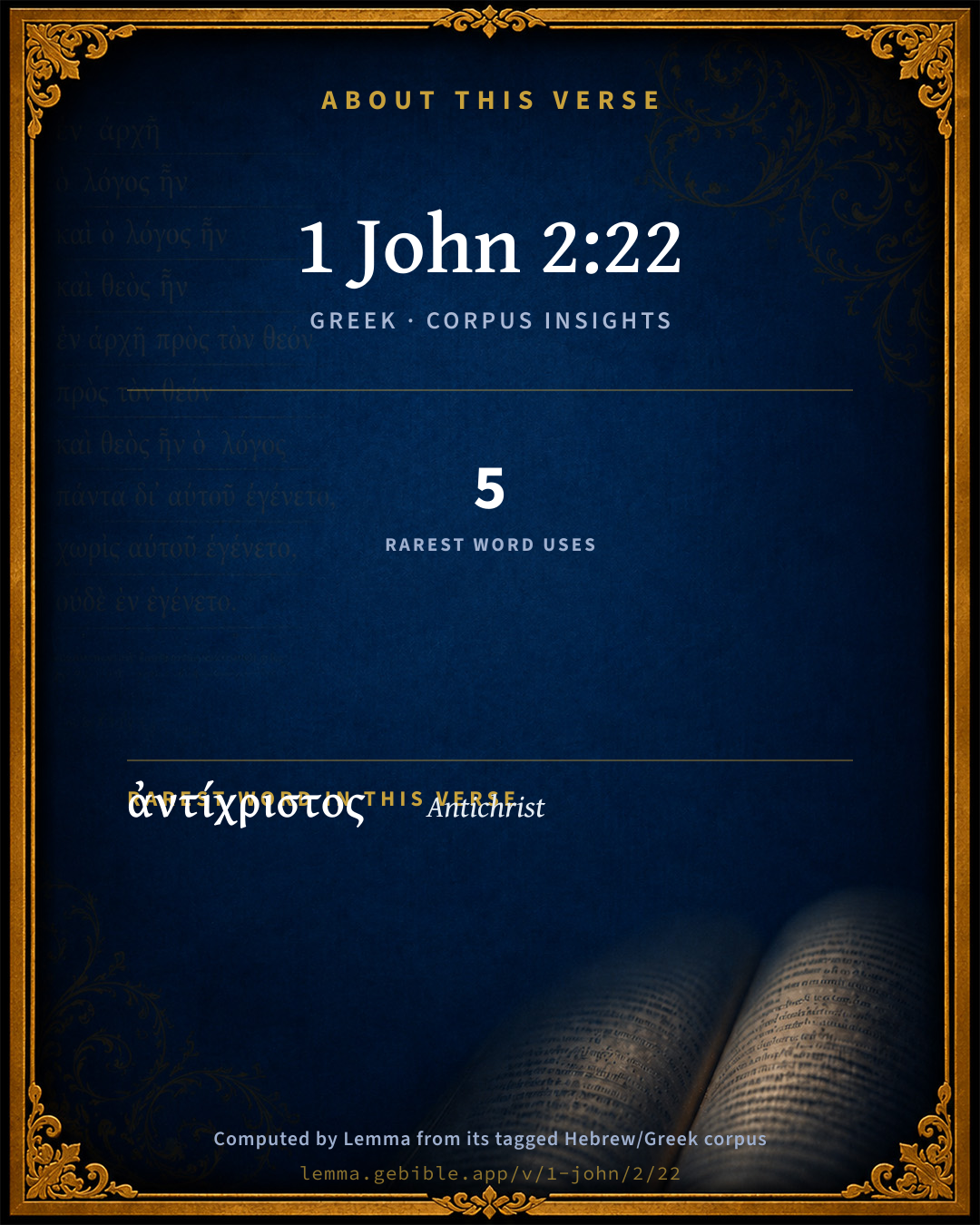
1 John 2:22

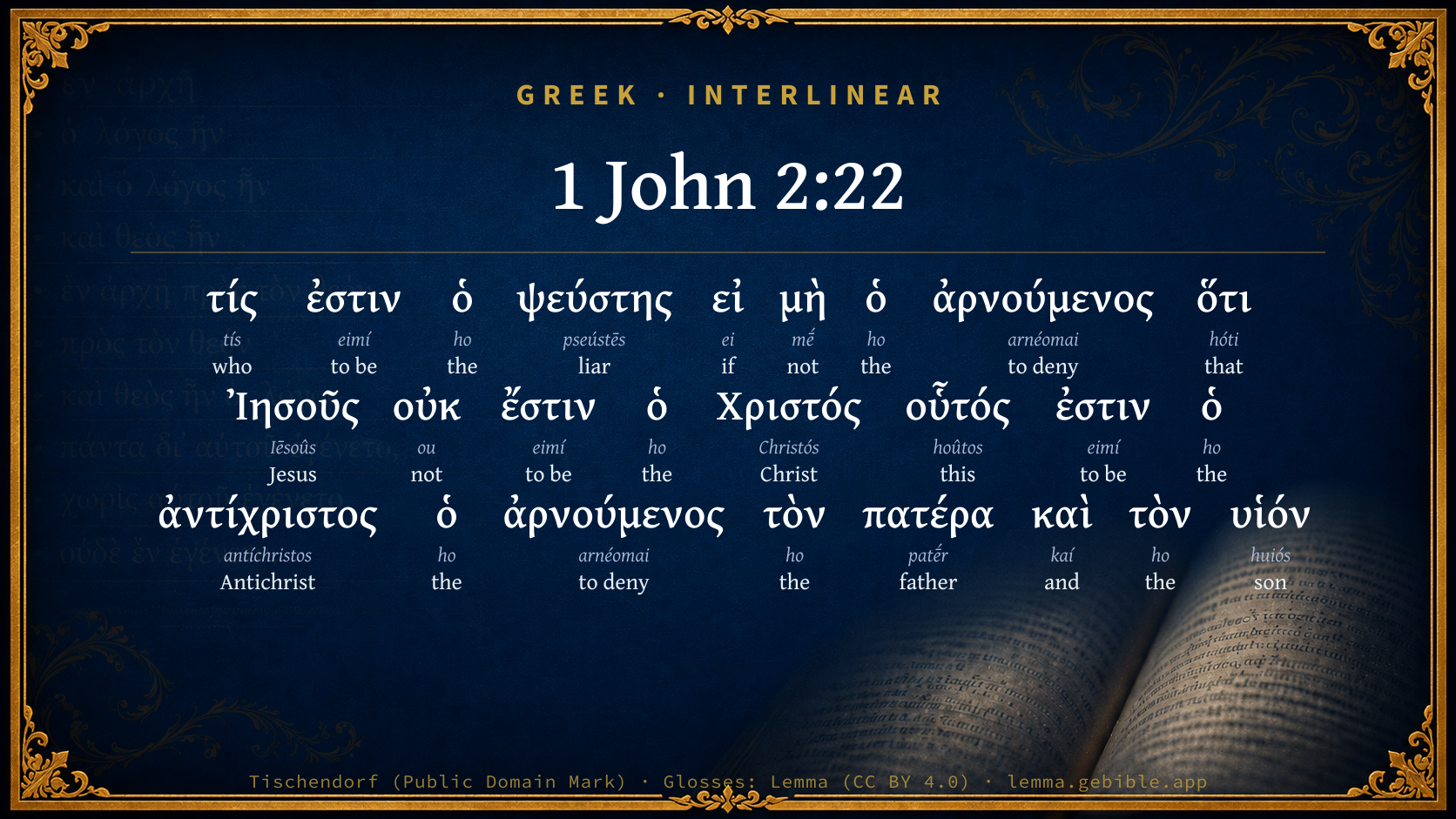
Greek (Tischendorf 8th ed.) 1 John 2:22 appears in the Greek New Testament. The text above is from the Tischendorf 8th edition. Each word links to its Strong’s number and a concise gloss. Click any word for its full Thayer’s Greek Lexicon entry.
Download image
Cite this verse

1 John 2:22 (World English Bible). Public Domain. Lemma interlinear Bible study tool, https://lemma.gebible.app/v/1-john/2/22.

Show BibTeX & RIS
BibTeX
RIS
English Translation
Who is the liar but he who denies that Jesus is the Christ? This is the Antichrist, he who denies the Father and the Son.
World English Bible · Public Domain
Download a study sheet

One document with this verse’s original text, its word-by-word gloss line, the meaning frame, cross-references with their text, attributed commentary, and full source and license credits — printable, and it pastes into notes with its structure intact.

This verse Autodidact and up

Study sheet (.html) Plain text (.txt)

A passage Seminary Student

Up to 50 verses in one chapter. A passage sheet keeps up to 6 commentary sources and 12 cross-references per verse, in the order this page ranks them, and says so on the sheet whenever that leaves anything out. Ask for a single verse and you get the Autodidact verse sheet above.

Everything on this page stays free to read, with no account — the sheet is a download of what is already on screen, not access to it.

Want to remove ads? Support Godless Engineer
Compare translations 3

The same verse in 3 English versions, stacked beneath the original-language interlinear above. Click any original word for its lexicon entry.

Each is an independent rendering of the whole verse — the interlinear is not word-aligned to these translations.

Highlighted words mark where these versions differ — a whole-verse word diff, not a word-by-word alignment.

  • World English Bible Public Domain
    Who is the liar but he who denies that Jesus is the Christ? This is the Antichrist, he who denies the Father and the Son.
  • King James Version Public Domain
    Who is a liar but he that denieth that Jesus is the Christ? He is antichrist, that denieth the Father and the Son.
  • unfoldingWord Literal Text CC BY-SA 4.0
    Who is the liar if not the one denying that Jesus is the Christ? This one is the antichrist, the one denying the Father and the Son.

unfoldingWord Literal Text — © unfoldingWord, licensed CC BY-SA 4.0. Word-aligned USFM3 via Door43 (git.door43.org/unfoldingWord/en_ult).

Versions to compare (up to 4)

3 of 4 selected

Show all 19 translations

Every available English version of this verse, each an independent rendering of the whole verse.

  • World English Bible Public Domain
    Who is the liar but he who denies that Jesus is the Christ? This is the Antichrist, he who denies the Father and the Son.
  • Berean Standard Bible Public Domain
    Who is the liar, if it is not the one who denies that Jesus is the Christ? This is the antichrist, who denies the Father and the Son.
  • Majority Standard Bible Public Domain
    Who is the liar, if it is not the one who denies that Jesus is the Christ? This is the antichrist, who denies the Father and the Son.
  • King James Version Public Domain
    Who is a liar but he that denieth that Jesus is the Christ? He is antichrist, that denieth the Father and the Son.
  • American Standard Version (1901) Public Domain
    Who is the liar but he that denieth that Jesus is the Christ? This is the antichrist, `even' he that denieth the Father and the Son.
  • Revised Version (1885) Public Domain
    Who is the liar but he that denieth that Jesus is the Christ? This is the antichrist, even he that denieth the Father and the Son.
  • Geneva Bible (1599) Public Domain
    Who is a liar, but he that denyeth that Iesus is that Christ? the same is that Antichrist that denyeth the Father and the Sonne.
  • Douay-Rheims (1899) Public Domain
    Who is a liar, but he who denieth that Jesus is the Christ? This is Antichrist, who denieth the Father, and the Son.
  • Young's Literal Translation Public Domain
    Who is the liar, except he who is denying that Jesus is the Christ? this one is the antichrist who is denying the Father and the Son;
  • Literal Standard Version CC BY-SA 4.0
    Who is the liar, except he who is denying that Jesus is the Christ? This one is the antichrist who is denying the Father and the Son;
  • Unlocked Literal Bible CC BY-SA 4.0
    Who is the liar but the one who denies that Jesus is the Christ? That person is the antichrist, since he denies the Father and the Son.
  • unfoldingWord Literal Text CC BY-SA 4.0
    Who is the liar if not the one denying that Jesus is the Christ? This one is the antichrist, the one denying the Father and the Son.
  • Darby Bible Public Domain
    Who is the liar but he who denies that Jesus is the Christ? *He* is the antichrist who denies the Father and the Son.
  • World Messianic Bible Public Domain
    Who is the liar but he who denies that Yeshua is the Messiah? This is the Anti-messiah, he who denies the Father and the Son.
  • Webster's Bible Public Domain
    Who is a liar but he that denieth that Jesus is the Christ? He is antichrist, that denieth the Father and the Son.
  • Free Bible Version CC BY-SA 4.0
    Who is the liar?—anyone who denies that Jesus is the Christ. The antichrist is anyone who denies the Father and the Son.
  • Bible in Basic English Public Domain
    Who is false but he who says that Jesus is not the Christ? He is the Antichrist who has no belief in the Father or the Son.
  • Text-Critical English NT CC BY 4.0
    Who is a liar but he who denies that Jesus is the Christ? Anyone who denies the Father and the Son is an antichrist.
  • Tyndale New Testament (1534) Public Domain
    Who is a lyar: but he that denyeth that Iesus is Christ? The same is the Antichrist that denyeth the father and the sonne.

Literal Standard Version (2020), Covenant Press — licensed CC BY-SA 4.0. Text via the HelloAO Bible API (eBible.org). Unlocked Literal Bible (unfoldingWord) — licensed CC BY-SA 4.0. Text via the HelloAO Bible API (eBible.org). unfoldingWord Literal Text — © unfoldingWord, licensed CC BY-SA 4.0. Word-aligned USFM3 via Door43 (git.door43.org/unfoldingWord/en_ult). Free Bible Version, Dr. Jonathan Gallagher — licensed CC BY-SA 4.0. Text via the HelloAO Bible API (eBible.org).

Word by word

More ways to search: Search by grammar → Find every occurrence → Compare this word →

Practice this passage: Drill this verse → Learn its vocabulary →

ἀντίχριστος
antíchristos
G500
“Antichrist”
Noun, Nominative, Singular, Masculine
Part of Speech
Noun
Case
Nominative
Number
Singular
Gender
Masculine
Full Thayer's Definition

Origin: from G473 and G5547

TDNT: 17:13,1

1. the adversary of the Messiah
  1. τίς tís G5101 “who” Interrogative pronoun, Nominative, Singular, Masculine
  2. ἐστιν eimí G1510 “to be” Verb, Present, Active, Indicative, 3rd person, Singular
  3. ὁ ho G3588 “the” Article, Nominative, Singular, Masculine
  4. ψεύστης pseústēs G5583 “liar” Noun, Nominative, Singular, Masculine
  5. εἰ ei G1487 “if” Conditional
  6. μὴ mḗ G3361 “not” Particle, Negative
  7. ὁ ho G3588 “the” Article, Nominative, Singular, Masculine
  8. ἀρνούμενος arnéomai G720 “to deny” Verb, Present, Middle or Passive deponent, Participle, Nominative, Singular, Masculine
  9. ὅτι hóti G3754 “that” Conjunction
  10. Ἰησοῦς Iēsoûs G2424 “Jesus” Noun, Nominative, Singular, Masculine
  11. οὐκ ou G3756 “not” Particle, Negative
  12. ἔστιν eimí G1510 “to be” Verb, Present, Active, Indicative, 3rd person, Singular
  13. ὁ ho G3588 “the” Article, Nominative, Singular, Masculine
  14. Χριστός Christós G5547 “Christ” Noun, Nominative, Singular, Masculine
  15. οὗτός hoûtos G3778 “this” Demonstrative pronoun, Nominative, Singular, Masculine
  16. ἐστιν eimí G1510 “to be” Verb, Present, Active, Indicative, 3rd person, Singular
  17. ὁ ho G3588 “the” Article, Nominative, Singular, Masculine
  18. ὁ ho G3588 “the” Article, Nominative, Singular, Masculine
  19. ἀρνούμενος arnéomai G720 “to deny” Verb, Present, Middle or Passive deponent, Participle, Nominative, Singular, Masculine
  20. τὸν ho G3588 “the” Article, Accusative, Singular, Masculine
  21. πατέρα patḗr G3962 “father” Noun, Accusative, Singular, Masculine
  22. καὶ kaí G2532 “and” Conjunction
  23. τὸν ho G3588 “the” Article, Accusative, Singular, Masculine
  24. υἱόν huiós G5207 “son” Noun, Accusative, Singular, Masculine

About this verse

These counts appear in no published source. They are computed here, from the morphology-tagged text and Lemma’s own curated glosses. What Lemma adds →

25
words
16
distinct lemmas
General Epistles
section

Notable vocabulary

The rarest word here is ἀντίχριστος Antichrist G500 — appearing just 5 times in the whole Greek New Testament.

Shared distinctive vocabulary

ἀντίχριστος Antichrist G500 occurs in 4 verses of the Greek New Testament. Also found in:

Repetition

Words recur within this verse:

  • ἐστιν to be G1510 ×3
  • ἀρνούμενος to deny G720 ×2
  • ὁ the G3588 ×7

Cross-references

11

Topical passages linked to 1 John 2:22 in the Treasury of Scripture Knowledge — connected by theme and wording, ordered by reader-vote popularity; previews shown in the World English Bible.

  • 2 John 1:7 For many deceivers have gone out into the world, those who don't confess that Jesus Christ came in the flesh. This is the deceiver and the Antichrist.
  • 1 John 4:3 and every spirit who doesn't confess that Jesus Christ has come in the flesh is not of God, and this is the spirit of the antichrist, of whom you have heard that it comes. Now it is in the world already.
  • 1 John 2:18 Little children, these are the end times, and as you heard that the Antichrist is coming, even now many antichrists have arisen. By this we know that it is the end times.
  • Jude 1:4 For there are certain men who crept in secretly, even those who were long ago written about for this condemnation: ungodly men, turning the grace of our God into lasciviousness, and denying our only Master, God, and Lord, Jesus Christ.
  • 1 John 2:23 Whoever denies the Son, the same doesn't have the Father. He who confesses the Son has the Father also.
  • 1 John 1:6 If we say that we have fellowship with him and walk in the darkness, we lie, and don't tell the truth.
  • 1 John 2:4 One who says, "I know him," and doesn't keep his commandments, is a liar, and the truth isn't in him.
  • 1 John 4:20 If a man says, "I love God," and hates his brother, he is a liar; for he who doesn't love his brother whom he has seen, how can he love God whom he has not seen?
  • John 8:44 You are of your Father, the devil, and you want to do the desires of your father. He was a murderer from the beginning, and doesn't stand in the truth, because there is no truth in him. When he speaks a lie, he speaks on his own; for he is a liar, and the father of it.
  • 1 Corinthians 12:2–3 You know that when you were heathen, you were led away to those mute idols, however you might be led.
  • Revelation 3:9 Behold, I give of the synagogue of Satan, of those who say they are Jews, and they are not, but lie. Behold, I will make them to come and worship before your feet, and to know that I have loved you.

Cross-references courtesy of OpenBible.info (CC BY 4.0).

Commentary

Notes on 1 John 2:22 from classic Christian and Jewish commentators (each source and its license shown beneath its notes). The classic Christian expositions comment on the surrounding passage and are grouped to its opening verse, so a note may address several verses; the Jewish commentaries on the Tanakh (Rashi and others) are per-verse, so they appear only where the commentator wrote on this verse.

Lemma curates 59 commentaries, every one of them public domain or Creative Commons licensed, each selected and text-cleaned for this edition rather than reprinted as found. About our sources →

Tyndale Open Study Notes

Tyndale Open Resources

2:22 John marks out as a liar any false teacher who denies that Jesus is the Christ, the Son of God, the unique revealer of the Father (4:2).

Tyndale Open Study Notes — © Tyndale Open Resources, licensed CC BY-SA 4.0. Text via the HelloAO Bible API.

Bengel's Gnomon

Johann Albrecht Bengel

1Jn 2:22. Τίς; who?) Thus, who? ch. 1Jn 5:5.—ὁ ψεύστης) ὁ has a force relative to the abstract, a lie, 1Jn 2:21; that is, who is guilty of that lie and imposture?—ὅτι, that) The chief truth is, that Jesus is the Christ: Joh 20:31. In the Acts, Paul continually demonstrated this main point; and in his Epistles he presupposed it. John often makes mention of this main point in his Gospel, and in this and the following Epistle. From which it may be inferred that these books were not written by him altogether at the close of his life.—ὁ ἀντίχριστος, antichrist) 1Jn 2:18. The truth respecting Jesus, that He is the Christ, that He is the Son of God and is come in the flesh, must be held in its integrity. He who denies one part respecting Jesus, does not hold both Him, in His completeness, and the Father at the same time. The spirit of antichrist, and antichrist has done and does this.—τὸν Πατέρα καὶ τὸν Υἱὸν, the Father and the Son) that is, the Son, and therefore the Father.

Bengel's Gnomon of the New Testament — English translation (T&T Clark, Edinburgh, 1860) — public domain. Text from a community e-Sword module.

Meyer's Critical & Exegetical Commentary

Heinrich August Wilhelm Meyer

1Jn_2:22-23. The existence of the antichrists and their relationship to the Christian Church having been previously stated, there follows now the more particular definition of the antichristian lie.

τίς ἐστιν ὁ ψεύστης;] The interrogative form, with which John addresses his readers who know the truth, is explained by the vividness of the feeling with which the apostle is writing; similarly in chap. 1Jn_5:5. He passes from the abstract (πᾶν ψεῦδος) directly to the concrete (ψεύστης). The definite article: ὁ ψεύστης (Luther incorrectly: a liar), brings out the idea in clearer distinctness: the liar κατʼ ἐξοχήν, i.e. he in whom the lie appears in concrete personality (so also Braune), identical with ὁ ἀντίχριστος, which is denied by Jachmann through mistake of Johns idea. The thought is weakened by the supposition that the apostle is speaking here comparatively (Grotius: quis potest major esse impostor?). Nor is Bengels interpretation satisfactory: quis est illius mendacii imposturaeque reus? with which Düsterdieck agrees, when he paraphrases: What sort of a lie I mean, ye know very well. Who are the liars? Are they not those who deny, etc.? The apostle certainly has the particular lie of the antichrists of his time in view, but this he regards as the one chief and fundamental lie in which all ψεῦδος is comprised (Lücke). The explanation of Baumgarten-Crusius is plainly quite erroneous: what else is a false doctrine than, etc.? nor is that of Ebrard less so, as he finds in this catechetical (!) question intended for children this meaning: on whose side is the lie? with which he then supplies the corresponding question: and on whose side is the truth?

εἰ μὴ ὁ ἀρνούμενος] εἰ μή, often after a negation, may also stand after a question, as in this a negation is contained; comp. Luk_17:18; Rom_11:15; 1Co_2:11; 2Co_2:2; 1Jn_5:5; it corresponds to the German: als nur (English: but only, except), and limits the general thought to a particular one; the sense accordingly is: No other is the liar but he who, etc. According to Ebrard, εἰ μή must here only have the meaning of than, because the question here is, which of the two dogmatical tendencies (!) belongs to the lie; that the apostle here has in view two parties, namely, the antichrists and the believing Christians, and asks which of them is in possession of the truth, is a pure fiction, for which there is not the slightest evidence in the text. ὅτι Ἰησοῦς οὐκ ἔστιν ὁ Χριστός] On the construction of the negative idea ἀρνεῖσθαι with the following οὐκ, by which the negation is more strongly emphasized, see Kühner, II. p. 410.

The lie of the Antichrist consists in the denial that Jesus is ὁ Χριστός, i.e. in the denial of the identity of Jesus and Christ, whereby is meant, according to 1Jn_2:19 and chap. 1Jn_4:3, not the Jewish unbelief, that Jesus is not the promised Messiah, but the Gnostic heresy of the distinction between Jesus and Christ, which forms the sharpest contradiction to the apostles doctrine that Jesus is the λόγος σὰρξ γενόμενος. It is erroneous to find here a reference to two different kinds of heresy; on the one hand the denial of the divine, on the other the denial of the human, nature of Jesus;[171] for John speaks only of one lie.

οὗτός ἐστιν ὁ ἀντίχριστος] οὗτος refers back to ὁ ἀρνούμενος: the liar who denies the identity of Jesus and Christ, he is the Antichrist. It is natural to take ὁ ψεύστης and ὁ ἀντιχρ. here in general signification, and to find therein a justification for Bengels conception of Johns idea of Antichrist; but as the lie of the antichrists proceeds from the πνεῦμα τοῦ ἀντιχρίστου, it may be ascribed to the Antichrist himself; the individual antichrists are the mouth by which he speaks.

ὁ ἀρνούμενος τὸν πατέρα καὶ τὸν υἱόν] is not to be connected with οὗτος, so that the sense would be: this one, who denies the Father and the Son, is the Antichrist; but as a clause of more particular definition subordinate to ὁ ἀντίχριστος. John hereby adds a new element which states the full unhappy consequence of that Antichristian lie (Düsterdieck; similarly Braune). The apostle wants to bring out here that the denial that Jesus is ὁ Χριστός is in its very essence a denial of the Father and of the Son. He who denies the identity of Jesus and Christ, directly denies the Son, for the Son is no other than Ἰησοῦς ὁ Χριστός (neither an Aeon named Christ that did not become man, nor Jesus who is not Christ, or, according to Joh_1:14, the Logos);[172] but he who denies the Son denies also the Father, and not merely inasmuch as Son and Father are logically interchangeable ideas, but because the nature of the Father is only manifested in the Son, and all true knowledge of the Father is conditioned by the knowledge of the Son, so that the God of those who deny the Son is not the true God, but a false image of their own thoughtsan ΕἼΔΩΛΟΝ.[173]

[171] So Tertullian (de Praescript. c. 33): Joh. in ep. cos maxime antichristos vocat, qui Christum negarent in carne venisse et qui non putarent Jesum esse Filium Dei; illud Marcion, hoe Ebion vindicavit. Similarly Besser: That Jesus was not the Christ, the Christ not Jesus. Either the Word that was from the beginning was separated from this Jesus, or the flesh was denied to the eternal Word. Comp. Introd. sec. 3.

[172] Weiss correctly brings out the distinction between the ideas Χριστός and υἱός, when he observes that ὁ Χριστός is a historical conception to the apostle, and that it is enough for him that that proposition of the false teachers denies the Messiahship of Christ, from which all belief in Him must take its starting-point, in order to arrive at the recognition that Jesus is the Son of God, and thus in the Son to recognise the Father.

[173] That such commentators as proceed on rationalistic assumptions have not been able to interpret the thought of the apostle is quite natural. But even others have got a more or less indistinct view of it by putting, as Düsterdieck rightly says, the ideas of John too directly into dogmatic forms (and, indeed, into those defined by the Church); or by ignoring the realism of the apostle, and regarding what he considered in an objectively real way as a mere element of the subjective consideration; or, finally, by bringing out one-sided references instead of giving the ideas the due force of their entire comprehension.

Meyer — Critical and Exegetical Commentary on the New Testament — English translation by Peter Christie, edited by Frederick Crombie (T&T Clark, 1880) — public domain. Text from a community e-Sword module.

Expositor's Greek Testament

ed. W. Robertson Nicoll

1Jn 2:22 . ψεύστης , cf. n. on 1Jn 1:6 . The Cerinthian distinction between Jesus and the Christ was a denial of the possibility of the Incarnation, i.e. , of the filial relation of man to God. οὐκ in dependent clause after ἀρνεῖσθαι is a common Gk. idiom, not unknown in English; cf. Shakespeare, Comedy of Errors , iv. ii. 7: “He denied you had in him no right”.

The Expositor's Greek Testament, edited by W. Robertson Nicoll (1897–1910) — public domain. Text from a community e-Sword module.

Geneva Bible (1599)

Geneva Bible translators

Is the true Messiah.

He showeth now plainly the false doctrine of the Antichrists, to wit, that either they fight against the person of Christ, or his office or both together, and at once. And they that do so do in vain boast and brag of God, for that in denying the Son the Father also is denied.

Geneva Bible (1599) marginal notes — public domain. Text via Bolls.life.

Jamieson, Fausset & Brown

Robert Jamieson, A. R. Fausset & David Brown

a liar--Greek, "Who is the liar?" namely, guilty of the lie just mentioned (Jo1 2:21).

that Jesus is the Christ--the grand central truth.

He is Antichrist--Greek, "the Antichrist"; not however here personal, but in the abstract; the ideal of Antichrist is "he that denieth the Father and the Son." To deny the latter is virtually to deny the former. Again, the truth as to the Son must be held in its integrity; to deny that Jesus is the Christ, or that He is the Son of God, or that He came in the flesh, invalidates the whole (Mat 11:27).

Jamieson, Fausset & Brown — Commentary Critical and Explanatory on the Whole Bible (1871) — public domain (CC PDM 1.0). Text via the HelloAO Bible API.

Adam Clarke's Commentary

Verse 22. Who is a liar but he that denieth that Jesus is the Christ?] Here we see some of the false doctrines which were then propagated in the world. There were certain persons who, while they acknowledged Jesus to be a Divine teacher, denied him to be the Christ, i.e. the MESSIAH.

He is antichrist, that denieth the Father and the Son,] He is antichrist who denies the supernatural and miraculous birth of Jesus Christ, who denies Jesus to be the Son of God, and who denies God to be the Father of the Lord Jesus; thus he denies the Father and the Son. The Jews in general, and the Gnostics in particular, denied the miraculous conception of Jesus; with both he was accounted no more than a common man, the son of Joseph and Mary. But the Gnostics held that a Divine person, AEon, or angelical being, dwelt in him; but all things else relative to his miraculous generation and Divinity they rejected. These were antichrists, who denied Jesus to be the Christ.

Adam Clarke's Commentary on the Bible (1810–1826) — public domain. Text from a community e-Sword/MySword module.

John Calvin's Commentaries

22 Who is a liar He does not assert that they alone were liars who denied that the Son of God appeared in the flesh, lest no one in unloosing the knot should above measure torment himself; but that they surpassed all others, as though he had said, that except this be deemed a lie, no other could be so reckoned; as we are wont commonly to say, “If perfidy towards God and men is not a crime, what else can we call a crime?”

What he had generally said of false prophets, he now applies to the state of his own time; for he points out, as by the finger, those who disturbed the Church. I readily agree with the ancients, who thought that Cerinthus and Carpocrates are here referred to. But the denial of Christ extends much wider; for it is not enough in words to confess that Jesus is the Christ, except he is acknowledged to be such as the Father offers him to us in the gospel. The two I have named gave the title of Christ to the Son of God, but imagined him to be man only. Others followed them, such as Arius, who, adorning him with the name of God, robbed him of his eternal divinity. Marcion dreamt that he was a mere phantom. Sabellius imagined that he differed nothing from the Father. All these denied the Son of God; for not one of them really acknowledged the true Christ; but, adulterating, as far as they could, the truth respecting him, they devised for themselves an idol instead of Christ. Then broke out Pelagius, who, indeed, raised no dispute respecting Christ’s essence, but allowed him to be true man and God; yet he transferred to us almost all the honor that belongs to him. It is, indeed, to reduce Christ to nothing, when his grace and power are set aside.

So the Papists, at this day, setting up freewill in opposition to the grace of the Holy Spirit, ascribing a part of their righteousness and salvation to the merits of works, feigning for themselves innumerable advocates, by whom they render God propitious to them, have a sort of fictitious Christ, I know not what; but the lively and genuine image of God, which shines forth in Christ, they deform by their wicked inventions; they lessen his power, subvert and pervert his office.

We now see that Christ, is denied, whenever those things which peculiarly belong to him, are taken away from him. And as Christ is the end of the law and of the gospel, and has in himself all the treasures of wisdom and knowledge, so he is the mark at which all heretics level and direct their arrows. Therefore the Apostle does not, without reason, make those the chief impostors, who fight against Christ, in whom the full truth is exhibited to us.

He is Antichrist He speaks not of that prince of defection who was to occupy the seat of God; but all those who seek to overthrow Christ, he puts them among that impious band. And that he might amplify their crime, he asserts that the Father, no less than the Son, is denied by them; as though he had said, “They have no longer any religion, because they wholly cast away God.” And this he afterwards confirms, by adding this reason, that the Father cannot be separated from the Son.

John Calvin's Commentaries (1540-1563) — public domain. Text from the Calvin Translation Society English edition (1840s-50s) via the Christian Classics Ethereal Library (ccel.org). Calvin's coverage is partial (roughly two-thirds of the Bible); uncommented books and verses are honest gaps, never fabricated. The 19th-century editor's footnotes and remarks are omitted so the notes are faithfully Calvin's own voice.

The Cambridge Bible for Schools and Colleges

gen. ed. J. J. S. Perowne

22. Who is a liar] More accurately, as R.V., Who is the liar: the A.V. here again follows the earlier English Versions. But we must beware of exaggerating the article in interpretation, although it is right to translate it. It merely marks the passage from the abstract to the concrete: ‘Every lie is absolutely alien from the truth. Who then is the one who speaks lies? There are no liars if he who denies that Jesus is the Christ is not one’. The exactly parallel construction in 1Jn_5:4-5 shews that ‘the liar’ here does not mean ‘the greatest liar possible’. Moreover, this would not be true. Is denying that Jesus is the Christ a greater lie than denying the existence of the Son, or of God?

The abruptness of the question is startling. Throughout these verses (22–24) “clause stands by clause in stern solemnity without any connecting particles.”

but he that denieth] These Gnostic teachers, who profess to be in possession of the higher truth, are really possessed by one of the worst of lies.—For the way in which the Gnostics denied the fundamental Christian truth of the Incarnation see the Introduction, p. 19.

He is Antichrist] Better, as R.V., This is the antichrist, or The antichrist is this man: ‘this’, as in 1Jn_2:25 and 1Jn_1:5, may be the predicate. The article before ‘antichrist’, almost certainly spurious in 1Jn_2:18, is certainly genuine here, 1Jn_4:3, and 2Jn_1:7. But ‘the antichrist’ here probably does not mean the great personal rival of Christ, but the antichristian teacher who is like him and in this matter acts as his mouth-piece.

that denieth the Father and the Son] This clause is substituted for ‘that denieth that Jesus is the Christ’. By this substitution, which is quite in S. John’s manner, he leads us on to see that to deny the one is to deny the other. Jesus is the Christ, and the Christ is the Son of God; therefore to deny that Jesus is the Christ is to deny the Son. And to deny the Son is to deny the Father; not merely because Son and Father are correlatives and mutually imply one another, but because the Son is the revelation of the Father, without whom the Father cannot be known. ‘Neither doth any know the Father, save the Son, and he to whomsoever the Son willeth to reveal Him’ (Mat_11:27). ‘No one cometh unto the Father but by Me’ (Joh_14:6). Comp. Joh_5:23; Joh_15:23. Some would put a full stop at ‘antichrist,’ and connect what follows with 1Jn_2:23, thus; This is the antichrist. He that denieth the Father (denieth) the Son also: every one that denieth the Son hath not the Father either.

The Cambridge Bible for Schools and Colleges (gen. ed. J. J. S. Perowne; Cambridge University Press, 1878–1918) — public domain. Text from a community e-Sword module.

John Gill's Exposition

Who is a liar, but he that denieth that Jesus is the Christ?.... Or that very Christ, and true Messiah, who was spoken of by all the prophets, since the beginning of the world, and so much, and so long desired by the Old Testament saints: he that denies that Jesus of Nazareth is the Messiah of the prophets, is not indeed the only liar in the world, but he is the greatest of liars; this is a consummate lie, being opposed to a glaring truth, to a fact clear an indisputable; and which rests not merely on the testimony of Jesus, who is truth itself, and who, in express words, more than once, declared and asserted himself to be the Christ; but all the characters of the Messiah, everything that is said of him in the Prophets, meet in Jesus, and the miracles which were done by him are flagrant proofs and undeniable evidences of his being the Christ of God; and all the apostles believed, and were sure that he was Christ, the Son of the living God: to which may be added the testimony of John, who was sent, and came to bear witness of him, and did; and who was a prophet, and a man of great probity and integrity. But there was a greater witness than he; even God himself, by a voice from heaven, bore a testimony to him; and angels, at his incarnation, declared him to be the Saviour, which is Christ the Lord; yea, the devil himself, who is a liar, and the father of ties in other things, knew and owned Jesus to be the Christ; so that those that deny him are the worst of liars, even worse than the devil himself. This may have regard not only to the Jews, that deny Jesus to be the Messiah, but chiefly to such who went by the name of Christians; who denied either his proper deity, or real humanity, as Ebion and Cerinthus, which was denying him to be the God-man, the Mediator, and Messiah; and is true of all such that deny him in any of his offices, or in things relating to them, as his Gospel, and any of the peculiar doctrines of it, delivered by him, and so deny his prophetic office; or any of his ordinances, institutions, and appointments, as lawgiver in his house, and King of saints, and so deny him in his kingly office; or reject him as the alone Saviour, joining their own works with him, in the business of salvation, and oppose his sacrifice and satisfaction, and despise his imputed righteousness, and so deny him in his priestly office. Now these are some of the liars, and these some of the doctrinal lies, which are not of the truth, as in 1Jo_2:21.

He is antichrist that denieth the Father and the Son: that denies the Father of Christ to be the Creator of the world, but asserts that it was made by angels, as some ancient heretics did; or that the Father of Christ is not the God of the Old Testament, as Marcion; or that denies that God is the Father of Christ, and that Christ is the Son of God; who will not allow that there is any such relation in nature between them; who affirm that Christ is only the Son of God by adoption, or because of his love to him, or because of his incarnation and resurrection from the dead; or that he is not his true and proper Son, only in a figurative and metaphorical sense; that he is not the natural and eternally begotten Son of God, only by office, and as Mediator, and that God is only his Father, as having installed him into an office; or he that denies that these two are distinct from each other, but affirms that Father is the Son, and the Son is the Father, and so confounds them both, and, by confounding both, denies that there are either Father or Son; and all such persons are antichrists, or opposers of Christ.

John Gill's Exposition of the Whole Bible (1746–1763) — public domain (CC PDM 1.0). Text via the HelloAO Bible API.

Trapp's Complete Commentary

John Trapp

22 Who is a liar but he that denieth that Jesus is the Christ? He is antichrist, that denieth the Father and the Son.

Ver. 22. That denieth that Jesus] Papists deny him as a King, in setting up the pope; as a Priest, in setting up the mass; as a Prophet, in piecing their human traditions to the Holy Scriptures.

John Trapp, A Commentary or Exposition upon All the Books of the Old and New Testament (1647–1656) — public domain. Text from a community e-Sword module.

Albert Barnes' Notes on the Bible

Who is a liar - That is, who is false; who maintains an erroneous doctrine; who is an impostor, if he is not? The object of the apostle is to specify one of the prevailing forms of error, and to show that, however plausible the arguments might be by which it was defended, it was impossible that it should be true. Their own knowledge of the nature of religion must convince them at once that this opinion was false.

That denieth that Jesus is the Christ - It would seem that the apostle referred to a class who admitted that Jesus lived, but who denied that he was the true Messiah. On what grounds they did this is unknown; but to maintain this was, of course, the same as to maintain that he was an impostor. The ground taken may have been that he had not the characteristics ascribed to the Messiah in the prophets; or that he did not furnish evidence that he was sent from God; or that he was an enthusiast. Or perhaps some special form of error may be referred to, like that which is said to have been held by Corinthus, who in his doctrine separated Jesus from Christ, maintaining them to be two distinct persons. - “Doddridge.”

He is antichrist - (See the notes at 1Jo 2:18). He has all the characteristics and attributes of antichrist; or, a doctrine which practically involves the denial of both the Father and the Son, must be that of antichrist.

That denieth the Father and the Son - That denies the special truths pertaining to God the Father, and to the Son of God. The charge here is not that they entertained incorrect views of God “as such” - as almighty, eternal, most wise, and good; but that they denied the doctrines which religion taught respecting God as Father and Son. Their opinions tended to a denial of what was revealed respecting God as a Father - not in the general sense of being the “Father” of the universe, but in the particular sense of his relation to the Son. It cannot be supposed that they denied the existence and perfections of God as such, nor that they denied that God is a “Father” in the relation which he sustains to the universe; but the meaning must be that what they held went to a practical denial of that which is special to the true God, considered as sustaining the relation of a Father to his Son Jesus Christ. Correct views of the Father could not be held without correct views of the Son; correct views of the Son could not be held without correct views of the Father. The doctrines respecting the Father and the Son were so connected that one could not be held without holding the other, and one could not be denied without denying the other. Compare the Mat 11:27 note; Joh 5:23 note. No man can have just views of God the Father who has not right apprehensions of the Son. As a matter of fact in the world, people have right apprehensions of God only when they have correct views of the character of the Lord Jesus Christ.

Albert Barnes' Notes on the Bible (1834–1885) — public domain. Text from a community e-Sword/MySword module.

Haydock's Catholic Bible Commentary

He who denieth that Jesus is the Christ? He is antichrist: is in a special manner an adversary of Christ and the Christian religion, when he denies Jesus to be the Messias, or to have been from eternity the true Son of God. --- He who denieth him to be the Son, neither hath he the Father. He who denies either of these truths denieth both. He who denies the Son of God to be the eternal Son, denies the Father to be the eternal Father. (Witham)

George Leo Haydock (1774–1849), Haydock's Catholic Family Bible and Commentary, 1859 edition — public domain. Excludes Psalms (Douay-Rheims chapter numbering differs from Protestant) and Deuterocanonical books (Catholic canon only).

Matthew Poole's English Annotations

Especially may the ill accord be discerned between Divine truth and a lie, when the lie is so directly levelled against the foundations upon which the whole fabric is built, as the denying Jesus to be the Christ strikes at all. And though he that doth so, seems not only an

antichrist as directing his opposition but against Christ, he really as much

denieth the Father, who testified of him.

Matthew Poole's English Annotations on the Holy Bible (1683–1685) — public domain. Text from a community e-Sword/MySword module.

Whedon's Commentary on the Bible

Daniel D. Whedon

22. A liar—Rather, the liar; or, as Wesley, more pointedly, that liar.

Jesus is the Christ—The errorists, who believed matter the source of all evil, denied that the material bodily Jesus was the real Christ, and affirmed that the Christ descended upon him at baptism. Hence the trinity was doctrinally disorganized. The antichrist of that last time, therefore, really denied the Father and the Son.

Daniel D. Whedon (gen. ed.), Commentary on the Old and New Testaments (1874–1909) — public domain. Text from a community e-Sword module.

The Pulpit Commentary

Who is the liar, but he that denieth, etc.? From the lie St. John passes on to the utterer of it. "Ye readily distinguish any lie from the truth. Who, then, is the liar? "The liar" does not mean the liar kat ejxochn, as if this denial constituted the very acme of falsehood. To deny the very existence of God is surely a worse lie. Still less can we say that "the context leaves no doubt that "the liar" is the same with "the antichrist. The article oJ yeusthv refers to the preceding yeudov, just askh. 1Jn_5:4, 5 oJ nikwn refers to the preceding ni The very form of sentence is the same: tiv ejstin oJ nikwn eij mh oJ k.t.l. and there oJ nikwn cannot mean the victor, kat ejxochn, who is Christ, and not the believer. So that the Authorized Version is not so very inaccurate in rendering oJ yeusthv "a liar." "Who tells lies, if not he who denies (and says) that Jesus is not the Christ?" This was the great Gnostic lie to which St. John"s Gospel and Epistle give the answer. The antichrist is this, he who denieth the Father and the Son. "The antichrist" here is not the great adversary, but one having similar characteristics. He denies the Messiahship of Jesus, and thus virtually denies both the Father and Son. (2Th_2:4) This truth St. John proceeds to restate and develop.

The greatest possible lie.

Connecting link: The chrism from the Christ will ward off antichrist, because it will give such clear and quick intuitions concerning what is true and what is false, that the lie of antichrist will be instantly seen to be such, and Christ"s anointed ones will not be deceived by him. And the value of this safeguard against antichrist is seen in the fact that the lie he would propagate being not merely on a minor point of detail, but concerning the Person of the Christ himself, it covers so much ground and carries so much along with it, that this lie of antichrist is the greatest which could be uttered. "Who is the liar," etc. oJ yeusthv? Hence the topic presented to the homiletic expositor. Topic The lie of antichrist the greatest falsehood possible.

I WHAT IS THAT WHICH ANTICHRIST DENIES? The several references to antichrist indicate that the main, if not the sole, mischief of antichrist lies in denial. It is not unfrequently so. To deny, or, if that be too daring an effort, to call in question, Divine testimony and even first principles, is the favourite method of the father of lies. It is an easy way of seeking to unsettle and beguile unstable souls, to cast doubt on everything. And as if he himself did not know the difference between a spirit of inquiry and a spirit of doubt, one of our foremost men of science has laid it down as an axiom that the first step in science is to doubt everything! The evil one knows too well that it is much quicker work to throw down than to build up. And hence he tries this easy way of ruining souls by attempting to overthrow all that is sacred in their religious beliefs. As he could not prevail against the King when he met him in single combat, he aims his deadly blow at his subjects, in order to seduce them from their loyalty by casting doubts upon and even denying the Christ. This denial, not without motive, gathers round the Son of God. If we lose him, all is lost that is peculiar to our faith, as we shall presently see. The denial of Jesus as the Christ may take one or more of four forms.

1. The denial of Jesus as the Messiah, the Anointed of the Father. In this respect the minds of the Jews (among others)are blinded to this day.

2. The denial of Jesus as combining the Divine and human natures in oneperson: according to the Gnostic theory that the Christ descended upon the man Jesus at his baptism, and left him before his Passion (see Westcott, in loc. ).

3. The denial of Jesus as the eternal Son of the Father, and the consequentdenial of the Incarnation. All the present systems of unbelief are at one on this point; though "neither so does their witness agree together" in aught save the denial.

4. The denial of Jesus as the Lord of his Church enthroned in heaven. Thelatest result of theology is affirmed to be, inter alia, "that the Christ holds no office whatever." The same in substance, the denial changes its forms.

II WHAT DOES THIS DENIAL INVOLVE? Many errors are not only serious in themselves, but are even more so on account of others which they drag along with them. (cf. 1Co 15) We have remarked that if we lose our Christ, we lose all. So, indeed, the apostle himself argues. "Whosoever denieth the Son, the same hath not the Father;" i.e., as Westcott aptly puts it, "He hath not the Son, whom he rejects, nor yet the Father, whom he professes to regard." According to this denial:

1. There is no Fatherhood and Sonship in the Divine Nature.

2. God is not the Father as Christ represented him (see "Speaker"sCommentary" on verse 23).

3. We have no personal revelation of God, nor any message of love fromthe eternal throne.

4. We have no redemption.

5. We have no Saviour and no salvation.

6. We have no Head of humanity with living and regenerative power toquicken the dead mass of souls. We may have from one source or other, to some extent, a revelation of law, order, and duty; but we have no disclosure of any power or provision to quicken to obedience to the Law, observance of the order or fulfillment of the duty.

III ON WHAT GROUNDS IS SUCH A DENIAL MADE? Broadly and generally this denial comes either of a misguided intellect or a depraved heart. It may be made in the name of philosophy or of science (in both cases falsely so called). The Christ comes as Revealer and Redeemer. Antichrist denies both the revelation and the redemption, either on the ground

(1) that we know nothing beyond phenomena, and that the infinite and eternal are absolutely and hopelessly beyond our reach; or

(2) that humanity is working itself right by a method of evolution, in the struggle for existence casting off the weak and worthless, and letting only the fittest survive, that thus no redemptive force ab extra is needed, the vis medicatrix is within humanity; or

(3) that nothing at all of the supernatural can be entertained for a moment.

IV THE CIRCUMSTANCES UNDER WHICH THE DENIAL IS MADE.

1. In spite of the dearest testimony to the facts and doctrines denied testimony, given by blameless men, in the teeth of their own natural and

2. strongest prepossessions to the contrary. (Let this last clause be duly weighed.)

3. In spite of the tenderest seal. The blood of Christ. "The blood of the everlasting covenant.

1. In spite of the most powerful confirmation. The resurrection of Christ. The descent of the Holy Ghost. The sustentation of a living Church to this day, in spite of every conceivable effort to destroy it.

2. And in many cases the denial is made with a defiant recklessness, or aproud supercilious scorn, as if by the efforts of their pen men would wish the dearest hopes of millions to be dashed to the ground!

V THE CONSEQUENCES WHICH WOULD FOLLOW THE SUCCESS OF ANTICHRIST"S DENIAL.

If (as shown under division II) the denial drags along with it all other Christian doctrines, then the basis and support of the noblest life ceases. Men talk largely about the evolution of the race, forgetting to note:

1. That it is only the portion of the race which is leavened by Christianthought that is thus advancing.

2. That the advance is prompted by men who, because leavened withChristian thought, are inspired by faith, hope, and level But destroy Christian doctrine, then

(1) faith must expire for want of an adequate Object;

(2) hope must decline from the lack of a specific goal;

(3) love must die out through lack of a revealed Object worthy of the perfect love of the soul, and then love to man will die out when the great reason for it and inspiration to it are withdrawn. And when neither faith, nor hope, nor love have any sustaining food, what will human life be worth? Life is dependent upon environment. Withdraw the environment, and life must decline from want of sustentation from without. Clearly, then, the lie of antichrist is the master-lie!

VI APPLICATION AND INFERENCES.

1. If these things be so, then no one need be surprised that some of thecontroversies respecting Christian doctrine which have been carried on in the Church have been so sharp and bitter. The many who took

2. thoughtlessly over the history of the divisions of Christendom, and who laugh at or pour scorn on the sternness of religious war, would do well to look a little deeper. If they understood more, they would jeer less. Tolerance may arise from short-sightedness or indifference; intolerance, from the clear foresight of what must follow if such and such an error be permitted to flourish. And the more ardently a believer loves his Lord, the more angry is he likely to be at aught which would obscure his glory! Of all the apostles John loved most fervently, yet he it is who lashes most severely.

3. Let us, too, be very jealous for the honour of our Lord and Master; andif any, in our hearing, deny him the glory which is his due, let us not be found wanting in the defense. We should at least insist on such points as these:

(1) that men have no right to deny, any more than to affirm, save on adequate grounds;

(2) that violent prejudice against the admission of the supernatural is but a faulty prepossession, which hinders the reception of evidence;

(3) that it is never right to rob men of an inspiring power for virtue, unless the denier has something better to put in its place.

4. The confession of Christ, by contending for the right doctrineconcerning him, should in every case be attended with a Christ-like life. We shall best contend for him non sonando, seal amando.

The Pulpit Commentary (1880–1919), ed. H.D.M. Spence-Jones & Joseph S. Exell — public domain. Text from a community e-Sword module.

John Wesley's Explanatory Notes

Who is that liar - Who is guilty of that lying, but he who denies that truth which is the sum of all Christianity? That Jesus is the Christ; that he is the Son of God; that he came in the flesh, is one undivided truth. and he that denies any part of this, in effect denies the whole. He is antichrist - And the spirit of antichrist, who in denying the Son denies the Father also.

John Wesley, Explanatory Notes Upon the Whole Bible (1754–1765) — public domain. Text via the GEBible commentary corpus.

The People's New Testament

B. W. Johnson

22. Who is a liar, etc.? Hence they will know how to reject these antichrists who lyingly deny Jesus Christ.

B. W. Johnson's The People's New Testament with Notes (1889–1891) — public domain. Electronic text from the Christian Classics Ethereal Library (CCEL) ThML edition.

unfoldingWord translationNotes

Door43 World Missions Community

Who is the liar but the one who denies that Jesus is the Christ?

"Who is the liar? Anyone who denies that Jesus is the Christ." John used a question to emphasize who liars are. (See: Rhetorical Question)

denies that Jesus is the Christ

"refuses to say that Jesus is the Christ" or "says that Jesus is not the Messiah"

denies the Father and the Son

"refuses to say the truth about the Father and the Son" or "rejects the Father and the Son."

Father ... Son

These are important titles that describe the relationship between God and Jesus. (See: Translating Son and Father)

has the Father

"belongs to the Father"

acknowledges the Son

"speaks the truth about the Son"

has the Father

"belongs to the Father"

translationWords

Jesus

Christ

antichrist

God the Father

Son of God

unfoldingWord translationNotes — © Distant Shores Media and the Door43 World Missions Community, licensed CC BY-SA 4.0. Source: git.door43.org/Door43/en_tn.

Cambridge Greek Testament for Schools and Colleges

22. τίς ἐστιν ὁ ψεύστης. Who is the liar? R.V. is here again superior to previous English Versions. But we must beware of exaggerating the article in interpretation, although it is right to translate it. It merely marks the passage from the abstract to the concrete: ‘Every lie is absolutely alien from the truth. Who then is the one who speaks lies? There are no liars if he who denies that Jesus is the Christ is not one.’ The exactly parallel construction in 1Jn 2:4-5 shews that ‘the liar’ here does not mean ‘the greatest liar possible’. Moreover, this would not be true. Is denying that Jesus is the Christ a greater lie than denying the existence of the Son, or of God? Nor does this lie include all falsehood. A Jew or Mahometan possesses a large portion of the truth along with this falsehood. It is, however, an instance of what Plato calls τὸ ὡς ἀληθῶς ψεῦδος, a lie περὶ τὰ κυριώτατα, i.e. a veritable falsehood on the most momentous subjects. Cerinthus and his Gnostic hearers, who profess to be in possession of the higher truth, are really possessed by one of the worst of lies (see Introduction).

The abruptness of the Apostle’s question is startling. Throughout these verses (22–24) “clause stands by clause in stern solemnity without any connecting particles” (Westcott).

οὗτός ἐστιν ὁ ἀντ. This is the antichrist, as R.V. The article, almost certainly spurious in 1Jn 2:18, is certainly genuine here, 1Jn 4:3, and 2Jn 1:7. But here ὁ ἀντίχριστος does not seem to mean the great personal rival of the Christ, but the antichristian teacher who exhibits his spirit and acts as his mouthpiece.

ὁ ἀρνούμενος τ. πατέρα κ. τ. υἱόν. This clause takes the place of ὁ ἀρν. ὅτι Ἰησοῦς οὐκ ἕστιν ὁ Χριστός. The change, which is quite in S. John’s manner, implies that to deny the one truth is to deny the other. Jesus is the Christ, and the Christ is the Son of God; therefore to deny that Jesus is the Christ is to deny the Son. And to deny the Son is to deny the Father; not merely because Son and Father are correlatives and mutually imply one another, but because the Son is the revelation of the Father, without whom the Father cannot be known. ‘Neither doth any know the Father, save the Son, and he to whomsoever the Son willeth to reveal Him’ (Mat 11:27). ‘No one cometh unto the Father but by Me’ (Joh 14:6). Comp. Joh 5:23; Joh 15:23. Some would put a full stop at ‘antichrist,’ and connect what follows with 1Jn 2:23, thus; This is the antichrist. He that denieth the Father (denieth) the Son also: every one that denieth the Son hath not the Father either.

Cambridge Greek Testament for Schools and Colleges (Cambridge University Press, 1896; 21 vols, various authors incl. Carr, Maclear, Plummer, Farrar, Lumby, Moule, M. R. James, Simcox) — public domain. Text from a community e-Sword module.

Alford’s Greek Testament

Henry Alford

22.] Who is the liar (the question passes from the abstract τὸ ψεῦδος to the concrete ὁ ψεύστης. “Quis est illius mendacii reus” as Bengel. The Apostle proceeds to identify the utterer of the ψεῦδος of which he has just spoken. We have a similar question in ch. 5:4, 5: where after describing the victory that overcometh the world, he rejoins τίς ἐστιν ὁ νικῶν κ.τ.λ. εἰ μὴ ὁ, as here. Some have neglected the article altogether; so Luther, and the E. V.; others have given it merely the force of pointing out as “insigne:” so Calv. (“nisi hoc censeatur mendacium, aliud nullum haberi posse”), Seb.-Schmidt; Socin. (“mendacium, quo nihil possit esse majus”), De Wette (‘diese Irrlehre gilt dem Ap. statt aller, scheint ihm alle andern einzuschliessen’). So also Lücke, and Huther. But there can be little doubt that the ὁ refers as above to the preceding ψεῦδος), but (“if not:” so εἰ μή in ref. and Luk 17:18, Rom 11:15, 1Co 2:11, 2Co 2:2) he that denieth that Jesus is the Christ (lit. “denieth (to the effect) that Jesus is not the Christ.” “This excepting εἰ μή,” says Kühner, Gram. ii. p. 561, “is frequently found after τί (= τί ἄλλο), and also after οὐδεὶς ἄλλος. Hom. hymn. Cer. 78, οὐδέ τις ἄλλος αἴτιος ἀθανάτοισιν, εἰ μὴ νεφεληγερέτα Ζεύς: Aristoph. Eq. 1106, μηδὲν ἄλλʼ, εἰ μὴ ἔσθιε: Xen. Œc. ix. 1, τί δέ, εἰ μὴ ὑπισχνεῖτό γε ἐπιμελήσεσθαι; Cf. Cyr. i. 4. 13.” So the Greeks often, bringing outmore distinctly the negative proposition involved in the verb of negation,—so Demosth. p. 871: ὡς δʼ οὐκ ἐκεῖνος ἐγεώργει τὴν γῆν, οὐκ ἠδύνατʼ ἀρνηθῆναι,—or prohibition,—so Herod. iii. 128, Δαρεῖος ἀπαγορεύει ὑμῖν μὴ δορυφορέειν Ὀροίτεα. See Kühner, Gram. ii. p. 410. On the meaning, see below)? This (the ψεύστης just described; ὁ ἀρνούμενος, &c. below being appositional, and an additional consequence from his former denial) is the antichrist (on the personal interpretation, see above, ver. 18. ὁ ἀντίχρ. is obviously here used not as predicating the one person in whom the character shall be finally and centrally realized, but as setting forth identity of character with him, and participation in the same development of the antichristian principle. Nor is this, as Huther characterizes it, a “willkurliche Umdeutung und Erganzung,” but something of the kind must be understood, whichever way antichrist be taken, collective or personal), who denieth the Father and the Son (it is implied then, that the denying Jesus to be the Christ, is equivalent to denying the Father and the Son. And this the Apostle carefully asserts in the next verse).

Henry Alford, The Greek Testament (1849–1861) — public domain. Text from a community e-Sword module.

International Critical Commentary

22. τίς] Cf. 5:5, τίς ἐστιν ὁ νικῶν … εἰ μή; there is no other exact parallel in the N.T. The expression is forcible. No one else stands for falsehood so completely as he who denies that Jesus is the Christ.

ὁ ψεύστης] The article is not merely generic, denoting the individual who adequately represents the class. It denotes the liar, par excellence, in whom falsehood finds its most complete expression. Cf. Joh 3:10 (σὺ εἶ ὁ διδάσκαλος;).

οὐκ ἔστιν] For the double negative, cf. Luk 20:27 (οἱ ἀντιλέγοντες ἀνάστασιν μὴ εἶναι); Heb 12:19 (παρῃτήσαντο μὴ προσθεῖναι). We are hardly justified in seeing any special force in the retention of “a redundant οὐ in a clause of indirect discourse depending on a verb meaning to deny” (cf. Burton, N.T. Moods and Tenses, p. 181, § 473).

Ἰησοῦς οὐκ ἔστιν ὁ χριστός] The following clause shows that ὁ Χριστός has come to mean much more than the Jewish Messiah. It includes a special relationship to God which was not a necessary part of Jewish Messianic expectation.

It is not easy to determine how far there is any special reference in the phrase, as used here, to the separation of Jesus from the Christ, according to the Cerinthian, or Gnostic, distinction of the human Jesus from the higher being, or “aeon,” according to later Gnostic terminology, who descended on Jesus at the Baptism, and left Him before the Passion. It may well include such a reference, without its meaning being thereby exhausted. The “master-lie” is the denial of the true nature of the Incarnate Christ, as the writer and his fellow-Christians had come to know Him. Cerinthianism may be included, but Cerinthus is not ὁ ἀντίχριστος. And there is no reason for assuming that the many Antichrists, in whose appearance the writer sees the fulfillment of the saying “Antichrist cometh,” all taught exactly the same doctrine.οὗτος] The liar, who denies the truth of the Incarnation. Cf. Joh 1:2, Joh 1:7, Joh 1:6:46, Joh 1:7:18, Joh 1:15:5; 1Jn 5:6, 1Jn 5:20; 2Jn 1:7, 2Jn 1:9. The reference of οὗτος in this writer is always to the subject, as previously described.

ὁ ἀντίχριστος] The writer spiritualizes, if he does not altogether depersonalize, the popular conception. The spirit of Antichrist finds its fullest expression in the denial of Father and Son. The writer is not specially interested in the literal fulfillment of the legend. He would probably have met curious questions on the subject with the answer, ἐν τούτῳ ὁ λόγος ἐστὶν ἀληθινὸς ὅτι Ἀντίχριστος ἔρχεται. πολλοὶ πλάνοι γεγόνασιν, οἱ μὴ ὁμολογοῦντες Ἰησοῦν Χριστὸν ἐν σαρκὶ ἐληλυθότα, or words to the same effect.

ὁ ἀρνούμενος κ.τ.λ.] Cf. Introduction, p. xlii. Recent writers like Wurm (Die Irrlehrer Bibl. St. 8.) and Clemen (in ZNTW vi. 3, 1905, p. 271 ff.) are right in insisting on the importance of this and the following clause in determining the character of the false teaching combated in these Epistles. But the clauses do not compel the conclusion that the false teachers agreed with the writer in their doctrine of God, and differed only in their Christology. The writer sees in their Christological views the starting-point of their errors, and he points out that these views involve wholly false conceptions of God, and debar those who hold them from any true intercourse or conscious communion with the Father. He certainly draws from their Christology the conclusion that they “have not the Father.” But these words would apply to any teachers who claimed to have special and unique knowledge of the Father, not only to those whose views on the subject agreed with the views of the writer. There is nothing in the words to exclude a reference to Cerinthus, or similar teaching, although he held the Creator of the World to be “uirtus quaedam ualde separata et distans ab ea principalitate quae est super universa, et ignorans eum qui est super omnia Deum” (Iren. 1. xxvi. 1). It is therefore quite possible that a polemic against Cerinthus is included, even if we regard Irenaeus, rather than the reconstructed Syntagma of Hippolytus, as giving the truer account of Cerinthus’ teaching.

The words would have special force if one of the most prominent of the false teachers had put forward the view that the giver of the Law, or the God of the Jews, was only one of the ἄγγελοι κοσμοποιοί, and not the supreme God. Such an one certainly denied not only the Son, but the Father as revealed by the Son.But the writer is not concerned with the details of a system. He is dealing with the general tendency of certain types of teaching. And his argument is that since all true knowledge of God comes through the revelation of Him made by Jesus Christ, before and by means of the Incarnation, those who reject this revelation in its fulness can have no conscious communion (ἔχειν) with the Father whom He revealed, whatever superior knowledge of God, as the Father of all, they may claim to possess.

τις] +γαρ Ic 258 (56).

ει μη] om. Ic 114 (335).

Ιησους] pr. o Ib 253 (2).

αντιχρηστος Ia 382, 173 (231).

τον πατερα] το πνευμα Ia δ454 (262).

υιον] + αρνειταιH δ6 (Ψ).

International Critical Commentary — older volumes (1896–1929), various authors — public domain. Text from a community e-Sword module.

Vincent's Word Studies in the New Testament

Marvin R. Vincent

A liar [ο ψευστης] . Rev., correctly, "the liar." For a similar interrogative phrase see ch. 1Jo 5:5. It marks the lively feeling with which the apostle writes. By the definite article, the liar, the lie is set forth in its concrete personality : the one who impersonates all that is false, as antichrist represents every form of hostility and opposition to Christ. The denial that Jesus is the Christ is the representative falsehood. He that denies is the representative liar.

He that denieth [ο αρνουμενος] . The article with the participle denotes the habitual denial. Lit., the one denying, the one who habitually represents this attitude towards Christ. The words are aimed at the heresy of Cerinthus, a man of Jewish decent and educated at Alexandria. He denied the miraculous conception of Jesus, and taught that, after His baptism, the Christ descended upon Him in the form of a dove, and that He then announced the unknown Father and wrought miracles; but that, towards the end of His ministry, the Christ departed again from Jesus, and Jesus suffered and rose from the dead, while the Christ remained impassible (incapable of suffering) as a spiritual being.

The Father. The title the Father occurs always in its simple form in the Epistle. Never his or our Father, or the Father in heaven.

Marvin R. Vincent, Word Studies in the New Testament (1887–1900) — public domain. Text from a community e-Sword/MySword module.

Westcott on Hebrews & the Epistles of John

Brooke Foss Westcott

22. τίς ἐστιν... Quis est mendax ...f V. Who is the liar...? The abrupt question (comp. 6. v. 5) corresponds with a brief mental pause after

denieth that... The insertion of the negative in the original (preserved in the Old Latin, gui negat quod Jesus non est Christus) gives a positive, aggressive, character to the negation. The adversary denies that Jesus is the Christ when the claim is made; and on his own part he affirms that He is not. Comp. Luke xx. 27; Gal. v. 7; Heb. xii. 19. For the converse see John i. 20.

The phrase by which St John describes the master-falsehood as the ‘denial that Jesus is the Christ,’ itself marks the progress of Christian thought. In the earliest stage of the Church the words. would have expressed a denial of the Messiahship of Jesus from the Jewish point of view (Acts v. 42, ix. 22, xvii. 3, xviii. 28). They now answer to a later form of opinion. A common ‘Gnostic’ theory was that ‘the seon Christ’ descended upon the man Jesus at His Baptism, and left Him before the Passion. Those who held

such a doctrine denied that ‘Jesus was the Christ’; and in so denying, denied the union of the divine and human in one Person. This heresy then St John signalises here, the direct contradiction to the fundamental truth which he proclaimed, the Word became flesh.

οὗτος] this liar, this maintainer of the central falsehood in regard to revelation, as to God and man, 7s the antichrist, even he that denteth the Father and the Son. The denial of the personal union of true manhood and true Godhead in Christ involves the denial of the essential relations of Fatherhood and Sonship in the Divine Nature. The conception of this relation in the immanent Trinity prepares the way for the fact of the Incarnation; and conversely, the fact of the Incarnation gives reality to that moral conception of God as active Love without which Theism becomes a formula.

ὁ avrixptoros| The term expresses the embodiment of a principle, and is not to be confined to one person. The character of ‘the antichrist’ is described in the words which follow (even he that...Son), which are not simply a resumption of οὗτος.

ὁ ἀρνούμενος τ. 7m.) To deny the Father is to refuse to acknowledge God as Father. Comp. Matt. x. 33; Acts iii. 13 f.; 2 Tim. ii. 12; 2 Pet. ii. 1; Jude 4.

τὸν πατέρα] The title the Father occurs in the Epistles of St John, as in the Gospel, in connexion with ‘the Son’ (vv. 22, 23, 24, i. 3, iv. 14; 2 J. 3, 9), and in relation to men (ii. 1, 14, 15 f., iii, 1; 2 J. 4) in virtue of the revelation of Christ. It is used also in relation to ‘the Life’ (i. 2 note).

The title always stands in the Epistles in its simple form. ‘His Father’

Other conjunctions are inserted in versions.

or ‘our Father, or ‘the Father in heaven’ do not occur. See Additional Note on i. 2.

τὸν υἱόν] By the use of the absolute term the Son (comp. John vy. 19 note), which occurs in the Epistle first here (comp. iv. 14, v. 12), St John brings out distinctly what is involved in the fact that the Christ and Jesus are personally one. There is no passage in the mind of the Apostle from one personality to another, from the human to the divine, nor yet from the conception of ‘the man Christ Jesus’ to that of ‘the Word’: the thought of ‘the Son’ includes both these conceptions in their ideal fulness.

Brooke Foss Westcott (1825–1901), The Epistle to the Hebrews (1889) and The Epistles of St John (1883) — public domain (pre-1929). Text recovered from Internet Archive / Google Books OCR scans. Westcott’s Gospel of John commentary is not included (its OCR lost the chapter running-heads required for reliable verse-keying). Some Greek quoted in the Hebrews volume is imperfectly rendered by the OCR.

Lesson kit

Teaching starters — assembled from the data on this page, not authored interpretation. Every prompt links to the verse data it draws on. Edit before teaching.

1 John, in the General Epistles, opens this verse with 25 words (16 distinct Greek lemmas). Its most distinctive word is antíchristos (“Antichrist”). A historical commentator’s framing appears above. Read the whole chapter for the surrounding context.

Discussion questions

  1. The word antíchristos carries the sense “Antichrist.” How does it shape the verse?
  2. 1 John 2:18 shares the word «Antichrist» with this verse. How do the two illuminate each other?
  3. “to be” occurs 3× in this one verse. What is the effect of the repetition?
  4. The translations on this page render this verse differently — a whole-verse word diff, not a word-by-word alignment. What might account for the different wordings?
  5. Reading how Tyndale Open Study Notes and Bengel's Gnomon read this verse, where do the two commentators agree and where do they part?

Things to notice

  • These translations choose different wording for 4 words in this verse.
  • “to be” occurs 3× in this single verse.
  • 16 distinct Greek lemmas span 25 words in this verse.

Reading settings

Reading text

Shown beneath each verse's original-language words.

Old Testament
Old Testament edition

Read the OT as the Masoretic Hebrew (MT) or the Greek Septuagint (LXX).

English shown for the Greek Septuagint (in the Hebrew ↔ Greek comparison).

Comparing translations? Open the Compare panel on any verse page to stack up to four side by side.