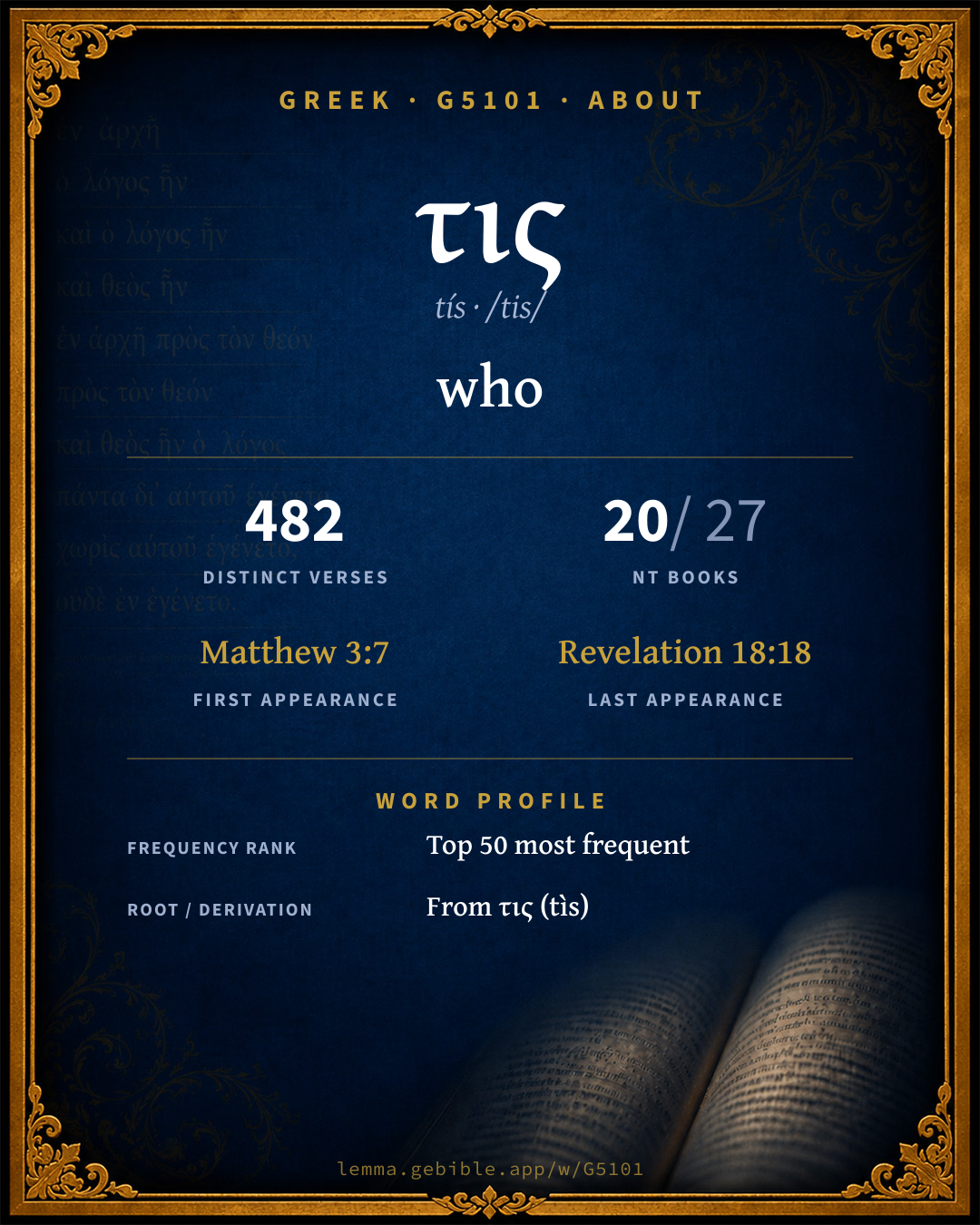
τίς
who
Full lexicon entry — Thayer's Greek Lexicon
From Thayer's Greek Lexicon
Where this word appears
See every Accusative-case word in the Greek New Testament →
Grammar key — what these labels mean
Part of speech
- Interrogative pronoun
- Asks a question (“who?”, “what?”).
- Indefinite pronoun
- Refers to someone or something unspecified (“someone,” “anything”).
Case
- Accusative
- The case of the direct object and of extent.
- Nominative
- The case of the subject (and the predicate nominative).
- Genitive
- The case of source, possession, or “of” — answers “whose / from what.”
- Dative
- The case of the indirect object, means, or location — “to / for / with / in.”
Gender
- Neuter
- Grammatically neuter.
- Masculine
- Grammatically masculine.
- Feminine
- Grammatically feminine.
Number
- Singular
- One.
- Plural
- More than one.
Every verse where G5101 appears in the Book of Acts — 53 distinct verses. Click any verse to open its interlinear word-by-word view. Verse text shown in the World English Bible for context — . Each verse’s Greek form is shown with its reference; the English is not keyword-highlighted, since the data carries no word-level English alignment. Use “Compare translations” on any verse to read it across multiple English versions. This concordance covers the Greek New Testament; Septuagint (Greek Old Testament) occurrences of this word are not indexed here.
Acts
- Acts 1:11 τί int.pron acc sg neut who also said, "You men of Galilee, why do you stand looking into the sky? This Jesus, who was received up from you into the sky will come back in the same way as you saw him going into the sky."
- Acts 2:12 τί int.pron nom sg neut They were all amazed, and were perplexed, saying one to another, "What does this mean?"
- Acts 2:37 τί int.pron acc sg neut Now when they heard this, they were cut to the heart, and said to Peter and the rest of the apostles, "Brothers, what shall we do?"
- Acts 3:12 τί τί int.pron acc sg neut int.pron acc sg neut When Peter saw it, he responded to the people, "You men of Israel, why do you marvel at this man? Why do you fasten your eyes on us, as though by our own power or godliness we had made him walk?
- Acts 4:9 τίνι int.pron dat sg masc if we are examined today concerning a good deed done to a crippled man, by what means this man has been healed,
- Acts 4:16 τί int.pron acc sg neut saying, "What shall we do to these men? Because indeed a notable miracle has been done through them, as can be plainly seen by all who dwell in Jerusalem, and we can't deny it.
- Acts 5:4 τί int.pron acc sg neut While you kept it, didn't it remain your own? After it was sold, wasn't it in your power? How is it that you have conceived this thing in your heart? You haven't lied to men, but to God."
- Acts 5:9 τί int.pron nom sg neut But Peter asked her, "How is it that you have agreed together to tempt the Spirit of the Lord? Behold, the feet of those who have buried your husband are at the door, and they will carry you out."
- Acts 5:24 τί int.pron nom sg neut Now when the high priest, the captain of the temple, and the chief priests heard these words, they were very perplexed about them and what might become of this.
- Acts 5:35 τί int.pron acc sg neut He said to them, "You men of Israel, be careful concerning these men, what you are about to do.
- Acts 7:27 τίς int.pron nom sg masc But he who did his neighbor wrong pushed him away, saying, 'Who made you a ruler and a judge over us?
- Acts 7:35 τίς int.pron nom sg masc "This Moses, whom they refused, saying, 'Who made you a ruler and a judge?'--God has sent him as both a ruler and a deliverer by the hand of the angel who appeared to him in the bush.
- Acts 7:40 τί int.pron nom sg neut saying to Aaron, 'Make us gods that will go before us, for as for this Moses, who led us out of the land of Egypt, we don't know what has become of him.'
- Acts 7:49 τίς int.pron nom sg masc 'heaven is my throne, And the earth a footstool for my feet. What kind of house will you build me?' says the Lord; 'Or what is the place of my rest?
- Acts 7:52 τίνα int.pron acc sg masc Which of the prophets didn't your fathers persecute? They killed those who foretold the coming of the Righteous One, of whom you have now become betrayers and murderers.
- Acts 8:33 τίς int.pron nom sg masc In his humiliation, his judgment was taken away. Who will declare His generation? For his life is taken from the earth."
- Acts 8:34 τίνος int.pron gen sg masc The eunuch answered Philip, "Who is the prophet talking about? About himself, or about someone else?"
- Acts 8:36 τί int.pron nom sg neut As they went on the way, they came to some water, and the eunuch said, "Behold, here is water. What is keeping me from being baptized?"
- Acts 9:4 τί int.pron acc sg neut He fell on the earth, and heard a voice saying to him, "Saul, Saul, why do you persecute me?"
- Acts 9:5 τίς int.pron nom sg masc He said, "Who are you, Lord?" The Lord said, "I am Jesus, whom you are persecuting.
- Acts 9:6 τί indef.pron acc sg neut But rise up, and enter into the city, and you will be told what you must do."
- Acts 10:4 τί int.pron nom sg neut He, fastening his eyes on him, and being frightened, said, "What is it, Lord?" He said to him, "Your prayers and your gifts to the needy have gone up for a memorial before God.
- Acts 10:17 τί int.pron nom sg neut Now while Peter was very perplexed in himself what the vision which he had seen might mean, behold, the men who were sent by Cornelius, having made inquiry for Simon's house, stood before the gate,
- Acts 10:21 τίς int.pron nom sg fem Peter went down to the men, and said, "Behold, I am he whom you seek. Why have you come?"
- Acts 10:29 τίνι int.pron dat sg masc Therefore also I came without complaint when I was sent for. I ask therefore, why did you send for me?"
- Acts 11:17 τίς int.pron nom sg masc If then God gave to them the same gift as us, when we believed in the Lord Jesus Christ, who was I, that I could withstand God?"
- Acts 12:18 τί int.pron nom sg neut Now as soon as it was day, there was no small stir among the soldiers about what had become of Peter.
- Acts 13:25 τί int.pron acc sg neut As John was fulfilling his course, he said, 'What do you suppose that I am? I am not he. But behold, one comes after me the sandals of whose feet I am not worthy to untie.'
- Acts 14:15 τί int.pron acc sg neut "Men, why are you doing these things? We also are men of like passions with you, and bring you good news, that you should turn from these vain things to the living God, who made the sky and the earth and the sea, and all that is in them;
- Acts 15:10 τί int.pron acc sg neut Now therefore why do you tempt God, that you should put a yoke on the neck of the disciples which neither our fathers nor we were able to bear?
- Acts 16:30 τί int.pron acc sg neut and brought them out and said, "Sirs, what must I do to be saved?"
- Acts 17:18 τί int.pron acc sg neut Some of the Epicurean and Stoic philosophers also were conversing with him. Some said, "What does this babbler want to say?" Others said, "He seems to be advocating foreign deities," because he preached Jesus and the resurrection.
- Acts 17:19 τίς int.pron nom sg fem They took hold of him, and brought him to the Areopagus, saying, "May we know what this new teaching is, which is spoken by you?
- Acts 17:20 τίνα int.pron nom pl neut For you bring certain strange things to our ears. We want to know therefore what these things mean."
- Acts 19:3 τί int.pron acc sg neut He said, "Into what then were you baptized?" They said, "Into John's baptism."
- Acts 19:15 τίνες int.pron nom pl masc The evil spirit answered, "Jesus I know, and Paul I know, but who are you?"
- Acts 19:32 τίνος int.pron gen sg neut Some therefore cried one thing, and some another, for the assembly was in confusion. Most of them didn't know why they had come together.
- Acts 19:35 τίς int.pron nom sg masc When the town clerk had quieted the multitude, he said, "You men of Ephesus, what man is there who doesn't know that the city of the Ephesians is temple-keeper of the great goddess Artemis, and of the image which fell down from Zeus?
- Acts 21:13 τί int.pron acc sg neut Then Paul answered, "What are you doing, weeping and breaking my heart? For I am ready not only to be bound, but also to die at Jerusalem for the name of the Lord Jesus."
- Acts 21:22 τί int.pron nom sg neut What then? The assembly must certainly meet, for they will hear that you have come.
- Acts 21:33 τίς τί int.pron nom sg masc int.pron nom sg neut Then the commanding officer came near, arrested him, commanded him to be bound with two chains, and inquired who he was and what he had done.
- Acts 22:7 τί int.pron acc sg neut I fell to the ground, and heard a voice saying to me, 'Saul, Saul, why are you persecuting me?'
- Acts 22:8 τίς int.pron nom sg masc I answered, 'Who are you, Lord?' He said to me, 'I am Jesus of Nazareth, whom you persecute.'
- Acts 22:10 τί int.pron acc sg neut I said, 'What shall I do, Lord?' The Lord said to me, 'Arise, and go into Damascus. There you will be told about all things which are appointed for you to do.'
- Acts 22:16 τί int.pron acc sg neut Now why do you wait? Arise, be baptized, and wash away your sins, calling on the name of the Lord.'
- Acts 22:26 τί int.pron acc sg neut When the centurion heard it, he went to the commanding officer and told him, "Watch what you are about to do, for this man is a Roman!"
- Acts 22:30 τί int.pron acc sg neut But on the next day, desiring to know the truth about why he was accused by the Jews, he freed him from the bonds, and commanded the chief priests and all the council to come together, and brought Paul down and set him before them.
- Acts 23:19 τί int.pron nom sg neut The commanding officer took him by the hand, and going aside, asked him privately, "What is it that you have to tell me?"
- Acts 24:20 τί int.pron acc sg neut Or else let these men themselves say what injustice they found in me when I stood before the council,
- Acts 25:26 τί int.pron acc sg neut Of whom I have no certain thing to write to my lord. Therefore I have brought him forth before you, and especially before you, King Agrippa, that, after examination, I may have something to write.
- Acts 26:8 τί int.pron acc sg neut Why is it judged incredible with you, if God does raise the dead?
- Acts 26:14 τί int.pron acc sg neut When we had all fallen to the earth, I heard a voice saying to me in the Hebrew language, 'Saul, Saul, why are you persecuting me? It is hard for you to kick against the goads.'
- Acts 26:15 τίς int.pron nom sg masc "I said, 'Who are you, Lord?' "He said, 'I am Jesus, whom you are persecuting.
About this entry
At a glance — auto-summarized from this page’s data, not written by a person. Every figure links to its source below. This summary describes the numbers; it doesn’t interpret them.
τις — transliterated tís — is a Greek word carrying the sense “who.” Debuting at Matthew 3:7, it then recurs through the corpus. Spanning 482 verses in 20 books, it ranks among the common words of the Greek New Testament. Each statement above links to its evidence; the full detail follows below.
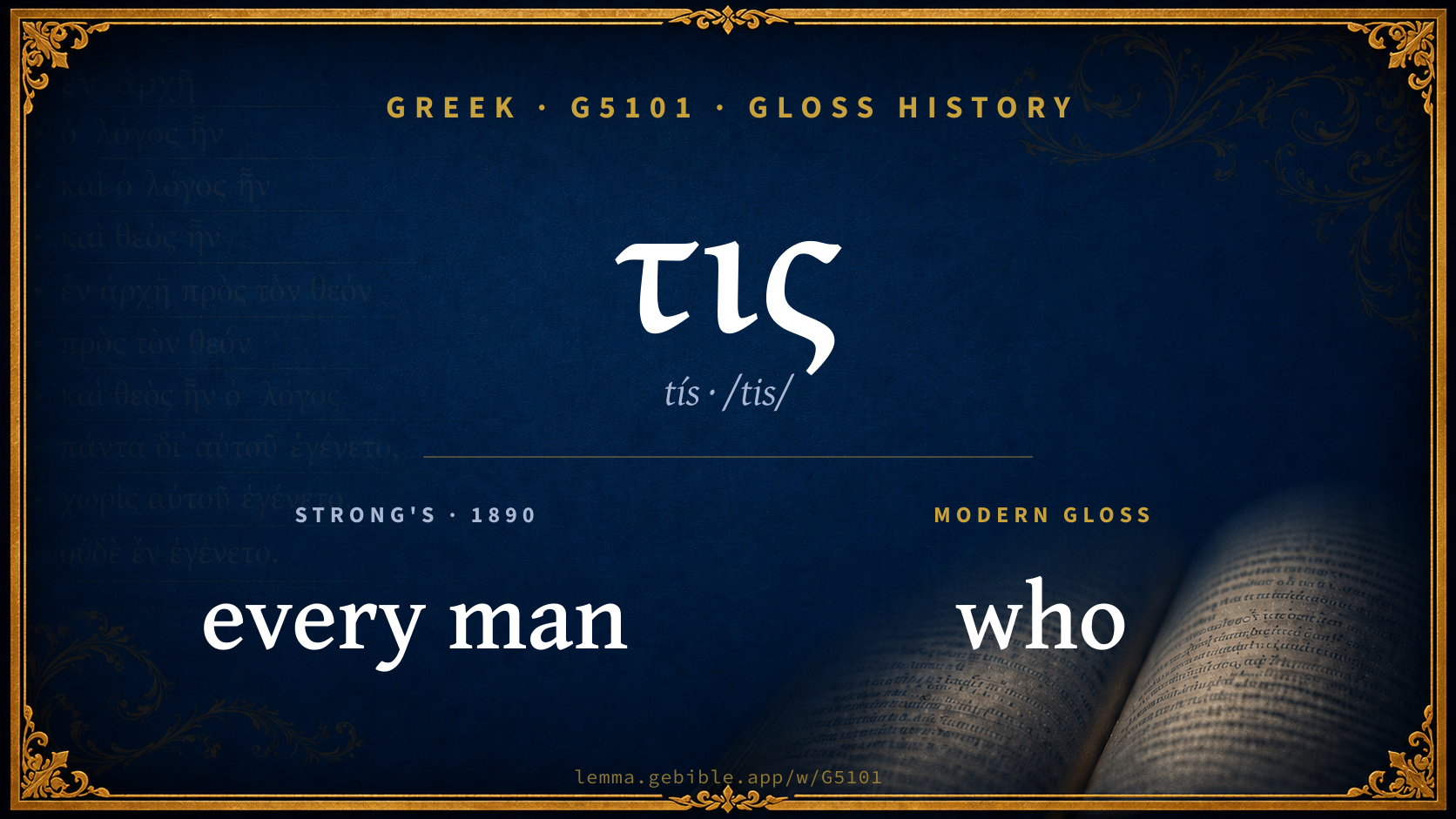
Gloss history
Strong's 1890 vs modern scholarship
About this word
Strong's G5101 catalogs a Greek word from the Greek New Testament.
These counts are not copied from any lexicon or concordance. They are computed here, from the morphology-tagged Greek New Testament. What Lemma adds →
- 482
- distinct verses
- The word appears in 482 distinct verses.
- 20 / 27
- NT books
- The word appears in 20 of 27 New Testament books.
- #36
- by frequency
- Top 50 most frequent Greek words (rank 36 of 5,347 Greek words by occurrence).
View all 482 occurrences in the concordance →
By section of the New Testament
By traditional corpus
Conventional, traditional groupings — biblical authorship is debated, so this is a traditional corpus grouping, not an authorship claim. Some books belong to more than one corpus (Luke is in both the Gospels and the Lukan corpus, and so on), so these shares overlap and need not total 100%. Each figure is a share of the word’s 482 distinct verses.
- Gospels 308 verses · 64%
- Lukan (Luke–Acts) 154 verses · 32%
- Pauline corpus 86 verses · 18%
- Johannine 83 verses · 17%
- Revelation 13 verses · 3%
- General (Catholic) Epistles 12 verses · 2%
- Hebrews 10 verses · 2%
How translations render this word
Counts come from each version’s own published word-to-Strong’s tagging or interlinear alignment — an approximate guide to how each version renders this word, not a word-level alignment the data otherwise carries. Because each total is that version’s own tagged count, the per-version totals vary from one another and need not match the appearance or distinct-verse counts above. These counts may also differ from a printed concordance because Lemma counts each distinctly tagged rendering and does not collapse phrase taggings into a single head-word total. This is a fixed set of word-tagged versions (KJV, ASV, BSB, ULT) and does not change with the reading translation you choose elsewhere. Each version’s license is shown beside its name below (and on Sources).
- King James Version: What 260×, Who 101×, Why 67×
- American Standard Version: What 246×, Who 107×, Why 76×
- Berean Standard Bible: What 232×, Who 118×, Why 78×
- unfoldingWord Literal Text: What 271×, Who 118×, Why 93×
King James Version Public Domain
Renders G5101 across 523 tagged occurrences — most commonly:
Plus 13 renderings that appear only once — usually multi-word phrases or single function words the recovered tagging swept in, not distinct renderings. Not rendered by a distinct English word in 14 further occurrences.
American Standard Version Public Domain
Renders G5101 across 541 tagged occurrences — most commonly:
Plus other, less common renderings. Plus 29 renderings that appear only once — usually multi-word phrases or single function words the recovered tagging swept in, not distinct renderings.
Berean Standard Bible Public Domain
Renders G5101 across 502 tagged occurrences — most commonly:
Plus 14 renderings that appear only once — usually multi-word phrases or single function words the recovered tagging swept in, not distinct renderings. Not rendered by a distinct English word in 58 further occurrences.
unfoldingWord Literal Text CC BY-SA 4.0
Renders G5101 across 611 tagged occurrences — most commonly:
Plus other, less common renderings. Plus 13 renderings that appear only once — usually multi-word phrases or single function words the recovered tagging swept in, not distinct renderings.
Senses in Thayer's
The 1 sense Thayer's distinguishes for this word, in lexicon order (not ranked by frequency or importance). The full entry — with sub-senses — is in the Lexicon Entry tab.
- who, which, what
Word origin
Derived from τις (tìs) (G5100) — a certain.
Probably emphatic of G5100 ; an interrogitive pronoun who which or what (in direct or indirect questions): - every man how (much) + no (-ne thing) what (manner thing) where ([-by -fore -of -unto -with -withal]) whether which who (-m -se) why.
— Strong’s Exhaustive Concordance (1890), public domain.
Forms in the corpus
The 13 distinct written forms G5101 takes in the Greek New Testament, most frequent first — each parse links to that case’s occurrences in the concordance.