2 Corinthians 11:29

Greek (Tischendorf 8th ed.) 2 Corinthians 11:29 appears in the Greek New Testament. The text above is from the Tischendorf 8th edition. Each word links to its Strong’s number and a concise gloss. Click any word for its full Thayer’s Greek Lexicon entry.
Download image
Cite this verse

2 Corinthians 11:29 (World English Bible). Public Domain. Lemma interlinear Bible study tool, https://lemma.gebible.app/v/2-corinthians/11/29.

Show BibTeX & RIS
BibTeX
RIS
English Translation
Who is weak, and I am not weak? Who is caused to stumble, and I don't burn with indignation?
World English Bible · Public Domain
Download a study sheet

One document with this verse’s original text, its word-by-word gloss line, the meaning frame, cross-references with their text, attributed commentary, and full source and license credits — printable, and it pastes into notes with its structure intact.

This verse Autodidact and up

Study sheet (.html) Plain text (.txt)

A passage Seminary Student

Up to 50 verses in one chapter. A passage sheet keeps up to 6 commentary sources and 12 cross-references per verse, in the order this page ranks them, and says so on the sheet whenever that leaves anything out. Ask for a single verse and you get the Autodidact verse sheet above.

Everything on this page stays free to read, with no account — the sheet is a download of what is already on screen, not access to it.

Want to remove ads? Support Godless Engineer
Compare translations 3

The same verse in 3 English versions, stacked beneath the original-language interlinear above. Click any original word for its lexicon entry.

Each is an independent rendering of the whole verse — the interlinear is not word-aligned to these translations.

Highlighted words mark where these versions differ — a whole-verse word diff, not a word-by-word alignment.

  • World English Bible Public Domain
    Who is weak, and I am not weak? Who is caused to stumble, and I don't burn with indignation?
  • King James Version Public Domain
    Who is weak, and I am not weak? who is offended, and I burn not?
  • unfoldingWord Literal Text CC BY-SA 4.0
    Who is weak, and I am not weak? Who is caused to stumble, and I am not inflamed?

unfoldingWord Literal Text — © unfoldingWord, licensed CC BY-SA 4.0. Word-aligned USFM3 via Door43 (git.door43.org/unfoldingWord/en_ult).

Versions to compare (up to 4)

3 of 4 selected

Show all 19 translations

Every available English version of this verse, each an independent rendering of the whole verse.

  • World English Bible Public Domain
    Who is weak, and I am not weak? Who is caused to stumble, and I don't burn with indignation?
  • Berean Standard Bible Public Domain
    Who is weak, and I am not weak? Who is led into sin, and I do not burn with grief?
  • Majority Standard Bible Public Domain
    Who is weak, and I am not weak? Who is led into sin, and I do not burn with grief?
  • King James Version Public Domain
    Who is weak, and I am not weak? who is offended, and I burn not?
  • American Standard Version (1901) Public Domain
    Who is weak, and I am not weak? who is caused to stumble, and I burn not?
  • Revised Version (1885) Public Domain
    Who is weak, and I am not weak? who is made to stumble, and I burn not?
  • Geneva Bible (1599) Public Domain
    Who is weake, and I am not weake? who is offended, and I burne not?
  • Douay-Rheims (1899) Public Domain
    Who is weak, and I am not weak? Who is scandalized, and I am not on fire?
  • Young's Literal Translation Public Domain
    Who is infirm, and I am not infirm? who is stumbled, and I am not fired;
  • Literal Standard Version CC BY-SA 4.0
    Who is weak, and I am not weak? Who is stumbled, and I am not burned?
  • Unlocked Literal Bible CC BY-SA 4.0
    Who is weak, and I am not weak? Who has been caused to stumble, and I do not burn?
  • unfoldingWord Literal Text CC BY-SA 4.0
    Who is weak, and I am not weak? Who is caused to stumble, and I am not inflamed?
  • Darby Bible Public Domain
    Who is weak, and I am not weak? Who is stumbled, and I burn not?
  • World Messianic Bible Public Domain
    Who is weak, and I am not weak? Who is caused to stumble, and I don’t burn with indignation?
  • Webster's Bible Public Domain
    Who is weak, and I am not weak? who is made to fall into sin, and I burn not?
  • Free Bible Version CC BY-SA 4.0
    Who is weak, and I don't feel weak too? Who is led into sin, and I don't burn up?
  • Bible in Basic English Public Domain
    Who is feeble and I am not feeble? who is in danger of falling, and I am not angry?
  • Text-Critical English NT CC BY 4.0
    Who is weak, and I am not weak? Who is made to stumble, and I do not burn with indignation?
  • Tyndale New Testament (1534) Public Domain
    Who is sicke and I am not sicke? Who is hurte in the fayth and my hert burneth not?

Literal Standard Version (2020), Covenant Press — licensed CC BY-SA 4.0. Text via the HelloAO Bible API (eBible.org). Unlocked Literal Bible (unfoldingWord) — licensed CC BY-SA 4.0. Text via the HelloAO Bible API (eBible.org). unfoldingWord Literal Text — © unfoldingWord, licensed CC BY-SA 4.0. Word-aligned USFM3 via Door43 (git.door43.org/unfoldingWord/en_ult). Free Bible Version, Dr. Jonathan Gallagher — licensed CC BY-SA 4.0. Text via the HelloAO Bible API (eBible.org).

Word by word

More ways to search: Search by grammar → Find every occurrence → Compare this word →

Practice this passage: Drill this verse → Learn its vocabulary →

πυροῦμαι
pyróō
G4448
“to burn”
Verb, Present, Passive, Indicative, 1st person, Singular
Part of Speech
Verb
Tense
Present
Voice
Passive
Mood
Indicative
Person
1st person
Number
Singular
Full Thayer's Definition

Origin: from G4442

TDNT: 21:49,0

1. to burn with fire, to set on fire, kindle a. to be on fire, to burn 1. to be incensed, indignant b. make to glow 1. full of fire, fiery, ignited 1b c. of darts filled with inflammable substances and set on fire 1. melted by fire and purged of dross
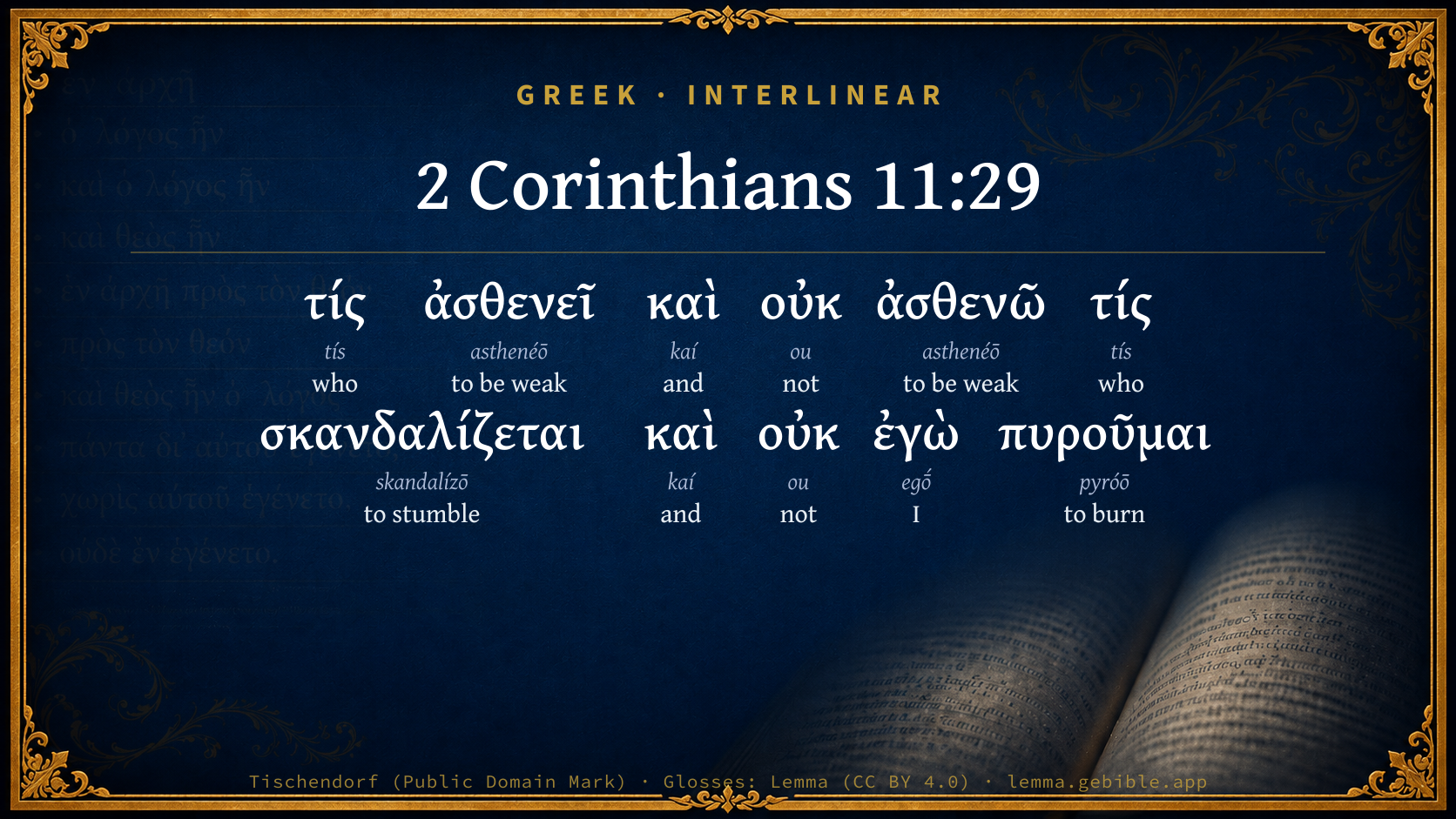
  1. τίς tís G5101 “who” Interrogative pronoun, Nominative, Singular, Masculine
  2. ἀσθενεῖ asthenéō G770 “to be weak” Verb, Present, Active, Indicative, 3rd person, Singular
  3. καὶ kaí G2532 “and” Conjunction
  4. οὐκ ou G3756 “not” Particle, Negative
  5. ἀσθενῶ asthenéō G770 “to be weak” Verb, Present, Active, Indicative, 1st person, Singular
  6. τίς tís G5101 “who” Interrogative pronoun, Nominative, Singular, Masculine
  7. σκανδαλίζεται skandalízō G4624 “to stumble” Verb, Present, Passive, Indicative, 3rd person, Singular
  8. καὶ kaí G2532 “and” Conjunction
  9. οὐκ ou G3756 “not” Particle, Negative
  10. ἐγὼ egṓ G1473 “I” Personal pronoun, 1st person, Nominative, Singular

About this verse

These counts appear in no published source. They are computed here, from the morphology-tagged text and Lemma’s own curated glosses. What Lemma adds →

11
words
7
distinct lemmas
Pauline Epistles
section

Notable vocabulary

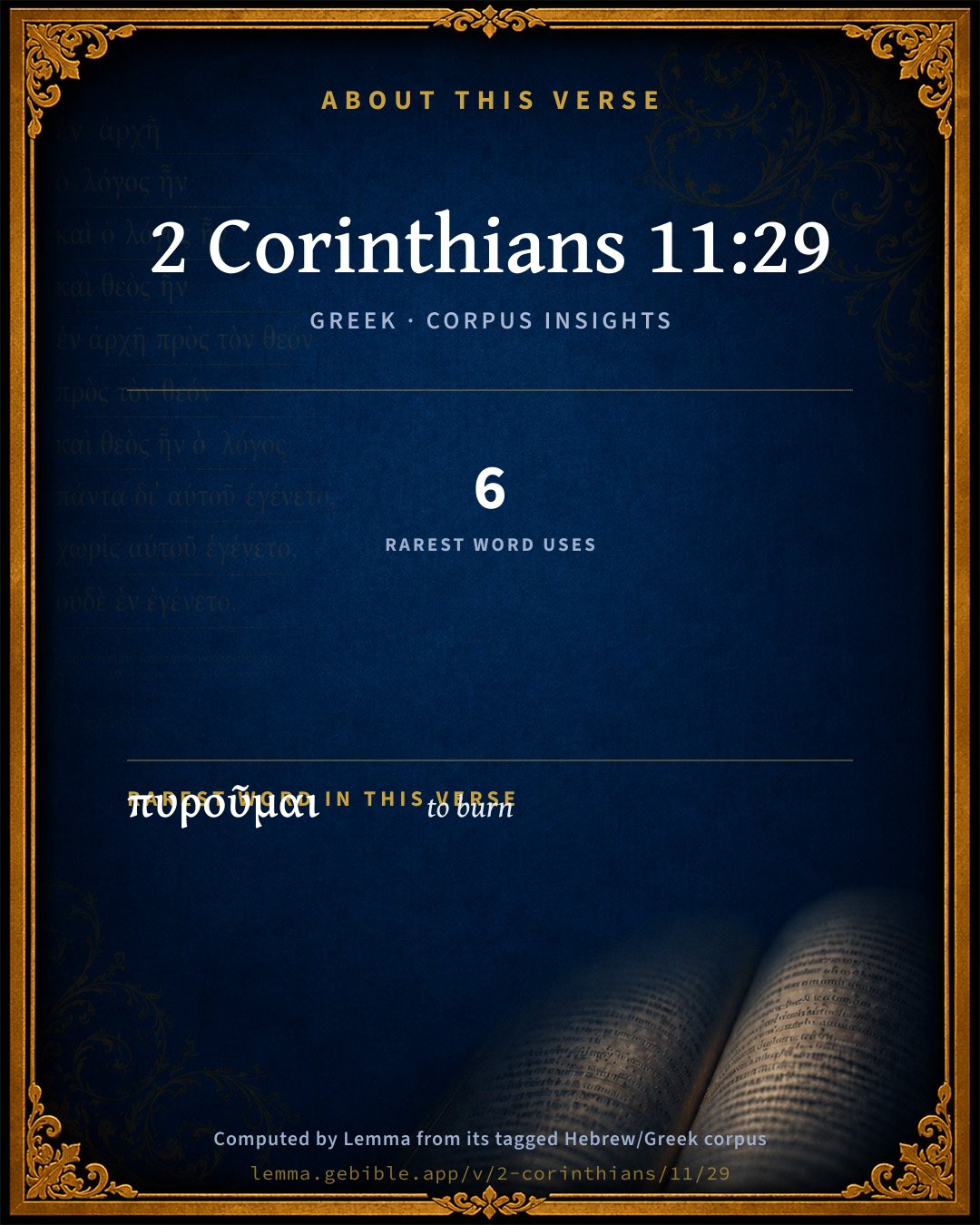
The rarest word here is πυροῦμαι to burn G4448 — appearing just 6 times in the whole Greek New Testament.

Shared distinctive vocabulary

πυροῦμαι to burn G4448 occurs in 6 verses of the Greek New Testament. Also found in:

Repetition

Words recur within this verse:

  • ἀσθενεῖ to be weak G770 ×2
  • τίς who G5101 ×2
  • καὶ and G2532 ×2
  • οὐκ not G3756 ×2

Cross-references

34

Topical passages linked to 2 Corinthians 11:29 in the Treasury of Scripture Knowledge — connected by theme and wording, ordered by reader-vote popularity; previews shown in the World English Bible.

  • 1 Corinthians 8:13 Therefore, if food causes my brother to stumble, I will eat no meat forevermore, that I don't cause my brother to stumble.
  • 1 Corinthians 9:22 To the weak I became as weak, that I might gain the weak. I have become all things to all men, that I may by all means save some.
  • Galatians 4:8–20 However at that time, not knowing God, you were in bondage to those who by nature are not gods.
  • Numbers 25:6–11 Behold, one of the children of Israel came and brought to his brothers a Midianite woman in the sight of Moses, and in the sight of all the congregation of the children of Israel, while they were weeping at the door of the tent of meeting.
  • Ezra 9:1–3 Now when these things were done, the princes drew near to me, saying, The people of Israel, and the priests and the Levites, have not separated themselves from the peoples of the lands, [doing] according to their abominations, even of the Canaanites, the Hittites, the Perizzites, the Jebusites, the Ammonites, the Moabites, the Egyptians, and the Amorites.
  • Nehemiah 5:6–13 I was very angry when I heard their cry and these words.
  • Nehemiah 13:15–20 In those days saw I in Judah some men treading wine-presses on the Sabbath, and bringing in sheaves, and lading donkeys [therewith]; as also wine, grapes, and figs, and all manner of burdens, which they brought into Jerusalem on the Sabbath day: and I testified [against them] in the day in which they sold food.
  • Nehemiah 13:23–25 In those days also saw I the Jews who had married women of Ashdod, of Ammon, [and] of Moab:
  • John 2:17 His disciples remembered that it was written, "Zeal for your house will eat me up."
  • Romans 12:15 Rejoice with those who rejoice. Weep with those who weep.
  • Romans 15:1 Now we who are strong ought to bear the weaknesses of the weak, and not to please ourselves.
  • 1 Corinthians 5:1–5 It is actually reported that there is sexual immorality among you, and such sexual immorality as is not even named among the Gentiles, that one has his father's wife.
  • 1 Corinthians 6:5–7 I say this to move you to shame. Isn't there even one wise man among you who would be able to decide between his brothers?
  • 1 Corinthians 6:15–18 Don't you know that your bodies are members of Christ? Shall I then take the members of Christ, and make them members of a prostitute? May it never be!
  • 1 Corinthians 11:22 What, don't you have houses to eat and to drink in? Or do you despise God's assembly, and put them to shame who don't have? What shall I tell you? Shall I praise you? In this I don't praise you.
  • 1 Corinthians 12:26 When one member suffers, all the members suffer with it. Or when one member is honored, all the members rejoice with it.
  • 1 Corinthians 15:12–34 Now if Christ is preached, that he has been raised from the dead, how do some among you say that there is no resurrection of the dead?
  • 1 Corinthians 15:36 You foolish one, that which you yourself sow is not made alive unless it dies.
  • 2 Corinthians 2:4–5 For out of much affliction and anguish of heart I wrote to you with many tears, not that you should be made sorry, but that you might know the love that I have so abundantly for you.
  • 2 Corinthians 7:5–6 For even when we had come into Macedonia, our flesh had no relief, but we were afflicted on every side. Fightings were outside. Fear was inside.
  • 2 Corinthians 11:13–15 For such men are false apostles, deceitful workers, masquerading as Christ's apostles.
  • 2 Corinthians 13:9 For we rejoice when we are weak and you are strong. And this we also pray for, even your perfecting.
  • Galatians 1:7–10 and there isn't another gospel. Only there are some who trouble you, and want to pervert the Gospel of Christ.
  • Galatians 2:4–6 This was because of the false brothers secretly brought in, who stole in to spy out our liberty which we have in Christ Jesus, that they might bring us into bondage;
  • Galatians 2:14 But when I saw that they didn't walk uprightly according to the truth of the Gospel, I said to Peter before them all, "If you, being a Jew, live as the Gentiles do, and not as the Jews do, why do you compel the Gentiles to live as the Jews do?
  • Galatians 3:1–3 Foolish Galatians, who has bewitched you not to obey the truth, before whose eyes Jesus Christ was openly set forth among you as crucified?
  • Galatians 5:2–4 Behold, I, Paul, tell you that if you receive circumcision, Christ will profit you nothing.
  • Galatians 6:2 Bear one another's burdens, and so fulfill the law of Christ.
  • 1 Thessalonians 3:5–8 For this cause I also, when I couldn't stand it any longer, sent that I might know your faith, for fear that by any means the tempter had tempted you, and our labor would have been in vain.
  • 2 John 1:10–11 If anyone comes to you, and doesn't bring this teaching, don't receive him into your house, and don't welcome him,
  • Jude 1:3–4 Beloved, while I was very eager to write to you about our common salvation, I was constrained to write to you exhorting you to contend earnestly for the faith which was once for all delivered to the saints.
  • Revelation 2:2 "I know your works, and your toil and perseverance, and that you can't tolerate evil men, and have tested those who call themselves apostles, and they are not, and found them false.
  • Revelation 2:20 But I have this against you, that you tolerate your woman, Jezebel, who calls herself a prophetess. She teaches and seduces my servants to commit sexual immorality, and to eat things sacrificed to idols.
  • Revelation 3:15–18 "I know your works, that you are neither cold nor hot. I wish you were cold or hot.

Cross-references courtesy of OpenBible.info (CC BY 4.0).

Commentary

Notes on 2 Corinthians 11:29 from classic Christian and Jewish commentators (each source and its license shown beneath its notes). The classic Christian expositions comment on the surrounding passage and are grouped to its opening verse, so a note may address several verses; the Jewish commentaries on the Tanakh (Rashi and others) are per-verse, so they appear only where the commentator wrote on this verse.

Lemma curates 59 commentaries, every one of them public domain or Creative Commons licensed, each selected and text-cleaned for this edition rather than reprinted as found. About our sources →

Bengel's Gnomon

Johann Albrecht Bengel

2Co 11:29. Τίς, who) He not merely cares for the churches, but for the souls of individuals.—ἀσθενῶ, I am weak) not only through condescension, συγκατάβασις, 1Co 9:22, but through compassion.—σκανδαλίζεται, is offended) To be weak and to be offended, at least in this passage, differ, comp. Rom 14:21, note. The former comes by itself; the latter, by means of others.—καὶ οὐκ ἐγὼ πυροῦμαι, and I burn not) He adds I, not in the former [no ἐγὼ before ἀσθενῶ], but in this part of the verse, for there he suits himself to the weak man; here he confesses that he bears no resemblance to the party offending, as he himself, for the sake of the offended party, takes up the duties neglected by the offender. The duties, neglected by the person offending, are love, prudence, etc. Paul however at the same time takes upon himself the part of the offended person, or the inconvenience, which the offended person feels. All these things thus follow from the force of the relatives [the things mutually related]. Πυροῦσθαι τοῖς θυμοῖς is read more than once in 2 Macc. They think or speak badly, who, seeing a scandal or offence, say in the mother tongue [alluding to a German saying], I have caused myself to offend.

Bengel's Gnomon of the New Testament — English translation (T&T Clark, Edinburgh, 1860) — public domain. Text from a community e-Sword module.

Meyer's Critical & Exegetical Commentary

Heinrich August Wilhelm Meyer

2Co_11:29. Two characteristic traits for illustrating the μέριμνα πασῶν τῶν ἐκκλησιῶν. Chrysostom aptly says: ἐπήγαγε καὶ τὴν ἐπίτασιν τῆς φροντίδος, and that for the individual members (Act_20:31).

As ἀσθενεῖ with σκανδαλίζεται, so also ἀσθενῶ with πυροῦμαι forms a climaxand in a way highly appropriate to the subject! For in point of fact he could not in the second clause say: καὶ οὐ σκανδαλίζομαι.

The meaning of the verse is to express the most cordial and most lively sympathy (comp. 1Co_12:26) of his care amidst the dangers, to which the Christian character and life of the brethren are exposed: Who is weak as regards his faith, conscience, or his Christian morality, and I am not weak, do not feel myself, by means of the sympathy of my care, transplanted into the same position? Who is offended, led astray to unbelief and sin, and I do not burn, do not feel myself seized by burning pain of soul? Semler and Billroth, also de Wette (comp. Luthers gloss), mix up what is foreign to the passage, when they make ἀσθενῶ apply to the condescension of the apostle, who would give no offence to the weak, 1Co_9:22. And Emmerling (followed by Olshausen) quite erroneously takes it: quem afflictum dicas, si me non dicas? quem calamitatem oppetere, si me non iis premi, quin uri memores? In that case it must have run καὶ οὐκ ἐγὼ ἀσθενῶ; besides, σκανδαλίζεσθαι never means calamitatibus affici, but constantly denotes religious or moral offence; and lastly, σκανδαλίζεται and πυροῦμαι would yield a quite inappropriate climax (Paul must have repeated σκανδαλίζομαι).

ἀσθενεῖ] comp. Rom_4:19; Rom_14:1-2; Rom_14:21; 1Co_8:9; 1Co_8:11; 1Th_5:14; Act_20:35. The correspondence of σκανδαλίζεται in the climax forbids us to understand it of suffering (Chrysostom, Beza, Flatt).

πυροῦμαι] What emotion is denoted by verbs of burning, is decided on each occasion by the context (comp. 1Co_7:9; see in general on Luk_24:32), which here presents a climax to ἀσθενῶ, therefore suggests far more naturally the idea of violent pain (comp. Chrys.: καθʼ ἕκαστον ὠδυνᾶτο μέλος) than that of anger (Luther: it galled him hard; comp. Bengel, Rückert). Augustine says aptly: quanto major caritas, tanto majores plagae de peccatis alienis. Comp. on the expression, the Latin ardere doloribus, faces doloris, and the like (Kühner, ad Cic. Tusc. ii. 25. 61); also 3Ma_4:2, and Abresch, ad Aesch. Sept. 519.

Lastly, we have to note the change in the form of the antitheses, which emerges with the increasing vividness of feeling in the two halves of the verse: οὐκ ἀσθενῶ and οὐκ ἐγὼ πυροῦμαι. In the former case the negation attaches itself to the verb, in the latter to the person. Who is weak without weakness likewise occurring in me? who is offended without its being I, who is burning? Of the offence which another takes, I on my part have the pain.

Meyer — Critical and Exegetical Commentary on the New Testament — English translation by Peter Christie, edited by Frederick Crombie (T&T Clark, 1880) — public domain. Text from a community e-Sword module.

Expositor's Greek Testament

ed. W. Robertson Nicoll

2Co 11:29 . τίς ἀσθενεῖ κ . τ . λ .: who is weak, sc. , in prejudice (as at Rom 14:1 , 1Co 8:11 ), and I am not weak, i.e. , in Christian sympathy ( cf. 1Co 9:22 ἐγενόμην τοῖς ἀσθενέσιν ἀσθενής ); who is made to stumble, and I burn not? i.e. , with the fire of righteous indignation ( cf. πυρωθείς = “inflamed” at 2Ma 4:38 ). The word ἀσθενῶ now suggests to him a new thought, that it is in his weakness as supported by God’s grace rather than in any strength of his own that his real boast may be made.

The Expositor's Greek Testament, edited by W. Robertson Nicoll (1897–1910) — public domain. Text from a community e-Sword module.

Jamieson, Fausset & Brown

Robert Jamieson, A. R. Fausset & David Brown

I . . . weak--in condescending sympathy with the weak (Co1 9:22). "Care generates sympathy, which causes the minister of Christ personally to enter into the feelings of all his people, as if he stood in their position, so as to accommodate himself to all" [CALVIN].

offended--by some stumbling-block put in his way by others: the "weak" is most liable to be "offended."

I burn not--The "I" in the Greek is emphatic, which it is not in the former clause, "I am not weak." I not only enter into the feeling of the party offended, but I burn with indignation at the offender, I myself taking up his cause as my own. "Who meets with a stumbling-block and I am not disturbed even more than himself" [NEANDER].

Jamieson, Fausset & Brown — Commentary Critical and Explanatory on the Whole Bible (1871) — public domain (CC PDM 1.0). Text via the HelloAO Bible API.

Adam Clarke's Commentary

Verse 29. Who is weak] What Church is there under persecution, with which I do not immediately sympathize? or who, from his weakness in the faith, and scrupulousness of conscience, is likely to be stumbled, or turned out of the way, to whom I do not condescend, and whose burden I do not bear?

Who is offended] Or likely to be turned out of the way, and I burn not with zeal to restore and confirm him? This seems to be the sense of these different questions.

Adam Clarke's Commentary on the Bible (1810–1826) — public domain. Text from a community e-Sword/MySword module.

John Calvin's Commentaries

29. Who is weak. How many there are that allow all offenses to pass by unheeded — who either despise the infirmities of brethren, or trample them under foot! This, however, arises from their having no concern for the Church. For concern, undoubtedly, produces συμπάθειαν (sympathy,) which leads the Minister of Christ to participate in the feelings of all, and put himself in the place of all, that he may suit himself to all.

John Calvin's Commentaries (1540-1563) — public domain. Text from the Calvin Translation Society English edition (1840s-50s) via the Christian Classics Ethereal Library (ccel.org). Calvin's coverage is partial (roughly two-thirds of the Bible); uncommented books and verses are honest gaps, never fabricated. The 19th-century editor's footnotes and remarks are omitted so the notes are faithfully Calvin's own voice.

Ellicott's Commentary for English Readers

(29) Who is weak and I am not weak . . .?—The words obviously spring from a recollection of all that was involved in that “rush” of which he had just spoken. Did any come to him with his tale of body-sickness or soul-sickness, he, in his infinite sympathy, felt as if he shared in it. He claimed no exemption from their infirmities, was reminded by every such tale of his own liability to them. The words that follow have a still stronger significance. The word “offended” (better, made to stumble—i.e., led to fall by a temptation which the man has not resisted) suggests the thought of some grievous sin, as distinct from weakness; and the dominant sense of the word, as in Mat_5:29-30; Mat_18:8-9; Mar_9:42-43; Mar_9:45; Mar_9:47; 1Co_8:13, is that of the sins to which men are led by the temptations of the senses. The other word—to “burn”—is even more startling in its suggestiveness. It had been used in 1Co_7:9 of the “burning” of sensual passion, and it is scarcely open to a doubt that the associations thus connected with it mingle with its meaning here. Men came to the Apostle with their tales of shame, and told how they had been tempted and had fallen; and here, too, he, in that illimitable sympathy of his, seemed to have travelled with them on the downward road. He felt himself suffused, as it were, with the burning glow of their shame. He blushed with them and for them, as though the sin had been his own. Simply as a word, it should be added, it is equally applicable to any emotion of intense pain or fiery indignation, and it has been so taken by many interpreters. The view which has been given above seems, however, most in harmony with the Apostle’s character.

A Bible Commentary for English Readers, edited by Charles John Ellicott (1878–1897) — public domain. Text from a community e-Sword module.

The Cambridge Bible for Schools and Colleges

gen. ed. J. J. S. Perowne

29. Who is weak, and I am not weak?] St Paul goes on to explain in what that care consisted. It consisted in taking upon himself the anxieties of every individual member of the flock. We may see how true his words are by a reference to Rom_14:1 to Rom_15:7; 1Co_1:11; 1Co_5:1-5; 1Co_6:1; 1Co_7:1; 1Co_8:1-13; 1Co_9:22; 1Co_10:25-33; the whole Epistle to the Galatians; Php_4:2-3, as well as ch. 2Co_2:5-11, 2Co_7:12 of this Epistle.

The Cambridge Bible for Schools and Colleges (gen. ed. J. J. S. Perowne; Cambridge University Press, 1878–1918) — public domain. Text from a community e-Sword module.

John Gill's Exposition

If I must needs glory.... The apostle signifies that glorying was not agreeable to him; he was not fond of it, it was a subject he did not delight to dwell upon; what he had done was by force, and through necessity; he was compelled to it by the boasts of the false apostles: and since he must needs glory in order to stop their mouths;

will glory says he, of things which concern mine infirmities; meaning not his sins, for these cause shame; but his afflictions and sufferings for Christ, under which he was supported, and from which he was delivered by the power of Christ; and that was the reason he chose to glory of them; for though they rendered him mean and despicable in the eyes of the world, yet his bearing them with so much patience, courage, and pleasure, and his many singular deliverances out of them, served greatly to illustrate the power and grace of Christ, and at the same time proved him to be a true and faithful minister of the Gospel; to whom so much honour was vouchsafed, as to suffer shame for the name of Christ, and to be so singularly marked out by him, as the object of his favour, love, and care.

John Gill's Exposition of the Whole Bible (1746–1763) — public domain (CC PDM 1.0). Text via the HelloAO Bible API.

Trapp's Complete Commentary

John Trapp

29 Who is weak, and I am not weak? who is offended, and I burn not?

Ver. 29. Who is weak] By passion.

And I am not weak] By compassion.

And I burn not] πυρουμαι, i.e. am exceedingly grieved. Compare Psa 10:2; Psa 7:14. He hotly pursueth the poor. The apostle was even scorched and scalded with sorrow and holy indignation, he felt twinges when others were hurt.

John Trapp, A Commentary or Exposition upon All the Books of the Old and New Testament (1647–1656) — public domain. Text from a community e-Sword module.

Albert Barnes' Notes on the Bible

Who is weak ... - I sympathize with all. I feel where others feel, and their sorrows excite deep sympathetic emotions in my bosom. Like a tender and compassionate friend I am affected when I see others in circumstances of distress. The word “weak” here may refer to any lack of strength, any infirmity or feebleness arising either from body or mind. It may include all who were feeble by persecution or by disease; or it may refer to the weak in faith and doubtful about their duty (see 1Co 9:22), and to those who were burdened with mental sorrows. The idea is, that Paul had a deep sympathy in all who needed such sympathy from any cause. And the statement here shows the depth of feeling of this great apostle; and shows what should be the feeling of every pastor; see the note on Rom 12:15.

And I am not weak? - I share his feelings and sympathize with him. If he suffers, I suffer. Bloomfield supposes that Paul means that in the case of those who were weak in the faith he accommodated himself to their weakness and thus became all things to all people; see my note on 1Co 9:22. But it seems to me probable that he uses the phrase here in a more general sense, as denoting that he sympathized with those who were weak and feeble in all their circumstances.

Who is offended - (σκανδαλίζεται skandalizetai). Who is “scandalized.” The word means properly to cause to stumble and fall; hence, to be a stumbling-block to any one; to give or cause offence to anyone. The idea here seems to be, “who is liable to be led astray; who has temptations and trials that are likely to lead him to sin or to cause him to fall, and I do not burn with impatience to restore him, or with indignation against the tempter?” In all such cases Paul deeply sympathized with them, and was prompt to aid them.

And I burn not? - That is, with anger or with great agitation of mind at learning that anyone had fallen into sin. This may either mean that he would burn with indignation against those who had led them into sin, or be deeply excited in view of the disgrace which would be thus brought on the Christian cause. In either case it means that his mind would be in a glow of emotion; he would feel deeply; he could not look upon such things with indifference or without being deeply agitated. With all he sympathized; and the condition of all, whether in a state of feeble faith, or feeble body, or falling into sin, excited the deepest emotions in his mind. The truth here taught is, that Paul felt a deep sympathy for all others who bore the Christian name, and this sympathy for others greatly increased the cares and toils of the apostolic office which he sustained. But having given this exposition, candor compels me to acknowledge that the whole verse may mean, “Who is feeble in the faith in regard to certain observances and rites and customs 1Co 9:22, and I do not also evince the same? I do not rouse their prejudices, or wound their feelings, or alarm them. On the other hand, who is scandalized, or led into sin by the example of others in regard to such custom; who is led by the example of others into transgression, and I do not burn with indignation?” In either case, however, the general sense is, that he sympathized with all others.

Albert Barnes' Notes on the Bible (1834–1885) — public domain. Text from a community e-Sword/MySword module.

Matthew Poole's English Annotations

Who, may be either, what church? Or, what particular Christian in any church?

Is weak, asyenei, through outward afflictions, or in respect of inward spiritual troubles,

and I am not weak, and I do not sympathize with that church, or with that person?

Who is offended, or scandalized, under temptations to be seduced and fall into sin,

and I burn not, and I am not on fire with a holy zeal for the glory of God, and the good of his soul, if possible to keep him upright? By which the apostle doth not only show us what was his own holy temper, but what should be the temper of every faithful minister, as to his province, or that part of the church over which he is concerned to watch; viz. to have a true compassion to every member of it, to watch over his flock, inquiring diligently into the state of it; to have a quick sense of any evils under which they, or any of them, labour. This is indeed the duty of ever private member, but more especially of him whose office is to feed any part of the flock of Christ, Rom 12:15. In this the members of the spiritual, mystical body of Christ should answer to the members of the body natural, to which our apostle before resembled it.

Matthew Poole's English Annotations on the Holy Bible (1683–1685) — public domain. Text from a community e-Sword/MySword module.

Whedon's Commentary on the Bible

Daniel D. Whedon

29. The distraction of this care arises from its carrying the apostle’s soul, as it were, out of himself into a sympathy and identification with its various individual objects.

Weak… weak—He becomes weak by tender sympathy with the weak, feeling for their infirmities, and trying, with them, to rise into strength. This weakness may consist in want of Christian faith, morality, or firm purpose.

Offended—Made by some one to stumble or falter in his Christian course.

Burn not—He cannot say I stumble with him, but I burn in shame and sorrow for him. The I in this last clause is, according to the Greek, emphatic. If any one is weak, I am sympathetically weak with him; if any stumble, the man to burn with agony thereat is I.

Daniel D. Whedon (gen. ed.), Commentary on the Old and New Testaments (1874–1909) — public domain. Text from a community e-Sword module.

The Pulpit Commentary

Who is weak, and I am not weak? See, by way of example, 1Co_8:13 1Co_9:22; Rom_14:21. Instead of stiffly maintaining my own prejudices, I am always ready to make concessions to weak brethren. Who is offended, and I burn not! That is, "who is ever caused to stumble without my burning with indignation?" In other words, "Is not the intensity of my sympathy whenever any scandal occurs an addition to the trials of my life?"

The Pulpit Commentary (1880–1919), ed. H.D.M. Spence-Jones & Joseph S. Exell — public domain. Text from a community e-Sword module.

John Wesley's Explanatory Notes

Who - So he had not only the care of the churches, but of every person therein. Is weak, and I am not weak - By sympathy, as well as by condescension. Who is offended - Hindered in, or turned out of, the good way. And I burn not - Being pained as though I had fire in my bosom.

John Wesley, Explanatory Notes Upon the Whole Bible (1754–1765) — public domain. Text via the GEBible commentary corpus.

Kretzmann's Popular Commentary

Paul E. Kretzmann

A further recital of hardships and difficulties:

v. 29. Who is weak, and I am not weak? Who is offended, and I burn not?

v. 30. If I must needs glory, I will glory of the things which concern mine infirmities.

v. 31. The God and father of our Lord Jesus Christ, which is blessed forevermore, knoweth that I lie not.

v. 32. In Damascus, the governor under Aretas, the king, kept the city of the Damascenes with a garrison, desirous to apprehend me;

v. 33. and through a window in a basket was I let down by the wall, and escaped his hands.

The first rhetorical questions contain a further explanation of the fact that Paul was burdened with the details of business concerning many congregations. If any important question of faith or of Christian life was to be decided, or when there was a quarrel, or when his advice was desired in any matter whatsoever, the apostle was invariably approached to give his assistance and decision. Not only the weal and woe of entire Congregations, however, rested upon his shoulders, but he also bore with the individual Christians. His apostolic sympathy went out to those that were weak in faith; he felt their weakness with them; he found the right word at the right time; he knew when to make allowances and when to use firmness; he became weak with the weak. On the other hand, when he heard that any person was being offended, was made to stumble, he was inflamed with righteous indignation. He felt the injury as though it had been done to himself. As a true pastor, he felt the spiritual troubles and perils of all his members everywhere and stood by their side with prayer and advice.

The principle which has guided the apostle thus far in his glorying he gives in the sentence: If it is necessary for me to boast, I will boast of my weakness. As though he would say: It is not my own free will, it is not my own choice to glory, but you Corinthians have compelled me to boast in order that the Gospel of Christ may remain in your midst. Since it is thus laid upon me as a necessity, I shall not boast as other people do, of my strength, of my successes, hut of that which belongs to my weakness, of my sufferings, of the persecutions and tribulations which I have endured. And herein the apostle solemnly protests that he is speaking the truth: The God and Father of the Lord Jesus, who is blessed forever, knows that I am not lying. This exclamation shows the depth of the feeling which was agitating the apostle. God is his witness. Not his own person, not the truth of his doctrine, hut the Gospel of Jesus Christ, the honor of his Lord, is endangered, and therefore this solemn assertion in the midst of his impassioned speech.

Paul now adds an account of a which befell him shortly after his conversion It was after his return from Arabia, when he was preaching so openly and fearlessly in Damascus, that the Jews took counsel to kill him, Act 9:23-25. Their influence in the city was so great that they induced the ethnarch of King Aretas of Arabia, the father-in-law of Herod Agrippa, to guard the city by placing a watch at all the gates, while they themselves searched the city and made every attempt to apprehend Paul. But the Lord watched over His servant. It seems that one of the members of the Christian congregation at Damascus lived nest to the city wall, and so the disciples took him to this house. When night came, hey took him either to an opening in the city wall or to a window of the house where it was flush with the wall, and let him down in a basket. Thus he escaped from the city, and the plans of his enemies were frustrated, both those of the Jews and those of the ethnarch. Note that it is right for a Christian and also for a Christian pastor to flee for his life in times of persecution, when there is an opportunity and it may be done without a denial of the truth.

Summary

Paul censures the spirit which permitted the Corinthians to be led astray; he asserts that he as in no way inferior to his opponents, although he insisted upon supporting himself, a fact which served also as a challenge to the false apostles; he boasts of the perils and hardships of his apostolic labors.

Paul E. Kretzmann, Popular Commentary of the Bible (1921–1924) — public domain. Text from a community e-Sword module.

Burkitt's Expository Notes on the New Testament

William Burkitt

That is, "What particular church, or what particular Christian in any of the churches of Christ, is weak in faith, or wavering in their profession: Where is the person that is assaulted with inward temptations, or outward troubles, and I do not sympathize with him, yea, burn with holy zeal and fervent desire for his settlement and establishing?" Sympathy among all the members, but especially in and among the ministers of Christ, is a great Christian duty: They ought to have a tender compassion to the whole flock, and also a quick sense both of the sins and the sufferings of every particular and individual member and part thereof.

As Christ, our head, is afflicted in all his church’s afflictions, so ought we, as his ministers and members, to be afflicted in the afflictions of our fellow-brethren. He that has no cross of his own, must take up and bear his brother’s: yea, he that has many of his own, must yet bear a part of all his brethren’s crosses. Good men ever have been and are men of tender and compassionate dispositions, ready to mourn over, and lament for, both the sins and sufferings of others, from the overflowing of a Christ-like spirit in them. True goodness evermore promotes compassion.

William Burkitt's Expository Notes on the New Testament (1700–1703) — public domain. Text from a community e-Sword module.

McGarvey & Pendleton's Commentaries

J. W. McGarvey

Who is weak, and I am not weak? who is caused to stumble, and I burn not? [In this verse Paul shows what the care of the churches meant to him. It was an excessive drain upon his sympathies. If any weak one suffered through the rash selfishness of a brother who abused his liberty by eating in an idol temple, Paul suffered with him as if he also were weak, and if any were caused to stumble, Paul made the case of such a one his own, and burned with indignation.]

J. W. McGarvey (with Philip Y. Pendleton), Commentaries on the New Testament (The Fourfold Gospel, 1914; Acts; and the epistles) — public domain. Text from a community e-Sword/MySword module.

The People's New Testament

B. W. Johnson

29. Who is weak? His sympathy for the churches was so great that if they suffered, he suffered with them.

B. W. Johnson's The People's New Testament with Notes (1889–1891) — public domain. Electronic text from the Christian Classics Ethereal Library (CCEL) ThML edition.

Cambridge Greek Testament for Schools and Colleges

29. Two illustrations of his all-embracing μέριμνα, each exhibiting the Apostle’s intense sympathy. Among new converts there would be many who would be weak in faith, or in judgment, or in conduct; and in every case he felt the weakness as if it were his own: ἐγενόμην τοῖς ἀσθενέσιν ἀσθενής (1Co 9:22). Comp. Rom 15:1. In οὐκ ἀσθενῶ the emphasis is on οὐκ: in οὐκ ἐγὼ πυροῦμαι on ἐγώ. Hence Cyprian (Ep. xvii. 1) changes the order, ego non … non ego: the Vulgate has ego non in both places. For ἀσθενῶ comp. Rom 4:19; Rom 14:1-2; 1Co 8:11-12. The verb is specially frequent in these last chapters (2Co 11:21, 2Co 12:10, 2Co 13:3-4; 2Co 13:9): so also ἀσθένεια (2Co 11:30, 2Co 12:5; 2Co 12:9-10, 2Co 13:4). Neither word, nor ἀσθενής (2Co 10:10), is found in chapters 1–9. How little such facts prove is pointed out in the Introduction § 7 (e).

τίς σκανδαλίζεται; Who is made to offend (1Co 8:13), or Who is made to stumble (R.V.), and I burn not (1Co 7:9) with distress? It is the fire of intense pain that is meant, rather than of indignation. The Apostle feels the agony of shame and sorrow which consumes the sinner (1Co 12:26): καθʼ ἕκαστον ὠδυνᾶτο μέλος (Chrysostom): quanto major caritas, tanto majores plagae de peccatis alienis (Augustine). There is nothing of Stoic indifference in S. Paul. The Christian does not dissemble his feelings, but tries to school and consecrate them. Comp. στεναγμοῖς πεπυρωμένης πάντοθεν αὐτῶν τῆς καρδίας (3Ma 4:2), and faces doloris (Cic. Tusc. Disp. II. xxv. 1). In all cases the exact meaning of πυροῦσθαι (in the N.T. πυροῦν is not found) is determined by the context (1Co 7:9; Eph 6:16; 2Pe 3:12; Rev 1:15; Rev 3:18). Note the balanced climax between ἀσθενεῖ and σκανδαλίζεται, and between ἀσθενῶ and πυροῦμαι.

Cambridge Greek Testament for Schools and Colleges (Cambridge University Press, 1896; 21 vols, various authors incl. Carr, Maclear, Plummer, Farrar, Lumby, Moule, M. R. James, Simcox) — public domain. Text from a community e-Sword module.

Alford’s Greek Testament

Henry Alford

29.] ‘Cura certe συμπάθειαν generat: quæ facit, ut omnium affectus in se suscipiat Christi minister, omnium personas induat, quo se accommodet omnibus,’ Calv.

Olsh., after Emmerling, strangely understands, ‘Who is weak, if I am not weak?’ i.e. ‘Who can be called weak, if I am not so?’

The ἀσθένεια of the τις may be in various ways; in faith, as Rom 14:1 al., or in purpose, or in courage: that of the Apostle, see 1Co 9:22, was a sympathetic weakness, a leaning to the same infirmity for the weak brother’s sake, but also a veritable θορυβοῦμαι κ. ταράσσομαι (as Chrys., p. 614) in himself, on the weak brother’s account.

τίς σκανδ.] “Non priore, sed hac versiculi parte addit ego: nam illic infirmo se accommodat: hic dissimilem se scandalizantis fatetur, partes a scandalizante neglectas scandalizati causa ipse suscipiens. Partes a scandalizante neglectæ sunt amor, prudentia, &c. Idem tamen Paulus etiam partes scandalizati, sive incommodum quod scandalizatus sentit, in se suscipit.” Bengel.

πυροῦμαι,—with zeal, or with indignation.

Henry Alford, The Greek Testament (1849–1861) — public domain. Text from a community e-Sword module.

International Critical Commentary

29. τίς ἀσθενεῖ, καὶ οὐκ ἀσθενῶ; At once he gives two examples of the μέριμνα which distracts him; “as though he were himself the Church throughout the world, so was he distressed for every member” (Chrys.). Needless scruples often troubled the weaker brethren; in his intense sympathy the Apostle felt the weakness, though he did not share the scruples (1Co 9:22; cf. 1Co 8:11, 1Co 8:12; Rom 4:19, Rom 4:14:1, Rom 4:2). But other forms of weakness are doubtless included. Of course he does not mean, ‘Who is weak, if I am not? If anyone can be called weak, I can.’ For that, ἐγώ must have been expressed, and the wording would have been different. Both ἀσθενῶ (v. 21, 12:10, 13:3, 4, 9) and ἀσθένεια (11:30, 12:5, 9, 10, 13:4) are freq. in these chapters.

τίς σκανδαλίζεται καὶ οὐκ ἐγὼ πυροῦμαι; ‘Who is made to stumble (1Co 8:13) and I burn not’ with shame and distress? Cf. ἕνα ἕκαστον ὑμῶν ὡς πατὴρ τέκνα ἑαυτοῦ (1Th 2:11). When any Christian, and especially one of his own converts, is seduced into sin or grievous error, the Apostle shares his remorse; quanto major caritas, tanto majores plagae de peccatis alienis (Aug.). The exact meaning of πυροῦμαι depends in each case on the context (see on 1Co 7:9; Eph 6:16; 2Pe 3:12; Rev 1:15, Rev 3:18), and here it means feeling burning shame with the sinner rather than hot indignation against the seducer. In Latin we find such expressions as flagrare pudore, dolorum faces, dolor ardentes faces intentat,—the last two in Cicero. Note the emphatic ἐγώ in this question; in the first question the emphasis is on οὐκ, and Cyprian (Ep. xvii. 1) marks the change with a change of order; ego non … non ego; Vulg. has ego non in both places. The second question is a studied advance on the first, for σκανδαλίζεται and πυροῦμαι express a great deal more than ἀσθενεῖ and ἀσθενῶ, and there is the addition of the emphatic ἐγώ: ‘Who is entrapped into sin, and my heart is not ablaze with pain?’ In such cases there was ὀδύνη φλογί ζουσα τὴν ἑαυτοῦ καρδίαν, summo dolore, quasi igne, cruciabatur ipse.

International Critical Commentary — older volumes (1896–1929), various authors — public domain. Text from a community e-Sword module.

Vincent's Word Studies in the New Testament

Marvin R. Vincent

Burn. With sorrow over the stumbling or with indignation over the cause. This and 1Co 7:9 are the only instances in which the word is used figuratively.

Marvin R. Vincent, Word Studies in the New Testament (1887–1900) — public domain. Text from a community e-Sword/MySword module.

Lesson kit

Teaching starters — assembled from the data on this page, not authored interpretation. Every prompt links to the verse data it draws on. Edit before teaching.

2 Corinthians, in the Pauline Epistles, opens this verse with 11 words (7 distinct Greek lemmas). Its most distinctive word is pyróō (“to burn”). A historical commentator’s framing appears above. Read the whole chapter for the surrounding context.

Discussion questions

  1. How does “to burn” (pyróō) shape what this verse is saying?
  2. How does 1 Corinthians 7:9, which shares the word «to burn», read alongside this verse?
  3. What does the repetition of “to be weak” (2× in this one verse) do in this verse?
  4. These translations render this verse differently. What is at stake in choosing one wording over another?
  5. Compare how Bengel's Gnomon and Meyer's Critical & Exegetical Commentary read this verse. Where do they agree or differ?

Things to notice

  • These translations choose different wording for 7 words in this verse.
  • “to be weak” occurs 2× in this single verse.
  • 7 distinct Greek lemmas span 11 words in this verse.

Reading settings

Reading text

Shown beneath each verse's original-language words.

Old Testament
Old Testament edition

Read the OT as the Masoretic Hebrew (MT) or the Greek Septuagint (LXX).

English shown for the Greek Septuagint (in the Hebrew ↔ Greek comparison).

Comparing translations? Open the Compare panel on any verse page to stack up to four side by side.