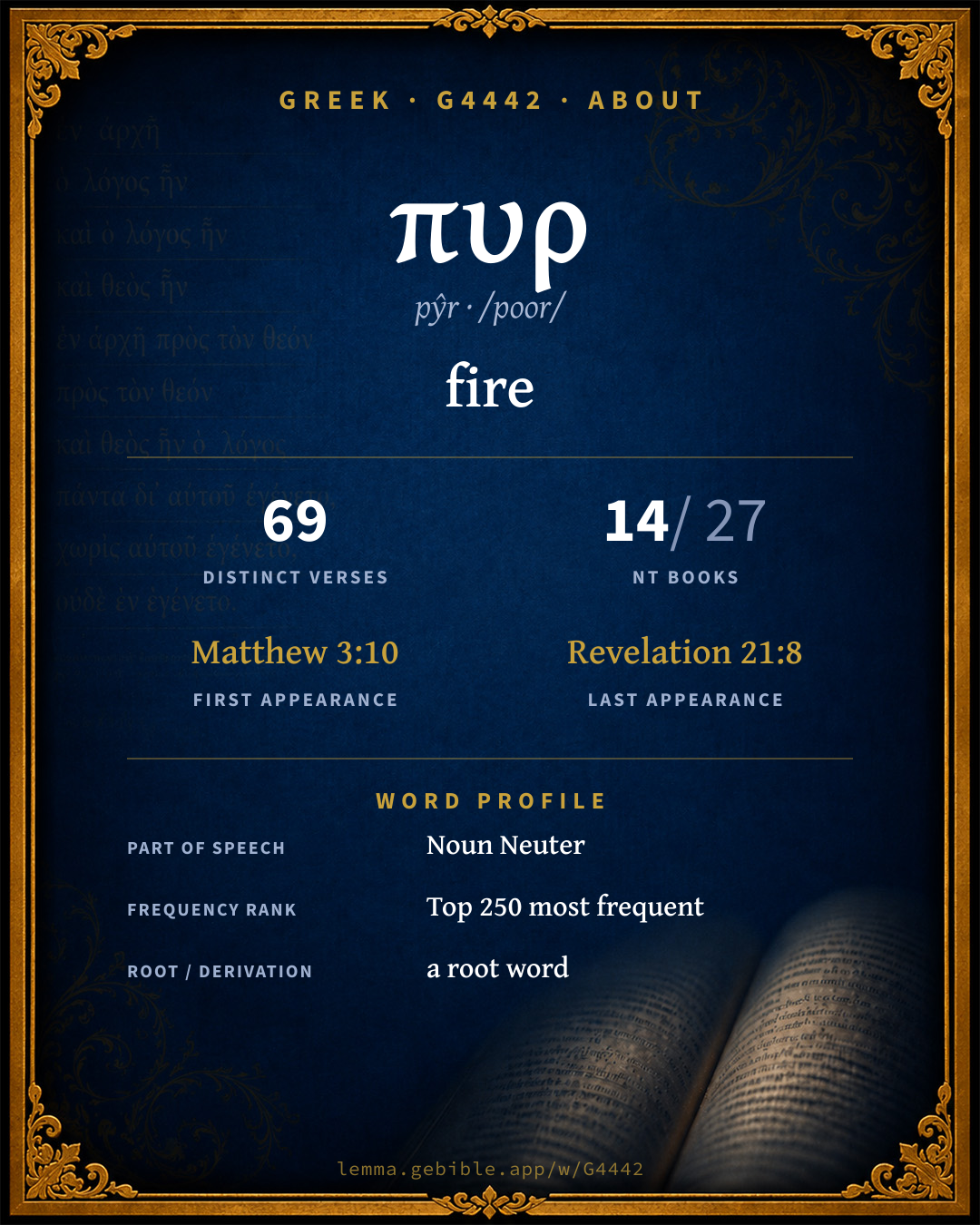
πῦρ
fire
Full lexicon entry — Thayer's Greek Lexicon
From Thayer's Greek Lexicon
Where this word appears
See every Dative-case word in the Greek New Testament →
Grammar key — what these labels mean
Part of speech
- Noun
- A naming word — a person, place, thing, or idea.
Case
- Genitive
- The case of source, possession, or “of” — answers “whose / from what.”
- Accusative
- The case of the direct object and of extent.
- Dative
- The case of the indirect object, means, or location — “to / for / with / in.”
- Nominative
- The case of the subject (and the predicate nominative).
Gender
- Neuter
- Grammatically neuter.
Number
- Singular
- One.
Every verse where G4442 appears in the Book of 1 Corinthians — 2 distinct verses. Click any verse to open its interlinear word-by-word view. Verse text shown in the World English Bible for context — . Each verse’s Greek form is shown with its reference; the English is not keyword-highlighted, since the data carries no word-level English alignment. Use “Compare translations” on any verse to read it across multiple English versions. This concordance covers the Greek New Testament; Septuagint (Greek Old Testament) occurrences of this word are not indexed here.
1 Corinthians
- 1 Corinthians 3:13 πυρὶ πῦρ n dat sg neut n nom sg neut each man's work will be revealed. For the Day will declare it, because it is revealed in fire; and the fire itself will test what sort of work each man's work is.
- 1 Corinthians 3:15 πυρός n gen sg neut If any man's work is burned, he will suffer loss, but he himself will be saved, but as through fire.
About this entry
At a glance — auto-summarized from this page’s data, not written by a person. Every figure links to its source below. This summary describes the numbers; it doesn’t interpret them.
πυρ — transliterated pŷr — is a Greek noun carrying the sense “fire.” It first appears in Matthew 3:10. With 69 verses in 14 books, it is a moderately common word in the Greek New Testament. Its uses concentrate in Revelation (36% of all occurrences). From the same root come πυρα, πυροω and πυρρος. Each statement above links to its evidence; the full detail follows below.
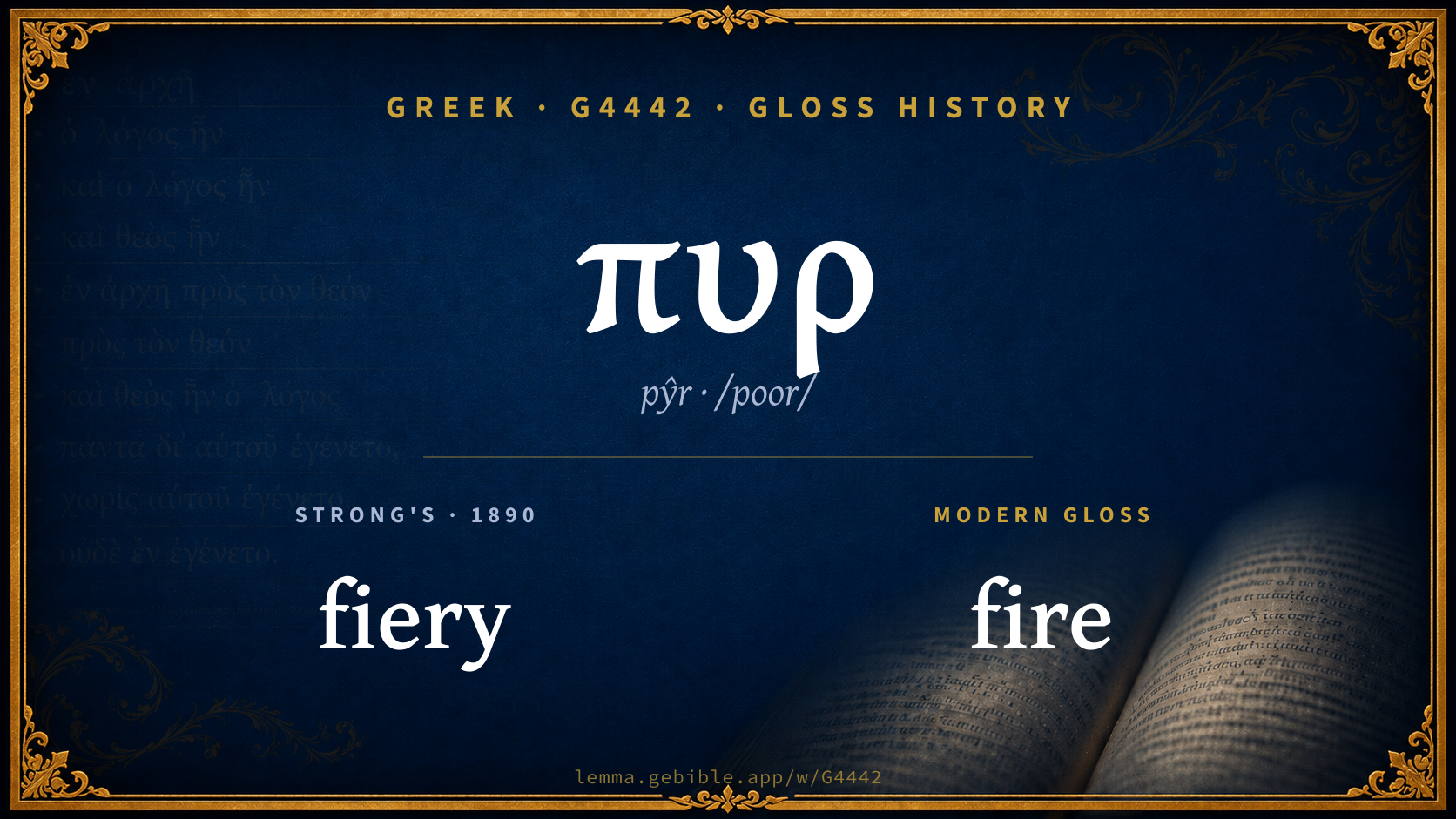
Gloss history
Strong's 1890 vs modern scholarship
About this word
Strong's G4442 catalogs a Greek word from the Greek New Testament.
These counts are not copied from any lexicon or concordance. They are computed here, from the morphology-tagged Greek New Testament. What Lemma adds →
- 69
- distinct verses
- The word appears in 69 distinct verses.
- 14 / 27
- NT books
- The word appears in 14 of 27 New Testament books.
- #236
- by frequency
- Top 250 most frequent Greek words (rank 236 of 5,347 Greek words by occurrence).
View all 69 occurrences in the concordance →
Most concentrated in
- Revelation 25 verses 36%
- Matthew 12 verses 17%
- Luke 7 verses 10%
By section of the New Testament
By traditional corpus
Conventional, traditional groupings — biblical authorship is debated, so this is a traditional corpus grouping, not an authorship claim. Some books belong to more than one corpus (Luke is in both the Gospels and the Lukan corpus, and so on), so these shares overlap and need not total 100%. Each figure is a share of the word’s 69 distinct verses.
- Johannine 26 verses · 38%
- Revelation 25 verses · 36%
- Gospels 24 verses · 35%
- Lukan (Luke–Acts) 11 verses · 16%
- General (Catholic) Epistles 7 verses · 10%
- Hebrews 5 verses · 7%
- Pauline corpus 4 verses · 6%
How translations render this word
Counts come from each version’s own published word-to-Strong’s tagging or interlinear alignment — an approximate guide to how each version renders this word, not a word-level alignment the data otherwise carries. Because each total is that version’s own tagged count, the per-version totals vary from one another and need not match the appearance or distinct-verse counts above. These counts may also differ from a printed concordance because Lemma counts each distinctly tagged rendering and does not collapse phrase taggings into a single head-word total. This is a fixed set of word-tagged versions (KJV, ASV, BSB, ULT) and does not change with the reading translation you choose elsewhere. Each version’s license is shown beside its name below (and on Sources).
- King James Version: Fire 72×
- American Standard Version: Fire 67×
- Berean Standard Bible: Fire 63×, Fiery 3×, Burning 2×
- unfoldingWord Literal Text: Fire 73×, With 2×
King James Version Public Domain
Renders G4442 across 74 tagged occurrences — most commonly:
Plus 2 renderings that appear only once — usually multi-word phrases or single function words the recovered tagging swept in, not distinct renderings.
American Standard Version Public Domain
Renders G4442 across 70 tagged occurrences — most commonly:
Plus 3 renderings that appear only once — usually multi-word phrases or single function words the recovered tagging swept in, not distinct renderings.
Berean Standard Bible Public Domain
Renders G4442 across 71 tagged occurrences — most commonly:
Plus 3 renderings that appear only once — usually multi-word phrases or single function words the recovered tagging swept in, not distinct renderings.
unfoldingWord Literal Text CC BY-SA 4.0
Renders G4442 across 78 tagged occurrences — most commonly:
Plus 3 renderings that appear only once — usually multi-word phrases or single function words the recovered tagging swept in, not distinct renderings.
Senses in Thayer's
The 1 sense Thayer's distinguishes for this word, in lexicon order (not ranked by frequency or importance). The full entry — with sub-senses — is in the Lexicon Entry tab.
- fire
Word origin
Origin: a root word
A primary word; fire (literally or figuratively specifically lightning ): - fiery fire.
— Strong’s Exhaustive Concordance (1890), public domain.
Forms in the corpus
The 6 distinct written forms G4442 takes in the Greek New Testament, most frequent first — each parse links to that case’s occurrences in the concordance.
| Form | Parsing | Example | Uses |
|---|---|---|---|
| πῦρ pŷr | Noun, Accusative, Singular, Neuter | Matthew 3:10 | 25 |
| πυρός pyrós | Noun, Genitive, Singular, Neuter | Matthew 5:22 | 15 |
| πυρὸς pyròs | Noun, Genitive, Singular, Neuter | Acts 7:30 | 13 |
| πυρὶ pyrì | Noun, Dative, Singular, Neuter | Matthew 3:12 | 11 |
| πυρί pyrí | Noun, Dative, Singular, Neuter | Matthew 3:11 | 6 |
| Πῦρ Pŷr | Noun, Accusative, Singular, Neuter | Luke 12:49 | 1 |
Same root — word family
Other Thayer's entries built from the same root as G4442, grouped by Strong’s listed origin. These share a root / origin per the lexicon — not necessarily a shared meaning. Each links to that word’s own entry.
Derived from this word
Compare all same-root words → They share a root, not necessarily a meaning.
Septuagint usage
The same Greek word πυρ appears 390 times in the Greek Old Testament (Septuagint), across 355 verses in 33 books.
- 390
- LXX occurrences
- Tagged occurrences of this Greek word in the Septuagint.
- 355
- verses
- Distinct Septuagint verses containing this word.
- 33 / 39
- OT books
- The word appears in 33 of the 39 Old Testament books.
Sample Septuagint occurrences
- Genesis 11:3 πῦρ
- Exodus 3:2 πῦρ
- Leviticus 1:7 πῦρ
- Numbers 3:4 πῦρ
- Deuteronomy 1:33 πῦρ
- Joshua 7:15 πῦρ
- Judges 1:8 πῦρ
- 1 Samuel 2:28 πῦρ
- 2 Samuel 14:30 πῦρ
- 1 Kings 15:13 πῦρ
- 2 Kings 1:10 πῦρ
- 1 Chronicles 14:12 πῦρ
Septuagint occurrences (same lexeme)
Every verse where the same Strong’s number (G4442) appears in the Greek Septuagint — showing the first 50 of 355. Verse text shown in the World English Bible for context; the Greek form is the matched word — the English is not keyword-highlighted.
- Genesis 11:3 πῦρ They said one to another, "Come, let's make brick, and burn them thoroughly." They had brick for stone, and they used tar for mortar.
- Genesis 15:17 πῦρ It came to pass that, when the sun went down, and it was dark, behold, a smoking furnace, and a flaming torch passed between these pieces.
- Genesis 19:24 πῦρ Then Yahweh rained on Sodom and on Gomorrah sulfur and fire from Yahweh out of the sky.
- Genesis 22:6 πῦρ Abraham took the wood of the burnt offering and laid it on Isaac his son. He took in his hand the fire and the knife. They both went together.
- Genesis 22:7 πῦρ Isaac spoke to Abraham his father, and said, "My father?" He said, "Here I am, my son." He said, "Here is the fire and the wood, but where is the lamb for a burnt offering?"
- Exodus 3:2 πῦρ The angel of Yahweh appeared to him in a flame of fire out of the midst of a bush. He looked, and behold, the bush burned with fire, and the bush was not consumed.
- Exodus 9:23 πῦρ Moses stretched forth his rod toward the heavens, and Yahweh sent thunder, hail, and lightning flashed down to the earth. Yahweh rained hail on the land of Egypt.
- Exodus 9:24 πῦρ So there was very severe hail, and lightning mixed with the hail, such as had not been in all the land of Egypt since it became a nation.
- Exodus 9:28 πῦρ Pray to Yahweh; for there has been enough of mighty thunderings and hail. I will let you go, and you shall stay no longer."
- Exodus 12:8 πῦρ They shall eat the flesh in that night, roasted with fire, and unleavened bread. They shall eat it with bitter herbs.
- Exodus 12:9 πῦρ Don't eat it raw, nor boiled at all with water, but roasted with fire; with its head, its legs and its inner parts.
- Exodus 12:10 πῦρ You shall let nothing of it remain until the morning; but that which remains of it until the morning you shall burn with fire.
- Exodus 13:21 πῦρ Yahweh went before them by day in a pillar of cloud, to lead them on their way, and by night in a pillar of fire, to give them light, that they might go by day and by night:
- Exodus 13:22 πῦρ the pillar of cloud by day, and the pillar of fire by night, didn't depart from before the people.
- Exodus 14:24 πῦρ It happened in the morning watch, that Yahweh looked out on the host of the Egyptians through the pillar of fire and of cloud, and confused the Egyptian army.
- Exodus 19:18 πῦρ Mount Sinai, the whole of it, smoked, because Yahweh descended on it in fire; and its smoke ascended like the smoke of a furnace, and the whole mountain quaked greatly.
- Exodus 22:5 πῦρ "If a man causes a field or vineyard to be eaten, and lets his animal loose, and it grazes in another man's field, he shall make restitution from the best of his own field, and from the best of his own vineyard.
- Exodus 24:17 πῦρ The appearance of the glory of Yahweh was like devouring fire on the top of the mountain in the eyes of the children of Israel.
- Exodus 29:14 πῦρ But the flesh of the bull, and its skin, and its dung, you shall burn with fire outside of the camp: it is a sin-offering.
- Exodus 29:34 πῦρ If anything of the flesh of the consecration, or of the bread, remains to the morning, then you shall burn the remainder with fire: it shall not be eaten, because it is holy.
- Exodus 32:20 πῦρ He took the calf which they had made, and burnt it with fire, ground it to powder, and scattered it on the water, and made the children of Israel drink of it.
- Exodus 32:24 πῦρ I said to them, 'Whoever has any gold, let them take it off:' so they gave it me; and I threw it into the fire, and out came this calf."
- Exodus 34:13 πῦρ but you shall break down their altars, and dash in pieces their pillars, and you shall cut down their Asherim;
- Exodus 35:3 πῦρ You shall kindle no fire throughout your habitations on the Sabbath day.'"
- Exodus 40:35 πῦρ Moses wasn't able to enter into the tent of meeting, because the cloud stayed on it, and Yahweh's glory filled the tent.
- Leviticus 1:7 πῦρ The sons of Aaron the priest shall put fire on the altar, and lay wood in order on the fire;
- Leviticus 1:8 πῦρ and Aaron's sons, the priests, shall lay the pieces, the head, and the fat in order on the wood that is on the fire which is on the altar;
- Leviticus 1:12 πῦρ He shall cut it into its pieces, with its head and its fat. The priest shall lay them in order on the wood that is on the fire which is on the altar,
- Leviticus 1:17 πῦρ He shall tear it by its wings, but shall not divide it apart. The priest shall burn it on the altar, on the wood that is on the fire. It is a burnt offering, an offering made by fire, of a sweet savor to Yahweh.
- Leviticus 3:5 πῦρ Aaron's sons shall burn it on the altar on the burnt offering, which is on the wood that is on the fire: it is an offering made by fire, of a sweet savor to Yahweh.
- Leviticus 4:12 πῦρ even the whole bull shall he carry forth outside the camp to a clean place, where the ashes are poured out, and burn it on wood with fire. Where the ashes are poured out it shall be burned.
- Leviticus 6:2 πῦρ "If anyone sins, and commits a trespass against Yahweh, and deals falsely with his neighbor in a matter of deposit, or of bargain, or of robbery, or has oppressed his neighbor,
- Leviticus 6:3 πῦρ or has found that which was lost, and dealt falsely therein, and swearing to a lie; in any of all these things that a man does, sinning therein;
- Leviticus 6:5 πῦρ or any thing about which he has sworn falsely; he shall restore it even in full, and shall add a fifth part more to it. To him to whom it belongs he shall give it, in the day of his being found guilty.
- Leviticus 6:6 πῦρ He shall bring his trespass offering to Yahweh, a ram without blemish from the flock, according to your estimation, for a trespass offering, to the priest.
- Leviticus 6:23 πῦρ Every meal offering of a priest shall be wholly burned. It shall not be eaten."
- Leviticus 7:17 πῦρ but what remains of the flesh of the sacrifice on the third day shall be burned with fire.
- Leviticus 7:19 πῦρ "'The flesh that touches any unclean thing shall not be eaten. It shall be burned with fire. As for the flesh, everyone who is clean may eat it;
- Leviticus 8:17 πῦρ But the bull, and its skin, and its flesh, and its dung, he burned with fire outside the camp; as Yahweh commanded Moses.
- Leviticus 8:32 πῦρ What remains of the flesh and of the bread you shall burn with fire.
- Leviticus 9:11 πῦρ The flesh and the skin he burned with fire outside the camp.
- Leviticus 9:24 πῦρ There came forth fire from before Yahweh, and consumed the burnt offering and the fat upon the altar: and when all the people saw it, they shouted, and fell on their faces.
- Leviticus 10:1 πῦρ Nadab and Abihu, the sons of Aaron, each took his censer, and put fire in it, and laid incense on it, and offered strange fire before Yahweh, which he had not commanded them.
- Leviticus 10:2 πῦρ And fire came forth from before Yahweh, and devoured them, and they died before Yahweh.
- Leviticus 13:24 πῦρ "Or when the body has a burn from fire on its skin, and the raw flesh of the burn becomes a bright spot, reddish-white, or white,
- Leviticus 13:52 πῦρ He shall burn the garment, whether the warp or the woof, in wool or in linen, or anything of skin, in which the plague is: for it is a destructive mildew. It shall be burned in the fire.
- Leviticus 13:55 πῦρ Then the priest shall examine it, after the plague is washed; and, behold, if the plague hasn't changed its color, and the plague hasn't spread, it is unclean; you shall burn it in the fire. It is a mildewed spot, whether the bareness is inside or outside.
- Leviticus 13:57 πῦρ and if it appears again in the garment, either in the warp, or in the woof, or in anything of skin, it is spreading. You shall burn with fire that in which the plague is.
- Leviticus 16:1 πῦρ Yahweh spoke to Moses, after the death of the two sons of Aaron, when they drew near before Yahweh, and died;
- Leviticus 16:12 πῦρ He shall take a censer full of coals of fire from off the altar before Yahweh, and two handfuls of sweet incense beaten small, and bring it within the veil:
These are occurrences of the same Greek lexeme (G4442) in the Septuagint — not a translation of any one Hebrew word. The store carries no word-level Hebrew↔Greek alignment, so no Hebrew original is asserted here. Counts come from the recovered LXX Strong's tagging — high-frequency vocabulary is well covered, while rare or late forms may be untagged — so they reflect tagged occurrences and may slightly undercount.