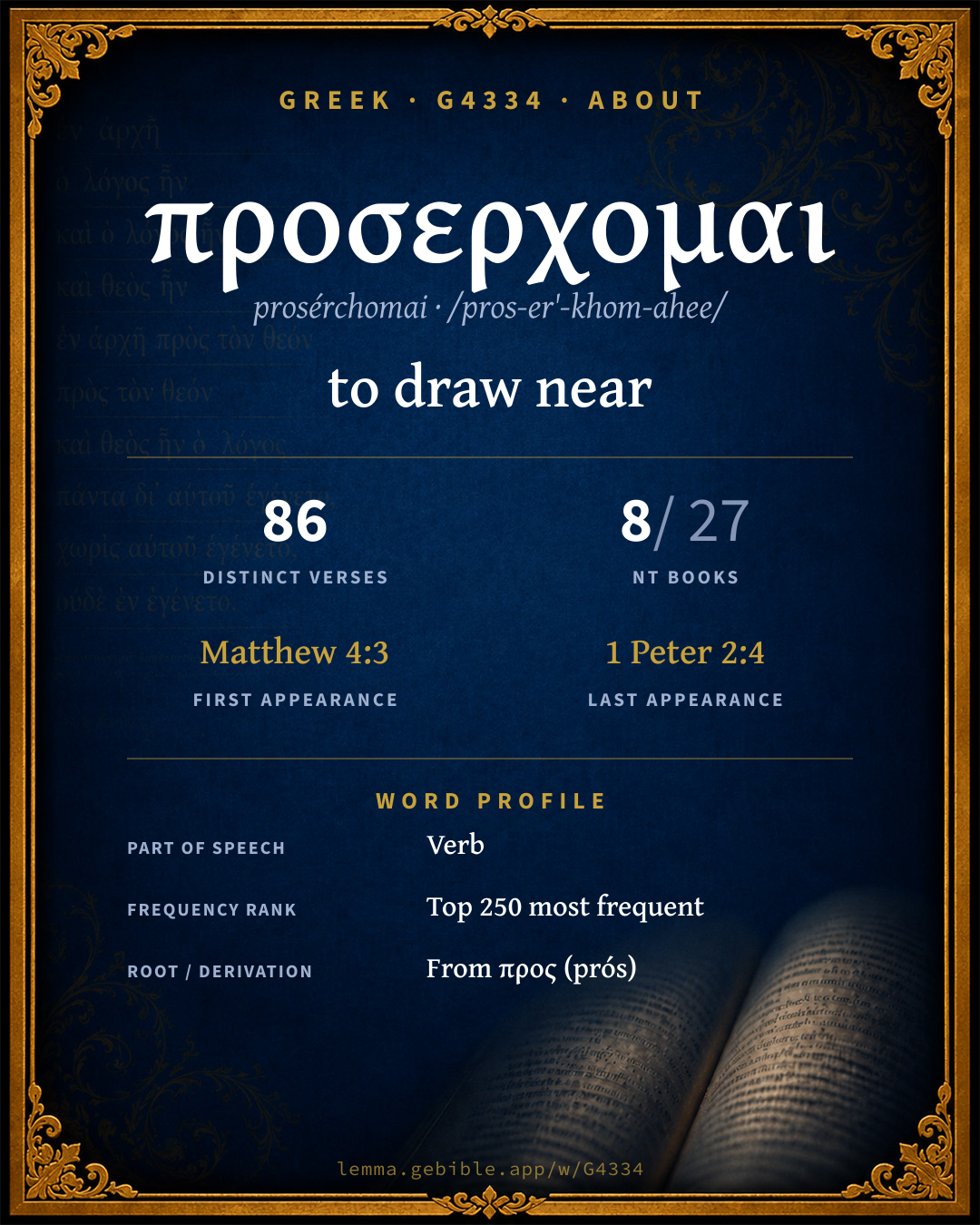
προσέρχομαι
to draw near
‘to draw near’ is one of 3 main senses fuller range ↓
Full lexicon entry — Thayer's Greek Lexicon
From Thayer's Greek Lexicon
Where this word appears
See every Aorist-tense verb in the Greek New Testament →
Grammar key — what these labels mean
Part of speech
- Verb
- An action or state-of-being word.
Tense
- Aorist
- Action viewed as a simple whole, without regard to duration — often past (perfective aspect).
- Perfect
- A completed past action with continuing present results.
- Present
- Ongoing or general action in present time (imperfective aspect).
- Imperfect
- Continuous or repeated action in past time (“was writing”).
Voice
- Active
- The subject performs the action.
- Middle or Passive deponent
- Middle/passive in form but active in meaning.
Mood
- Participle
- A verbal adjective (“writing,” “having written”).
- Indicative
- States a fact or asks a factual question (the mood of reality).
- Subjunctive
- Expresses probability, purpose, or possibility (the mood of contingency).
- Imperative
- Expresses a command or request.
- Infinitive
- A verbal noun (“to write”), unmarked for person or number.
Case
- Nominative
- The case of the subject (and the predicate nominative).
- Accusative
- The case of the direct object and of extent.
- Genitive
- The case of source, possession, or “of” — answers “whose / from what.”
Person
- 3rd person
- The one spoken about (“he / she / it / they”).
- 2nd person
- The one addressed (“you”).
- 1st person
- The speaker (“I / we”).
Gender
- Masculine
- Grammatically masculine.
- Feminine
- Grammatically feminine.
Number
- Singular
- One.
- Plural
- More than one.
2 verses where G4334 appears in the Present tense in the Book of Acts. Filtered view — show all forms. Click any verse to open its interlinear word-by-word view. Verse text shown in the World English Bible for context — . Each verse’s Greek form is shown with its reference; the English is not keyword-highlighted, since the data carries no word-level English alignment. Use “Compare translations” on any verse to read it across multiple English versions. This concordance covers the Greek New Testament; Septuagint (Greek Old Testament) occurrences of this word are not indexed here.
Acts
- Acts 7:31 προσερχομένου pres mid/pass.dep ptcp gen sg masc When Moses saw it, he wondered at the sight. As he came close to see, a voice of the Lord came to him,
- Acts 10:28 προσέρχεσθαι pres mid/pass.dep inf He said to them, "You yourselves know how it is an unlawful thing for a man who is a Jew to join himself or come to one of another nation, but God has shown me that I shouldn't call any man unholy or unclean.
About this entry
At a glance — auto-summarized from this page’s data, not written by a person. Every figure links to its source below. This summary describes the numbers; it doesn’t interpret them.
The Greek verb προσερχομαι centers on the idea of “to draw near.” Matthew dominates its distribution — 51 of 86 verses. Spanning 86 verses in 8 books, it ranks among the moderately common words of the Greek New Testament. Lexicons map it across 3 senses. Its English rendering has broadened — “came” classically, “having approached” (unfoldingWord Literal Text) in modern versions; see the renderings breakdown. Dig into 86-verse concordance and the renderings breakdown below.
Gloss history
Strong's 1890 vs modern scholarship

About this word
Strong's G4334 catalogs a Greek word from the Greek New Testament.
These counts are not copied from any lexicon or concordance. They are computed here, from the morphology-tagged Greek New Testament. What Lemma adds →
- 86
- distinct verses
- The word appears in 86 distinct verses.
- 8 / 27
- NT books
- The word appears in 8 of 27 New Testament books.
- #198
- by frequency
- Top 250 most frequent Greek words (rank 198 of 5,347 Greek words by occurrence).
View all 86 occurrences in the concordance →
By section of the New Testament
By traditional corpus
Conventional, traditional groupings — biblical authorship is debated, so this is a traditional corpus grouping, not an authorship claim. Some books belong to more than one corpus (Luke is in both the Gospels and the Lukan corpus, and so on), so these shares overlap and need not total 100%. Each figure is a share of the word’s 86 distinct verses.
- Gospels 67 verses · 78%
- Lukan (Luke–Acts) 20 verses · 23%
- Hebrews 7 verses · 8%
- Johannine 1 verse · 1%
- Pauline corpus 1 verse · 1%
- General (Catholic) Epistles 1 verse · 1%
How translations render this word
Counts come from each version’s own published word-to-Strong’s tagging or interlinear alignment — an approximate guide to how each version renders this word, not a word-level alignment the data otherwise carries. Because each total is that version’s own tagged count, the per-version totals vary from one another and need not match the appearance or distinct-verse counts above. These counts may also differ from a printed concordance because Lemma counts each distinctly tagged rendering and does not collapse phrase taggings into a single head-word total. This is a fixed set of word-tagged versions (KJV, ASV, BSB, ULT) and does not change with the reading translation you choose elsewhere. Each version’s license is shown beside its name below (and on Sources).
- King James Version: Came 53×, He came 5×, Come 4×
- American Standard Version: Came 46×, He came 5×, Came unto 4×
- Berean Standard Bible: Came 37×, Went 9×, Came up 7×
- unfoldingWord Literal Text: Having approached 37×, Approached 18×, Came 5×
King James Version Public Domain
Renders G4334 across 89 tagged occurrences — most commonly:
Plus 21 renderings that appear only once — usually multi-word phrases or single function words the recovered tagging swept in, not distinct renderings.
American Standard Version Public Domain
Renders G4334 across 88 tagged occurrences — most commonly:
Plus 26 renderings that appear only once — usually multi-word phrases or single function words the recovered tagging swept in, not distinct renderings.
Berean Standard Bible Public Domain
Renders G4334 across 85 tagged occurrences — most commonly:
Plus 20 renderings that appear only once — usually multi-word phrases or single function words the recovered tagging swept in, not distinct renderings. Not rendered by a distinct English word in 1 further occurrence.
unfoldingWord Literal Text CC BY-SA 4.0
Renders G4334 across 96 tagged occurrences — most commonly:
Plus 19 renderings that appear only once — usually multi-word phrases or single function words the recovered tagging swept in, not distinct renderings.
Senses in Thayer's
The 3 senses Thayer's distinguishes for this word, in lexicon order (not ranked by frequency or importance). The full entry — with sub-senses — is in the Lexicon Entry tab.
- to come to, approach
- draw near to
- to assent to
Word origin
Derived from προς (prós) (G4314).
Forms in the corpus
The 21 distinct written forms G4334 takes in the Greek New Testament, most frequent first — each parse links to that tense’s occurrences in the concordance.
Same root — word family
Other Thayer's entries built from the same root as G4334, grouped by Strong’s listed origin. These share a root / origin per the lexicon — not necessarily a shared meaning. Each links to that word’s own entry.
Derives from
Shares the same root
- προσαγορευω prosagoreúō G4316 to address
- προσαγω proságō G4317 to bring
- προσαιτεω prosaitéō G4319 to ask alms
- προσαναβαινω prosanabaínō G4320 to go up higher
- προσαναλισκω prosanalískō G4321 to spend additionally
- προσαναπληροω prosanaplēróō G4322 to fill up
- προσανατιθημι prosanatíthēmi G4323 to lay upon
- προσαπειλεω prosapeiléō G4324 to threaten further
- προσδαπαναω prosdapanáō G4325 to spend besides
- προσδεομαι prosdéomai G4326 to need additionally
- προσδεχομαι prosdéchomai G4327 to receive to oneself
- προσδοκαω prosdokáō G4328 to expect
- προσεαω proseáō G4330 to permit approach
- προσεγγιζω prosengízō G4331 to approach
- προσεδρευω prosedreúō G4332 to sit near
- προσεργαζομαι prosergázomai G4333 to work besides
- προσευχομαι proseúchomai G4336 to pray
- προσεχω proséchō G4337 to attend to
- προσηλοω prosēlóō G4338 to nail to
- προσκαιρος próskairos G4340 temporary
- προσκαλεομαι proskaléomai G4341 to call to
- προσκαρτερεω proskarteréō G4342 to adhere to
- προσκεφαλαιον proskephálaion G4344 pillow
- προσκληροω prosklēróō G4345 to allot
+27 more words share this root (not shown).
Derived from this word
Compare all same-root words → Showing 4 of 54 — not the complete family. They share a root, not necessarily a meaning.
Septuagint usage
The same Greek word προσερχομαι appears 80 times in the Greek Old Testament (Septuagint), across 79 verses in 19 books.
- 80
- LXX occurrences
- Tagged occurrences of this Greek word in the Septuagint.
- 79
- verses
- Distinct Septuagint verses containing this word.
- 19 / 39
- OT books
- The word appears in 19 of the 39 Old Testament books.
Sample Septuagint occurrences
- Genesis 29:10 προςἔρχομαι
- Exodus 12:48 προςἔρχομαι
- Leviticus 9:5 προςἔρχομαι
- Numbers 9:6 προςἔρχομαι
- Deuteronomy 1:22 προςἔρχομαι
- Joshua 5:13 προςἔρχομαι
- Judges 20:24 προςἔρχομαι
- Ruth 2:14 προςἔρχομαι
- 1 Samuel 4:16 προςἔρχομαι
- 2 Samuel 1:15 προςἔρχομαι
- 1 Kings 21:13 προςἔρχομαι
- 2 Chronicles 24:27 προςἔρχομαι
Septuagint occurrences (same lexeme)
Every verse where the same Strong’s number (G4334) appears in the Greek Septuagint — showing the first 50 of 79. Verse text shown in the World English Bible for context; the Greek form is the matched word — the English is not keyword-highlighted.
- Genesis 29:10 προςἔρχομαι It happened, when Jacob saw Rachel the daughter of Laban, his mother's brother, and the sheep of Laban, his mother's brother, that Jacob went near, and rolled the stone from the well's mouth, and watered the flock of Laban his mother's brother.
- Genesis 42:24 προςἔρχομαι He turned himself about from them, and wept, and he returned to them, and spoke to them, and took Simeon from among them, and bound him before their eyes.
- Genesis 43:19 προςἔρχομαι They came near to the steward of Joseph's house, and they spoke to him at the door of the house,
- Exodus 12:48 προςἔρχομαι When a stranger shall live as a foreigner with you, and will keep the Passover to Yahweh, let all his males be circumcised, and then let him come near and keep it; and he shall be as one who is born in the land: but no uncircumcised person shall eat of it.
- Exodus 12:49 προςἔρχομαι One law shall be to him who is born at home, and to the stranger who lives as a foreigner among you."
- Exodus 16:9 προςἔρχομαι Moses said to Aaron, "Tell all the congregation of the children of Israel, 'Come near before Yahweh, for he has heard your murmurings.'"
- Exodus 19:15 προςἔρχομαι He said to the people, "Be ready by the third day. Don't have sexual relations with a woman."
- Exodus 22:7 προςἔρχομαι "If a man delivers to his neighbor money or stuff to keep, and it is stolen out of the man's house; if the thief is found, he shall pay double.
- Exodus 34:32 προςἔρχομαι Afterward all the children of Israel came near, and he gave them all of the commandments that Yahweh had spoken with him on Mount Sinai.
- Leviticus 9:5 προςἔρχομαι They brought what Moses commanded before the Tent of Meeting: and all the congregation drew near and stood before Yahweh.
- Leviticus 9:7 προςἔρχομαι Moses said to Aaron, "Draw near to the altar, and offer your sin offering, and your burnt offering, and make atonement for yourself, and for the people; and offer the offering of the people, and make atonement for them; as Yahweh commanded."
- Leviticus 9:8 προςἔρχομαι So Aaron drew near to the altar, and killed the calf of the sin offering, which was for himself.
- Leviticus 10:4 προςἔρχομαι Moses called Mishael and Elzaphan, the sons of Uzziel the uncle of Aaron, and said to them, "Draw near, carry your brothers from before the sanctuary out of the camp."
- Leviticus 10:5 προςἔρχομαι So they drew near, and carried them in their coats out of the camp, as Moses had said.
- Leviticus 18:6 προςἔρχομαι "'None of you shall approach anyone who are his close relatives, to uncover their nakedness: I am Yahweh.
- Leviticus 18:19 προςἔρχομαι "'You shall not approach a woman to uncover her nakedness, as long as she is impure by her uncleanness.
- Leviticus 19:33 προςἔρχομαι "'If a stranger lives as a foreigner with you in your land, you shall not do him wrong.
- Leviticus 20:16 προςἔρχομαι "'If a woman approaches any animal, and lies down with it, you shall kill the woman, and the animal: they shall surely be put to death; their blood shall be upon them.
- Leviticus 21:17 προςἔρχομαι "Say to Aaron, 'None of your seed throughout their generations who has a blemish, may approach to offer the bread of his God.
- Leviticus 21:18 προςἔρχομαι For whatever man he is that has a blemish, he shall not draw near: a blind man, or a lame, or he who has a flat nose, or any deformity,
- Leviticus 21:21 προςἔρχομαι no man of the seed of Aaron the priest, who has a blemish, shall come near to offer the offerings of Yahweh made by fire. Since has a blemish, he shall not come near to offer the bread of his God.
- Leviticus 21:23 προςἔρχομαι He shall not come near to the veil, nor come near to the altar, because he has a blemish; that he may not profane my sanctuaries, for I am Yahweh who sanctifies them.'"
- Leviticus 22:3 προςἔρχομαι Tell them, 'If anyone of all your seed throughout your generations approaches the holy things, which the children of Israel make holy to Yahweh, having his uncleanness on him, that soul shall be cut off from before me. I am Yahweh.
- Numbers 9:6 προςἔρχομαι There were certain men, who were unclean because of the dead body of a man, so that they could not keep the Passover on that day, and they came before Moses and before Aaron on that day.
- Numbers 9:14 προςἔρχομαι If a foreigner lives among you, and desires to keep the Passover to Yahweh; according to the statute of the Passover, and according to its ordinance, so shall he do. You shall have one statute, both for the foreigner, and for him who is born in the land.'"
- Numbers 10:4 προςἔρχομαι If they blow but one, then the princes, the heads of the thousands of Israel, shall gather themselves to you.
- Numbers 17:5 προςἔρχομαι It shall happen, that the rod of the man whom I shall choose shall bud: and I will make to cease from me the murmurings of the children of Israel, which they murmur against you.
- Numbers 18:3 προςἔρχομαι They shall keep your charge, and the charge of all the Tent: only they shall not come near to the vessels of the sanctuary and to the altar, that they not die, neither they, nor you.
- Numbers 18:4 προςἔρχομαι They shall be joined to you, and keep the charge of the tent of meeting, for all the service of the Tent: and a stranger shall not come near to you.
- Numbers 18:22 προςἔρχομαι Henceforth the children of Israel shall not come near the tent of meeting, lest they bear sin, and die.
- Numbers 27:1 προςἔρχομαι Then drew near the daughters of Zelophehad, the son of Hepher, the son of Gilead, the son of Machir, the son of Manasseh, of the families of Manasseh the son of Joseph; and these are the names of his daughters: Mahlah, Noah, and Hoglah, and Milcah, and Tirzah.
- Numbers 31:48 προςἔρχομαι The officers who were over the thousands of the host, the captains of thousands, and the captains of hundreds, came near to Moses;
- Numbers 32:2 προςἔρχομαι the children of Gad and the children of Reuben came and spoke to Moses, and to Eleazar the priest, and to the princes of the congregation, saying,
- Numbers 32:16 προςἔρχομαι They came near to him, and said, We will build sheepfolds here for our cattle, and cities for our little ones:
- Numbers 36:1 προςἔρχομαι The heads of the fathers' [houses] of the family of the children of Gilead, the son of Machir, the son of Manasseh, of the families of the sons of Joseph, came near, and spoke before Moses, and before the princes, the heads of the fathers' [houses] of the children of Israel:
- Deuteronomy 1:22 προςἔρχομαι You came near to me everyone of you, and said, Let us send men before us, that they may search the land for us, and bring us word again of the way by which we must go up, and the cities to which we shall come.
- Deuteronomy 2:37 προςἔρχομαι only to the land of the children of Ammon you didn't come near; all the side of the river Jabbok, and the cities of the hill-country, and wherever Yahweh our God forbade us.
- Deuteronomy 4:11 προςἔρχομαι You came near and stood under the mountain; and the mountain burned with fire to the heart of the sky, with darkness, cloud, and thick darkness.
- Deuteronomy 5:23 προςἔρχομαι It happened, when you heard the voice out of the midst of the darkness, while the mountain was burning with fire, that you came near to me, even all the heads of your tribes, and your elders;
- Deuteronomy 5:27 προςἔρχομαι Go you near, and hear all that Yahweh our God shall say: and speak you to us all that Yahweh our God shall speak to you; and we will hear it, and do it.
- Deuteronomy 20:10 προςἔρχομαι When you draw near to a city to fight against it, then proclaim peace to it.
- Deuteronomy 21:5 προςἔρχομαι The priests the sons of Levi shall come near; for them Yahweh your God has chosen to minister to him, and to bless in the name of Yahweh; and according to their word shall every controversy and every stroke be.
- Deuteronomy 22:14 προςἔρχομαι and lay shameful things to her charge, and bring up an evil name on her, and say, I took this woman, and when I came near to her, I didn't find in her the tokens of virginity;
- Deuteronomy 25:1 προςἔρχομαι If there be a controversy between men, and they come to judgment, and [the judges] judge them; then they shall justify the righteous, and condemn the wicked;
- Deuteronomy 25:9 προςἔρχομαι then his brother's wife shall come to him in the presence of the elders, and loose his shoe from off his foot, and spit in his face; and she shall answer and say, So shall it be done to the man who does not build up his brother's house.
- Deuteronomy 25:11 προςἔρχομαι When men strive together one with another, and the wife of the one draws near to deliver her husband out of the hand of him who strikes him, and puts forth her hand, and takes him by the secrets;
- Joshua 5:13 προςἔρχομαι It happened, when Joshua was by Jericho, that he lifted up his eyes and looked, and, behold, there stood a man over against him with his sword drawn in his hand: and Joshua went to him, and said to him, Are you for us, or for our adversaries?
- Joshua 10:24 προςἔρχομαι It happened, when they brought forth those kings to Joshua, that Joshua called for all the men of Israel, and said to the chiefs of the men of war who went with him, Come near, put your feet on the necks of these kings. They came near, and put their feet on the necks of them.
- Joshua 14:6 προςἔρχομαι Then the children of Judah drew near to Joshua in Gilgal: and Caleb the son of Jephunneh the Kenizzite said to him, You know the thing that Yahweh spoke to Moses the man of God concerning me and concerning you in Kadesh-barnea.
- Joshua 21:1 προςἔρχομαι Then came near the heads of fathers' [houses] of the Levites to Eleazar the priest, and to Joshua the son of Nun, and to the heads of fathers' [houses] of the tribes of the children of Israel;
These are occurrences of the same Greek lexeme (G4334) in the Septuagint — not a translation of any one Hebrew word. The store carries no word-level Hebrew↔Greek alignment, so no Hebrew original is asserted here. Counts come from the recovered LXX Strong's tagging — high-frequency vocabulary is well covered, while rare or late forms may be untagged — so they reflect tagged occurrences and may slightly undercount.