1 Timothy 6:3

Greek (Tischendorf 8th ed.) 1 Timothy 6:3 appears in the Greek New Testament. The text above is from the Tischendorf 8th edition. Each word links to its Strong’s number and a concise gloss. Click any word for its full Thayer’s Greek Lexicon entry.
Download image
Cite this verse

1 Timothy 6:3 (World English Bible). Public Domain. Lemma interlinear Bible study tool, https://lemma.gebible.app/v/1-timothy/6/3.

Show BibTeX & RIS
BibTeX
RIS
English Translation
If anyone teaches a different doctrine, and doesn't consent to sound words, the words of our Lord Jesus Christ, and to the doctrine which is according to godliness,
World English Bible · Public Domain
Download a study sheet

One document with this verse’s original text, its word-by-word gloss line, the meaning frame, cross-references with their text, attributed commentary, and full source and license credits — printable, and it pastes into notes with its structure intact.

This verse Autodidact and up

Study sheet (.html) Plain text (.txt)

A passage Seminary Student

Up to 50 verses in one chapter. A passage sheet keeps up to 6 commentary sources and 12 cross-references per verse, in the order this page ranks them, and says so on the sheet whenever that leaves anything out. Ask for a single verse and you get the Autodidact verse sheet above.

Everything on this page stays free to read, with no account — the sheet is a download of what is already on screen, not access to it.

Want to remove ads? Support Godless Engineer
Compare translations 3

The same verse in 3 English versions, stacked beneath the original-language interlinear above. Click any original word for its lexicon entry.

Each is an independent rendering of the whole verse — the interlinear is not word-aligned to these translations.

Highlighted words mark where these versions differ — a whole-verse word diff, not a word-by-word alignment.

  • World English Bible Public Domain
    If anyone teaches a different doctrine, and doesn't consent to sound words, the words of our Lord Jesus Christ, and to the doctrine which is according to godliness,
  • King James Version Public Domain
    If any man teach otherwise, and consent not to wholesome words, even the words of our Lord Jesus Christ, and to the doctrine which is according to godliness;
  • unfoldingWord Literal Text CC BY-SA 4.0
    If anyone is teaching differently and does not come to the healthy words, the ones of our Lord Jesus Christ, and to the teaching according to godliness,

unfoldingWord Literal Text — © unfoldingWord, licensed CC BY-SA 4.0. Word-aligned USFM3 via Door43 (git.door43.org/unfoldingWord/en_ult).

Versions to compare (up to 4)

3 of 4 selected

Show all 19 translations

Every available English version of this verse, each an independent rendering of the whole verse.

  • World English Bible Public Domain
    If anyone teaches a different doctrine, and doesn't consent to sound words, the words of our Lord Jesus Christ, and to the doctrine which is according to godliness,
  • Berean Standard Bible Public Domain
    If anyone teaches another doctrine and disagrees with the sound words of our Lord Jesus Christ and with godly teaching,
  • Majority Standard Bible Public Domain
    If anyone teaches another doctrine and disagrees with the sound words of our Lord Jesus Christ and with godly teaching,
  • King James Version Public Domain
    If any man teach otherwise, and consent not to wholesome words, even the words of our Lord Jesus Christ, and to the doctrine which is according to godliness;
  • American Standard Version (1901) Public Domain
    If any man teacheth a different doctrine, and consenteth not to sound words, `even' the words of our Lord Jesus Christ, and to the doctrine which is according to godliness;
  • Revised Version (1885) Public Domain
    If any man teacheth a different doctrine, and consenteth not to sound words, even the words of our Lord Jesus Christ, and to the doctrine which is according to godliness;
  • Geneva Bible (1599) Public Domain
    If any man teach otherwise, and consenteth not to the wholesome wordes of our Lord Iesus Christ, and to the doctrine, which is according to godlinesse,
  • Douay-Rheims (1899) Public Domain
    If any man teach otherwise, and consent not to the sound words of our Lord Jesus Christ, and to that doctrine which is according to godliness,
  • Young's Literal Translation Public Domain
    if any one be teaching otherwise, and do not consent to sound words -- those of our Lord Jesus Christ -- and to the teaching according to piety,
  • Literal Standard Version CC BY-SA 4.0
    if anyone be teaching otherwise, and does not consent to sound words—those of our Lord Jesus Christ—and to the teaching according to piety,
  • Unlocked Literal Bible CC BY-SA 4.0
    If anyone teaches something that does not agree with the reliable instruction of our Lord Jesus Christ and to godly teaching,
  • unfoldingWord Literal Text CC BY-SA 4.0
    If anyone is teaching differently and does not come to the healthy words, the ones of our Lord Jesus Christ, and to the teaching according to godliness,
  • Darby Bible Public Domain
    If any one teach differently, and do not accede to sound words, those of our Lord Jesus Christ, and the teaching which [is] according to piety,
  • World Messianic Bible Public Domain
    If anyone teaches a different doctrine and doesn’t consent to sound words, the words of our Lord Yeshua the Messiah, and to the doctrine which is according to godliness,
  • Webster's Bible Public Domain
    If any man teacheth otherwise, and consenteth not to wholesome words, even the words of our Lord Jesus Christ, and the doctrine which is according to godliness,
  • Free Bible Version CC BY-SA 4.0
    Those who teach different beliefs, and don't listen to good counsel, particularly the words of our Lord Jesus Christ and the true teachings of God,
  • Bible in Basic English Public Domain
    If any man gives different teaching, not in agreement with the true words of our Lord Jesus Christ, and with the teaching which is in agreement with true religion,
  • Text-Critical English NT CC BY 4.0
    If anyone teaches a different doctrine and does not agree with the sound words of our Lord Jesus Christ and the teaching that is in accordance with godliness,
  • Tyndale New Testament (1534) Public Domain
    Yf eny man teache other wise and is not content with the wholsome wordes of oure lorde Iesu christ and with the doctryne of godlines

Literal Standard Version (2020), Covenant Press — licensed CC BY-SA 4.0. Text via the HelloAO Bible API (eBible.org). Unlocked Literal Bible (unfoldingWord) — licensed CC BY-SA 4.0. Text via the HelloAO Bible API (eBible.org). unfoldingWord Literal Text — © unfoldingWord, licensed CC BY-SA 4.0. Word-aligned USFM3 via Door43 (git.door43.org/unfoldingWord/en_ult). Free Bible Version, Dr. Jonathan Gallagher — licensed CC BY-SA 4.0. Text via the HelloAO Bible API (eBible.org).

Word by word

More ways to search: Search by grammar → Find every occurrence → Compare this word →

Practice this passage: Drill this verse → Learn its vocabulary →

ἑτεροδιδασκαλεῖ
heterodidaskaléō
G2085
“to teach differently”
Verb, Present, Active, Indicative, 3rd person, Singular
Part of Speech
Verb
Tense
Present
Voice
Active
Mood
Indicative
Person
3rd person
Number
Singular
Full Thayer's Definition

Origin: from G2087 and G1320

TDNT: 04:43,2

1. to teach other or different doctrine a. deviating from the truth
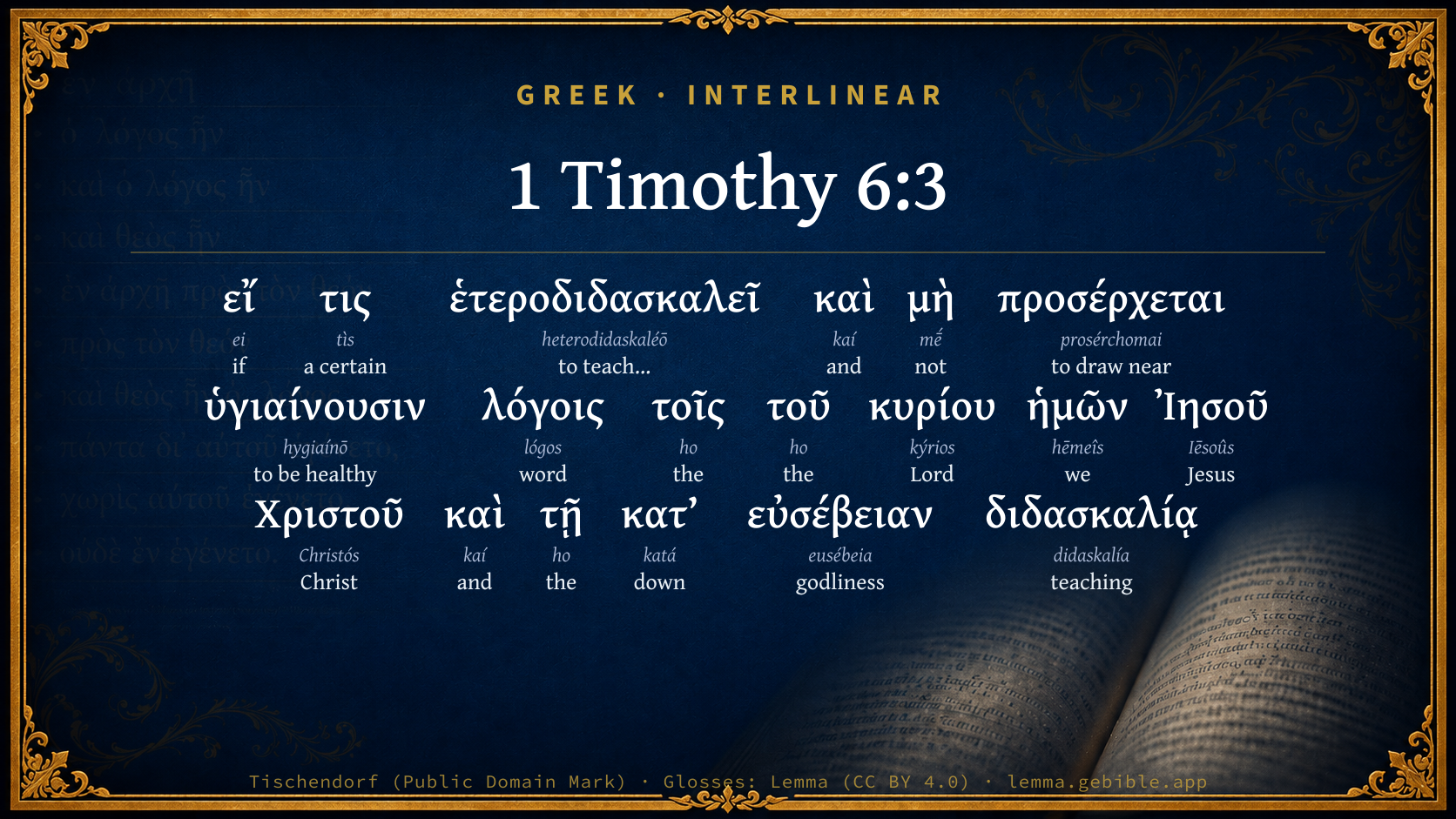
  1. εἴ ei G1487 “if” Conditional
  2. τις tìs G5100 “a certain” Indefinite pronoun, Nominative, Singular, Masculine
  3. καὶ kaí G2532 “and” Conjunction
  4. μὴ mḗ G3361 “not” Particle, Negative
  5. προσέρχεται prosérchomai G4334 “to draw near” Verb, Present, Middle or Passive deponent, Indicative, 3rd person, Singular
  6. ὑγιαίνουσιν hygiaínō G5198 “to be healthy” Verb, Present, Active, Participle, Dative, Plural, Masculine
  7. λόγοις lógos G3056 “word” Noun, Dative, Plural, Masculine
  8. τοῖς ho G3588 “the” Article, Dative, Plural, Masculine
  9. τοῦ ho G3588 “the” Article, Genitive, Singular, Masculine
  10. κυρίου kýrios G2962 “Lord” Noun, Genitive, Singular, Masculine
  11. ἡμῶν hēmeîs G2249 “we” Personal pronoun, 1st person, Genitive, Plural
  12. Ἰησοῦ Iēsoûs G2424 “Jesus” Noun, Genitive, Singular, Masculine
  13. Χριστοῦ Christós G5547 “Christ” Noun, Genitive, Singular, Masculine
  14. καὶ kaí G2532 “and” Conjunction
  15. τῇ ho G3588 “the” Article, Dative, Singular, Feminine
  16. κατ’ katá G2596 “down” Preposition
  17. εὐσέβειαν eusébeia G2150 “godliness” Noun, Accusative, Singular, Feminine
  18. διδασκαλίᾳ didaskalía G1319 “teaching” Noun, Dative, Singular, Feminine

About this verse

These counts appear in no published source. They are computed here, from the morphology-tagged text and Lemma’s own curated glosses. What Lemma adds →

19
words
16
distinct lemmas
Pauline Epistles
section

Notable vocabulary

The rarest word here is ἑτεροδιδασκαλεῖ to teach differently G2085 — appearing just 2 times in the whole Greek New Testament.

Shared distinctive vocabulary

ἑτεροδιδασκαλεῖ to teach differently G2085 occurs in 2 verses of the Greek New Testament. Also found in:

Repetition

Words recur within this verse:

Cross-references

19

Topical passages linked to 1 Timothy 6:3 in the Treasury of Scripture Knowledge — connected by theme and wording, ordered by reader-vote popularity; previews shown in the World English Bible.

  • 1 Timothy 1:3 As I exhorted you to stay at Ephesus when I was going into Macedonia, that you might charge certain men not to teach a different doctrine,
  • Romans 16:17 Now I beg you, brothers, look out for those who are causing the divisions and occasions of stumbling, contrary to the doctrine which you learned, and turn away from them.
  • 1 Timothy 1:10 for the sexually immoral, for homosexuals, for slave-traders, for liars, for perjurers, and for any other thing contrary to the sound doctrine;
  • 2 Timothy 4:3 For the time will come when they will not listen to the sound doctrine, but, having itching ears, will heap up for themselves teachers after their own lusts;
  • Titus 1:9 holding to the faithful word which is according to the teaching, that he may be able to exhort in the sound doctrine, and to convict those who contradict him.
  • 1 Thessalonians 4:8 Therefore he who rejects doesn't reject man, but God, who has also given his Holy Spirit to you.
  • 1 Timothy 1:6 from which things some, having missed the mark, have turned aside to vain talking;
  • 2 Timothy 1:13 Hold the pattern of sound words which you have heard from me, in faith and love which is in Christ Jesus.
  • Titus 1:1 Paul, a servant of God, and an apostle of Jesus Christ, according to the faith of God's chosen ones, and the knowledge of the truth which is according to godliness,
  • Titus 2:1–2 But say the things which fit sound doctrine,
  • Proverbs 15:4 A gentle tongue is a tree of life, But deceit in it crushes the spirit.
  • Matthew 28:20 teaching them to observe all things that I commanded you. Behold, I am with you always, even to the end of the age." Amen.
  • Galatians 1:6–7 I marvel that you are so quickly deserting him who called you in the grace of Christ to a different gospel;
  • 1 Thessalonians 4:1–2 Finally then, brothers, we beg and exhort you in the Lord Jesus, that as you received from us how you ought to walk and to please God, that you abound more and more.
  • 1 Timothy 4:7–8 But refuse profane and old wives' fables. Exercise yourself toward godliness.
  • Matthew 22:21 They said to him, "Caesar's." Then he said to them, "Give therefore to Caesar the things that are Caesar's, and to God the things that are God's."
  • Titus 2:11–14 For the grace of God has appeared, bringing salvation to all men,
  • Titus 3:8 This saying is faithful, and concerning these things I desire that you affirm confidently, so that those who have believed God may be careful to maintain good works. These things are good and profitable to men;
  • 2 Peter 1:3–7 seeing that his divine power has granted to us all things that pertain to life and godliness, through the knowledge of him who called us by his own glory and virtue;

Cross-references courtesy of OpenBible.info (CC BY 4.0).

Commentary

Notes on 1 Timothy 6:3 from classic Christian and Jewish commentators (each source and its license shown beneath its notes). The classic Christian expositions comment on the surrounding passage and are grouped to its opening verse, so a note may address several verses; the Jewish commentaries on the Tanakh (Rashi and others) are per-verse, so they appear only where the commentator wrote on this verse.

Lemma curates 59 commentaries, every one of them public domain or Creative Commons licensed, each selected and text-cleaned for this edition rather than reprinted as found. About our sources →

The Cambridge Bible for Schools and Colleges

gen. ed. J. J. S. Perowne

3. teach otherwise] More fully R.V., teacheth a different doctrine, but even this does not completely give the force; for the ‘different’ is not so much ‘different from what has just been laid down,’ as ‘different from the one true deposit, the creed of all my gospel and all your life;’ and helps to form the meaning now attached to heterodoxy, lit. ‘opinions different from established truth.’ The close of the Epistle takes up the opening where this word has occurred before there has been time to lay down any teaching, 1Ti_1:3. Lewin renders here ‘if any man teach what is heterodox.’

wholesome words] Again taking up his opening phrase 1Ti_1:10, where see note. Sound is the best English equivalent, if we do not stay on the most modern and ‘cant’ sense of the word, but go back to its early vigour, so as to appreciate St Paul’s contrast here with the ‘sickly questionings’ of the false teacher, 1Ti_6:4. See Appendix, K.

our Lord Jesus Christ] This exact order of the words so familiar to us in St Paul’s other writings occurs only here and 1Ti_6:14 throughout these Epistles according to the true text. An imitator would surely, as we see by the various readings so often attempted, have taken pains to make the well-known formula a marked feature. It may be also noted that the aged saint, so near the end of his ‘good fight,’ does not presume familiarly on his Saviour’s intimacy, so as to use the one name ‘Jesus’ with tripping fluency. It is still ‘Christ Jesus,’ ‘Jesus Christ,’ ‘The Lord.’ See note on 1Ti_1:1.

the doctrine … according to godliness] Two characteristic words of these Epistles combined in a phrase which might be taken as their keynote—‘Holy Truth—True Holiness.’ See previous notes on the words and especially the note on the central doctrinal passage 1Ti_3:16.

3–10. A further warning against false Teachers. Their covetousness

From the 3rd verse to the 16th St Paul once again resumes two of the chief topics of the Epistle—false teachers’ perverted doctrine, and Timothy’s own true unswerving life; in each case with a new thought, (1) of the debasing motive of traffic in godliness, (2) of the inspiring motive of the Master’s appearing. He then, 1Ti_6:17-19, gives one further direction (suggested perhaps by 1Ti_6:10) of pastoral faithfulness towards the rich; and in a last abrupt and touchingly natural outburst throws himself upon his son Timothy, and gathers up all his fears and hopes on the one chiefest subject in the brief appeal of 1Ti_6:20-21, from which he can no longer keep back the misused name of the monster evil—‘knowledge—falsely named, Gnosis—the Misnomer,’ 1Ti_6:3-10, unsound teaching, especially for gain.

The Cambridge Bible for Schools and Colleges (gen. ed. J. J. S. Perowne; Cambridge University Press, 1878–1918) — public domain. Text from a community e-Sword module.

The Biblical Illustrator

Joseph S. Exell

1Ti_6:3; 1Ti_6:5

Wholesome words.

Wholesome words

The opposite of wholesome in our common speech is that which tends to produce disease; but the opposite of the Greek word, of which this is a translation, is that which is already unsound or diseased. The thought of the apostle is, that there is nothing morbid or unhealthy about the words of Jesus. The words of the Lord are healthy, having nothing of the disproportion of monstrosity, or the colouring of disease about them; and therefore they are wholesome, so that all who believe and obey them become thereby stronger, nobler, and sounder in all the qualities of moral manhood. Now let us see how this statement of Paul may be verified and illustrated.

I. We may take first the matter of creed, and we shall find, when we come to investigate, that in this department the words of the Lord Jesus were distinguished by two qualities which mark them as pre-eminently healthy. The first of these is their positive character. The Lord was no mere dealer in negations. Dr. Samuel Johnson complained of Priestley, as a philosopher, that he unsettled everything and settled nothing; but no one can read the four Gospels without feeling that in meeting Jesus he has come into contact with One who speaks in the most positive manner. On subjects regarding which the wisest minds of antiquity were completely uncertain, He has the fullest assurance. We may wade through volumes of metaphysics, from those of Aristotle to those of Kant, without getting any distinct notion of God, but when we hear Jesus say, God is a Spirit, and they that worship Him must worship Him in spirit and in truth, we feel that God is a personal reality; and though Christ does not define the nature of spirit, yet when He speaks of God as thinking, loving, willing--His Father and ours--we understand Him better than the philosophers, though He penetrates to the depth of a nature which they had vainly sought to define. He has settled our minds upon the subject, not by argument, but by awakening in us the God-consciousness which is one of the instincts of our being, and so bringing us to say, It must be so, for I can rest in that. In like manner, when He enforces duty He evokes the conscience within us to a recognition of its responsibility. So, too, in reference to the future. He does not argue, He asserts with the speech of One who knows whereof He affirms, and forthwith the natural longing of the heart for immortality finds its craving satisfied, and settles in the certainty that dust thou art, to dust returnest, was not spoken of the soul. Akin to this positive characteristic of the Saviours words concerning creed is the discouragement which they give to all indulgence in speculations about things which are merely curious, and have no bearing upon our character or conduct. Thus, when one of His disciples asked, Are there few that be saved? He declined to answer the question, and fixed the attention of His hearers on the vital and urgent matter of individual duty, saying, Strive ye to enter in at the strait gate, Everything that is profitless and without bearing on life and godliness He brands as unworthy of consideration or discussion, and all mere logomachies are unsparingly condemned by Him. Now in these two things you have the symptoms of mental and spiritual health. The man who accounts nothing certain never focuses his mind on anything; while he who runs after every sort of speculation, scatters his mind over everything. The one never gets ready to do anything; the other attempts so much that he really accomplishes nothing. Is it not, precisely, in these two respects that the unhealthiness of much of the thinking in our own age manifests itself?

II. But now, passing from the domain of creed to that of character, we are equally struck with the healthiness of the Saviours words in reference to that.

1. For in dealing with that subject He is careful to put supreme emphasis, not on that which is without, but on that which is within. He distinguishes between the head and the heart, and never confounds intellectual ability with moral greatness. Now the healthiness of all this is apparent at a glance, for it goes to the root of the matter, and only One who was Himself whole-hearted could thus have prescribed for diseased humanity.

2. Again, in reference to character, the healthiness of the Saviours words appears in that He insists, not on asceticism in any one particular, but on full-rounded holiness. He does not require the eradication of any one principle of our nature, but rather the consecration of them all.

3. But looking now, to the department of conduct, we have in that another equally striking exemplification of the healthiness of the words of the Lord Jesus. He was very far from giving any countenance to the idea that religion is a thing only of sentiment. He insisted, indeed, as we have seen, on the importance of faith in the great central doctrines; and He was equally emphatic in declaring the innerness of holiness. But He dwelt on both of these only that He might the more effectually reach that conduct which one has called three-fourths of life.

4. But another illustration of the healthiness of Christs words in regard to conduct may be seen in the absence of all minute and specific details. He lays down great principles, leaving it to the conscience of the individual to make the application of these to the incidents and occasions of life as they arise. The words of Christ are not like the directions on a finger-pest at a crossing, or the indicators of the cardinal points upon a spire, which are of service only in the places where they are set up; but rather like a pocket compass, which, rightly used and understood, will give a man his bearings anywhere. Nothing so educates a man into weakness and helplessness as to be told in every emergency precisely what he must do. That makes for him a moral go-cart, outside of which he is not able to stand, and the consequence is that he can never be depended upon. If the teacher shows the pupil how to work each individual sum, he will never make him proficient in arithmetic. The man who is continually asking himself, as to his food, what he shall eat and what he shall drink and what he shall avoid, is either a dyspeptic or a valetudinarian. He is not healthy. And in like manner, he who in the domain of morals is continually inquiring of somebody, may I do this? may I go thither? or must I refrain from that? has never rightly comprehended the healthiness of Christs words, and is far from having attained the strength which they are calculated to foster. Here is the great law, Watch and pray, lest ye enter into temptation. (W. M. Taylor, D. D.)

A contrast between true and false teaching

At the close of the second verse Paul urges Timothy not to be silent, but to teach and exhort the Christians in Ephesus on the subject in slavery.

I. The wholesomeness of Christs teaching. The apostle speaks of wholesome words, a translation which we prefer to that given in the Revised Version (sound words), because it conveys the idea of imparting health to men and to society. Christs teaching is the ozone of the moral atmosphere.

1. It concerned itself with practical questions. The Sermon on the Mount (which is the chief specimen given us of His teaching) proves this to demonstration. As Jesus Himself put it: a candle was not lighted by Him in order to be looked at or talked about; but that it might give light to all that were in the house. In other words, the Christian religion is to be used rather than to be discussed, and is meant to throw light upon all the obscurities of lifes pathway until it leads up to the light of heaven.

2. His teaching was embodied in His perfect life. This made it the more helpful. These slaves, for example, to whom the apostle had been speaking, wanted to know what they were to do under the provocations and hardships of their lot. And nothing could help them more than the knowledge of Him whose gentleness was never at fault; who, when He was reviled, reviled not again; when He suffered He threatened not, but committed Himself to Him that judgeth righteously.

3. His teaching, tended, to the increase of godliness. The doctrine which is according to godliness, means the teaching which makes men more like God--in holiness and righteousness and love. But in sharp contrast with this is presented--

II. the unwholesomeness of false teaching, the effects of which were visible in the character of those who accepted and taught it.

1. Self-sufficiency was written on the forehead of each of them. As Paul says, He is proud, literally carried away with conceit, knowing nothing. A footman is generally more awe-inspiring than his master. And this was true of pretentious teachers in Pauls days, of whom he says they are carried away with conceit.

2. Love of verbal disputes was another characteristic of theirs. The word translated doting indicates a distempered and sickly condition, which turns away from the wholesome food of the gospel; just as a child with a poor appetite refuses bread-and-butter, and can only daintily pick and choose among delicacies, and the more he has of them the worse his appetite becomes. It is a bad sign when society has unwholesome appetites, caring more for art than for truth--more for manner than for matter; for these are signs of decadence such as preceded the fall of the Roman empire.

3. A carnal appetite was displayed by these opponents of our Lords wholesome words. Our translation, supposing that gain is godliness, is incorrect and misleading. No one supposes, or ever supposed, that worldly gain is godliness, or leads to it; but many in all ages have been guilty of what Paul suggests, namely, of using godliness as a way of gain. In other words, these men, corrupted as they were in mind, in the whole inner life, and bereft of the truth, only professed the Christian faith so far as it was serviceable to their worldly interests. (A. Rowland, LL. B.)

Supposing that gain is godliness.--

Gain not godliness

That men are greatly exposed to embrace the absurd doctrine that virtue exists in utility.

I. I am to explain the meaning of the doctrine that virtue consists is utility. This sentiment has been maintained by those who believe, as well as by those who disbelieve Divine revelation. The turning point is utility. Intention is of no farther value than as it leads to utility: it is the means, and not the end. The result of this part of the subject is, that those persons have been grossly mistaken, who taught that virtue was to be pursued for its own sake. Virtue is upon no other account valuable, than as it is the instrument of the most exquisite pleasure. All who suppose that virtue consists in utility, agree in maintaining that virtue has no intrinsic excellence, as an end, but only a relative excellence, as a means to promote the only ultimate end in nature, that is, happiness. Since happiness is, in their view, the supreme good, and misery the supreme evil, they conclude that the whole duty of men consists in pursuing happiness, and avoiding misery. Upon this single principle, that virtue wholly consists in its tendency to promote natural good, in distinction from natural evil, Godwin has founded a scheme of sentiments which, carried into practice, would subvert all morality, religion and government.

II. I proceed to demonstrate the absurdity of supposing that gain is godliness, or that virtue essentially consists in utility. This sentiment is not only false, but absurd, because it contradicts the plainest dictates of reason and conscience.

1. To suppose that virtue consists in utility, is to suppose that virtue may be predicated of inanimate objects. These have a natural tendency, in various ways, to promote human happiness. The mode in which a man is made subservient is by inducement and persuasion. But both are equally the affair of necessity. The man differs from the knife as the iron candlestick differs from the brass one; he has one more way of being acted upon. This additional way in man is motive, in the candlestick it is magnetism. Such is the natural and avowed consequence of the doctrine, that virtue consists in utility. It necessarily implies that mere material objects may be really virtuous; and some material objects may have more virtue than the most benevolent of the human race.

2. To suppose that virtue consists in utility, is to suppose that virtue may be predicated of the mere animal creation. It is no less absurd to ascribe virtue to the utility of animals than to ascribe virtue to a refreshing shower, or a fruitful field.

3. To suppose that virtue consists in utility, is to suppose that men may be virtuous, without any intention to do good. They certainly may be very useful, without having utility in view. Men are every day performing actions which have a tendency to promote that public good which lies beyond all their views and intentions. But the doctrine under consideration places all virtue in the tendency of an action, and not in the intention of the actor. Intention is of no farther value than as it leads to utility. This is stripping moral virtue of every moral quality, which is a gross absurdity.

4. To suppose that virtue consists in utility, is to suppose that men may be virtuous in acting, not only without any intention, but from a positively bad intention. If the virtue of an action consists altogether in its tendency, it may be as virtuous when it flows from a bad intention as when it flows from a good intention, or from no intention at all. The intention of an agent does not alter the tendency of his action. A man may do that from a good intention, which has a tendency to do evil; or he may do that from a bad intention, which has a tendency to do good. Some actions done from the worst intentions have been the most beneficial to mankind. Be it so, that no malevolent action has a natural or direct tendency to promote happiness; yet if virtue consists in utility the good effect of a malevolent action is just as virtuous as the good effect of a benevolent one. For the doctrine we are considering places all virtue in the tendency of an action, and not in the intention of the agent.

5. To suppose that virtue consists in utility, is to suppose that there is nothing right nor wrong in the nature of things, but that virtue and vice depend entirely upon mere accidental and mutable circumstances. There are certain relations which men bear to each other, and which they bear to our Creator, which create obligations that never can be violated without committing a moral crime.

6. To suppose that virtue consists in utility is to suppose that there is nothing in the universe intrinsically good or evil but happiness and misery.

7. To suppose that virtue consists in utility is to suppose that there is really no such thing as either virtue or vice in the world. If the actions of free agents are either good or evil, solely on account of their tendency to promote either pleasure or pain, then nothing can be predicated of them but advantage or disadvantage. Actions which promote happiness may be denominated advantageous, but not virtuous; and actions which produce misery may be denominated disadvantageous, but not vicious.

III. Men are greatly exposed to embrace it. This the apostle plainly intimates, by exhorting Timothy to withdraw himself from those who supposed that gain is godliness.

1. From the resemblance which this error hears to the truth, though it be diametrically opposite to it. Those who maintain that virtue consists in utility, represent it under the alluring name of universal philanthropy, which is an imposing appellation. They pretend that happiness is the supreme good, and virtue solely consists in promoting it to the highest degree. They insinuate that this philanthropy directly tends to diffuse universal happiness, and to raise human nature to a state of perfection in this life.

2. The danger will appear greater if we consider by whom this pleasing and plausible error is disseminated. It is taught by grave divines, in their moral and religious treatises and public discourses. Law and Paley have been mentioned as placing the whole of virtue in utility. Dr. Brown, in his remarks upon the Earl of Shaftesburys characteristics, maintains that virtue consists in its tendency to promote individual happiness.

3. There is a strong propensity in human nature to believe any other scheme of moral and religious sentiments, than that which is according to godliness. Men naturally love happiness, and as naturally hate holiness. (N. Emmons, D. D.)

A mercenary motive

A Christian lady in America, who has earnestly and prayerfully laboured to carry the gospel to the Mongolian laundrymen around her, at length succeeded in getting one of them to attend Sunday school and church regularly. The man was attentive and well-behaved, and the lady had great hopes of him. She tried to interest others in his welfare, too, and induced her friends to patronise his laundry. Visiting him at his home a few days ago, she received a warm welcome. John gave her to understand that he enjoyed very much attending the Sunday school, information that was exceedingly gratifying. Anxious, however, to receive more practical demonstration of the influence of the school upon him, she asked him if he did not think it did him good. Yi, yi! came the convincing response, washee fol le whole conglogation. The Chinamans idea of getting good is not an uncommon one; unhappily, it is the motive of many a church connection.

The Biblical Illustrator, edited by Joseph S. Exell (c. 1880s–1900s) — public domain. Text from a community e-Sword module.

Joseph Benson's Commentary

1Ti 6:3-5. If any man teach otherwise — Than strict, practical holiness, in all its branches; and consent not to wholesome words — Υγιαινουσι λογοις, literally, healing, or healthful words, words that have no taint of falsehood, or tendency to encourage sin; and the doctrine which is according to godliness — The sole design and direct tendency of which is to make people godly, and to promote the glory of God, while it secures the salvation of men; he is proud — Greek, τετυφωται, puffed up; which is the cause of his not consenting to this doctrine; knowing nothing — As he ought to know; but doting — Greek, νοστων, being sick, or distempered in his mind; about questions — Dotingly fond of disputes; an evil, but common disease, especially where practice is forgotten. Such contend earnestly for singular phrases and favourite points of their own; but every thing else, however like the preaching of Christ and his apostles, is all law and bondage, and carnal reasoning. And strifes of words, whereof cometh envy — Of the gifts and success of others; contention for the pre- eminence. Such disputants seldom like the prosperity of others, or to be less esteemed themselves; railings — Βλασφημιαι, evil speakings, against those that differ from them; evil surmisings — Or unjust suspicions easily entertained against others; it not being their way to think well of those that hold opinions different from theirs. Perverse disputings —

Carried on contrary to conscience, by men wholly corrupted in their minds, and destitute of the truth — Of the knowledge of, and faith in, the true doctrine of the gospel; supposing that gain is godliness — That what promises the greatest gain is the most worthy of their pursuit; or who reckon whatever produces most money to be the best religion. A far more common case than is usually supposed. From such withdraw thyself — Shun all society with them.

Joseph Benson's Commentary on the Old and New Testaments (1811–1818) — public domain. Text from a community e-Sword module.

The Preacher's Complete Homiletical Commentary

Joseph S. Exell (gen. ed.)

CRITICAL AND EXPLANATORY NOTES

1Ti_6:3. Teach otherwise.—R.V. “teacheth a different doctrine.” Wholesome words.—R.V. “sound [margin, Gr. healthful] words.”

1Ti_6:4. Doting about questions.—R.V. margin, “sick”—in contrast to the healthful words of the Lord Jesus.

1Ti_6:5. Perverse disputings.—A. V. margin, “gallings one of another.” R.V. “wranglings.” Supposing that gain is godliness.—Men may choose mammon rather than God, but we can hardly suppose they mistake one for the other, as this translation says. R.V. corrects this—“supposing that godliness is a way of gain.”

MAIN HOMILETICS OF THE PARAGRAPH.—1Ti_6:3-5

The Vagaries of False Teachers—

I. Ignore the wholesome doctrines of the Divine Teacher (1Ti_6:3).—There is no possible folly that the unregenerate mind will not adopt and eagerly champion as if it were the soberest truth. Christ is Himself the Truth in its highest and most complete embodiment, and His words are full of invigorating moral health. The teacher who has no regard for the teachings of Christ, but is carried away with the crude, unshapen fancies of his own brain, deceives others and is himself deceived. No wonder that the mind that cherishes unwholesome doctrines becomes itself diseased, and its high-flown theories are but the ravings of a fanatic.

II. Are a compound of pride and ignorance.—“He is proud, knowing nothing” (1Ti_6:4). He is wrapt in smoke, darkened with the fumes of his inordinate self-conceit. The man who boasts of superior knowledge betrays his utter ignorance; and ignorance is the foster-parent of pride. True knowledge makes a man modest and humble. The wisest men feel that they know nothing compared with what they are capable of knowing. A man who was regarded as a marvel of learning once said: “I seem to myself like a basket in which are being carried away the fragments of a hotel—a bit of this, the fag-end of that, and all sorts of things jumbled up together. I do not know anything except little fragmentary parts of this, that, and the other.”

III. Are the occasion of meaningless controversy and quarrelsomeness.—“Doting about questions and strifes of words … perverse disputings of men of corrupt minds, and destitute of the truth” (1Ti_6:4-5). Controversy is valueless where there is a lack of knowledge and exact definition. Words are but wind, unless there is the clear recognition of substantial and unvarying truth. Reckless controversy raises more disputes than it settles, and generally intensifies the quarrel. A corrupt heart reappears in corrupt speech. A question of mere words creates endless confusion, envyings, and strife.

IV. Are the prolific offspring of an utterly false conception of godliness.—“Supposing that gain is godliness” (1Ti_6:5). Godliness was espoused and advocated by the false teachers as a means of gain. There is nothing more despicable than to make money out of religion, or to be religious because of the gains it brings. The love of gain endangers righteous principles. An old Elector of Brandenburg once said to the Duke of Saxony, “How do you manage to coin so much money, you princes of Saxony?” “Oh,” replied he, “we make money by it.” And so they did, by the quantity of alloy they put into their coin. Godliness is gain; but gain is not godliness.

V. Are to be deliberately shunned.—“From such withdraw thyself” (1Ti_6:5). To be associated with tricksters, whether in religion or commerce is to lose caste. We are to “avoid the appearance of evil,” and “have no fellowship with the unfruitful works of darkness.”

Lessons.—

1. Error is a wicked caricature of truth.

2. Ignorance may be detected by its proud pretensions.

3. Godliness and false doctrine are antagonistic.

GERM NOTES ON THE VERSES

1Ti_6:3-5. The Provision made in the Plan of Salvation by the Free Grace of God through Faith to secure the Interests of Morality and promote Holiness of Life.

I. The state of mind of any man and also his outward conduct are necessarily influenced by what he believes, so far as it may be of a nature fitted to influence him, and all the doctrines revealed in Scripture are fitted by their nature to produce each its own specific effect on his heart and conduct; and if these doctrines were clearly understood, firmly believed, and at liberty to produce their full effects upon his soul, the result would be a character similar in all respects to the character of our Lord Jesus Christ.

II. In the plan of redemption provision is made for enlisting the powerfully operative affections of love and gratitude on the side of holiness.

III. The scheme of redemption unites us to Christ in several relations which contain in them the basis of certain combinations of affections and principles which are most operative in human affairs.—

1. Christ’s redeemed people stand related to Him as children to their parents, and thereby a foundation is laid for their being animated by the spirit of children.

2. Are united to Him on the footing on which a wife is united to her husband.

3. In the relation of soldiers to their general and sovereign.—Anonymous.

The Preacher's Complete Homiletical Commentary (gen. ed. Joseph S. Exell; Funk & Wagnalls, c. 1892) — public domain (pre-1929). A full-Bible homiletical/sermon-outline anthology covering 65 of 66 books (2 John is absent from the source module). Text from a community e-Sword module.

Bengel's Gnomon

Johann Albrecht Bengel

1Ti 6:3. Ἑτεροδιδασκαλεῖ, teach otherwise) The antithesis is, teach, in 1Ti 6:2. The conclusion thus corresponding to the beginning of the discussion, ch. 1Ti 1:3.—μὴ προσέρχεται, accede [consent] not) Seneca has, “accedere opinioni,” to accede or consent to an opinion: and so others, as we find in Pricæus.

Bengel's Gnomon of the New Testament — English translation (T&T Clark, Edinburgh, 1860) — public domain. Text from a community e-Sword module.

Meyer's Critical & Exegetical Commentary

Heinrich August Wilhelm Meyer

1Ti_6:3-5. Description of the heretics.

εἴ τις ἑτεροδιδασκαλεῖ] On ἑτεροδιδασκαλεῖν, comp. 1Ti_1:3; εἴ τις often occurs in the epistle for ὅστις or the like; comp. 1Ti_3:5, 1Ti_5:8; the thought is given in its most comprehensive form.

καὶ μὴ προσέρχεται κ.τ.λ.] defines ἑτεροδιδασκαλεῖν more exactly, characterizing it as opposed to the pure doctrine of the gospel, as a preaching therefore of heresy (not merely of a doctrine which has not the quality of being pious (!), Hofmann).

προσέρχεσθαι is used of mental agreement, and is equivalent to agree with (de Wette, Wiesinger, van Oosterzee); comp. Philo, de Gigantt. p. 289: μηδενὶ προσέρχεσθαι γνώμῃ τῶν εἰρημένων. On ὑγιαίνουσι λόγοις, comp. 1Ti_1:10. Hofmann arbitrarily explains the word by: devote oneself to a thing; employ ones pains on it. If προσέχεται is the correct reading, then it is to be explained: and does not hold fast by sound words. The genitive τοῦ κυρίου ἡμ. Ἰ. Χρ. gives the source from which the λόγοι proceed. Καὶ τῇ κατʼ εὐσέβειαν διδασκαλίᾳ] an epexegetic addition to what preceded. The expression is not, with Leo and Wiesinger, to be explained by: doctrina ad pietatem ducens; κατά rather expresses the relation of correspondence, suitability (van Oosterzee). By εὐσέβεια is meant Christian piety.1Ti_6:4. τετύφωται] comp. 1Ti_3:6.[199] With this word begins the apodosis, which Wegscheider, Mack, and others find expressed only in ἀφίστασο ἀπὸ τ. τοιούτων, which words we can hardly consider genuine. μηδὲν ἐπιστάμενος (comp. 1Ti_1:7), the participle is not to be resolved into although; all the more that τετύφωται conveys a suggestion of dumbness. Their knowledge, on which they, presume, is limited to fables, and does not penetrate into the truth.

ἀλλὰ νοσῶν περὶ ζητήσεις καὶ λογομαχίας] νοσῶν, in contrast with ὑγιαίνουσι λόγοις in 1Ti_6:3.

Περὶ ζητήσεις κ.τ.λ. gives the sickness of which he is ill (comp. Plato, Phaedr. p. 288: ὁ νοσῶν περὶ λόγων ἀκοήν; Winer, p. 379 [E. T. p. 506]). Luther, not clear: diseased in questions; Stier, correct: diseased with.

On ζητήσεις, comp. 1Ti_1:4; the addition of λογομαχίαι denotes more exactly the nature of the ζητήσεις. Calvin: λογομαχίας nominat contentiosas disputationes de verbis magis, quam de rebus, vel (ut vulgo loquuntur) sine materia aut subjecto. The word (occurring only in later Greek) is ἅπ. λεγ., the verb λογομαχεῖν, 2Ti_2:14.

Hitherto he has described the condition of soul among the ἑτεροδιδασκαλοῦντες (Wiesinger); the consequences of their ζητ. and λογομ., particularly the destructive tendencies, are given in what follows: ἐξ ὧν γίνεται κ.τ.λ.] φθόνος, ἔρις,[200] ΒΛΑΣΦΗΜΊΑΙ, form a climax. ΒΛΑΣΦΗΜΊΑΙ and ὙΠΌΝΟΙΑΙ ΠΟΝΗΡΑΊ are wrongly understood by Chrysostom of conduct towards God. On the latter expression, equivalent to wicked suspicion (Luther), see Wisd. 3:24; the word is ἍΠ. ΛΕΓ. in the N. T. Hofmann wishes to separate ΠΟΝΗΡΑΊ from ὙΠΌΝΟΙΑΙ, and to connect it with the next word, because ὙΠΟΝΟΕῖΝ in itself means suspecting evil. But, on the one hand, ὙΠΟΝΟΕῖΝ has often the simple meaning conjecture (e.g. Act_13:25; also in classic Greek); and, on the other hand, the suspicion of something evil, and the evil, wicked suspicion, are by no means identical things.1Ti_6:5. διαπαρατριβαί] This word and ΠΑΡΑΔΙΑΤΡΙΒΑΊ (according to the usual reading) are not equivalent, as Heydenreich thinks; see Winer, p. 96 [E. T. p. 126]. The distinction between ΠΑΡΑΤΡΙΒΉ and ΔΙΑΤΡΙΒΉ is to be maintained. ΔΙΑΤΡΙΒΉ means, in regard to time: its consumption, pastime, occupation; with the prefix ΠΑΡΑ there is added the idea of idle, useless, so that ΠΑΡΑΔΙΑΤΡΙΒΉ denotes the useless occupation of time. The word ΠΑΡΑΤΡΙΒΉ (only in later Greek) means: wrangling, dispute; ΔΙΑ serves to intensify the meaning, hence ΔΙΑΠΑΡΑΤΡΙΒΉ is equivalent to continuous or violent wraingling (de Wette). Luther translated it: scholastic disputes. As the idea of strife has been given already by ἔρις, we might be inclined to consider the Rec. to be the original reading, were the evidence for it not too weak. The same may be said of the reading διατριβαί, which Hofmann, without sufficient ground, maintains to be what was originally written. At any rate, the idea continual wrangling is not so identical with that of strife (ἜΡΙς) as to prevent them from being used together.[201] Reiche paraphrases the reading ΔΙʼ Ἃ ΠΑΡΑΤΡΙΒΑΊ as equivalent to per quae, nempe vitia morbosque animi vs 4, exoriuntur rixae et certamina, etc.; but ΔΙʼ Ἅ is not equivalent to per quae, and the previous ἐξ ὧν is against this construction.

ΔΙΕΦΘΑΡΜΈΝΩΝ ἈΝΘΡΏΠΩΝ ΤῸΝ ΝΟῦΝ] Regarding this accus., see Winer, p. 205 [E. T. p. 287]; comp. 2Ti_3:8 (Xenophon, De Exped. Cyri, iv. 259: διεφθαρμένοι τοὺς ὀφθαλμούς): whose understanding is destroyed.

καὶ ἀπεστερημένων τῆς ἀληθείας] who have been robbed of the truth. This and the previous participial clauses indicate that formerly the heretics had their understanding sound, and were in possession of the truth, but that they had lost both these jewels, according to 1Ti_4:1, by the influence of demons. It should never have been denied that they who are thus described were actual heretics.

The next clause adds another peculiar characteristic, which proves the διεφθαρμένων κ.τ.λ.: νομιζόντων πορισμὸν εἶναι τὴν εὐσέβειαν] πορισμός (only here and at 1Ti_6:6; comp. Sir_13:19; Sir_14:2) is equivalent to means of gain, i.e. a business bringing gain; Luther: trade.

Wegscheider wrongly explains εὐσέβεια as equivalent to Ἡ ΚΑΤʼ ΕὐΣΈΒΕΙΑΝ ΔΙΔΑΣΚΑΛΊΑ. The idea is to be kept in its proper meaning; although that which the heretics made to appear ΕὐΣΈΒΕΙΑ was not ΕὐΣΈΒΕΙΑ, but only the appearance of it (2Ti_3:5 : ΜΌΡΦΩΣΙΝ ΕὐΣΕΒΕΊΑς), by means of which they sought to make earthly gain (Tit_1:11).

As to the construction, it seems most natural to make the substantive at the beginning of the verse dependent on ἘΞ ὯΝ ΓΊΝΕΤΑΙ, 1Ti_6:4, along with the substantives before it. Hofmann, on the contrary, thinks it curious, that besides the bad things already mentioned, there should also be named those with whom they occur; and he wishes rather to regard ΠΟΝΗΡΑῚ ΔΙΑΤΡΙΒΑΊ (which he reads) as in apposition to ΖΗΤΉΣΕΙς ΚΑῚ ΛΟΓΟΜΑΧΊΑς, just as in Jam_3:8, where the nominative stands in apposition to the previous accusative as a kind of exclamation. This construction is possible, but it is by no means necessary, and from the structure of the sentence not even probable.

The last remark furnishes the apostle with an opportunity for a digression on Christian contentment.[202]

[199] Hofmann thinks that τετύφωται does not here, as in 1Ti_3:6, contain the idea of darkness, since Paul means to express regarding the schismatics an opinion, not in regard to their moral, but in regard to their spiritual condition. This opinion is contradicted by the fact that in what follows νοσῶν κ.τ.λ. manifestly denotes a moral fault.

[200] Clemens Al. Stromata, vii. p. 759: ὑπὸ δοξοσοφίας ἐπῃρμένοι ἐρίζοντες πελοῦσι.

[201] Oecumenius explains the expression ἀπὸ μεταφορᾶς τῶν ψωραλέων προβάτων, and Chrysostom says likewise: καθάπερ τὰ ψωραλέα τῶν προβάτων παρατριβόμενα νόσου καὶ τὰ ὑγιαίνοντα ἐμπίμπλησιν, οὕτω καὶ οὗτοι οἱ πονηροὶ ἄνδρες.The meaning provocations (Mack), and this other: wicked and hurtful meetings or clubs (Heinrichs), can he assigned neither to παραδιατριβαί nor to διαπαρατριβαί.

[202] Hofmanns opinion, that the deductions following are not occasioned by the conduct of the heretics, but by Timothys conduct, are not warranted by the exhortation in 1Ti_6:11 : ταῦτα φεῦγε.

Meyer — Critical and Exegetical Commentary on the New Testament — English translation by Peter Christie, edited by Frederick Crombie (T&T Clark, 1880) — public domain. Text from a community e-Sword module.

Expositor's Greek Testament

ed. W. Robertson Nicoll

1Ti 6:3-21 . Thoughts about the right use of wealth are suggested by the slave problem, a mischievous attitude towards which is associated with false doctrine. If a man possesses himself, he has enough. This possession is eternal as well as temporal. This is my lesson for the poor, for you as a man of God (and I solemnly adjure you to learn and teach it), and for the rich.

1Ti 6:3 . ἑτεροδιδασκαλεῖ : See note on 1Ti 1:3 .

καὶ μὴ : Blass ( Gramm . p. 514) notes this case of μή following εἰ with the indicative (supposed reality) as an abnormal conformity to classical use. The usual N.T. use, εἰ … οὐ , appears in 1Ti 3:5 ; 1Ti 5:8 . In these examples, however, the οὐ is in the same clause as εἰ , not separated from it, as here, by a καί .

προσέρχεται : assents to . The noun προσήλυτος , proselyte, “one who has some over,” might alone render this use of προσέρχομαι defensible. But Ell. gives examples of this verb from Irenæus and Philo; and Alf. from Origen, which completely justify it. The reading προσέχεται , which seems to derive support from the use of προσέχειν , 1Ti 1:4 , Tit 1:14 , has not exactly the same force; “to give heed,” or “attend to,” a doctrine falls short of giving in one’s adhesion to it.

ὑγιαίνουσι λόγοις : See on 1Ti 1:10 .

τοῖς τοῦ Κυρίου : This is in harmony with St. Paul’s teaching elsewhere, that the words spoken through the prophets of the Lord are the Lord’s own words. It is thus we are to understand Act 16:7 , “The Spirit of Jesus suffered them not,” and 1Co 11:23 , “I received of the Lord,” etc. The words of Jesus, “He that heareth you heareth me” (Luk 10:16 ) have a wider reference than was seen at first.

τῇ κατʼ εὐσέβειαν διδασκαλίᾳ : See ref. and notes on 1Ti 1:10 , 1Ti 2:2 .

The Expositor's Greek Testament, edited by W. Robertson Nicoll (1897–1910) — public domain. Text from a community e-Sword module.

Cambridge Greek Testament for Schools and Colleges

3–5. RENEWED WARNINGS AGAINST FALSE TEACHERS

3. Tischendorf is almost alone among critical editors in his adoption of προσέχεται the reading of א* (formerly conjectured by Bentley) for the better attested προσέρχεται.

3. εἴ τις ἑτεροδιδασκαλεῖ κ.τ.λ., if any man teach other [sc. inconsistent] doctrine &c. For ἑτεροδιδασκαλεῖν see on 1Ti 1:3, the only other place where the word is found; it is here used in contrast to δίδασκε of the preceding verse, and probably the feature of the false teaching which is, for the moment, in the writer’s mind, is its worldliness. He has just declared that slaves are not to make their Christianity a pretext for seeking social advancement; and he proceeds to give a warning against the heretical teachers who, by their example, would encourage the idea that godliness is a way of gain.

μὴ προσέρχεται, assenteth not (see crit. note). In the N.T. as a rule εἰ with the indicative (supposed reality) takes οὐ, where classical Greek would have μή (cp. 1Ti 3:5, 1Ti 5:8); here however the more correct literary form εἰ … μή is found. (See Blass, Grammar of N.T. Greek, § 75, 3.) προσέρχεσθαι is not used elsewhere by St Paul, and in all the other passages where it occurs in the N.T., it is used of the approach of the body, and not of the assent of the mind; the latter sense is, however, quite legitimate and not uncommon in later Greek. Cp. Sir 1:28; Act 10:28 and the term προσήλυτος, as marking the transition from the original to the derivative meaning.

ὑγιαίνουσιν λόγοις, wholesome words; see on 1Ti 1:10.

τοῖς τοῦ κυρίου ἡμῶν Ἰ. Χ., those of our Lord Jesus Christ. This is a gen. originis. There is no reference to actual words of the Lord, but to the fact that He (and not man) is the source of the sound doctrine, of which His words furnish the standard.

καὶ τῇ κατʼ εὐσέβειαν διδασκαλίᾳ. The test of the διδασκαλία is its conformity with that εὐσέβεια (see on 1Ti 2:2), without which it is impossible to appreciate the moral distinctions so vital in all sound theology; cp. Tit 1:1.

In 1Ti 6:3 the ἑτεροδιδασκαλία is described as discrepant both from the standards and appropriate test of the true doctrine; its practical results are now brought forward, a picture of the false teacher himself being first drawn.

Cambridge Greek Testament for Schools and Colleges (Cambridge University Press, 1896; 21 vols, various authors incl. Carr, Maclear, Plummer, Farrar, Lumby, Moule, M. R. James, Simcox) — public domain. Text from a community e-Sword module.

Geneva Bible (1599)

Geneva Bible translators

He condemneth severely, and excommunicateth or casteth out of the Church as proud men, such as content not themselves with Christ’s doctrine, (that is to say, the doctrine of godliness) but weary both themselves and others in vain questions, (for all other things are vain) because they content not themselves in Christ’s doctrine: and as lying deceivers, because they savor or sound of nothing but vanity: as mad men, because they trouble themselves so much in matters of nothing: as mischievous plagues, for that they cause great contentions, and corrupt men’s minds and judgment: to be short, as profane and wicked, because they abuse the precious name of godliness and religion to filthy lucre.

Geneva Bible (1599) marginal notes — public domain. Text via Bolls.life.

Jamieson, Fausset & Brown

Robert Jamieson, A. R. Fausset & David Brown

teach otherwise--than I desire thee to "teach" (Ti1 6:2). The Greek indicative implies, he puts not a merely supposed case, but one actually existing, Ti1 1:3, "Every one who teaches otherwise," that is, who teaches heterodoxy.

consent not--Greek, "accede not to."

wholesome--"sound" (Ti1 1:10): opposed to the false teachers' words, unsound through profitless science and immorality.

words of our Lord Jesus Christ--Paul's inspired words are not merely his own, but are also Christ's words.

Jamieson, Fausset & Brown — Commentary Critical and Explanatory on the Whole Bible (1871) — public domain (CC PDM 1.0). Text via the HelloAO Bible API.

Adam Clarke's Commentary

Verse 3. If any man teach otherwise] It appears that there were teachers of a different kind in the Church, a sort of religious levellers, who preached that the converted servant had as much right to the master's service as the master had to his. Teachers of this kind have been in vogue long since the days of Paul and Timothy.

And consent not to wholesome words] υγιαινουσι λογοις Healing doctrines-doctrines which give nourishment and health to the soul, which is the true character of all the doctrines taught by our Lord Jesus Christ; doctrines which are according to godliness-securing as amply the honour and glory of God, as they do the peace, happiness, and final salvation of man.

All this may refer to the general tenor of the Gospel; and not to any thing said, or supposed to have been said, by our Lord, relative to the condition of slaves. With political questions, or questions relative to private rights, our Lord scarcely ever meddled; he taught all men to love one another; to respect each other's rights; to submit to each other; to show all fidelity; to be obedient, humble, and meek; and to know that his kingdom was not of this world.

Adam Clarke's Commentary on the Bible (1810–1826) — public domain. Text from a community e-Sword/MySword module.

John Calvin's Commentaries

3 If anyone teacheth differently The word ἑτεροδιδασκαλεῖ, being a compound, may also, not improperly, be translated, teacheth other things Yet there is no ambiguity as to the meaning; for he condemns all those who do not agree with this manner of teaching, although they do not openly and avowedly oppose sound doctrine. It is possible that he who does not profess any wicked or open error may yet, by endeavoring to insinuate himself by means of silly babbling, corrupt the doctrine of godliness; for, when there is no progress, and no edification in the doctrine itself, there is already a departure from the ordinance of Christ. Now although Paul does not speak of the avowed supporters of wicked doctrines, but of vain and irreligious teachers, who, by their ambition or covetousness, disfigure the plain and simple doctrine of godliness, yet we see with what sharpness and severity he attacks them. Nor need we wonder at this; for it is almost impossible to tell how much injury is done by preaching that is hypocritical and altogether framed for the purposes of ostentation and of idle display. But who they are that are blamed by him, appears more clearly from what immediately follows —

And consenteth not to sound words This clause is intended to explain the former. It frequently happens that such men as are here described, carried away by foolish curiosity, despise everything that is useful and solid, and thus indulge in wanton freaks, like unruly horses. And what is this but to reject the sound words of Christ? for they are called “sound” or “healthful,” because they give health to us, or are fitted to promote it.

And to the doctrine which is according to godliness This has the same meaning with the former clause; for the “doctrine” will not be consistent with “godliness,” if it do not instruct us in the fear and worship of God, if it do not edify our faith, if it do not train us to patience, humility, and all the duties of that love which we owe to our fellowmen. Whoever, therefore, does not strive to teach usefully, does not teach as he ought to do; and not only so, but that doctrine is neither godly nor sound, whatever may be the brilliancy of its display, that does not tend to the profit of the hearers.

John Calvin's Commentaries (1540-1563) — public domain. Text from the Calvin Translation Society English edition (1840s-50s) via the Christian Classics Ethereal Library (ccel.org). Calvin's coverage is partial (roughly two-thirds of the Bible); uncommented books and verses are honest gaps, never fabricated. The 19th-century editor's footnotes and remarks are omitted so the notes are faithfully Calvin's own voice.

Ellicott's Commentary for English Readers

(3) If any man teach otherwise.—Without confining the reference strictly to what had just been taught respecting the duty of Christian slaves, there is little doubt but that some influential teaching, contrary to St. Paul’s, on the subject of the behaviour and disposition of that unhappy class was in the Apostle’s mind when he wrote the terrible denunciation contained in these three verses against the false teachers of Ephesus. Schismatic and heretical preachers and writers in all ages have sadly hindered the progress of true religion; but in the days of St. Paul, when the foundation-stones of the faith were being so painfully laid, there seems to have been a life-and-death contest between the teachers of the true and the false. In this passage St. Paul lays bare the secret springs of much of this anti-Christian doctrine. There is little doubt but that at Ephesus there existed then a school, professedly Christian, which taught the slave who had accepted the yoke of Christ to rebel against the yoke of any earthly lord. Hence the indignation of St. Paul. “If any man teach otherwise,” different to my interpretation of the rule of Christ, which bids us bear all with brave patience, with loyal fortitude.

And consent not to wholesome words, even the words of our Lord Jesus Christ.—The Apostle, no doubt, was referring to well-known sayings of the Redeemer, such as “Render unto Cæsar the things that are Cæsar’s,” or “Blessed are the meek, for they shall inherit the earth,” or “If any man will follow me, let him take up his cross daily, and follow me;” “But I say unto you, resist not evil,” “Love your enemies, pray for them which despitefully use you.” It was upon such sublime sayings as these—no doubt, current watchwords in all the churches—it was upon the spirit of the Sermon on the Mount that St. Paul based his teaching and grounded his advice to the slaves in the flock of Christ. But the false teachers, who would be Timothy’s bitterest and most determined foes at Ephesus, would not consent to these “wholesome words,” though they were the words of the Lord Jesus Christ.

To the doctrine which is according to godliness.—These self-willed men, in consenting not to the sublime words of Christ, at the same time refused to acquiesce in the doctrine which insisted upon a holy life: for Christian truth is inseparable from purity, single-heartedness, self-forgetfulness, brave patience.

A Bible Commentary for English Readers, edited by Charles John Ellicott (1878–1897) — public domain. Text from a community e-Sword module.

John Gill's Exposition

If any man teach otherwise,.... Or another doctrine, as the Syriac version renders it; a doctrine different from what the apostle had now taught, concerning the duty of servants to their masters; as did the false teachers, who despised dominion or government; not only civil government, and so spoke evil of rulers and magistrates; and church government, and therefore reviled the apostles, elders, and pastors of churches; but family government, and encouraged disobedience to parents and masters; see Pe2 2:10

or teach another doctrine, from that of the Bible, of Christ and his apostles:

and consent not to wholesome words: such as the doctrines of the Gospel; they are food to the saints, milk for babes, and meat for strong men; they are sweet and savoury food to a spiritual taste; they are nourishing, and the means of a spiritual growth; they are salutary and healthful; they have no corruption, taint, or poison in them:

even the words of our Lord Jesus Christ; the doctrines which he preached when on each, who was anointed with the Spirit of God without measure, to preach the Gospel, and by whom all the doctrines of grace and truth came; or the doctrines relating to Christ, to his person, offices, grace, righteousness, sacrifice and satisfaction; to what he is, has done, does, and will do.

And to the doctrine which is according to godliness. The whole Gospel is the mystery of godliness; it is the truth that is after it, and it has a tendency to promote true godliness in heart and life: even such is the nature of the more distinguishing doctrines of it, which are charged with licentiousness; as the doctrine of eternal and personal election; for though it is not of works, but of grace, yet holiness is a means fixed in election, and an end secured by it; it is the source and spring of all real holiness; holiness of heart is an evidence of it to believers themselves; and holiness of life is an evidence of it to the world; nor can anything more powerfully engage men to it than the consideration that they are chosen of God to grace and glory. The covenant of grace, which is absolute and unconditional, provides for both internal and external holiness; and the promises of it, under the influence of grace, powerfully operate in the minds of believers, to the cleansing of them from all impurity of flesh and spirit, and to the perfecting of holiness in the fear of the Lord: and so the doctrines of free justification, by the righteousness of Christ, which does not make void the law, nor discourage good works; and of Christ's bearing the sins of his people, and making satisfaction for them, that they being dead to sin might live unto righteousness; and of redemption of them by the blood of Christ from sin, Satan, and the law, which is done that they might be a peculiar people, zealous of good works; and of the effectual calling of them, which is with an holy calling; and of their final perseverance in grace and holiness, are all of them doctrines according to godliness, and greatly encourage and promote it: now, whoever does not accede to these truths, and acquiesce in them, but differs from them, and teaches the reverse of them, he is a false teacher, and is all that the apostle says in the next words.

John Gill's Exposition of the Whole Bible (1746–1763) — public domain (CC PDM 1.0). Text via the HelloAO Bible API.

Trapp's Complete Commentary

John Trapp

3 If any man teach otherwise, and consent not to wholesome words, even the words of our Lord Jesus Christ, and to the doctrine which is according to godliness;

Ver. 3. If any man teach otherwise] ετεροδιδασκαλει, discover himself heterodox out of affectation of singularity, &c., as divers do in this licentious age; broaching things different from the received doctrine, as holding it, with Phocion, a goodly thing to dissent from others.

Consent not to wholesome words] Words that have a healing property in them. The Scripture (as that library of Alexandria) may be properly said to be the soul’s medicine, η της ψυχης ιατρεια. By the reading of Livy, Curtius, Aventinus, and other historians, many are said to have been recovered of various desperate diseases. 0 facile et beatum curationis genus, saith John Bodin (de Utilit. Historiae). But the reading of the Holy Scriptures doth a far greater cure than this upon the soul. King Alphonsus, cured of a fever by reading Quintus Curtius, cried out, Valeat Avicenna, vivat Curtius, Farewell medicine, well fare history. May not we better say so of these wholesome words, this doctrine according to godliness, purposely composed for the promoting of piety in the world?

John Trapp, A Commentary or Exposition upon All the Books of the Old and New Testament (1647–1656) — public domain. Text from a community e-Sword module.

Albert Barnes' Notes on the Bible

If any man teach otherwise - Any otherwise than that respect should be shown to masters; and that a more cheerful and ready service should be rendered because they were Christians. It is evidently implied here that some might be disposed to inculcate such views of religion as would produce discontent and a spirit of insubordination among those who were held to servitude. Who they were is not known, nor is it known what arguments they would employ to do it. It would seem probable that the arguments which would be employed would be such as these: that God made all people equal; that all had been redeemed by the same blood; that all true Christians were fellow-heirs of heaven; and that it was wrong to hold a Christian brother in bondage, etc. From undeniable principles it would seem that they drew the inference that slaves ought at once to assert their freedom; that they should refuse obedience to their masters; and that the tendency of their teaching was, instead of removing the evil by the gradual and silent influence of Christian principles, to produce discontent and insurrection. From some of the expressions here used by the apostle, as characteristic of these teachers, it would seem to be probable that these persons were Jews. They were people given to subtle disputations, and those who doted about questions and verbal disputes, and who were intent on gain, supposing that that which conduced to mere worldly prosperity was of course religion. These characteristics apply well to Jewish teachers.

And consent not to wholesome words - Words conducing to a healthful state of the church; that is, doctrines tending to produce order and a due observance of the proprieties of life; doctrines leading to contentment, and sober industry, and the patient endurance of evils.

Even the words of our Lord Jesus Christ - The doctrines of the Saviour - all of which tended to a quiet life, and to a patient endurance of wrongs.

And to the doctrine which is according to godliness - Which tends to produce piety or religion; that is, the doctrine which would be most favorable to an easy and rapid propagation of the gospel. The idea seems to be, that such a state of insubordination and discontent as they would produce, would be unfavorable to the promotion of religion. Who can doubt it?

Albert Barnes' Notes on the Bible (1834–1885) — public domain. Text from a community e-Sword/MySword module.

Matthew Poole's English Annotations

If any man teach otherwise; if there be any person who either more publicly or more privately shall take upon him to instruct people otherwise.

And consent not to wholesome words: what he means by wholesome words his next words show; they are called wholesome because they tend to prevent the sickness of sin, or to cure the soul of its spiritual distempers.

Even the words of our Lord Jesus Christ, and to the doctrine which is according to godliness; words either spoken by Christ, or from Christ, or tending to his honour and glory, or to the promoting of piety and godliness, or which are according to the rule of godliness.

Matthew Poole's English Annotations on the Holy Bible (1683–1685) — public domain. Text from a community e-Sword/MySword module.

Whedon's Commentary on the Bible

Daniel D. Whedon

3. Teach otherwise—Said here in concluding, as in 1Ti_1:3 in commencing. A general refutation of the errorists, as opposing against Christianity a system of technical notions, abounding in words without meaning, adverse to actual piety, and with none but mercenary motives.

Wholesome—Healthful, as opposed to doting; that is, unhealthful, or morbid.

Words of… Christ—Their teaching contradicted the health-giving teaching of the historical Jesus of the gospels, and contradicted godliness, piety of heart.

Daniel D. Whedon (gen. ed.), Commentary on the Old and New Testaments (1874–1909) — public domain. Text from a community e-Sword module.

The Pulpit Commentary

Teacheth for teach, A.V; a different doctrine for otherwise, A.V; consenteth for consent, A.V; sound for wholesome, A.V Teacheth a different doctrine (eJterodidaskalei); see above, rcetai); 1Ti_1:3, note. Consenteth (prose) very common in the New Testament, in the literal sense of "coming to" or "approaching," but only here in the metaphorical sense of "assenting to." The steps seem to he, first, approaching a subject with the mind with a view of considering it; and then consenting to it coming over to it. The term proshlutov, a convert to Judaism, and the phrase from Irenaeus ("Fragm.," 2.), quoted by Ellicott, Ouj toiv twn Ioudaiwn dogmasi prosercontai, "They do not fall in with, or agree to, the doctrines of the Jews," sufficiently illustrate the usage of the word here. Sound (uJgiainousi) seea); 1Ti_1:10, note. Godliness (ejusebei) see 1Ti_2:2, note.

Vers. 3-5. Heterodoxy. It is a great mistake to limit the notion of heterodoxy to the holding of wrong opinions in dogmatic theology. Heterodoxy is teaching anything otherwise than as the Word of God teaches it. Here they are declared to be heterodox who depart from the wholesome teaching of Christ concerning the duties of slaves to their masters, and use language in speaking to slaves which is provocative of strife and envy, of railings and suspicions. Such men, instead of being guided by a disinterested love of truth, are actuated by selfish motives. They seek to curry favor with those whose cause they espouse, and receive in money the reward of their patronage of the cause. And so we may generally discern between the orthodox and- the heterodox by the methods they pursue, and the results they attain. The one seeks to promote peace and contentment by gentle words and by counsels of love and patience, and has his reward in the happiness of those whom he advises. The other flatters, and inflames the passions of those whom he pretends to befriend; plays upon the bad parts of human nature; raises questions which tend to loosen the joints which bind society together; declaims and fumes and agitates, and receives in money or other selfish advantages the price of his mischievous patronage. Disinterested love is the characteristic of orthodox teaching, selfish gain that of the heterodox. Peace and contentment are the fruit of the one, strife and suspicion are the fruit of the other.

Vers. 3-5.

A warning against those who oppose such wholesome teaching.

I THE OPPOSITION TO APOSTOLIC TEACHING- ON THE DUTIES OF SLAVES. "If any one teacheth other doctrine, and does not assent to sound words, even the words of our Lord Jesus Christ, and to the doctrine which is according to godliness.

1. The nature of this false teaching. It points, as the word signifies, to "a different doctrine" from that of the apostle. There were false teachers in Ephesus who, from a pretended interest in the class of Christian slaves, taught them that the gospel was a political charter of emancipation; for the yoke of Christ was designed to break every other yoke. They must have been of the class referred to elsewhere who despised government" (2Pe_2:10; Jud_1:8) and encouraged disobedience to parents. The tendency of their teaching would be to sow the seeds of discontent in the minds of the slaves, and its effects would be to plunge them into a contest with society which would have the unhappiest effects.

2. The opposition of this teaching to Divine truth.

(1) It was opposed to "wholesome words," to words without poison or taint of corruption, such as would maintain social relations on a basis of healthy development.

(2) It was opposed to the words of Christ, either directly or through his apostles. He had dropped sayings of a suggestive character which could not but touch the minds of the slave class: "Render to Caesar the things that are Caesar"s;" "Blessed are the meek: for they shall inherit the earth;" "Resist not evil;" "Love your enemies, pray for them which despitefully use you.

(3) It was opposed to the doctrine of godliness. It was a strange thing for teachers in the Church to espouse doctrines opposed to the interests of godliness. The disobedience of slaves would commit them to a course of ungodly dishonoring of God and his gospel.

II THE MORAL AND INTELLECTUAL CHARACTER OF THESE FALSE TEACHERS.

1. They were besotted with pride." They were utterly wanting in the humility of spirit which the gospel engenders, but were puffed up with an empty show of knowledge.

2. Yet they were ignorant. "Knowing nothing." They had no true understanding of the social risks involved in their doctrine of emancipation, or of the true method of ameliorating the condition of the slaves.

3. They doted about questions and disputes about words." They had a diseased appetency for all sorts of profitless discussions turning upon the meanings of words, which had no tendency to promote godliness, but rather altercations and bad feeling of all sorts which cometh envy, strife, evil-speakings, wicked suspicions, incessant quarrels." These controversial collisions sowed the seeds of all sorts of bitter hatred.

4. The moral deficiency of these false teachers. They were "men corrupted in their mind, destitute of the truth, who suppose that godliness is gain.

(1) They had first corrupted the Word of God, and thus prepared the way for the debasement of their own mind, leading in turn to that pride and ignorance which were their most distinguishing qualities.

(2) They were "deprived of the truth." It was theirs once, but they forfeited this precious treasure by their unfaithfulness and their corruption. It is a dangerous thing to tamper with the truth.

(3) They heard that "godliness was a source of gain." They did not preach contentment to the slaves, or induce them to acquiesce with patience in their hard lot, but rather persuaded them to use religion as a means of worldly betterment. Such counsel would have disorganizing, disintegrating effects upon society. But it was, besides, a degradation of true religion.

Godliness was not designed to be a merely lucrative business, or to be followed only so far as it subserved the promotion of worldly interests. Simon Magus and such men as "made merchandise" of the disciples are examples of this class. Such persons would "teach things which they ought not for the sake of base gain". T.C. (Tit_1:11)

HOMILIES BY W.M. STATHAM Ver. 3.

The health of religion.

words." There is no word more representative of the spirit of the gospel than this word "wholesome." It shows us that the gospel means health.

I THEY ARE WHOLESOME BECAUSE THEY ARE HEALING WORDS. They heal breaches in families; they heal the division between God and the soul; they heal the heart itself. And in the vade-mecum of the Bible we find a cure for all the diseases of the inner man.

II THEY ARE WHOLESOME WORDS AS CONTRASTED WITH OTHER LITERATURES. With much that is good in the best of authors, there is much that is harmful. All is not wholesome in Dante, or Goethe, or Shakespeare. It requires an infinite mind to inspire words that shall always and ever be wholesome; and it would be difficult to speak of any human literature that is wholesome every way. Some has in it too much romance and sentiment; some has too great a power upon the passions; some feeds the intellect and starves the heart.

III THESE WORDS ABE WHOLESOME IN EVERY SPHERE. It is not too much to say of the gospel of Jesus Christ that it saves and sanctifies body, soul, and spirit. It has no word of encouragement to the unwashed monk, or to the ascetic who neglects the care of the body. It supplies a true culture to the mind, and feeds and nourishes all the graces of the heart. So it becomes a doctrine according to godliness. W.M.S.

The Pulpit Commentary (1880–1919), ed. H.D.M. Spence-Jones & Joseph S. Exell — public domain. Text from a community e-Sword module.

John Wesley's Explanatory Notes

If any teach otherwise - Than strict practical holiness in all Its branches. And consent not to sound words - Literally, healthful words; words that have no taint of falsehood, or tendency to encourage sin. And the doctrine which is after godliness - Exquisitely contrived to answer all the ends, and secure every interest, of real piety.

John Wesley, Explanatory Notes Upon the Whole Bible (1754–1765) — public domain. Text via the GEBible commentary corpus.

Fairbairn on Ezekiel, Jonah & the Pastoral Epistles

Patrick Fairbairn

Ver. 3. If any one teacheth other doctrine, and does not assent to sound words, those [namely] of our Lord Jesus Christ, and the instruction that is according to godliness. This description of the false teacher incidentally arose out of the charge in the immediately preceding clause, to teach and exhort after the manner enjoined by the apostle. The word ἑτεροδιδασκαλεῖν has already occurred—1Ti 1:3; and both there and here means to teach otherwise, or differently, that is, as compared with a proper kind of teaching, expressed or understood. This latter sort of teaching has here again, as at 1Ti 1:10, the epithet sound or wholesome attached to it, and is explicitly connected with the prophetic agency of Christ—the sound words of our Lord Jesus Christ; not necessarily meaning those which were directly spoken by Him, but such as bear upon them the stamp of His authority; along with His own, therefore, those also of His divinely commissioned apostles and evangelists. The teaching which emanated from this source was emphatically of a healthful character, being at once clear in its enunciations and practical in its aim, disposing the soul to grapple with the great interests of its being, and creating in it a distaste for idle speculations and questions that cannot profit. Hence it is said of such Christian teaching, that it is according to godliness; that is, in accordance with the nature and interests of godliness. Hence, also, it augured ill for any persons wishing to be regarded as teachers in the church, that they should refuse to come into proper accord with it. Προσέρχεσθαι is the word employed; (Tisch., in his eighth edition, follows the single authority of the Sinaitic in adopting here the easier reading προσέχεται, instead of προσέρχεται, which has the support of A, D, F, G, K, L, P, the Goth., Syr., Sah., Cop., Ethiop. versions. The received text seems clearly entitled to the preference.) it means primarily, to come near to, to approach, then to coincide with, to assent to; thus used also by Philo, de Gigant., μηδενὶ προσέρχεσθαι γνώμῃ τῶν εἰρημένων; Migr. Abr., προσελθόντες ἀρετῇ.

Patrick Fairbairn — An Exposition of Ezekiel (1851), Jonah (1849), and The Pastoral Epistles (1874) — public domain. Text from a community e-Sword module.

Kretzmann's Popular Commentary

Paul E. Kretzmann

A Description Characterizing the Errorists.

v. 3. If any man teach otherwise, and consent not to wholesome words, even the words of our Lord Jesus Christ, and to the doctrine which is according to godliness,

v. 4. he is proud, knowing nothing, but doting about questions and strifes of words, whereof cometh envy, strife, railings, evil surmisings,

v. 5. perverse disputings of men of corrupt minds and destitute of the truth, supposing that gain is godliness. From such withdraw thyself.

The apostle has finished his table of duties concerning the work of Christians in the various stations, and now finds it necessary to expose the false position of the errorists also with reference to questions of life: If any man teaches otherwise and does not adhere to the wholesome words of our Lord Jesus Christ and to the teaching that agrees with godliness, he is conceited, understanding nothing. The apostle knows that the doctrine which he was teaching was right and true; this he had emphasized with still greater force upon other occasions, 1Co 11:23; 1Co 15:3. If any person, therefore, has the temerity to differ from him in the proclamation of faith and love, in the teaching of justification and sanctification, he belongs to a class opposed to Christ. He does not assent, he does not adhere to the wholesome words of Christ; he does not apply himself properly to that teaching which agrees with godliness, which is in agreement with Christ’s demands concerning true righteousness of life. The right doctrine is preached without a shadow of selfish interests, always looking forward to the edification and sanctification of the hearers. Paul’s jealousy for the honor of God was so great that it caused him to express his criticism in very sharp terms; for he says that such errorists are ignorant from conceit. Their spiritual condition of foolishness is the result of their moral attitude, of their boundless conceit concerning their own knowledge and ability. They had no understanding of those principles, those fundamentals, in which they pretended to possess all knowledge.

The apostle now continues his characterization from the positive side: But [they] have a morbid passion for questionings and strifes of words, out of which come envy, strife, blasphemies, evil opinions, quarrellings of men that are affected in mind and deprived of the truth, supposing godliness to be a source of gain. This sentence is an excellent description of the sectarian enthusiasts of all times. They have a morbid, feverish passion for all manner of questionings; they like to be occupied with apparently abstruse reasonings, with matters that are of no value in doctrine, but serve only for vain disputings. This is an abnormal, a morbid condition, always dangerous where the Word of God is concerned. And the result of such empty disputings is envy, mutual mistrust, and disfavor of people that are jealous of one another, culminating in quarrels, no one being able to claim the victory for lack of sound arguments. Then follow blasphemies, the one party promptly spreading slanderous reports about the other, each one trying to harm the reputation of the other; evil opinions, insinuations, one accusing the other of impure motives and misrepresenting the situation; and finally quarrellings, constant friction between people that are depraved in mind, that cause them all to be heated to an uncomfortable degree. No wonder that the idea is found with such persons according to which they suppose godliness, piety, the Christian religion, to be a source of income. The false teachers were careful to arrange for payment in advance for their dubious teaching, probably haggling over the price which they expected for their services, while Paul’s attitude was one of the most unselfish devotion and service. The entire situation brought about by the manner of the errorists was one which naturally tended to fill St. Paul with the deepest disgust, for which reason he also writes to Timothy that this is a notion, a false opinion, on their part, thus including a warning to all faithful ministers not to be found in a similar condemnation.

Paul E. Kretzmann, Popular Commentary of the Bible (1921–1924) — public domain. Text from a community e-Sword module.

Burkitt's Expository Notes on the New Testament

William Burkitt

Observe here, 1. The solemn charge which the Holy Ghost by St. Paul gives to Timothy, to teach and press these relative duties of servants towards their masters, with great zeal and affectionate earnestness, These things teach and exhort: as if our apostle had said, "They are duties of great moment, therefore teach and press them earnestly."

Doubtless there is much of the pleasure and will of God in these commands, and the honour and glory of God is much concerned in them, otherwise the Spirit of God had never been so earnest in the pressing of them; the power of holiness in nothing discovers itself more conspicuously than in the performance of relative duties: we are no more really than what we are relatively; relative holiness is the brightest ornament of religion.

Observe, 2. The high character which St. Paul gives of this doctrine, which urges the practice of these relative duties: he calls what he says and writes about it, Wholesome words, even the words of our Lord Jesus Christ.

Learn thence, That the words written by St. Paul in this and his other epistles, are the words of our Lord Jesus Christ, that is, words agreeable to his mind and will, written with an eye to his glory, promoting his honour, correspondent with and suitable to his practice when here on earth.

Observe, 3. The odious character wherewith he brands those false and flattering teachers, which preached contrary doctrine to what Jesus Christ by his apostles had delivered; he charges them with pride, ignorance, envy, strife, railing, evil surmising, and with supposing that gain was godliness; that is, their end in professing godliness was this, that they might make gain of it, and get preferment by it, making use of religion only as a block to take horse: but to make use of religion in policy, for worldly advantage sake, is the way to be damned with a vengeance for religion sake.

Observe lastly, St. Paul’s advice to Timothy to withdraw from these men, From such withdraw thyself; hold no communion with them, maintain no disputes with them, for they dote about questions, and strive about words.

Note here, from St. Paul bidding Timothy withdraw himself from them, that it is very evident that he speaks of persons who were then in being, the Gnostic heretics, according to some; the judiazing teachers, in the opinion of others; that is, they of the circumcision, who taught things which they ought not, for filthy lucre sake.

Whoever they were, St. Paul’s admonition to Timothy, to withdraw himself from such, teaches us that heretical seducers are to be shunned and avoided, rather than disputed with, as unfit for our Christian communion, and common conversation.

William Burkitt's Expository Notes on the New Testament (1700–1703) — public domain. Text from a community e-Sword module.

Godbey's Commentary on the New Testament

William B. Godbey

ARGUMENT 15

HERESY

3. “Teach these things and exhort.” These constitute the work of the preacher. We must teach the people the truth of God and exhort them, in view of death, judgment, hell, heaven, and eternity, to obey these momentous commandments, and walk in the light of these grand and inspiring truths. “If any one teaches otherwise, and does not give heed to the hygienic words of our Lord Jesus Christ, and the teaching which is according to godliness.” Hygienic is the Greek, so frequently used to describe the Word of God. While regeneration raises you from the dead, sanctification cures all of your spiritual diseases, makes you healthy, and qualifies you to live in harmony with all the laws of spiritual hygiene, so you will never again contract spiritual malaria and get sick. Heterodoxy is a Greek word, and simply means “another opinion” different from God’s plain Word.

4. “He is puffed up.” Spiritual pride lies at the bottom of all heresy. The man is proud, and wants his own way. Salvation makes people humble and teachable. You can not teach a proud man, because he thinks he knows it already. If he does not get rid of his pride, he will have to be taught in the flames of hell. “Knowing nothing.” This heretic, who will not accept the plain Word of God as the umpire in every case, is really a miserable idolater, worshipping his poor little creed, and so blinded by the devil that he has never received the beautiful light of God in regeneration. He knows nothing about God and his blessed saving truth, but much about questions and word battles. I have frequently met this miserable character in my travels, always ready for dispute. They are ignorant of God, and so blinded by Satan that they constantly handle the Word of God deceitfully. They will talk you to death, and say nothing. It is all a senseless clatter. Nuisance is no name for them.

5. “From which [these disputes and controversies] come envy, strife, blasphemies, evil surmisings, and disputations of people, corrupt as to their mind and turned away from the truth, thinking that gain is godliness.” They think if they gain a proselyte, they have achieved a victory for God; whereas it is for the devil, as they really serve the devil, thinking he is God. The scribes (the popular pastors in our Savior’s time) and the Pharisees (the official members of the popular Churches) were on this line, even “compassing sea and land to make one proselyte, and making him twofold more the child of hell.” He still had his own old sins, and now he joins them, adding the sin of hypocrisy, and doubling the mess for hell. Look out for these deluded people! Their name is legion. They make all sorts of professions, and possess but an evil heart. How can I know them? If you have much acquaintance with God’s Word, you will have no trouble to identify them. Their peculiarity is, they are wedded to a poor little creed, and want to bend the Bible to it. In this you can readily detect them. They are not willing to take the Bible for their only guide. They explain away the plain Word of God. They are objects of pity; having been caught in Satan’s lasso, they are faithfully working for him.

6. “Godliness with contentment is great gain.” If we have godliness, and are perfectly content with godliness alone, we have great gain, because God gives heaven and earth. If we are not contented with godliness, we will lose all in the end.

William B. Godbey, Commentary on the New Testament (1896–1900) — public domain. Text from a community e-Sword module.

The People's New Testament

B. W. Johnson

3–5. If any man teach otherwise. Teach new doctrines or duties which differ from the doctrine of Christ. See 1:3, 4.

B. W. Johnson's The People's New Testament with Notes (1889–1891) — public domain. Electronic text from the Christian Classics Ethereal Library (CCEL) ThML edition.

unfoldingWord translationNotes

Door43 World Missions Community

he is proud ... He has an unhealthy interest

Here "he" refers to anyone in general that teaches what is not correct. To make this clear, you can translate "he" as "they" as in the UDB. (See: Generic Noun Phrases)

understands nothing

"understands nothing about God's truth"

He has an unhealthy interest in controversies and arguments

Paul speaks of people who feel compelled to engage in useless arguments as if they were ill. Such people greatly desire to argue, and they do not really want to find a way to agree. AT: "all he wants to do is argue" or "he craves arguments" (See: Metaphor)

controversies and arguments about words that result in envy

"controversies and arguments about words, and these controversies and arguments result in envy"

about words

"about the meaning of words"

strife

arguments, fights

insults

people falsely saying bad things about each other

evil suspicions

"people feeling like others want to do evil to them"

depraved minds

"wicked minds"

They have lost the truth

Here the word "They" refers to anyone who teaches anything that does not agree with the teaching of Jesus. The phrase "have lost the truth" represents ignoring it or forgetting it. AT: "They have ignored the truth" or "They have forgotten the truth" (See: Metaphor)

translationWords

faithful

instruct

word

lord

Jesus

godly

proud

envy

evil

mind

turn

true

unfoldingWord translationNotes — © Distant Shores Media and the Door43 World Missions Community, licensed CC BY-SA 4.0. Source: git.door43.org/Door43/en_tn.

Alford’s Greek Testament

Henry Alford

3-5.] Designation of those who oppose such wholesome teaching—fervid indeed, and going further (see Prolegg.) than strict adherence to the limits of the context would require, but still suggested by, and returning to the context: cf. ver. 5 fin. and note. If any man is a teacher of other ways (see on ch. 1:3: sets up as an adviser of different conduct from that which I have above recommended), and does not accede to (so a convert to the true faith was called προσήλυτος: and we have in Origen, ii. 255 (Wolf), προσιόντας τῷ λόγῳ in the sense of just converted, and in ib. 395, προσερχομένους τῷ θείῳ λόγῳ. So also Irenæus, in two places cited by Wolf: see also Philo in reff. There was therefore no need for Bentley’s conjecture, προσέχεται (see itacism in , var. read.) or προσέχει, or προσίσχεται, though the use of these is commoner: see ch. 1:4 reff. Cf. also Ellic.’s note) wholesome words (reff.), (namely) those of our Lord Jesus Christ (either, precepts given by Him respecting this duty of subjection, such as that Mat 22:21,—which however seems rather far-fetched: or words agreeing with His teaching and expressing His will, which is more probable), and to the doctrine which is according to (after the rules of) piety,—he is (the apodosis begins here, not as Mack, al., with the spurious ἀφίστασο, ver. 5) besotted with pride (see ch. 3:6, note), knowing (being one who knows: not, ‘although he knows’) nothing (not οὐδέν, which would be used to express the bare fact of absolute ignorance or idiotcy), but mad after (so Plato, Phædr. p. 228, ἀπαντήσας δὲ τῷ νοσοῦντι περὶ λόγων ἀκοήν, ἰδὼν μὲν ἰδὼν ἥσθη ὅτι ἕξοι τὸν συγκορυβαντιῶντα. Bengel and Wetst. quote from Plut. de laud. propr. p. 546 f, νοσεῖν περὶ δόξαν,—de ira cohib. p. 460 d, ν. περὶ σφραγίδια πολυτελῆ, insanire amore gloriœ, vel sigillorum pretiosorum. See more examples in Kypke. “περί with a genitive serves to mark an object as the central point, as it were, of he activity (e.g. 1Co 12:1, the πνευμ. δῶρα formed as it were the centre of the ἄγνοια): the further idea of any action or motion round it is supplied by περί with the accusative. Cf. Winer, edn. 6, § 47. e: Donalds. Gr. § 482.” Ellicott) questionings (reff.) and disputes about words (see ref. The word is found only in ecclesiastical writers: see Wetst. Calv. explains it well, “contensiosas disputationes de verbis magis quam de rebus, vel, ut vulgo loquuntur, sine materia, aut subjecto”), from which cometh envy, strife, evil speakings (the context of such passages as Col 3:8, shews that it is not blasphemy, properly so called (ἐκ δὲ τῆς ἔριδος ἡ κατὰ τοῦ θεοῦ βλασφημία τολμᾶται, Thdrt.), but mutual slander and reproach which is here meant), wicked suspicions (not concerning God (περὶ θεοῦ ἂ μὴ δεῖ ὑποπτεύομεν, Chrys.), but of one another: not “ ‘opiniones malœ,’ quales Diagoræ, non esse Deum,” as Grot.), incessant quarrels (δια- gives the sense of continuance; παρατριβή, primarily ‘friction,’ is found in later writers in the sense of irritating provocation, or hostile collision: so Polyb. ii. 36. 5, τὰ μὲν οὖν κατὰ Καρχηδονίους καὶ Ῥωμαίους ἀπὸ τούτων ἤδη τῶν καιρῶν ἐν ὑποψίαις ἦν πρὸς ἀλλήλους καὶ παρατριβαῖς:—xxiii. 10. 4, διὰ τὴν πρὸς τὸν Φιλοποίμενα παρατριβήν: see also iv. 21. 5; xxi. 13. 5; xxiv. 3. 4. According to the other reading, παρά would give the sense of useless, vain, perverse, and διατριβή would be disputation, thus giving the sense ‘perverse disputing,’ as E. V. Chrys., Œc., Thdrt., explain our word ἀπὸ μεταφορᾶς τῶν ψωραλέων προβάτων (Œc.): and Chrys. says, καθάπερ τὰ ψωραλέα τῶν προβάτων παρατριβόμενα νόσου καὶ τὰ ὑγιαίνοντα ἐμπίπλησιν, οὕτω καὶ οὗτοι οἱ πονηροὶ ἄνδρες) of men depraved in mind (reff.; and see Ellic. on the psychology and construction) and destitute of the truth, who suppose that godliness is gain (lit., ‘a gainful trade,’ as Conyb.: see reff.:—and therefore do not teach contentment and acquiescence in God’s providence, as in ver. 6: but strive to make men discontented, and persuade them to use religion as a means of worldly bettering themselves).

Henry Alford, The Greek Testament (1849–1861) — public domain. Text from a community e-Sword module.

International Critical Commentary

3-21. Conclusion. Final warning and exhortation, returning to the thought and often to the very words of 1:3-20; but there the stress was on the character of the teaching, here on the character of the teachers. Two contrasts underlie the whole: (a) The faithful and unfaithful teacher: the latter loving novelty and controversy, with his eye set on material gain; the former pursuing spiritual aims, loyal to the teaching he has received, with his eye set on the coming of the Lord and on the life eternal. (b) The true and false attitude to riches: the desire for wealth, the source of all evil and the ruin of teachers; the true use of wealth leading to a wealth of good deeds here and eternal life hereafter.

The “words of the Lord Jesus Christ”3 form the standard for the teaching, and His words about contentment and the danger of the desire of riches (Mat 6:24-34, Mar 10:23-25, Luk 12:15-21, Luk 16:19-31) may lie at the back of the second contrast, though there is not sufficient verbal similarity to prove a literary dependence.

3-10. Paraphrase. I go back to the warning with which I began. If any teacher sets himself up to teach novel doctrines and does not loyally adhere to sound words—I mean words that come from the Lord Jesus Christ Himself—and to the teaching which is true to real religion, such an one’s head has been turned: he has no real knowledge: he is like a delirious patient feverishly excited over this small point and that, fighting with words as his only weapons; and the result is envy, strife, abuse of other teachers, ill-natured suspicions, incessant friction between men whose minds have been confused and who have been deprived of the truth they once knew; they have come to think of religion wholly as a source of gain. Aye, and religion is a source of true gain, if combined with a contented spirit: and we ought to be contented, for we can carry nothing with us when we leave the world, and that is why we brought nothing with us when we came into it. Nay, if we have food for our lifetime and a shelter and clothing, that will be enough for us. Whereas those who set their heart on becoming rich fall into temptations, into dangerous positions, into many desires which are foolish and worse than foolish, fatal, for they lead men to shipwreck and plunge them into death and destruction. For the love of money is proverbially the root from which the whole host of evils springs: and already some teachers through their craving for money have wandered from the safe path of the faith and have fallen pierced through with many a pang and many a sorrow.

3. ἐτεροδιδ.] 1:3 note. προσέρχεται applies himself to; cf. Epict. iv. 11. 24, προσελθεῖν φιλοσοφίᾳ (Dibelius); but the present tense implies constant application and approach to the words of a living and speaking master, and for one already a teacher some word denoting “abiding in” would be more natural. Hence Bentley conj. προσέχει from 1:4, and Tischendorf reads προσέχεται; cf. Introd. p. xxxvii. Was the original reading προσέχει τοῖς?

τοῖς τοῦ κυρίου] possibly the teaching about the Lord, cf. II 1:8, but more probably “the teaching of the Lord.” There is possibly an allusion to some collection of His sayings, cf. 5:18 note, Act 20:35.

τετύφωται] 3:6 note. νοσῶν suggested by ὑγιαίν. λόγοι: he is not yet dead (5:6) but is in a dangerous state, on the way to death 9; cf. Plut. de Laud. propr. p. 546 f. τοῖς περὶ δόξαν νοσοῦσι(Wetstein), Chrys. de Sacerd. iv. 3, ὅταν περὶ δόγματα νοσῇ ἡ ψυχὴ τὰ νόθα. ζητήσεις, cf. 1:4 note. λογομαχίας (cf. II 2:14) hair-splitting—fights in which words are the weapons and perhaps also the object; there is no reality behind them.

ἐξ ὧν γίνεται] for the singular cf. 1:20, II 2:18; Moulton, Gr. i. p. 58. For a similar formula cf. Didache, c. 3, §§ 2, 3, 4, 5, ἐκ γὰρ τούτων ἁπάντων γεννῶνται φόνοι . . . μοιχεῖαι . . . εἰ̔δωλολατρία . . . κλοπαί . . . βλασφημίαι, which suggests that we should here read γεννᾶται or γεννῶνται with D d g m62.

βλασφημίαι] not here of God, but of their rival teachers. ὑπόν. πονηραί, cf. Ecclus 3:24 ὑπόνοια πονηρὰ ὠλίσθησε διάνοίας αὐτῶν.

International Critical Commentary — older volumes (1896–1929), various authors — public domain. Text from a community e-Sword module.

Vincent's Word Studies in the New Testament

Marvin R. Vincent

Teach otherwise [ετεροδιδασκαλει] . See on ch. 1ti 1:3.

Consent [προσερχεται] . Lit. draw nigh. To approach as one who confidingly accepts another's proffer. Hence, to assent to. Comp. Act 10:28; 1Pe 2:4; Heb 4:16; Heb 10:22. Often in LXX, and habitually in the literal sense. The figurative sense, Sir. 1 27, 30; 4 15; Heb 6:26. o P. The phrase only here.

Of our Lord, etc. Either concerning our Lord, or spoken by him. Probably the latter, according to N. T. usage, in which word of the Lord or word of God commonly means the word that proceeds from God. The phrase words of our Lord Jesus Christ only here.

Doctrine which is according to godliness [τη κατ ευσεβειαν διδασκαλια] . The phrase only here. See on 1Ti 1:10. For eujsebeia, on 1Ti 2:2.

Marvin R. Vincent, Word Studies in the New Testament (1887–1900) — public domain. Text from a community e-Sword/MySword module.

Lesson kit

Teaching starters — assembled from the data on this page, not authored interpretation. Every prompt links to the verse data it draws on. Edit before teaching.

1 Timothy, in the Pauline Epistles, opens this verse with 19 words (16 distinct Greek lemmas). Its most distinctive word is heterodidaskaléō (“to teach differently”). A historical commentator’s framing appears above. Read the whole chapter for the surrounding context.

Discussion questions

  1. How does “to teach differently” (heterodidaskaléō) shape what this verse is saying?
  2. 1 Timothy 1:3 shares the word «to teach differently» with this verse. How do the two illuminate each other?
  3. “the” occurs 3× in this one verse. What is the effect of the repetition?
  4. These translations render this verse differently; the difference is in the English rendering, not the original. What questions does that raise?
  5. Reading how The Cambridge Bible for Schools and Colleges and The Biblical Illustrator read this verse, where do the two commentators agree and where do they part?

Things to notice

Reading settings

Reading text

Shown beneath each verse's original-language words.

Old Testament
Old Testament edition

Read the OT as the Masoretic Hebrew (MT) or the Greek Septuagint (LXX).

English shown for the Greek Septuagint (in the Hebrew ↔ Greek comparison).

Comparing translations? Open the Compare panel on any verse page to stack up to four side by side.