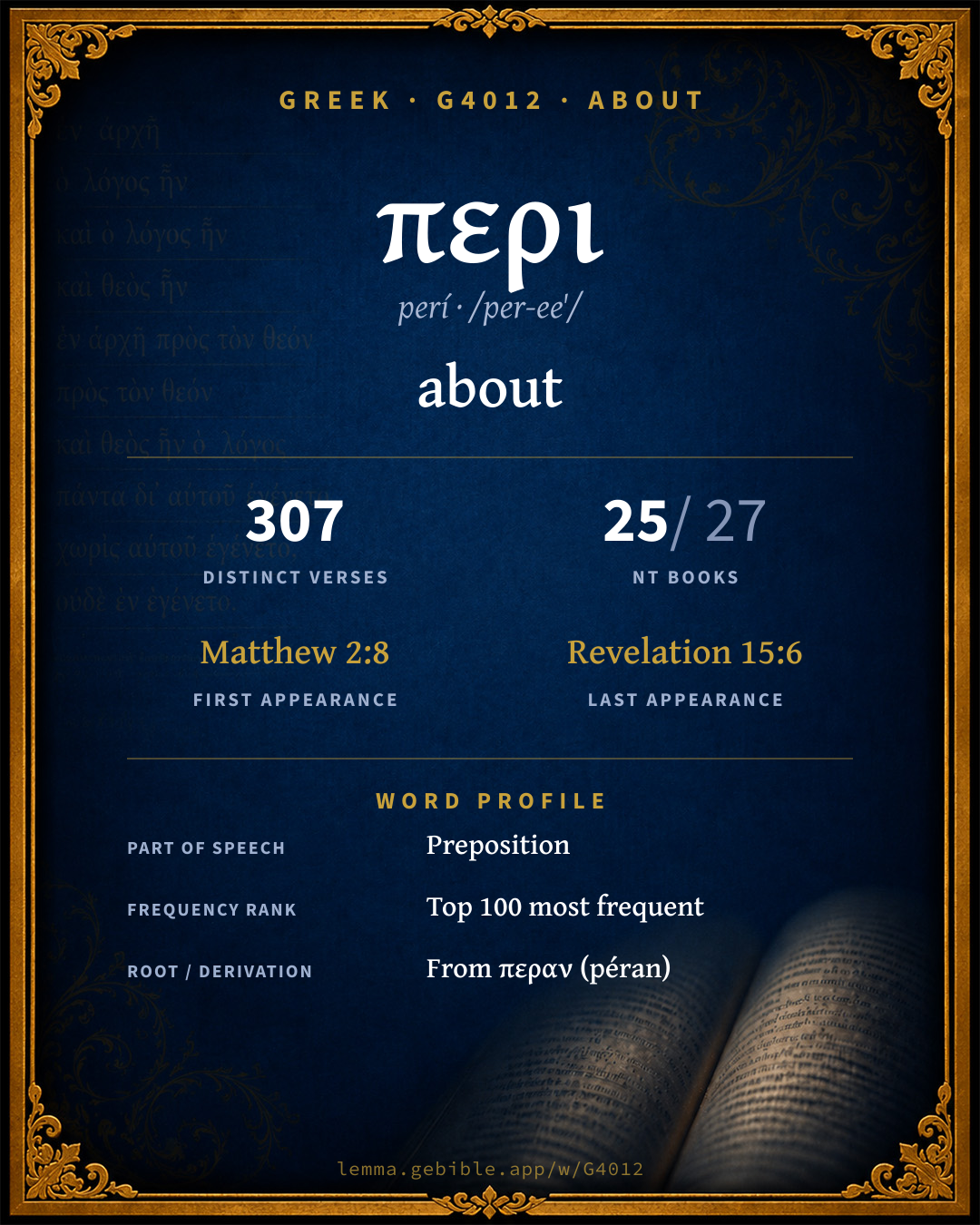
περί
about
Full lexicon entry — Thayer's Greek Lexicon
From Thayer's Greek Lexicon
Where this word appears
Grammar key — what these labels mean
Part of speech
- Preposition
- A relational word governing a noun in a particular case.
Every verse where G4012 appears in the Book of Colossians — 4 distinct verses. Click any verse to open its interlinear word-by-word view. Verse text shown in the World English Bible for context — . Each verse’s Greek form is shown with its reference; the English is not keyword-highlighted, since the data carries no word-level English alignment. Use “Compare translations” on any verse to read it across multiple English versions. This concordance covers the Greek New Testament; Septuagint (Greek Old Testament) occurrences of this word are not indexed here.
Colossians
- Colossians 1:3 περὶ prep We give thanks to God the Father of our Lord Jesus Christ, praying always for you,
- Colossians 4:3 περὶ prep praying together for us also, that God may open to us a door for the word, to speak the mystery of Christ, for which I am also in bonds;
- Colossians 4:8 περὶ prep I am sending him to you for this very purpose, that he may know your circumstances and comfort your hearts,
- Colossians 4:10 περὶ prep Aristarchus, my fellow prisoner greets you, and Mark, the cousin of Barnabas (concerning whom you received commandments, "if he comes to you, receive him"),
About this entry
At a glance — auto-summarized from this page’s data, not written by a person. Every figure links to its source below. This summary describes the numbers; it doesn’t interpret them.
περι — transliterated perí — is a Greek preposition carrying the sense “about.” Where the King James Version says “of,” newer translations reach for “about” (Berean Standard Bible); the renderings breakdown has the detail. It appears 307 verses across 25 books of the Greek New Testament, among its common vocabulary. Debuting at Matthew 2:8, it then recurs through the corpus. Related forms include περαν, πειρα and περ. Each statement above links to its evidence; the full detail follows below.
Gloss history
Strong's 1890 vs modern scholarship
About this word
Strong's G4012 catalogs a Greek word from the Greek New Testament.
These counts are not copied from any lexicon or concordance. They are computed here, from the morphology-tagged Greek New Testament. What Lemma adds →
- 307
- distinct verses
- The word appears in 307 distinct verses.
- 25 / 27
- NT books
- The word appears in 25 of 27 New Testament books.
- #54
- by frequency
- Top 100 most frequent Greek words (rank 54 of 5,347 Greek words by occurrence).
View all 307 occurrences in the concordance →
By section of the New Testament
By traditional corpus
Conventional, traditional groupings — biblical authorship is debated, so this is a traditional corpus grouping, not an authorship claim. Some books belong to more than one corpus (Luke is in both the Gospels and the Lukan corpus, and so on), so these shares overlap and need not total 100%. Each figure is a share of the word’s 307 distinct verses.
- Gospels 150 verses · 49%
- Lukan (Luke–Acts) 107 verses · 35%
- Johannine 67 verses · 22%
- Pauline corpus 53 verses · 17%
- Hebrews 20 verses · 7%
- General (Catholic) Epistles 19 verses · 6%
- Revelation 1 verse · 0%
How translations render this word
Counts come from each version’s own published word-to-Strong’s tagging or interlinear alignment — an approximate guide to how each version renders this word, not a word-level alignment the data otherwise carries. Because each total is that version’s own tagged count, the per-version totals vary from one another and need not match the appearance or distinct-verse counts above. These counts may also differ from a printed concordance because Lemma counts each distinctly tagged rendering and does not collapse phrase taggings into a single head-word total. This is a fixed set of word-tagged versions (KJV, ASV, BSB, ULT) and does not change with the reading translation you choose elsewhere. Each version’s license is shown beside its name below (and on Sources).
- King James Version: Of 146×, For 59×, Concerning 39×
- American Standard Version: Of 106×, Concerning 80×, For 50×
- Berean Standard Bible: About 144×, For 50×, Around 15×
- unfoldingWord Literal Text: About 172×, Concerning 87×, For 35×
King James Version Public Domain
Renders G4012 across 330 tagged occurrences — most commonly:
Plus other, less common renderings. Plus 21 renderings that appear only once — usually multi-word phrases or single function words the recovered tagging swept in, not distinct renderings. Not rendered by a distinct English word in 3 further occurrences.
American Standard Version Public Domain
Renders G4012 across 323 tagged occurrences — most commonly:
Plus 29 renderings that appear only once — usually multi-word phrases or single function words the recovered tagging swept in, not distinct renderings.
Berean Standard Bible Public Domain
Renders G4012 across 283 tagged occurrences — most commonly:
Plus other, less common renderings. Plus 10 renderings that appear only once — usually multi-word phrases or single function words the recovered tagging swept in, not distinct renderings. Not rendered by a distinct English word in 44 further occurrences.
unfoldingWord Literal Text CC BY-SA 4.0
Renders G4012 across 335 tagged occurrences — most commonly:
Plus 4 renderings that appear only once — usually multi-word phrases or single function words the recovered tagging swept in, not distinct renderings.
Senses in Thayer's
The 1 sense Thayer's distinguishes for this word, in lexicon order (not ranked by frequency or importance). The full entry — with sub-senses — is in the Lexicon Entry tab.
- about, concerning, on account of, because of, around, near
Word origin
Derived from περαν (péran) (G4008) — beyond.
From the base of G4008 ; properly through (all over ) that is around ; figuratively with respect to; used in various applications of place cause or time (with the genitive case denoting the subject or occasion or superlative point; with the accusative case the locality circuit matter circumstance or general period ): - (there-) about above against at on behalf of X and his company which concern (as) concerning for X how it will go with ([there- where-]) of on over pertaining (to) for sake X (e-) state (as) touching [where-] by (in) with. In compounds it retains substantially the same meaning of circuit ( around ) excess ( beyond ) or completeness ( through ).
— Strong’s Exhaustive Concordance (1890), public domain.
Forms in the corpus
The 3 distinct written forms G4012 takes in the Greek New Testament, most frequent first — each parse links to that case’s occurrences in the concordance.
| Form | Parsing | Example | Uses |
|---|---|---|---|
| περὶ perì | Preposition | Matthew 2:8 | 322 |
| Περὶ Perì | Preposition | Matthew 24:36 | 12 |
| περί perí | Preposition | Acts 25:19 | 1 |
Same root — word family
Other Thayer's entries built from the same root as G4012, grouped by Strong’s listed origin. These share a root / origin per the lexicon — not necessarily a shared meaning. Each links to that word’s own entry.
Derives from
Shares the same root
- πειρα peîra G3984 trial
- περ per G4007 very much
- περας péras G4009 end
- περπερευομαι perpereúomai G4068 to boast
- πιπρασκω pipráskō G4097 to sell
- φαραγξ pháranx G5327 ravine
Derived from this word
- περιαγω periágō G4013 to lead around
- περιαιρεω periairéō G4014 to take away
- περιαστραπτω periastráptō G4015 to shine around
- περιβαλλω peribállō G4016 to throw around
- περιβλεπω periblépō G4017 to look around
- περιδεω peridéō G4019 to bind around
- περιεργαζομαι periergázomai G4020 to bustle about
- περιεργος períergos G4021 busybody
- περιερχομαι periérchomai G4022 to go about
- περιεχω periéchō G4023 to surround
- περιζωννυμι perizṓnnymi G4024 to gird
- περιΐστημι periḯstēmi G4026 to stand around
- περικαθαρμα perikátharma G4027 scum
- περικαλυπτω perikalýptō G4028 to cover up
- περικειμαι períkeimai G4029 to lie around
- περικεφαλαια perikephalaía G4030 helmet
- περικρατης perikratḗs G4031 to have power over
- περικρυπτω perikrýptō G4032 to hide
- περικυκλοω perikyklóō G4033 to encircle
- περιλαμπω perilámpō G4034 to shine around
- περιλειπω perileípō G4035 to remain over
- περιλυπος perílypos G4036 deeply sorrowful
- περιμενω periménō G4037 to wait for
- περιξ périx G4038 round about
+18 more words derive from G4012 (not shown).
Proper names from this root
People and places named from this root — a name, not an additional meaning of the word.
Compare all same-root words → Showing 4 of 51 — not the complete family. 1 of the same-root words is a proper name (a person or place). They share a root, not necessarily a meaning.
Septuagint usage
The same Greek word περι appears 530 times in the Greek Old Testament (Septuagint), across 425 verses in 25 books.
- 530
- LXX occurrences
- Tagged occurrences of this Greek word in the Septuagint.
- 425
- verses
- Distinct Septuagint verses containing this word.
- 25 / 39
- OT books
- The word appears in 25 of the 39 Old Testament books.
Sample Septuagint occurrences
- Genesis 12:17 περί
- Exodus 8:4 περί
- Leviticus 1:4 περί
- Numbers 5:8 περί
- Deuteronomy 3:22 περί
- Joshua 5:4 περι
- Judges 9:3 περί
- 1 Samuel 1:5 περί
- 2 Samuel 3:8 περί
- 1 Kings 2:18 περί
- 2 Kings 6:11 περί
- 1 Chronicles 6:34 περί
Septuagint occurrences (same lexeme)
Every verse where the same Strong’s number (G4012) appears in the Greek Septuagint — showing the first 50 of 425. Verse text shown in the World English Bible for context; the Greek form is the matched word — the English is not keyword-highlighted.
- Genesis 12:17 περί Yahweh plagued Pharaoh and his house with great plagues because of Sarai, Abram's wife.
- Genesis 12:20 περί Pharaoh gave men charge concerning him: and they brought him on the way, and his wife, and all that he had.
- Genesis 15:12 περί When the sun was going down, a deep sleep fell on Abram. Now terror and great darkness fell on him.
- Genesis 17:20 περί As for Ishmael, I have heard you. Behold, I have blessed him, and will make him fruitful, and will multiply him exceedingly. He will become the father of twelve princes, and I will make him a great nation.
- Genesis 19:21 περί He said to him, "Behold, I have granted your request concerning this thing also, that I will not overthrow the city of which you have spoken.
- Genesis 20:2 περί Abraham said about Sarah his wife, "She is my sister." Abimelech king of Gerar sent, and took Sarah.
- Genesis 20:3 περί But God came to Abimelech in a dream of the night, and said to him, "Behold, you are a dead man, because of the woman whom you have taken. For she is a man's wife."
- Genesis 20:7 περί Now therefore, restore the man's wife. For he is a prophet, and he will pray for you, and you will live. If you don't restore her, know for sure that you will die, you, and all who are yours."
- Genesis 21:11 περί The thing was very grievous in Abraham's sight on account of his son.
- Genesis 21:12 περί God said to Abraham, "Don't let it be grievous in your sight because of the boy, and because of your handmaid. In all that Sarah says to you, listen to her voice. For from Isaac will your seed be called.
- Genesis 21:25 περί Abraham complained to Abimelech because of a water well, which Abimelech's servants had violently taken away.
- Genesis 23:8 περί He talked with them, saying, "If it be your mind that I should bury my dead out of my sight, hear me, and entreat for me to Ephron the son of Zohar,
- Genesis 24:9 περί The servant put his hand under the thigh of Abraham his master, and swore to him concerning this matter.
- Genesis 24:47 περί I asked her, and said, 'Whose daughter are you?' She said, 'The daughter of Bethuel, Nahor's son, whom Milcah bare to him.' I put the ring on her nose, and the bracelets on her hands.
- Genesis 24:67 περί Isaac brought her into his mother Sarah's tent, and took Rebekah, and she became his wife. He loved her. Isaac was comforted after his mother's death.
- Genesis 25:21 περί Isaac entreated Yahweh for his wife, because she was barren. Yahweh was entreated by him, and Rebekah his wife conceived.
- Genesis 26:7 περί The men of the place asked him about his wife. He said, "She is my sister," for he was afraid to say, "My wife," lest, he thought, the men of the place might kill me for Rebekah, because she was beautiful to look on.
- Genesis 26:21 περί They dug another well, and they argued over that, also. He called the name of it Sitnah.
- Genesis 26:22 περί He left that place, and dug another well. They didn't argue over that one. He called it Rehoboth. He said, "For now Yahweh has made room for us, and we will be fruitful in the land."
- Genesis 26:32 περί It happened the same day, that Isaac's servants came, and told him concerning the well which they had dug, and said to him, "We have found water."
- Genesis 27:41 περί Esau hated Jacob because of the blessing with which his father blessed him. Esau said in his heart, "The days of mourning for my father are at hand. Then I will kill my brother Jacob."
- Genesis 29:18 περί Jacob loved Rachel. He said, "I will serve you seven years for Rachel, your younger daughter."
- Genesis 29:20 περί Jacob served seven years for Rachel. They seemed to him but a few days, for the love he had for her.
- Genesis 29:25 περί It happened in the morning that, behold, it was Leah. He said to Laban, "What is this you have done to me? Didn't I serve with you for Rachel? Why then have you deceived me?"
- Genesis 30:26 περί Give me my wives and my children for whom I have served you, and let me go: for you know my service with which I have served you."
- Genesis 37:23 περί It happened, when Joseph came to his brothers, that they stripped Joseph of his coat, the coat of many colors that was on him;
- Genesis 40:14 περί But remember me when it will be well with you, and show kindness, please, to me, and make mention of me to Pharaoh, and bring me out of this house.
- Genesis 41:15 περί Pharaoh said to Joseph, "I have dreamed a dream, and there is no one who can interpret it. I have heard it said of you, that when you hear a dream you can interpret it."
- Genesis 41:32 περί The dream was doubled to Pharaoh, because the thing is established by God, and God will shortly bring it to pass.
- Genesis 41:42 περί Pharaoh took off his signet ring from his hand, and put it on Joseph's hand, and arrayed him in robes of fine linen, and put a gold chain about his neck,
- Genesis 41:55 περί When all the land of Egypt was famished, the people cried to Pharaoh for bread, and Pharaoh said to all the Egyptians, "Go to Joseph. What he says to you, do."
- Genesis 42:21 περί They said one to another, "We are most assuredly guilty concerning our brother, in that we saw the distress of his soul, when he begged us, and we wouldn't listen. Therefore this distress has come on us."
- Genesis 50:4 περί When the days of weeping for him were past, Joseph spoke to the house of Pharaoh, saying, "If now I have found favor in your eyes, please speak in the ears of Pharaoh, saying,
- Genesis 50:20 περί As for you, you meant evil against me, but God meant it for good, to bring to pass, as it is this day, to save many people alive.
- Exodus 8:4 περί and the frogs shall come up both on you, and on your people, and on all your servants.'"
- Exodus 8:5 περί Yahweh said to Moses, "Tell Aaron, 'Stretch forth your hand with your rod over the rivers, over the streams, and over the pools, and cause frogs to come up on the land of Egypt.'"
- Exodus 8:8 περί Then Pharaoh called for Moses and Aaron, and said, "Entreat Yahweh, that he take away the frogs from me, and from my people; and I will let the people go, that they may sacrifice to Yahweh."
- Exodus 8:24 περί Yahweh did so; and there came grievous swarms of flies into the house of Pharaoh, and into his servants' houses: and in all the land of Egypt the land was corrupted by reason of the swarms of flies.
- Exodus 9:28 περί Pray to Yahweh; for there has been enough of mighty thunderings and hail. I will let you go, and you shall stay no longer."
- Exodus 11:4 περί Moses said, "This is what Yahweh says: 'About midnight I will go out into the midst of Egypt,
- Exodus 14:14 περί Yahweh will fight for you, and you shall be still."
- Exodus 14:25 περί He took off their chariot wheels, and they drove them heavily; so that the Egyptians said, "Let's flee from the face of Israel, for Yahweh fights for them against the Egyptians!"
- Exodus 22:8 περί If the thief isn't found, then the master of the house shall come near to God, to find out if he hasn't put his hand to his neighbor's goods.
- Exodus 24:8 περί Moses took the blood, and sprinkled it on the people, and said, "Look, this is the blood of the covenant, which Yahweh has made with you concerning all these words."
- Exodus 28:12 περί You shall put the two stones on the shoulder-pieces of the ephod, to be stones of memorial for the children of Israel: and Aaron shall bear their names before Yahweh on his two shoulders for a memorial.
- Exodus 30:15 περί The rich shall not give more, and the poor shall not give less, than the half shekel, when they give the offering of Yahweh, to make atonement for your souls.
- Exodus 30:16 περί You shall take the atonement money from the children of Israel, and shall appoint it for the service of the tent of meeting; that it may be a memorial for the children of Israel before Yahweh, to make atonement for your souls."
- Exodus 32:14 περί Yahweh repented of the evil which he said he would do to his people.
- Exodus 32:30 περί It happened on the next day, that Moses said to the people, "You have sinned a great sin. Now I will go up to Yahweh. Perhaps I shall make atonement for your sin."
- Exodus 32:35 περί Yahweh struck the people, because they made the calf, which Aaron made.
These are occurrences of the same Greek lexeme (G4012) in the Septuagint — not a translation of any one Hebrew word. The store carries no word-level Hebrew↔Greek alignment, so no Hebrew original is asserted here. Counts come from the recovered LXX Strong's tagging — high-frequency vocabulary is well covered, while rare or late forms may be untagged — so they reflect tagged occurrences and may slightly undercount.