
Exodus 32:35

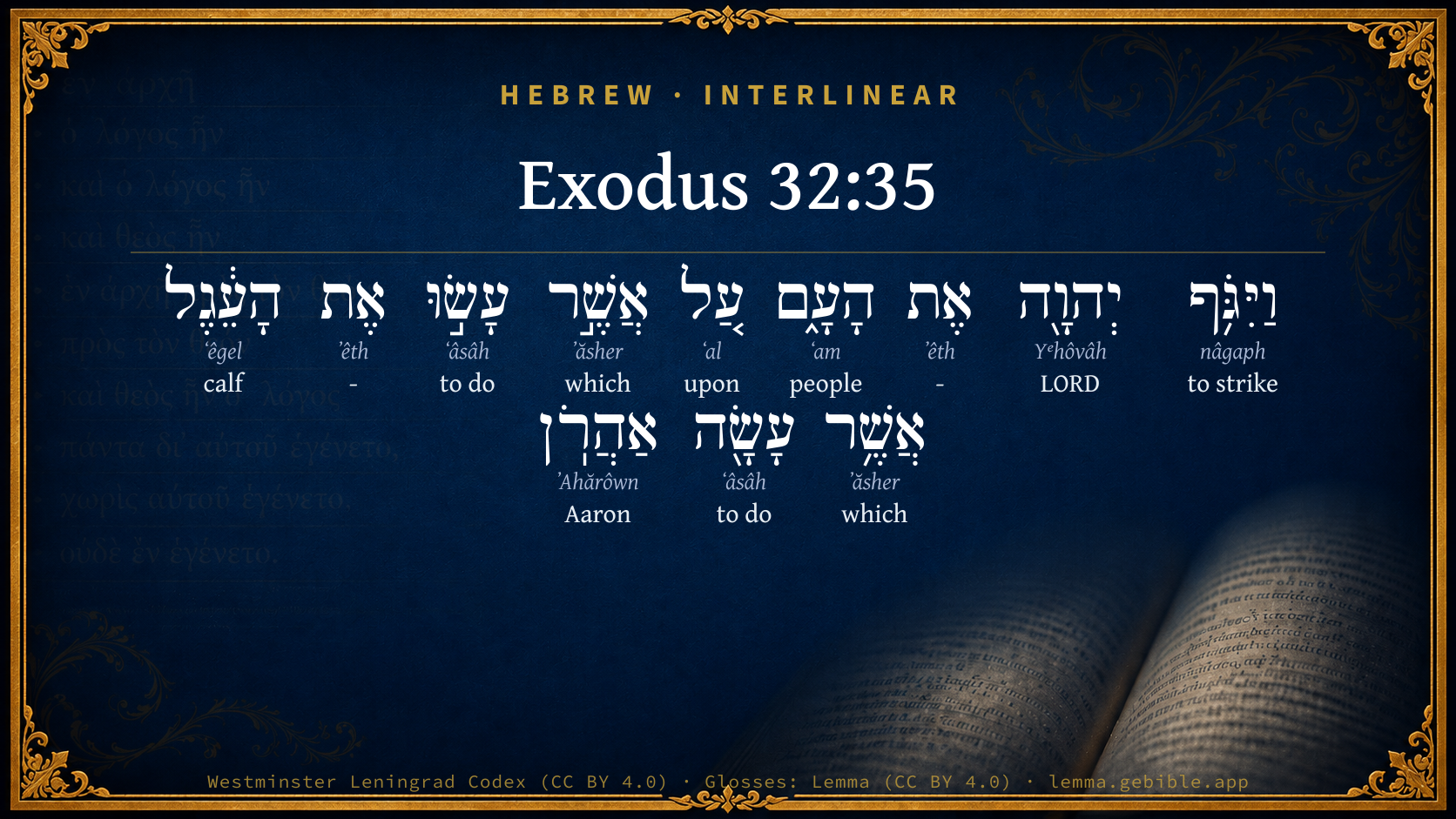
Hebrew (Westminster Leningrad Codex) Exodus 32:35 appears in the Hebrew Old Testament. The text above is from the Westminster Leningrad Codex. Each word links to its Strong’s number, a concise gloss, and parsing drawn from the Open Scriptures Hebrew Bible morphology. Click any word for its full Brown-Driver-Briggs (BDB) entry.
Download image
Cite this verse

Exodus 32:35 (World English Bible). Public Domain. Lemma interlinear Bible study tool, https://lemma.gebible.app/v/exodus/32/35.

Show BibTeX & RIS
BibTeX
RIS
English Translation
Yahweh struck the people, because they made the calf, which Aaron made.
World English Bible · Public Domain
Download a study sheet

One document with this verse’s original text, its word-by-word gloss line, the meaning frame, cross-references with their text, attributed commentary, and full source and license credits — printable, and it pastes into notes with its structure intact.

This verse Autodidact and up

Study sheet (.html) Plain text (.txt)

A passage Seminary Student

Up to 50 verses in one chapter. A passage sheet keeps up to 6 commentary sources and 12 cross-references per verse, in the order this page ranks them, and says so on the sheet whenever that leaves anything out. Ask for a single verse and you get the Autodidact verse sheet above.

Everything on this page stays free to read, with no account — the sheet is a download of what is already on screen, not access to it.

Want to remove ads? Support Godless Engineer
Compare translations 3

The same verse in 3 English versions, stacked beneath the original-language interlinear above. Click any original word for its lexicon entry.

Each is an independent rendering of the whole verse — the interlinear is not word-aligned to these translations.

Highlighted words mark where these versions differ — a whole-verse word diff, not a word-by-word alignment.

  • World English Bible Public Domain
    Yahweh struck the people, because they made the calf, which Aaron made.
  • King James Version Public Domain
    And the LORD plagued the people, because they made the calf, which Aaron made.
  • unfoldingWord Literal Text CC BY-SA 4.0
    And Yahweh plagued the people because they had made the calf (that Aaron made).

unfoldingWord Literal Text — © unfoldingWord, licensed CC BY-SA 4.0. Word-aligned USFM3 via Door43 (git.door43.org/unfoldingWord/en_ult).

Versions to compare (up to 4)

3 of 4 selected

Show all 18 translations

Every available English version of this verse, each an independent rendering of the whole verse.

  • World English Bible Public Domain
    Yahweh struck the people, because they made the calf, which Aaron made.
  • Berean Standard Bible Public Domain
    And the LORD sent a plague on the people because of what they had done with the calf that Aaron had made.
  • Majority Standard Bible Public Domain
    And the LORD sent a plague on the people because of what they had done with the calf that Aaron had made.
  • King James Version Public Domain
    And the LORD plagued the people, because they made the calf, which Aaron made.
  • American Standard Version (1901) Public Domain
    And Jehovah smote the people, because they made the calf, which Aaron made.
  • Revised Version (1885) Public Domain
    And the LORD smote the people, because they made the calf, which Aaron made.
  • Geneva Bible (1599) Public Domain
    So the Lord plagued the people, because they caused Aaron to make ye calfe which he made.
  • Douay-Rheims (1899) Public Domain
    The Lord therefore struck the people for the guilt on occasion of the calf which Aaron had made.
  • Young's Literal Translation Public Domain
    And Jehovah plagueth the people, because they made the calf which Aaron made.
  • Literal Standard Version CC BY-SA 4.0
    And YHWH plagues the people because they made the calf which Aaron made.
  • Unlocked Literal Bible CC BY-SA 4.0
    Yahweh sent a plague on the people because they had made the calf, the one that Aaron made.
  • unfoldingWord Literal Text CC BY-SA 4.0
    And Yahweh plagued the people because they had made the calf (that Aaron made).
  • Darby Bible Public Domain
    And Jehovah smote the people, because they made the calf, which Aaron had made.
  • World Messianic Bible Public Domain
    The LORD struck the people, because of what they did with the calf, which Aaron made.
  • Webster's Bible Public Domain
    And the LORD afflicted the people, because they made the calf which Aaron made.
  • Free Bible Version CC BY-SA 4.0
    The Lord brought a plague on the people because they made Aaron make the bull calf.
  • Bible in Basic English Public Domain
    And the Lord sent punishment on the people because they gave worship to the ox which Aaron made.
  • JPS Tanakh (1917) Public Domain
    And the LORD smote the people, because they made the calf, which Aaron made.

Literal Standard Version (2020), Covenant Press — licensed CC BY-SA 4.0. Text via the HelloAO Bible API (eBible.org). Unlocked Literal Bible (unfoldingWord) — licensed CC BY-SA 4.0. Text via the HelloAO Bible API (eBible.org). unfoldingWord Literal Text — © unfoldingWord, licensed CC BY-SA 4.0. Word-aligned USFM3 via Door43 (git.door43.org/unfoldingWord/en_ult). Free Bible Version, Dr. Jonathan Gallagher — licensed CC BY-SA 4.0. Text via the HelloAO Bible API (eBible.org).

Word by word

More ways to search: Search by grammar → Find every occurrence → Compare this word →

Practice this passage: Drill this verse → Learn its vocabulary →

הָעֵ֔גֶל
ʻêgel
H5695
“the · calf”
Particle, Definite Article + Noun, Common, Masculine, Singular, Absolute
Part of Speech
Particle + Noun
Type
Common
Gender
Masculine
Number
Singular
State
Absolute
Full BDB Definition

Origin: from the same as H5696

TWOT: 1560a

calf, bull-calf
  1. וַיִּגֹּ֥ף nâgaph H5062 “and · to strike” Conjunction + Verb, Qal, Sequential Imperfect, 3rd Person, Masculine, Singular
  2. יְהוָ֖ה Yᵉhôvâh H3068 “LORD” Noun, Proper
  3. אֶת ʼêth H853 “-” Particle, Direct Object
  4. הָעָ֑ם ʻam H5971 “the · people” Particle, Definite Article + Noun, Common, Masculine, Singular, Absolute
  5. עַ֚ל ʻal H5921 “upon” Preposition
  6. אֲשֶׁ֣ר ʼăsher H834 “which” Particle, Relative
  7. עָשׂ֣וּ ʻâsâh H6213 “to do” Verb, Qal, Perfect, 3rd Person, Common, Plural
  8. אֶת ʼêth H853 “-” Particle, Direct Object
  9. אֲשֶׁ֥ר ʼăsher H834 “which” Particle, Relative
  10. עָשָׂ֖ה ʻâsâh H6213 “to do” Verb, Qal, Perfect, 3rd Person, Masculine, Singular
  11. אַהֲרֹֽן ʼAhărôwn H175 “Aaron” Noun, Proper

About this verse

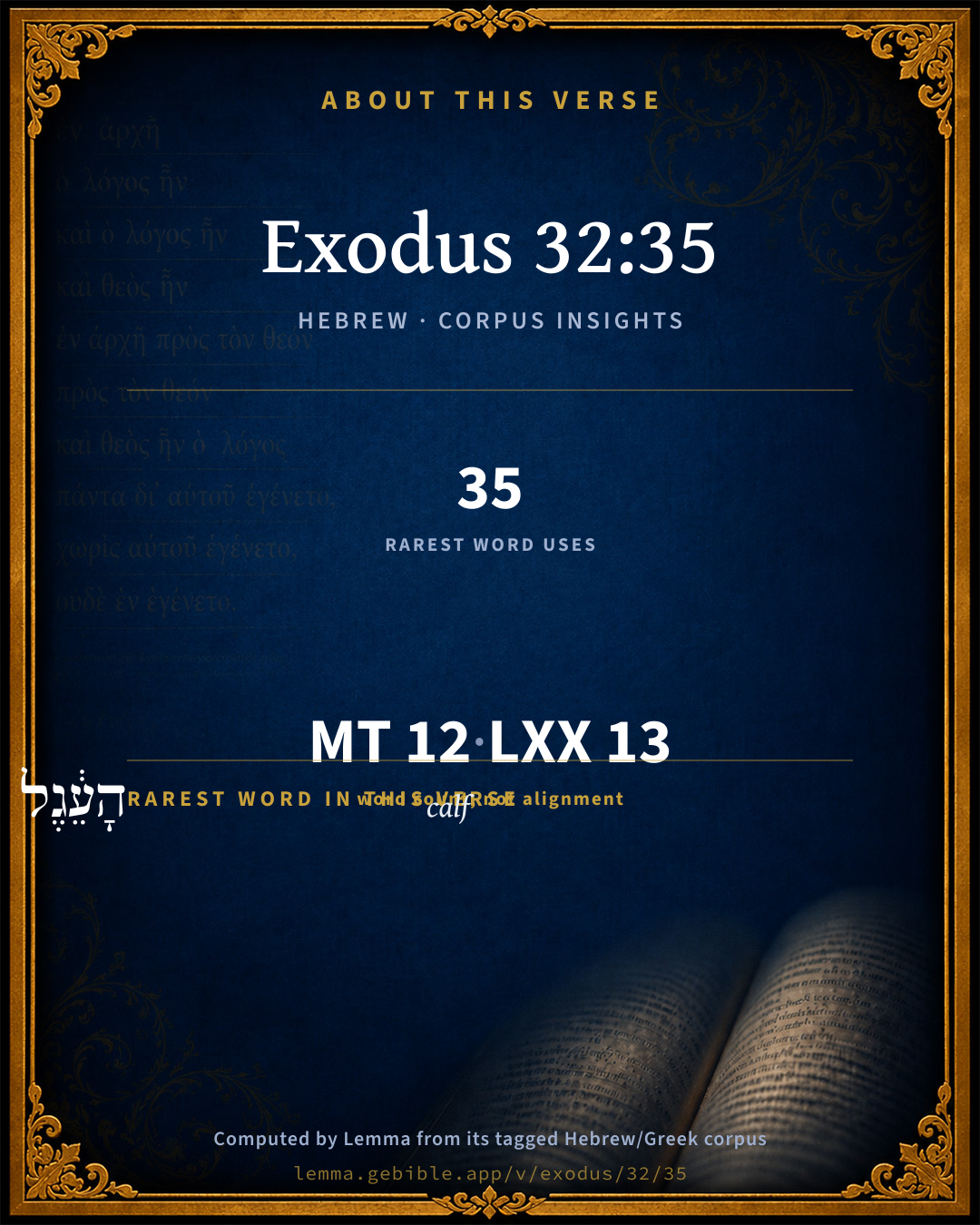
These counts appear in no published source. They are computed here, from the morphology-tagged text and Lemma’s own curated glosses. What Lemma adds →

12
words
9
distinct lemmas
Pentateuch
section

Shared distinctive vocabulary

הָעֵ֔גֶל calf H5695 occurs in 35 verses of the Hebrew Bible. Also found in:

Grammatical profile

  • 3 verbs
  • 4 nouns
  • 1 preposition
  • 4 particles

Verb forms

  • וַיִּגֹּ֥ף Qal · Sequential Imperfect
  • עָשׂ֣וּ Qal · Perfect
  • עָשָׂ֖ה Qal · Perfect

Repetition

Words recur within this verse — often emphatic in Hebrew:

  • עָשׂ֣וּ to do H6213 ×2
  • אֲשֶׁ֣ר which H834 ×2

Hebrew & Septuagint length

In English translation the verse runs 12 words from the Hebrew and 14 from the Septuagint (LXX English) — closely comparable.

A rough comparison of the two English renderings, which tokenize alike — not a word-level alignment.

Word counts can differ between the Hebrew and the Greek without any difference in meaning — e.g. the Hebrew direct-object marker אֵת has no separate Greek word, and Greek often adds the article ὁ.

In the original languages it is 12 Hebrew tokens and 13 Greek tokens — but the two are counted differently (Hebrew bundles its prefixes and suffixes into one token; the Greek is in lemma form), so that isn’t a like-for-like length.

Cross-references

6

Topical passages linked to Exodus 32:35 in the Treasury of Scripture Knowledge — connected by theme and wording, ordered by reader-vote popularity; previews shown in the World English Bible.

  • 2 Samuel 12:9–10 Why have you despised the word of Yahweh, to do that which is evil in his sight? You have struck Uriah the Hittite with the sword, and have taken his wife to be your wife, and have slain him with the sword of the children of Ammon.
  • Exodus 32:4 He received what they handed him, and fashioned it with an engraving tool, and made it a molten calf; and they said, "These are your gods, Israel, which brought you up out of the land of Egypt."
  • Exodus 32:25 When Moses saw that the people had broken loose, (for Aaron had let them loose for a derision among their enemies),
  • Matthew 27:3–7 Then Judas, who betrayed him, when he saw that Jesus was condemned, felt remorse, and brought back the thirty pieces of silver to the chief priests and elders,
  • Acts 1:18 Now this man obtained a field with the reward for his wickedness, and falling headlong, his body burst open, and all his intestines gushed out.
  • Acts 7:41 They made a calf in those days, and brought a sacrifice to the idol, and rejoiced in the works of their hands.

Cross-references courtesy of OpenBible.info (CC BY 4.0).

Hebrew and Greek witnesses Masoretic Hebrew ↔ Greek Septuagint

The same verse in the two great witnesses to the Old Testament, shown verse-for-verse.

These are two independent witnesses, not word-aligned to each other, and the Septuagint is shown in lemma (dictionary) form.

Hebrew Exodus 32:35 Masoretic · Westminster Leningrad Codex

וַיִּגֹּ֥ף יְהוָ֖ה אֶת הָעָ֑ם עַ֚ל אֲשֶׁ֣ר עָשׂ֣וּ אֶת הָעֵ֔גֶל אֲשֶׁ֥ר עָשָׂ֖ה אַהֲרֹֽן

Yahweh struck the people, because they made the calf, which Aaron made.

World English Bible · Public Domain

Greek LXX Exodus 32:35 Septuagint · lemma form

καί πατάσσω κύριος ὁ λαός περί ὁ ποίησις ὁ μόσχος ὅς ποιέω ααρων

And the Lord struck the people for the making the calf, which Aaron made.

LXX2012 (modern English Septuagint) · Public Domain

Hebrew: Westminster Leningrad Codex (CC BY 4.0). Greek: Septuagint (public domain); English from LXX2012 (modern English Septuagint) (Public Domain). How the Septuagint differs from the Hebrew →

Targum (Aramaic paraphrase)

2

The Targum is the ancient Jewish Aramaic paraphrase of the Hebrew Scriptures — an interpretive translation, not the Hebrew text itself. Onkelos (literal) and Pseudo-Jonathan (expansive) render the Torah, and Jonathan the Prophets. Coverage is partial: where no permissively-licensed English translation exists for a verse, only the Aramaic is shown. This is verse-level text, not a word-by-word alignment to the Hebrew.

  1. Targum Onkelos Torah (Genesis–Deuteronomy)
    וּמְחָא יְיָ יָת עַמָא עַל דִי אִשְׁתַּעְבָּדוּ לְעֶגְלָא דִי עֲבַד אַהֲרֹן:

    (no public-domain English translation for this verse)

    Targum Onkelos — Aramaic: “Onkelos Genesis” (public domain); “Onkelos Exodus” (public domain); “Onkelos Leviticus” (public domain); “Onkelos Numbers” (public domain); “Onkelos Deuteronomy” (public domain). English: “Sefaria Community Translation” (CC0 1.0 (public-domain dedication)); “J.W. Etheridge. The Targums of Onkelos and Jonathan Ben Uzziel on the Pentateuch. London: Longmans, Green, 1862” (public domain). Text via Sefaria.

  2. Targum Pseudo-Jonathan Torah (Genesis–Deuteronomy)
    וַחֲבַל מֵימְרָא דַיְיָ יַת עַמָּא עַל דְּגָחְנָן לְעִגְלָא דְעָבַד אַהֲרן

    And the Word of the Lord plagued the people, because they had bowed themselves to the calf that Aharon had made.

    Targum Pseudo-Jonathan — Aramaic: “Targum Jonathan on Genesis” (public domain); “Targum Jonathan on Exodus” (public domain); “Targum Jonathan on Leviticus” (public domain); “Targum Jonathan on Numbers” (public domain); “Targum Jonathan on Deuteronomy” (public domain). English: “The Targum of Jonathan ben Uzziel, trans. J. W. Etheridge, London, 1862” (public domain). Text via Sefaria.

Commentary

Notes on Exodus 32:35 from classic Christian and Jewish commentators (each source and its license shown beneath its notes). The classic Christian expositions comment on the surrounding passage and are grouped to its opening verse, so a note may address several verses; the Jewish commentaries on the Tanakh (Rashi and others) are per-verse, so they appear only where the commentator wrote on this verse.

Lemma curates 59 commentaries, every one of them public domain or Creative Commons licensed, each selected and text-cleaned for this edition rather than reprinted as found. About our sources →

Trapp's Complete Commentary

John Trapp

Exo 32:35 And the LORD plagued the people, because they made the calf, which Aaron made.

Ver. 35. They made.] {See Trapp on "Exo 32:1"}

John Trapp, A Commentary or Exposition upon All the Books of the Old and New Testament (1647–1656) — public domain. Text from a community e-Sword module.

Geneva Bible (1599)

Geneva Bible translators

This declareth how grievous a sin idolatry is, seeing that at Moses’ prayer God would not fully remit it.

Geneva Bible (1599) marginal notes — public domain. Text via Bolls.life.

Jamieson, Fausset & Brown

Robert Jamieson, A. R. Fausset & David Brown

the Lord plagued the people, because they made the calf--No immediate judgments were inflicted, but this early lapse into idolatry was always mentioned as an aggravation of their subsequent apostasies.

Next: Exodus Chapter 33

Jamieson, Fausset & Brown — Commentary Critical and Explanatory on the Whole Bible (1871) — public domain (CC PDM 1.0). Text via the HelloAO Bible API.

Adam Clarke's Commentary

Verse 35. The Lord plagued the people] Every time they transgressed afterwards Divine justice seems to have remembered this transgression against them. The Jews have a metaphorical saying, apparently founded on this text: "No affliction has ever happened to Israel in which there was not some particle of the dust of the golden calf."

1. THE attentive reader has seen enough in this chapter to induce him to exclaim, How soon a clear sky may be overcast! How soon may the brightest prospects be obscured! Israel had just ratified its covenant with Jehovah, and had received the most encouraging and unequivocal pledges of his protection and love. But they sinned, and provoked the Lord to depart from them, and to destroy the work of his hands. A little more faith, patience, and perseverance, and they should have been safely brought into the promised land. For want of a little more dependence upon God, how often does an excellent beginning come to an unhappy conclusion! Many who were just on the borders of the promised land, and about to cross Jordan, have, through an act of unfaithfulness, been turned back to wander many a dreary year in the wilderness. Reader, be on thy guard. Trust in Christ, and watch unto prayer.

2. Many people have been greatly distressed on losing their baptismal register, and have been reduced in consequence to great political inconvenience. But still they had their lives, and should a living man complain? But a man may so sin as to provoke God to cut him off; or, like a fruitless tree, be cut down, because he encumbers the ground. Or he may have sinned a sin unto death, 1Jo 5:16-17, that is, a sin which God will punish with temporal death, while he extends mercy to the soul.

3. With respect to the blotting out of God's book, on which there has been so much controversy, Is it not evident that a soul could not be blotted out of a book in which it had never been written? And is it not farther evident from Ex 32:32-33, that, although a man be written in God's book, if he sins he may be blotted out? Let him that readeth understand; and let him that standeth take heed lest he fall. Reader, be not high-minded, but fear. See Clarke on Ex 32:32, and "Ex 32:33".

Adam Clarke's Commentary on the Bible (1810–1826) — public domain. Text from a community e-Sword/MySword module.

Ellicott's Commentary for English Readers

(35) The Lord plagued the people.—We are not to understand by this (with Kalisch) that a pestilence was sent, but only that sufferings of various kinds befell those who had worshipped the calf, and were, in fact, punishments inflicted on them for that transgression.

A Bible Commentary for English Readers, edited by Charles John Ellicott (1878–1897) — public domain. Text from a community e-Sword module.

The Cambridge Bible for Schools and Colleges

gen. ed. J. J. S. Perowne

35. The verse seems here out of place (so Di.): perhaps it originally formed the sequel to v. 20 (We., Bä.). It does not read like a description of the punishment threatened at the end of v. 34.

which Aaron made] The words read like a scribe’s correction of the less exact ‘they made’ just before.

The Cambridge Bible for Schools and Colleges (gen. ed. J. J. S. Perowne; Cambridge University Press, 1878–1918) — public domain. Text from a community e-Sword module.

John Gill's Exposition

And when the people saw that Moses delayed to come down out of the mount,.... The time, according to the Targum of Jonathan, being elapsed, which he had fixed for his descent, and through a misreckoning, as Jarchi suggests; they taking the day of his going up to be one of the forty days, at the end of which he was to return, whereas he meant forty complete days; but it is not probable that Moses knew himself how long he should stay, and much less that he acquainted them before hand of it; but he staying longer than they supposed he would, they grew uneasy and impatient, and wanted to set out in their journey to Canaan, and to have some symbol and representation of deity to go before them:

the people gathered themselves together unto Aaron; who with Hur was left to judge them in the absence of Moses: it was very likely that they had had conferences with him before upon this head, but now they got together in a tumultuous manner, and determined to carry their point against all that he should say to the contrary:

and said unto him, up; put us off no longer, make no more delay, but arise at once, and set about what has been once and again advised to and importuned:

make us gods which shall go before us; not that they were so very stupid to think, that anything that could be made with hands was really God, or even could have life and breath, and the power of self-motion, or of walking before them; but that something should be made as a symbol and representation of the divine Being, carried before them; for as for the cloud which had hitherto gone before them, from their coming out of Egypt, that had not moved from its place for forty days or more, and seemed to them to be fixed on the mount, and would not depart from it; and therefore they wanted something in the room of it as a token of the divine Presence with them:

for as for this Moses; of whom they speak with great contempt, though he had been the deliverer of them, and had wrought so many miracles in their favour, and had been the instrument of so much good unto them:

the man that brought us up out of the land of Egypt; this they own, but do not seem to be very thankful for it:

we wot not what is become of him; they could scarcely believe that he was alive, that it was possible to live so long a time without eating and drinking; or they supposed he was burnt on the mount of flaming fire from before the Lord, as the Targum of Jonathan expresses it.

John Gill's Exposition of the Whole Bible (1746–1763) — public domain (CC PDM 1.0). Text via the HelloAO Bible API.

Haydock's Catholic Bible Commentary

Struck, with some judgment, not specified; (Lyranus) or perhaps, the various punishments which were inflicted on the Hebrews in the wilderness, were all partly designed to chastise this first act of idolatry. Calmet explains this of the devastation caused by the Levites, as he supposes the narration of Moses does not deserve the order of time. He thinks Moses expostulated with the people, and was then sent by God to punish them; and while they were unarmed, (chap. xxxiii. 5,) the Levites fell upon them. Then Moses removed the tabernacle out of the camp, and obtained of God that he would go before them, and not an angel only, ver. 34. and chap. xxxiii. 17. Moses continued full forty days, standing or lying prostrate on the mount, before the Lord, to obtain the pardon of his people, Deuteronomy ix. 25. and x. 10. At the expiration of which term he returned, with an order to prepare two other tables of stone, on which, after a supplication of the same length of time, he obtained the law to be again engraven, chap. xxxiv. 28. The favour cost him therefore 120 days’ earnest prayer; and yet how little are we touched with God’s mercy, in giving us his law! (Haydock)

George Leo Haydock (1774–1849), Haydock's Catholic Family Bible and Commentary, 1859 edition — public domain. Excludes Psalms (Douay-Rheims chapter numbering differs from Protestant) and Deuterocanonical books (Catholic canon only).

Matthew Poole's English Annotations

This relates either to the destruction of three thousand of them by the Levites, or rather to the future plagues, in which God also reckoned with them for this sin.

Because they made the calf; they made it because they urged

Aaron to make it, as Judas is said to purchase the field, Act 1:18, which was purchased by his money; and Aaron made it, by giving command to make it. The Chaldee, Syriac, Arabic, and Samaritan render the words thus,

they worshipped or sacrificed to the calf which Aaron made. And the word which signifies to make, is oft used for worshipping or sacrificing, as Exo 10:25; Jdg 13:15; 1Ki 18:26.

Matthew Poole's English Annotations on the Holy Bible (1683–1685) — public domain. Text from a community e-Sword/MySword module.

Whedon's Commentary on the Bible

Daniel D. Whedon

35. Plagued — This implies that the severe blow ministered by the Levites (27-29) was followed by still other visitations of penal wrath.

Daniel D. Whedon (gen. ed.), Commentary on the Old and New Testaments (1874–1909) — public domain. Text from a community e-Sword module.

The Pulpit Commentary

The Lord plagued, or "strucki.e. , "punished" the people. There is nothing in the expression which requires us to understand the sending of a pestilence.

The Pulpit Commentary (1880–1919), ed. H.D.M. Spence-Jones & Joseph S. Exell — public domain. Text from a community e-Sword module.

John Wesley's Explanatory Notes

And the Lord plagued the people - Probably by the pestilence, or some other infectious disease. Thus Moses prevailed for a mitigation of the punishment, but could not wholly turn away the wrath of God.

John Wesley, Explanatory Notes Upon the Whole Bible (1754–1765) — public domain. Text via the GEBible commentary corpus.

Keil & Delitzsch

C. F. Keil & F. Delitzsch

"Thus Jehovah smote the people because they had made the calf." With these words the historian closes the first act of Moses' negotiations with the Lord on account of this sin, from which it was apparent how God had repented of the evil with which He had threatened the nation (Exo 32:14). Moses had obtained the preservation of the people and their entrance into the promised land, under the protection of God, through his intercession, and averted from the nation the abrogation of the covenant; but the covenant relation which had existed before was not restored in its integrity. Though grace may modify and soften wrath, it cannot mar the justice of the holy God. No doubt an atonement had been made to justice, through the punishment which the Levites had inflicted upon the nation, but only a passing and imperfect one. Only a small portion of the guilty nation had been punished, and that without the others showing themselves worthy of forgiving grace through sorrow and repentance. The punishment, therefore, was not remitted, but only postponed in the long-suffering of God, "until the day of retribution" or visitation. The day of visitation came at length, when the stiff-necked people had filled up the measure of their sin through repeated rebellion against Jehovah and His servant Moses, and were sentenced at Kadesh to die out in the wilderness (Num 14:26.). The sorrow manifested by the people (Exo 33:4), when the answer of God was made known to them, was a proof that the measure was not yet full.

Keil & Delitzsch — Biblical Commentary on the Old Testament (1861–1891) — public domain (CC PDM 1.0). Text via the HelloAO Bible API. (Old Testament only.)

Rashi

Rabbi Shlomo Yitzchaki (Rashi)

ויגף ה' את העם AND THE LORD PLAGUED THE PEOPLE — This was death inflicted by the heavenly Judge on those to whose offence there had been witnesses but no legal caution (cf. Rashi on v. 20).

Rashi on the Tanakh — English translations: “The Judaica Press complete Tanach with Rashi, translated by A. J. Rosenberg” (CC BY 4.0); “Pentateuch with Rashi's commentary by M. Rosenbaum and A.M. Silbermann, 1929-1934” (public domain); “The Metsudah Tanach series, Lakewood, N.J” (CC BY 4.0); and “The Book of Joshua, Metsudah Publications, 1997” (CC BY 4.0). Text via Sefaria.

Ramban (Nachmanides)

Rabbi Moshe ben Nachman (Ramban / Nachmanides)

AND THE ETERNAL SMOTE THE PEOPLE. Scripture does not state how many died in this plague, as it stated the number of those that fell by the hand of the sons of Levi,. and as it mentioned in the case of the plague about the matter of Korah,. and in connection with the Baal of Peor, 25:9: And those that died by the plague were twenty and four thousand. the reason perhaps being that those here did not all die in one plague, but they were smitten and died prematurely, something like it said, but the Eternal shall smite him, or his day shall come to die. Perhaps Scripture did not bother to number them, for similarly it did not number those that died in the plague at Taberah, and at Kibroth-hattaavah, where it says, and the Eternal smote the people with a very great plague., 33. Those that fell, however, through the sons of Levi He counted in their honor, thus saying that they slew many of the people but yet they did not fear them, for they trusted in the Eternal.

BECAUSE THEY MADE THE CALF. This means that they were not amongst those who worshipped it or sacrificed to it, but they were the men who “made” it, that is to say, they were the ones who gathered around Aaron and brought him the gold. Now since Scripture states that they were punished for making the calf, not for worshipping it, and in reality they did not make it, it explains further, which Aaron made, meaning that Aaron made it at their command.But Onkelos translated [the expression, because they ‘made’ the calf], “because they ‘worshipped’ the calf which Aaron made.” By this Onkelos intended to explain that the ones who died in the plague were those who embraced and kissed it, and were pleased with the calf. Now [although the same term asah (“did”) is mentioned in both cases, because they ‘made’ the calf, which Aaron ‘made’], Onkelos did not feel obliged to translate both alike [but instead he translated: “because they ‘worshipped’ the calf, which Aaron ‘made’ “]. A similar case [of Onkelos’ rendition] is the verse, and whatsoever they ‘did’ there, he was the ‘doer’ of it, which he translated: “and whatsoever they did there ‘was done’ by his command.” This plague occurred after Moses had punished the worshippers and prayed for Israel, saying, and if not, blot me, I pray Thee, out of Thy book. For because Moses had shown his readiness to give his life for them, the Holy One, blessed be He, had mercy upon them, and told him to bring them up to the Land, and that He would send an angel before them; but since He wanted to take away from them part of the great sin, in order that they should be worthy [to go up to the Land], He sent upon them this plague. Or it may be that He had decreed this plague upon them [before Moses’ prayer] and the plague had already begun, and after that He said again to Moses, Go up hence, thou and the people, Verse 1. meaning, that the plague will not blot out their sin from before Me so that I should again dwell in their midst. He mentioned though, unto the land of which I swore unto Abraham, to Isaac, and to Jacob, Verse 1. and further said, and I will drive out the Canaanite, etc.; for on account of the plague which He brought or decreed upon them, part of their sin was blotted out, and He was partially appeased to them, in remembering the merit of the patriarchs, and [promising] that He would fulfill to them the oath He had taken to bring them unto a good land, a land flowing with milk and honey. Thus He hinted to Moses that the earth [i.e., the land of Canaan] would not become corrupt nor would it be defiled under the inhabitants thereof on account of their sin, and that He would drive out all the six nations whose land they were originally promised. And He also said by way of pacification, for I will not go up in the midst of thee, this being to your benefit, lest I consume thee in the way, because of your stiff-neckedness.Thus there were here two punishments for Israel: firstly, that He would not cause His Divine Glory to dwell amongst them, and secondly, that He would send an angel before Moses until the nations would be driven out; but He did not promise them after they would inherit the Land even an angel to help them, for this is why He mentioned in the way [lest I consume thee ‘in the way’]. It is with reference to all this that Scripture says, And when the people heard these evil tidings, they mourned; and no man put on him his ornaments, Verse 4. — just as mourners. But G-d is merciful, abounding in compassion, and when He saw that they mourned, He said again by way of mercy, Say unto the children of Israel etc., Verse 5. for up till now He had used the terms, thy people, and the people, Verse 1. but now He mentioned them by their beloved name, and He commanded Moses to tell them that it was to their benefit that He would not go up in their midst, in order that He should not consume them in one moment. However, they have done well in repenting and mourning for their sin. So should they always do, and I will know what to do unto them., Verse 5. That is to say, I will visit their sin in accordance with My knowledge of their mourning and repenting their sin, since it is I Who tries the heart and searches the kidneys. By way of the Truth, [the mystic teachings of the Cabala], the expression, that I may know what to do unto thee, Verse 5. means that He will do unto them in the knowledge of mercy, similar to what is said, and if not, I will know, as I have already explained., Verse 20. Vol. I, p. 245.

Ramban (Nachmanides) on the Tanakh — English translation: “Commentary on the Torah by Ramban (Nachmanides). Translated and annotated by Charles B. Chavel. New York, Shilo Pub. House, 1971-1976” (CC BY 4.0). Text via Sefaria.

Lesson kit

Teaching starters — assembled from the data on this page, not authored interpretation. Every prompt links to the verse data it draws on. Edit before teaching.

Exodus, in the Pentateuch, opens this verse with 12 words (9 distinct Hebrew lemmas). Its most distinctive word is ʻêgel (“calf”). A historical commentator’s framing appears above. Read the whole chapter for the surrounding context.

Discussion questions

  1. What does “calf” (ʻêgel) contribute to the verse as a whole?
  2. How does Exodus 32:4, which shares the word «calf», read alongside this verse?
  3. What does the repetition of “to do” (2× in this one verse) do in this verse?
  4. These translations render this verse differently; the difference is in the English rendering, not the original. What questions does that raise?
  5. «וַיִּגֹּ֥ף» is a Qal Sequential Imperfect verb. How does that grammatical form shape the action described?
  6. Compare how Trapp's Complete Commentary and Geneva Bible (1599) read this verse. Where do they agree or differ?

Things to notice

Reading settings

Reading text

Shown beneath each verse's original-language words.

Old Testament
Old Testament edition

Read the OT as the Masoretic Hebrew (MT) or the Greek Septuagint (LXX).

English shown for the Greek Septuagint (in the Hebrew ↔ Greek comparison).

Comparing translations? Open the Compare panel on any verse page to stack up to four side by side.