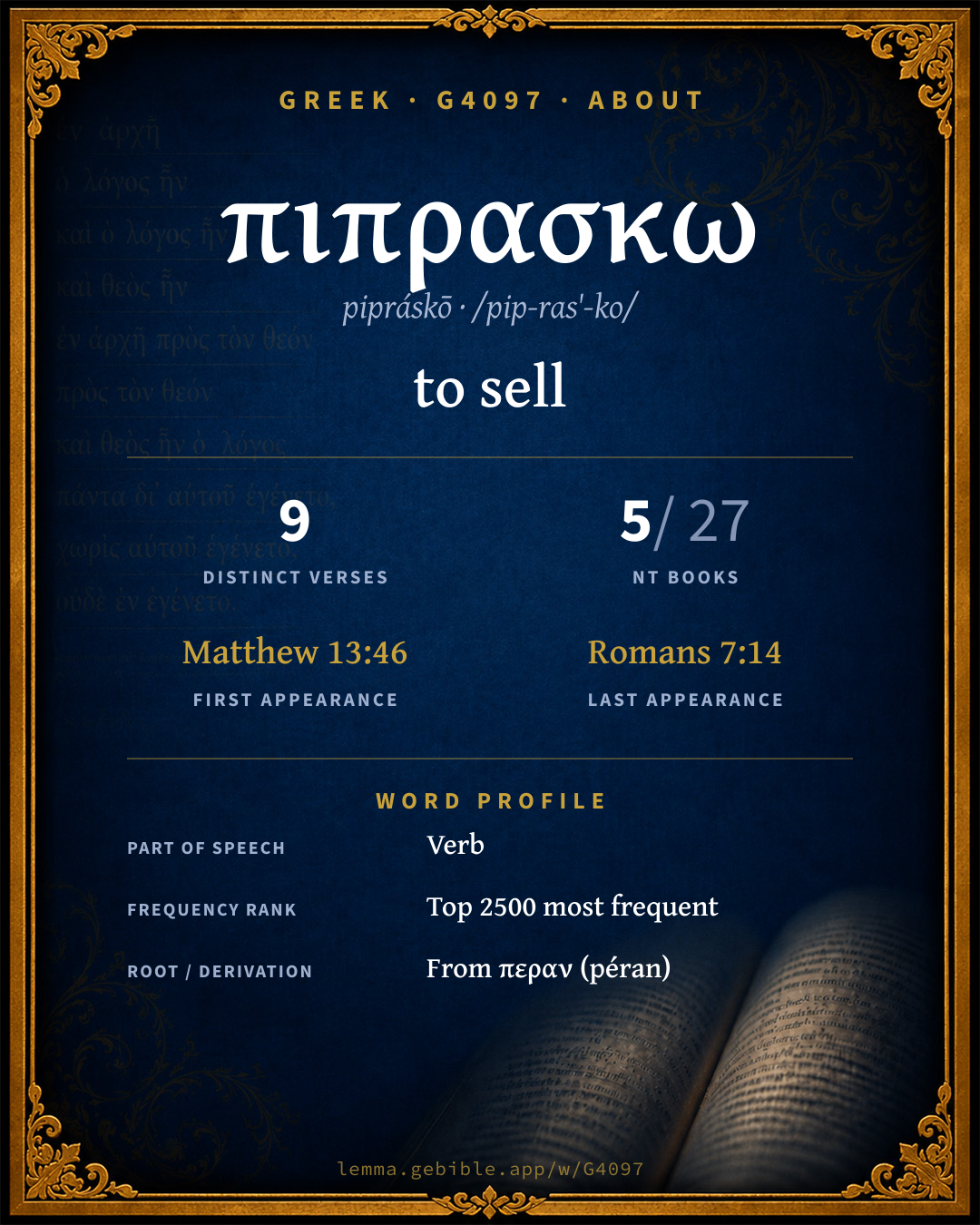
πιπρασκω
to sell
‘to sell’ is one of 3 main senses fuller range ↓
Full lexicon entry — Thayer's Greek Lexicon
From Thayer's Greek Lexicon
Where this word appears
See every Aorist-tense verb in the Greek New Testament →
Grammar key — what these labels mean
Part of speech
- Verb
- An action or state-of-being word.
Tense
- Aorist
- Action viewed as a simple whole, without regard to duration — often past (perfective aspect).
- Imperfect
- Continuous or repeated action in past time (“was writing”).
- Present
- Ongoing or general action in present time (imperfective aspect).
- Perfect
- A completed past action with continuing present results.
Voice
- Passive
- The subject receives the action.
- Active
- The subject performs the action.
Mood
- Infinitive
- A verbal noun (“to write”), unmarked for person or number.
- Indicative
- States a fact or asks a factual question (the mood of reality).
- Participle
- A verbal adjective (“writing,” “having written”).
Case
- Nominative
- The case of the subject (and the predicate nominative).
- Genitive
- The case of source, possession, or “of” — answers “whose / from what.”
Person
- 3rd person
- The one spoken about (“he / she / it / they”).
Gender
- Neuter
- Grammatically neuter.
- Masculine
- Grammatically masculine.
Number
- Singular
- One.
- Plural
- More than one.
Grammatical forms
- Verb, Aorist, Passive, Infinitive 3 times (33%)
- Verb, Aorist, Passive, Indicative, 3rd person, Singular 1 time (11%)
- Verb, Aorist, Passive, Participle, Nominative, Singular, Neuter 1 time (11%)
- Verb, Imperfect, Active, Indicative, 3rd person, Plural 1 time (11%)
- Verb, Present, Passive, Participle, Genitive, Plural, Neuter 1 time (11%)
- Verb, Perfect, Active, Indicative, 3rd person, Singular 1 time (11%)
- Verb, Perfect, Passive, Participle, Nominative, Singular, Masculine 1 time (11%)
Parsed forms decoded from the imported morphology (Robinson–Tischendorf, public domain), counted across 9 parsed occurrences — not distinct verses.
Every verse where G4097 appears — 9 distinct verses across 5 books. Click any verse to open its interlinear word-by-word view. Verse text shown in the World English Bible for context — . Each verse’s Greek form is shown with its reference; the English is not keyword-highlighted, since the data carries no word-level English alignment. Use “Compare translations” on any verse to read it across multiple English versions. This concordance covers the Greek New Testament; Septuagint (Greek Old Testament) occurrences of this word are not indexed here.
Matthew 3 verses
- Matthew 13:46 πέπρακεν perf act ind 3sg who having found one pearl of great price, he went and sold all that he had, and bought it.
- Matthew 18:25 πραθῆναι aor pass inf But because he couldn't pay, his lord commanded him to be sold, with his wife, his children, and all that he had, and payment to be made.
- Matthew 26:9 πραθῆναι aor pass inf For this ointment might have been sold for much, and given to the poor."
Mark 1 verse
John 1 verse
Acts 3 verses
- Acts 2:45 ἐπίπρασκον impf act ind 3pl They sold their possessions and goods, and distributed them to all, according as anyone had need.
- Acts 4:34 πιπρασκομένων pres pass ptcp gen pl neut For neither was there among them any who lacked, for as many as were owners of lands or houses sold them, and brought the proceeds of the things that were sold,
- Acts 5:4 πραθὲν aor pass ptcp nom sg neut While you kept it, didn't it remain your own? After it was sold, wasn't it in your power? How is it that you have conceived this thing in your heart? You haven't lied to men, but to God."
Romans 1 verse
About this entry
At a glance — auto-summarized from this page’s data, not written by a person. Every figure links to its source below. This summary describes the numbers; it doesn’t interpret them.
At its core, πιπρασκω (pipráskō) means “to sell.” First canonically at Matthew 13:46, it enters the text early. With 9 verses in 5 books, it is an uncommon word in the Greek New Testament. Its uses concentrate in Matthew (33% of all occurrences). Catalogued under 3 senses, its meaning is not single-sense. Each statement above links to its evidence; the full detail follows below.
Gloss history
Strong's 1890 vs modern scholarship
About this word
Strong's G4097 catalogs a Greek word from the Greek New Testament.
These counts are not copied from any lexicon or concordance. They are computed here, from the morphology-tagged Greek New Testament. What Lemma adds →
- 9
- distinct verses
- The word appears in 9 distinct verses.
- 5 / 27
- NT books
- The word appears in 5 of 27 New Testament books.
- #1,140
- by frequency
- Top 2500 most frequent Greek words (rank 1,140 of 5,347 Greek words by occurrence).
View all 9 occurrences in the concordance →
By section of the New Testament
By traditional corpus
Conventional, traditional groupings — biblical authorship is debated, so this is a traditional corpus grouping, not an authorship claim. Some books belong to more than one corpus (Luke is in both the Gospels and the Lukan corpus, and so on), so these shares overlap and need not total 100%. Each figure is a share of the word’s 9 distinct verses.
- Gospels 5 verses · 56%
- Lukan (Luke–Acts) 3 verses · 33%
- Johannine 1 verse · 11%
- Pauline corpus 1 verse · 11%
How translations render this word
Counts come from each version’s own published word-to-Strong’s tagging or interlinear alignment — an approximate guide to how each version renders this word, not a word-level alignment the data otherwise carries. Because each total is that version’s own tagged count, the per-version totals vary from one another and need not match the appearance or distinct-verse counts above. These counts may also differ from a printed concordance because Lemma counts each distinctly tagged rendering and does not collapse phrase taggings into a single head-word total. This is a fixed set of word-tagged versions (KJV, ASV, BSB, ULT) and does not change with the reading translation you choose elsewhere. Each version’s license is shown beside its name below (and on Sources).
- King James Version: Sold 4×, Have been sold 2×
- American Standard Version: Sold 3×, Have been sold 2×
- Berean Standard Bible: Have been sold 2×, Sold 2×
- unfoldingWord Literal Text: Be sold 3×, Being sold 2×
King James Version Public Domain
Renders G4097 across 10 tagged occurrences — most commonly:
Plus 4 renderings that appear only once — usually multi-word phrases or single function words the recovered tagging swept in, not distinct renderings.
American Standard Version Public Domain
Renders G4097 across 9 tagged occurrences — most commonly:
Plus 4 renderings that appear only once — usually multi-word phrases or single function words the recovered tagging swept in, not distinct renderings.
Berean Standard Bible Public Domain
Renders G4097 across 9 tagged occurrences — most commonly:
Plus 5 renderings that appear only once — usually multi-word phrases or single function words the recovered tagging swept in, not distinct renderings.
unfoldingWord Literal Text CC BY-SA 4.0
Renders G4097 across 10 tagged occurrences — most commonly:
Plus 5 renderings that appear only once — usually multi-word phrases or single function words the recovered tagging swept in, not distinct renderings.
Senses in Thayer's
The 3 senses Thayer's distinguishes for this word, in lexicon order (not ranked by frequency or importance). The full entry — with sub-senses — is in the Lexicon Entry tab.
- of price, one into slavery
- of the master to whom one is sold as a slave
- metaph.
Word origin
Derived from περαν (péran) (G4008) — beyond.
the first is a reduplicated and prolonged form of the second (which occurs only as an alternate in certain tenses); contracted from περάω peraō (to traverse ; from the base of G4008 ); to traffic (by travelling ) that is dispose of as merchandise or into slavery (literally or figuratively): - sell.
— Strong’s Exhaustive Concordance (1890), public domain.
Forms in the corpus
The 7 distinct written forms G4097 takes in the Greek New Testament, most frequent first — each parse links to that tense’s occurrences in the concordance.
| Form | Parsing | Example | Uses |
|---|---|---|---|
| πραθῆναι prathē̂nai | Verb, Aorist, Passive, Infinitive | Matthew 18:25 | 3 |
| πέπρακεν pépraken | Verb, Perfect, Active, Indicative, 3rd person, Singular | Matthew 13:46 | 1 |
| πεπραμένος pepraménos | Verb, Perfect, Passive, Participle, Nominative, Singular, Masculine | Romans 7:14 | 1 |
| πιπρασκομένων pipraskoménōn | Verb, Present, Passive, Participle, Genitive, Plural, Neuter | Acts 4:34 | 1 |
| πραθὲν prathèn | Verb, Aorist, Passive, Participle, Nominative, Singular, Neuter | Acts 5:4 | 1 |
| ἐπίπρασκον epípraskon | Verb, Imperfect, Active, Indicative, 3rd person, Plural | Acts 2:45 | 1 |
| ἐπράθη epráthē | Verb, Aorist, Passive, Indicative, 3rd person, Singular | John 12:5 | 1 |
Same root — word family
Other Thayer's entries built from the same root as G4097, grouped by Strong’s listed origin. These share a root / origin per the lexicon — not necessarily a shared meaning. Each links to that word’s own entry.
Derives from
Shares the same root
- πειρα peîra G3984 trial
- περ per G4007 very much
- περας péras G4009 end
- περι perí G4012 about
- περπερευομαι perpereúomai G4068 to boast
- φαραγξ pháranx G5327 ravine
Derived from this word
Proper names from this root
People and places named from this root — a name, not an additional meaning of the word.
Compare all same-root words → Showing 4 of 10 — not the complete family. 1 of the same-root words is a proper name (a person or place). They share a root, not necessarily a meaning.
Septuagint usage
The same Greek word πιπρασκω appears 24 times in the Greek Old Testament (Septuagint), across 23 verses in 12 books.
- 24
- LXX occurrences
- Tagged occurrences of this Greek word in the Septuagint.
- 23
- verses
- Distinct Septuagint verses containing this word.
- 12 / 39
- OT books
- The word appears in 12 of the 39 Old Testament books.
Sample Septuagint occurrences
- Genesis 31:15 πιπράσκω
- Exodus 22:2 πιπράσκω
- Leviticus 25:23 πιπράσκω
- Deuteronomy 15:12 πιπράσκω
- 1 Samuel 23:7 πιπράσκω
- 1 Kings 20:20 πιπράσκω
- 2 Kings 17:17 πιπράσκω
- Esther 7:4 πιπράσκω
- Psalms 104:17 πιπράσκω
- Isaiah 48:10 πιπράσκω
- Jeremiah 41:14 πιπράσκω
- Ezekiel 48:14 πιπράσκω
Septuagint occurrences (same lexeme)
Every verse where the same Strong’s number (G4097) appears in the Greek Septuagint. Verse text shown in the World English Bible for context; the Greek form is the matched word — the English is not keyword-highlighted.
- Genesis 31:15 πιπράσκω Aren't we accounted by him as foreigners? For he has sold us, and has also quite devoured our money.
- Exodus 22:2 πιπράσκω If the thief is found breaking in, and is struck so that he dies, there shall be no guilt of bloodshed for him.
- Leviticus 25:23 πιπράσκω "'The land shall not be sold in perpetuity, for the land is mine; for you are strangers and live as foreigners with me.
- Leviticus 25:34 πιπράσκω But the field of the suburbs of their cities may not be sold; for it is their perpetual possession.
- Leviticus 25:39 πιπράσκω "'If your brother has grown poor among you, and sells himself to you; you shall not make him to serve as a slave.
- Leviticus 25:42 πιπράσκω For they are my servants, whom I brought forth out of the land of Egypt. They shall not be sold as slaves.
- Leviticus 25:47 πιπράσκω "'If a stranger or sojourner with you becomes rich, and your brother beside him has grown poor, and sells himself to the stranger or foreigner living among you, or to a member of the stranger's family;
- Leviticus 25:48 πιπράσκω after he is sold he may be redeemed. One of his brothers may redeem him;
- Leviticus 27:27 πιπράσκω If it is an unclean animal, then he shall buy it back according to your valuation, and shall add to it the fifth part of it: or if it isn't redeemed, then it shall be sold according to your valuation.
- Deuteronomy 15:12 πιπράσκω If your brother, a Hebrew man, or a Hebrew woman, be sold to you, and serve you six years; then in the seventh year you shall let him go free from you.
- Deuteronomy 21:14 πιπράσκω It shall be, if you have no delight in her, then you shall let her go where she will; but you shall not sell her at all for money, you shall not deal with her as a slave, because you have humbled her.
- Deuteronomy 28:68 πιπράσκω Yahweh will bring you into Egypt again with ships, by the way of which I said to you, You shall see it no more again: and there you shall sell yourselves to your enemies for bondservants and for bondmaids, and no man shall buy you.
- 1 Samuel 23:7 πιπράσκω It was told Saul that David was come to Keilah. Saul said, God has delivered him into my hand; for he is shut in, by entering into a town that has gates and bars.
- 1 Kings 20:20 πιπράσκω They killed everyone his man; and the Syrians fled, and Israel pursued them: and Ben Hadad the king of Syria escaped on a horse with horsemen.
- 1 Kings 20:25 πιπράσκω and number you an army, like the army that you have lost, horse for horse, and chariot for chariot; and we will fight against them in the plain, and surely we shall be stronger than they. He listened to their voice, and did so.
- 2 Kings 17:17 πιπράσκω They caused their sons and their daughters to pass through the fire, and used divination and enchantments, and sold themselves to do that which was evil in the sight of Yahweh, to provoke him to anger.
- Esther 7:4 πιπράσκω for we are sold, I and my people, to be destroyed, to be slain, and to perish. But if we had been sold for bondservants and bondmaids, I had held my peace, although the adversary could not have compensated for the king's damage.
- Psalms 104:17 πιπράσκω Where the birds make their nests. The stork makes its home in the fir trees.
- Isaiah 48:10 πιπράσκω Behold, I have refined you, but not as silver; I have chosen you in the furnace of affliction.
- Isaiah 50:1 πιπράσκω Thus says Yahweh, Where is the bill of your mother's divorce, with which I have put her away? or which of my creditors is it to whom I have sold you? Behold, for your iniquities were you sold, and for your transgressions was your mother put away.
- Isaiah 52:3 πιπράσκω For thus says Yahweh, You were sold for nothing; and you shall be redeemed without money.
- Jeremiah 41:14 πιπράσκω So all the people who Ishmael had carried away captive from Mizpah turned about and came back, and went to Johanan the son of Kareah.
- Ezekiel 48:14 πιπράσκω They shall sell none of it, nor exchange it, nor shall the first fruits of the land be alienated; for it is holy to Yahweh.
These are occurrences of the same Greek lexeme (G4097) in the Septuagint — not a translation of any one Hebrew word. The store carries no word-level Hebrew↔Greek alignment, so no Hebrew original is asserted here. Counts come from the recovered LXX Strong's tagging — high-frequency vocabulary is well covered, while rare or late forms may be untagged — so they reflect tagged occurrences and may slightly undercount.