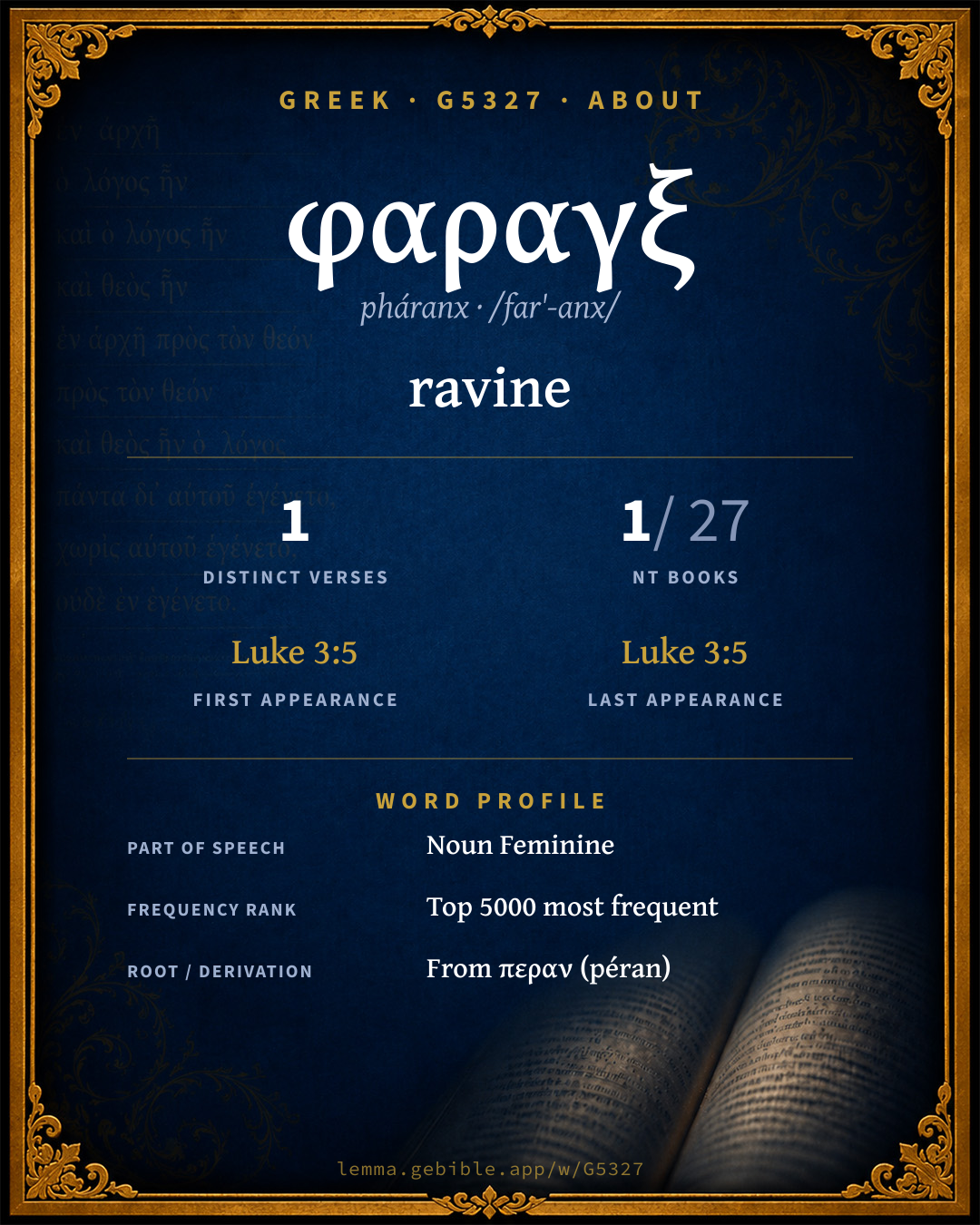
φάραγξ
ravine
‘ravine’ is one of 2 main senses fuller range ↓
Full lexicon entry — Thayer's Greek Lexicon
From Thayer's Greek Lexicon
Where this word appears
Grammar key — what these labels mean
Part of speech
- Noun
- A naming word — a person, place, thing, or idea.
Case
- Nominative
- The case of the subject (and the predicate nominative).
Gender
- Feminine
- Grammatically feminine.
Number
- Singular
- One.
Every verse where G5327 appears — 1 distinct verse across 1 book. Click any verse to open its interlinear word-by-word view. Verse text shown in the World English Bible for context — . Each verse’s Greek form is shown with its reference; the English is not keyword-highlighted, since the data carries no word-level English alignment. Use “Compare translations” on any verse to read it across multiple English versions. This concordance covers the Greek New Testament; Septuagint (Greek Old Testament) occurrences of this word are not indexed here.
Luke 1 verse
About this entry
At a glance — auto-summarized from this page’s data, not written by a person. Every figure links to its source below. This summary describes the numbers; it doesn’t interpret them.
φαραγξ (pháranx) is a Greek noun most often rendered “ravine.” It occurs a mere 1 verse across Scripture. Luke dominates its distribution — 1 of 1 verses. A true hapax — its single appearance is Luke 3:5. Ranging over 2 senses, it is not a single-sense word. For the data behind this summary, explore the sense tree and the renderings breakdown below.
Gloss history
Strong's 1890 vs modern scholarship

About this word
Strong's G5327 catalogs a Greek word from the Greek New Testament.
These counts are not copied from any lexicon or concordance. They are computed here, from the morphology-tagged Greek New Testament. What Lemma adds →
- 1
- distinct verses
- The word appears in 1 distinct verse.
- 1 / 27
- NT books
- The word appears in 1 of 27 New Testament books.
- #3,503
- by frequency
- Top 5000 most frequent Greek words (rank 3,503 of 5,347 Greek words by occurrence).
View all 1 occurrence in the concordance →
Most concentrated in
- Luke 1 verse 100%
By section of the New Testament
By traditional corpus
Conventional, traditional groupings — biblical authorship is debated, so this is a traditional corpus grouping, not an authorship claim. Some books belong to more than one corpus (Luke is in both the Gospels and the Lukan corpus, and so on), so these shares overlap and need not total 100%. Each figure is a share of the word’s 1 distinct verse.
- Gospels 1 verse · 100%
- Lukan (Luke–Acts) 1 verse · 100%
How translations render this word
Counts come from each version’s own published word-to-Strong’s tagging or interlinear alignment — an approximate guide to how each version renders this word, not a word-level alignment the data otherwise carries. Because each total is that version’s own tagged count, the per-version totals vary from one another and need not match the appearance or distinct-verse counts above. These counts may also differ from a printed concordance because Lemma counts each distinctly tagged rendering and does not collapse phrase taggings into a single head-word total. This is a fixed set of word-tagged versions (KJV, ASV, BSB, ULT) and does not change with the reading translation you choose elsewhere. Each version’s license is shown beside its name below (and on Sources).
- King James Version: Valley 1×
- American Standard Version: Valley 1×
- Berean Standard Bible: Valley 1×
- unfoldingWord Literal Text: Valley 1×
King James Version Public Domain
Renders G5327 across 1 tagged occurrence — most commonly:
American Standard Version Public Domain
Renders G5327 across 1 tagged occurrence — most commonly:
Berean Standard Bible Public Domain
Renders G5327 across 1 tagged occurrence — most commonly:
unfoldingWord Literal Text CC BY-SA 4.0
Renders G5327 across 1 tagged occurrence — most commonly:
Senses in Thayer's
The 2 senses Thayer's distinguishes for this word, in lexicon order (not ranked by frequency or importance). The full entry — with sub-senses — is in the Lexicon Entry tab.
- a valley shut off by cliffs and precipices
- a ravine
Word origin
Derived from περαν (péran) (G4008) — beyond.
Same root — word family
Other Thayer's entries built from the same root as G5327, grouped by Strong’s listed origin. These share a root / origin per the lexicon — not necessarily a shared meaning. Each links to that word’s own entry.
Derives from
Shares the same root
- πειρα peîra G3984 trial
- περ per G4007 very much
- περας péras G4009 end
- περι perí G4012 about
- περπερευομαι perpereúomai G4068 to boast
- πιπρασκω pipráskō G4097 to sell
Proper names from this root
People and places named from this root — a name, not an additional meaning of the word.
Compare all same-root words → Showing 4 of 9 — not the complete family. 1 of the same-root words is a proper name (a person or place). They share a root, not necessarily a meaning.
Septuagint usage
The same Greek word φαραγξ appears 77 times in the Greek Old Testament (Septuagint), across 67 verses in 15 books.
- 77
- LXX occurrences
- Tagged occurrences of this Greek word in the Septuagint.
- 67
- verses
- Distinct Septuagint verses containing this word.
- 15 / 39
- OT books
- The word appears in 15 of the 39 Old Testament books.
Sample Septuagint occurrences
- Genesis 14:3 φάραγξ
- Numbers 13:23 φάραγξ
- Deuteronomy 1:24 φάραγξ
- Joshua 7:24 φάραγξ
- 2 Samuel 24:5 φάραγξ
- 2 Kings 23:10 φάραγξ
- 2 Chronicles 14:9 φάραγξ
- Ezra 12:15 φάραγξ
- Psalms 59:2 φάραγξ
- Proverbs 30:17 φάραγξ
- Isaiah 7:19 φάραγξ
- Jeremiah 7:31 φάραγξ
Septuagint occurrences (same lexeme)
Every verse where the same Strong’s number (G5327) appears in the Greek Septuagint — showing the first 50 of 67. Verse text shown in the World English Bible for context; the Greek form is the matched word — the English is not keyword-highlighted.
- Genesis 14:3 φάραγξ All these joined together in the valley of Siddim (the same is the Salt Sea).
- Genesis 26:17 φάραγξ Isaac departed from there, encamped in the valley of Gerar, and lived there.
- Genesis 26:19 φάραγξ Isaac's servants dug in the valley, and found there a well of springing water.
- Numbers 13:23 φάραγξ They came to the valley of Eshcol, and cut down from there a branch with one cluster of grapes, and they bore it on a staff between two; [they brought] also of the pomegranates, and of the figs.
- Numbers 13:24 φάραγξ That place was called the valley of Eshcol, because of the cluster which the children of Israel cut down from there.
- Numbers 21:12 φάραγξ From there they traveled, and encamped in the valley of Zered.
- Numbers 32:9 φάραγξ For when they went up to the valley of Eshcol, and saw the land, they discouraged the heart of the children of Israel, that they should not go into the land which Yahweh had given them.
- Deuteronomy 1:24 φάραγξ and they turned and went up into the hill-country, and came to the valley of Eshcol, and spied it out.
- Deuteronomy 2:13 φάραγξ Now rise up, and get you over the brook Zered. We went over the brook Zered.
- Deuteronomy 2:14 φάραγξ The days in which we came from Kadesh-barnea, until we were come over the brook Zered, were thirty-eight years; until all the generation of the men of war were consumed from the midst of the camp, as Yahweh swore to them.
- Deuteronomy 2:24 φάραγξ Rise up, take your journey, and pass over the valley of the Arnon: behold, I have given into your hand Sihon the Amorite, king of Heshbon, and his land; begin to possess it, and contend with him in battle.
- Deuteronomy 2:36 φάραγξ From Aroer, which is on the edge of the valley of the Arnon, and [from] the city that is in the valley, even to Gilead, there was not a city too high for us; Yahweh our God delivered up all before us:
- Deuteronomy 4:46 φάραγξ beyond the Jordan, in the valley over against Beth Peor, in the land of Sihon king of the Amorites, who lived at Heshbon, whom Moses and the children of Israel struck, when they came forth out of Egypt.
- Deuteronomy 21:4 φάραγξ and the elders of that city shall bring down the heifer to a valley with running water, which is neither plowed nor sown, and shall break the heifer's neck there in the valley.
- Deuteronomy 21:6 φάραγξ All the elders of that city, who are nearest to the slain man, shall wash their hands over the heifer whose neck was broken in the valley;
- Joshua 7:24 φάραγξ Joshua, and all Israel with him, took Achan the son of Zerah, and the silver, and the mantle, and the wedge of gold, and his sons, and his daughters, and his oxen, and his donkeys, and his sheep, and his tent, and all that he had: and they brought them up to the valley of Achor.
- Joshua 10:12 φάραγξ Then spoke Joshua to Yahweh in the day when Yahweh delivered up the Amorites before the children of Israel; and he said in the sight of Israel, Sun, stand you still on Gibeon; You, Moon, in the valley of Aijalon.
- Joshua 12:1 φάραγξ Now these are the kings of the land, whom the children of Israel struck, and possessed their land beyond the Jordan toward the sunrise, from the valley of the Arnon to Mount Hermon, and all the Arabah eastward:
- Joshua 12:2 φάραγξ Sihon king of the Amorites, who lived in Heshbon, and ruled from Aroer, which is on the edge of the valley of the Arnon, and [the city that is in] the middle of the valley, and half Gilead, even to the river Jabbok, the border of the children of Ammon;
- Joshua 13:9 φάραγξ from Aroer, that is on the edge of the valley of the Arnon, and the city that is in the middle of the valley, and all the plain of Medeba to Dibon;
- Joshua 13:16 φάραγξ Their border was from Aroer, that is on the edge of the valley of the Arnon, and the city that is in the middle of the valley, and all the plain by Medeba;
- Joshua 15:4 φάραγξ and it passed along to Azmon, and went out at the brook of Egypt; and the goings out of the border were at the sea: this shall be your south border.
- Joshua 15:7 φάραγξ and the border went up to Debir from the valley of Achor, and so northward, looking toward Gilgal, that is over against the ascent of Adummim, which is on the south side of the river; and the border passed along to the waters of En Shemesh, and the goings out of it were at En Rogel;
- Joshua 15:8 φάραγξ and the border went up by the valley of the son of Hinnom to the side of the Jebusite southward (the same is Jerusalem); and the border went up to the top of the mountain that lies before the valley of Hinnom westward, which is at the uttermost part of the valley of Rephaim northward;
- Joshua 17:9 φάραγξ The border went down to the brook of Kanah, southward of the brook: these cities belonged to Ephraim among the cities of Manasseh: and the border of Manasseh was on the north side of the brook, and the goings out of it were at the sea:
- Joshua 19:11 φάραγξ and their border went up westward, even to Maralah, and reached to Dabbesheth; and it reached to the brook that is before Jokneam;
- 2 Samuel 24:5 φάραγξ They passed over the Jordan, and encamped in Aroer, on the right side of the city that is in the middle of the valley of Gad, and to Jazer:
- 2 Kings 23:10 φάραγξ He defiled Topheth, which is in the valley of the children of Hinnom, that no man might make his son or his daughter to pass through the fire to Molech.
- 2 Chronicles 14:9 φάραγξ There came out against them Zerah the Ethiopian with an army of a million troops, and three hundred chariots; and he came to Mareshah.
- 2 Chronicles 26:9 φάραγξ Moreover Uzziah built towers in Jerusalem at the corner gate, and at the valley gate, and at the turning [of the wall], and fortified them.
- 2 Chronicles 32:6 φάραγξ He set captains of war over the people, and gathered them together to him in the broad place at the gate of the city, and spoke comfortably to them, saying,
- Ezra 12:15 φάραγξ
- Ezra 13:13 φάραγξ
- Psalms 59:2 φάραγξ Deliver me from the workers of iniquity. Save me from the bloodthirsty men.
- Psalms 103:10 φάραγξ He has not dealt with us according to our sins, Nor repaid us for our iniquities.
- Proverbs 30:17 φάραγξ The eye that mocks at his father, And scorns obedience to his mother: The ravens of the valley shall pick it out, The young eagles shall eat it.
- Isaiah 7:19 φάραγξ They shall come, and shall all rest in the desolate valleys, in the clefts of the rocks, on all thorn-hedges, and on all pastures.
- Isaiah 8:7 φάραγξ now therefore, behold, the Lord brings up on them the waters of the River, strong and many, [even] the king of Assyria and all his glory: and it shall come up over all its channels, and go over all its banks;
- Isaiah 10:29 φάραγξ they are gone over the pass; they have taken up their lodging at Geba; Ramah trembles; Gibeah of Saul is fled.
- Isaiah 11:15 φάραγξ Yahweh will utterly destroy the tongue of the Egyptian sea; and with his scorching wind will he wave his hand over the River, and will strike it into seven streams, and cause men to march over in sandals.
- Isaiah 15:7 φάραγξ Therefore the abundance they have gotten, and that which they have laid up, shall they carry away over the brook of the willows.
- Isaiah 17:5 φάραγξ It shall be as when the harvester gathers the standing grain, and his arm reaps the ears; yes, it shall be as when one gleans ears in the valley of Rephaim.
- Isaiah 22:1 φάραγξ The burden of the valley of vision. What ails you now, that you are wholly gone up to the housetops?
- Isaiah 22:5 φάραγξ For it is a day of confusion, and of treading down, and of perplexity, from the Lord, Yahweh of Hosts, in the valley of vision; a breaking down of the walls, and a crying to the mountains.
- Isaiah 22:7 φάραγξ It happened that your choicest valleys were full of chariots, and the horsemen set themselves in array at the gate.
- Isaiah 28:21 φάραγξ For Yahweh will rise up as on Mount Perazim, he will be angry as in the valley of Gibeon; that he may do his work, his strange work, and bring to pass his act, his strange act.
- Isaiah 30:28 φάραγξ and his breath is as an overflowing stream, that reaches even to the neck, to sift the nations with the sieve of destruction: and a bridle that causes to err [shall be] in the jaws of the peoples.
- Isaiah 30:33 φάραγξ For a Topheth is prepared of old; yes, for the king it is made ready; he has made it deep and large; the pile of it is fire and much wood; the breath of Yahweh, like a stream of sulfur, does kindle it.
- Isaiah 34:9 φάραγξ The streams of [Edom] shall be turned into pitch, and the dust of it into sulfur, and the land of it shall become burning pitch.
- Isaiah 35:6 φάραγξ Then shall the lame man leap as a hart, and the tongue of the mute shall sing; for in the wilderness shall waters break out, and streams in the desert.
These are occurrences of the same Greek lexeme (G5327) in the Septuagint — not a translation of any one Hebrew word. The store carries no word-level Hebrew↔Greek alignment, so no Hebrew original is asserted here. Counts come from the recovered LXX Strong's tagging — high-frequency vocabulary is well covered, while rare or late forms may be untagged — so they reflect tagged occurrences and may slightly undercount.