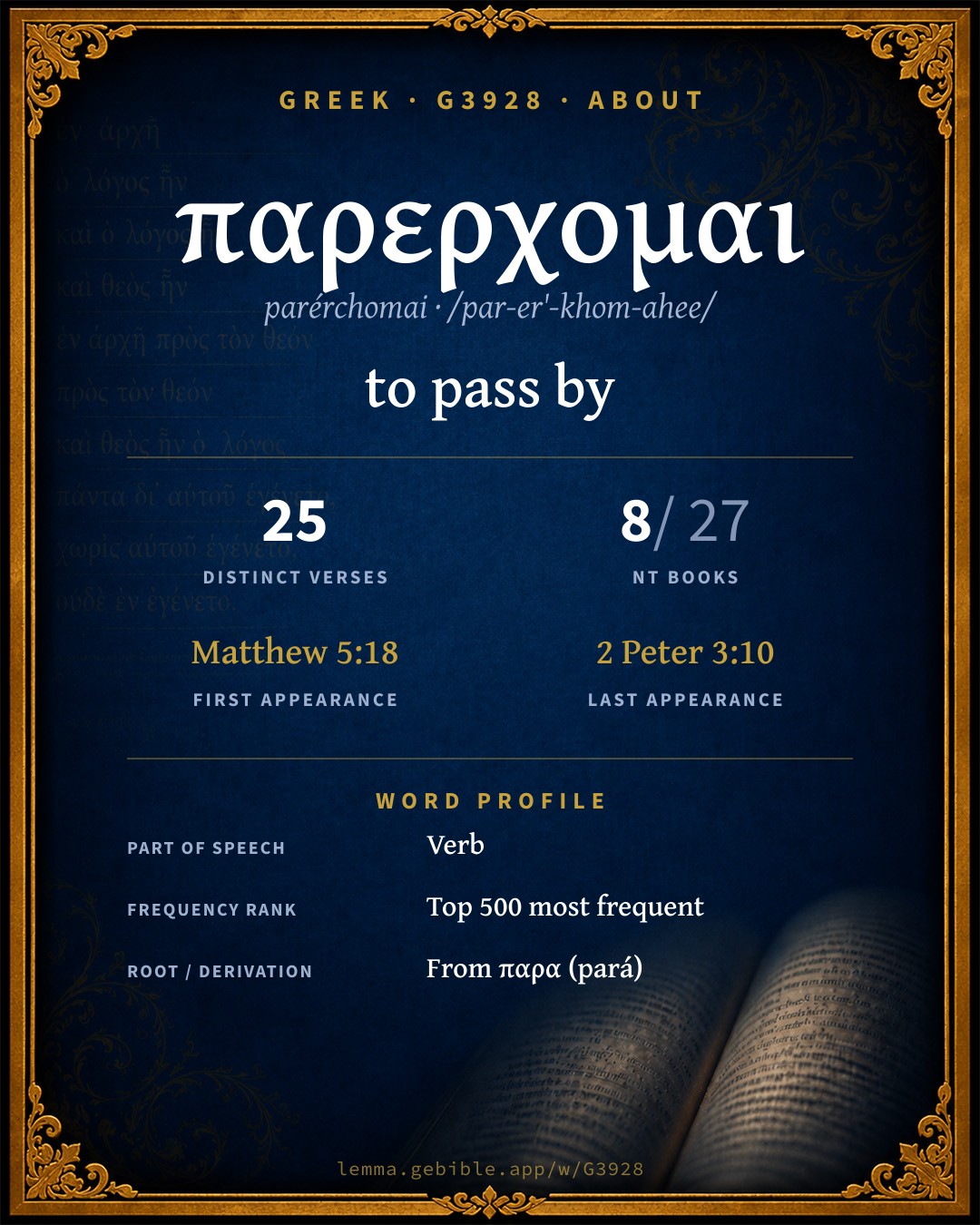
παρέρχομαι
to pass by
‘to pass by’ is one of 4 main senses fuller range ↓
Full lexicon entry — Thayer's Greek Lexicon
From Thayer's Greek Lexicon
Where this word appears
See every Aorist-tense verb in the Greek New Testament →
Grammar key — what these labels mean
Part of speech
- Verb
- An action or state-of-being word.
Tense
- Aorist
- Action viewed as a simple whole, without regard to duration — often past (perfective aspect).
- Future
- Action expected in future time.
- Perfect
- A completed past action with continuing present results.
- Present
- Ongoing or general action in present time (imperfective aspect).
Voice
- Active
- The subject performs the action.
- Middle deponent
- Middle in form but active in meaning.
- Middle or Passive deponent
- Middle/passive in form but active in meaning.
Mood
- Subjunctive
- Expresses probability, purpose, or possibility (the mood of contingency).
- Indicative
- States a fact or asks a factual question (the mood of reality).
- Infinitive
- A verbal noun (“to write”), unmarked for person or number.
- Participle
- A verbal adjective (“writing,” “having written”).
- Imperative
- Expresses a command or request.
Case
- Nominative
- The case of the subject (and the predicate nominative).
Person
- 3rd person
- The one spoken about (“he / she / it / they”).
- 1st person
- The speaker (“I / we”).
- 2nd person
- The one addressed (“you”).
Gender
- Masculine
- Grammatically masculine.
Number
- Singular
- One.
- Plural
- More than one.
Grammatical forms 14 distinct
- Verb, Aorist, Active, Subjunctive, 3rd person, Singular 6 times (21%)
- Verb, Future, Middle deponent, Indicative, 3rd person, Plural 5 times (17%)
- Verb, Aorist, Active, Infinitive 4 times (14%)
- Verb, Aorist, Active, Indicative, 3rd person, Singular 2 times (7%)
- Verb, Aorist, Active, Participle, Nominative, Singular, Masculine 2 times (7%)
- Verb, Future, Middle deponent, Indicative, 3rd person, Singular 2 times (7%)
- Verb, Aorist, Active, Indicative, 1st person, Singular 1 time (3%)
- Verb, Aorist, Active, Imperative, 3rd person, Singular 1 time (3%)
+6 more forms (6 occurrences)
Parsed forms decoded from the imported morphology (Robinson–Tischendorf, public domain), counted across 29 parsed occurrences — not distinct verses.
Every verse where G3928 appears — 25 distinct verses across 8 books. Click any verse to open its interlinear word-by-word view. Verse text shown in the World English Bible for context — . Each verse’s Greek form is shown with its reference; the English is not keyword-highlighted, since the data carries no word-level English alignment. Use “Compare translations” on any verse to read it across multiple English versions. This concordance covers the Greek New Testament; Septuagint (Greek Old Testament) occurrences of this word are not indexed here.
Matthew 7 verses
- Matthew 5:18 παρέλθῃ παρέλθῃ aor act subj 3sg aor act subj 3sg For most assuredly, I tell you, until heaven and earth pass away, not even one smallest letter or one tiny pen stroke shall in any way pass away from the law, until all things are accomplished.
- Matthew 8:28 παρελθεῖν aor act inf When he came to the other side, into the country of the Gergesenes, two people possessed by demons met him there, coming out of the tombs, exceedingly fierce, so that nobody could pass by that way.
- Matthew 14:15 παρῆλθεν aor act ind 3sg When evening had come, his disciples came to him, saying, "This place is deserted, and the hour is already late. Send the multitudes away, that they may go into the villages, and buy themselves food."
- Matthew 24:34 παρέλθῃ aor act subj 3sg Most assuredly I tell you, this generation will not pass away, until all these things are accomplished.
- Matthew 24:35 παρελεύσεται παρέλθωσιν fut mid.dep ind 3sg aor act subj 3pl Heaven and earth will pass away, but my words will not pass away.
- Matthew 26:39 παρελθάτω aor act impv 3sg He went forward a little, fell on his face, and prayed, saying, "My Father, if it is possible, let this cup pass away from me; nevertheless, not what I desire, but what you desire."
- Matthew 26:42 παρελθεῖν aor act inf Again, a second time he went away, and prayed, saying, "My Father, if this cup can't pass away from me unless I drink it, your desire be done."
Mark 4 verses
- Mark 6:48 παρελθεῖν aor act inf Seeing them distressed in rowing, for the wind was contrary to them, about the fourth watch of the night he came to them, walking on the sea, and he would have passed by them,
- Mark 13:30 παρέλθῃ aor act subj 3sg Most assuredly I say to you, this generation will not pass away until all these things happen.
- Mark 13:31 παρελεύσονται παρελεύσονται fut mid.dep ind 3pl fut mid.dep ind 3pl Heaven and earth will pass away, but my words will not pass away.
- Mark 14:35 παρέλθῃ aor act subj 3sg He went forward a little, and fell on the ground, and prayed that, if it were possible, the hour might pass away from him.
Luke 8 verses
- Luke 11:42 παρέρχεσθε pres mid/pass.dep ind 2pl But woe to you Pharisees! For you tithe mint and rue and every herb, but you bypass justice and the love of God. You ought to have done these, and not to have left the other undone.
- Luke 12:37 παρελθὼν aor act ptcp nom sg masc Blessed are those servants, whom the lord will find watching when he comes. Most assuredly I tell you, that he will dress himself, and make them recline, and will come and serve them.
- Luke 15:29 παρῆλθον aor act ind 1sg But he answered his father, 'Behold, these many years I have served you, and I never disobeyed a commandment of yours, but you never gave me a goat, that I might celebrate with my friends.
- Luke 16:17 παρελθεῖν aor act inf But it is easier for heaven and earth to pass away, than for one tiny stroke of a pen in the law to fall.
- Luke 17:7 παρελθὼν aor act ptcp nom sg masc But who is there among you, having a servant plowing or keeping sheep, that will say, when he comes in from the field, 'Come immediately and sit down at the table,'
- Luke 18:37 παρέρχεται pres mid/pass.dep ind 3sg They told him that Jesus of Nazareth was passing by.
- Luke 21:32 παρέλθῃ aor act subj 3sg Most assuredly I tell you, this generation will not pass away until all things are accomplished.
- Luke 21:33 παρελεύσονται παρελεύσονται fut mid.dep ind 3pl fut mid.dep ind 3pl Heaven and earth will pass away, but my words will by no means pass away.
Acts 2 verses
2 Corinthians 1 verse
James 1 verse
1 Peter 1 verse
2 Peter 1 verse
About this entry
At a glance — auto-summarized from this page’s data, not written by a person. Every figure links to its source below. This summary describes the numbers; it doesn’t interpret them.
At its core, παρερχομαι (parérchomai) means “to pass by.” Ranging over 4 senses, it is not a single-sense word. It appears 25 verses across 8 books of the Greek New Testament, among its uncommon vocabulary. The word gravitates to Luke (32%), then Matthew and Mark. Scripture first uses it in Matthew 5:18. Dig into 25-verse concordance and the renderings breakdown below.
Gloss history
Strong's 1890 vs modern scholarship

About this word
Strong's G3928 catalogs a Greek word from the Greek New Testament.
These counts are not copied from any lexicon or concordance. They are computed here, from the morphology-tagged Greek New Testament. What Lemma adds →
- 25
- distinct verses
- The word appears in 25 distinct verses.
- 8 / 27
- NT books
- The word appears in 8 of 27 New Testament books.
- #471
- by frequency
- Top 500 most frequent Greek words (rank 471 of 5,347 Greek words by occurrence).
View all 25 occurrences in the concordance →
By section of the New Testament
By traditional corpus
Conventional, traditional groupings — biblical authorship is debated, so this is a traditional corpus grouping, not an authorship claim. Some books belong to more than one corpus (Luke is in both the Gospels and the Lukan corpus, and so on), so these shares overlap and need not total 100%. Each figure is a share of the word’s 25 distinct verses.
- Gospels 19 verses · 76%
- Lukan (Luke–Acts) 10 verses · 40%
- General (Catholic) Epistles 3 verses · 12%
- Pauline corpus 1 verse · 4%
How translations render this word
Counts come from each version’s own published word-to-Strong’s tagging or interlinear alignment — an approximate guide to how each version renders this word, not a word-level alignment the data otherwise carries. Because each total is that version’s own tagged count, the per-version totals vary from one another and need not match the appearance or distinct-verse counts above. These counts may also differ from a printed concordance because Lemma counts each distinctly tagged rendering and does not collapse phrase taggings into a single head-word total. This is a fixed set of word-tagged versions (KJV, ASV, BSB, ULT) and does not change with the reading translation you choose elsewhere. Each version’s license is shown beside its name below (and on Sources).
- King James Version: Pass 7×, Pass away 5×, Shall 5×
- American Standard Version: Shall 8×, Pass away 7×, Pass 6×
- Berean Standard Bible: Pass away 4×, Pass 3×, Will pass away 3×
- unfoldingWord Literal Text: Pass away 10×, Will 7×, Will pass away 4×
King James Version Public Domain
Renders G3928 across 38 tagged occurrences — most commonly:
Plus 14 renderings that appear only once — usually multi-word phrases or single function words the recovered tagging swept in, not distinct renderings.
American Standard Version Public Domain
Renders G3928 across 39 tagged occurrences — most commonly:
Plus 14 renderings that appear only once — usually multi-word phrases or single function words the recovered tagging swept in, not distinct renderings.
Berean Standard Bible Public Domain
Renders G3928 across 28 tagged occurrences — most commonly:
Plus 12 renderings that appear only once — usually multi-word phrases or single function words the recovered tagging swept in, not distinct renderings. Not rendered by a distinct English word in 1 further occurrence.
unfoldingWord Literal Text CC BY-SA 4.0
Renders G3928 across 41 tagged occurrences — most commonly:
Plus 20 renderings that appear only once — usually multi-word phrases or single function words the recovered tagging swept in, not distinct renderings.
Senses in Thayer's
The 4 senses Thayer's distinguishes for this word, in lexicon order (not ranked by frequency or importance). The full entry — with sub-senses — is in the Lexicon Entry tab.
- of persons moving forward
- of time
- metaph.
- to come near, come forward, arrive
Word origin
Derived from παρα (pará) (G3844) — from.
Forms in the corpus
The 14 distinct written forms G3928 takes in the Greek New Testament, most frequent first — each parse links to that tense’s occurrences in the concordance.
Same root — word family
Other Thayer's entries built from the same root as G3928, grouped by Strong’s listed origin. These share a root / origin per the lexicon — not necessarily a shared meaning. Each links to that word’s own entry.
Derives from
Shares the same root
- παραβαινω parabaínō G3845 to neglect
- παραβαλλω parabállō G3846 to place beside
- παραβιαζομαι parabiázomai G3849 to compel
- παραβουλευομαι parabouleúomai G3851 to consult wrongly
- παραγγελλω parangéllō G3853 to announce
- παραγινομαι paragínomai G3854 to appear
- παραγω parágō G3855 to pass by
- παραδειγματιζω paradeigmatízō G3856 to make example
- παραδεχομαι paradéchomai G3858 to receive
- παραδιατριβη paradiatribḗ G3859 empty business
- παραδιδωμι paradídōmi G3860 to deliver
- παραδοξος parádoxos G3861 strange
- παραζηλοω parazēlóō G3863 to provoke
- παραθαλασσιος parathalássios G3864 by the sea
- παραθεωρεω paratheōréō G3865 to compare
- παραινεω parainéō G3867 to exhort
- παραιτεομαι paraitéomai G3868 to beg pardon
- παρακαθιζω parakathízō G3869 to sit beside
- παρακαλεω parakaléō G3870 to call beside
- παρακαλυπτω parakalýptō G3871 to cover up
- παρακαταθηκη parakatathḗkē G3872 deposit
- παρακειμαι parákeimai G3873 to lie beside
- παρακολουθεω parakolouthéō G3877 to follow after
- παρακουω parakoúō G3878 to disobey
+51 more words share this root (not shown).
Proper names from this root
People and places named from this root — a name, not an additional meaning of the word.
Compare all same-root words → Showing 4 of 78 — not the complete family. 1 of the same-root words is a proper name (a person or place). They share a root, not necessarily a meaning.
Septuagint usage
The same Greek word παρερχομαι appears 126 times in the Greek Old Testament (Septuagint), across 111 verses in 20 books.
- 126
- LXX occurrences
- Tagged occurrences of this Greek word in the Septuagint.
- 111
- verses
- Distinct Septuagint verses containing this word.
- 20 / 39
- OT books
- The word appears in 20 of the 39 Old Testament books.
Sample Septuagint occurrences
- Genesis 18:3 παραἔρχομαι
- Exodus 3:3 παραἔρχομαι
- Numbers 13:32 παραἔρχομαι
- Deuteronomy 2:8 παραἔρχομαι
- Joshua 4:23 παραἔρχομαι
- Judges 3:26 παραἔρχομαι
- 1 Samuel 16:8 παραἔρχομαι
- 2 Samuel 2:15 παραἔρχομαι
- 1 Kings 18:29 παραἔρχομαι
- 2 Kings 3:10 παραἔρχομαι
- 2 Chronicles 8:15 παραἔρχομαι
- Ezra 12:14 παραἔρχομαι
Septuagint occurrences (same lexeme)
Every verse where the same Strong’s number (G3928) appears in the Greek Septuagint — showing the first 50 of 111. Verse text shown in the World English Bible for context; the Greek form is the matched word — the English is not keyword-highlighted.
- Genesis 18:3 παραἔρχομαι and said, "My lord, if now I have found favor in your sight, please don't go away from your servant.
- Genesis 18:5 παραἔρχομαι I will get a morsel of bread so you can refresh your heart. After that you may go your way, now that you have come to your servant." They said, "Very well, do as you have said."
- Genesis 30:32 παραἔρχομαι I will pass through all your flock today, removing from there every speckled and spotted one, and every black one among the sheep, and the spotted and speckled among the goats. This will be my hire.
- Genesis 32:32 παραἔρχομαι Therefore the children of Israel don't eat the sinew of the hip, which is on the hollow of the thigh, to this day, because he touched the hollow of Jacob's thigh in the sinew of the hip.
- Genesis 41:53 παραἔρχομαι The seven years of plenty, that was in the land of Egypt, came to an end.
- Genesis 50:4 παραἔρχομαι When the days of weeping for him were past, Joseph spoke to the house of Pharaoh, saying, "If now I have found favor in your eyes, please speak in the ears of Pharaoh, saying,
- Exodus 3:3 παραἔρχομαι Moses said, I will turn aside now, and see this great sight, why the bush is not burnt.
- Exodus 12:23 παραἔρχομαι For Yahweh will pass through to strike the Egyptians; and when he sees the blood on the lintel, and on the two side-posts, Yahweh will pass over the door, and will not allow the destroyer to come in to your houses to strike you.
- Exodus 15:16 παραἔρχομαι Terror and dread falls on them. By the greatness of your arm they are as still as a stone; Until your people pass over, Yahweh, Until the people pass over who you have purchased.
- Exodus 23:5 παραἔρχομαι If you see the donkey of him who hates you fallen down under his burden, don't leave him, you shall surely help him with it.
- Exodus 33:19 παραἔρχομαι He said, "I will make all my goodness pass before you, and will proclaim the name of Yahweh before you. I will be gracious to whom I will be gracious, and will show mercy on whom I will show mercy."
- Exodus 33:22 παραἔρχομαι It will happen, while my glory passes by, that I will put you in a cleft of the rock, and will cover you with my hand until I have passed by;
- Exodus 34:6 παραἔρχομαι Yahweh passed by before him, and proclaimed, "Yahweh! Yahweh, a merciful and gracious God, slow to anger, and abundant in loving kindness and truth,
- Numbers 13:32 παραἔρχομαι They brought up an evil report of the land which they had spied out to the children of Israel, saying, The land, through which we have gone to spy it out, is a land that eats up the inhabitants of it; and all the people who we saw in it are men of great stature.
- Numbers 20:17 παραἔρχομαι Please let us pass through your land: we will not pass through field or through vineyard, neither will we drink of the water of the wells: we will go along the king's highway; we will not turn aside to the right hand nor to the left, until we have passed your border.
- Numbers 20:19 παραἔρχομαι The children of Israel said to him, We will go up by the highway; and if we drink of your water, I and my cattle, then will I give the price of it: let me only, without [doing] anything [else], pass through on my feet.
- Numbers 20:21 παραἔρχομαι Thus Edom refused to give Israel passage through his border: why Israel turned away from him.
- Numbers 21:22 παραἔρχομαι Let me pass through your land: we will not turn aside into field, or into vineyard; we will not drink of the water of the wells: we will go by the king's highway, until we have passed your border.
- Numbers 21:23 παραἔρχομαι Sihon would not allow Israel to pass through his border: but Sihon gathered all his people together, and went out against Israel into the wilderness, and came to Jahaz; and he fought against Israel.
- Numbers 32:21 παραἔρχομαι and every armed man of you will pass over the Jordan before Yahweh, until he has driven out his enemies from before him,
- Numbers 32:27 παραἔρχομαι but your servants will pass over, every man who is armed for war, before Yahweh to battle, as my lord says.
- Numbers 34:4 παραἔρχομαι and your border shall turn about southward of the ascent of Akrabbim, and pass along to Zin; and the goings out of it shall be southward of Kadesh-barnea; and it shall go forth to Hazar Addar, and pass along to Azmon;
- Deuteronomy 2:8 παραἔρχομαι So we passed by from our brothers the children of Esau, who dwell in Seir, from the way of the Arabah from Elath and from Ezion Geber. We turned and passed by the way of the wilderness of Moab.
- Deuteronomy 2:13 παραἔρχομαι Now rise up, and get you over the brook Zered. We went over the brook Zered.
- Deuteronomy 2:14 παραἔρχομαι The days in which we came from Kadesh-barnea, until we were come over the brook Zered, were thirty-eight years; until all the generation of the men of war were consumed from the midst of the camp, as Yahweh swore to them.
- Deuteronomy 2:24 παραἔρχομαι Rise up, take your journey, and pass over the valley of the Arnon: behold, I have given into your hand Sihon the Amorite, king of Heshbon, and his land; begin to possess it, and contend with him in battle.
- Deuteronomy 2:27 παραἔρχομαι Let me pass through your land: I will go along by the highway, I will turn neither to the right hand nor to the left.
- Deuteronomy 2:28 παραἔρχομαι You shall sell me food for money, that I may eat; and give me water for money, that I may drink: only let me pass through on my feet,
- Deuteronomy 2:29 παραἔρχομαι as the children of Esau who dwell in Seir, and the Moabites who dwell in Ar, did to me; until I shall pass over the Jordan into the land which Yahweh our God gives us.
- Deuteronomy 2:30 παραἔρχομαι But Sihon king of Heshbon would not let us pass by him; for Yahweh your God hardened his spirit, and made his heart obstinate, that he might deliver him into your hand, as at this day.
- Deuteronomy 17:2 παραἔρχομαι If there be found in the midst of you, within any of your gates which Yahweh your God gives you, man or woman, who does that which is evil in the sight of Yahweh your God, in transgressing his covenant,
- Deuteronomy 26:13 παραἔρχομαι You shall say before Yahweh your God, I have put away the holy things out of my house, and also have given them to the Levite, and to the foreigner, to the fatherless, and to the widow, according to all your commandment which you have commanded me: I have not transgressed any of your commandments, neither have I forgotten them:
- Deuteronomy 29:11 παραἔρχομαι your little ones, your wives, and your foreigner who is in the midst of your camps, from the one who cuts your wood to the one who draws your water;
- Deuteronomy 29:15 παραἔρχομαι but with him who stands here with us this day before Yahweh our God, and also with him who is not here with us this day
- Joshua 4:23 παραἔρχομαι For Yahweh your God dried up the waters of the Jordan from before you, until you were passed over, as Yahweh your God did to the Red Sea, which he dried up from before us, until we were passed over;
- Joshua 6:8 παραἔρχομαι It was so, that when Joshua had spoken to the people, the seven priests bearing the seven trumpets of rams' horns before Yahweh passed on, and blew the trumpets: and the ark of the covenant of Yahweh followed them.
- Joshua 15:10 παραἔρχομαι and the border turned about from Baalah westward to Mount Seir, and passed along to the side of Mount Jearim on the north (the same is Chesalon), and went down to Beth-shemesh, and passed along by Timnah;
- Joshua 15:11 παραἔρχομαι and the border went out to the side of Ekron northward; and the border extended to Shikkeron, and passed along to Mount Baalah, and went out at Jabneel; and the goings out of the border were at the sea.
- Joshua 16:2 παραἔρχομαι and it went out from Bethel to Luz, and passed along to the border of the Archites to Ataroth;
- Joshua 16:6 παραἔρχομαι and the border went out westward at Michmethath on the north; and the border turned about eastward to Taanath Shiloh, and passed along it on the east of Janoah;
- Joshua 18:17 παραἔρχομαι and it extended northward, and went out at En Shemesh, and went out to Geliloth, which is over against the ascent of Adummim; and it went down to the stone of Bohan the son of Reuben;
- Joshua 24:17 παραἔρχομαι for Yahweh our God, he it is who brought us and our fathers up out of the land of Egypt, from the house of bondage, and who did those great signs in our sight, and preserved us in all the way in which we went, and among all the peoples through the midst of whom we passed;
- Judges 3:26 παραἔρχομαι Ehud escaped while they waited, and passed beyond the quarries, and escaped to Seirah.
- Judges 9:26 παραἔρχομαι Gaal the son of Ebed came with his brothers, and went over to Shechem; and the men of Shechem put their trust in him.
- Judges 11:17 παραἔρχομαι then Israel sent messengers to the king of Edom, saying, Please let me pass through your land; but the king of Edom didn't listen. In the same way, he sent to the king of Moab; but he would not: and Israel abode in Kadesh.
- Judges 11:19 παραἔρχομαι Israel sent messengers to Sihon king of the Amorites, the king of Heshbon; and Israel said to him, Let us pass, we pray you, through your land to my place.
- Judges 11:20 παραἔρχομαι But Sihon didn't trust Israel to pass through his border; but Sihon gathered all his people together, and encamped in Jahaz, and fought against Israel.
- Judges 11:29 παραἔρχομαι Then the Spirit of Yahweh came on Jephthah, and he passed over Gilead and Manasseh, and passed over Mizpeh of Gilead, and from Mizpeh of Gilead he passed over to the children of Ammon.
- Judges 11:32 παραἔρχομαι So Jephthah passed over to the children of Ammon to fight against them; and Yahweh delivered them into his hand.
- Judges 12:1 παραἔρχομαι The men of Ephraim were gathered together, and passed northward; and they said to Jephthah, Why did you pass over to fight against the children of Ammon, and didn't call us to go with you? we will burn your house on you with fire.
These are occurrences of the same Greek lexeme (G3928) in the Septuagint — not a translation of any one Hebrew word. The store carries no word-level Hebrew↔Greek alignment, so no Hebrew original is asserted here. Counts come from the recovered LXX Strong's tagging — high-frequency vocabulary is well covered, while rare or late forms may be untagged — so they reflect tagged occurrences and may slightly undercount.