Joshua 11:5

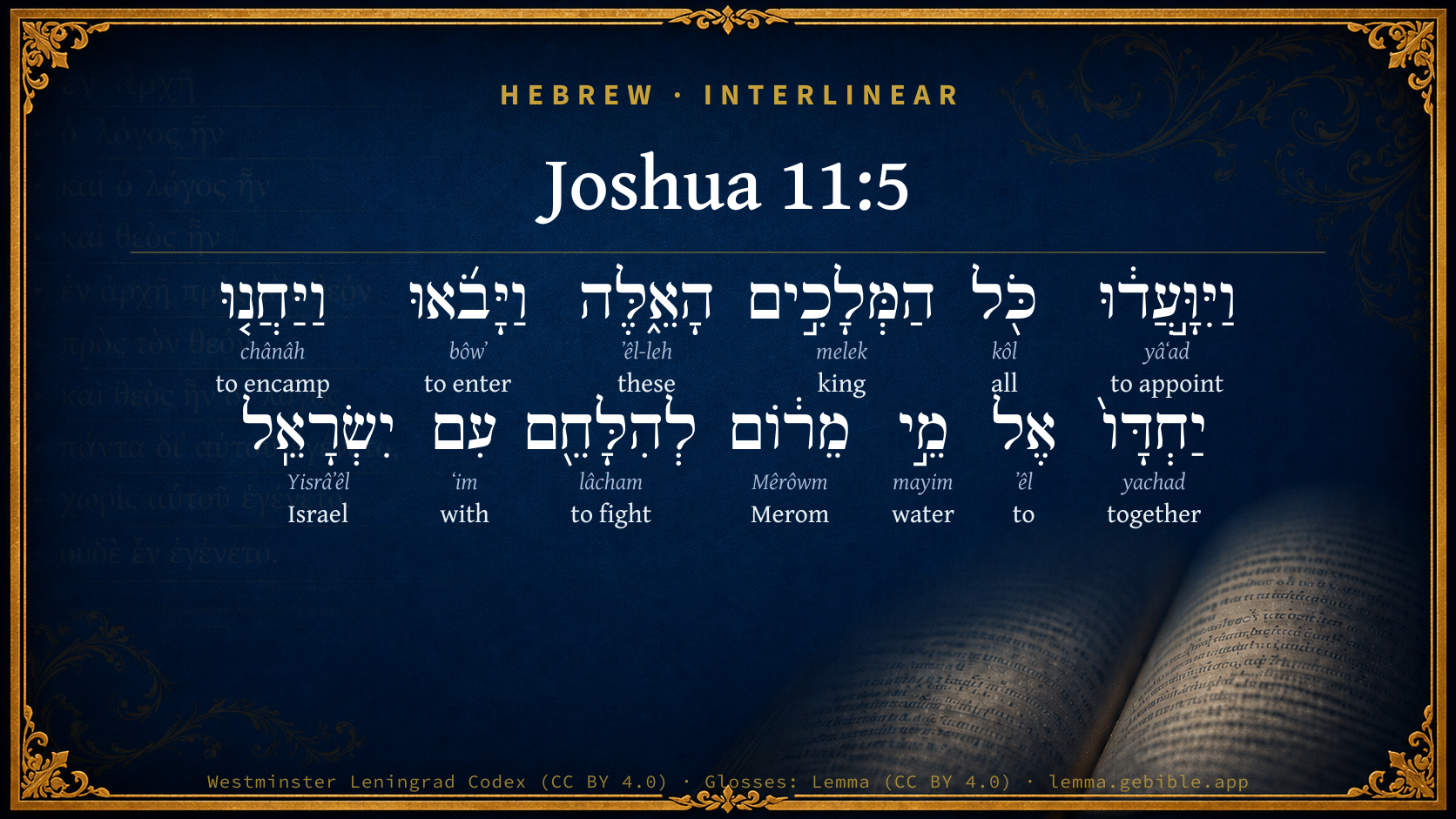
Hebrew (Westminster Leningrad Codex) Joshua 11:5 appears in the Hebrew Old Testament. The text above is from the Westminster Leningrad Codex. Each word links to its Strong’s number, a concise gloss, and parsing drawn from the Open Scriptures Hebrew Bible morphology. Click any word for its full Brown-Driver-Briggs (BDB) entry.
Download image
Cite this verse

Joshua 11:5 (World English Bible). Public Domain. Lemma interlinear Bible study tool, https://lemma.gebible.app/v/joshua/11/5.

Show BibTeX & RIS
BibTeX
RIS
English Translation
All these kings met together; and they came and encamped together at the waters of Merom, to fight with Israel.
World English Bible · Public Domain
Highlights
  • 1 first appearance in the Hebrew Bible
Full analysis ↓
Download a study sheet

One document with this verse’s original text, its word-by-word gloss line, the meaning frame, cross-references with their text, attributed commentary, and full source and license credits — printable, and it pastes into notes with its structure intact.

This verse Autodidact and up

Study sheet (.html) Plain text (.txt)

A passage Seminary Student

Up to 50 verses in one chapter. A passage sheet keeps up to 6 commentary sources and 12 cross-references per verse, in the order this page ranks them, and says so on the sheet whenever that leaves anything out. Ask for a single verse and you get the Autodidact verse sheet above.

Everything on this page stays free to read, with no account — the sheet is a download of what is already on screen, not access to it.

Want to remove ads? Support Godless Engineer
Compare translations 3

The same verse in 3 English versions, stacked beneath the original-language interlinear above. Click any original word for its lexicon entry.

Each is an independent rendering of the whole verse — the interlinear is not word-aligned to these translations.

Highlighted words mark where these versions differ — a whole-verse word diff, not a word-by-word alignment.

  • World English Bible Public Domain
    All these kings met together; and they came and encamped together at the waters of Merom, to fight with Israel.
  • King James Version Public Domain
    And when all these kings were met together, they came and pitched together at the waters of Merom, to fight against Israel.
  • unfoldingWord Literal Text CC BY-SA 4.0
    And all of these kings met together and came and camped together at the waters of Merom to fight with Israel.

unfoldingWord Literal Text — © unfoldingWord, licensed CC BY-SA 4.0. Word-aligned USFM3 via Door43 (git.door43.org/unfoldingWord/en_ult).

Versions to compare (up to 4)

3 of 4 selected

Show all 18 translations

Every available English version of this verse, each an independent rendering of the whole verse.

  • World English Bible Public Domain
    All these kings met together; and they came and encamped together at the waters of Merom, to fight with Israel.
  • Berean Standard Bible Public Domain
    All these kings joined forces and encamped at the waters of Merom to fight against Israel.
  • Majority Standard Bible Public Domain
    All these kings joined forces and encamped at the waters of Merom to fight against Israel.
  • King James Version Public Domain
    And when all these kings were met together, they came and pitched together at the waters of Merom, to fight against Israel.
  • American Standard Version (1901) Public Domain
    And all these kings met together; and they came and encamped together at the waters of Merom, to fight with Israel.
  • Revised Version (1885) Public Domain
    And all these kings met together; and they came and pitched together at the waters of Merom, to fight with Israel.
  • Geneva Bible (1599) Public Domain
    So all these Kings met together, and came and pitched together at the waters of Merom, for to fight against Israel.
  • Douay-Rheims (1899) Public Domain
    And all these kings assembled together at the waters of Merom, to fight against Israel.
  • Young's Literal Translation Public Domain
    and all these kings are met together, and they come and encamp together at the waters of Merom, to fight with Israel.
  • Literal Standard Version CC BY-SA 4.0
    and all these kings are met together, and they come and encamp together at the waters of Merom, to fight with Israel.
  • Unlocked Literal Bible CC BY-SA 4.0
    All these kings met at the appointed time, and they camped at the waters of Merom to wage war with Israel.
  • unfoldingWord Literal Text CC BY-SA 4.0
    And all of these kings met together and came and camped together at the waters of Merom to fight with Israel.
  • Darby Bible Public Domain
    And all these kings met together, and came and encamped together at the waters of Merom, to fight against Israel.
  • World Messianic Bible Public Domain
    All these kings met together; and they came and encamped together at the waters of Merom, to fight with Israel.
  • Webster's Bible Public Domain
    And when all these kings were met together, they came and encamped together at the waters of Merom, to fight against Israel.
  • Free Bible Version CC BY-SA 4.0
    All these kings joined forces and set up camp beside the waters of Merom to fight against Israel.
  • Bible in Basic English Public Domain
    And all these kings came together, and put their forces in position at the waters of Merom, to make war on Israel.
  • JPS Tanakh (1917) Public Domain
    And all these kings met together, and they came and pitched together at the waters of Merom, to fight with Israel.

Literal Standard Version (2020), Covenant Press — licensed CC BY-SA 4.0. Text via the HelloAO Bible API (eBible.org). Unlocked Literal Bible (unfoldingWord) — licensed CC BY-SA 4.0. Text via the HelloAO Bible API (eBible.org). unfoldingWord Literal Text — © unfoldingWord, licensed CC BY-SA 4.0. Word-aligned USFM3 via Door43 (git.door43.org/unfoldingWord/en_ult). Free Bible Version, Dr. Jonathan Gallagher — licensed CC BY-SA 4.0. Text via the HelloAO Bible API (eBible.org).

Word by word

More ways to search: Search by grammar → Find every occurrence → Compare this word →

Practice this passage: Drill this verse → Learn its vocabulary →

מֵר֔וֹם
Mêrôwm
H4792
“Merom”
Noun, Proper
Part of Speech
Noun
Type
Proper
Full BDB Definition

Origin: formed like H4791

TWOT: None

Merom = "high place" - the lake in northern Canaan at which Joshua routed the northern confederacy headed by Jabin - site uncertain; probably the lake formed by the Jordan river about 10 miles (16 kilometers) north of the Sea of Galilee
  1. וַיִּוָּ֣עֲד֔וּ yâʻad H3259 “and · to appoint” Conjunction + Verb, Niphal, Sequential Imperfect, 3rd Person, Masculine, Plural
  2. כֹּ֖ל kôl H3605 “all of” Noun, Common, Masculine, Singular, Construct
  3. הַמְּלָכִ֣ים melek H4428 “the · kings” Particle, Definite Article + Noun, Common, Masculine, Plural, Absolute
  4. הָאֵ֑לֶּה ʼêl-leh H428 “the · these” Particle, Definite Article + Pronoun, Demonstrative, Common, Plural
  5. וַיָּבֹ֜אוּ bôwʼ H935 “and · to enter” Conjunction + Verb, Qal, Sequential Imperfect, 3rd Person, Masculine, Plural
  6. וַיַּחֲנ֤וּ chânâh H2583 “and · to encamp” Conjunction + Verb, Qal, Sequential Imperfect, 3rd Person, Masculine, Plural
  7. יַחְדָּו֙ yachad H3162 “together” Adverb
  8. אֶל ʼêl H413 “to” Preposition
  9. מֵ֣י mayim H4325 “water(s) of” Noun, Common, Masculine, Plural, Construct
  10. לְהִלָּחֵ֖ם lâcham H3898 “to fight” Preposition + Verb, Niphal, Infinitive Construct
  11. עִם ʻim H5973 “with” Preposition
  12. יִשְׂרָאֵֽל Yisrâʼêl H3478 “Israel” Noun, Proper

About this verse

These counts appear in no published source. They are computed here, from the morphology-tagged text and Lemma’s own curated glosses. What Lemma adds →

13
words
13
distinct lemmas
Historical
section

Notable vocabulary

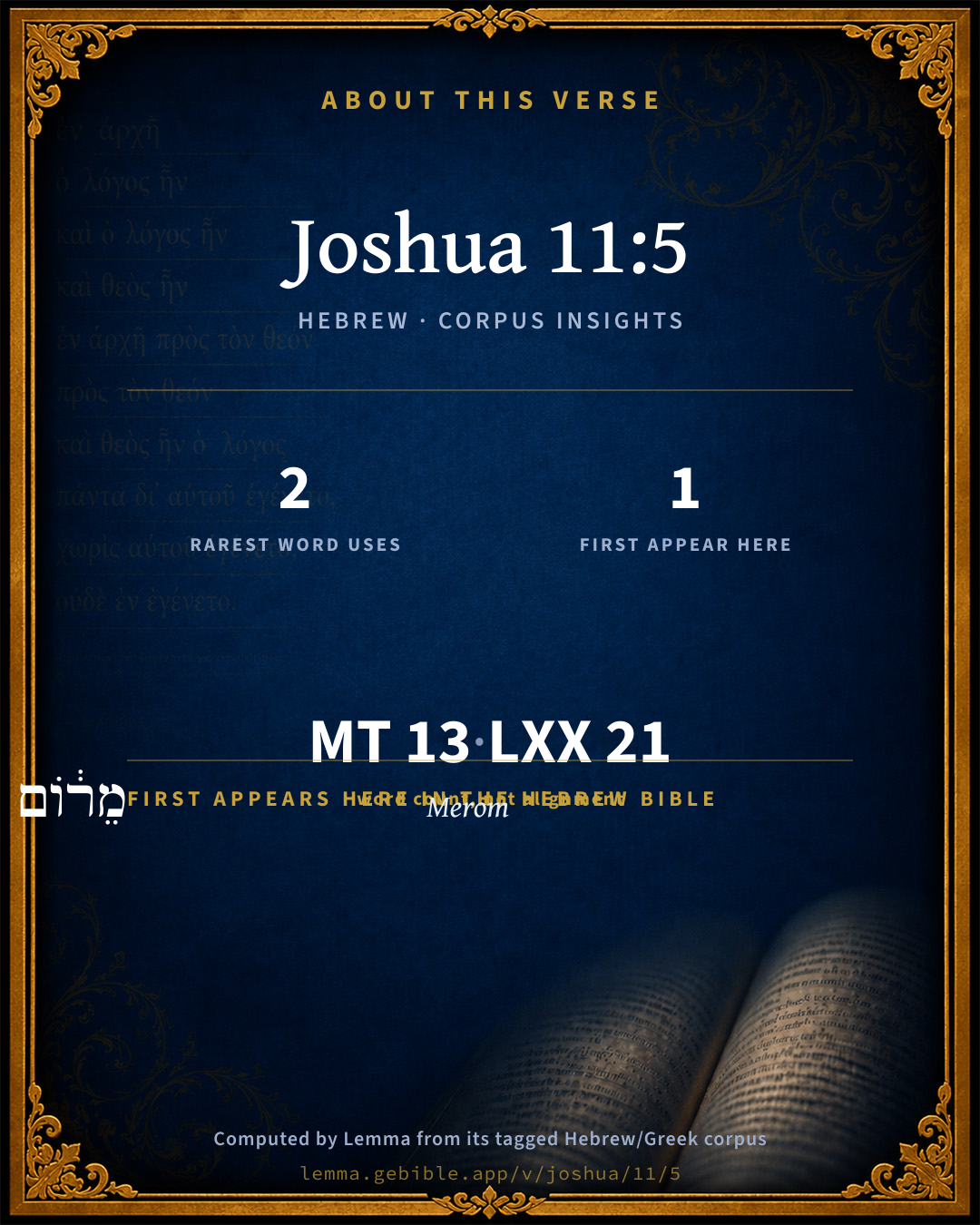
The rarest word here is מֵר֔וֹם Merom H4792 — appearing just 2 times in the whole Hebrew Bible.

First appearance in Scripture

This word makes its first canonical appearance in the Hebrew Bible here:

  • מֵר֔וֹם Merom H4792

Shared distinctive vocabulary

מֵר֔וֹם Merom H4792 occurs in 2 verses of the Hebrew Bible. Also found in:

Grammatical profile

  • 4 verbs
  • 5 nouns
  • 1 pronoun
  • 2 prepositions
  • 1 adverb

Verb forms

  • וַיִּוָּ֣עֲד֔וּ Niphal · Sequential Imperfect
  • וַיָּבֹ֜אוּ Qal · Sequential Imperfect
  • וַיַּחֲנ֤וּ Qal · Sequential Imperfect
  • לְהִלָּחֵ֖ם Niphal · Infinitive Construct

Hebrew & Septuagint length

In English translation the verse runs 20 words from the Hebrew and 24 from the Septuagint (LXX English) — closely comparable.

A rough comparison of the two English renderings, which tokenize alike — not a word-level alignment.

Word counts can differ between the Hebrew and the Greek without any difference in meaning — e.g. the Hebrew direct-object marker אֵת has no separate Greek word, and Greek often adds the article ὁ.

In the original languages it is 13 Hebrew tokens and 21 Greek tokens — but the two are counted differently (Hebrew bundles its prefixes and suffixes into one token; the Greek is in lemma form), so that isn’t a like-for-like length.

Cross-references

4

Topical passages linked to Joshua 11:5 in the Treasury of Scripture Knowledge — connected by theme and wording, ordered by reader-vote popularity; previews shown in the World English Bible.

  • Psalms 3:1 Yahweh, how my adversaries have increased! Many are those who rise up against me.
  • Psalms 118:10–12 All the nations surrounded me, But in the name of Yahweh, I cut them off.
  • Isaiah 8:9 Make an uproar, O you peoples, and be broken in pieces! And give ear, all you of far countries: gird yourselves, and be broken in pieces! Gird yourselves, and be broken in pieces!
  • Revelation 16:14 for they are spirits of demons, performing signs; which go forth to the kings of the whole inhabited earth, to gather them together for the war of that great day of God, the Almighty.

Cross-references courtesy of OpenBible.info (CC BY 4.0).

Hebrew and Greek witnesses Masoretic Hebrew ↔ Greek Septuagint

The same verse in the two great witnesses to the Old Testament, shown verse-for-verse.

These are two independent witnesses, not word-aligned to each other, and the Septuagint is shown in lemma (dictionary) form.

Hebrew Joshua 11:5 Masoretic · Westminster Leningrad Codex

וַיִּוָּ֣עֲד֔וּ כֹּ֖ל הַמְּלָכִ֣ים הָאֵ֑לֶּה וַיָּבֹ֜אוּ וַיַּחֲנ֤וּ יַחְדָּו֙ אֶל מֵ֣י מֵר֔וֹם לְהִלָּחֵ֖ם עִם יִשְׂרָאֵֽל

All these kings met together; and they came and encamped together at the waters of Merom, to fight with Israel.

World English Bible · Public Domain

Greek LXX Joshua 11:5 Septuagint · lemma form

καί συνἔρχομαι πᾶς ὁ βασιλεύς οὗτος καί παραγίγνομαι ἐπί ὁ αὐτός καί παρα ἐνβάλλω ἐπί ὁ ὕδωρ μαρρων πολεμέω ὁ ἰσραήλ

And all the kings assembled in person, and came to the same place, and encamped at the waters of Maron to war with Israel.

LXX2012 (modern English Septuagint) · Public Domain

Hebrew: Westminster Leningrad Codex (CC BY 4.0). Greek: Septuagint (public domain); English from LXX2012 (modern English Septuagint) (Public Domain). How the Septuagint differs from the Hebrew →

Targum (Aramaic paraphrase)

1

The Targum is the ancient Jewish Aramaic paraphrase of the Hebrew Scriptures — an interpretive translation, not the Hebrew text itself. Onkelos (literal) and Pseudo-Jonathan (expansive) render the Torah, and Jonathan the Prophets. Coverage is partial: where no permissively-licensed English translation exists for a verse, only the Aramaic is shown. This is verse-level text, not a word-by-word alignment to the Hebrew.

  1. Targum Jonathan Prophets (Joshua–Malachi)
    וְאִזְדַמְנוּ כֹּל מַלְכַיָא הָאִילֵין וַאֲתוֹ וּשְׁרוֹ כַחְדָא עַל מֵי מֵרוֹם לְאַגָחָא קְרָבָא עִם יִשְׂרָאֵל:

    (no public-domain English translation for this verse)

    Targum Jonathan — Aramaic: “Mikraot Gedolot” (public domain). English: “Sefaria Community Translation” (CC0 1.0 (public-domain dedication)); “London "Chaldee Paraphrase," 1871” (public domain). Text via Sefaria.

Commentary

Notes on Joshua 11:5 from classic Christian and Jewish commentators (each source and its license shown beneath its notes). The classic Christian expositions comment on the surrounding passage and are grouped to its opening verse, so a note may address several verses; the Jewish commentaries on the Tanakh (Rashi and others) are per-verse, so they appear only where the commentator wrote on this verse.

Lemma curates 59 commentaries, every one of them public domain or Creative Commons licensed, each selected and text-cleaned for this edition rather than reprinted as found. About our sources →

Trapp's Complete Commentary

John Trapp

Jos 11:5 And when all these kings were met together, they came and pitched together at the waters of Merom, to fight against Israel.

Ver. 5. And when all these kings were met together.] Heb., Assembled by appointment, at a set time. Ducunt volentes fata, nolentes trahunt. See Psa 37:12-13.

John Trapp, A Commentary or Exposition upon All the Books of the Old and New Testament (1647–1656) — public domain. Text from a community e-Sword module.

Joseph Benson's Commentary

Jos 11:5. These kings — pitched at the waters of Merom — A lake made by the river Jordan in the northern part of it, which was in the territory of the king of Shimron, near Hazor, Jabin’s royal city, and almost in the middle of these confederate kings.

Joseph Benson's Commentary on the Old and New Testaments (1811–1818) — public domain. Text from a community e-Sword module.

Tyndale Open Study Notes

Tyndale Open Resources

11:5 The location of Merom is unclear. The most likely site was in Upper Galilee a few miles west of Hazor.

Tyndale Open Study Notes — © Tyndale Open Resources, licensed CC BY-SA 4.0. Text via the HelloAO Bible API.

Adam Clarke's Commentary

Verse 5. The waters of Merom] Where these waters were, interpreters are not agreed. Whether they were the waters of the Lake Semechon, or the waters of Megiddo, mentioned Jdg 5:19, cannot be easily determined. The latter is the more probable opinion.

Adam Clarke's Commentary on the Bible (1810–1826) — public domain. Text from a community e-Sword/MySword module.

Ellicott's Commentary for English Readers

(5) The waters of Merom.—The most northerly of the three lakes on the course of the Jordan.

A Bible Commentary for English Readers, edited by Charles John Ellicott (1878–1897) — public domain. Text from a community e-Sword module.

The Cambridge Bible for Schools and Colleges

gen. ed. J. J. S. Perowne

5. at the waters of Merom] i.e. “the Upper Waters;” the uppermost of the three lakes in the Jordan valley, called by the Greeks “Semechonitis,” or Samochonitis (Jos. Ant. 5:5. 1), and by the Arabs “Hûleh.” The lake is formed by the expansion of the descending Jordan, about 7 miles long by 5 in breadth, of a triangular shape, the point being at the south, where the Jordan, which enters it on the north, again quits it. It is surrounded by marshes and numberless streams bordered with thickets of papyrus. For the fullest and most graphic description of this lake, and the surrounding morasses, see Macgregor’s Rob Roy on the Jordan, xii.—xvii.

The Cambridge Bible for Schools and Colleges (gen. ed. J. J. S. Perowne; Cambridge University Press, 1878–1918) — public domain. Text from a community e-Sword module.

John Gill's Exposition

And when all those kings were met together,.... At some certain place, which Jabin had appointed:

they came and pitched together at the waters of Merom: Josephus (a) says it was at Berotha; perhaps it should be Merotha, a city of upper Galilee, not far from Cedesa, the same he elsewhere calls (b) Meroth, These waters are the same with the lake Samachonitis, on which Hazor was situated; so that it was near Jabin where the rendezvous was. This lake is thought (c) to have its name from the Arabic word "Samacha", which signifies high, as Merom does in Hebrew. It was, as Josephus says (d) thirty furlongs broad, and sixty long, and its waters clayish. Jerom says (e), in his time there was here a village called Merrus, twelve miles from the city Sebaste by Dothaim: here the kings and their armies met

to fight against Israel; so that they were the aggressors, which made the war still more lawful.

(a) Ibid. (Antiq. l. 5. c. 1. sect. 8.) (b) De Bello Jud. l. 2. c. 20. sect. 6. (c) Reland. Palestin. Illustrat. tom. 1. p. 262. (d) De Bello Jud. l. 4. c. 1. sect. 1. & l. 3. c. 9. sect. 7. (e) De loc. Heb. fol. 93. D.

John Gill's Exposition of the Whole Bible (1746–1763) — public domain (CC PDM 1.0). Text via the HelloAO Bible API.

Albert Barnes' Notes on the Bible

Waters of Merom - i. e. “the upper waters,” the modern Bahr el Huleh, the lake Semechonitis, or Samochonitis of Josephus. This lake occupies the southern half of the Ard el Huleh, a depressed basin some 15 miles long and 3 or 4 miles wide lying between the hills of Galilee on the west and the lower spurs of Hermon on the east. The size of the lake varies with the season, and the northern side of it ends in a large swamp. The shape of the lake is triangular, the point being at the south, where the Jordan, which enters it on the north, again quits it. There is a considerable space of tableland along the southwestern shore, and here probably the troops of Jabin and his confederates were encamped, preparing to move southward when Joshua and his army fell suddenly upon them.

Albert Barnes' Notes on the Bible (1834–1885) — public domain. Text from a community e-Sword/MySword module.

Haydock's Catholic Bible Commentary

Merom, or the lake of Semechon, according to most interpreters; though it is more probable, that the confederates would advance to meet Josue near the lake of Cisson, to the important pass 12 miles north of Samaria, in the canton of Meron, or Merone, Judges iv. 10., and v. 18. This place was famous for the victory of Barac, and for the defeat of king Josias.

George Leo Haydock (1774–1849), Haydock's Catholic Family Bible and Commentary, 1859 edition — public domain. Excludes Psalms (Douay-Rheims chapter numbering differs from Protestant) and Deuterocanonical books (Catholic canon only).

Matthew Poole's English Annotations

The waters of Merom; a lake made by the river Jordan in the northern part of it, which was in the territory of the king of Shimron, or Shimron-meron, and near Hazor, Jabin’s royal city, and almost in the middle of these confederate kings.

Matthew Poole's English Annotations on the Holy Bible (1683–1685) — public domain. Text from a community e-Sword/MySword module.

Whedon's Commentary on the Bible

Daniel D. Whedon

5. Waters of Merom — This first lake through which the Jordan flows was the Samochonitis of Josephus. Its modern name is Huleh. Its name Merom occurs nowhere else in the Bible. It is of a triangular shape, and measures about six miles in each direction. It is surrounded by a marshy basin, which is sufficiently elevated on the southwestern margin to afford an encampment and battle-field. It was the use of “horses and chariots very many” which probably fixed the scene of the encampment on the uplands near by the plain of the lake, along whose level shores they could have full play for their force. See Jos_11:7, note.

Daniel D. Whedon (gen. ed.), Commentary on the Old and New Testaments (1874–1909) — public domain. Text from a community e-Sword module.

The Pulpit Commentary

The waters of Merom. Robinson and the later travellers generally identify this with the Samochonitis (Joseph, Ant. 5:1; Bell. Jud_1:3:9:7 4:1:1), now Huleh. Keil and Delitzseh deny this, but it may be regarded as established, on the authority of Ritter, Vandevelde, Tristram, in short of all who have visited Palestine during the last thirty years. But its name, "the waters of height," would seem to answer to this, the highest of the inland lakes of Palestine. The Jordan runs through it, and it is also the reservoir for numerous other streams. "In the centre of this plain, half morass, half tarn, lies the uppermost lake of the Jordan the little lake Phiala excepted seven miles long, and at its greatest width six miles broad, the mountains slightly compressing it at either extremity, surrounded by an almost impenetrable jungle of reeds, abounding in wild fowl, the sloping hills near it scoured by herds of gazelles" (Stanley, "Sinai and Palestine," p. 382).

The Pulpit Commentary (1880–1919), ed. H.D.M. Spence-Jones & Joseph S. Exell — public domain. Text from a community e-Sword module.

John Wesley's Explanatory Notes

Merom - A lake made by the river Jordan in the northern part of it, which was in the territory of the King of Schimron, near Hazor, Jabin's royal city, and almost in the middle of these confederate kings.

John Wesley, Explanatory Notes Upon the Whole Bible (1754–1765) — public domain. Text via the GEBible commentary corpus.

Lesson kit

Teaching starters — assembled from the data on this page, not authored interpretation. Every prompt links to the verse data it draws on. Edit before teaching.

Joshua, in the Historical, opens this verse with 13 words (13 distinct Hebrew lemmas). Its most distinctive word is Mêrôwm (“Merom”). A historical commentator’s framing appears above. Read the whole chapter for the surrounding context.

Discussion questions

  1. How does “Merom” (Mêrôwm) shape what this verse is saying?
  2. This is the first place “Merom” appears in Scripture (first appears here). What does its debut here establish?
  3. How does Joshua 11:7, which shares the word «Merom», read alongside this verse?
  4. The translations on this page render this verse differently — a whole-verse word diff, not a word-by-word alignment. What might account for the different wordings?
  5. «וַיִּוָּ֣עֲד֔וּ» is a Niphal Sequential Imperfect verb. How does that grammatical form shape the action described?
  6. Compare how Trapp's Complete Commentary and Joseph Benson's Commentary read this verse. Where do they agree or differ?

Things to notice

Reading settings

Reading text

Shown beneath each verse's original-language words.

Old Testament
Old Testament edition

Read the OT as the Masoretic Hebrew (MT) or the Greek Septuagint (LXX).

English shown for the Greek Septuagint (in the Hebrew ↔ Greek comparison).

Comparing translations? Open the Compare panel on any verse page to stack up to four side by side.