1 John 1:10

Greek (Tischendorf 8th ed.) 1 John 1:10 appears in the Greek New Testament. The text above is from the Tischendorf 8th edition. Each word links to its Strong’s number and a concise gloss. Click any word for its full Thayer’s Greek Lexicon entry.
Download image
Cite this verse

1 John 1:10 (World English Bible). Public Domain. Lemma interlinear Bible study tool, https://lemma.gebible.app/v/1-john/1/10.

Show BibTeX & RIS
BibTeX
RIS
English Translation
If we say that we haven't sinned, we make him a liar, and his word is not in us.
World English Bible · Public Domain
Download a study sheet

One document with this verse’s original text, its word-by-word gloss line, the meaning frame, cross-references with their text, attributed commentary, and full source and license credits — printable, and it pastes into notes with its structure intact.

This verse Autodidact and up

Study sheet (.html) Plain text (.txt)

A passage Seminary Student

Up to 50 verses in one chapter. A passage sheet keeps up to 6 commentary sources and 12 cross-references per verse, in the order this page ranks them, and says so on the sheet whenever that leaves anything out. Ask for a single verse and you get the Autodidact verse sheet above.

Everything on this page stays free to read, with no account — the sheet is a download of what is already on screen, not access to it.

Want to remove ads? Support Godless Engineer
Compare translations 3

The same verse in 3 English versions, stacked beneath the original-language interlinear above. Click any original word for its lexicon entry.

Each is an independent rendering of the whole verse — the interlinear is not word-aligned to these translations.

Highlighted words mark where these versions differ — a whole-verse word diff, not a word-by-word alignment.

  • World English Bible Public Domain
    If we say that we haven't sinned, we make him a liar, and his word is not in us.
  • King James Version Public Domain
    If we say that we have not sinned, we make him a liar, and his word is not in us.
  • unfoldingWord Literal Text CC BY-SA 4.0
    If we say that we have not sinned, we make him a liar, and his word is not in us.

unfoldingWord Literal Text — © unfoldingWord, licensed CC BY-SA 4.0. Word-aligned USFM3 via Door43 (git.door43.org/unfoldingWord/en_ult).

Versions to compare (up to 4)

3 of 4 selected

Show all 19 translations

Every available English version of this verse, each an independent rendering of the whole verse.

  • World English Bible Public Domain
    If we say that we haven't sinned, we make him a liar, and his word is not in us.
  • Berean Standard Bible Public Domain
    If we say we have not sinned, we make Him out to be a liar, and His word is not in us.
  • Majority Standard Bible Public Domain
    If we say we have not sinned, we make Him out to be a liar, and His word is not in us.
  • King James Version Public Domain
    If we say that we have not sinned, we make him a liar, and his word is not in us.
  • American Standard Version (1901) Public Domain
    If we say that we have not sinned, we make him a liar, and his word is not in us.
  • Revised Version (1885) Public Domain
    If we say that we have not sinned, we make him a liar, and his word is not in us.
  • Geneva Bible (1599) Public Domain
    If wee say we haue not sinned, wee make him a liar, and his word is not in vs.
  • Douay-Rheims (1899) Public Domain
    If we say that we have not sinned, we make him a liar, and his word is not in us.
  • Young's Literal Translation Public Domain
    if we may say -- `we have not sinned,' a liar we make Him, and His word is not in us.
  • Literal Standard Version CC BY-SA 4.0
    if we may say, “We have not sinned,” we make Him a liar, and His word is not in us.
  • Unlocked Literal Bible CC BY-SA 4.0
    If we say that we have not sinned, we make him out to be a liar, and his word is not in us.
  • unfoldingWord Literal Text CC BY-SA 4.0
    If we say that we have not sinned, we make him a liar, and his word is not in us.
  • Darby Bible Public Domain
    If we say that we have not sinned, we make him a liar, and his word is not in us.
  • World Messianic Bible Public Domain
    If we say that we haven’t sinned, we make him a liar, and his word is not in us.
  • Webster's Bible Public Domain
    If we say that we have not sinned, we make him a liar, and his word is not in us.
  • Free Bible Version CC BY-SA 4.0
    If we claim we haven't sinned, we turn him into a liar, and his word is not in us.
  • Bible in Basic English Public Domain
    If we say that we have no sin, we make him false and his word is not in us.
  • Text-Critical English NT CC BY 4.0
    If we say that we have not sinned, we make him a liar, and his word is not in us.
  • Tyndale New Testament (1534) Public Domain
    Yf we saye we have not sinned we make him a lyar and his worde is not in vs.

Literal Standard Version (2020), Covenant Press — licensed CC BY-SA 4.0. Text via the HelloAO Bible API (eBible.org). Unlocked Literal Bible (unfoldingWord) — licensed CC BY-SA 4.0. Text via the HelloAO Bible API (eBible.org). unfoldingWord Literal Text — © unfoldingWord, licensed CC BY-SA 4.0. Word-aligned USFM3 via Door43 (git.door43.org/unfoldingWord/en_ult). Free Bible Version, Dr. Jonathan Gallagher — licensed CC BY-SA 4.0. Text via the HelloAO Bible API (eBible.org).

Word by word

More ways to search: Search by grammar → Find every occurrence → Compare this word →

Practice this passage: Drill this verse → Learn its vocabulary →

ψεύστην
pseústēs
G5583
“liar”
Noun, Accusative, Singular, Masculine
Part of Speech
Noun
Case
Accusative
Number
Singular
Gender
Masculine
Full Thayer's Definition

Origin: from G5574

TDNT: 18:54,1

1. a liar 2. one who breaks faith 3. a false and faithless man
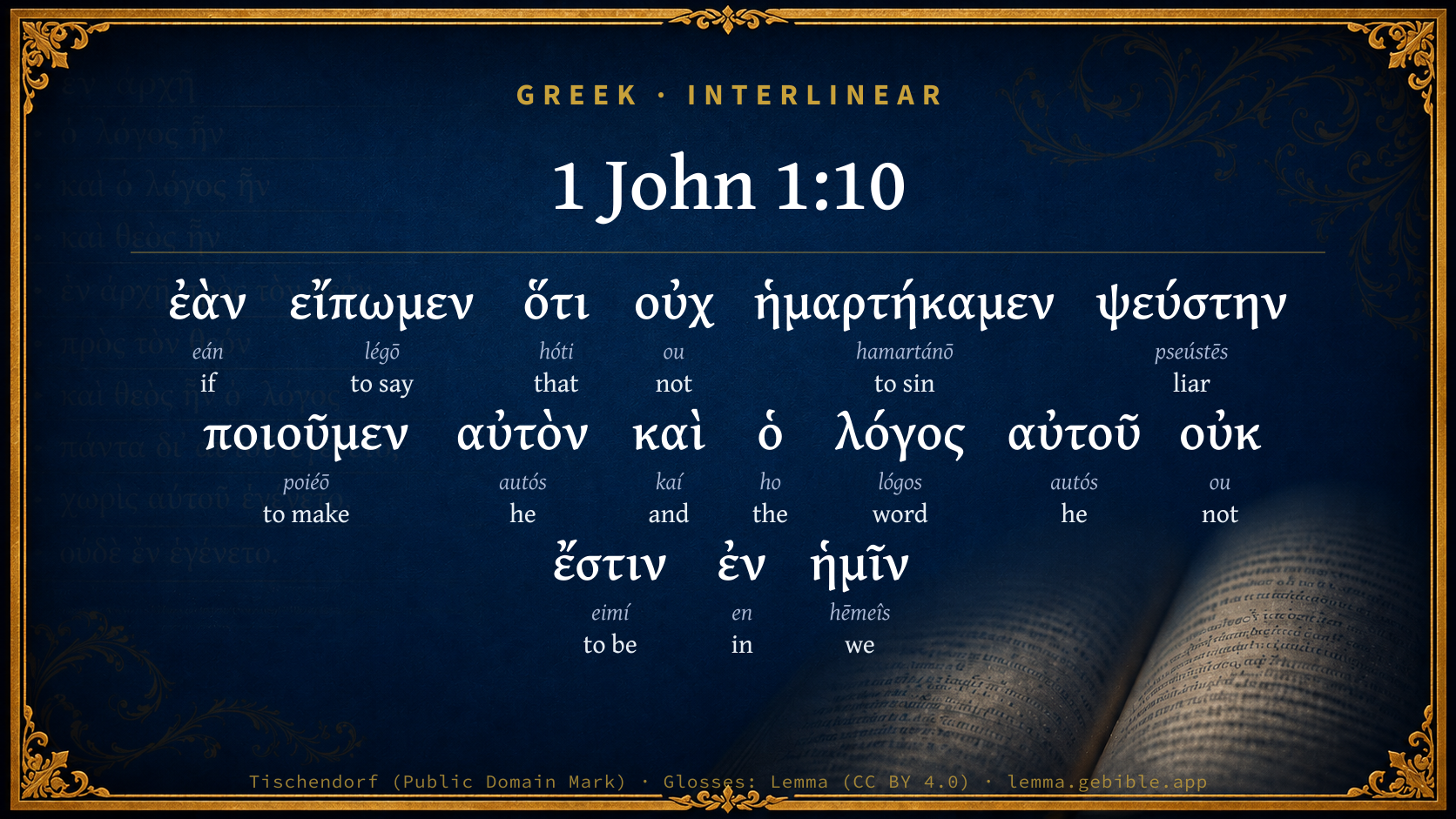
  1. ἐὰν eán G1437 “if” Conditional
  2. εἴπωμεν légō G3004 “to say” Verb, Aorist, Active, Subjunctive, 1st person, Plural
  3. ὅτι hóti G3754 “that” Conjunction
  4. οὐχ ou G3756 “not” Particle, Negative
  5. ἡμαρτήκαμεν hamartánō G264 “to sin” Verb, Perfect, Active, Indicative, 1st person, Plural
  6. ποιοῦμεν poiéō G4160 “to make” Verb, Present, Active, Indicative, 1st person, Plural
  7. αὐτὸν autós G846 “he” Personal pronoun, Accusative, Singular, Masculine
  8. καὶ kaí G2532 “and” Conjunction
  9. ὁ ho G3588 “the” Article, Nominative, Singular, Masculine
  10. λόγος lógos G3056 “word” Noun, Nominative, Singular, Masculine
  11. αὐτοῦ autós G846 “he” Personal pronoun, Genitive, Singular, Masculine
  12. οὐκ ou G3756 “not” Particle, Negative
  13. ἔστιν eimí G1510 “to be” Verb, Present, Active, Indicative, 3rd person, Singular
  14. ἐν en G1722 “in” Preposition
  15. ἡμῖν hēmeîs G2249 “we” Personal pronoun, 1st person, Dative, Plural

About this verse

These counts appear in no published source. They are computed here, from the morphology-tagged text and Lemma’s own curated glosses. What Lemma adds →

16
words
14
distinct lemmas
General Epistles
section

Notable vocabulary

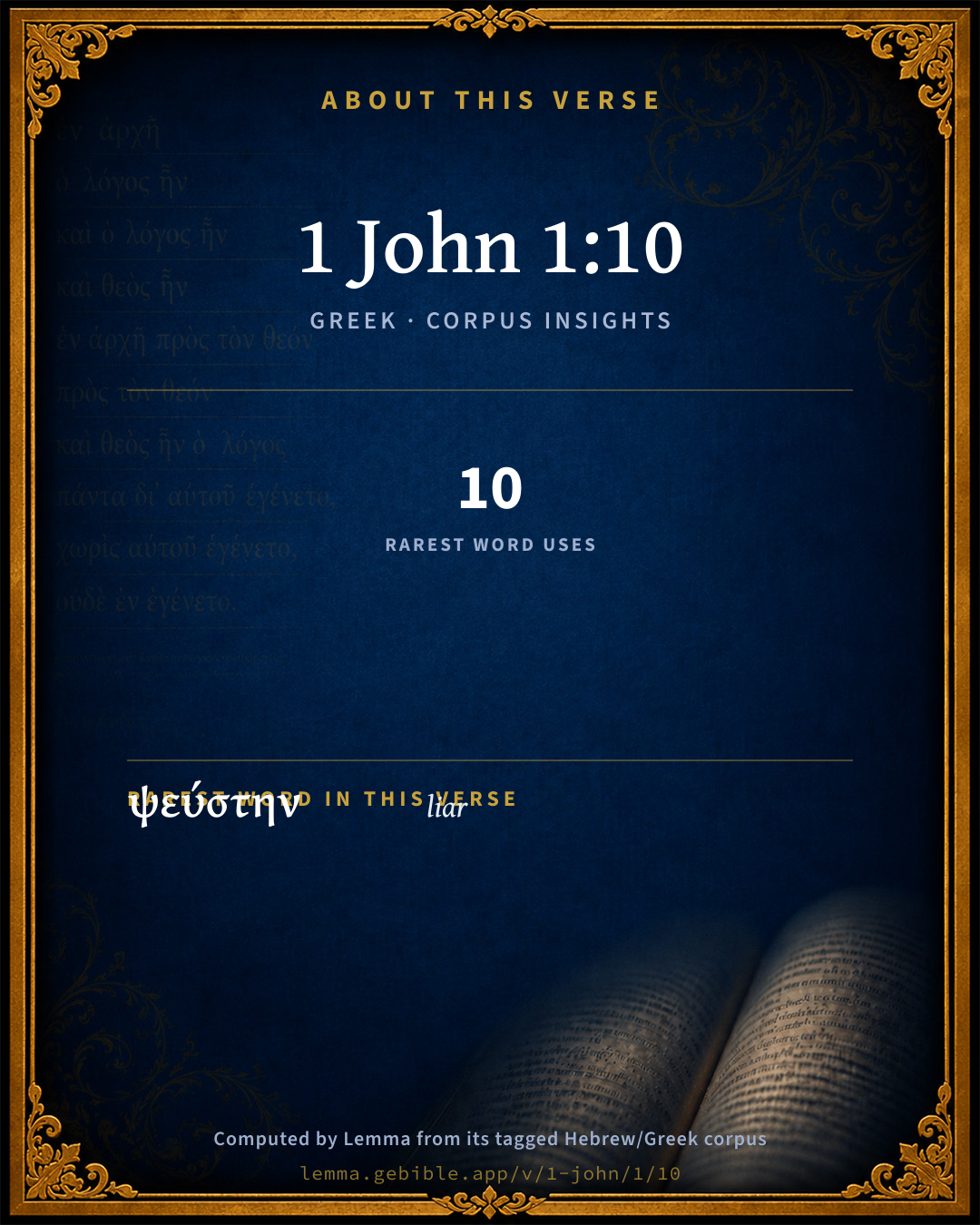
The rarest word here is ψεύστην liar G5583 — appearing just 10 times in the whole Greek New Testament.

Shared distinctive vocabulary

ψεύστην liar G5583 occurs in 10 verses of the Greek New Testament. Also found in:

Repetition

Words recur within this verse:

  • οὐχ not G3756 ×2
  • αὐτὸν he G846 ×2

Cross-references

8

Topical passages linked to 1 John 1:10 in the Treasury of Scripture Knowledge — connected by theme and wording, ordered by reader-vote popularity; previews shown in the World English Bible.

  • 1 John 1:8 If we say that we have no sin, we deceive ourselves, and the truth is not in us.
  • 1 John 5:10 He who believes in the Son of God has the testimony in himself. He who doesn't believe God has made him a liar, because he has not believed in the testimony that God has given concerning his Son.
  • Psalms 130:3 If you, Yah, kept a record of sins, Lord, who could stand?
  • 1 John 2:4 One who says, "I know him," and doesn't keep his commandments, is a liar, and the truth isn't in him.
  • 2 John 1:2 for the truth's sake, which remains in us, and it will be with us forever:
  • Job 24:25 If it isn't so now, who will prove me a liar, And make my speech worth nothing?"
  • Colossians 3:16 Let the word of Christ dwell in you richly; in all wisdom teaching and admonishing one another with psalms, hymns, and spiritual songs, singing with grace in your heart to the Lord.
  • 1 John 2:14 I have written to you, fathers, because you know him who is from the beginning. I have written to you, young men, because you are strong, and the word of God remains in you, and you have overcome the evil one.

Cross-references courtesy of OpenBible.info (CC BY 4.0).

Commentary

Notes on 1 John 1:10 from classic Christian and Jewish commentators (each source and its license shown beneath its notes). The classic Christian expositions comment on the surrounding passage and are grouped to its opening verse, so a note may address several verses; the Jewish commentaries on the Tanakh (Rashi and others) are per-verse, so they appear only where the commentator wrote on this verse.

Lemma curates 59 commentaries, every one of them public domain or Creative Commons licensed, each selected and text-cleaned for this edition rather than reprinted as found. About our sources →

Tyndale Open Study Notes

Tyndale Open Resources

1:10 If we claim we have not sinned, we are calling God a liar: God’s word emphasizes the permeating and penetrating nature of sin (see study note on 1:8).

Tyndale Open Study Notes — © Tyndale Open Resources, licensed CC BY-SA 4.0. Text via the HelloAO Bible API.

Bengel's Gnomon

Johann Albrecht Bengel

1Jn 1:10. Ψεύστην ποιοῦμεν αὐτὸν, we make Him a liar) God says, Thou hast sinned; to deny this is impious. Comp. ch. 1Jn 5:10.—ὁ λόγος αὐτοῦ, His word) which is true: 1Jn 1:8. The word accuses us with truth; and by contradiction it is driven from the heart.—ἐν ἡμῖν, in us) and therefore we are liars: ch. 1Jn 2:4.

Bengel's Gnomon of the New Testament — English translation (T&T Clark, Edinburgh, 1860) — public domain. Text from a community e-Sword module.

Meyer's Critical & Exegetical Commentary

Heinrich August Wilhelm Meyer

1Jn_1:10. Not a repetition, but a strengthening of 1Jn_1:8 (Baumgarten-Crusius). As 1Jn_1:8 is connected with the end of 1Jn_1:7, so is this verse with 1Jn_1:9.

ἐὰν εἴπωμεν] as in 1Jn_1:8.

ὅτι οὐχ ἡμαρτήκαμεν] is substantially synonymous with ὅτι ἁμαρτ. οὐκ ἔχομεν, only distinguished from it in this way that the former describes an activity, the latter a state (so also Braune); the expression used here is called forth by the plural τὰς ἁμαρτίας and the idea ἡ ἀδικία (1Jn_1:9), by which the sinful character is more definitely specified as an activity than by ἁμαρτία in 1Jn_1:7. The perfect does not prove that ἡμαρτήκαμεν is meant of sins before conversion (Socinus, Russmeyer, Paulus, etc.); the subject here, as in all the verses before, is the sinning of Christians; for to deny former sin could not occur to a Christian.[74] The perfect is explained both by Johns usus loquendi, according to which an action lasting up to the present is often represented in this tense, and also by the fact that the confession every time refers to sins previously committed.

ΨΕΎΣΤΗΝ ΠΟΙΟῦΜΕΝ ΑὐΤΌΝ] corresponds to ἙΑΥΤΟῪς ΠΛΑΝῶΜΕΝ; it brings out that the Christian by the denial of his sin accuses God (ΑὐΤΌΝ, i.e. τὸν Θεόν) of lying. In ΠΟΙΕῖΝ there lies, as Düsterdieck remarks, a certain reproachful bitterness; comp. Joh_5:18; Joh_8:53; Joh_10:33; Joh_19:7; Joh_19:12. This thought presupposes the declaration of God that even the Christian sins, which 1Jn_1:9 ΠΙΣΤΌς ἘΣΤΙ Κ.Τ.Λ. also suggests; for if God has promised Christians forgiveness of their sins on condition of their confessing them, the above declaration is thereby made on Gods side.

ΚΑῚ Ὁ ΛΌΓΟς ΑὐΤΟῦ (i.e. τοῦ Θεοῦ) οὐκ ἔστιν ἐν ἡμῖν] ὁ λόγος, corresponding to the thought Ἡ ἈΛΉΘΕΙΑ in 1Jn_1:8, refers directly to the preceding ΨΕΎΣΤΗΝ Κ.Τ.Λ. Lücke explains it correctly: the revelation of God, especially the gospel of Jesus Christ (so also Brückner, Düsterdieck, Braune); to understand by it (with Oecumenius, Grotius, de Wette, etc.) especially the O. T., is forbidden by the train of thought, for the subject here is not the sinfulness of man in general, but the ἁμαρτάνειν of Christians.[75] Ebrard interprets Ὁ ΛΌΓΟς Τ. Θ. as the self-proclamation of the nature of God, which has taken place both in the verbal revelations of the O. and N. T. and in the revelations of deeds, so that even the ΛΌΓΟς of Gospel of Joh_1:1 is to be regarded as included; but from the fact that the elements mentioned here are very closely connected, it does not follow that that idea has here, or anywhere else, this extensive signification. The words ΟὐΚ ἜΣΤΙΝ ἘΝ ἩΜῖΝ are erroneously explained by Baumgarten-Crusius: we have given it up, or also: we are not qualified or fit for it; it means rather: it is not vividly imprinted in our hearts (Spener); it has remained external to us, inwardly unknown.

[74] Therefore it is also not correct to refer ἡμαρτήκ. to present and past, as Hornejus explains: si dixerimus nos non tantum peccatum nunc non habere, sed nec peccatores unquam fuisse.

[75] This has been more or less overlooked by the commentators (even by Düsterdieck and Ebrard), although it is also important for the understanding of chap. 1Jn_2:1-2. But John may with justice assume that the word of God denies the absolute sinlessness of Christians, sinceapart from the fact that even the O. T. does not depict the δίκαιοι as perfectly holyin every evangelical announcement the παράκλησις is an essential element for believers, which presupposes their having and doing sin.

Meyer — Critical and Exegetical Commentary on the New Testament — English translation by Peter Christie, edited by Frederick Crombie (T&T Clark, 1880) — public domain. Text from a community e-Sword module.

International Critical Commentary

10. The third false plea is the denial of the fact of having committed sin. Though a man may allow the abiding power of sin as a principle in those who have sinned, or the existence of sin in Christians after forgiveness, he may yet deny that he has himself sinned. To do so is to deny the truth of God’s revelation. Apart from actual statements in Scripture (cf. Psa_13 (14.):3, 52. (53.):2), the whole plan of God’s dealings with men is based on the assumption that all have sinned. To deny the fact in our own case is to make Him a liar, since it is implied in His whole message to us. His word can have no place in the development of our being.

ἡμαρτήκαμεν] have committed no act of sin, of which the consequences remain.ψεύστην] Cf. Joh 8:44, Joh 8:55; 1Jn 2:4, 1Jn 2:22, 1Jn 2:4:20. And for the exact phrase, 1Jn 5:10.

ὁ λόγος] Like the truth, the word can be viewed objectively or subjectively, an external message or an inward force effective and active in men. There is, of course, no reference to the personal Logos, though the word implies a more personal relationship than ἀλήθεια. It suggests the speaker. Cf. Joh 8:37, ὁ λόγος ὁ ἐμὸς οὐ χωρεῖ ἐν ὑμῖν: Heb 4:12; Jas 1:21; 1Jn 2:14.

ουκ εστιν] post ημιν69. 137 ascr arm. syrp arm. Thphyl.

ημιν] + habitans, arm-osc.

A δ4. Codex Alexandrinus. London. Brit. Mus. Royal Libr. I. D. v.-viii. (v.).

L α5. Rome. Angel. 39 (ol. A. 2. 15) (ix.).

B δ1. Codex Vaticanus. Rome. Vat. Gr. 1209 (iv.).

אԠא. δ2. Codex Sinaiticus. Petersburg (iv.).

C δ3. Codex Ephraimi. Paris. Bibl. Nat. 9 (v.); 1Jn 1:1 τους—(2) εωρα[κομεν]. 4:2 εστιν—(3Jn 1:2) ψυχη.

P P. α3. Petersburg. Bibl. Roy. 225 (ix.). Palimpsest. 1Jn 3:2-1 του.

13 13 ( = 33gosp.). δ48. Paris. Bibl. Nat. Gr. 14 (ix.-x.).

m m. Liber de divinis Scripturis sive Speculum, ed. Weihrich. Vienna Corpus xii., 1887. The following verses are quoted: 1Jn 1:2, 1Jn 1:3, 1Jn 1:8, 1Jn 1:9, 1Jn 1:2:9, 1Jn 1:10, 21, 23, 3:1Jn 1:7-10, 16-18, 1Jn 1:4:1, 1Jn 1:9, 15, 18, 1Jn 1:5:1, 1Jn 1:6-8, 1Jn 1:10, 20, 21; 2Jn 1:7, 2Jn 1:10, 2Jn 1:11.

International Critical Commentary — older volumes (1896–1929), various authors — public domain. Text from a community e-Sword module.

Geneva Bible (1599)

Geneva Bible translators

A rehearsal of the former sentence: wherein he condemned all of sin without exception, insomuch that if any man persuade himself otherwise, he doth as much as in him lieth, make the word of God himself vain and to no purpose, yea he maketh God a liar, for to what end either in times past needed sacrifices or now Christ and the Gospel, if we be not sinners?

They do not only deceive themselves, but also are blasphemous against God.

His doctrine shall have no place in us, that is, in our hearts.

Geneva Bible (1599) marginal notes — public domain. Text via Bolls.life.

Jamieson, Fausset & Brown

Robert Jamieson, A. R. Fausset & David Brown

Parallel to Jo1 1:8.

we have not sinned--referring to the commission of actual sins, even after regeneration and conversion; whereas in Jo1 1:8, "we have no sin," refers to the present GUILT remaining (until cleansed) from the actual sins committed, and to the SIN of our corrupt old nature still adhering to us. The perfect "have . . . sinned" brings down the commission of sins to the present time, not merely sins committed before, but since, conversion.

we make him a liar--a gradation; Jo1 1:6, "we lie"; Jo1 1:8, "we deceive ourselves"; worst of all, "we make Him a liar," by denying His word that all men are sinners (compare Jo1 5:10).

his word is not in us--"His word," which is "the truth" (Jo1 1:8), accuses us truly; by denying it we drive it from our hearts (compare Joh 5:38). Our rejection of "His word" in respect to our being sinners, implies as the consequence our rejection of His word and will revealed in the law and Gospel as a whole; for these throughout rest on the fact that we have sinned, and have sin.

Next: 1 John Chapter 2

Jamieson, Fausset & Brown — Commentary Critical and Explanatory on the Whole Bible (1871) — public domain (CC PDM 1.0). Text via the HelloAO Bible API.

John Calvin's Commentaries

10 We make him a liar He goes still further, that they who claim purity for themselves blaspheme God. For we see that he everywhere represents the whole race of man as guilty of sin.

Whosoever then tries to escape this charge carries on war with God, and accuses him of falsehood, as though he condemned the undeserving. To confirm this he adds, and his word is not in us; as though he had said, that we reject this great truth, that all are under guilt.

We hence learn, that we then only make a due progress in the knowledge of the word of the Lord, when we become really humbled, so as to groan under the burden of our sins and learn to flee to the mercy of God, and acquiesce in nothing else but in his paternal favor.

John Calvin's Commentaries (1540-1563) — public domain. Text from the Calvin Translation Society English edition (1840s-50s) via the Christian Classics Ethereal Library (ccel.org). Calvin's coverage is partial (roughly two-thirds of the Bible); uncommented books and verses are honest gaps, never fabricated. The 19th-century editor's footnotes and remarks are omitted so the notes are faithfully Calvin's own voice.

The Cambridge Bible for Schools and Colleges

gen. ed. J. J. S. Perowne

10. that we have not sinned] This is not the same as ‘that we have no sin’ (1Jn_1:8), and therefore we have once more not repetition, but expansion and strengthening of what precedes. ‘Have no sin’ refers to a sinful state; ‘have not sinned’ refers to the actual commission of particular acts of sin: the one is the inward principle, the other is its result. But the whole context shews that neither expression refers to sins committed before baptism: no Christian would have denied these: moreover S. John does not write to the recently converted, but to those who have had time to grow lukewarm and indifferent. Both expressions refer to sin after baptism, and the perfect (ἡμαρτήκαμεν) has the common meaning of the Greek perfect, present result of past action; ‘we are in the condition of not having sinned’. This use of the perfect is specially frequent in S. John.

we make Him a liar] Worse than ‘we lead ourselves astray’ (1Jn_1:8), as that is worse than ‘we lie’ (1Jn_1:6). This use of the verb ‘make’ in the sense of ‘assert that one is’ is frequent in the Gospel: ‘He made Himself the Son of God’; ‘Every one that maketh himself a king’ (Joh_19:7; Joh_19:12; comp. Joh_5:18, Joh_8:53, Joh_10:33). God’s promise to forgive sin to the penitent would be a lie if there were no sin to be repented of. And more than this; God’s whole scheme of salvation assumes that all men are sinful and need to be redeemed: therefore those who deny their sinfulness charge God with deliberately framing a vast libel on human nature. Whereas S. Paul says, ‘Let God be found true, but every man a liar’ (Rom_3:3).

His word is not in us] God’s revelation of Himself has no home in our hearts: it remains outside us, as the light remains outside and separated from him who shuts himself up in darkness. The expressions, ‘to be in’ and ‘to abide in’, to express intimate relationship, are characteristic of S. John: and either of the things related can be said to be in the other. Thus, either ‘His word is not in us’ (comp. 1Jn_2:14), or ‘If ye abide in My word’ (Joh_8:31): either ‘The truth is not in us’ (1Jn_1:8), or ‘He standeth not in the truth’ (Joh_8:44). Sometimes the two modes of expression are combined; ‘Abide in Me, and I in you’ (Joh_15:4). ‘His word’ means especially the Gospel: as it is the sins of Christians which are being considered, the O.T., though not excluded, cannot be specially meant. ‘Word’ is more personal than ‘the truth’ (1Jn_1:8), which does not necessarily imply a speaker.

The Cambridge Bible for Schools and Colleges (gen. ed. J. J. S. Perowne; Cambridge University Press, 1878–1918) — public domain. Text from a community e-Sword module.

John Gill's Exposition

If we say that we have not sinned,.... Have never sinned, in time past as well as now; deny original sin, and that men are born in sin, but affirm they come into the world pure and holy; and assert that concupiscence is not sin; and so not regarding internal lusts and desires as sinful, only what is external, fancy they have so lived as to have been without sin: but if any of us give out such an assertion,

we make him a liar: that is, God, who in his word declares that the wicked are estranged from the womb, and go astray as soon as they be born, speaking lies; that his own people are transgressors from the womb; that all have sinned and come short of his glory; and that there is none that does good, no, not one, but all are under sin, under the power and guilt of it, and become filthy by it, and so obnoxious to the wrath of God:

and his word is not in us; either Christ the Word of God, or rather the word of God which declares these things; no regard is had unto it; it "is not with us", as the Syriac and Ethiopic versions render it; it is not used and attended to as the rule and standard of truth, but is east away and despised; at least it has no place in the hearts of such, nor does it work effectually; for, was this the case, they would have other notions of themselves than that of sinless creatures. The apostle has regard either to the Gnostics, a set of heretics of this age, who fancied themselves pure, spiritual, and perfect, even in the midst of all their impurities, and notwithstanding their vicious lives; or to judaizing Christians, and it may be to the Jews themselves, who entertained such sort of notions as these of being perfect and without sin (h).

(h) Vid. T. Bab. Temura, fol. 15. 2. & Bava Kama, fol. 80. 1. T. Hieros. Sota, fol. 24. 1. &. Chagiga, fol. 77. 4.

Next: 1 John Chapter 2

John Gill's Exposition of the Whole Bible (1746–1763) — public domain (CC PDM 1.0). Text via the HelloAO Bible API.

Trapp's Complete Commentary

John Trapp

10 If we say that we have not sinned, we make him a liar, and his word is not in us.

Ver. 10. We make him a liar] For the Scripture hath concluded all under sin, Rom 11:32. {See Trapp on "Rom 11:32"}

John Trapp, A Commentary or Exposition upon All the Books of the Old and New Testament (1647–1656) — public domain. Text from a community e-Sword module.

Albert Barnes' Notes on the Bible

If we say that we have not sinned - In times that are past. Some perhaps might be disposed to say this; and as the apostle is careful to guard every point, he here states that if a man should take the ground that his past life had been wholly upright, it would prove that he had no true religion. The statement here respecting the past seems to prove that when, in 1Jo 1:8, he refers to the present - “if we say we have no sin” - he meant to say that if a man should claim to be perfect, or to be wholly sanctified, it would demonstrate that he deceived himself; and the two statements go to prove that neither in reference to the past nor the present can anyone lay claim to perfection.

We make him a liar - Because he has everywhere affirmed the depravity of all the race. Compare the notes at Rom. 1; 2; 3. On no point have his declarations been more positive and uniform than on the fact of the universal sinfulness of man. Compare Gen 6:11-12; Job 14:4; Job 15:16; Psa 14:1-3; Psa 51:5; Psa 58:3; Rom 3:9-20; Gal 3:21.

And his word is not in us - His truth; that is, we have no true religion. The whole system of Christianity is based on the fact that man is a fallen being, and needs a Saviour; and unless a man admits that, of course he cannot be a Christian.

Remarks On 1 John 1

(1) The importance of the doctrine of the incarnation of the Son of God, 1Jo 1:1-2. On that doctrine the apostle lays great stress; begins his Epistle with it; presents it in a great variety of forms; dwells upon it as if he would not have it forgotten or misunderstood. It has all the importance which he attached to it, for.

(a)It is the most wonderful of all the events of which we have any knowledge;

(b)It is the most deeply connected with our welfare.

(2) The intense interest which true piety always takes in this doctrine, 1Jo 1:1-2. The feelings of John on the subject are substantially the feelings of all true Christians. The world passes it by in unbelief, or as if it were of no importance; but no true Christian can look at the fact that the Son of God became incarnate but with the deepest emotion.

(3) It is an object of ardent desire with true Christians that all others should share their joys, 1Jo 1:3-4. There is nothing selfish, or narrow, or exclusive in true religion; but every sincere Christian who is happy desires that all others should be happy too.

(4) Wherever there is true fellowship with God, there is with all true Christians, 1Jo 1:3-4. There is but one church, one family of God; and as all true Christians have fellowship with God, they must have with each other.

(5) Wherever there is true fellowship with Christians, there is with God himself, 1Jo 1:3-4. If we love his people, share their joys, labor with them in promoting his cause, and love the things which they love, we shall show that we love him. There is but one God, and one church; and if all the members love each other, they will love their common God and Saviour. An evidence, therefore, that we love Christians, becomes an evidence that we love God.

(6) It is a great privilege to be a Christian, 1Jo 1:3-4. If we are Christians, we are associated with:

God the Father;

(b)With his Son Jesus Christ;

(c)With all his redeemed on earth and in heaven;

(d)With all holy angels.

There is one bond of fellowship that unites all together; and what a privilege it is to be united in the eternal bonds of friendship with all the holy minds in the universe!

(7) If God is “light” 1Jo 1:5, then all that occurs is reconcilable with the idea that he is worthy of confidence. What he does may seem to be dark to us, but we may be assured that it is all light with him. A cloud may come between us and the sun, but beyond the cloud the sun shines with undimmed splendor, and soon the cloud itself will pass away. At midnight it is dark to us, but it is not because the sun is shorn of his beams, or is extinguished. He will rise again upon our hemisphere in the fullness of his glory, and all the darkness of the cloud and of midnight is reconcilable with the idea that the sun is a bright orb, and that in him is no darkness at all. So with God. We may be under a cloud of sorrow and of trouble, but above that the glory of God shines with splendor, and soon that cloud will pass away, and reveal him in the fullness of his beauty and truth.

(8) We should, therefore, at all times exercise a cheerful confidence in God, 1Jo 1:5. Who supposes that the sun is never again to shine when the cloud passes over it, or when the shades of midnight have settled down upon the world? We confide in that sun that it will shine again when the cloud has passed off, and when the shades of night have been driven away. So let us confide in God, for with more absolute certainty we shall yet see him to be light, and shall come to a world where there is no cloud.

(9) We may look cheerfully onward to heaven, 1Jo 1:5. There all is light. There we shall see God as He is. Well may we then bear with our darkness a little longer, for soon we shall be ushered into a world where there is no need of the sun or the stars; where there is no darkness, no night.

(10) Religion is elevating in its nature, 1Jo 1:6-7. It brings us from a world of darkness to a world of light. It scatters the rays of light on a thousand dark subjects, and gives promise that all that is now obscure will yet become clear as noonday. Wherever there is true religion, the mind emerges more and more into light; the scales of ignorance and error pass away.

(11) there is no sin so great that it may not be removed by the blood of the atonement, 1Jo 1:7, “last clause.” This blood has shown its efficacy in the pardon of all the great sinners who have applied to it, and its efficacy is as great now as it was when it was applied to the first sinner that was saved. No one, therefore, however great his sins, needs to hesitate about applying to the blood of the cross, or fear that his sins are so great that they cannot be taken away!

(12) the Christian will yet be made wholly pure, 1Jo 1:7, “last clause.” It is of the nature of that blood which the Redeemer shed that it ultimately cleanses the soul entirely from sin. The prospect before the true Christian that he will become perfectly holy is absolute; and whatever else may befall him, he is sure that he will yet be holy as God is holy.

(13) there is no use in attempting to conceal our offences, 1Jo 1:8. They are known, all known, to one Being, and they will at some future period all be disclosed. We cannot hope to evade punishment by hiding them; we cannot hope for impunity because we suppose they may be passed over as if unobserved. No man can escape on the presumption either that his sins are unknown, or that they are unworthy of notice.

(14) it is manly to make confession when we have sinned, 1Jo 1:9-10. All meanness was in doing the wrong, not in confessing it; what we should be ashamed of is that we are guilty, not that confession is to be made. When a wrong has been done, there is no nobleness in trying to conceal it; and as there is no nobleness in such an attempt, so there could be no safety.

(15) peace of mind, when wrong has been done, can be found only in confession, 1Jo 1:9-10. That is what nature prompts to when we have done wrong, if we would find peace, and that the religion of grace demands. When a man has done wrong, the least that he can do is to make confession; and when that is done and the wrong is pardoned, all is done that can be to restore peace to the soul.

(16) the “ease” of salvation, 1Jo 1:9. What more easy terms of salvation could we desire than an acknowledgment of our sins? No painful sacrifice is demanded; no penance, pilgrimage, or voluntary scourging; all that is required is that there should be an acknowledgment of sin at the foot of the cross, and if this is done with a true heart the offender will be saved. If a man is not willing to do this, why should he be saved? How can he be?

Albert Barnes' Notes on the Bible (1834–1885) — public domain. Text from a community e-Sword/MySword module.

Matthew Poole's English Annotations

If we say that we have not sinned: see 1Jo 1:8,9.

We make him a liar; which they make him that believe not his word, 1Jo 5:10, expressly charging all men with sin, Rom 3:19,23.

And, consequently, his word, or truth, as 1Jo 1:8, which we contradict, is not in us. The sum is: That we are not to he received into God’s holy society and communion under the notion of always innocent and unoffending persons, but as pardoned and purified sinners.

Matthew Poole's English Annotations on the Holy Bible (1683–1685) — public domain. Text from a community e-Sword/MySword module.

Whedon's Commentary on the Bible

Daniel D. Whedon

10. This concluding verse is added, as parallel and completing to 1Jn_1:8, in order to emphasize the fact that not only is the denial of sin as a state, but of sin as an actual commission and practice in the past, flagrantly false.

Have not sinned—The applying this to the Christian (as Alford and Huther) is, as above on 1Jn_1:8, clearly erroneous. If the supposition be that the Christian says, I have not sinned since my conversion, no sensible Christian ever said that, and the admonition is absurd. If it be, I have not sinned in a particular case, it may be true. Clearly, John is laying the foundation of conversion of sinners to Christ in deep confession of sin both of character and act.

Make him a liar—For both the universal condemnation of men and their universal redemption through Christ, is based upon the assumption that all men, of full responsible age and powers, have sinned.

Daniel D. Whedon (gen. ed.), Commentary on the Old and New Testaments (1874–1909) — public domain. Text from a community e-Sword module.

The Pulpit Commentary

Once more we have no mere repetition, but a fresh thought. "We have not sin" (verse 8) refers to our natural condition; "we have not sinned" (verse 10) refers to definite acts. Note the climax: we lie (verse 6); we lead ourselves utterly astray (verse 8): we make God a liar (verse 10). The whole of God"s dealing with man since the Fall, especially in the Incarnation, is based on the fact of man"s innate sinfulness. To deny this fact, therefore, is to charge the God of light and truth with acting and maintaining a vast and persistent lie. It is difficult to see how this strong language can be reconciled with the Roman dogma of the immaculate conception of the Virgin Mary: why does not her "son" (Joh_19:26, Joh_19:27) except her from its sweep? His word is not in us; i.e., we are cut off from all communication with him. (Joh_5:38 Joh_8:31) "His Word" is the sum total of the Divine revelation. That which in itself is "the truth "(verse 8), when communicated to us is "his Word." How thoroughly the Church of England enters into the spirit of these verses (8-10) is shown by the fact that it appoints confession and absolution as part of public service every morning and evening throughout the year, as well as of every celebration of the Eucharist. As Bede points out, the Lord"s Prayer itself, with the petition, "Forgive us our trespasses," is a conclusive answer to Pelagian opponents of St. John"s doctrine.

The Pulpit Commentary (1880–1919), ed. H.D.M. Spence-Jones & Joseph S. Exell — public domain. Text from a community e-Sword module.

John Wesley's Explanatory Notes

Yet still we are to retain, even to our lives' end, a deep sense of our past sins. Still if we say, we have not sinned, we make him a liar - Who saith, all have sinned. And his word is not in us - We do not receive it; we give it no place in our hearts.

John Wesley, Explanatory Notes Upon the Whole Bible (1754–1765) — public domain. Text via the GEBible commentary corpus.

Burkitt's Expository Notes on the New Testament

William Burkitt

Note here, The impiety and blasphemy of those who affirm themselves to be in a state of sinless perfection: they do not only lie themselves, but intepretatively, and as much as in them is, they make God a liar, by contradicting what he has asserted in his word, that all are sinners: So that upon the whole it appears, that to affirm we have no sin, is the highest pride, the greatest deceit, the loudest lie, the prophanest blasphemy; it is to make the God of truth a liar, and to turn the truth of God into a lie, which evidences that his word is not in us.

William Burkitt's Expository Notes on the New Testament (1700–1703) — public domain. Text from a community e-Sword module.

The People's New Testament

B. W. Johnson

10. If we say that we have not sinned. God says we have sinned. He declares “There is none righteous; no, not one.” Hence, if we affirm that we are sinless we make God a liar.

Note. —It must be noted that these words concerning sin, found in verses 8–10, are not addressed to Gentile sinners, but a generation which had grown up in the church. Indeed, of all the epistles, this is the only one which can truly be said to have been addressed to a Christian generation. Hence, it would naturally emphasize, not the unconverted sinner's need of pardon, but of the Christian's constant need of a pardoning Savior. It is the Christian who cannot say that he has no sin, and who must find pardon by confessing his sins to Christ. Acts 2:38 shows how the alien sinner may obtain remission; 1 John 1:9 shows how the Christian, when he sins, may obtain remission.

B. W. Johnson's The People's New Testament with Notes (1889–1891) — public domain. Electronic text from the Christian Classics Ethereal Library (CCEL) ThML edition.

Cambridge Greek Testament for Schools and Colleges

10. οὐχ ἡμαρτήκαμεν. This is the third false profession. It is not equivalent to ἁμαρτίαν οὐκ ἔχομεν (1Jn 1:8), which refers to the sinful state, the inward principle: whereas this indicates the result of that state, viz. the commission of sinful Acts 1. We may ignore the difference between right and wrong and thereby deny that sin exists (1Jn 1:6). 2. We may deny that our own nature is sinful (1Jn 1:8). 3. Or, admitting the reality of sin and the sinful tendency of our nature, we may deny that we, as a matter of fact, have sinned. Of course sins committed before baptism are not meant: no Christian would have denied these. Both in Gospel and in Epistles S. John has in mind adult Christians, not catechumens. The Greek perfect here again (1Jn 1:1; 1Jn 1:3) has its full force; present result of past action: ‘We are in the condition of having avoided sin.’

ψεύστην ποιοῦμεν αὐτόν. At first sight this third false profession seems less serious than the others: but to avoid the other two and yet adopt this is more conspicuously a sin against light. There is a marked gradation of guilt. ‘To lead ourselves astray’ (1Jn 1:8) is worse than ‘to lie’ (1Jn 1:6): but ‘to make God a liar’ is worst of all. This use of ποιεῖν for ‘to assert that one is’ is another of S. John’s characteristics: τίνα σεαυτὸν ποιεῖς; (Joh 8:53); ποιεῖς σεαυτὸν θεόν (Joh 10:33). Comp. Joh 5:18, Joh 19:7; Joh 19:12. The O. T. proclaims the universality of sin. Moreover, God’s whole scheme of salvation assumes that every human being sins and has need of redemption, the Redeemer only excepted. Therefore those who profess that they have never sinned, and have no need of a Redeemer, charge God with having deliberately framed a libel against themselves, and having misstated the possibilities of human nature. It has been acutely remarked of Renan’s Life of Jesus that “sin does not appear in it at all. Now if there is anything which explains the success of the Good News among men, it is that it offered deliverance from sin—salvation” (Amiel).

ὁ λόγος αὐτοῦ οὐκ ἔστιν ἐν ἡμῖν. God’s revelation of Himself has no home in our hearts: it remains outside us, as the light remains outside and separate from those who shut themselves up in darkness. Obviously ὁ λόγος here is not personal: nothing has been said about the indwelling of Christ. ‘His word’ means the whole of God’s Revelation in both O. and N.T., especially in the Gospel (Joh 10:35; Joh 17:6; Joh 17:14; Joh 17:17). Ὁ λόγος is more definite than ἡ ἀλήθεια (1Jn 1:8), and also more personal: it implies that the truth has been uttered. Utterance there must be in word or deed to make truth of any worth to mankind. The expressions εἶναι ἐν and μένειν ἐν, to express intimate relationship, are very characteristic of S. John: and either of the things related can be said to be in the other. Thus, either ‘His word is not in us’ (comp. 1Jn 2:14) or ‘If ye abide in My Word’ (Joh 8:31): either ‘The truth is not in us’ (1Jn 1:8) or ‘He standeth not in the truth’ (Joh 8:44). Sometimes the two modes of expression are combined; ‘Abide in Me, and I in you’ (Joh 15:4).

Note that the contrary hypothesis to the first and second false professions is given (1Jn 1:7; 1Jn 1:9) but not to the third. That to the second (1Jn 1:9) covers the third also. The mere confession of sinfulness, which would be the exact contrary to the second false profession, is omitted as being of no moral value.

Cambridge Greek Testament for Schools and Colleges (Cambridge University Press, 1896; 21 vols, various authors incl. Carr, Maclear, Plummer, Farrar, Lumby, Moule, M. R. James, Simcox) — public domain. Text from a community e-Sword module.

Alford’s Greek Testament

Henry Alford

10.] Not a mere repetition, but a confirmation and intensification of ver. 8. Huther well remarks, that this verse is related to ver. 9 as ver. 8 to ver. 7). If we say that we have not sinned (if we deny, that is, the fact of our commission of sins in our Christian state. The perf., so far from removing the time to that before conversion, brings it down to the present: had it been ἡμαρτήσαμεν, it might have had that signification. ἡμαρτήκαμεν answers in time to ἁμαρτίαν οὐκ ἔχομεν: the one representing the state as existing, the other the sum of sinful acts which have gone to make it up), we make Him (God, see above) a liar (this is the climax, gradually reached through ψευδόμεθα ver. 6, and ἑαυτοὺς πλανῶμεν ver. 8. And it is justified, by the uniform assertion of God both in the O. T. and N. T. that all men are sinners, which we thus falsify as far as in us lies), and His word in not is us (cf. Joh 5:38. ὁ λόγος αὐτοῦ may be interpreted generally,—“that which He saith.” “Deus dixit ‘peccasti:’ id negare nefandum est. Verbum nos vere accusat, et contradicendo arcetur a corde.” Bengel. οὐκ ἔστιν ἐν ἡμῖν, as in John l. c., has no abiding place in, within, us: is something heard by the ear, and external to us, but not finding place among the thoughts and maxims of our heart and life. God declares that to be true which we assume to be untrue. It is evident that with Œc., Grot., De Wette, to understand the O. T. by ὁ λόγος αὐτοῦ is to miss the connexion, seeing that it is of the sins of Christians that St. John is treating, to whom ὁ λόγος αὐτοῦ has become a far higher revelation of His will, viz. that given by Christ, and brought home to the heart by His indwelling Spirit. This final revelation of God includes the O. and N. T., and all other manifestations of His will to us: and it is this as a whole, which we reject and thrust from us, if we say at any time that we have not sinned, for its united testimony proclaims the contrary).

Henry Alford, The Greek Testament (1849–1861) — public domain. Text from a community e-Sword module.

Lesson kit

Teaching starters — assembled from the data on this page, not authored interpretation. Every prompt links to the verse data it draws on. Edit before teaching.

1 John, in the General Epistles, opens this verse with 16 words (14 distinct Greek lemmas). Its most distinctive word is pseústēs (“liar”). A historical commentator’s framing appears above. Read the whole chapter for the surrounding context.

Discussion questions

  1. How does “liar” (pseústēs) shape what this verse is saying?
  2. John 8:44 shares the word «liar» with this verse. How do the two illuminate each other?
  3. “not” occurs 2× in this one verse. What is the effect of the repetition?
  4. These translations render this verse differently; the difference is in the English rendering, not the original. What questions does that raise?
  5. Reading how Tyndale Open Study Notes and Bengel's Gnomon read this verse, where do the two commentators agree and where do they part?

Things to notice

Reading settings

Reading text

Shown beneath each verse's original-language words.

Old Testament
Old Testament edition

Read the OT as the Masoretic Hebrew (MT) or the Greek Septuagint (LXX).

English shown for the Greek Septuagint (in the Hebrew ↔ Greek comparison).

Comparing translations? Open the Compare panel on any verse page to stack up to four side by side.