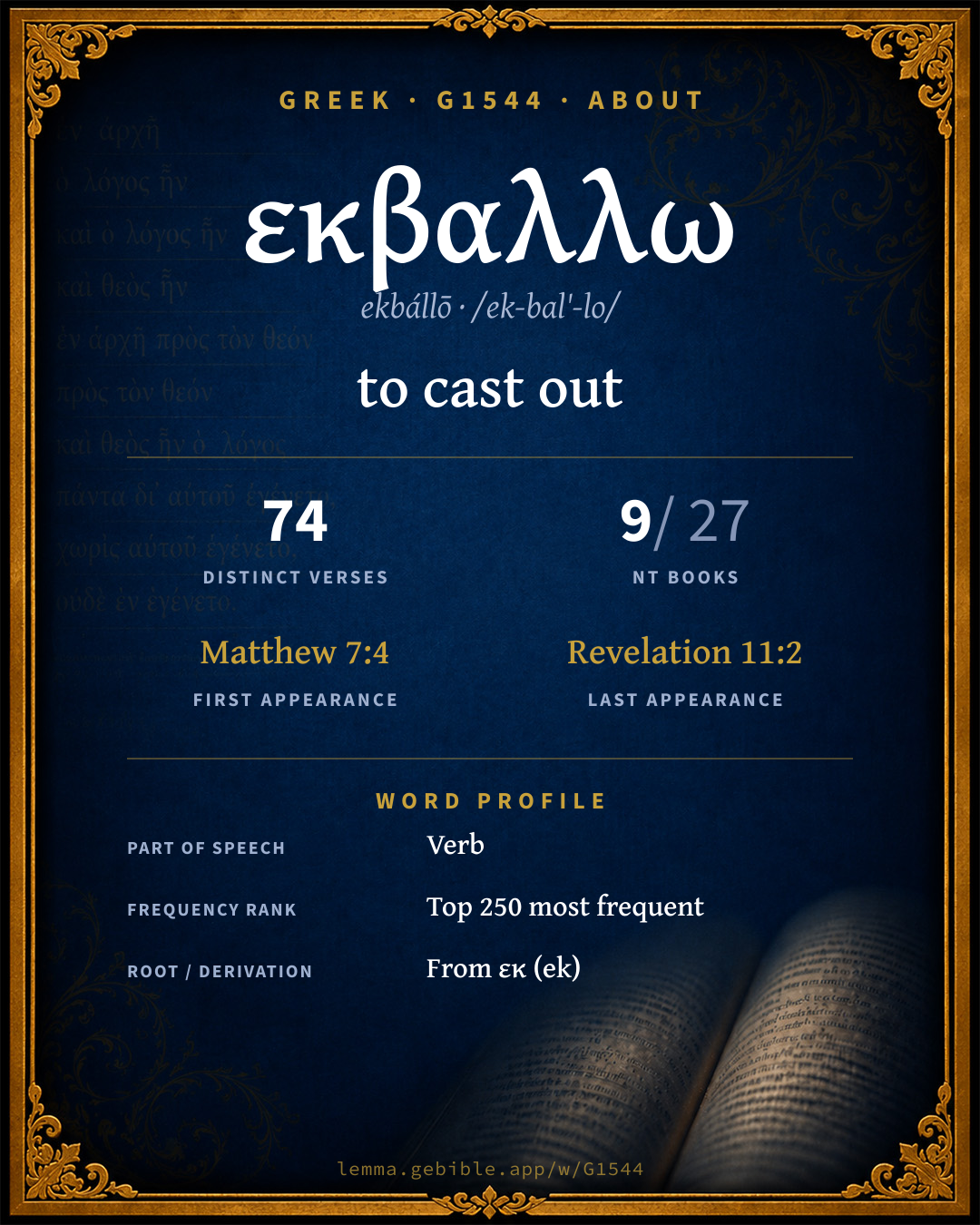
ἐκβάλλω
to cast out
also: drive out, to send out fuller range ↓
Full lexicon entry — Thayer's Greek Lexicon
From Thayer's Greek Lexicon
Where this word appears
See every Aorist-tense verb in the Greek New Testament →
Grammar key — what these labels mean
Part of speech
- Verb
- An action or state-of-being word.
Tense
- Present
- Ongoing or general action in present time (imperfective aspect).
- Aorist
- Action viewed as a simple whole, without regard to duration — often past (perfective aspect).
- Future
- Action expected in future time.
- Imperfect
- Continuous or repeated action in past time (“was writing”).
- Pluperfect
- A past action completed before another past point (“had written”).
Voice
- Active
- The subject performs the action.
- Passive
- The subject receives the action.
- Middle
- The subject acts on or for itself, or with special interest in the action.
Mood
- Indicative
- States a fact or asks a factual question (the mood of reality).
- Infinitive
- A verbal noun (“to write”), unmarked for person or number.
- Imperative
- Expresses a command or request.
- Subjunctive
- Expresses probability, purpose, or possibility (the mood of contingency).
- Participle
- A verbal adjective (“writing,” “having written”).
Case
- Nominative
- The case of the subject (and the predicate nominative).
- Accusative
- The case of the direct object and of extent.
- Genitive
- The case of source, possession, or “of” — answers “whose / from what.”
Person
- 3rd person
- The one spoken about (“he / she / it / they”).
- 2nd person
- The one addressed (“you”).
- 1st person
- The speaker (“I / we”).
Gender
- Masculine
- Grammatically masculine.
- Feminine
- Grammatically feminine.
- Neuter
- Grammatically neuter.
Number
- Singular
- One.
- Plural
- More than one.
8 verses where G1544 appears in the Aorist tense in the Book of Mark. Filtered view — show all forms. Click any verse to open its interlinear word-by-word view. Verse text shown in the World English Bible for context — . Each verse’s Greek form is shown with its reference; the English is not keyword-highlighted, since the data carries no word-level English alignment. Use “Compare translations” on any verse to read it across multiple English versions. This concordance covers the Greek New Testament; Septuagint (Greek Old Testament) occurrences of this word are not indexed here.
Mark
- Mark 1:34 ἐξέβαλεν aor act ind 3sg He healed many who were sick with various diseases, and cast out many demons. He didn't allow the demons to speak, because they knew him.
- Mark 1:43 ἐξέβαλεν aor act ind 3sg He strictly warned him, and immediately sent him out,
- Mark 5:40 ἐκβαλὼν aor act ptcp nom sg masc They ridiculed him. But he, having put them all out, took the father of the child and her mother and those who were with him, and went in where the child was lying.
- Mark 7:26 ἐκβάλῃ aor act subj 3sg Now the woman was a Greek, a Syrophoenician by race. She begged him that he would cast the demon out of her daughter.
- Mark 9:18 ἐκβάλωσιν aor act subj 3pl and wherever it seizes him, it throws him down, and he foams at the mouth, and grinds his teeth, and wastes away. I asked your disciples to cast it out, and they weren't able."
- Mark 9:28 ἐκβαλεῖν aor act inf When he had come into the house, his disciples asked him privately, "Why couldn't we cast it out?"
- Mark 9:47 ἔκβαλε aor act impv 2sg If your eye causes you to stumble, cast it out. It is better for you to enter into the Kingdom of God with one eye, rather than having two eyes to be cast into the Gehenna of fire,
- Mark 12:8 ἐξέβαλον aor act ind 3pl They took him, killed him, and cast him out of the vineyard.
About this entry
At a glance — auto-summarized from this page’s data, not written by a person. Every figure links to its source below. This summary describes the numbers; it doesn’t interpret them.
εκβαλλω (ekbállō) is a Greek verb most often rendered “to cast out.” Translators differ — “cast out” in the King James Version, then “drive out” (Berean Standard Bible) and “out” (unfoldingWord Literal Text), as the renderings breakdown shows. It turns up in 74 verses across 9 books, a moderately common footprint. It concentrates in Matthew, which alone accounts for 32% of its uses. The lexical range runs to 2 senses — “to cast out” plus “drive out” and “to send out”. The sections below give every sense, occurrence, and version rendering.
Gloss history
Strong's 1890 vs modern scholarship

About this word
Strong's G1544 catalogs a Greek word from the Greek New Testament.
These counts are not copied from any lexicon or concordance. They are computed here, from the morphology-tagged Greek New Testament. What Lemma adds →
- 74
- distinct verses
- The word appears in 74 distinct verses.
- 9 / 27
- NT books
- The word appears in 9 of 27 New Testament books.
- #211
- by frequency
- Top 250 most frequent Greek words (rank 211 of 5,347 Greek words by occurrence).
View all 74 occurrences in the concordance →
By section of the New Testament
By traditional corpus
Conventional, traditional groupings — biblical authorship is debated, so this is a traditional corpus grouping, not an authorship claim. Some books belong to more than one corpus (Luke is in both the Gospels and the Lukan corpus, and so on), so these shares overlap and need not total 100%. Each figure is a share of the word’s 74 distinct verses.
- Gospels 65 verses · 88%
- Lukan (Luke–Acts) 22 verses · 30%
- Johannine 8 verses · 11%
- General (Catholic) Epistles 2 verses · 3%
- Pauline corpus 1 verse · 1%
- Revelation 1 verse · 1%
How translations render this word
Counts come from each version’s own published word-to-Strong’s tagging or interlinear alignment — an approximate guide to how each version renders this word, not a word-level alignment the data otherwise carries. Because each total is that version’s own tagged count, the per-version totals vary from one another and need not match the appearance or distinct-verse counts above. These counts may also differ from a printed concordance because Lemma counts each distinctly tagged rendering and does not collapse phrase taggings into a single head-word total. This is a fixed set of word-tagged versions (KJV, ASV, BSB, ULT) and does not change with the reading translation you choose elsewhere. Each version’s license is shown beside its name below (and on Sources).
- King James Version: Cast out 21×, Cast 9×, Out 9×
- American Standard Version: Cast out 21×, Cast 16×, Out 11×
- Berean Standard Bible: Drive out 13×, Drive it out 4×, Driving out 4×
- unfoldingWord Literal Text: Out 18×, Cast out 15×, Take out 6×
King James Version Public Domain
Renders G1544 across 96 tagged occurrences — most commonly:
Plus 40 renderings that appear only once — usually multi-word phrases or single function words the recovered tagging swept in, not distinct renderings.
American Standard Version Public Domain
Renders G1544 across 98 tagged occurrences — most commonly:
Plus 31 renderings that appear only once — usually multi-word phrases or single function words the recovered tagging swept in, not distinct renderings.
Berean Standard Bible Public Domain
Renders G1544 across 81 tagged occurrences — most commonly:
Plus 37 renderings that appear only once — usually multi-word phrases or single function words the recovered tagging swept in, not distinct renderings.
unfoldingWord Literal Text CC BY-SA 4.0
Renders G1544 across 106 tagged occurrences — most commonly:
Plus 41 renderings that appear only once — usually multi-word phrases or single function words the recovered tagging swept in, not distinct renderings.
Senses in Thayer's
The 2 senses Thayer's distinguishes for this word, in lexicon order (not ranked by frequency or importance). The full entry — with sub-senses — is in the Lexicon Entry tab.
- to cast out, drive out, to send out
- to command or cause one to depart in haste
Word origin
Derived from εκ (ek) (G1537) — from.
Forms in the corpus
The 29 distinct written forms G1544 takes in the Greek New Testament, most frequent first — each parse links to that tense’s occurrences in the concordance.
Same root — word family
Other Thayer's entries built from the same root as G1544, grouped by Strong’s listed origin. These share a root / origin per the lexicon — not necessarily a shared meaning. Each links to that word’s own entry.
Derives from
Shares the same root
- εκβασις ékbasis G1545 exit
- εκγαμιζω ekgamízō G1547 to give in marriage
- εκγαμισκω ekgamískō G1548 to give in marriage
- εκγονον ékgonon G1549 offspring
- εκδαπαναω ekdapanáō G1550 to spend
- εκδεχομαι ekdéchomai G1551 to receive
- εκδηλος ékdēlos G1552 evident
- εκδημεω ekdēméō G1553 to depart
- εκδιδωμι ekdídōmi G1554 to give out
- εκδιηγεομαι ekdiēgéomai G1555 to relate
- εκδικος ékdikos G1558 without justice
- εκδιωκω ekdiṓkō G1559 to banish
- εκδοτος ékdotos G1560 delivered up
- εκδυω ekdýō G1562 to put off
- εκζητεω ekzētéō G1567 to seek out
- εκθαμβος ékthambos G1569 astonished
- εκθετος ékthetos G1570 exposed
- εκκαθαιρω ekkathaírō G1571 to cleanse
- εκκαιω ekkaíō G1572 to burn
- εκκακεω ekkakéō G1573 to be exhausted
- εκκεντεω ekkentéō G1574 to pierce
- εκκλαω ekkláō G1575 to cut off
- εκκλειω ekkleíō G1576 to shut out
- εκκλησια ekklēsía G1577 assembly
+88 more words share this root (not shown).
Derived from this word
Compare all same-root words → Showing 4 of 115 — not the complete family. They share a root, not necessarily a meaning.
Septuagint usage
The same Greek word εκβαλλω appears 85 times in the Greek Old Testament (Septuagint), across 80 verses in 24 books.
- 85
- LXX occurrences
- Tagged occurrences of this Greek word in the Septuagint.
- 80
- verses
- Distinct Septuagint verses containing this word.
- 24 / 39
- OT books
- The word appears in 24 of the 39 Old Testament books.
Sample Septuagint occurrences
- Genesis 3:24 ἐκβάλλω
- Exodus 2:17 ἐκβάλλω
- Leviticus 1:16 ἐκβάλλω
- Numbers 21:32 ἐκβάλλω
- Deuteronomy 11:23 ἐκβάλλω
- Joshua 15:4 ἐκβάλλω
- Judges 6:9 ἐκβάλλω
- 1 Samuel 26:19 ἐκβάλλω
- 2 Samuel 7:23 ἐκβάλλω
- 1 Kings 2:27 ἐκβάλλω
- 2 Kings 16:6 ἐκβάλλω
- 1 Chronicles 17:21 ἐκβάλλω
Septuagint occurrences (same lexeme)
Every verse where the same Strong’s number (G1544) appears in the Greek Septuagint — showing the first 50 of 80. Verse text shown in the World English Bible for context; the Greek form is the matched word — the English is not keyword-highlighted.
- Genesis 3:24 ἐκβάλλω So he drove out the man; and he placed Cherubs at the east of the garden of Eden, and the flame of a sword which turned every way, to guard the way to the tree of life.
- Genesis 4:14 ἐκβάλλω Behold, you have driven me out this day from the surface of the ground. I will be hidden from your face, and I will be a fugitive and a wanderer in the earth. It will happen that whoever finds me will kill me."
- Genesis 21:10 ἐκβάλλω Therefore she said to Abraham, "Cast out this handmaid and her son! For the son of this handmaid will not be heir with my son, even with Isaac."
- Exodus 2:17 ἐκβάλλω The shepherds came and drove them away; but Moses stood up and helped them, and watered their flock.
- Exodus 6:1 ἐκβάλλω Yahweh said to Moses, "Now you shall see what I will do to Pharaoh, for by a strong hand he shall let them go, and by a strong hand he shall drive them out of his land."
- Exodus 10:11 ἐκβάλλω Not so! Go now you who are men, and serve Yahweh; for that is what you desire!" They were driven out from Pharaoh's presence.
- Exodus 11:1 ἐκβάλλω Yahweh said to Moses, "Yet one plague more will I bring on Pharaoh, and on Egypt; afterwards he will let you go. When he lets you go, he will surely thrust you out altogether.
- Exodus 12:33 ἐκβάλλω The Egyptians were urgent with the people, to send them out of the land in haste, for they said, "We are all dead men."
- Exodus 12:39 ἐκβάλλω They baked unleavened cakes of the dough which they brought forth out of Egypt; for it wasn't leavened, because they were thrust out of Egypt, and couldn't wait, neither had they prepared for themselves any food.
- Exodus 23:18 ἐκβάλλω "You shall not offer the blood of my sacrifice with leavened bread, neither shall the fat of my feast remain all night until the morning.
- Exodus 23:28 ἐκβάλλω I will send the hornet before you, which will drive out the Hivite, the Canaanite, and the Hittite, from before you.
- Exodus 23:29 ἐκβάλλω I will not drive them out from before you in one year, lest the land become desolate, and the animals of the field multiply against you.
- Exodus 23:30 ἐκβάλλω Little by little I will drive them out from before you, until you have increased and inherit the land.
- Exodus 23:31 ἐκβάλλω I will set your border from the Red Sea even to the sea of the Philistines, and from the wilderness to the River; for I will deliver the inhabitants of the land into your hand, and you shall drive them out before you.
- Exodus 33:2 ἐκβάλλω I will send an angel before you; and I will drive out the Canaanite, the Amorite, and the Hittite, and the Perizzite, the Hivite, and the Jebusite:
- Exodus 34:11 ἐκβάλλω Observe that which I command you this day. Behold, I drive out before you the Amorite, the Canaanite, the Hittite, the Perizzite, the Hivite, and the Jebusite.
- Exodus 34:24 ἐκβάλλω For I will drive out nations before you and enlarge your borders; neither shall any man desire your land when you go up to appear before Yahweh, your God, three times in the year.
- Leviticus 1:16 ἐκβάλλω and he shall take away its crop with its filth, and cast it beside the altar on the east part, in the place of the ashes.
- Leviticus 14:40 ἐκβάλλω then the priest shall command that they take out the stones in which is the plague, and cast them into an unclean place outside of the city:
- Leviticus 21:7 ἐκβάλλω "'They shall not marry a woman who is a prostitute, or profane; neither shall they marry a woman divorced from her husband: for he is holy to his God.
- Leviticus 21:14 ἐκβάλλω A widow, or one divorced, or a woman who has been defiled, or a prostitute, these he shall not marry: but a virgin of his own people shall he take as a wife.
- Leviticus 22:13 ἐκβάλλω But if a priest's daughter is a widow, or divorced, and has no child, and has returned to her father's house, as in her youth, she may eat of her father's bread: but no stranger shall eat any of it.
- Numbers 21:32 ἐκβάλλω Moses sent to spy out Jazer; and they took the towns of it, and drove out the Amorites who were there.
- Numbers 22:6 ἐκβάλλω Please come now therefore curse me this people; for they are too mighty for me: peradventure I shall prevail, that we may strike them, and that I may drive them out of the land; for I know that he whom you bless is blessed, and he whom you curse is cursed.
- Numbers 22:11 ἐκβάλλω Behold, the people that is come out of Egypt, it covers the surface of the earth: now, come curse me them; peradventure I shall be able to fight against them, and shall drive them out.
- Numbers 30:10 ἐκβάλλω If she vowed in her husband's house, or bound her soul by a bond with an oath,
- Deuteronomy 11:23 ἐκβάλλω then will Yahweh drive out all these nations from before you, and you shall dispossess nations greater and mightier than yourselves.
- Deuteronomy 29:27 ἐκβάλλω therefore the anger of Yahweh was kindled against this land, to bring on it all the curse that is written in this book;
- Deuteronomy 33:27 ἐκβάλλω The eternal God is [your] dwelling-place, Underneath are the everlasting arms. He thrust out the enemy from before you, Said, Destroy.
- Joshua 15:4 ἐκβάλλω and it passed along to Azmon, and went out at the brook of Egypt; and the goings out of the border were at the sea: this shall be your south border.
- Joshua 15:7 ἐκβάλλω and the border went up to Debir from the valley of Achor, and so northward, looking toward Gilgal, that is over against the ascent of Adummim, which is on the south side of the river; and the border passed along to the waters of En Shemesh, and the goings out of it were at En Rogel;
- Joshua 15:8 ἐκβάλλω and the border went up by the valley of the son of Hinnom to the side of the Jebusite southward (the same is Jerusalem); and the border went up to the top of the mountain that lies before the valley of Hinnom westward, which is at the uttermost part of the valley of Rephaim northward;
- Joshua 15:9 ἐκβάλλω and the border extended from the top of the mountain to the spring of the waters of Nephtoah, and went out to the cities of Mount Ephron; and the border extended to Baalah (the same is Kiriath Jearim);
- Joshua 15:11 ἐκβάλλω and the border went out to the side of Ekron northward; and the border extended to Shikkeron, and passed along to Mount Baalah, and went out at Jabneel; and the goings out of the border were at the sea.
- Joshua 16:7 ἐκβάλλω and it went down from Janoah to Ataroth, and to Naarah, and reached to Jericho, and went out at the Jordan.
- Joshua 24:12 ἐκβάλλω I sent the hornet before you, which drove them out from before you, even the two kings of the Amorites; not with your sword, nor with your bow.
- Joshua 24:18 ἐκβάλλω and Yahweh drove out from before us all the peoples, even the Amorites who lived in the land: therefore we also will serve Yahweh; for he is our God.
- Judges 6:9 ἐκβάλλω and I delivered you out of the hand of the Egyptians, and out of the hand of all who oppressed you, and drove them out from before you, and gave you their land;
- Judges 9:41 ἐκβάλλω Abimelech lived at Arumah: and Zebul drove out Gaal and his brothers, that they should not dwell in Shechem.
- Judges 11:2 ἐκβάλλω Gilead's wife bore him sons; and when his wife's sons grew up, they drove out Jephthah, and said to him, You shall not inherit in our father's house; for you are the son of another woman.
- Judges 11:7 ἐκβάλλω Jephthah said to the elders of Gilead, Didn't you hate me, and drive me out of my father's house? and why are you come to me now when you are in distress?
- 1 Samuel 26:19 ἐκβάλλω Now therefore, please let my lord the king hear the words of his servant. If it be Yahweh that has stirred you up against me, let him accept an offering: but if it be the children of men, cursed be they before Yahweh: for they have driven me out this day that I shouldn't cling to Yahweh's inheritance, saying, Go, serve other gods.
- 2 Samuel 7:23 ἐκβάλλω What one nation in the earth is like your people, even like Israel, whom God went to redeem to himself for a people, and to make him a name, and to do great things for you, and awesome things for your land, before your people, whom you redeem to you out of Egypt, [from] the nations and their gods?
- 1 Kings 2:27 ἐκβάλλω So Solomon thrust out Abiathar from being priest to Yahweh, that he might fulfill the word of Yahweh, which he spoke concerning the house of Eli in Shiloh.
- 2 Kings 16:6 ἐκβάλλω At that time Rezin king of Syria recovered Elath to Syria, and drove the Jews from Elath; and the Syrians came to Elath, and lived there, to this day.
- 1 Chronicles 17:21 ἐκβάλλω What one nation in the earth is like your people Israel, whom God went to redeem to himself for a people, to make you a name by great and awesome things, in driving out nations from before your people, whom you redeem out of Egypt?
- 2 Chronicles 11:14 ἐκβάλλω For the Levites left their suburbs and their possession, and came to Judah and Jerusalem: for Jeroboam and his sons cast them off, that they should not execute the priest's office to Yahweh;
- 2 Chronicles 11:16 ἐκβάλλω After them, out of all the tribes of Israel, such as set their hearts to seek Yahweh, the God of Israel, came to Jerusalem to sacrifice to Yahweh, the God of their fathers.
- 2 Chronicles 13:9 ἐκβάλλω Haven't you driven out the priests of Yahweh, the sons of Aaron, and the Levites, and made you priests after the manner of the peoples of [other] lands? so that whoever comes to consecrate himself with a young bull and seven rams, the same may be a priest of [those who are] no gods.
- 2 Chronicles 15:8 ἐκβάλλω When Asa heard these words, and the prophecy of Oded the prophet, he took courage, and put away the abominations out of all the land of Judah and Benjamin, and out of the cities which he had taken from the hill-country of Ephraim; and he renewed the altar of Yahweh, that was before the porch of Yahweh.
These are occurrences of the same Greek lexeme (G1544) in the Septuagint — not a translation of any one Hebrew word. The store carries no word-level Hebrew↔Greek alignment, so no Hebrew original is asserted here. Counts come from the recovered LXX Strong's tagging — high-frequency vocabulary is well covered, while rare or late forms may be untagged — so they reflect tagged occurrences and may slightly undercount.