
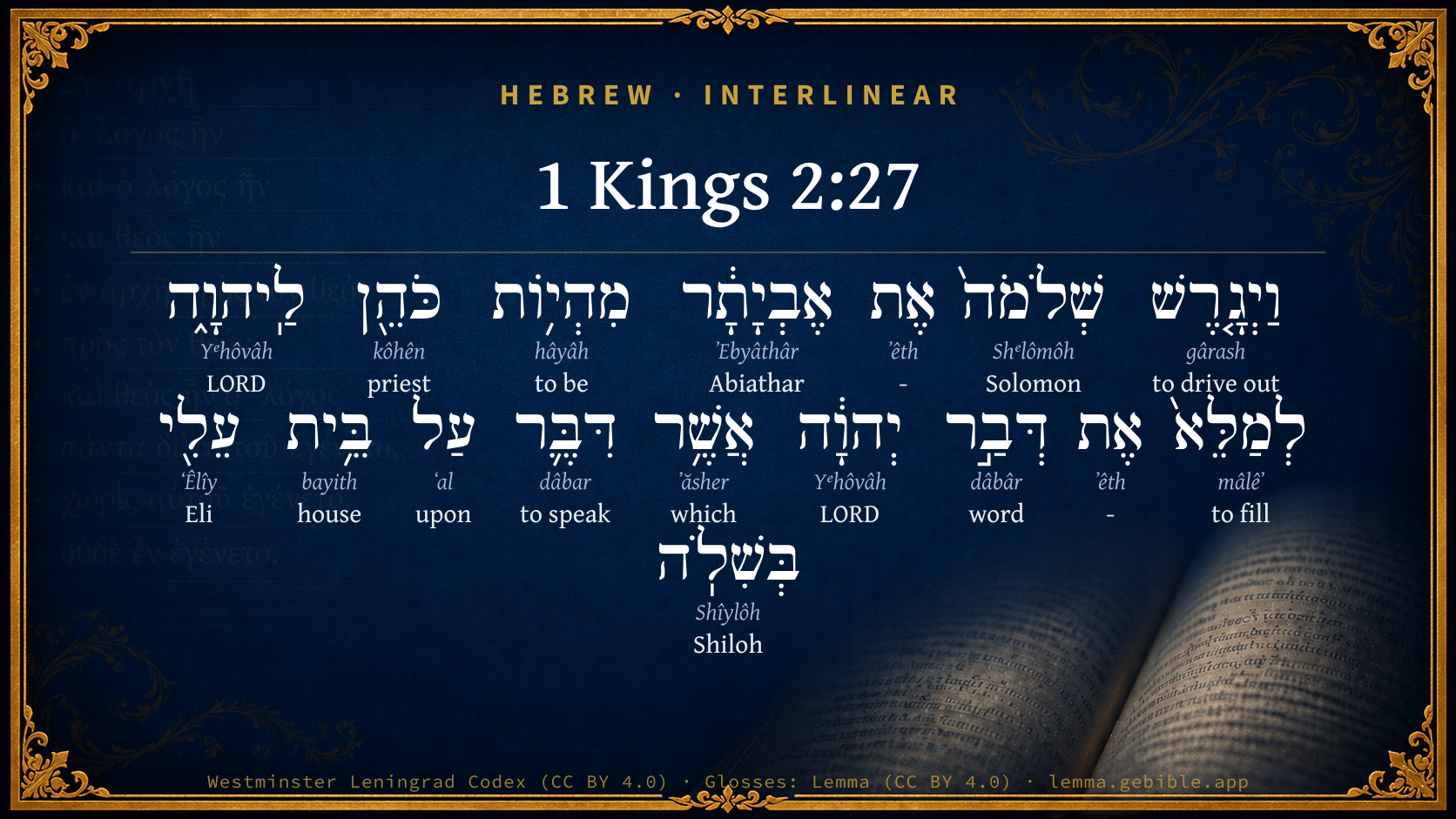
1 Kings 2:27

Hebrew (Westminster Leningrad Codex) 1 Kings 2:27 appears in the Hebrew Old Testament. The text above is from the Westminster Leningrad Codex. Each word links to its Strong’s number, a concise gloss, and parsing drawn from the Open Scriptures Hebrew Bible morphology. Click any word for its full Brown-Driver-Briggs (BDB) entry.
Download image
Cite this verse

1 Kings 2:27 (World English Bible). Public Domain. Lemma interlinear Bible study tool, https://lemma.gebible.app/v/1-kings/2/27.

Show BibTeX & RIS
BibTeX
RIS
English Translation
So Solomon thrust out Abiathar from being priest to Yahweh, that he might fulfill the word of Yahweh, which he spoke concerning the house of Eli in Shiloh.
World English Bible · Public Domain
Download a study sheet

One document with this verse’s original text, its word-by-word gloss line, the meaning frame, cross-references with their text, attributed commentary, and full source and license credits — printable, and it pastes into notes with its structure intact.

This verse Autodidact and up

Study sheet (.html) Plain text (.txt)

A passage Seminary Student

Up to 50 verses in one chapter. A passage sheet keeps up to 6 commentary sources and 12 cross-references per verse, in the order this page ranks them, and says so on the sheet whenever that leaves anything out. Ask for a single verse and you get the Autodidact verse sheet above.

Everything on this page stays free to read, with no account — the sheet is a download of what is already on screen, not access to it.

Want to remove ads? Support Godless Engineer
Compare translations 3

The same verse in 3 English versions, stacked beneath the original-language interlinear above. Click any original word for its lexicon entry.

Each is an independent rendering of the whole verse — the interlinear is not word-aligned to these translations.

Highlighted words mark where these versions differ — a whole-verse word diff, not a word-by-word alignment.

  • World English Bible Public Domain
    So Solomon thrust out Abiathar from being priest to Yahweh, that he might fulfill the word of Yahweh, which he spoke concerning the house of Eli in Shiloh.
  • King James Version Public Domain
    So Solomon thrust out Abiathar from being priest unto the LORD; that he might fulfil the word of the LORD, which he spake concerning the house of Eli in Shiloh.
  • unfoldingWord Literal Text CC BY-SA 4.0
    So Solomon drove out Abiathar from being a priest to Yahweh, to fulfill the word of Yahweh that he had spoken concerning the house of Eli at Shiloh.

unfoldingWord Literal Text — © unfoldingWord, licensed CC BY-SA 4.0. Word-aligned USFM3 via Door43 (git.door43.org/unfoldingWord/en_ult).

Versions to compare (up to 4)

3 of 4 selected

Show all 18 translations

Every available English version of this verse, each an independent rendering of the whole verse.

  • World English Bible Public Domain
    So Solomon thrust out Abiathar from being priest to Yahweh, that he might fulfill the word of Yahweh, which he spoke concerning the house of Eli in Shiloh.
  • Berean Standard Bible Public Domain
    So Solomon banished Abiathar from the priesthood of the LORD and thus fulfilled the word that the LORD had spoken at Shiloh against the house of Eli.
  • Majority Standard Bible Public Domain
    So Solomon banished Abiathar from the priesthood of the LORD and thus fulfilled the word that the LORD had spoken at Shiloh against the house of Eli.
  • King James Version Public Domain
    So Solomon thrust out Abiathar from being priest unto the LORD; that he might fulfil the word of the LORD, which he spake concerning the house of Eli in Shiloh.
  • American Standard Version (1901) Public Domain
    So Solomon thrust out Abiathar from being priest unto Jehovah, that he might fulfil the word of Jehovah, which he spake concerning the house of Eli in Shiloh.
  • Revised Version (1885) Public Domain
    So Solomon thrust out Abiathar from being priest unto the LORD; that he might fulfill the word of the LORD, which he spake concerning the house of Eli in Shiloh.
  • Geneva Bible (1599) Public Domain
    So Salomon cast out Abiathar from being Priest vnto the Lord, that he might fulfill the wordes of the Lord, which he spake against the house of Eli in Shiloh.
  • Douay-Rheims (1899) Public Domain
    So Solomon cast out Abiathar, from being the priest of the Lord, that the word of the Lord might be fulfilled, which he spoke concerning the house of Deli in Silo.
  • Young's Literal Translation Public Domain
    And Solomon casteth out Abiathar from being priest to Jehovah, to fulfil the word of Jehovah which He spake concerning the house of Eli in Shiloh.
  • Literal Standard Version CC BY-SA 4.0
    And Solomon casts out Abiathar from being priest of YHWH, to fulfill the word of YHWH which He spoke concerning the house of Eli in Shiloh.
  • Unlocked Literal Bible CC BY-SA 4.0
    So Solomon dismissed Abiathar from being priest to Yahweh, that he might fulfill the word of Yahweh, which he had spoken concerning the house of Eli at Shiloh.
  • unfoldingWord Literal Text CC BY-SA 4.0
    So Solomon drove out Abiathar from being a priest to Yahweh, to fulfill the word of Yahweh that he had spoken concerning the house of Eli at Shiloh.
  • Darby Bible Public Domain
    And Solomon thrust out Abiathar from being priest to Jehovah, to fulfil the word of Jehovah, which he had spoken concerning the house of Eli in Shiloh.
  • World Messianic Bible Public Domain
    So Solomon thrust Abiathar out from being priest to the LORD, that he might fulfill the LORD’s word which he spoke concerning the house of Eli in Shiloh.
  • Webster's Bible Public Domain
    So Solomon removed Abiathar from being priest to the LORD; that he might fulfill the word of the LORD, which he spoke concerning the house of Eli in Shiloh.
  • Free Bible Version CC BY-SA 4.0
    So Solomon dismissed Abiathar from his position as priest of the Lord, and so fulfilled what the Lord had said at Shiloh regarding the descendants of Eli.
  • Bible in Basic English Public Domain
    So Solomon let Abiathar be priest no longer, so that he might make the word of the Lord come true which he said about the sons of Eli in Shiloh.
  • JPS Tanakh (1917) Public Domain
    So Solomon thrust out Abiathar from being priest unto the LORD; that the word of the LORD might be fulfilled, which He spoke concerning the house of Eli in Shiloh.

Literal Standard Version (2020), Covenant Press — licensed CC BY-SA 4.0. Text via the HelloAO Bible API (eBible.org). Unlocked Literal Bible (unfoldingWord) — licensed CC BY-SA 4.0. Text via the HelloAO Bible API (eBible.org). unfoldingWord Literal Text — © unfoldingWord, licensed CC BY-SA 4.0. Word-aligned USFM3 via Door43 (git.door43.org/unfoldingWord/en_ult). Free Bible Version, Dr. Jonathan Gallagher — licensed CC BY-SA 4.0. Text via the HelloAO Bible API (eBible.org).

Word by word

More ways to search: Search by grammar → Find every occurrence → Compare this word →

Practice this passage: Drill this verse → Learn its vocabulary →

אֶבְיָתָ֔ר
ʼEbyâthâr
H54
“Abiathar”
Noun, Proper
Part of Speech
Noun
Type
Proper
Full BDB Definition

Origin: contracted from H1 and H3498

TWOT: None

Abiathar = "my father is great" - priest, son of Ahitub (Ahimelech), faithful to David, but later rebelled with Adonijah
  1. וַיְגָ֤רֶשׁ gârash H1644 “and · to drive out” Conjunction + Verb, Piel, Sequential Imperfect, 3rd Person, Masculine, Singular
  2. שְׁלֹמֹה֙ Shᵉlômôh H8010 “Solomon” Noun, Proper
  3. אֶת ʼêth H853 “-” Particle, Direct Object
  4. מִהְי֥וֹת hâyâh H1961 “from · to be” Preposition + Verb, Qal, Infinitive Construct
  5. כֹּהֵ֖ן kôhên H3548 “priest” Noun, Common, Masculine, Singular, Absolute
  6. לַֽיהוָ֑ה Yᵉhôvâh H3068 “to/for · LORD” Preposition + Noun, Proper
  7. לְמַלֵּא֙ mâlêʼ H4390 “to fill” Preposition + Verb, Piel, Infinitive Construct
  8. אֶת ʼêth H853 “-” Particle, Direct Object
  9. דְּבַ֣ר dâbâr H1697 “word of” Noun, Common, Masculine, Singular, Construct
  10. יְהוָ֔ה Yᵉhôvâh H3068 “LORD” Noun, Proper
  11. אֲשֶׁ֥ר ʼăsher H834 “which” Particle, Relative
  12. דִּבֶּ֛ר dâbar H1696 “to speak” Verb, Piel, Perfect, 3rd Person, Masculine, Singular
  13. עַל ʻal H5921 “upon” Preposition
  14. בֵּ֥ית bayith H1004 “house of” Noun, Common, Masculine, Singular, Construct
  15. עֵלִ֖י ʻÊlîy H5941 “Eli” Noun, Proper
  16. בְּשִׁלֹֽה Shîylôh H7887 “in/at · Shiloh” Preposition + Noun, Proper

About this verse

These counts appear in no published source. They are computed here, from the morphology-tagged text and Lemma’s own curated glosses. What Lemma adds →

17
words
15
distinct lemmas
Historical
section

Shared distinctive vocabulary

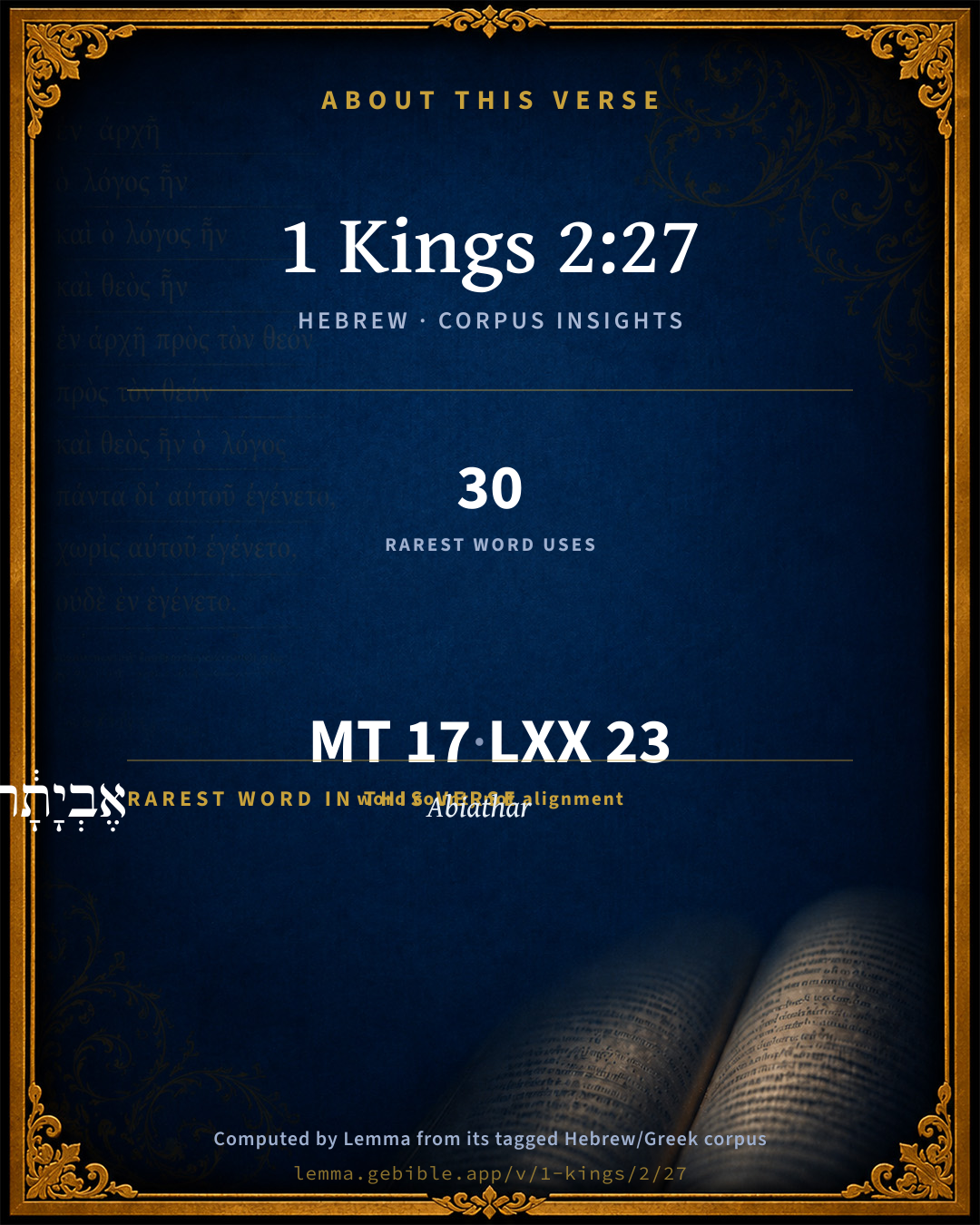
אֶבְיָתָ֔ר Abiathar H54 occurs in 28 verses of the Hebrew Bible. Also found in:

Grammatical profile

  • 4 verbs
  • 9 nouns
  • 1 preposition
  • 3 particles

Verb forms

  • וַיְגָ֤רֶשׁ Piel · Sequential Imperfect
  • מִהְי֥וֹת Qal · Infinitive Construct
  • לְמַלֵּא֙ Piel · Infinitive Construct
  • דִּבֶּ֛ר Piel · Perfect

Repetition

A word recurs within this verse — often emphatic in Hebrew:

  • לַֽיהוָ֑ה LORD H3068 ×2

Hebrew & Septuagint length

In English translation the verse runs 28 words from the Hebrew and 30 from the Septuagint (LXX English) — closely comparable.

A rough comparison of the two English renderings, which tokenize alike — not a word-level alignment.

Word counts can differ between the Hebrew and the Greek without any difference in meaning — e.g. the Hebrew direct-object marker אֵת has no separate Greek word, and Greek often adds the article ὁ.

In the original languages it is 17 Hebrew tokens and 23 Greek tokens — but the two are counted differently (Hebrew bundles its prefixes and suffixes into one token; the Greek is in lemma form), so that isn’t a like-for-like length.

Cross-references

5

Topical passages linked to 1 Kings 2:27 in the Treasury of Scripture Knowledge — connected by theme and wording, ordered by reader-vote popularity; previews shown in the World English Bible.

  • 1 Samuel 2:27–36 There came a man of God to Eli, and said to him, Thus says Yahweh, Did I reveal myself to the house of your father, when they were in Egypt [in bondage] to Pharaoh's house?
  • 1 Samuel 3:12–14 In that day I will perform against Eli all that I have spoken concerning his house, from the beginning even to the end.
  • Jeremiah 7:12–14 But go you now to my place which was in Shiloh, where I caused my name to dwell at the first, and see what I did to it for the wickedness of my people Israel.
  • Joshua 18:1 The whole congregation of the children of Israel assembled themselves together at Shiloh, and set up the tent of meeting there: and the land was subdued before them.
  • Psalms 78:60 So that he forsook the tent of Shiloh, The tent which he placed among men;

Cross-references courtesy of OpenBible.info (CC BY 4.0).

Hebrew and Greek witnesses Masoretic Hebrew ↔ Greek Septuagint

The same verse in the two great witnesses to the Old Testament, shown verse-for-verse.

These are two independent witnesses, not word-aligned to each other, and the Septuagint is shown in lemma (dictionary) form.

Hebrew 1 Kings 2:27 Masoretic · Westminster Leningrad Codex

וַיְגָ֤רֶשׁ שְׁלֹמֹה֙ אֶת אֶבְיָתָ֔ר מִהְי֥וֹת כֹּהֵ֖ן לַֽיהוָ֑ה לְמַלֵּא֙ אֶת דְּבַ֣ר יְהוָ֔ה אֲשֶׁ֥ר דִּבֶּ֛ר עַל בֵּ֥ית עֵלִ֖י בְּשִׁלֹֽה

So Solomon thrust out Abiathar from being priest to Yahweh, that he might fulfill the word of Yahweh, which he spoke concerning the house of Eli in Shiloh.

World English Bible · Public Domain

Greek LXX 1 Kings 2:27 Septuagint · lemma form

καί ἐκβάλλω σαλωμών ὁ αβιαθαρ ὁ μή εἰμί ἱερεύς ὁ κύριος πληρόω ὁ ῥῆμα κύριος ὅς λαλέω ἐπί ὁ οἶκος ηλι ἐν σηλωμ

And Solomon removed Abiathar from being a priest of the Lord, that the word of the Lord might be fulfilled, which he spoke concerning the house of Heli in Selom.

LXX2012 (modern English Septuagint) · Public Domain

Hebrew: Westminster Leningrad Codex (CC BY 4.0). Greek: Septuagint (public domain); English from LXX2012 (modern English Septuagint) (Public Domain). How the Septuagint differs from the Hebrew →

Targum (Aramaic paraphrase)

1

The Targum is the ancient Jewish Aramaic paraphrase of the Hebrew Scriptures — an interpretive translation, not the Hebrew text itself. Onkelos (literal) and Pseudo-Jonathan (expansive) render the Torah, and Jonathan the Prophets. Coverage is partial: where no permissively-licensed English translation exists for a verse, only the Aramaic is shown. This is verse-level text, not a word-by-word alignment to the Hebrew.

  1. Targum Jonathan Prophets (Joshua–Malachi)
    וְתָרִיךְ שְׁלֹמֹה יַת אֶבְיָתָר מִלְמֶהֱוֵי כָהֵן מְשַׁמֵשׁ קֳדָם יְיָ לְקַיָמָא יַת פִּתְגָמָא דַייָ דִי מַלֵיל עַל בֵּית עֵלִי בְּשִׁלֹה:

    (no public-domain English translation for this verse)

    Targum Jonathan — Aramaic: “Mikraot Gedolot” (public domain). English: “Sefaria Community Translation” (CC0 1.0 (public-domain dedication)); “London "Chaldee Paraphrase," 1871” (public domain). Text via Sefaria.

Commentary

Notes on 1 Kings 2:27 from classic Christian and Jewish commentators (each source and its license shown beneath its notes). The classic Christian expositions comment on the surrounding passage and are grouped to its opening verse, so a note may address several verses; the Jewish commentaries on the Tanakh (Rashi and others) are per-verse, so they appear only where the commentator wrote on this verse.

Lemma curates 59 commentaries, every one of them public domain or Creative Commons licensed, each selected and text-cleaned for this edition rather than reprinted as found. About our sources →

Trapp's Complete Commentary

John Trapp

1Ki 2:27 So Solomon thrust out Abiathar from being priest unto the LORD; that he might fulfil the word of the LORD, which he spake concerning the house of Eli in Shiloh.

Ver. 27. So Solomon thrust out Abiathar.] Our Henry II could not so easily rid his hands of Thomas Becket, that arch-traitor; but having had him above his wit while he lived, he was forced to have him over his faith being dead, kneeling and praying to his shrine. And yet forty-eight years after he was sainted, it was disputed at Paris among the doctors whether he was damned or saved. And one Roger, a Norman, maintained he had justly deserved death for rebelling against his sovereign, the minister of God. {a}

{a} Dan., Hist., 99.

John Trapp, A Commentary or Exposition upon All the Books of the Old and New Testament (1647–1656) — public domain. Text from a community e-Sword module.

Adam Clarke's Commentary

Verse 27. So Solomon thrust out Abiathar] This was for having taken part before with Adonijah, but by it a remarkable prophecy was fulfilled; see 1Sa 2:13-35, and the notes there. God had told Eli that the priesthood should depart from his house; Abiathar was the last of the descendants of Ithamar, of which family was Eli the high priest. Zadok, who was made priest in the stead of Abiathar, was of the family of Eliezer; and by this change the priesthood reverted to its ancient channel. Abiathar deserved this degradation; he supported Adonijah in his unnatural assumption of the royal dignity, even during the life of his father. This was the head and front of his offending.

Adam Clarke's Commentary on the Bible (1810–1826) — public domain. Text from a community e-Sword/MySword module.

Ellicott's Commentary for English Readers

(27) That he might fulfil.—In these words is described, not the purpose, but the effect of Solomon’s action. The prophecy referred to is, of course, that of 1Sa_2:30-35; 1Sa_3:11-14, fulfilled by the degradation, in Abiathar’s person, of the house of Ithamar, and the exaltation, or restoration, in Zadok, of the house of Eleazar, to whom, as the elder son of Aaron, the primacy would have seemed naturally to belong. It seems clear from 1Ki_2:35 that Abiathar had hitherto had some superiority, although in the various notices of the two, Zadok’s name stands first; but whether of actual authority, or only of priority of dignity, cannot be determined. While the Tabernacle remained at Gibeon under Zadok’s charge, and the Ark was in Mount Zion under Abiathar, there might, indeed, be something like co-ordination between the two. This, in any case, must have disappeared at the building of the Temple; and the disgrace of Abiathar determined that the undivided dignity should pass to Zadok.

A Bible Commentary for English Readers, edited by Charles John Ellicott (1878–1897) — public domain. Text from a community e-Sword module.

The Cambridge Bible for Schools and Colleges

gen. ed. J. J. S. Perowne

27. So Solomon thrust out Abiathar] The verb is the same which is used (Gen_3:24) of the driving out of Adam from Paradise.

fulfil the word of the Lord] The allusion is to 1Sa_2:31-36, where it is foretold to Eli that his family, to which Abiathar belonged, should be deprived of the priest’s office, and that a faithful priest should be raised up in their stead. The order of descent from Eli was Eli—Phinehas—Ahitub—Ahimelech—Abiathar. These were of the family of Ithamar. Zadok was of the family of Eleazar (1Ch_6:8). This is the first passage in the O.T. where the phrase ‘to fulfil the word of the Lord’ appears.

The Cambridge Bible for Schools and Colleges (gen. ed. J. J. S. Perowne; Cambridge University Press, 1878–1918) — public domain. Text from a community e-Sword module.

John Gill's Exposition

Then tidings came to Joab,.... Of the death of Adonijah, and the deposition of Abiathar:

for Joab had turned after Adonijah; publicly appeared at his feast, when he was saluted king by him, and others, and privately gave him advice in the affair of Abishag:

though he turned not after Absalom; did not join with him in his rebellion, but faithfully adhered to David; and yet both in his lifetime, and after his death, acted the traitorous part in favour of Adonijah: Ben Gersom gives these words a different sense, as if he was blameworthy in both cases; that he turned after Adonijah to make him king, without consulting David, and having his consent; and he did not turn after Absalom, to deliver him from death, as David commanded him; but the former sense is best:

and Joab fled unto the tabernacle of the Lord; which was at Gibeon, see Ch2 1:3; it was four miles from Jerusalem to the north, situated on an hill (e); according to Josephus (f), it was forty furlongs, or five miles, from it; though Kimchi thinks it was the altar in Jerusalem he fled to, which was before the ark, in the tent David made for it; but that is never called the tabernacle of the Lord, only that of Moses: Joab's fleeing hither showed guilt, and that he was in the conspiracy of Adonijah, and was conscious he deserved to die, and now expected it, since Adonijah was put to death; while he remained reprieved or pardoned, he thought himself safe, but now in danger, and therefore fled for it:

and caught hold of the horns of the altar; See Gill on Kg1 1:50.

(e) Bunting's Travels, &c. p. 98. (f) Antiqu. l. 7. c. 11. sect. 7.

John Gill's Exposition of the Whole Bible (1746–1763) — public domain (CC PDM 1.0). Text via the HelloAO Bible API.

Albert Barnes' Notes on the Bible

That he might fulfil the word of the L RD - We need not understand this as stating that the fulfillment of the old prophecy was Solomon’s motive, or even one of his motives. The reference is to the overruling providence of God, which thus brought about the fulfillment of the prophecy. (Compare Mat 1:22; Mat 2:15; Mat 27:35, etc.) The deposition of Abiathar involved the rejection of the house of Ithamar 1Ch 24:3, to which Eli belonged, and the reestablishment of the high priesthood in the line of Eleazar.

Albert Barnes' Notes on the Bible (1834–1885) — public domain. Text from a community e-Sword/MySword module.

Matthew Poole's English Annotations

From being priest unto the Lord; either from his office, or at least, from the execution of his office. For some think that he was thrust from his office before David’s death, when Zadok was formerly made priest, i.e. high priest, in his stead, 1Ch 29:22. But that seems to be a mistake; for although that passage immediately follows the history of what was done in the time of David’s life and health, when he was in a capacity of going into the public congregation; yet it manifestly belongs to another time, and was done after it; for he there speaks of Solomon’s

being made king the second time, and he was made king but twice; once undoubtedly before this, 1Ch 23:1; and again 1Ki 1:39; when David was bedrid, and Adonijah’s usurpation made a second unction necessary. And therefore what is said 1Ch 29:22, of Zadok’s being made priest, was done after Abiathar’s deposition, and upon that occasion.

That he might fulfil the word of the Lord; for what hinders but Solomon might intend this not only as a punishment for his treason, but also as a means to accomplish God’s word?

Concerning the house of Eli, i.e. concerning the translation of the priesthood from the house of Eli, and of Ithamar, unto that of Eleazar; which being threatened eighty years ago, is now executed. So Divine vengeance, though sometimes it be slow, is always sure.

Matthew Poole's English Annotations on the Holy Bible (1683–1685) — public domain. Text from a community e-Sword/MySword module.

Whedon's Commentary on the Bible

Daniel D. Whedon

27. That he might fulfil the word of the Lord — See 1Sa_2:33-36, and notes there. “This word had been partly fulfilled by the death of Hophni and Phinehas, (1Sa_4:11,) and by the destruction of the priests by Saul, (1Sa_22:18,) and now it was fully accomplished, and therefore the author here uses the words, ‘that he might fulfil.’” — Wordsworth. But Eli’s posterity were not to be utterly cut off; and after the exile we find descendants of Ithamar returning from Babylon. Ezr_8:2.

Daniel D. Whedon (gen. ed.), Commentary on the Old and New Testaments (1874–1909) — public domain. Text from a community e-Sword module.

The Pulpit Commentary

So Solomon thrust out Abtathar from being priest unto the Lord, that he might fulfil Heb. to fulfil "An addition of the narrator, not the intention of Solomon. It is the ina plhrwqh of the New Testament." Bahr the word of the Lord, which he spake concerning the house of Eli in Shiloh 1Sa_2:31-35. Abiathar was the last descendant of the house of Ithamar. With his deposition the high priesthood reverted to the house of Eleazar, and so another "word of the Lord" had its fulfilment. (Num_25:15)

No one can justly accuse Solomon of unnecessary severity or of cruelty in his treatment of Abiathar. On the occasion of his first conspiracy, Abiathar seems to have escaped even censure. And yet that conspiracy, had it succeeded, would almost certainly have involved Solomon"s death (ch. 1:12). He is now found plotting again, for the action of Solomon proves that there had been a second plot. Oriental usages would have justified his death. He is simply warned and banished.

The Pulpit Commentary (1880–1919), ed. H.D.M. Spence-Jones & Joseph S. Exell — public domain. Text from a community e-Sword module.

John Wesley's Explanatory Notes

Which he spake - Concerning the translation of the priesthood from the house of Eli, and of Ithamar, to that of Eleazar: which being threatened eighty years ago, is now executed. So divine vengeance, though sometimes it be slow, is always sure.

John Wesley, Explanatory Notes Upon the Whole Bible (1754–1765) — public domain. Text via the GEBible commentary corpus.

Rashi

Rabbi Shlomo Yitzchaki (Rashi)

That He had spoken concerning the house of Eili. [As it is stated,] “And I will appoint for Myself a faithful kohein,” [and] “and you will see a rival in My dwelling place, etc.” Once [the Tabernacle at] Shilo was destroyed, there was no house worthy of service to the Holy One Blessed Is He, but now that the Beis Hamikdosh will be built, the Holy One Blessed Is He, fulfilled His word to banish Eili’s descendants.

Rashi on the Tanakh — English translations: “The Judaica Press complete Tanach with Rashi, translated by A. J. Rosenberg” (CC BY 4.0); “Pentateuch with Rashi's commentary by M. Rosenbaum and A.M. Silbermann, 1929-1934” (public domain); “The Metsudah Tanach series, Lakewood, N.J” (CC BY 4.0); and “The Book of Joshua, Metsudah Publications, 1997” (CC BY 4.0). Text via Sefaria.

Lesson kit

Teaching starters — assembled from the data on this page, not authored interpretation. Every prompt links to the verse data it draws on. Edit before teaching.

1 Kings, in the Historical, opens this verse with 17 words (15 distinct Hebrew lemmas). Its most distinctive word is ʼEbyâthâr (“Abiathar”). A historical commentator’s framing appears above. Read the whole chapter for the surrounding context.

Discussion questions

  1. The word ʼEbyâthâr carries the sense “Abiathar.” How does it shape the verse?
  2. 1 Samuel 22:20 shares the word «Abiathar» with this verse. How do the two illuminate each other?
  3. “LORD” occurs 2× in this one verse. What is the effect of the repetition?
  4. The translations on this page render this verse differently — a whole-verse word diff, not a word-by-word alignment. What might account for the different wordings?
  5. The verb «וַיְגָ֤רֶשׁ» is Piel Sequential Imperfect. How does its form color the action?
  6. Reading how Trapp's Complete Commentary and Adam Clarke's Commentary read this verse, where do the two commentators agree and where do they part?

Things to notice

Reading settings

Reading text

Shown beneath each verse's original-language words.

Old Testament
Old Testament edition

Read the OT as the Masoretic Hebrew (MT) or the Greek Septuagint (LXX).

English shown for the Greek Septuagint (in the Hebrew ↔ Greek comparison).

Comparing translations? Open the Compare panel on any verse page to stack up to four side by side.